Email List Building Strategies That Actually Work in 2026
Most lists stall around 500 subscribers and then decay faster than they grow. Here are the nine email list building strategies that still compound in 2026 — with real costs, timelines, and the legal lines you cannot cross.
TL;DR
- Most email list building strategies fail on math, not creativity: a list decaying at roughly 22.5% a year needs ~190 net-new subscribers monthly just to hold 10,000 flat.
- The cheapest subscribers come from content upgrades and partner swaps. The fastest come from paid lead magnets. The highest-intent come from targeted outbound sourced with an email finder — a different motion entirely.
- One comparison table below prices every channel by cost per subscriber, time to first 1,000, and risk profile.
- Opt-in lists and outbound prospect lists are legally different animals. Consent rules under GDPR apply to marketing sends; CAN-SPAM allows cold B2B mail with clear opt-out. Do not blend the two into one send.
- Verification is not optional maintenance. Unverified lists drag bounce rates past the 2% mark where inbox providers start throttling everything you send.
What counts as an "email list" in 2026?#
Two things share the name and behave nothing alike.
The first is an opt-in list — people who typed their address into your form because they wanted something. Newsletters, product updates, drip courses. High engagement, slow to build, legally clean everywhere.
The second is an outbound prospect list — verified business addresses of people who fit your ICP but have never heard of you. Built from domain research, LinkedIn sourcing, or enrichment APIs. Zero engagement history, fast to build, legally permitted for B2B in most jurisdictions with strict conditions.
Confusing the two is the single most common way companies torch a sending domain. You send a newsletter to an outbound list, complaints spike, your opt-in list stops reaching the inbox. Different lists, different sending infrastructure, different metrics. Keep them apart from day one.
Why do most email list building strategies stall?#
Because acquisition gets budgeted and retention doesn't.
B2B contact data goes stale at roughly 22.5% per year — people change jobs, companies rebrand domains, aliases get retired. HubSpot's marketing research has tracked this decay for over a decade and the number barely moves. Run the arithmetic on a 10,000-address list:
- 2,250 addresses die per year, about 187 per month
- If you add 150 subscribers monthly, your list is shrinking while your dashboard shows "growth"
- At a 25% open rate, that's 47 lost opens every month you never see, because the deliverability drop is invisible until bounces cross the threshold
The second stall point is structural. A single sidebar form on a blog converts somewhere around 0.5–1.5% of visitors. At 5,000 monthly sessions that's 25–75 signups. You cannot outrun 22.5% decay with one form. You need three or four overlapping mechanisms running at once.
What are the highest-yield email list building strategies?#
Ranked by yield-per-hour-invested for a B2B team under 50 people:
Content upgrades over generic lead magnets. A checklist that matches the specific article beats a site-wide ebook by 3–5x on conversion, because the offer is contextually relevant. Ten upgrades on your ten highest-traffic posts outperform one heavily designed gated report.
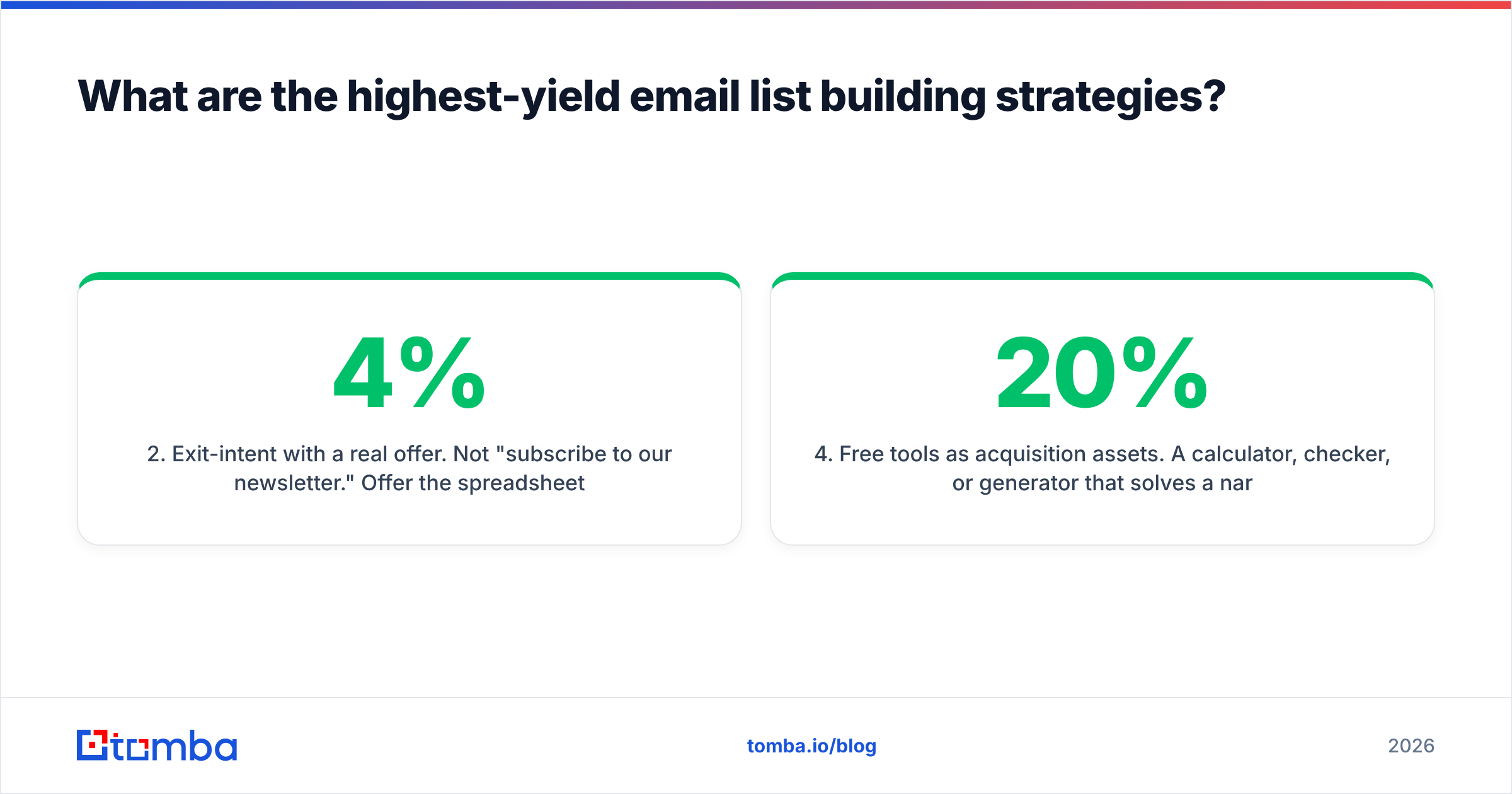
Exit-intent with a real offer. Not "subscribe to our newsletter." Offer the spreadsheet, the template, the calculator. Exit-intent overlays convert 2–4% of abandoning visitors when the offer is concrete and under 1% when it's vague.
Partner newsletter swaps. Find five non-competing newsletters serving your ICP with 2,000–20,000 subscribers. Swap a dedicated mention. Cost: zero dollars, two hours of outreach. This is the most underused channel in B2B and the subscribers arrive pre-qualified.
Free tools as acquisition assets. A calculator, checker, or generator that solves a narrow job, gated at the results step. Conversion rates of 8–20% are normal because the user has already invested effort. Our own free email checker and subject line generator exist for exactly this reason.
Webinars and live teardowns. Expensive in hours, but a 45-minute session with 80 registrants delivers 80 addresses plus intent signal plus recorded content you can gate afterward.
Targeted outbound sourcing. For sales lists specifically: pick 200 target accounts, run a domain search to pull verified contacts at each, then enrich and sequence. This does not build a newsletter — it builds a pipeline list, and it's the fastest path to a usable set of addresses when you have zero traffic.
Most teams run one of these. The teams whose lists actually compound run four simultaneously, because each channel plateaus independently.
Which channel gets you subscribers cheapest?#
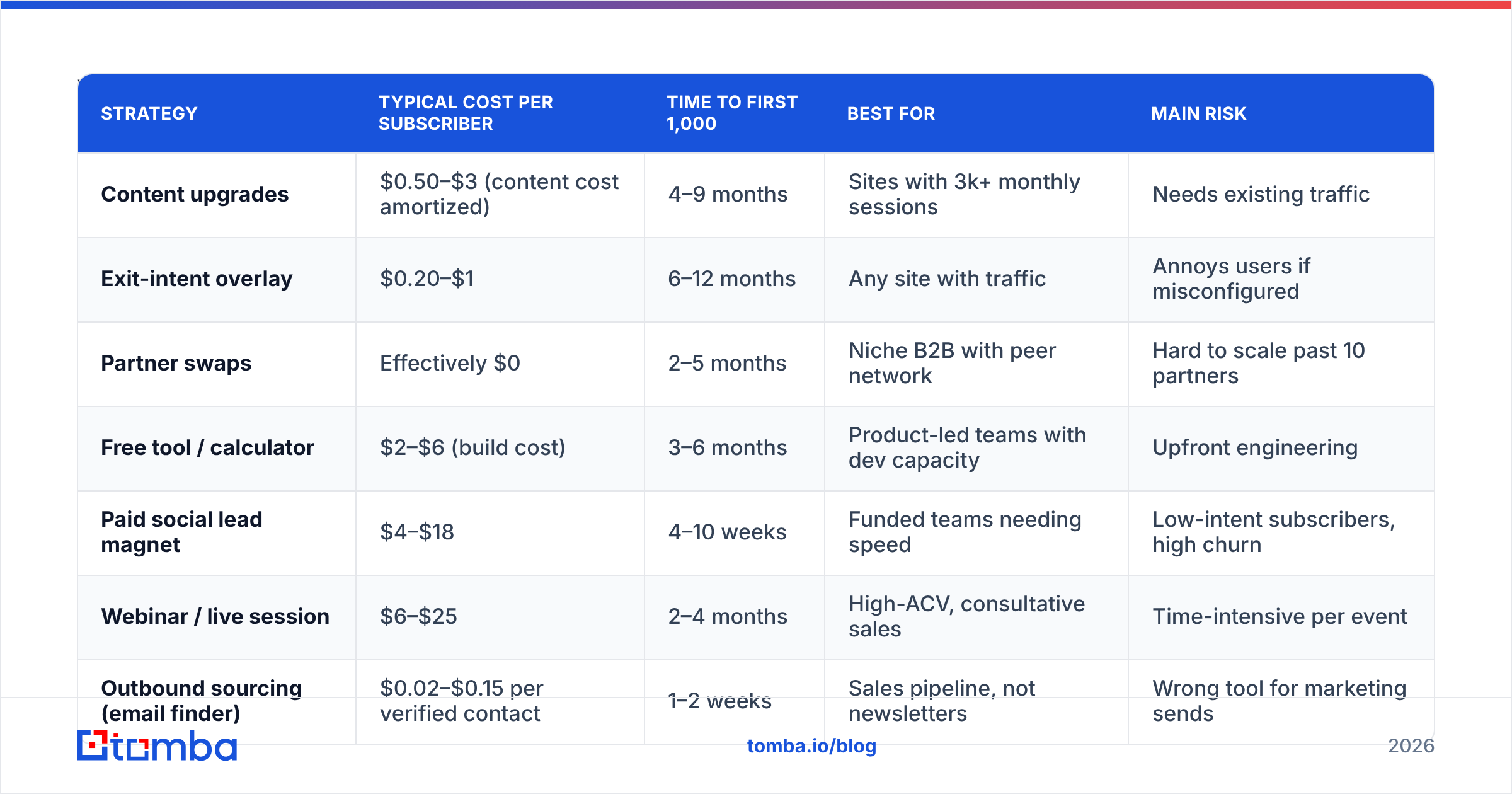
| Strategy | Typical cost per subscriber | Time to first 1,000 | Best for | Main risk |
|---|---|---|---|---|
| Content upgrades | $0.50–$3 (content cost amortized) | 4–9 months | Sites with 3k+ monthly sessions | Needs existing traffic |
| Exit-intent overlay | $0.20–$1 | 6–12 months | Any site with traffic | Annoys users if misconfigured |
| Partner swaps | Effectively $0 | 2–5 months | Niche B2B with peer network | Hard to scale past 10 partners |
| Free tool / calculator | $2–$6 (build cost) | 3–6 months | Product-led teams with dev capacity | Upfront engineering |
| Paid social lead magnet | $4–$18 | 4–10 weeks | Funded teams needing speed | Low-intent subscribers, high churn |
| Webinar / live session | $6–$25 | 2–4 months | High-ACV, consultative sales | Time-intensive per event |
| Outbound sourcing (email finder) | $0.02–$0.15 per verified contact | 1–2 weeks | Sales pipeline, not newsletters | Wrong tool for marketing sends |
| Purchased list | $0.10–$0.40 | Instant | Almost nobody | Bounce spikes, domain damage, compliance exposure |
Two things jump out.
Outbound sourcing is by far the cheapest per address — a Starter plan at $49/mo covers thousands of lookups — but it produces a fundamentally different asset. Those contacts owe you nothing. Treat them as a prospecting list for 1:1 sequences, never as newsletter subscribers.
Purchased lists look cheap and are not. You're buying addresses collected without consent, often years old, frequently seeded with spam traps. A single send to a bought list can put your domain on a blocklist that takes weeks to clear. Run any list you didn't collect yourself through a blacklist checker before it touches your sending domain — and honestly, just don't buy them.
Is outbound list building legal?#
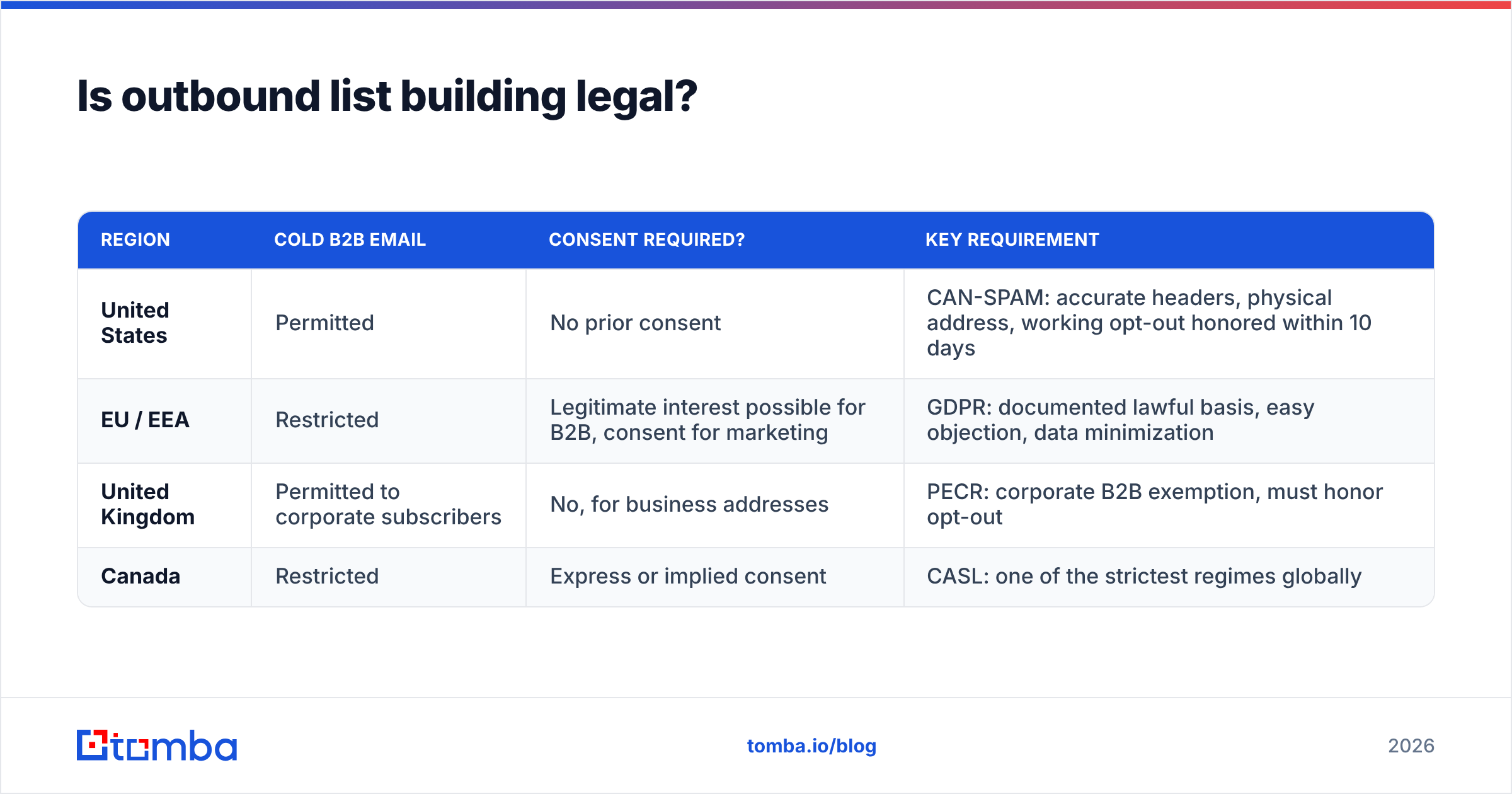
It depends on jurisdiction and on what you send, and the distinction matters more than most teams realize.
| Region | Cold B2B email | Consent required? | Key requirement |
|---|---|---|---|
| United States | Permitted | No prior consent | CAN-SPAM: accurate headers, physical address, working opt-out honored within 10 days |
| EU / EEA | Restricted | Legitimate interest possible for B2B, consent for marketing | GDPR: documented lawful basis, easy objection, data minimization |
| United Kingdom | Permitted to corporate subscribers | No, for business addresses | PECR: corporate B2B exemption, must honor opt-out |
| Canada | Restricted | Express or implied consent | CASL: one of the strictest regimes globally |
The FTC's CAN-SPAM compliance guide is the authoritative US reference and takes ten minutes to read. For EU contacts, the practical rule is: personalized 1:1 business outreach with a clear objection path is generally defensible under legitimate interest; a bulk promotional newsletter to non-consenting addresses is not.
Practical implementation: tag every contact with its acquisition source at import time. When a regulator or an angry recipient asks where you got their address, "row 4,882 of a CSV" is not an answer. "Domain search on their company site, October 2026, sourced from public business listing" is.
How do you stop your list from rotting?#
Growth without hygiene is a leaking bucket with a bigger tap.

Four maintenance habits, in order of impact:
Verify at capture, not at send. Real-time validation on your form catches typos (gmial.com), disposable addresses, and role accounts before they enter the database. An email verification API call at form submit costs a fraction of a cent and prevents a permanent bad row.
Re-verify quarterly. Run the whole list through bulk verification every 90 days. Expect 4–7% to come back invalid each round. That's the decay curve showing up on schedule.
Sunset inactive subscribers. Anyone who hasn't opened in 180 days gets a two-email re-engagement sequence, then removal. Painful for vanity metrics, excellent for deliverability. Inbox providers weight engagement heavily, and a segment of dead weight suppresses inbox placement for everyone else on the list.
Watch the bounce threshold. Stay under 2% hard bounces per send. Above that, Google and Microsoft start throttling. If a campaign bounces at 5%, stop sending and clean before you send again — the reputation damage compounds across every subsequent campaign.
Segment by engagement tier rather than treating the list as one block: 0–30 day openers, 31–90, 91–180, dormant. Send your riskiest campaigns to the most engaged tier first. Their opens buy you reputation headroom for the wider send.
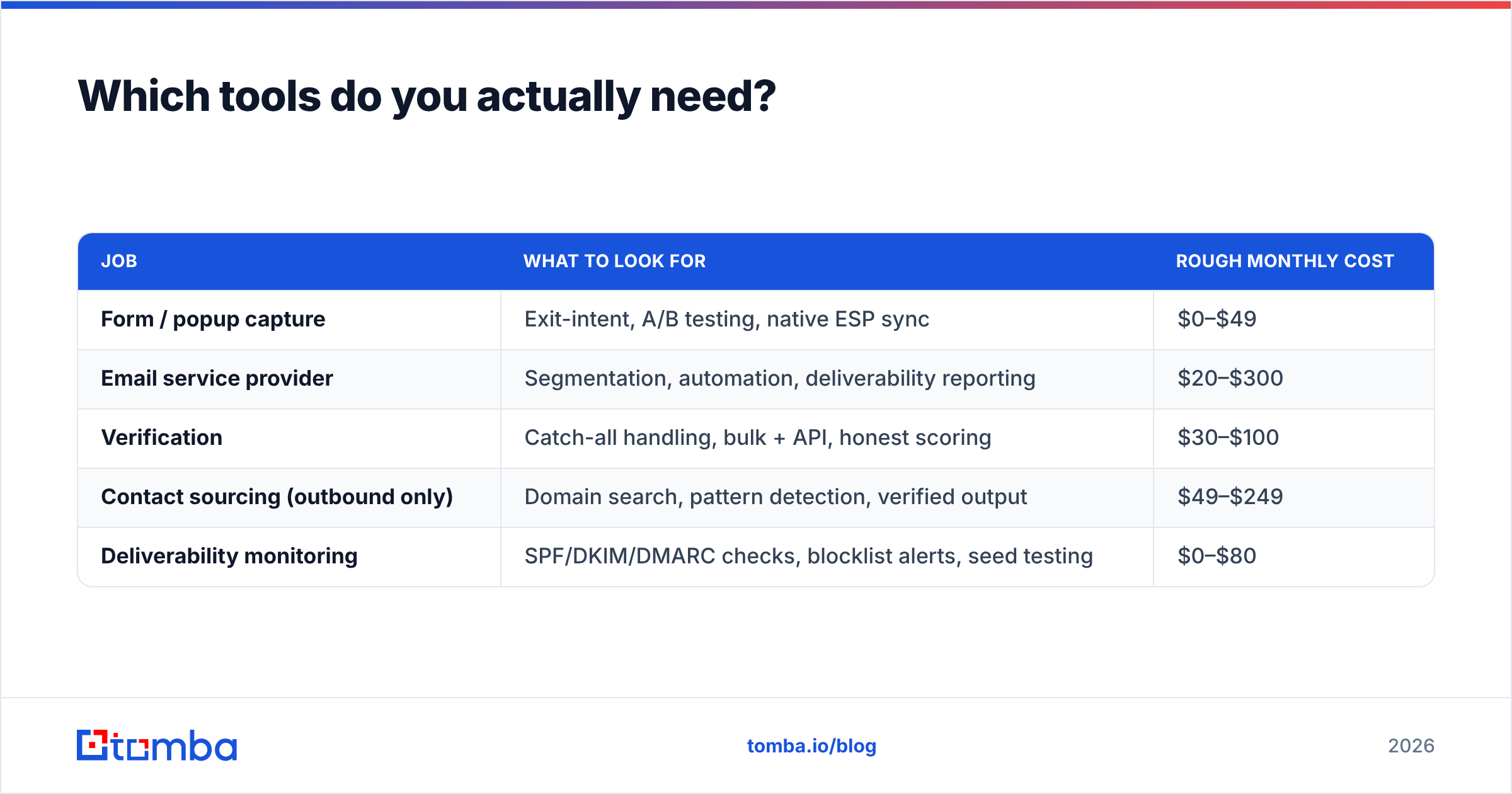
Which tools do you actually need?#
Fewer than the software vendors would like.
| Job | What to look for | Rough monthly cost |
|---|---|---|
| Form / popup capture | Exit-intent, A/B testing, native ESP sync | $0–$49 |
| Email service provider | Segmentation, automation, deliverability reporting | $20–$300 |
| Verification | Catch-all handling, bulk + API, honest scoring | $30–$100 |
| Contact sourcing (outbound only) | Domain search, pattern detection, verified output | $49–$249 |
| Deliverability monitoring | SPF/DKIM/DMARC checks, blocklist alerts, seed testing | $0–$80 |
For sourcing, evaluate on verified-accuracy rather than headline database size — a 700M-record database with 60% accuracy is worse than a 200M-record one at 95%. Check independent review data on G2 rather than vendor landing pages. Established B2B data providers like BookYourData serve the bulk-list use case well; API-first tools like Tomba fit teams that want sourcing embedded in their own workflow. Both are legitimate approaches to different problems.
For catch-all domains — where the mail server accepts everything and tells you nothing — a dedicated catch-all verifier is the difference between guessing and knowing. Roughly 15–20% of B2B domains are catch-all configured, so this is not an edge case.
What are the mistakes that cost the most?#
- Gating everything. If your best content is all behind forms, you have no top-of-funnel. Gate the tool, the template, the data — never the argument.
- One list for everything. Newsletter subscribers, trial signups, and cold prospects need separate lists, separate sending domains, and separate metrics.
- Skipping double opt-in in the EU. It costs you 20–30% of raw signups and buys you documented consent plus a materially cleaner list. Worth it.
- Chasing list size as the metric. 2,000 engaged subscribers outperform 20,000 dormant ones on revenue, deliverability, and cost. Track engaged-list-size, not total rows.
- No warmup on new domains. A brand-new sending domain blasting 5,000 emails on day one gets filtered immediately. Ramp volume over 3–4 weeks; a warmup calculator gives you the schedule.
Where should you start this week?#
If you have traffic: build three content upgrades on your top three posts, add exit-intent with a concrete offer, and set up quarterly re-verification. That's a weekend of work and it changes your growth curve.
If you have no traffic: skip opt-in entirely for now. Build a targeted outbound list of 200 accounts, verify every address, and run 1:1 sequences. Revenue first, newsletter second.
Either way, verification is the load-bearing piece. Every strategy above degrades into wasted spend the moment your bounce rate climbs, and bounce rate is the one metric fully under your control.
When you're ready to source those contacts, the Tomba Email Finder pulls verified professional addresses by domain, name, or company — with real-time verification built in, so contacts arrive clean instead of getting cleaned later. The free tier covers 25 searches a month if you want to test accuracy against a list you already trust before committing to anything.
Related guides#
Ready to find emails that actually work?
Join 150,000+ professionals who stopped guessing and started sending. Free credits on signup — no credit card required.
Get the Tomba newsletter
Practical outbound tactics and product updates — once every two weeks.
About the author