Email Marketing Spam Words in 2026: What Actually Triggers Filters
Spam-word lists are the most over-rated deliverability advice on the internet. Here is what modern filters actually score, which words still cost you, and how to test an email before it hits 50,000 inboxes.
TL;DR
- Spam-word lists are the least important part of modern filtering. Gmail, Outlook, and Yahoo score sender reputation, authentication, and engagement first — content is a tiebreaker, not the verdict.
- A clean, verified list beats clever word choice every time. Bounces and spam traps do more damage in one send than the word "free" does in a year.
- Some words genuinely still hurt: high-pressure financial claims, ALL CAPS subject lines, "risk free", "act now", and anything paired with a shortened link or a bare image.
- The real content signals filters weigh are link reputation, image-to-text ratio, HTML quality, unsubscribe presence, and whether the message resembles mail people already marked as spam.
- Test with SpamAssassin-style scoring plus a seed-inbox send before scale. Fix authentication and list hygiene before you rewrite a single subject line.
What are email marketing spam words?#
Email marketing spam words are terms and phrases that historically correlated with unsolicited bulk mail — "free", "guaranteed", "act now", "no obligation", "click here", "100% satisfied", "risk free", "make money fast". Filters in the early 2000s ran largely on Bayesian text classification, so these words carried real, measurable weight. Send an email with eight of them and you scored yourself into the junk folder.
Think of it like airport security in 2003 versus today. Back then, a screener flagged you for the shape of your bag. Now the system knows your travel history, your booking pattern, and who you fly with — the bag is a small factor in a much bigger profile. Email filtering went through the same evolution.
The word lists survived anyway. They get republished every year as "500 spam trigger words to avoid", usually copy-pasted from a 2011 blog post, and they cause marketers to write bloodless copy while ignoring the things that are actually killing their email deliverability.
Do spam words still trigger spam filters in 2026?#
Short answer: weakly, and only in combination with other negative signals.
Modern filtering at Gmail and Microsoft is a machine-learned reputation system. Google's own sender guidelines spend their length on authentication (SPF, DKIM, DMARC), spam-complaint rates below 0.3%, one-click unsubscribe, and valid forward-and-reverse DNS. Word choice is not in the requirements at all. Microsoft's SNDS and Yahoo's sender policies read the same way.
What still exists is rule-based scoring at the gateway layer. If your recipient's company runs SpamAssassin or a similar appliance — and a very large share of mid-market B2B mail still passes through one — then yes, literal text rules fire. Rules like MONEY_BACK, URGENT_SUBJECT, and BODY_ENHANCEMENT add fractions of a point each. You typically need a score of 5.0 to get quarantined, and no realistic marketing email reaches 5.0 on word choice alone. It reaches 5.0 when spammy phrasing stacks on top of a bad sending IP, a mismatched From domain, and a link to a URL shortener.
So the honest framing is: spam words are a multiplier on existing risk, not a standalone cause of failure. A sender with excellent reputation can write "FREE trial — claim yours now" and land in Primary. A sender with a cold IP, a purchased list, and no DMARC will land in spam writing the most tasteful prose you have ever seen.
Which factors actually decide inbox placement?#
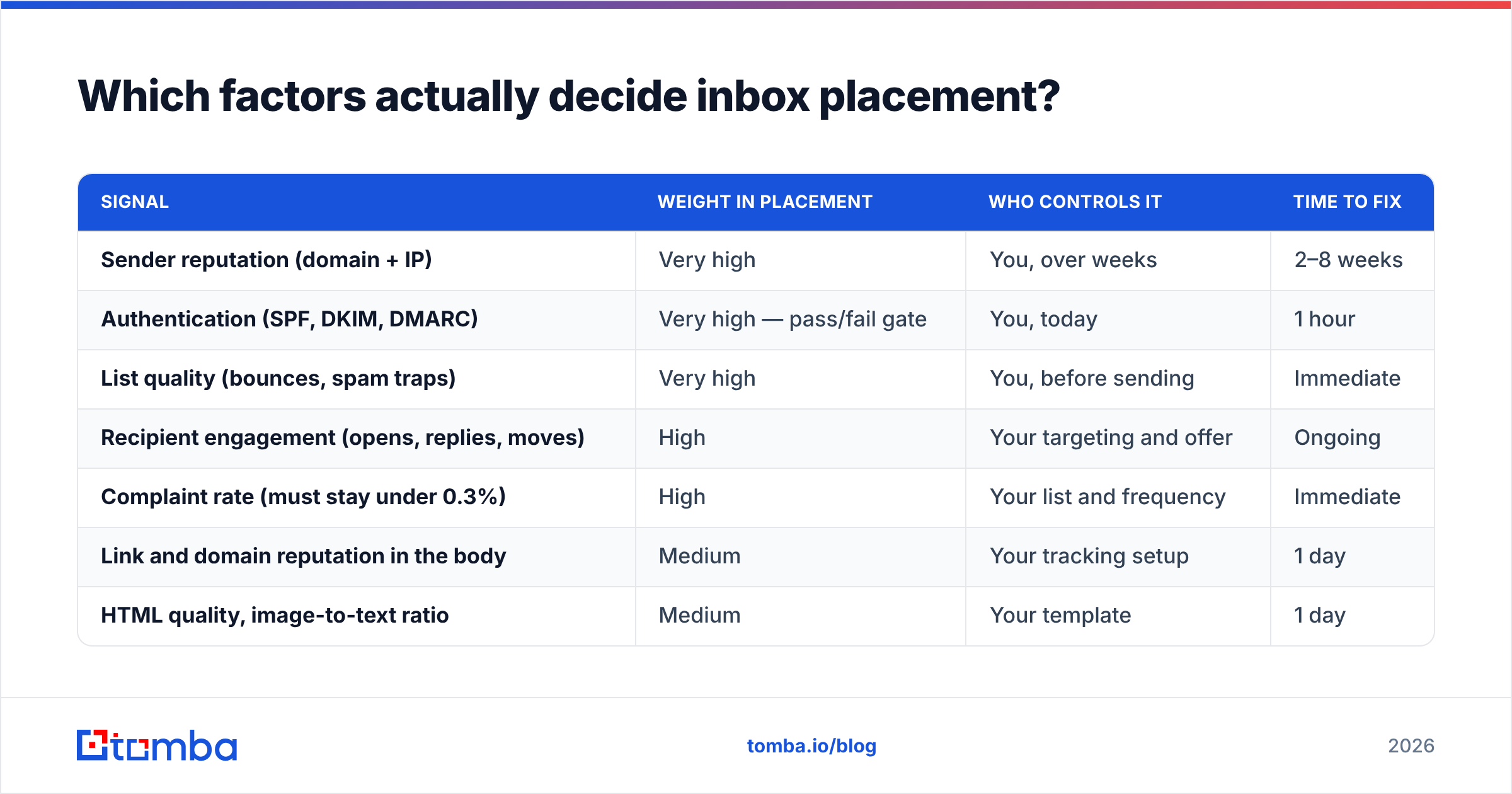
Here is the ranking that matters, from the signals with the most leverage to the least. Use it to decide where your next hour of work goes.
| Signal | Weight in placement | Who controls it | Time to fix |
|---|---|---|---|
| Sender reputation (domain + IP) | Very high | You, over weeks | 2–8 weeks |
| Authentication (SPF, DKIM, DMARC) | Very high — pass/fail gate | You, today | 1 hour |
| List quality (bounces, spam traps) | Very high | You, before sending | Immediate |
| Recipient engagement (opens, replies, moves) | High | Your targeting and offer | Ongoing |
| Complaint rate (must stay under 0.3%) | High | Your list and frequency | Immediate |
| Link and domain reputation in the body | Medium | Your tracking setup | 1 day |
| HTML quality, image-to-text ratio | Medium | Your template | 1 day |
| Spam words in subject and body | Low | Your copy | 10 minutes |
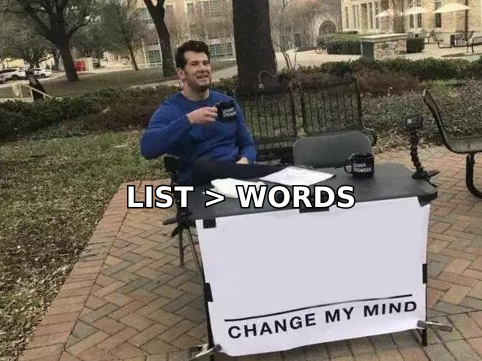
Notice the pattern. The lowest-leverage item on the list is the one most articles obsess over, because it is the one that takes ten minutes and requires no infrastructure work. That is convenience, not strategy.
The clearest evidence: two identical emails sent from two different domains — one warmed and authenticated, one fresh — land in different folders. Same words. Different outcome. Copy is not the variable.
Which email marketing spam words are still worth avoiding?#
That said, some categories genuinely still fire rules and genuinely still spook human readers, which matters because complaints are a real ranking signal. These are the ones worth editing out, grouped by why they hurt.
- Financial urgency claims — "make money fast", "earn extra cash", "double your income", "no credit check", "eliminate debt". These fire multiple SpamAssassin rules and read as consumer scam mail even in a B2B context.
- Absolute guarantees — "100% guaranteed", "risk free", "no obligation", "satisfaction guaranteed", "money back". Legal-sounding absolutes are heavily represented in the training data of every filter on earth.
- Manufactured urgency — "act now", "urgent", "limited time only", "don't delete", "this won't last". Combine with an ALL CAPS subject and you have stacked three penalties for one idea.
- Formatting tells — ALL CAPS words, three or more exclamation marks, red font, oversized text, and the word "free" repeated more than twice. Formatting rules are cheap for filters to run and still active.
- Deceptive framing — "Re:" or "Fwd:" on a message that is neither, "as discussed" when you never spoke, fake reply threads. This is the fastest way to earn a complaint, and complaints outweigh everything else here.
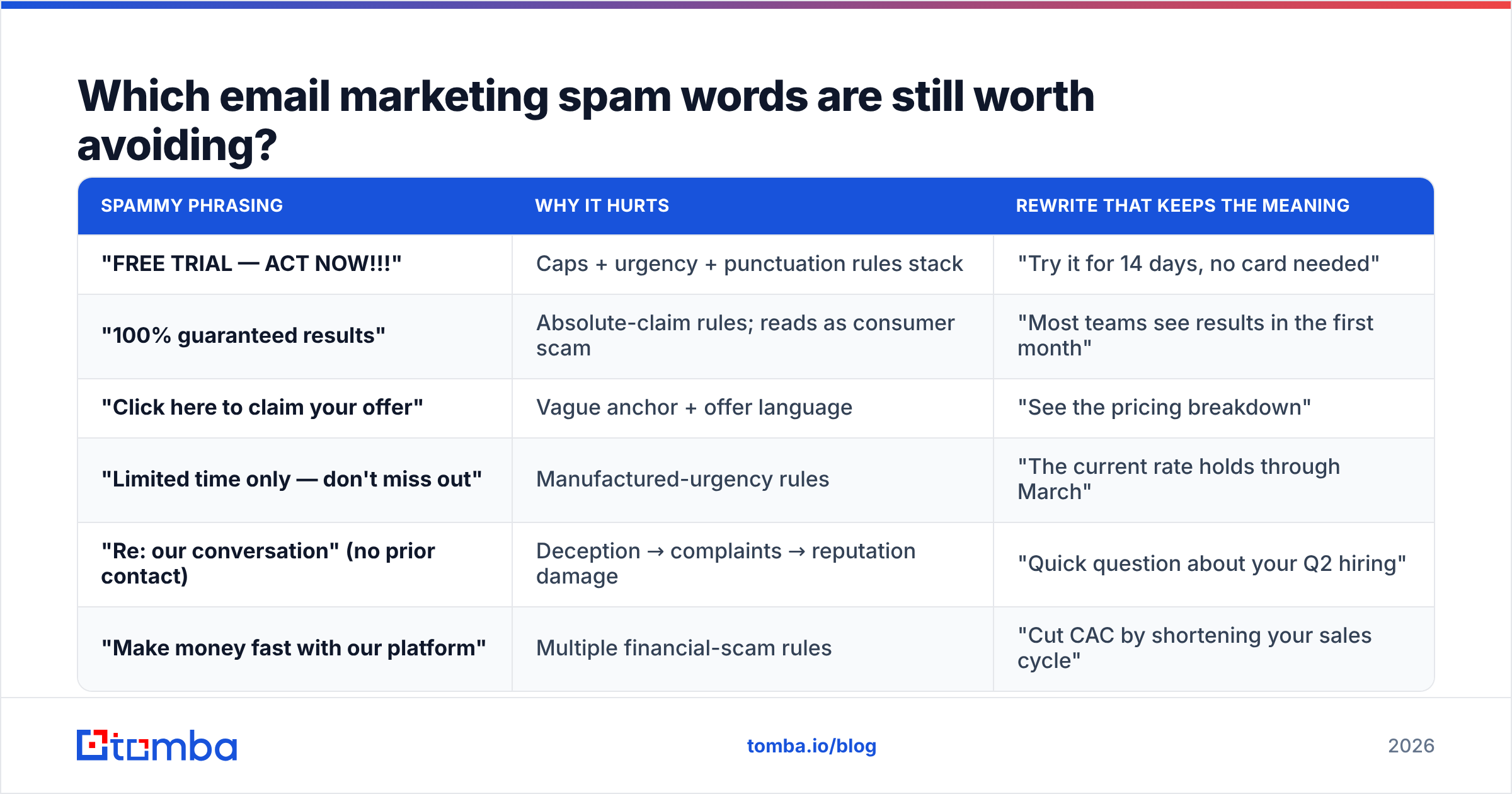
And here is the rewrite table — same message, without the penalty.
| Spammy phrasing | Why it hurts | Rewrite that keeps the meaning |
|---|---|---|
| "FREE TRIAL — ACT NOW!!!" | Caps + urgency + punctuation rules stack | "Try it for 14 days, no card needed" |
| "100% guaranteed results" | Absolute-claim rules; reads as consumer scam | "Most teams see results in the first month" |
| "Click here to claim your offer" | Vague anchor + offer language | "See the pricing breakdown" |
| "Limited time only — don't miss out" | Manufactured-urgency rules | "The current rate holds through March" |
| "Re: our conversation" (no prior contact) | Deception → complaints → reputation damage | "Quick question about your Q2 hiring" |
| "Make money fast with our platform" | Multiple financial-scam rules | "Cut CAC by shortening your sales cycle" |
The rewrites are also better copy. That is not a coincidence — spam-word phrasing is lazy phrasing, and specificity is both safer and more persuasive.
Are spam words different for B2B cold email versus marketing blasts?#
Yes, and the difference is worth understanding.
Bulk marketing email to opted-in subscribers goes through consumer filters — Gmail, Yahoo, iCloud — where reputation and engagement dominate and rule-based text scoring is minor. Your risk there is the promotions tab and complaint rate, not word lists.
B2B cold email goes through corporate gateways: Microsoft Defender for Office 365, Proofpoint, Mimecast, Barracuda. These stack ML with explicit rulesets and are far more literal. A gateway will happily quarantine a message for a combination of an unknown sender domain, a tracking-pixel-heavy HTML template, and three urgency phrases. Cold email is where content hygiene still earns its keep.
Cold email also has a failure mode that word choice cannot save you from: sending to addresses that do not exist. A hard-bounce rate above 3–5% signals list purchasing to every major provider, and spam traps — recycled addresses that mailbox providers monitor — can blacklist a domain outright from a single hit. This is why running your list through an email verifier before a cold campaign does more for placement than any amount of copy editing. Catch-all domains deserve their own pass; a catch-all verifier tells you whether the server accepts everything or the mailbox is real.

How do you test an email before you send it?#
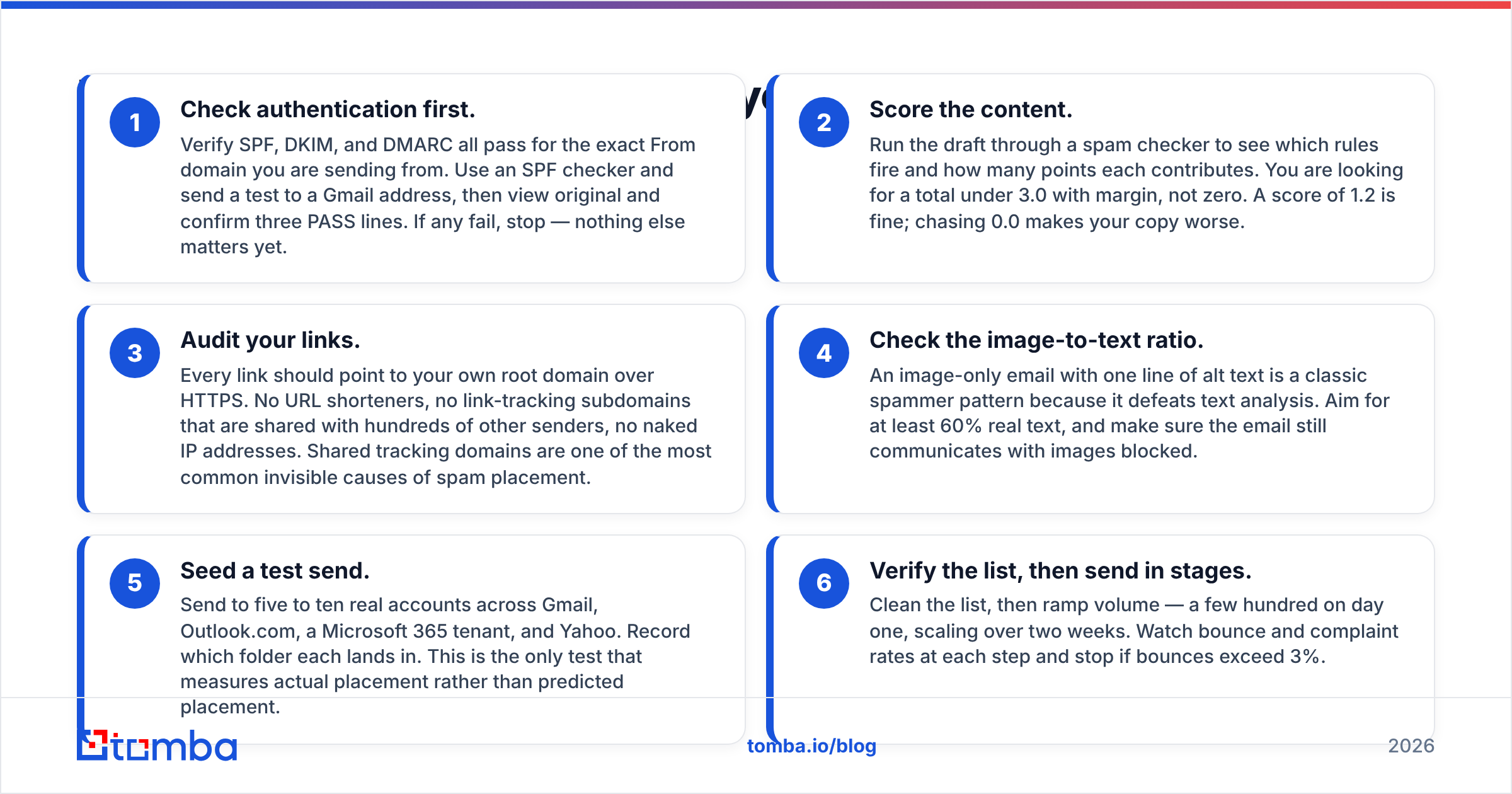
Run this sequence every time you launch a new template or a new sending domain. It takes about twenty minutes and catches nearly everything.
- Check authentication first. Verify SPF, DKIM, and DMARC all pass for the exact From domain you are sending from. Use an SPF checker and send a test to a Gmail address, then view original and confirm three PASS lines. If any fail, stop — nothing else matters yet.
- Score the content. Run the draft through a spam checker to see which rules fire and how many points each contributes. You are looking for a total under 3.0 with margin, not zero. A score of 1.2 is fine; chasing 0.0 makes your copy worse.
- Audit your links. Every link should point to your own root domain over HTTPS. No URL shorteners, no link-tracking subdomains that are shared with hundreds of other senders, no naked IP addresses. Shared tracking domains are one of the most common invisible causes of spam placement.
- Check the image-to-text ratio. An image-only email with one line of alt text is a classic spammer pattern because it defeats text analysis. Aim for at least 60% real text, and make sure the email still communicates with images blocked.
- Seed a test send. Send to five to ten real accounts across Gmail, Outlook.com, a Microsoft 365 tenant, and Yahoo. Record which folder each lands in. This is the only test that measures actual placement rather than predicted placement.
- Verify the list, then send in stages. Clean the list, then ramp volume — a few hundred on day one, scaling over two weeks. Watch bounce and complaint rates at each step and stop if bounces exceed 3%.
If step 5 shows spam placement while step 2 shows a clean score, your problem is reputation, not words. Go back to step 1 and to your list.
What should you fix before you touch your word choice?#
Three things, in order.
Your list. Every invalid address is a bounce, and bounce rate is the single fastest way to burn a sending domain. Pull contacts from a source that validates at retrieval time rather than scraping and hoping. Tomba's email finder returns a confidence score with every result and runs SMTP-level checks before handing back an address, which means the list you build is already most of the way to clean. For large campaigns, the bulk email finder applies the same verification across a full CSV.
Your authentication and warmup. SPF, DKIM, DMARC on the sending domain, plus a separate subdomain for marketing mail so a bad campaign cannot damage your corporate mail flow. Then warm the domain gradually. Sender reputation is earned over weeks and lost in a day.
Your targeting. The most underrated deliverability lever is relevance. Engagement — opens, replies, moves out of spam — feeds directly into placement for every subsequent send. A tightly targeted list of 500 people who care outperforms 50,000 who do not, and it protects your domain while doing it. HubSpot's email marketing research has documented the segmentation-to-engagement relationship across large samples for years.
Only after those three should you audit your copy. And then the audit is quick: strip the caps, cut the exclamation marks, replace absolutes with specifics, and make sure a human would not feel manipulated reading it.
What does a rewritten email look like?#
Before:
Subject: FREE DEMO — ACT NOW!!!
Hi there, our 100% guaranteed platform will help you make money fast with ZERO risk. Limited time only! Click here to claim your free demo before it's gone.
After:
Subject: Question about your Q2 pipeline reporting
Hi Dana — I saw your team is hiring two more SDRs this quarter. Most teams at that stage lose visibility into which sources actually convert. We built reporting that answers that in one view. Worth 15 minutes next week? If not, no problem — reply "no" and I'll close the loop.
The second version fires zero content rules, but that is almost beside the point. It fires zero rules because it is specific, and specificity is what gets replies. The deliverability benefit is a side effect of writing like a person instead of a billboard.
The practical takeaway#
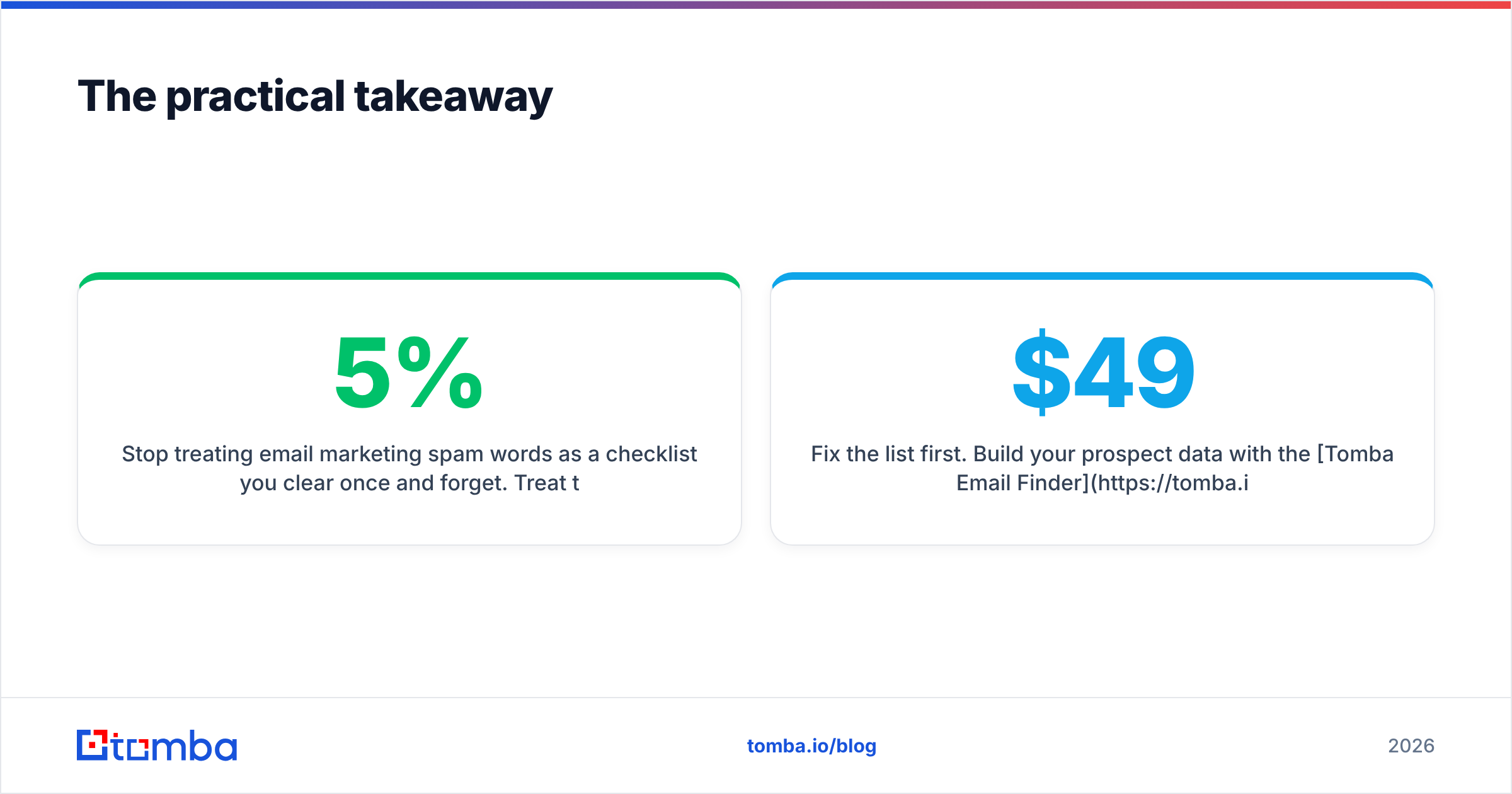
Stop treating email marketing spam words as a checklist you clear once and forget. Treat them as the last 5% of a system whose first 95% is infrastructure and data quality. If you are landing in spam and your copy is already clean, the answer is upstream: authentication, warmup, complaint rate, or a list full of addresses that never existed.
Fix the list first. Build your prospect data with the Tomba Email Finder — verified addresses with confidence scores at the point of discovery, so you are not paying for bounces you then have to clean up. The free tier gives you 25 searches a month to test the accuracy against a list you already trust, and paid plans start at $49/mo on Tomba pricing when you are ready to scale. Clean data in, inbox placement out — and your subject lines can go back to being interesting.
Related guides#
Ready to find emails that actually work?
Join 150,000+ professionals who stopped guessing and started sending. Free credits on signup — no credit card required.
Get the Tomba newsletter
Practical outbound tactics and product updates — once every two weeks.
About the author