Email Outros: How to End Cold Emails and Get Replies
Your outro is the only part of a cold email that asks for something. Here is how to build closing lines, CTAs and sign-offs that turn a read into a reply — with templates and a scenario-by-scenario comparison.
TL;DR
- An email outro is the last 1–3 lines of your email: the closing line, the call to action, and the sign-off. It is the only part that actually asks for something.
- Most cold emails fail at the outro, not the subject line. "Let me know your thoughts" and "Looking forward to hearing from you" put all the work on the reader.
- The highest-performing outros pick one ask, make it low-effort to answer, and give the reader an easy exit.
- Interest-based CTAs ("Worth a look?") consistently beat calendar-based CTAs ("15 minutes Thursday at 2?") on first touch. Flip the order on follow-ups.
- Your sign-off matters far less than your CTA — but a bloated signature block can cost you deliverability and mobile readability.
What is an email outro?#
An email outro is everything after your last argument. In practice it has three parts stacked together:
- The closing line — one sentence that transitions from your pitch to your request ("If your team is still routing leads manually, this is the part that breaks first.")
- The call to action — the specific thing you want the reader to do next ("Want me to send the 2-minute teardown?")
- The sign-off — the valediction plus your name and signature ("Best, Sara").
Think of it like the end of a sales call. You can spend 20 minutes building a great case, but if you hang up without asking for anything, the call produced nothing. The outro is your ask. The valediction — "Best", "Regards", "Cheers" — is just the handshake on the way out.
Most writers obsess over subject lines and first sentences because those decide whether the email is opened and read. The outro decides whether it is answered. Those are different jobs, and one of them is the one your pipeline is measured on.
Why do most email outros get ignored?#
Because they ask the reader to do the thinking. Here are the four failure patterns that show up in almost every underperforming sequence:
- The no-ask outro. "Let me know if you have any questions." There is no question, so there is nothing to answer. The reader files it under "later" and later never comes.
- The multi-ask outro. You offer a demo, a case study, a free audit, and a LinkedIn connect in four lines. Every additional option adds decision cost. Two asks reliably underperform one.
- The presumptive calendar ask. "Does Tuesday at 10am or Thursday at 3pm work?" This assumes a meeting has already been agreed. On a cold first touch from a stranger, it reads as entitled — you are asking for 30 minutes from someone who has spent nine seconds with you.
- The apology outro. "Sorry to bother you", "I know you're busy", "Thanks in advance for your time." These signal low status and pre-frame the email as an imposition.
The fix is not clever wording. It is structural: reduce the ask until answering costs the reader less energy than ignoring you.
What are the four parts of a high-reply outro?#
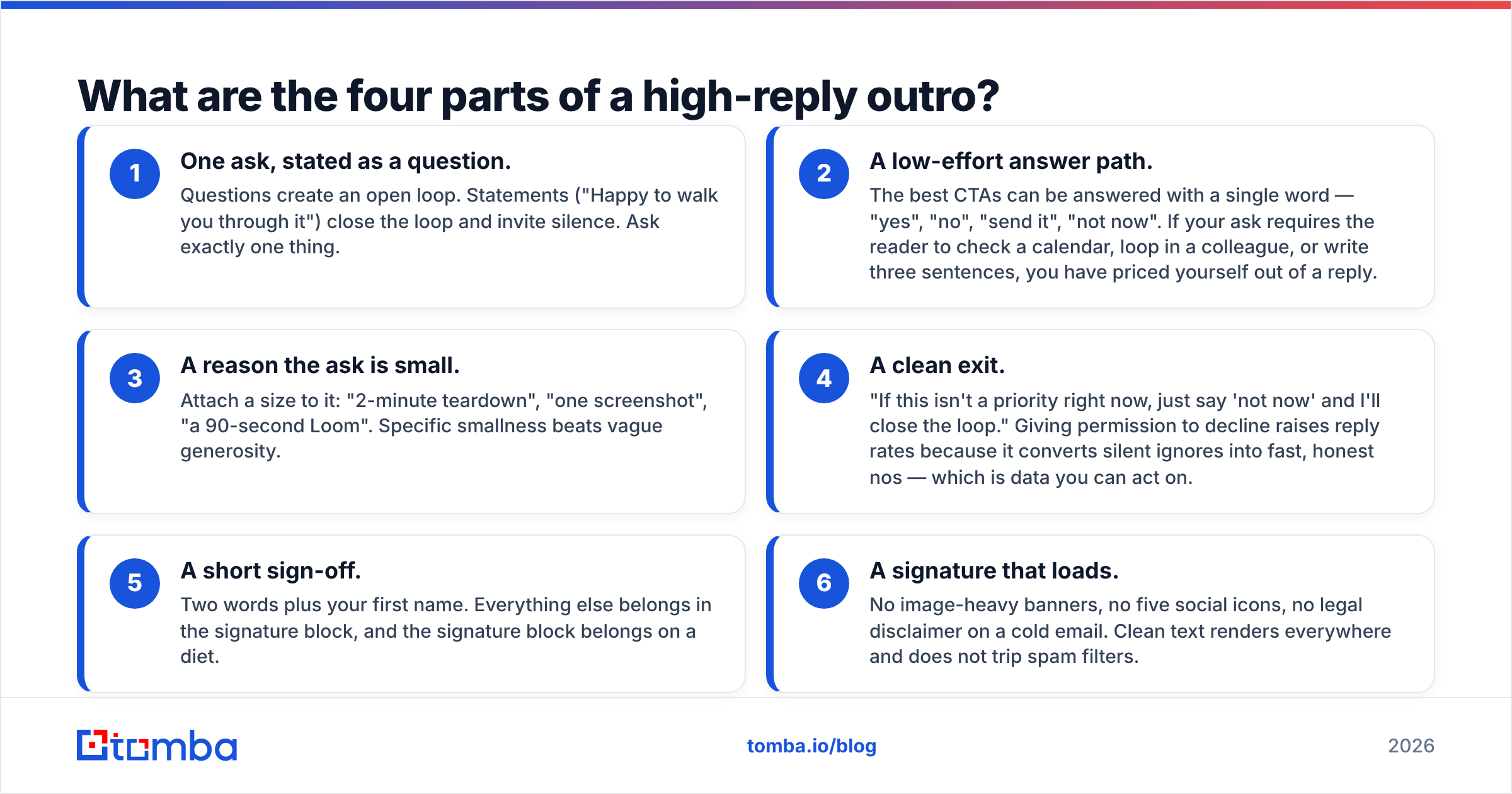
Every outro that consistently converts has the same skeleton. Use this as a checklist before you hit send:
- One ask, stated as a question. Questions create an open loop. Statements ("Happy to walk you through it") close the loop and invite silence. Ask exactly one thing.
- A low-effort answer path. The best CTAs can be answered with a single word — "yes", "no", "send it", "not now". If your ask requires the reader to check a calendar, loop in a colleague, or write three sentences, you have priced yourself out of a reply.
- A reason the ask is small. Attach a size to it: "2-minute teardown", "one screenshot", "a 90-second Loom". Specific smallness beats vague generosity.
- A clean exit. "If this isn't a priority right now, just say 'not now' and I'll close the loop." Giving permission to decline raises reply rates because it converts silent ignores into fast, honest nos — which is data you can act on.
- A short sign-off. Two words plus your first name. Everything else belongs in the signature block, and the signature block belongs on a diet.
- A signature that loads. No image-heavy banners, no five social icons, no legal disclaimer on a cold email. Clean text renders everywhere and does not trip spam filters.
That is the whole system. Most of the variance between a 2% and a 9% response rate on otherwise identical emails lives in items 1 through 3.
Which type of email outro should you use?#
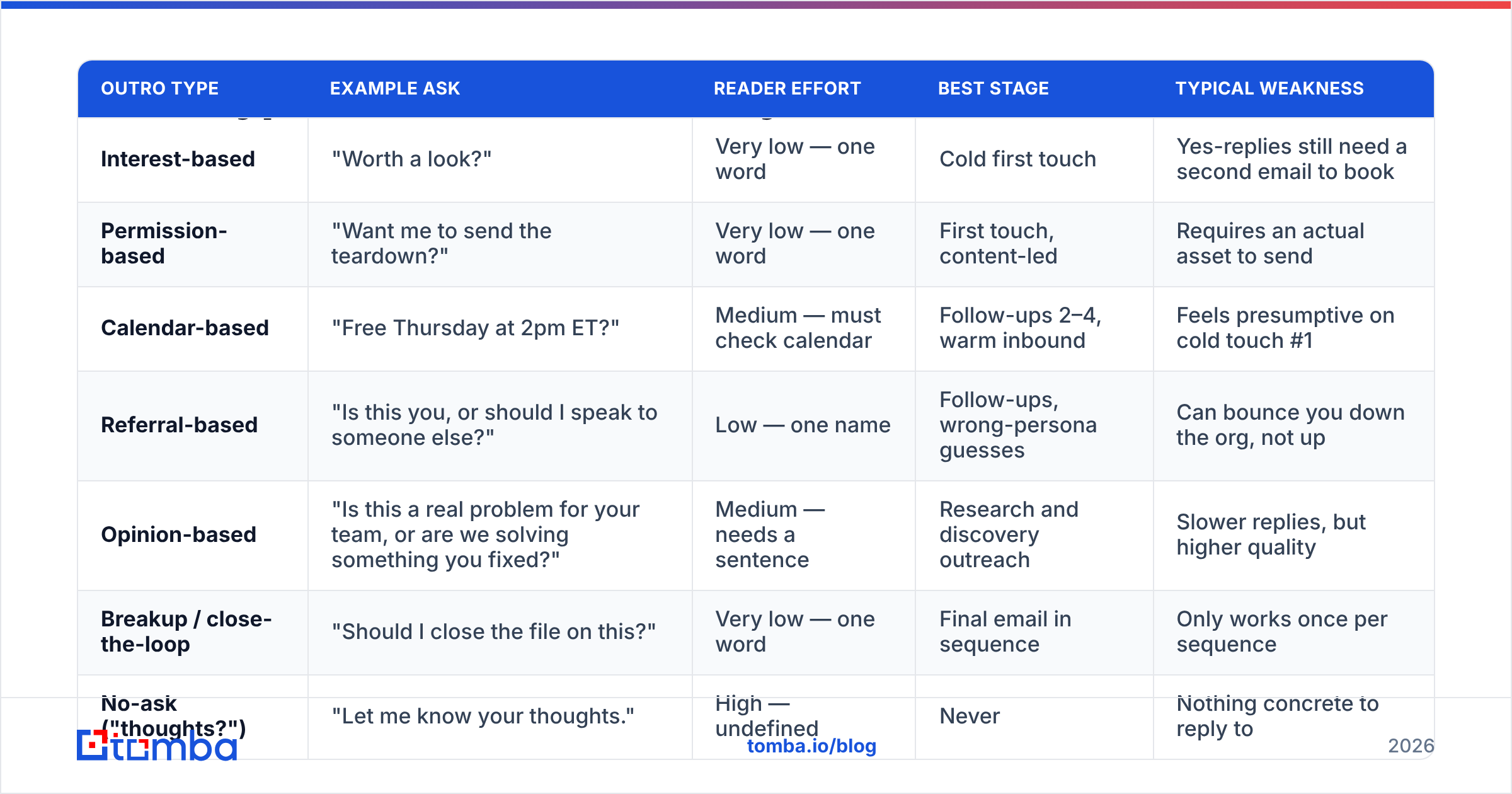
Different asks fit different stages. Here is how the main outro types compare on the dimensions that actually matter:
| Outro type | Example ask | Reader effort | Best stage | Typical weakness |
|---|---|---|---|---|
| Interest-based | "Worth a look?" | Very low — one word | Cold first touch | Yes-replies still need a second email to book |
| Permission-based | "Want me to send the teardown?" | Very low — one word | First touch, content-led | Requires an actual asset to send |
| Calendar-based | "Free Thursday at 2pm ET?" | Medium — must check calendar | Follow-ups 2–4, warm inbound | Feels presumptive on cold touch #1 |
| Referral-based | "Is this you, or should I speak to someone else?" | Low — one name | Follow-ups, wrong-persona guesses | Can bounce you down the org, not up |
| Opinion-based | "Is this a real problem for your team, or are we solving something you fixed?" | Medium — needs a sentence | Research and discovery outreach | Slower replies, but higher quality |
| Breakup / close-the-loop | "Should I close the file on this?" | Very low — one word | Final email in sequence | Only works once per sequence |
| No-ask ("thoughts?") | "Let me know your thoughts." | High — undefined | Never | Nothing concrete to reply to |
The pattern is consistent: the lower the reader's effort, the earlier in the sequence the outro belongs. Start with interest, escalate to calendar once the prospect has shown a signal. HubSpot's sales team has made the same argument for years in its sales blog — micro-commitments outperform macro-asks on first contact.
What are the best email outro examples by scenario?#
Copy these, then rewrite them in your own voice. Templates you paste verbatim sound like templates.
Cold first touch (SaaS, mid-market)
Most RevOps teams we talk to are still stitching this together in a spreadsheet by Q3.
Worth a look at how three of your peers stopped doing that?
Best,
Sara
Cold first touch (content-led)
I pulled a 2-minute teardown of your signup flow — three fixes, no pitch.
Want me to send it over?
Best,
Sara
Follow-up #2 (no reply yet)
Bumping this once in case it got buried.
Still a "not now", or is it a "not us"? Either answer is useful.
Best,
Sara
Wrong-persona correction
If demand gen isn't the owner here, no problem — who is?
Happy to take it off your plate with one name.
Best,
Sara
Post-demo follow-up
You mentioned procurement is the long pole. I've attached the security one-pager they usually ask for.
Do you want me to hold your onboarding slot for two weeks while that runs?
Best,
Sara
Breakup / final touch
This is my last note on this — I don't want to become the person clogging your inbox.
Should I close the file, or check back in Q1?
Best,
Sara
Notice what none of these do: none say "looking forward to hearing from you", none apologise, and none ask two things. If you want a starting library to adapt, the cold email templates collection is a faster on-ramp than writing from scratch.
Which sign-offs actually perform?#
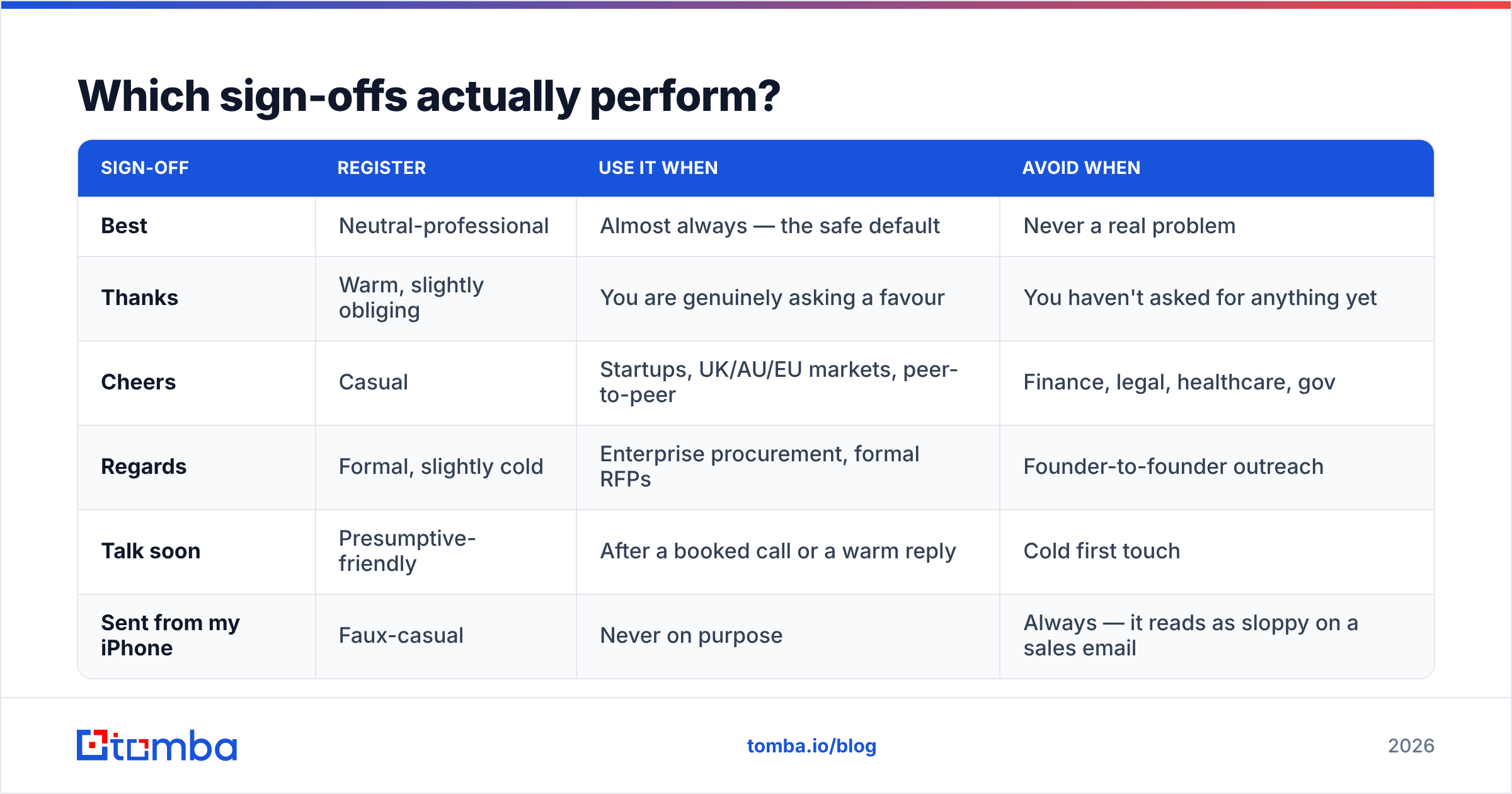
Sign-off choice is the most over-debated, lowest-impact decision in cold email. That said, tone mismatches do cost you credibility. Rough guidance:
| Sign-off | Register | Use it when | Avoid when |
|---|---|---|---|
| Best | Neutral-professional | Almost always — the safe default | Never a real problem |
| Thanks | Warm, slightly obliging | You are genuinely asking a favour | You haven't asked for anything yet |
| Cheers | Casual | Startups, UK/AU/EU markets, peer-to-peer | Finance, legal, healthcare, gov |
| Regards | Formal, slightly cold | Enterprise procurement, formal RFPs | Founder-to-founder outreach |
| Talk soon | Presumptive-friendly | After a booked call or a warm reply | Cold first touch |
| Sent from my iPhone | Faux-casual | Never on purpose | Always — it reads as sloppy on a sales email |
Two rules that matter more than which word you pick:
- Match the register of the reply you want. If you want a two-word answer, do not sign off like a legal notice.
- Keep the signature block under four lines. Name, role, company, one link. A clean email signature renders correctly on mobile, where roughly half of B2B email is now opened, and avoids the image-heavy footers that filters treat as marketing mail.
Do email outros affect deliverability?#
Indirectly, yes — and in two ways people usually miss.
First, reply rate is a positive signal. Mailbox providers weigh recipient engagement heavily. An outro that generates real replies improves your sender reputation over time; an outro that generates silence and the occasional spam complaint degrades it.
Second, the block below your outro is where deliverability goes to die. Tracking pixels, three image banners, a "Book a meeting" button, an unsubscribe footer copied from your marketing platform, and a 60-word legal disclaimer add HTML weight and marketing fingerprints to what is supposed to be a one-to-one email. Strip cold email signatures to plain text plus one link. Run a draft through a spam checker before you scale a sequence, not after.
Third-party review data on sales engagement platforms shows the same complaint repeatedly: teams blame the tool for low reply rates when the actual problem is a bloated template that never asks a clear question.
How do you test email outros properly?#
Testing outros is easier than testing subject lines because the metric is unambiguous — replies, not opens.
- Change one variable. Same subject, same body, two outros. If you swap the CTA and the sign-off, you learn nothing.
- Use a real sample size. Reply rates are low-frequency events. At a 4% baseline you need several hundred sends per variant before a difference means anything. Under 200 sends per arm, you are reading noise.
- Count positive replies, not all replies. A CTA that generates "please remove me" is technically a reply-rate winner and a pipeline loser. Track interested, not-now, and negative separately.
- Segment by seniority. VPs answer one-word interest CTAs. Practitioners answer opinion CTAs. The same outro rarely wins across both.
- Re-test quarterly. Outros decay. "Worth a look?" was a differentiator in 2021 and is close to wallpaper now. What separates a good sequence in 2026 is specificity, not novelty phrasing.
One prerequisite people skip: none of this is measurable if a meaningful share of your sends bounce. Bounces contaminate your denominator and your domain reputation at the same time. Clean the list with an email verifier before you run any outro experiment, otherwise you are A/B testing against a broken delivery pipe.
What are the most common email outro mistakes?#
- Asking for 30 minutes from someone who has never heard of you.
- Ending with a link instead of a question — links are an action, not an ask.
- Stacking a P.S. that introduces a second CTA.
- Writing "Let me know if this resonates." It never resonates.
- Using "Just following up" as the entire outro of a follow-up. Add new information or don't send.
- Signing off with a title stack ("VP of Strategic Enterprise Growth Partnerships") that outweighs the ask.
- Copy-pasting a marketing footer into a one-to-one sales email.
If you want a broader frame for where the outro sits inside the whole sequence, the analysis in Gartner's sales research on buyer self-service is worth reading — buyers increasingly want to move at their own pace, which is exactly why low-effort, opt-in CTAs outperform calendar demands on first contact.
Ready to put better outros in front of the right people?#
A perfect outro sent to the wrong address is still a zero. Before you rewrite a single closing line, make sure the sequence is landing in real inboxes owned by real decision-makers.
Use the Tomba Email Finder to find verified professional email addresses by name, company, or domain — then pair it with verification so your reply-rate tests measure your copy instead of your bounce rate. The free tier includes 25 searches a month, and paid plans start at $49/mo on Starter with $99/mo Growth and $249/mo Pro tiers as volume grows; full details are on the Tomba pricing page.
Write one ask. Make it small. Send it to someone who actually exists.
Related guides#
Ready to find emails that actually work?
Join 150,000+ professionals who stopped guessing and started sending. Free credits on signup — no credit card required.
Get the Tomba newsletter
Practical outbound tactics and product updates — once every two weeks.
About the author