Email Scraper Online: How to Extract B2B Emails Legally in 2026
Most online email scrapers hand you a CSV full of bounces. Here's how email scraping actually works in 2026, what's legal, what accuracy to expect, and which tools survive a real bounce test.
TL;DR
- An "email scraper online" is any browser-based or API-based tool that pulls email addresses out of web pages, directories, or company domains — no software install required.
- Raw scraping without verification is the single biggest cause of 20%+ bounce rates. Scraping and verifying are two different jobs, and you need both.
- Scraping publicly listed business emails is generally lawful in the US under CAN-SPAM, but GDPR and CASL require a legitimate-interest basis, disclosure, and easy opt-out. Scraping personal Gmail addresses is where teams get burned.
- Pattern-only scrapers (guessing
first.last@domain.com) hit roughly 40–60% accuracy. Tools that combine crawling, historical data, and SMTP validation land in the 85–95% range. - Skip the scraper entirely when you only need contacts at a known company — a domain search returns the same result in one call, already deduplicated.
What is an email scraper online, exactly?#
An email scraper online is a hosted tool that extracts email addresses from web content without you installing anything. You paste a URL, a domain, a block of text, or a list of company names, and it returns addresses.
Think of it like a metal detector at the beach. Sweep it over the sand and it beeps at anything metallic — coins, bottle caps, rusted nails. The detector doesn't know which is which. A scraper is the same: it finds strings that look like emails. Whether they're deliverable, current, or attached to a real human is a separate question the scraper never answers.
That distinction matters because the market lumps four different products under one search term:
- Text extractors — paste raw HTML, a PDF, or a page dump and get every
something@something.tldstring back. Zero intelligence, useful for cleaning up a conference attendee list. A free email extractor covers this. - Page crawlers — you give a URL and the tool crawls that page plus linked pages (team page, contact page, blog author bios) looking for addresses.
- Domain-level finders — you give
stripe.comand the tool returns known addresses at that company plus the detected email pattern. This is the highest-value category for B2B. - Profile-based finders — you point at a LinkedIn profile or a person's name plus company, and the tool resolves one specific address.
Most people typing "email scraper online" actually want #3 or #4. They just don't know the vocabulary yet.
How does an online email scraper actually find addresses?#
Under the hood, every serious tool blends four techniques. The mix determines your accuracy.
- Crawling and indexing. The tool has already crawled millions of public pages — company sites, press releases, GitHub commits, conference speaker lists, author bylines — and stored every address it found alongside the source URL. This is the highest-confidence layer because the address was published, not guessed.
- Pattern inference. Once the tool knows that
sarah.chen@acme.comexists, it infers Acme's pattern isfirst.last@. Now it can generate a candidate for anyone at Acme. Fast, cheap, and wrong often enough that you can't ship it unverified. A company email pattern check tells you the dominant format before you generate anything. - MX and SMTP probing. The tool opens a conversation with the receiving mail server and asks whether the mailbox exists — without sending mail. This kills most invented addresses. It fails on catch-all domains, which accept everything.
- Cross-source corroboration. The same address appearing in three independent sources, with a recent last-seen date, scores far higher than one found once in 2019. Recency is the signal most cheap scrapers ignore entirely.
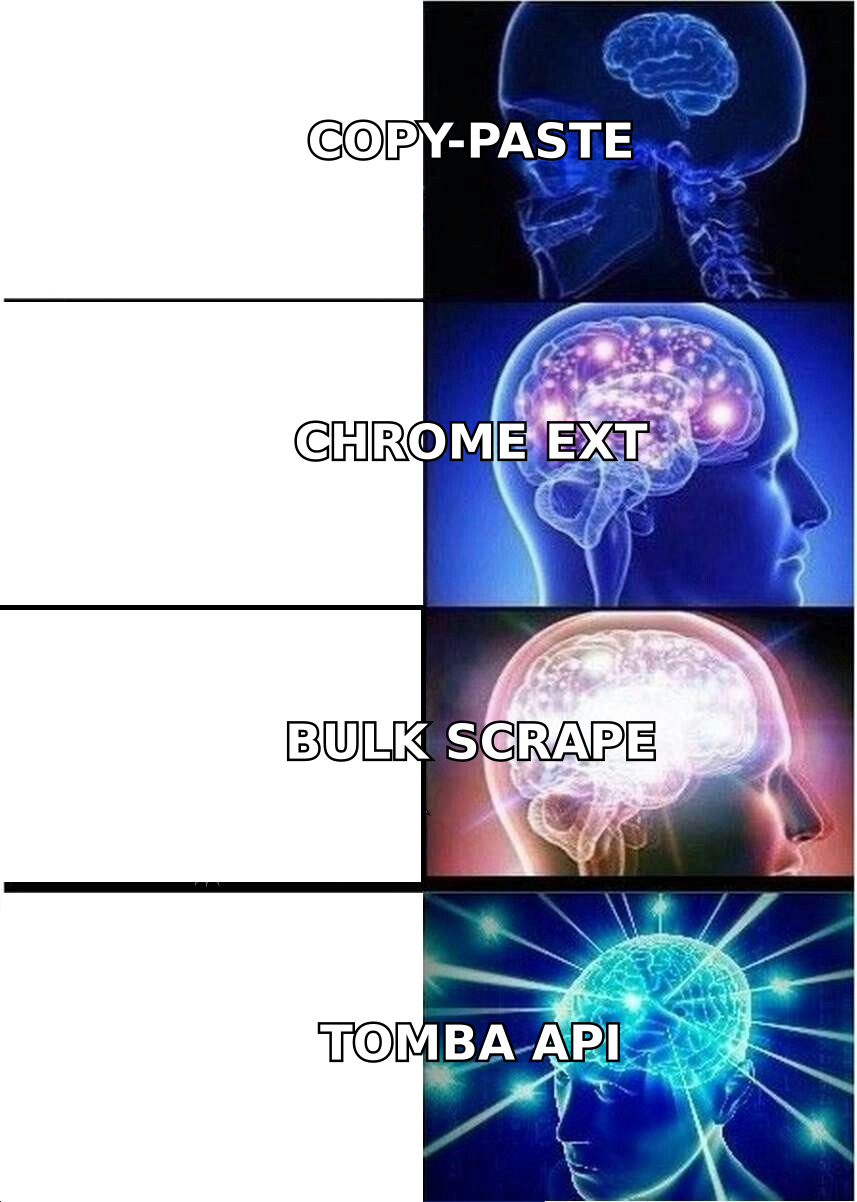
The tools that publish honest accuracy numbers are the ones weighting layer 1 and layer 4 heavily. The tools that don't publish numbers are usually running layer 2 with a thin SMTP check bolted on.
Is scraping emails online legal in 2026?#
Short answer: scraping publicly available business contact data is legal in most jurisdictions. What you do next is where the rules bite.
The legal question splits into two halves that people constantly conflate — the act of collecting, and the act of contacting.
Collecting. In the US, the hiQ v. LinkedIn line of cases established that scraping publicly accessible data does not violate the Computer Fraud and Abuse Act. Scraping content behind a login, or in violation of a contract you actively agreed to, is a different story. Email address harvesting from sites that publish anti-harvesting terms sits in a grey zone worth avoiding.
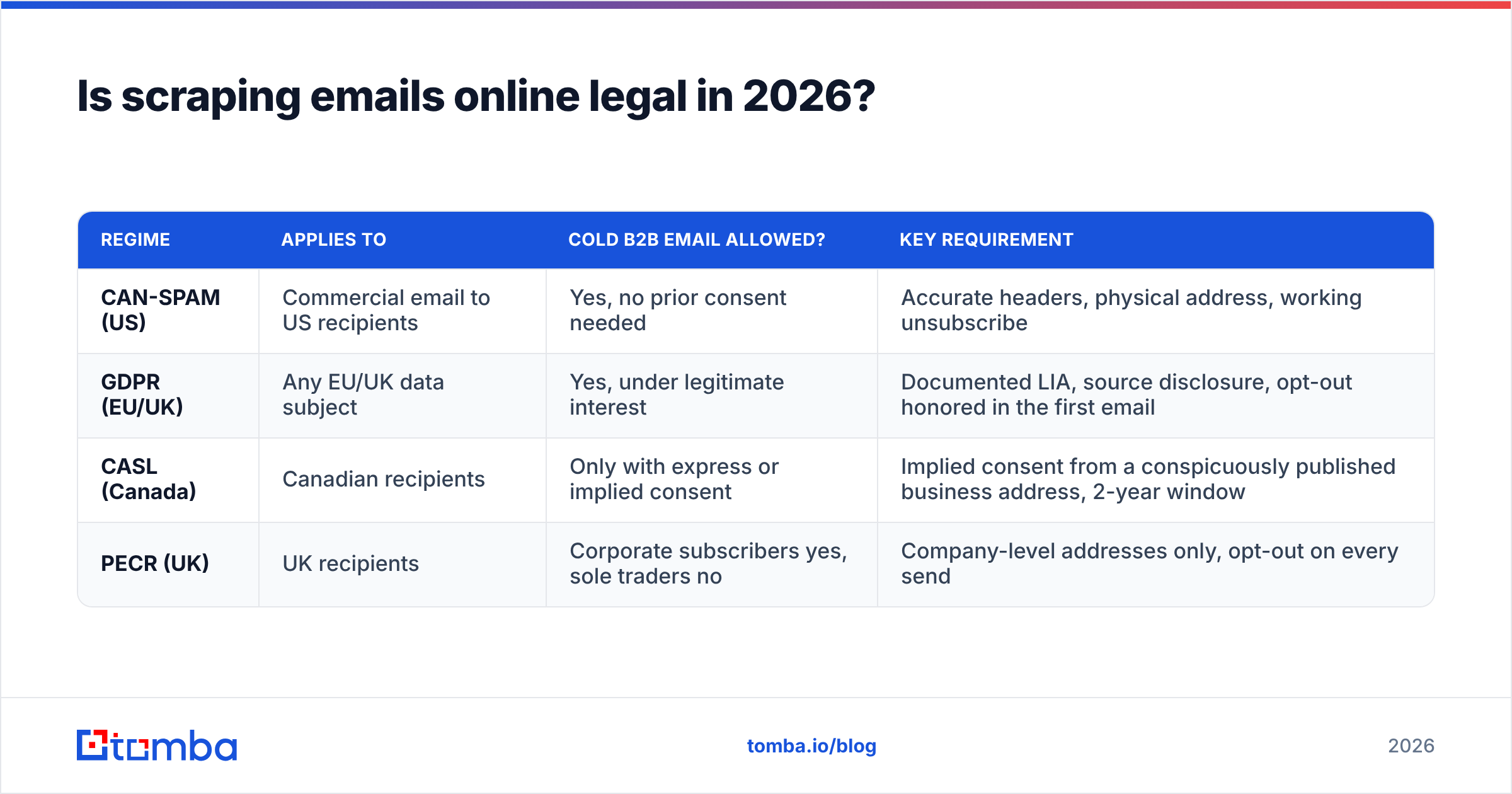
Contacting. This is stricter:
| Regime | Applies to | Cold B2B email allowed? | Key requirement |
|---|---|---|---|
| CAN-SPAM (US) | Commercial email to US recipients | Yes, no prior consent needed | Accurate headers, physical address, working unsubscribe |
| GDPR (EU/UK) | Any EU/UK data subject | Yes, under legitimate interest | Documented LIA, source disclosure, opt-out honored in the first email |
| CASL (Canada) | Canadian recipients | Only with express or implied consent | Implied consent from a conspicuously published business address, 2-year window |
| PECR (UK) | UK recipients | Corporate subscribers yes, sole traders no | Company-level addresses only, opt-out on every send |
Three rules that keep you clean regardless of jurisdiction:
- Target role and company addresses at businesses, not personal
@gmail.comor@yahoo.comaddresses. - Keep the source of every record. If a recipient asks where you got their address, "we scraped it" is a bad answer; "it was published on your company's team page on 12 March" is a fine one.
- Honor unsubscribes globally and instantly, including replies that say "remove me" in plain English.
What separates an accurate scraper from a list-poisoning one?#
Accuracy is the only metric that matters, and vendors define it three incompatible ways. Before you compare numbers, know which one you're reading.
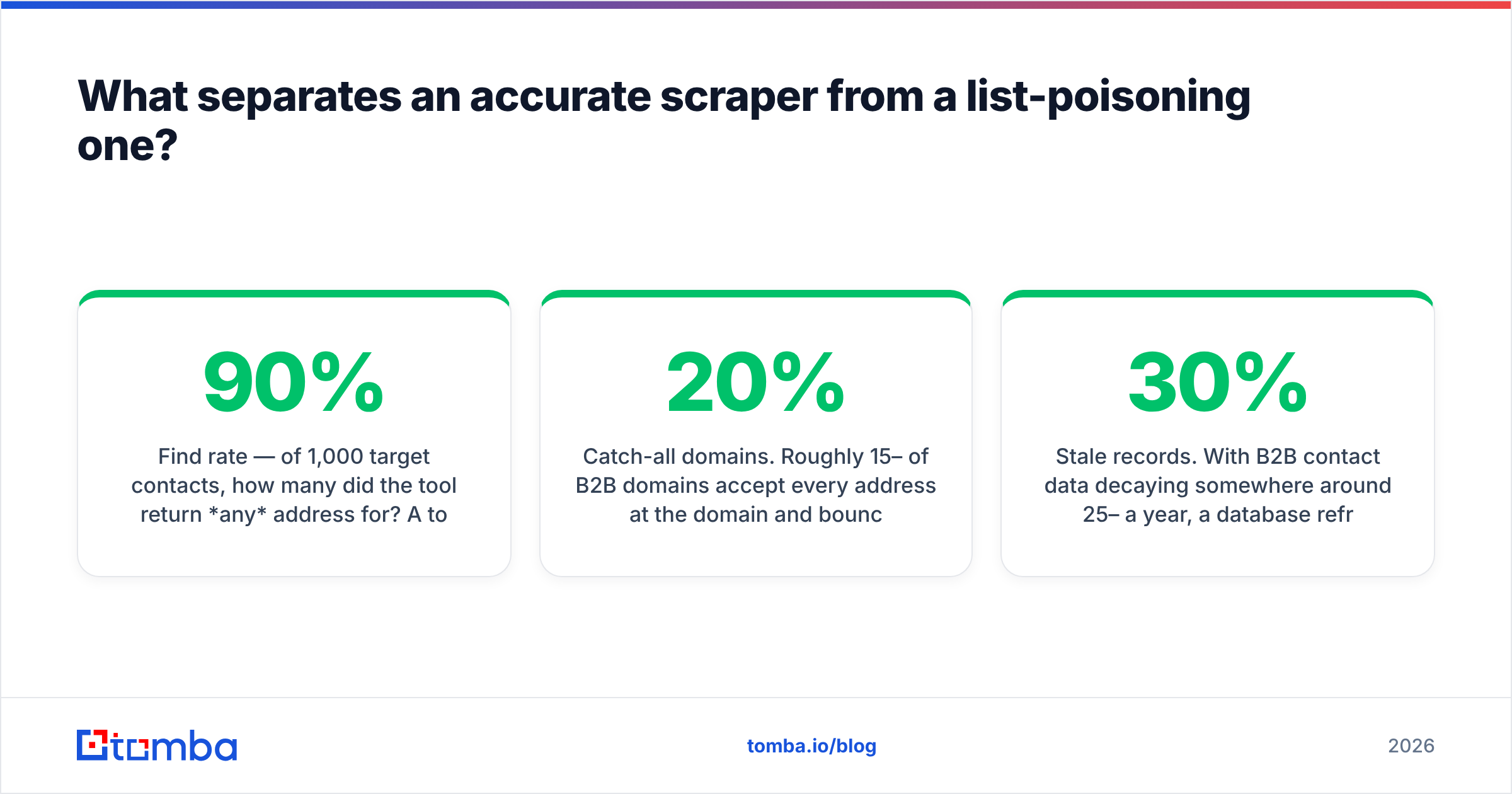
- Find rate — of 1,000 target contacts, how many did the tool return any address for? A tool can hit 90% find rate by guessing.
- Deliverability rate — of the addresses returned, how many actually accepted mail? This is the number that predicts your bounce rate.
- Person-match rate — of the delivered addresses, how many belonged to the intended human rather than a colleague or a catch-all sink? Rarely published, most important.

Run this test before committing to any vendor. Take 100 contacts you already have verified addresses for — from closed-won deals, your CRM, or your newsletter list. Strip the emails, feed the names and companies into the scraper, and compare. You'll learn the real person-match rate in an afternoon, and you'll learn it for your market rather than a vendor's cherry-picked sample.
Two failure modes to watch for:
Catch-all domains. Roughly 15–20% of B2B domains accept every address at the domain and bounce nothing at the SMTP layer. A scraper without dedicated catch-all handling will mark every guess as "valid." Look for a catch-all verifier that scores these separately instead of pretending they're clean.
Stale records. With B2B contact data decaying somewhere around 25–30% a year, a database refreshed annually is a third wrong before you open it. Ask when the record was last confirmed, not when the database was "last updated."
Which email scraper online tools are worth using in 2026?#
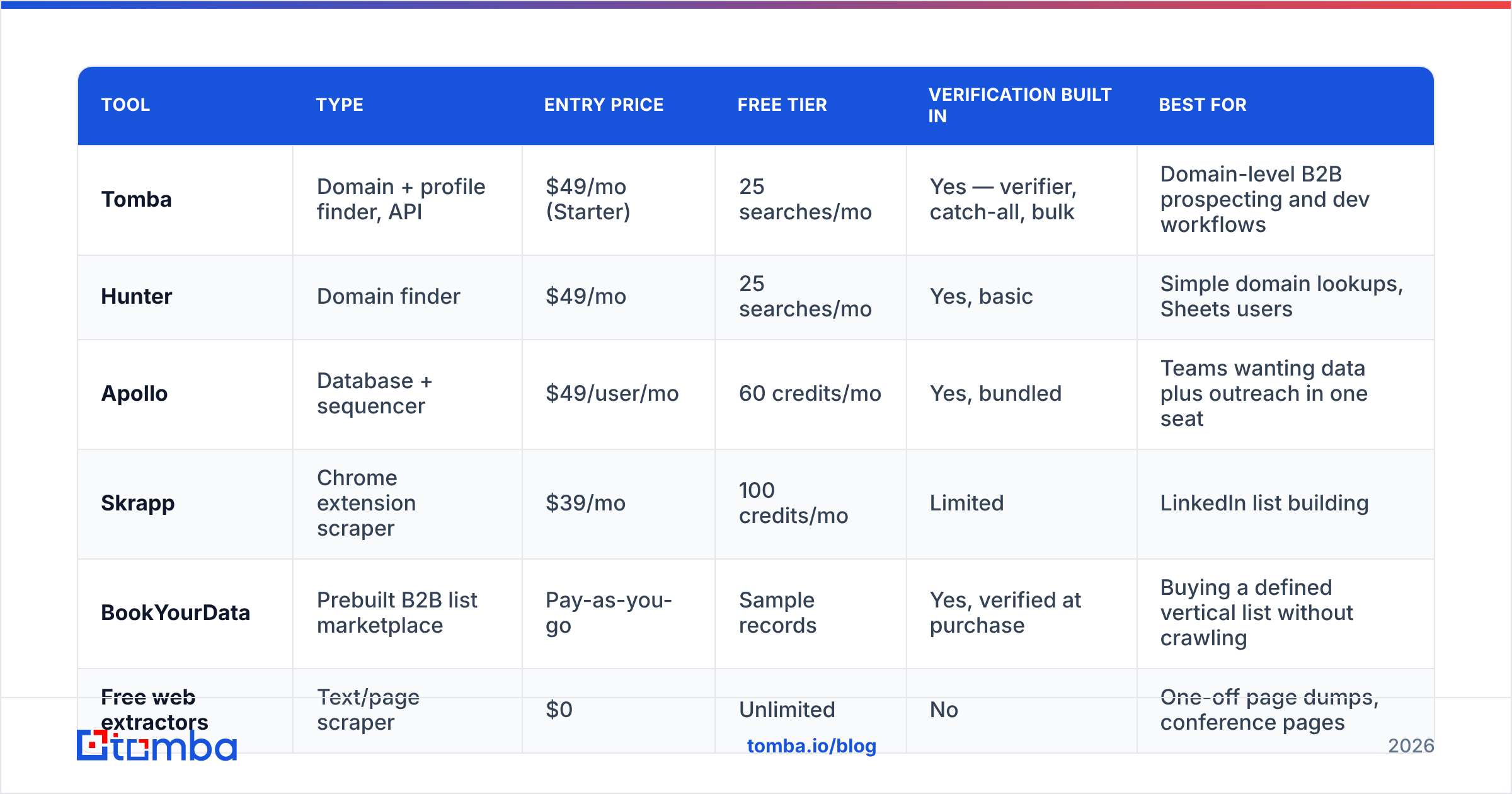
Here's how the main categories compare on the criteria that actually change your reply rate.
| Tool | Type | Entry price | Free tier | Verification built in | Best for |
|---|---|---|---|---|---|
| Tomba | Domain + profile finder, API | $49/mo (Starter) | 25 searches/mo | Yes — verifier, catch-all, bulk | Domain-level B2B prospecting and dev workflows |
| Hunter | Domain finder | $49/mo | 25 searches/mo | Yes, basic | Simple domain lookups, Sheets users |
| Apollo | Database + sequencer | $49/user/mo | 60 credits/mo | Yes, bundled | Teams wanting data plus outreach in one seat |
| Skrapp | Chrome extension scraper | $39/mo | 100 credits/mo | Limited | LinkedIn list building |
| BookYourData | Prebuilt B2B list marketplace | Pay-as-you-go | Sample records | Yes, verified at purchase | Buying a defined vertical list without crawling |
| Free web extractors | Text/page scraper | $0 | Unlimited | No | One-off page dumps, conference pages |

A few honest notes on that table.
Free extractors are genuinely useful — just not for prospecting. Use them when you already have a page containing the addresses you want and you don't want to copy-paste 60 rows by hand.
Chrome-extension scrapers are the fastest path from a LinkedIn search to a CSV, but they are also the most fragile. Platform changes break them regularly, and per-profile rate limits cap your throughput. If you're building lists in volume, an API is more durable than an extension.
BookYourData sits in a different lane entirely: instead of crawling, you filter a verified database by industry, title, and geography and buy the slice you need. When your ICP is well-defined and you don't want to manage crawl logic, buying beats scraping. When your ICP is "companies that just posted a job for a Rails developer," scraping wins because no static list captures that signal.
Apollo bundles data with sequencing, which is convenient until you want to switch sending tools and discover your data contract is tied to your outreach seat. If that's your situation, an Apollo alternative that decouples data from sending is worth pricing out.

How much should an email scraper online cost?#
Price per credit is the wrong unit. Price per usable, delivered, correct contact is the right one.
Work it out like this. A tool at $49/month for 1,000 credits is $0.049 per credit. If its person-match rate is 55%, your true cost is $0.089 per usable contact. A tool at $99/month for 1,000 credits ($0.099) with a 90% match rate costs $0.11 — barely more, and you skip the hours spent scrubbing bounces and the sender-reputation damage that comes with them.
Three pricing traps:
- Credits burned on failures. Some tools charge for a search that returns nothing. Confirm the policy in writing.
- Verification sold separately. If the scraper returns unverified addresses and verification is a separate SKU, add it to your comparison — because you will need it.
- Annual lock-in before a pilot. Any vendor confident in their data will let you test monthly. Check Tomba pricing or any competitor's page for a monthly option before you sign a year.
For context on how buyers rate these tools beyond vendor claims, the lead intelligence category on G2 is a reasonable sanity check — filter reviews by company size closest to yours, since accuracy varies wildly by segment.
How do you scrape without wrecking your deliverability?#
Scraping is step one of five. Skipping steps two through four is why scraped lists have a reputation.
- Scrape into a staging list, never into your sending tool. Treat scraper output as raw material, not a campaign.
- Deduplicate against your CRM and suppression list. Emailing an existing customer as a cold prospect is a credibility hit you can't undo.
- Verify everything. Run the full list through an email verifier and drop anything marked invalid. Segment catch-alls into their own bucket and send to them last, at low volume, after your reputation is established.
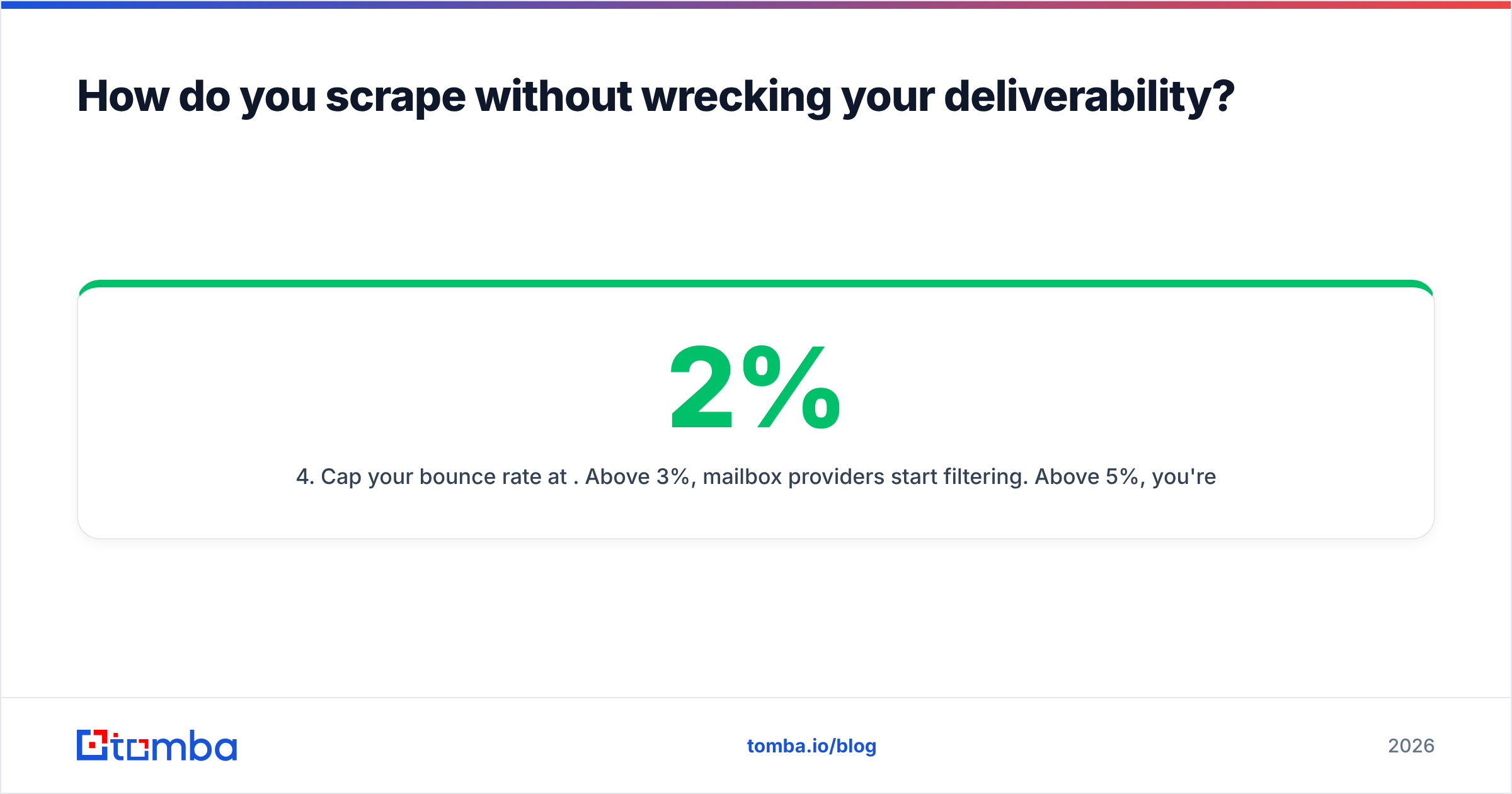
- Cap your bounce rate at 2%. Above 3%, mailbox providers start filtering. Above 5%, you're rebuilding your domain reputation for a month.
- Warm the domain before volume. A fresh domain sending 500 cold emails on day one gets filtered regardless of list quality. HubSpot's guide to email deliverability covers the authentication side — SPF, DKIM, DMARC — which no amount of data quality substitutes for.
If you're processing thousands of records, do steps 1–3 as one job through a bulk email finder rather than stitching CSVs between tools. Every manual export is a chance to reintroduce duplicates.
When should you skip scraping altogether?#
Scraping is the right tool when your target list is defined by a behavior — hiring signals, tech stack, funding events, conference attendance — because no static database captures those in real time.
Skip it when:
- You already know the companies. A domain-level lookup across 200 known domains is faster, cleaner, and cheaper than crawling 200 websites.
- You need one specific person. Name plus company through an email finder beats crawling their employer's entire site.
- Your ICP maps to standard firmographics. Industry, headcount, geography, title — that's a database filter, not a crawl.
- Compliance risk outweighs the volume. In heavily regulated verticals, an opted-in list at higher cost per contact is the cheaper decision once you price in risk.
The bottom line#
An email scraper online is a starting point, not a pipeline. The tools that get judged badly are usually the ones being asked to do a job they never claimed to do: guaranteeing that a string shaped like an email belongs to a real, reachable, correctly-titled human. Pair collection with verification, keep provenance for every record, cap your bounce rate, and scraped data performs about as well as purchased data — often better, because it's fresher.
If your workflow is "I know the companies, I need the people," start with the Tomba Email Finder. Find addresses by domain, name, or company, verify them in the same pass, and export clean. The free tier gives you 25 searches a month to run your own 100-contact accuracy test before you pay anything — which is exactly how you should evaluate any vendor on this page.
Related guides#
// get started
Find, verify and enrich your first contacts today
Start on the free plan with 25 searches a month, then scale when your team is ready.
Free plan · No credit card required · GDPR & CCPA
// about the author