Email Sequence First Email: How to Write the One That Gets Replies
The first email in a sequence does 80% of the work and gets 20% of the attention. Here's what belongs in it, what to cut, and how the openers that actually earn replies are structured in 2026.
TL;DR
- The first email in a sequence is not an introduction — it is a qualification test. Its job is to make a specific person say "that's me" in under eight seconds.
- Openers between 50 and 125 words consistently outperform longer first touches. Every sentence past the ask costs you replies.
- Personalization only pays when it is observable and recent: a hiring post, a pricing page change, a new integration. Merge-tag flattery ("love what you're building at {{company}}") is worse than nothing.
- Bad data breaks email one before copy ever matters. A 12% bounce rate on the first send suppresses every follow-up behind it.
- One ask, one link, no attachments. Save the deck, the calendar embed, and the case study for emails two through five.
What is the first email in an email sequence?#
The first email in an email sequence is the initial cold touch — the message that lands before any follow-up, reminder, or bump. Everything downstream inherits its consequences: your sender reputation, your reply rate, your list health, and whether the prospect even sees email two.
Think of it like the first knock on a door. If you knock politely and say something the person behind it actually cares about, you get a conversation. If you hammer, shout your company name, and slide a brochure under the door, nobody answers the second knock either — and now they know your knock.
That is the part most teams get wrong. They treat email one as an announcement and emails two through five as the "real" persuasion. In practice the sequence is front-loaded: the majority of positive replies to a well-built four-to-six touch sequence come from the first two emails, and follow-ups mostly harvest attention that email one earned but didn't convert on the day it arrived.
Why does the first email decide the whole sequence?#
Three mechanical reasons, none of them about copywriting.
1. It sets your deliverability floor. The first send is where invalid addresses bounce, spam traps fire, and inactive mailboxes drag your engagement signal down. Mailbox providers weigh early engagement heavily — Google's sender guidelines are explicit that complaint rates and unwanted mail determine whether your future messages reach the inbox. A sloppy first send doesn't just fail; it taxes every message behind it.
2. It sets the thread context. Most sequences reply into the same thread. If email one is vague, every follow-up quotes vagueness. If email one names a specific, checkable problem, follow-ups can add evidence rather than repeat themselves.
3. It filters your pipeline. A first email that is deliberately narrow ("if you're still routing inbound leads manually across three tools…") returns fewer replies but better ones. A first email that is broad returns more replies, most of which are unqualified curiosity that eats your reps' time.
What should the first email actually contain?#
Five components, in this order. Anything else is optional and probably harmful.
- A trigger line that proves you looked. One clause naming something observable: a job posting, a funding round, a stack change, a new location, a conference talk. It must be checkable and recent — ideally within 60 days.
- A problem statement in the prospect's language. Not your feature. The symptom they'd describe to a peer: "reps rebuilding the same list in three tools," "SDRs bouncing 15% of sends," "no one owns lifecycle after the handoff."
- One line of proof, quantified. A named-tier customer, a percentage, or a timeframe. "We cut list-build time from 6 hours to 40 minutes for a 12-rep team" beats "we help companies scale outbound."
- A single low-friction ask. A yes/no question or an interest check. Not a 30-minute meeting request. Not a Calendly link. "Worth a look?" converts better than "Do you have 30 minutes Thursday at 2?"
- A plain signature. Name, role, company, one link. No banner image, no legal block, no six social icons — each one adds weight and image-to-text ratio that spam filters notice.
Notice what is absent: your company boilerplate, your founding story, a PDF, a video thumbnail, and the phrase "I hope this email finds you well."
How long should the first email be?#
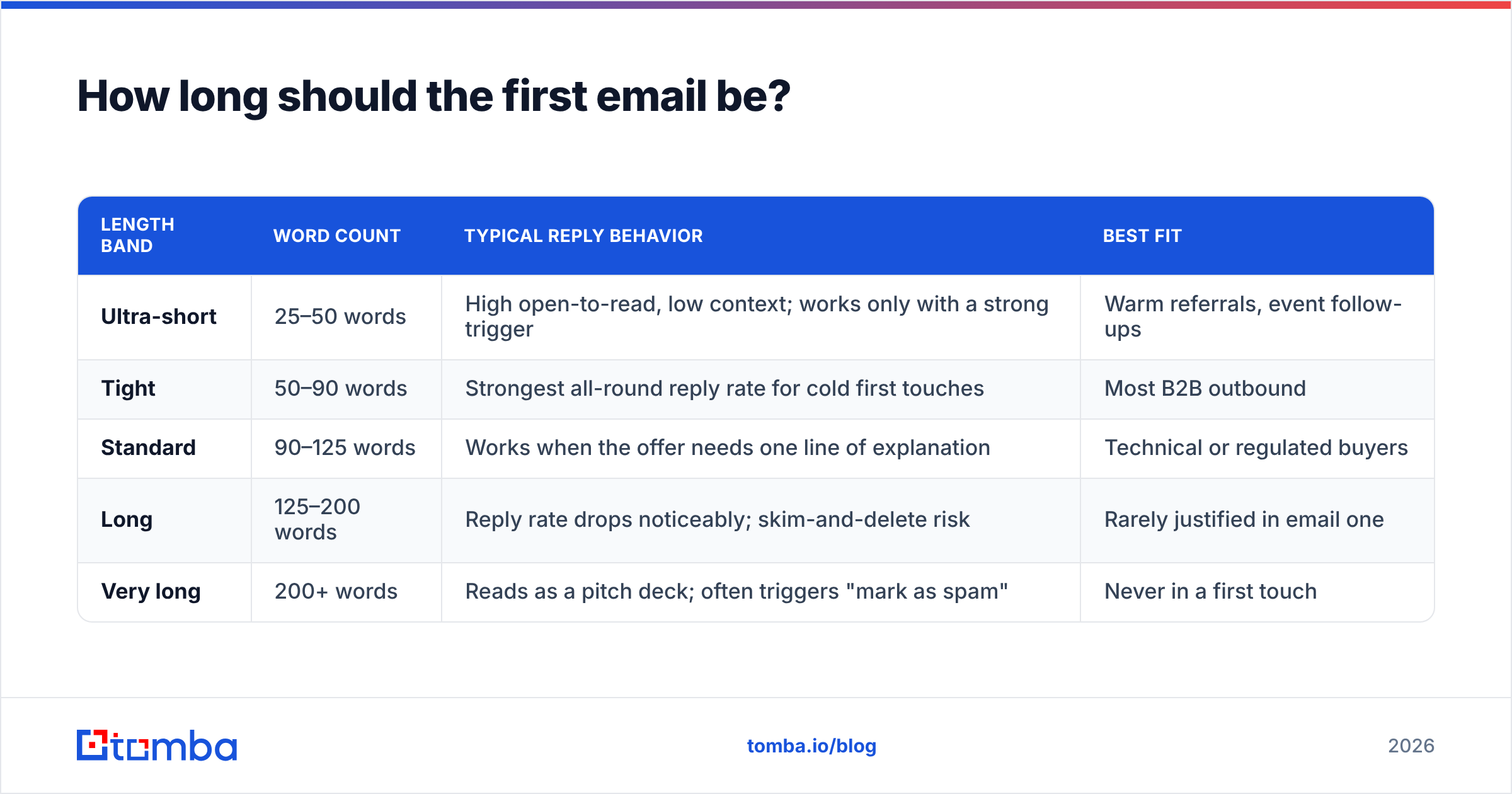
Short, but not so short it reads as automated. Here is how the common length bands actually behave in B2B outbound:
| Length band | Word count | Typical reply behavior | Best fit |
|---|---|---|---|
| Ultra-short | 25–50 words | High open-to-read, low context; works only with a strong trigger | Warm referrals, event follow-ups |
| Tight | 50–90 words | Strongest all-round reply rate for cold first touches | Most B2B outbound |
| Standard | 90–125 words | Works when the offer needs one line of explanation | Technical or regulated buyers |
| Long | 125–200 words | Reply rate drops noticeably; skim-and-delete risk | Rarely justified in email one |
| Very long | 200+ words | Reads as a pitch deck; often triggers "mark as spam" | Never in a first touch |
The practical rule: if your first email doesn't fit on a phone screen without scrolling, it isn't a first email — it's email three wearing email one's clothes.
Which first-email approach performs best?#
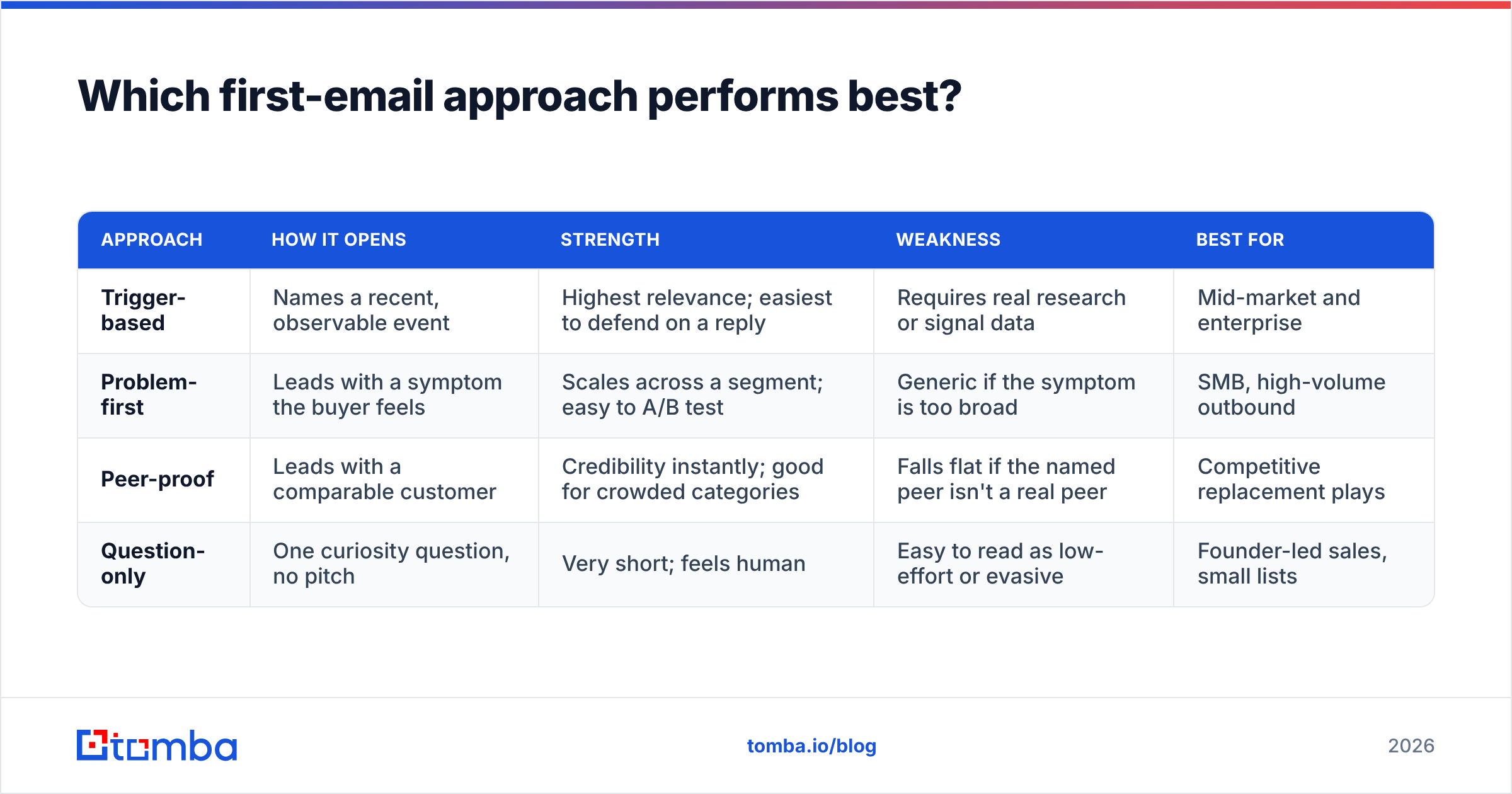
There are four dominant openers in circulation. They are not equally good, and they are not interchangeable across segments.
| Approach | How it opens | Strength | Weakness | Best for |
|---|---|---|---|---|
| Trigger-based | Names a recent, observable event | Highest relevance; easiest to defend on a reply | Requires real research or signal data | Mid-market and enterprise |
| Problem-first | Leads with a symptom the buyer feels | Scales across a segment; easy to A/B test | Generic if the symptom is too broad | SMB, high-volume outbound |
| Peer-proof | Leads with a comparable customer | Credibility instantly; good for crowded categories | Falls flat if the named peer isn't a real peer | Competitive replacement plays |
| Question-only | One curiosity question, no pitch | Very short; feels human | Easy to read as low-effort or evasive | Founder-led sales, small lists |
Most high-performing sequences blend two: a trigger line followed by a problem statement, or peer-proof followed by a single question. What fails reliably is the "all four" email — a trigger, a problem, three proof points, two questions, and a calendar link. That is a landing page, not an email.
If you want an outside baseline before you commit to a structure, HubSpot's sales research library and vetted user reviews on G2 are both useful for sanity-checking claims vendors make about reply rates. Treat any benchmark you didn't measure yourself as directional, not a target.
What does a good first email look like in practice?#
Three patterns you can adapt today. Keep the structure, replace every specific.
Trigger + problem (mid-market SaaS)
Subject: your three new AE reqs
Saw the three AE openings on the Northwind careers page this month.
Teams that scale AE headcount that fast usually hit the same wall: the list-building process that worked for two reps quietly breaks at six, and everyone rebuilds the same accounts in parallel.
We fixed exactly that for a 14-rep team at Contoso — list-build time went from ~6 hours a week per rep to under 45 minutes.
Worth a look, or is list ops already owned by someone there?
— Sam, Growth, Acme
Problem-first (high-volume SMB)
Subject: bounce rate on your outbound
Quick one: if your outbound bounce rate is above 5%, your follow-ups are landing in spam whether or not anyone tells you.
Most teams find the cause is a list that was scraped once and never re-checked. Re-verifying before each send usually drops bounces under 2% inside a week.
Want the two-step check we use? Takes about ten minutes.
— Sam
Peer-proof (replacement play)
Subject: switching off a per-seat contact tool
Three teams in your space moved off per-seat contact databases last quarter — same reason each time: they were paying for 20 seats and 4 people were actually pulling data.
Credit-based pricing cut their spend roughly in half without touching coverage.
Is per-seat still how you're buying, or already changed?
— Sam
Each one is under 100 words. Each has one ask. None includes an attachment, a booking link, or a tracked image pixel in the body.
How much does data quality change your first-email results?#
More than your copy does. This is the uncomfortable part.
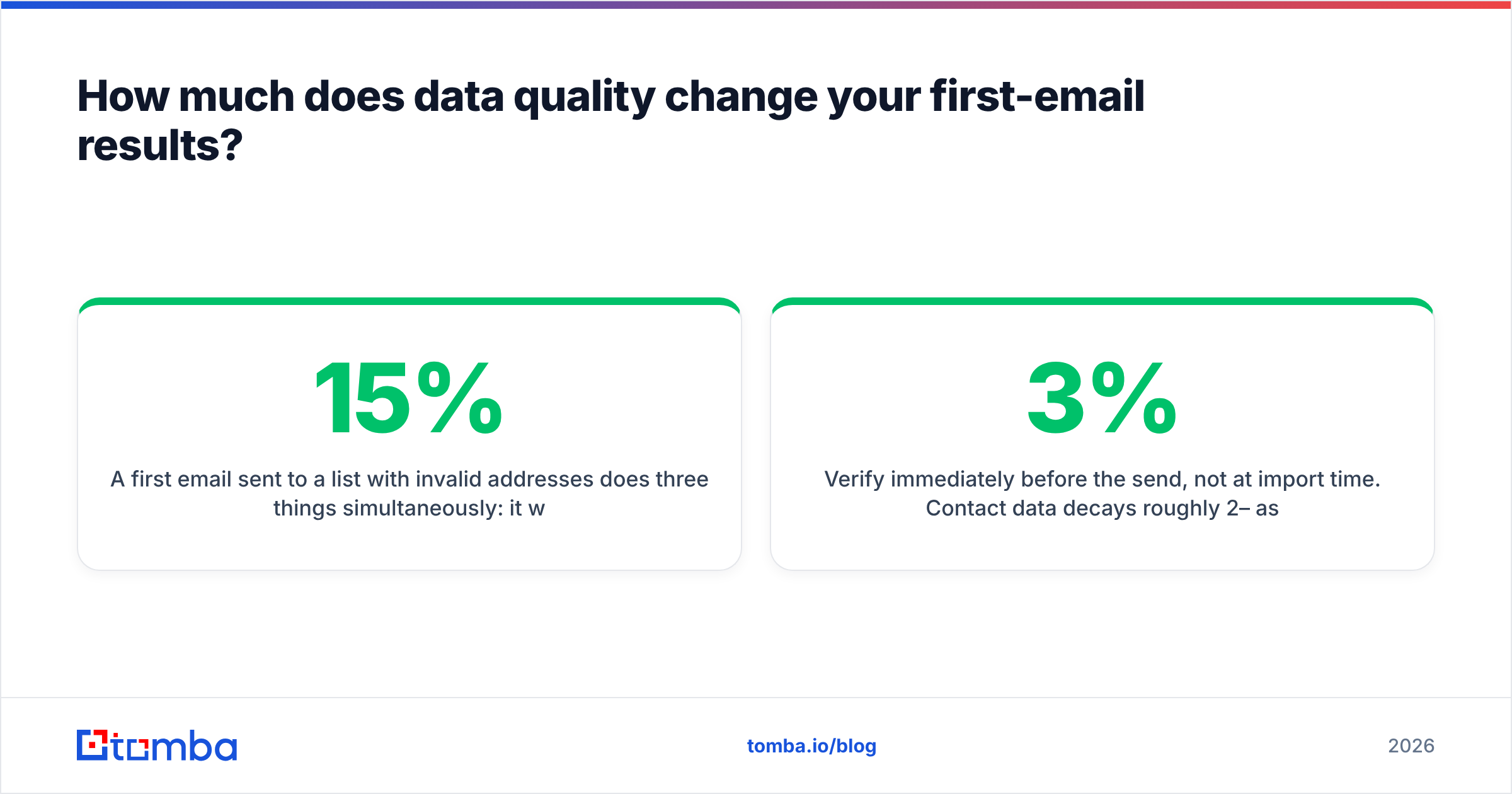
A first email sent to a list with 15% invalid addresses does three things simultaneously: it wastes 15% of your volume, it signals to mailbox providers that you're sending to addresses you don't own permission for, and it corrupts your own metrics — your "reply rate" is now calculated against a denominator that includes mailboxes that never existed.
The fix sequence before you send email one:
- Find the right address, don't guess it. Pattern-guessing produces plausible addresses that bounce. Use a proper email finder or a domain search to resolve the actual address on the actual domain.
- Verify immediately before the send, not at import time. Contact data decays roughly 2–3% per month as people change jobs. A list verified in January is measurably worse in April. Run an email verifier pass within a few days of launch.
- Handle catch-all domains explicitly. Catch-alls accept everything and tell you nothing. Segment them into their own send with lower volume rather than mixing them into your main list, and use a catch-all verifier to score them where possible.
- Enrich for the trigger line. Your trigger only works if you know role, seniority, and company context. That comes from data enrichment, not from a spreadsheet of first names and domains.
What mistakes kill the first email most often?#
- Two asks. "Reply if interested, or book here" splits the decision and both options lose. Pick one.
- A subject line that promises more than the body delivers. Openers spike, replies don't, unsubscribes do. If you test subject lines, do it with a subject line tester before you burn a segment on the experiment.
- Tracking pixels on a first touch. Open tracking on a cold first email adds an external image to a message from an unknown sender — one of the oldest spam-filter signals there is. Track replies instead.
- Named personalization with no substance. "{{first_name}}, love what {{company}} is doing" is now a recognized spam pattern, not a compliment.
- Sending to the whole list on day one. Ramp. 30–50 sends per mailbox per day for a new domain, scaling weekly. The email warmup calculator will give you a schedule that doesn't torch a fresh domain.
- Writing email one last. Many teams build the follow-up cadence first and back into the opener. Reverse it — the opener carries the sequence.
What should you measure after email one?#
Not opens. Email marketing measurement has drifted since privacy proxies started pre-fetching images, and open rates on cold sends are now inflated by machine opens that never involved a human.
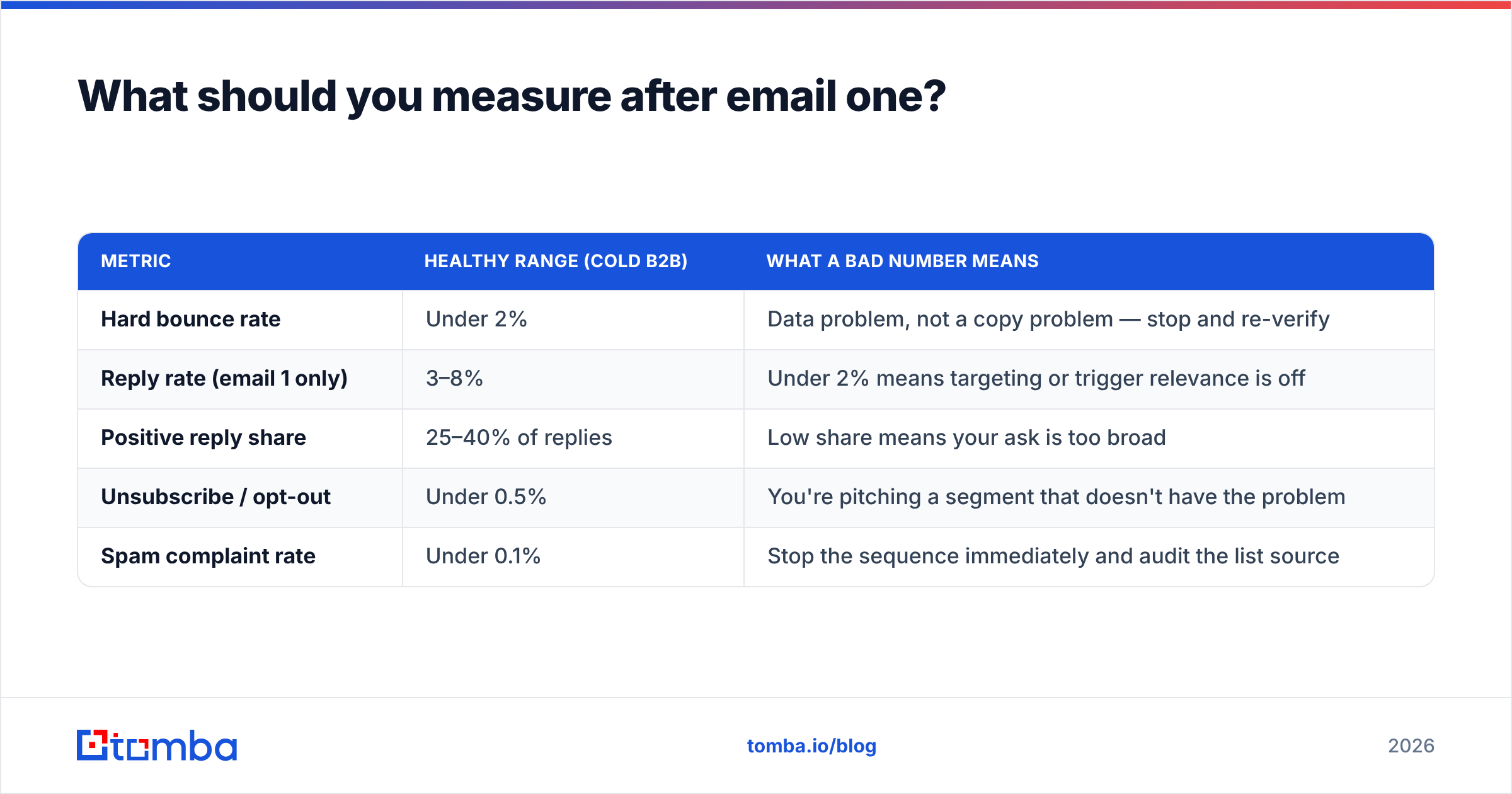
Measure these instead, per first-email variant:
| Metric | Healthy range (cold B2B) | What a bad number means |
|---|---|---|
| Hard bounce rate | Under 2% | Data problem, not a copy problem — stop and re-verify |
| Reply rate (email 1 only) | 3–8% | Under 2% means targeting or trigger relevance is off |
| Positive reply share | 25–40% of replies | Low share means your ask is too broad |
| Unsubscribe / opt-out | Under 0.5% | You're pitching a segment that doesn't have the problem |
| Spam complaint rate | Under 0.1% | Stop the sequence immediately and audit the list source |
Run one variable at a time. Change the trigger line or the ask, never both, and give each variant at least 200 sends before you call it. Anything smaller is noise dressed as a decision.
How do you build a first-email system rather than one good email?#
Treat email one as a template with three swappable slots: trigger, problem, proof. Build a small library — four triggers per segment, two problem statements, three proof points — and assemble rather than rewrite. That gives you real personalization at volume without a rep spending nine minutes per prospect.
Then gate the whole thing on data. No send goes out unless the address was found (not guessed), verified inside the last 14 days, and enriched with enough context to fill the trigger slot honestly. If a record can't fill the trigger slot, it belongs in a different, lower-priority sequence — not in your best one with a blank merge tag.
Peers in the space do this differently and well: providers like BookYourData sell pre-verified contact sets that let smaller teams skip the build step entirely, which is a perfectly reasonable path when your segment is stable and well-defined. Build-your-own list workflows make more sense when your ICP shifts quarterly or your triggers are narrow.
Where to start#
Rewrite one sequence this week. Take your current opener, cut it to 90 words, strip everything but one trigger, one problem, one proof point, and one question — then re-verify the list before you send it. That combination, in our experience reading a lot of outbound, moves reply rate further than any other single change teams make.
If the data side is the weak link, start there. Tomba's Email Finder resolves real addresses by domain, name, or company and pairs with built-in verification so your first email lands in a live mailbox instead of a bounce log. The free tier covers 25 searches a month if you just want to test the workflow on a small segment; paid plans start at $49/mo on Starter, with Growth at $99/mo — see Tomba pricing for the full breakdown. Fix the list, then fix the copy. In that order.
Related guides#
Ready to find emails that actually work?
Join 150,000+ professionals who stopped guessing and started sending. Free credits on signup — no credit card required.
Get the Tomba newsletter
Practical outbound tactics and product updates — once every two weeks.
About the author