Email Sign Off Guide: 25 Closings That Get More Replies
Your email sign off is the last thing a prospect reads before deciding to reply, ignore, or report. Here are 25 closings ranked by context, the 6 that quietly kill replies, and the data behind them.
TL;DR
- Your email sign off is the last thing a reader processes before deciding to reply, archive, or hit spam — it carries more weight per character than any other line except the subject.
- "Thanks" and "Best" are safe but invisible. Gratitude-based closings ("Thanks in advance", "Appreciate it") consistently outperform neutral ones in reply-rate studies, while "Sent from my iPhone" and "Regards" underperform.
- The sign off is not just a word. It's a three-part block: the closing phrase, your name, and the signature — and most reply damage happens in the signature, not the phrase.
- Six closings actively cost you replies: "Regards", "Sincerely" (in cold outbound), "Cheers" (US B2B), "Yours truly", "Talk soon" (to strangers), and anything with an emoji in enterprise sales.
- Match your closing to relationship stage, not to your personal taste. A first-touch cold email and a fifth-thread negotiation need different endings.
What is an email sign off, exactly?#
An email sign off is the closing block of your message: the valediction (the word or phrase before your name), your name, and the signature that follows. In formal correspondence this is called a valediction — the written equivalent of how you leave a room.
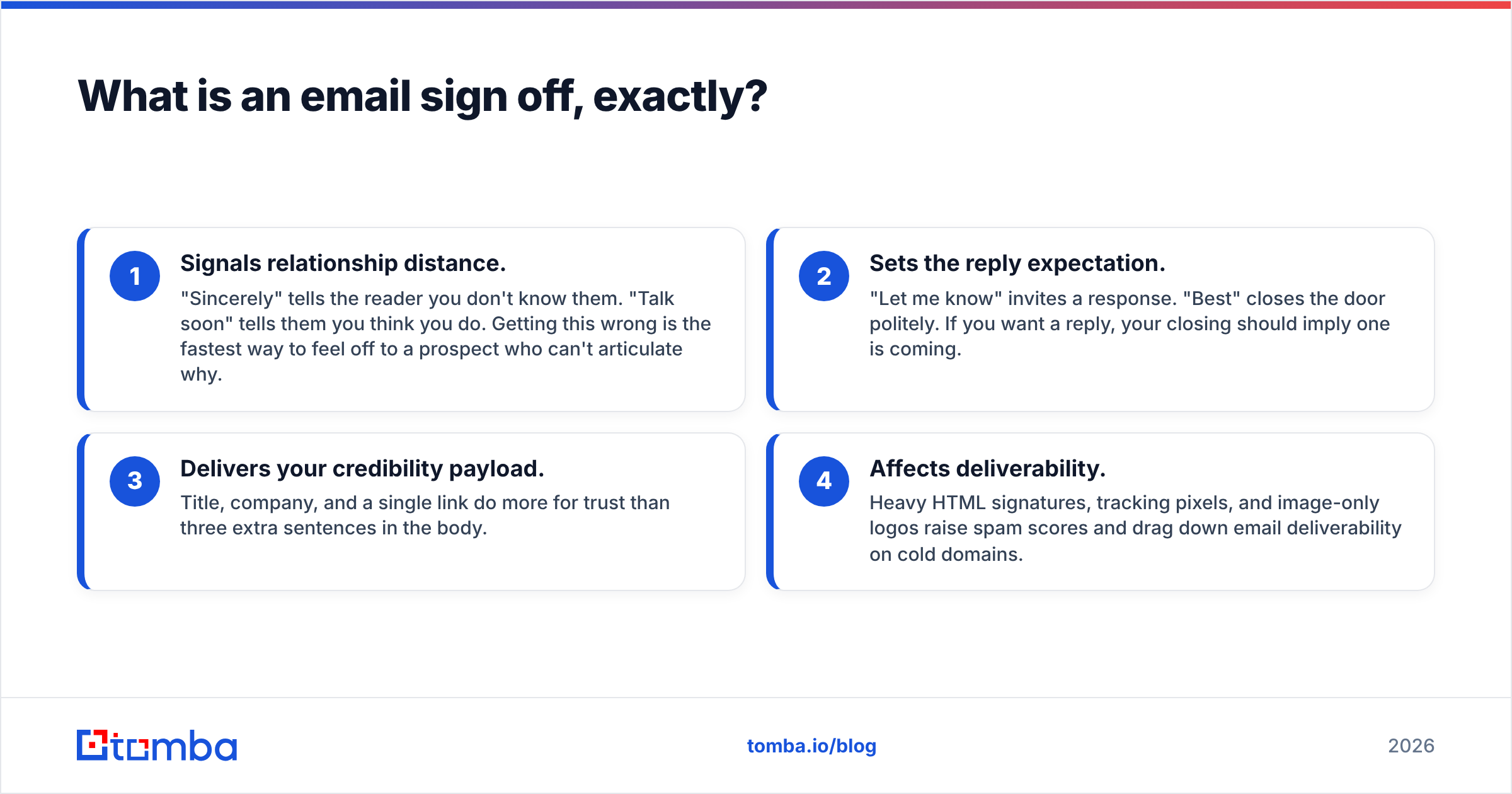
Most people treat it as decoration. It isn't. The sign off does four jobs at once:
- Signals relationship distance. "Sincerely" tells the reader you don't know them. "Talk soon" tells them you think you do. Getting this wrong is the fastest way to feel off to a prospect who can't articulate why.
- Sets the reply expectation. "Let me know" invites a response. "Best" closes the door politely. If you want a reply, your closing should imply one is coming.
- Delivers your credibility payload. Title, company, and a single link do more for trust than three extra sentences in the body.
- Affects deliverability. Heavy HTML signatures, tracking pixels, and image-only logos raise spam scores and drag down email deliverability on cold domains.
That fourth point surprises people. A 400 KB signature with a banner image, three social icons, and an award badge is a text-to-image ratio problem. Filters notice.
Which email sign off actually gets the most replies?#
The most-cited data point comes from a Boomerang analysis of over 350,000 email threads: closings that express gratitude outperformed neutral ones by a wide margin. "Thanks in advance" led at roughly a 66% response rate, followed by "Thanks" and "Thank you", while "Best" and "Regards" trailed by 10 or more percentage points.
Treat those numbers as directional, not gospel. That study skewed toward a specific population (Q&A forum-style threads), and correlation with reply rate isn't the same as causation. Someone who writes "Thanks in advance" is usually asking a small, specific favor — and small specific asks get answered. The closing is a symptom of a well-scoped email as much as a cause of the reply.
The useful takeaway holds anyway: gratitude implies an ask, and an ask implies a reply. Neutral closings imply nothing.
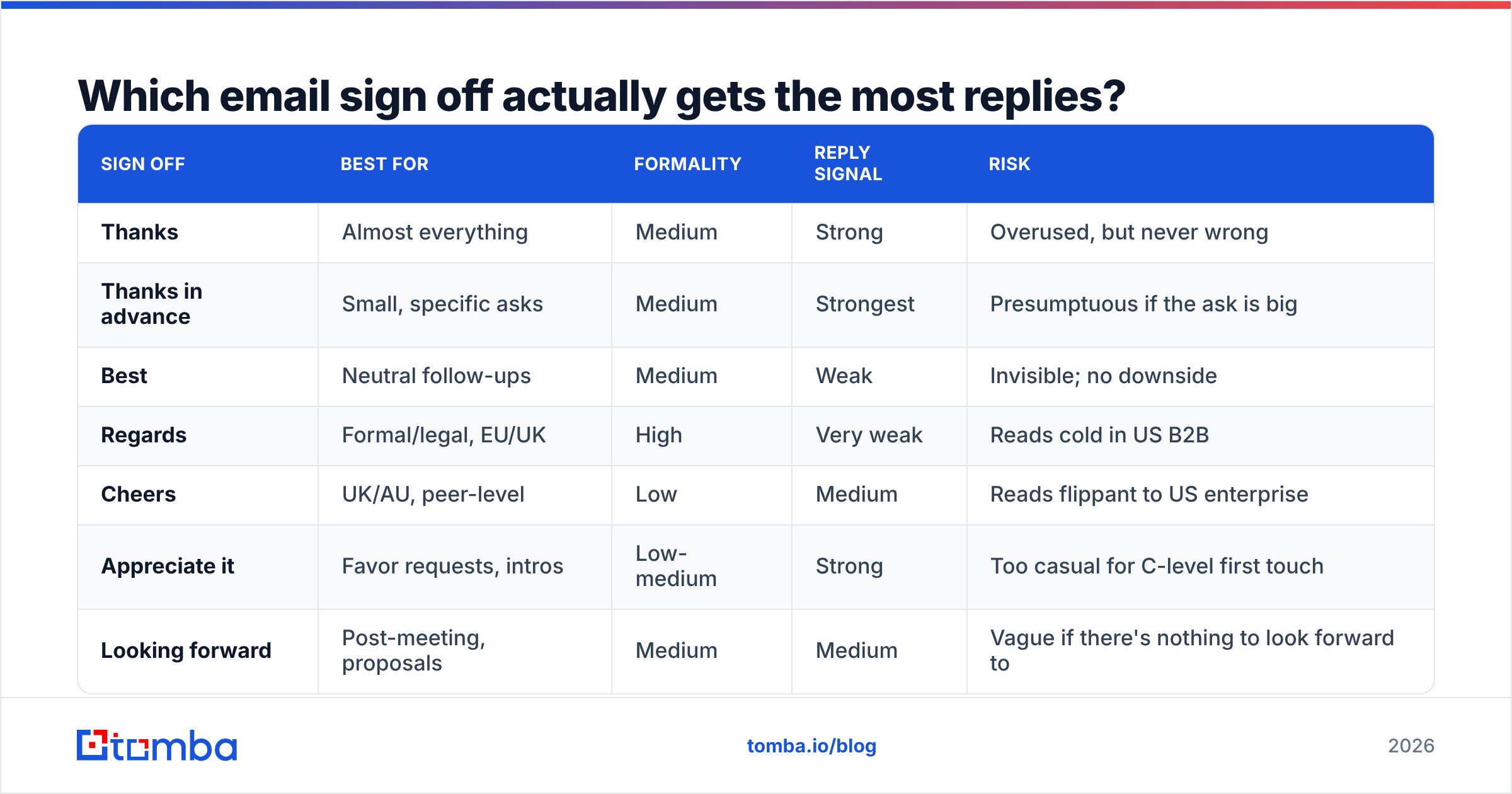
Here is how the common options break down when you compare them on the dimensions that matter for B2B outbound.
| Sign off | Best for | Formality | Reply signal | Risk |
|---|---|---|---|---|
| Thanks | Almost everything | Medium | Strong | Overused, but never wrong |
| Thanks in advance | Small, specific asks | Medium | Strongest | Presumptuous if the ask is big |
| Best | Neutral follow-ups | Medium | Weak | Invisible; no downside |
| Regards | Formal/legal, EU/UK | High | Very weak | Reads cold in US B2B |
| Cheers | UK/AU, peer-level | Low | Medium | Reads flippant to US enterprise |
| Appreciate it | Favor requests, intros | Low-medium | Strong | Too casual for C-level first touch |
| Looking forward | Post-meeting, proposals | Medium | Medium | Vague if there's nothing to look forward to |
| Sincerely | Cover letters, contracts | Very high | None | Dead in cold outbound |
| No sign off | Fast internal threads | None | Neutral | Reads abrupt to strangers |
Notice that "Best" isn't listed as bad. It's listed as invisible — which is exactly what you want when the closing shouldn't compete with your call to action. Invisible beats wrong.
What are the six email sign offs that kill replies?#
1. "Regards" in US cold outbound. It's the corporate equivalent of a handshake with no eye contact. Fine in a UK or German legal thread, flat everywhere else.
2. "Sincerely" outside formal documents. It belongs on cover letters and contracts. On a cold email it signals template.
3. "Cheers" to US enterprise buyers. Works beautifully peer-to-peer and in the UK/Australia. To a VP of Procurement in Ohio it reads as either British or unserious.
4. "Yours truly" / "Yours faithfully". Unless you're writing to a government office, this dates your email to 1994.
5. "Talk soon" to someone who has never spoken to you. Presumed familiarity is the single most-reported irritant in cold email surveys. You haven't talked. There's no "soon".
6. "Sent from my iPhone" as a deliberate tactic. Reps add it to fake casualness. Buyers who receive 40 cold emails a week have seen the trick. It also breaks the moment you send from a sequencing tool at 6:02am on the dot.
Add a seventh honorable mention: closing with a question mark and no closing at all — "Worth a chat?" with nothing after it. On mobile, with a signature block below, this reads as a truncated email rather than a deliberate style choice.
How should your sign off change by relationship stage?#
This is where most reps go wrong. They pick one closing and use it for every email in every stage, from first touch to renewal. The right approach maps closing to context.
- First cold touch (never met). Use a neutral or lightly grateful close: "Thanks", "Best". Save enthusiasm for after they've shown any. Pair it with a single low-friction ask.
- Follow-up 2–4 (no reply yet). Shift toward gratitude and easy outs: "Appreciate the time either way", "Thanks — happy to close the loop if this isn't a fit". Giving permission to say no measurably increases replies, because it converts a non-decision into a cheap one.
- After a meeting. "Looking forward to it" or "Talk [specific day]". Specificity beats vagueness: "Talk Thursday" outperforms "Talk soon" because it restates the commitment.
- Active negotiation. Drop the flourish entirely. "Thanks, [Name]" or just your first name. At this stage the closing should get out of the way of the terms.
- Existing customer / warm network. "Cheers", "Talk soon", first-name-only — anything that reflects the actual relationship. Formality here reads as distance, and distance in an account you already own is a churn signal.
The rule underneath all five: your closing should be one notch less formal than the reader expects, never two. One notch reads as confident. Two reads as sloppy.
What belongs in the signature block itself?#
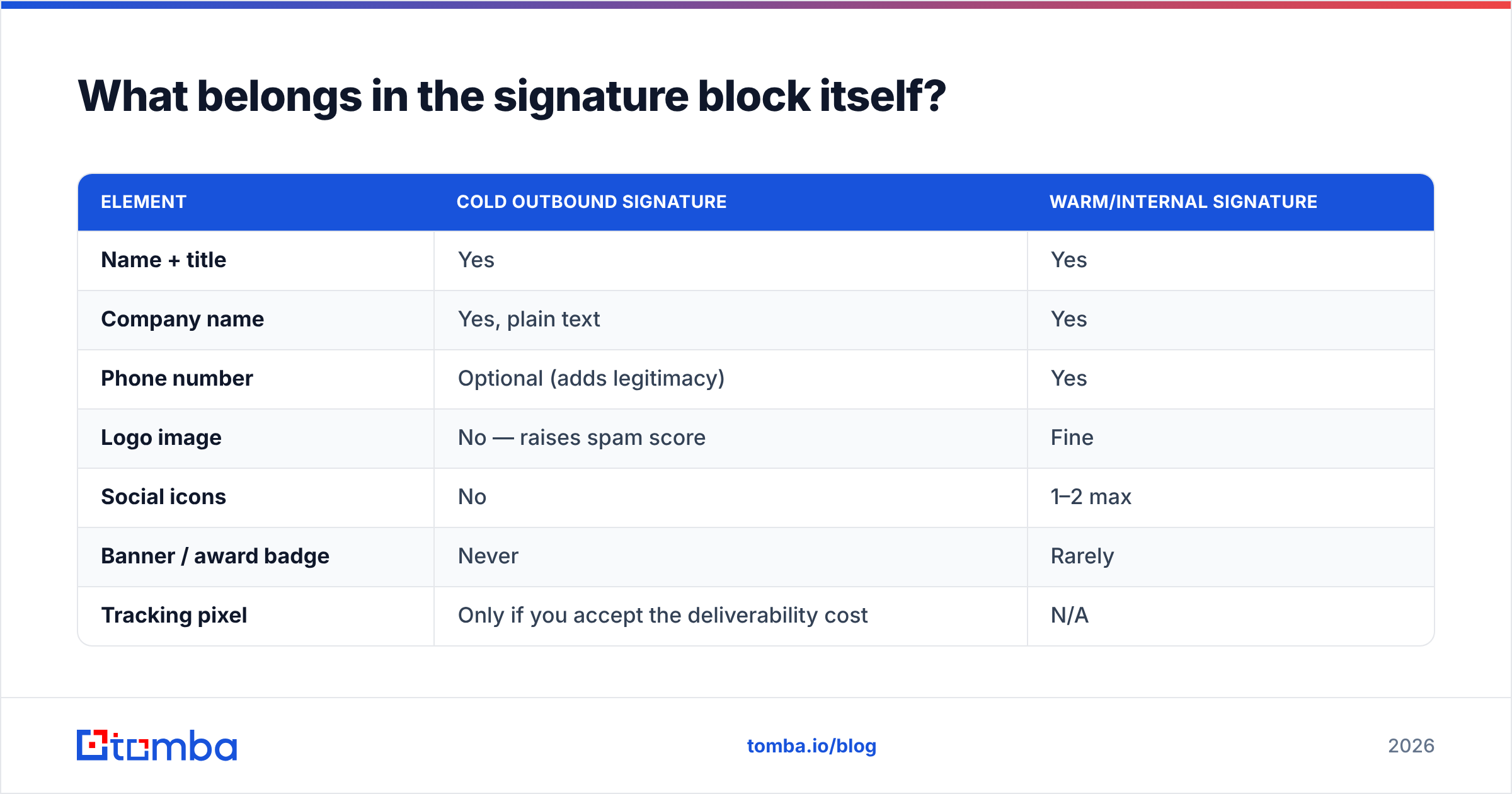
The signature is where most of the damage happens. A study of B2B sender reputation issues consistently finds bloated signatures among the contributors to spam placement on new domains — mostly through image weight, link count, and text-to-HTML ratio.
Here's the comparison that matters for cold outbound versus a normal business thread:
| Element | Cold outbound signature | Warm/internal signature |
|---|---|---|
| Name + title | Yes | Yes |
| Company name | Yes, plain text | Yes |
| Phone number | Optional (adds legitimacy) | Yes |
| Logo image | No — raises spam score | Fine |
| Social icons | No | 1–2 max |
| Banner / award badge | Never | Rarely |
| Tracking pixel | Only if you accept the deliverability cost | N/A |
| Unsubscribe line | Yes — plain text, one line | N/A |
| Total size | Under 5 KB | Under 50 KB |
For cold email, four plain-text lines is the ceiling:
Sam Okonkwo
Head of Partnerships, Northwind
sam@northwind.io | +1 415 555 0182
Not relevant? Reply "no" and I'll stop.
That last line does real work. It's a soft opt-out, it lowers the perceived cost of replying, and it keeps you on the right side of CAN-SPAM and GDPR expectations without a legalese footer. If you want to build the block cleanly, an email signature generator will keep the HTML light instead of pasting in whatever your CRM outputs.
Before you send at volume, run the whole message — signature included — through a spam checker. Most reps discover their signature is contributing 30–40% of their spam score.
How does the sign off interact with your CTA?#
The closing and the call to action are adjacent, and they compete. If your CTA is "Open to a 15-minute call Thursday?" and your closing is "Looking forward to hearing from you!", you've asked twice and softened once. Pick one.
Three patterns that work:
- Ask, then close neutral. CTA carries the weight; "Thanks" gets out of the way. Best for first touch.
- Close as the ask. "Worth a look? — Sam" with no separate CTA line. Best for short follow-ups where a full CTA would bloat a three-line email.
- Ask, then close with an out. "Happy to send the teardown either way. Thanks, Sam." Best for touch 3+ where you want to lower the cost of a reply.
What doesn't work: stacking a CTA, an enthusiastic closing, a P.S., and a four-line signature. That's four closing moves in a row, and each one dilutes the last. Every additional element after your ask reduces the probability the reader acts on it. If you're testing variations, a subject line tester covers the top of the message — but the bottom deserves the same discipline. HubSpot's sales team has published similar findings on email closing lines, and the consistent theme is brevity over warmth.
Do sign offs differ by region and channel?#
Yes, and more than most reps expect.
- US: "Thanks" and "Best" dominate. "Regards" reads formal-to-cold. Emoji in sign offs is fine in startup SaaS, risky in financial services and healthcare.
- UK / Australia: "Cheers" is genuinely neutral, not casual. "Kind regards" is the safe default, not the stiff one.
- Germany / Austria / Switzerland: Formality is the default. "Mit freundlichen Grüßen" or its English equivalent "Kind regards" is expected on first contact; dropping straight to "Thanks" can read as careless.
- France: Formal closings are long and structured. Anglophone brevity can register as brusque.
- Japan: Hierarchy and formality carry heavily; a first-touch email that opens and closes casually will typically be ignored rather than corrected.
Channel matters too. On LinkedIn, a sign off is often unnecessary — the platform already shows your name and title, so "Thanks" plus your first name is the ceiling. In SMS, no sign off at all. In a threaded reply chain past message three, most people drop the closing entirely and just type their first initial, which is a legitimate signal of familiarity rather than laziness. Salesforce's guidance on sales email best practices makes the same point about matching register to channel.
What if the sign off doesn't matter as much as the address?#
Here's the uncomfortable part. You can A/B test "Thanks" against "Appreciate it" for a quarter and move your reply rate by a point or two. Send to a stale, unverified list and you'll lose 20 points before anyone reads a word.
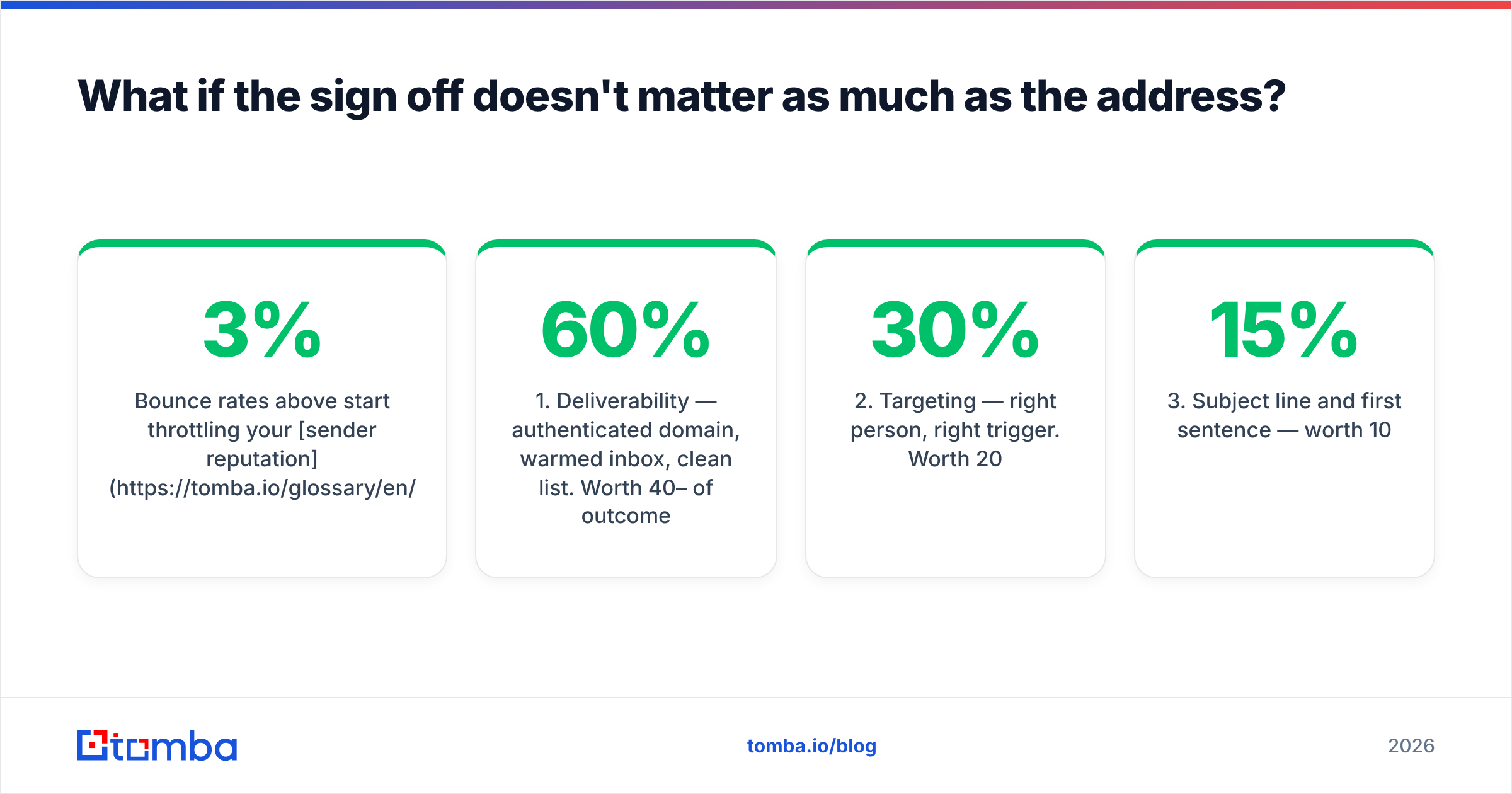
Bounce rates above 3% start throttling your sender reputation with Google and Microsoft, and once you're in the promotions tab or the spam folder, the closing is irrelevant. The order of operations for reply rate looks like this:
- Deliverability — authenticated domain, warmed inbox, clean list. Worth 40–60% of outcome.
- Targeting — right person, right trigger. Worth 20–30%.
- Subject line and first sentence — worth 10–15%.
- CTA and closing — worth 5–10%.
The closing is the last 5%. It's real, it's cheap to fix, and it's worth fixing — but only after the first three are solid. If your list is guesswork, start by running it through an email verifier and dropping anything that comes back risky or catch-all-unknown. Peer reviews on G2's email verification category show the same pattern across vendors: teams that verify before sending report materially higher engagement regardless of copy quality.
The 25-closing quick reference#
Grouped by when to use them:
Cold first touch: Thanks · Best · Thanks in advance · Appreciate the time · Best regards
Follow-up, no reply: Appreciate it either way · Happy to close the loop · Thanks for considering · No worries if not · Either way, thanks
Post-meeting: Looking forward to it · Talk [day] · Speak then · Great meeting you · Thanks again
Negotiation / late stage: Thanks, [Name] · [First name only] · Standing by · Let me know · Ready when you are
Warm relationship: Cheers · Talk soon · Catch you [day] · All the best · Take care
Pick three, not twenty-five. Consistency across a sequence is worth more than variety, and it makes your A/B tests readable.
Where to go from here#
Fix the bottom of your email in this order: strip the signature to four plain-text lines, pick one closing per sequence stage, add a soft opt-out, and stop stacking closing moves after your CTA. That's a 30-minute job and it will outperform another week of subject-line testing.
Then fix the thing underneath it. A perfect sign off delivered to a bounced address is worth nothing. Tomba's Email Finder verifies as it finds, so the addresses you send to are real before your copy ever gets a chance to work. The free tier covers 25 searches a month; paid plans start at $49/mo on Starter — see Tomba pricing for the full breakdown. Get the address right first, then let your closing do its 5%.
Related guides#
Ready to find emails that actually work?
Join 150,000+ professionals who stopped guessing and started sending. Free credits on signup — no credit card required.
Get the Tomba newsletter
Practical outbound tactics and product updates — once every two weeks.
About the author