Email Subject Line Ideas: 120+ Openers That Get Replies
Most subject lines fail before the first word is read. Here are the subject line formulas, real examples, and testing rules that actually lift open rates in 2026 — plus the ones to retire.
TL;DR
- Subject lines don't sell — they buy attention for the first line of your email. Judge them on reply rate, not open rate.
- Short and specific beats clever. Lines of 3–7 words with a concrete noun (a company name, a number, a page title) consistently outperform curiosity bait.
- The fake-reply trick (
RE:,Fwd:) still gets opens and still burns trust. It inflates your open metric and depresses replies. - Apple Mail Privacy Protection has made open rate a directional signal at best since 2021. Build your tests around replies and meetings booked.
- A great subject line on a bad list is wasted work. Verified, correctly-matched contacts move the numbers more than any word choice.
Why do most email subject line ideas fail?#
Because they're written for the wrong reader. Most lists of email subject line ideas are optimized for newsletters going to people who already opted in. Cold B2B email is a different game: your recipient has never heard of you, is scanning a preview pane on a phone, and is deciding in roughly one second whether you're a person or a sequence.
That one second is the whole battle. The subject line has one job — get the first sentence read. It is not a headline, it is not a pitch, and it should not try to close anything.
Three failure modes account for most bad subject lines:
- Over-cleverness. "A wild idea 🤯" reads as marketing. Marketing gets archived.
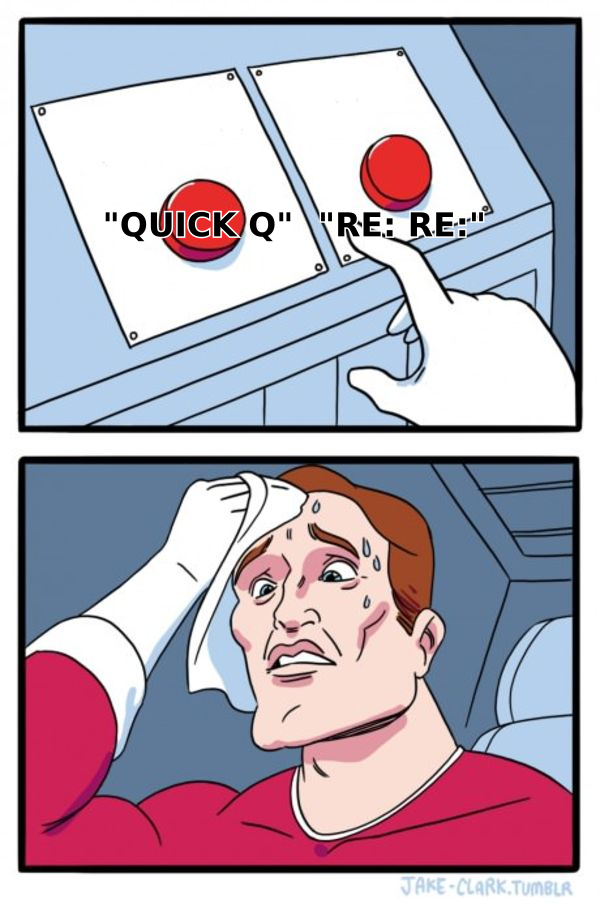
- Vagueness. "Quick question" was fresh in 2016. It's now one of the most-sent cold subject lines in existence, which means it signals template, not human.
- Mismatch. The subject promises one thing and the body delivers another. The open happens, the reply doesn't, and you've trained that person to ignore your domain.
There's a fourth, quieter failure that nobody credits: the email reaches a stale or wrong address. You can A/B test wording for a quarter and never notice that 18% of your list bounces or lands on catch-all domains where nothing is measurable. Run your list through an email verifier before you touch the copy — otherwise you're optimizing signal inside noise.
What makes a subject line actually get opened?#
Four attributes, in order of impact.
- Specificity — a proper noun the reader recognizes. Their company, their product, a competitor, a page on their site, a number from their world. "Acme's checkout flow" beats "improving conversion."
- Length — 3 to 7 words. Gmail on mobile truncates around 35–40 characters; Outlook desktop shows more but nobody reads the tail. Front-load the meaningful word.
- Lowercase, human casing — "quick note on your pricing page" reads like a colleague. "Quick Note On Your Pricing Page" reads like a campaign. Title Case is a tell.
- Zero punctuation theater — no brackets, no emoji in cold B2B, no exclamation marks. Save them for opt-in newsletters where brand recognition is already doing work.
Everything else — personalization tokens, urgency, question marks — is secondary and heavily context-dependent. A {{first_name}} in the subject line lifted results in 2018 and now often reads as merge-field spam, because every sequencer does it by default.
Which subject line formulas still work in 2026?#
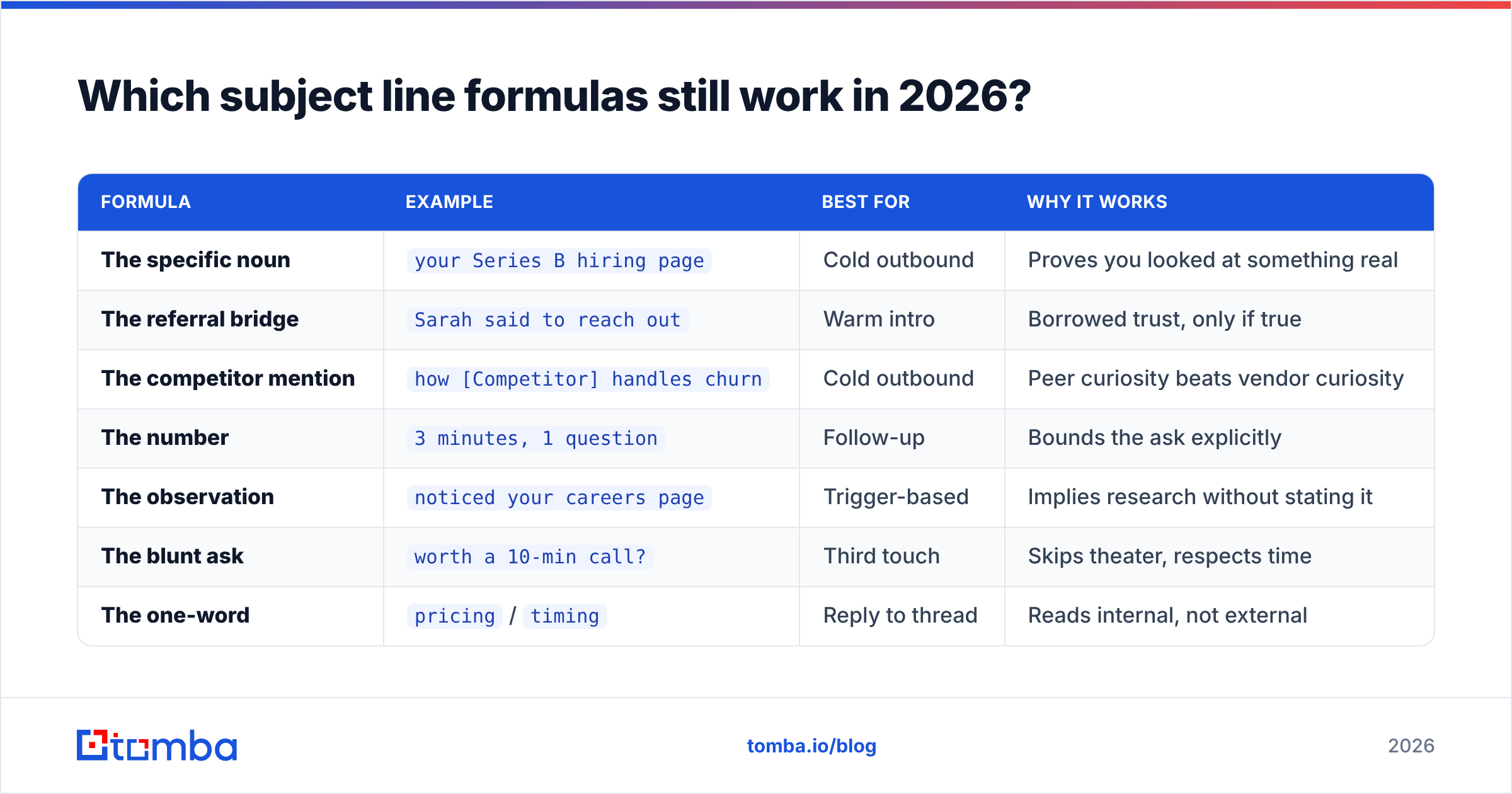
Here's the working set, with real examples you can adapt. Replace the bracketed parts with actual research — a formula with a generic fill-in is just a different template.
| Formula | Example | Best for | Why it works |
|---|---|---|---|
| The specific noun | your Series B hiring page |
Cold outbound | Proves you looked at something real |
| The referral bridge | Sarah said to reach out |
Warm intro | Borrowed trust, only if true |
| The competitor mention | how [Competitor] handles churn |
Cold outbound | Peer curiosity beats vendor curiosity |
| The number | 3 minutes, 1 question |
Follow-up | Bounds the ask explicitly |
| The observation | noticed your careers page |
Trigger-based | Implies research without stating it |
| The blunt ask | worth a 10-min call? |
Third touch | Skips theater, respects time |
| The one-word | pricing / timing |
Reply to thread | Reads internal, not external |
| The question they'd ask | who owns SDR tooling there? |
Routing email | Easy to forward, low commitment |
| The event hook | saw the Q3 announcement |
Timely outreach | Anchors to something they care about |
| The direct value | cut your bounce rate by half |
Product-led | Only if you can prove it in line one |
12 cold outreach subject lines#
your integrations pagequestion about [Company]'s SDR stack[Competitor] switched last monthwho handles outbound at [Company]?re: your post on data hygienenoticed you're hiring 4 AEsquick thought on your onboarding flowis this the right person?worth 10 minutes?[Company] + [Your Company]two ideas for Q4 pipelinesaw the Series A — congrats
10 follow-up subject lines#
bumping this upstill the right person?closing the loopone more ideashould I stop?last note from mefollowing up on [specific thing]re: [original subject](only on a genuine thread)timing?parking this?
10 newsletter and nurture subject lines#
the deliverability mistake nobody catcheswhat changed in Gmail's rules this monthwe tested 40,000 cold emails — here's what heldyour competitors just did this3 charts on B2B reply ratesunpopular opinion: stop A/B testing subject linesthe 6-word email that booked 12 meetingsread this before your next sendwe were wrong about personalizationinside our worst-performing campaign
8 re-engagement subject lines#
did we lose you?should I close your file?still relevant?one last checkmoving you off the listbad timing back in March?anything change since we spoke?permission to close?
If you want to stress-test any of these before sending, the free subject line tester scores length, spam triggers, and truncation on mobile — and the subject line generator will spin variants when you're stuck on a blank page.
Should you personalize the subject line?#
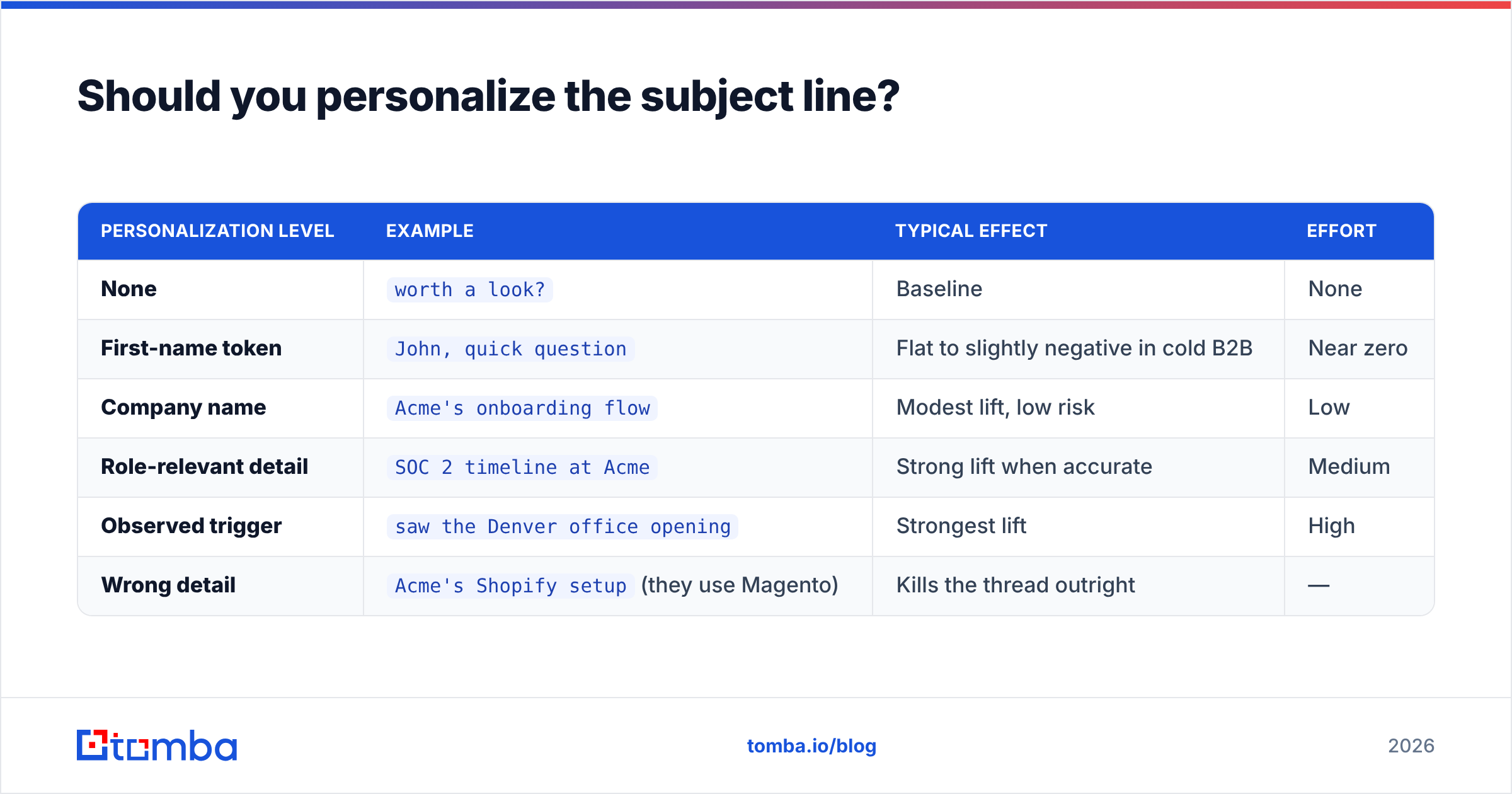
Only when the personalization is earned. There's a hierarchy, and merge fields sit at the bottom of it.
| Personalization level | Example | Typical effect | Effort |
|---|---|---|---|
| None | worth a look? |
Baseline | None |
| First-name token | John, quick question |
Flat to slightly negative in cold B2B | Near zero |
| Company name | Acme's onboarding flow |
Modest lift, low risk | Low |
| Role-relevant detail | SOC 2 timeline at Acme |
Strong lift when accurate | Medium |
| Observed trigger | saw the Denver office opening |
Strongest lift | High |
| Wrong detail | Acme's Shopify setup (they use Magento) |
Kills the thread outright | — |
The bottom row matters more than the top five. One wrong fact in a subject line does more damage than five generic sends, because it proves the email is automated and sloppy. That's why the personalization layer has to sit on clean data — the company, the role, and the address all have to be right at the same time. Contact enrichment is what makes level-4 and level-5 personalization survivable at volume; without it, you're guessing in public.
Is open rate still a useful metric?#
No — not on its own. Apple's Mail Privacy Protection, rolled out in 2021, pre-fetches tracking pixels for Apple Mail users regardless of whether the message was ever read. Depending on your audience mix, somewhere between 30% and 60% of your "opens" may be machine-generated. HubSpot's own reporting guidance has acknowledged the same distortion.
What that means practically:
- Use open rate for direction, not truth. A subject line that doubles opens is probably doing something. A 4% difference is noise.
- Optimize for reply rate. It's the only metric in cold email that maps cleanly to revenue.
- Watch reply-to-open ratio. If opens climb but replies don't, your subject line is writing checks the body can't cash — the classic symptom of curiosity-gap bait.
- Segment by client. Compare Gmail-heavy segments separately from Outlook-heavy ones. Mixing them makes every test unreadable.
How should you A/B test subject lines?#
Most B2B teams don't have enough volume for statistically meaningful subject line tests, and testing anyway is how you end up chasing noise for six months.
The math: to detect a 2-percentage-point lift in reply rate from a 3% baseline at 95% confidence, you need roughly 10,000+ sends per variant. Most outbound teams send a few thousand a month, total. So:
- Test formulas, not words. Compare "specific noun" against "blunt ask" — categories with large expected differences. Don't test
worth a chat?againstworth a call?. - Run one variable at a time. Changing subject and first line together tells you nothing about either.
- Give it four weeks minimum. Day-of-week and seasonality swamp small effects.
- Kill losers hard. If a formula underperforms by 30%+ across two cohorts, retire it. Don't wait for significance you'll never reach.
- Log everything in one place. A shared sheet with formula, sample size, replies, and meetings beats scattered platform dashboards.
- Re-baseline every quarter. Patterns decay as they spread. Today's winner is next year's
Quick question.
Also worth doing before any test: run the copy through a spam checker and confirm your authentication is clean with an SPF checker. A subject line that never reaches the inbox scores 0% no matter how good it is — and Google and Yahoo's bulk sender requirements have made authentication non-negotiable since 2024.
What subject lines should you retire in 2026?#
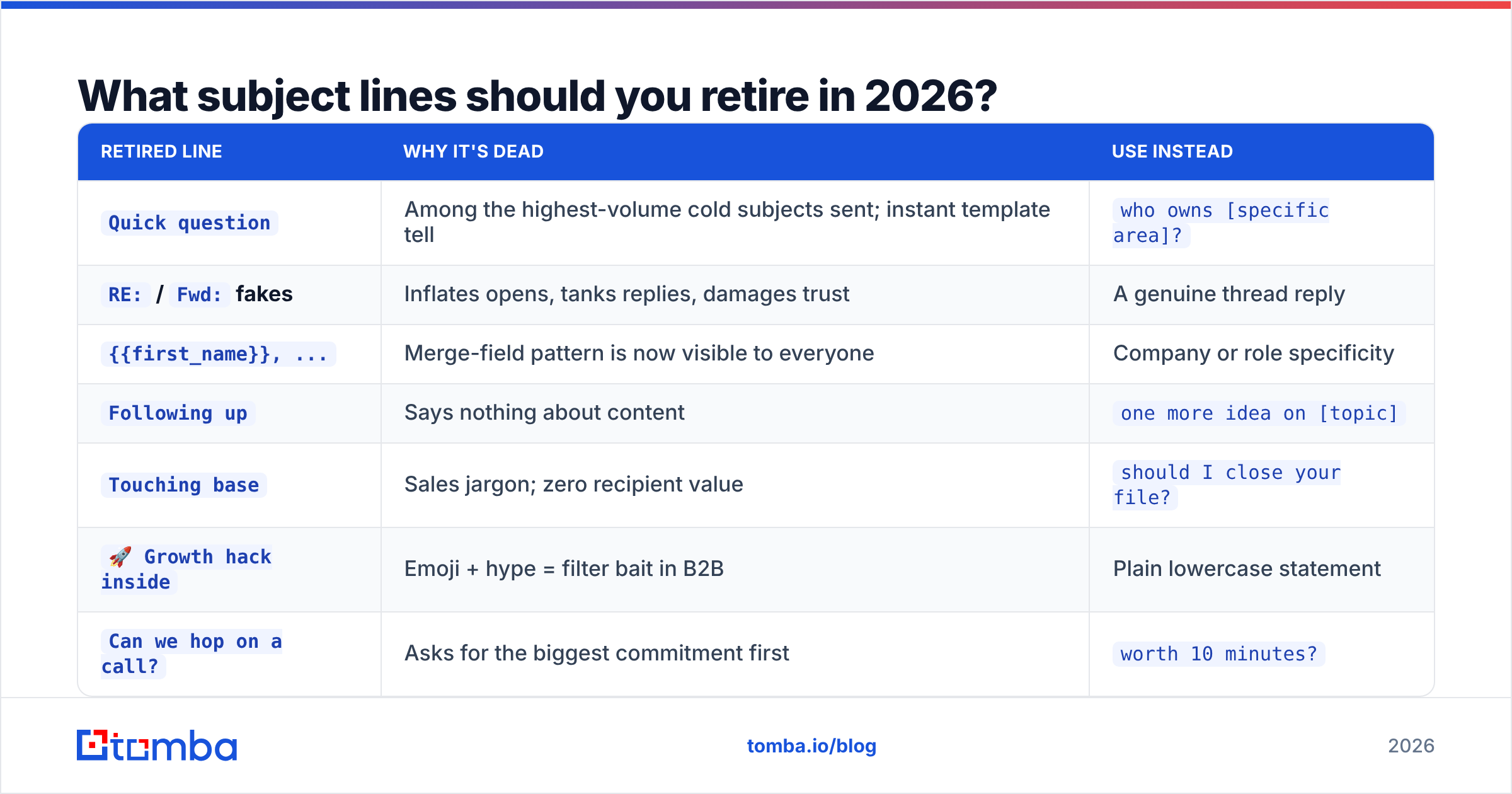
These are burned. Not because they're bad English, but because volume has destroyed their signal value.
| Retired line | Why it's dead | Use instead |
|---|---|---|
Quick question |
Among the highest-volume cold subjects sent; instant template tell | who owns [specific area]? |
RE: / Fwd: fakes |
Inflates opens, tanks replies, damages trust | A genuine thread reply |
{{first_name}}, ... |
Merge-field pattern is now visible to everyone | Company or role specificity |
Following up |
Says nothing about content | one more idea on [topic] |
Touching base |
Sales jargon; zero recipient value | should I close your file? |
🚀 Growth hack inside |
Emoji + hype = filter bait in B2B | Plain lowercase statement |
Can we hop on a call? |
Asks for the biggest commitment first | worth 10 minutes? |
Last chance! |
Manufactured urgency the reader can verify is fake | Real deadline or nothing |
The pattern behind all eight: they were once effective, got copied into every sequence template on the market, and became a fingerprint. Anything a sequencer suggests to you by default is, by definition, already saturated.
How do subject lines fit into the rest of the send?#
Think of the subject line as the doorbell and the first line as the doorway. A great doorbell on a locked door is a wasted press.
Practical sequencing that holds up:
- Subject line — 3–7 words, one concrete noun, lowercase.
- Preview text — the first 8–12 words of your body. Never waste it on "Hi {{first_name}}, hope you're well." That's the second-most-visible copy in the entire email.
- First line — the reason you're writing, in one sentence, about them.
- Ask — one, small, and specific.
- Signature — plain text, no image banners; use a signature generator if you need something consistent across the team.
For a wider view of what carries a cold sequence beyond the subject, response rate benchmarks and the mechanics of email deliverability are the two levers with more upside than word choice.
What data quality does a subject line strategy require?#
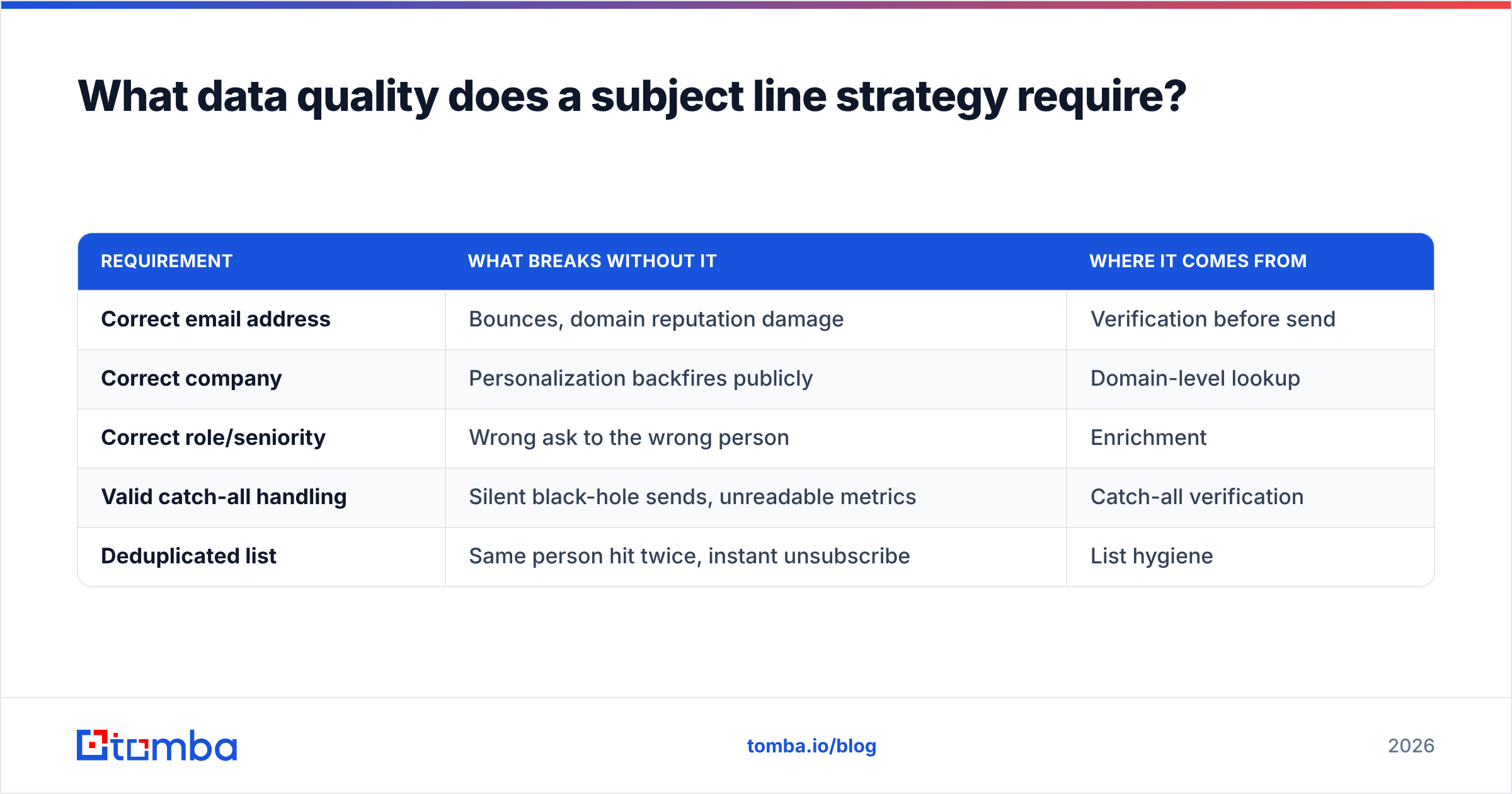
Every formula above depends on something being true about the recipient. That's the constraint people skip.
| Requirement | What breaks without it | Where it comes from |
|---|---|---|
| Correct email address | Bounces, domain reputation damage | Verification before send |
| Correct company | Personalization backfires publicly | Domain-level lookup |
| Correct role/seniority | Wrong ask to the wrong person | Enrichment |
| Valid catch-all handling | Silent black-hole sends, unreadable metrics | Catch-all verification |
| Deduplicated list | Same person hit twice, instant unsubscribe | List hygiene |
Bounce rate above ~3% starts pulling your sender reputation down at the major providers, which means your best subject line ends up in a spam folder where nobody grades it. Sequence matters here: build the list, verify it, enrich it, then write. Teams that reverse the order spend months blaming copy for a data problem.
Tomba's stack covers that front half — the email finder for sourcing by name and domain, domain search for mapping an entire company, and the catch-all verifier for the addresses most tools quietly mark "unknown" and hand back to you anyway. Free tier runs 25 searches a month; paid Tomba pricing starts at $49/mo on Starter, $99/mo on Growth, and $249/mo on Pro. Peers like BookYourData approach the same problem from a prebuilt-database angle, which suits teams who'd rather buy a list than build one — both routes end at the same place: verified addresses before verified copy.
Frequently asked questions#
How long should a cold email subject line be? Three to seven words, or under about 40 characters. Mobile clients truncate aggressively and the front half is what gets read.
Should I use emoji in B2B subject lines? No for cold outbound. They read as marketing and correlate with filter scrutiny. In opt-in newsletters where the reader knows your brand, one emoji is defensible.
Do question marks help? Sometimes. A question implies a low-commitment reply, which helps. A rhetorical or hype question ("Ready to 10x pipeline?") hurts. Ask something a human would actually ask.
Is it OK to reuse a subject line across a sequence?
Replying inside the existing thread — which keeps the original subject with a real Re: — generally outperforms starting fresh threads for touches 2 through 4. Faking that Re: on a first touch does not.
What about AI-generated subject lines? Useful for volume of options, dangerous as a final answer. Models converge on the same phrasings, which is exactly how a pattern becomes saturated. Generate 20, keep the two that reference something specific, throw out the rest.
Where should you start?#
Pick three formulas from the table above, write ten lines against real research on real accounts, and send them to a list you've actually verified. Measure replies for four weeks. Retire whatever loses by more than 30%. That loop, repeated quarterly, beats any static swipe file — including this one.
And before the first send: fix the input. Use the Tomba Email Finder to source accurate, verified addresses by name or domain, so the specificity in your subject line is backed by data that's actually correct. Start free with 25 searches a month, and spend your optimization budget on copy instead of bounces.
Related guides#
Ready to find emails that actually work?
Join 150,000+ professionals who stopped guessing and started sending. Free credits on signup — no credit card required.
Get the Tomba newsletter
Practical outbound tactics and product updates — once every two weeks.
About the author