Email Subject Lines for Sales: 2026 Data-Backed Guide
Most sales subject lines fail before the body is ever read. Here's what actually moves open rates in 2026 — with 40+ tested lines, a scoring rubric, and the mistakes that quietly kill deliverability.
TL;DR
- Short beats clever. Subject lines of 2–5 words consistently outperform clever 8–12 word lines in cold B2B outbound, because they read as internal mail, not marketing.
- The subject line's only job is to earn the open. The preview text and first sentence do the persuading — stop cramming your pitch into 50 characters.
- Personalization tokens are table stakes, not a strategy. "Quick question, {{first_name}}" now underperforms a specific noun the prospect recognizes (a competitor, a tool in their stack, a metric).
- Open rate is a broken metric post-MPP. Judge subject lines by reply rate per 100 sent, not opens.
- The fastest lever isn't the words — it's the list. A 12% bounce rate destroys sender reputation faster than any bad subject line, so verify before you send.
Why do most email subject lines for sales fail?#
Because they announce themselves as sales email.
Think of a prospect's inbox like a doorman at a building entrance. The doorman doesn't read your whole pitch — he does a half-second pattern match: does this person look like they belong here, or like they're selling something? Your subject line is your outfit. "Transform Your Revenue Operations in 2026 🚀" is a sandwich board. "pricing page" is a resident walking in without breaking stride.
The three failure modes, in order of how often they show up in audits:
- Value-prop stuffing — trying to compress the entire offer into the subject. "Cut your CAC by 40% with AI-powered pipeline intelligence" is a landing-page headline, not an email subject.
- Fake familiarity — "Following up" on an email that never happened, or "Re:" prefixes on a first touch. It works once, then it burns the domain and the brand.
- Zero specificity — "Quick question" was a great line in 2017. In 2026 it's the single most common cold-email subject in existence, which means it has the pattern signature of spam.
The correction is not "be more creative." It's be more specific and less complete. A subject line should raise a question the first line of the body answers.
What subject line length actually performs best?#
Short. Measurably, repeatably short.
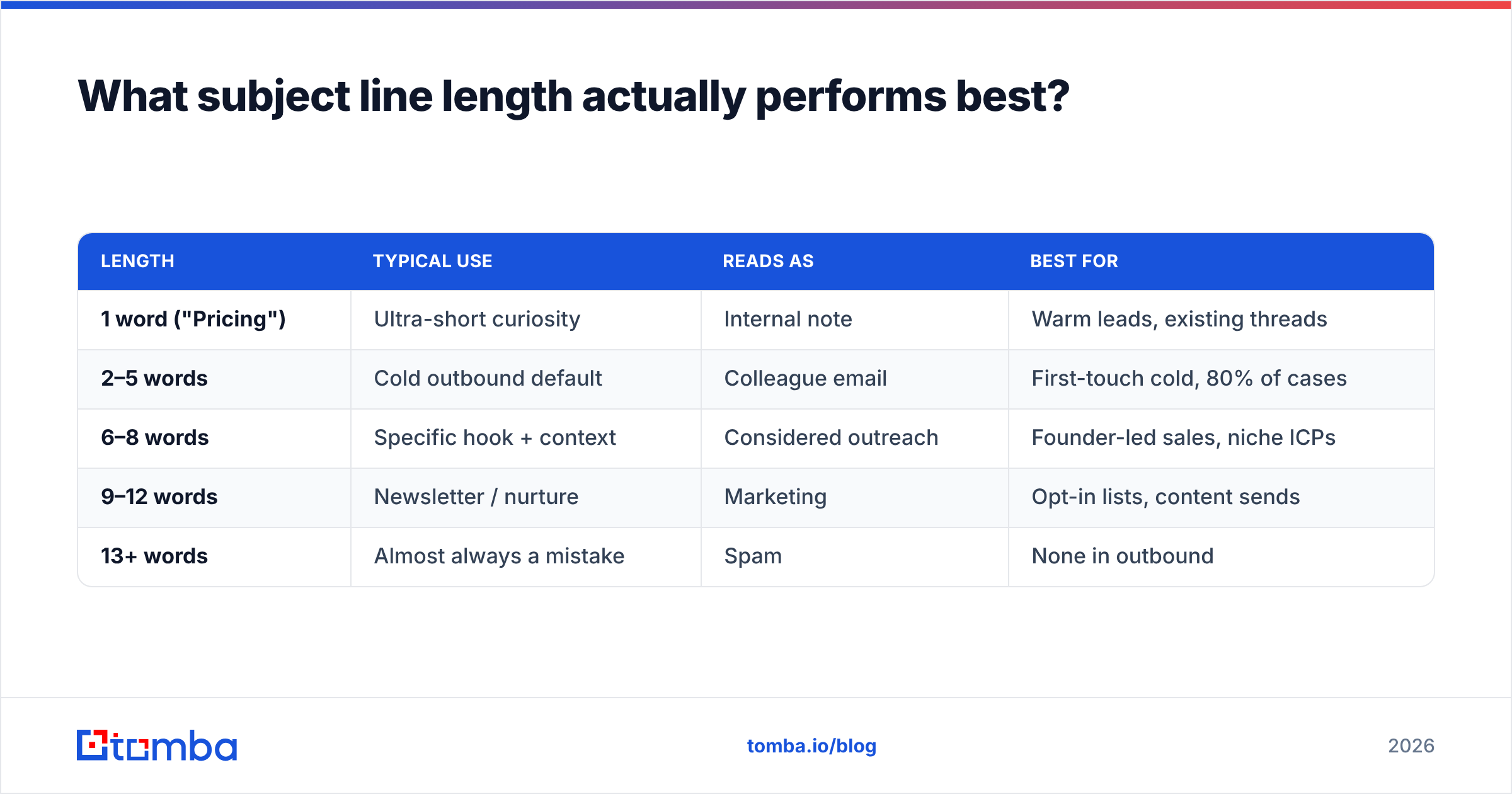
Across cold B2B outbound, the length curve is roughly bell-shaped with a peak between two and five words. Below two words you lose context; above eight you start reading like a newsletter. The mechanism is mobile: on an iPhone in portrait, the subject truncates around 35–40 characters, so anything longer gets cut mid-thought and the recipient judges you on a fragment.
| Length | Typical use | Reads as | Best for |
|---|---|---|---|
| 1 word ("Pricing") | Ultra-short curiosity | Internal note | Warm leads, existing threads |
| 2–5 words | Cold outbound default | Colleague email | First-touch cold, 80% of cases |
| 6–8 words | Specific hook + context | Considered outreach | Founder-led sales, niche ICPs |
| 9–12 words | Newsletter / nurture | Marketing | Opt-in lists, content sends |
| 13+ words | Almost always a mistake | Spam | None in outbound |
The one exception: highly technical, highly specific niches. If you're selling to platform engineers and your subject is "your Terraform provider throws on nested modules," length is fine because the specificity is the signal. Nobody spams that.
A practical constraint to internalize: write the subject last. Draft the body, find the single most concrete noun in it, and build a 3-word subject around that noun. If your body has no concrete noun, the problem was never the subject line.
What are the highest-performing subject line formulas?#
There are about seven patterns that consistently earn replies. Everything else is a variation.
- The bare noun —
pricing,onboarding,Q3 numbers. Works because it mimics how coworkers actually title emails. Highest open rates, but only converts if the body immediately justifies it. - The competitor mention —
switching from Outreach?,after Clearbit sunset. Uses a name the prospect already has an opinion about. High risk of feeling stalker-ish if you're wrong about their stack — verify first. - The observed trigger —
saw the Series B,new SDR role at Acme. Ties the email to a real, recent, public event. Best reply rates of any category when the trigger is genuine and recent (under 14 days). - The specific question —
who owns lead routing?,is {{competitor}} still your ESP?. Low commitment to answer, which is the point. Do not ask a question you could have Googled. - The number —
3 SDRs, 200 accounts,$0.04 per verified email. Numbers survive truncation and feel like data, not opinion. - The permission ask —
worth 5 minutes?,bad time?. Overused now, but still works in the third or fourth follow-up when everything direct has failed. - The pattern break —
unsubscribe from me,closing your file. Reserved for the final email in a sequence. It gets opens because it signals an ending, not a beginning.
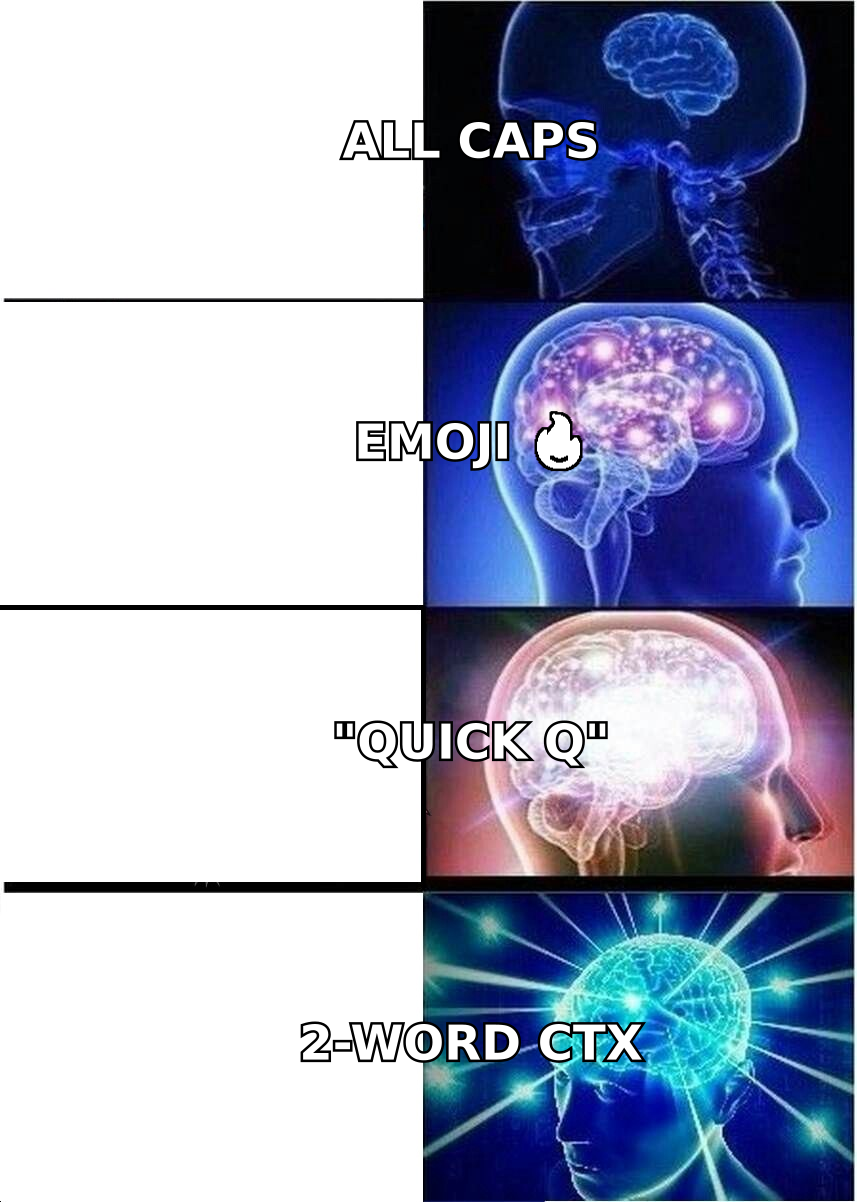
Notice what is not on this list: puns, emoji, ALL CAPS urgency, and anything containing the word "revolutionary." Those aren't underperforming for stylistic reasons — spam filters weight them, so they cost you deliverability alongside opens.
Which subject lines work for each stage of the sequence?#
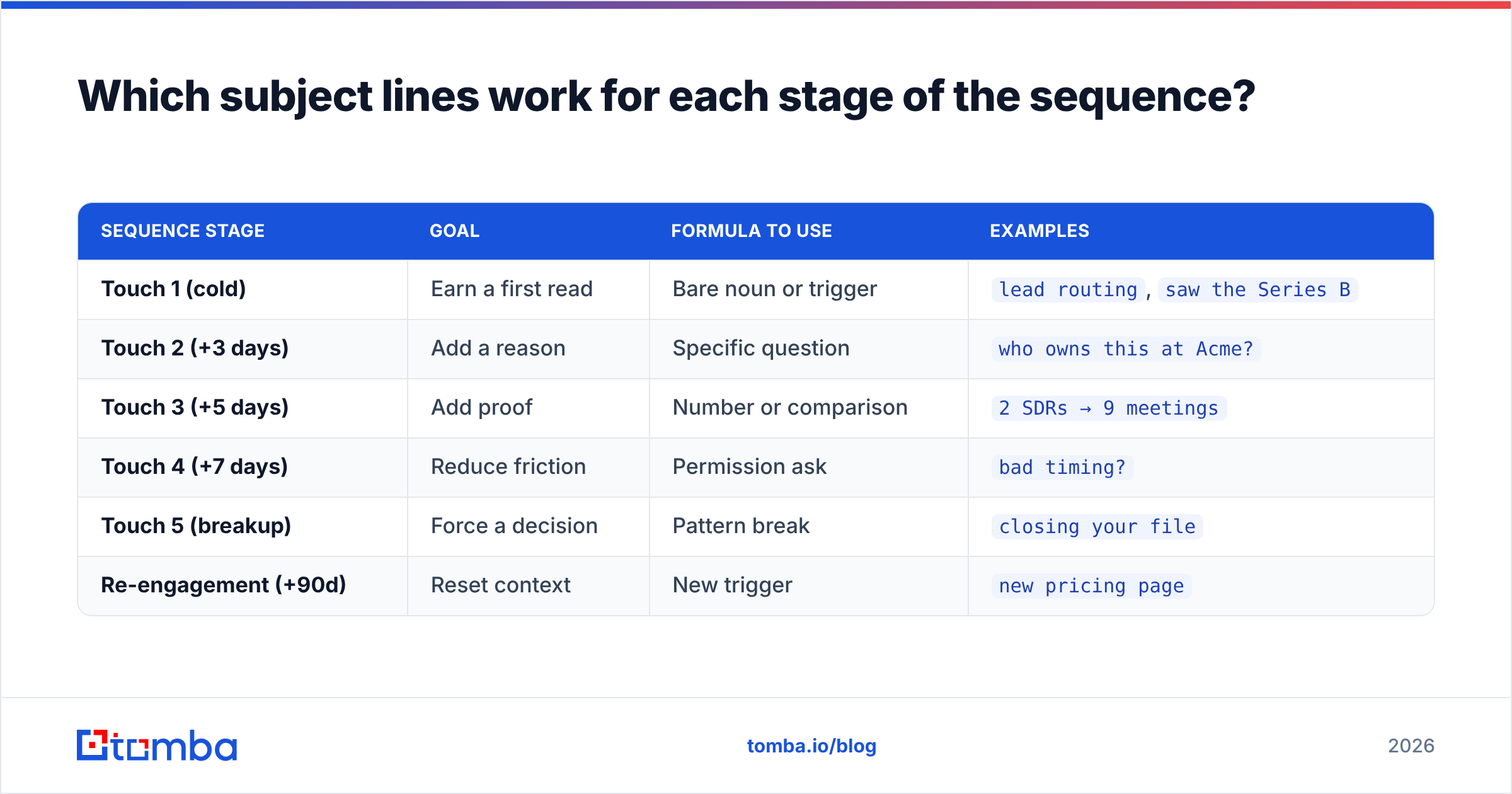
The same line does not work at touch one and touch five. Early emails need context; late emails need pattern breaks.
| Sequence stage | Goal | Formula to use | Examples |
|---|---|---|---|
| Touch 1 (cold) | Earn a first read | Bare noun or trigger | lead routing, saw the Series B |
| Touch 2 (+3 days) | Add a reason | Specific question | who owns this at Acme? |
| Touch 3 (+5 days) | Add proof | Number or comparison | 2 SDRs → 9 meetings |
| Touch 4 (+7 days) | Reduce friction | Permission ask | bad timing? |
| Touch 5 (breakup) | Force a decision | Pattern break | closing your file |
| Re-engagement (+90d) | Reset context | New trigger | new pricing page |
Two operational rules that matter more than the copy:
Do not change the subject line mid-thread if you're replying. Threading is a deliverability asset — Gmail groups the conversation and the recipient sees accumulated context. Changing the subject spawns a new thread and resets that.
Do change it entirely between sequences. If touches 1–5 failed, sending touch 6 under a variant of the same subject is how you get filtered.
How do you test subject lines without fooling yourself?#
Stop measuring opens. Start measuring replies per 100 sent.
Apple's Mail Privacy Protection pre-fetches images for a large share of consumer and mixed-device recipients, which inflates opens for anyone using an open-tracking pixel. That inflation isn't evenly distributed across your test cells, so a subject line "winning" on opens may just be reaching more Apple Mail users. Litmus and other deliverability researchers documented this shift, and it hasn't reversed.
A test protocol that survives scrutiny:
- Minimum 400 sends per variant. Below that, a 2-point difference is noise. Most "we tested this" LinkedIn posts are running n=50 and reporting coin flips.
- One variable at a time. If you change the subject and the first line, you learned nothing about either.
- Same send window, same segment. Testing variant A on Monday to enterprise and variant B on Thursday to SMB is not a test.
- Track reply rate, positive-reply rate, and bounce rate together. A subject line that lifts replies while raising bounces is usually a list problem masquerading as a copy win.
- Run the loser again. Reversion is common. Re-run the winning pair a second time before you rewrite the whole sequence around it.
Use a subject line tester for a pre-send sanity check on length, spam-trigger words, and truncation, then let live reply data settle the argument. Automated scoring tools catch obvious mistakes; they cannot tell you whether "lead routing" resonates with VP Sales at 200-person SaaS companies. Only sending can.
Does the subject line even matter if deliverability is broken?#
No. This is the part most subject-line articles skip.
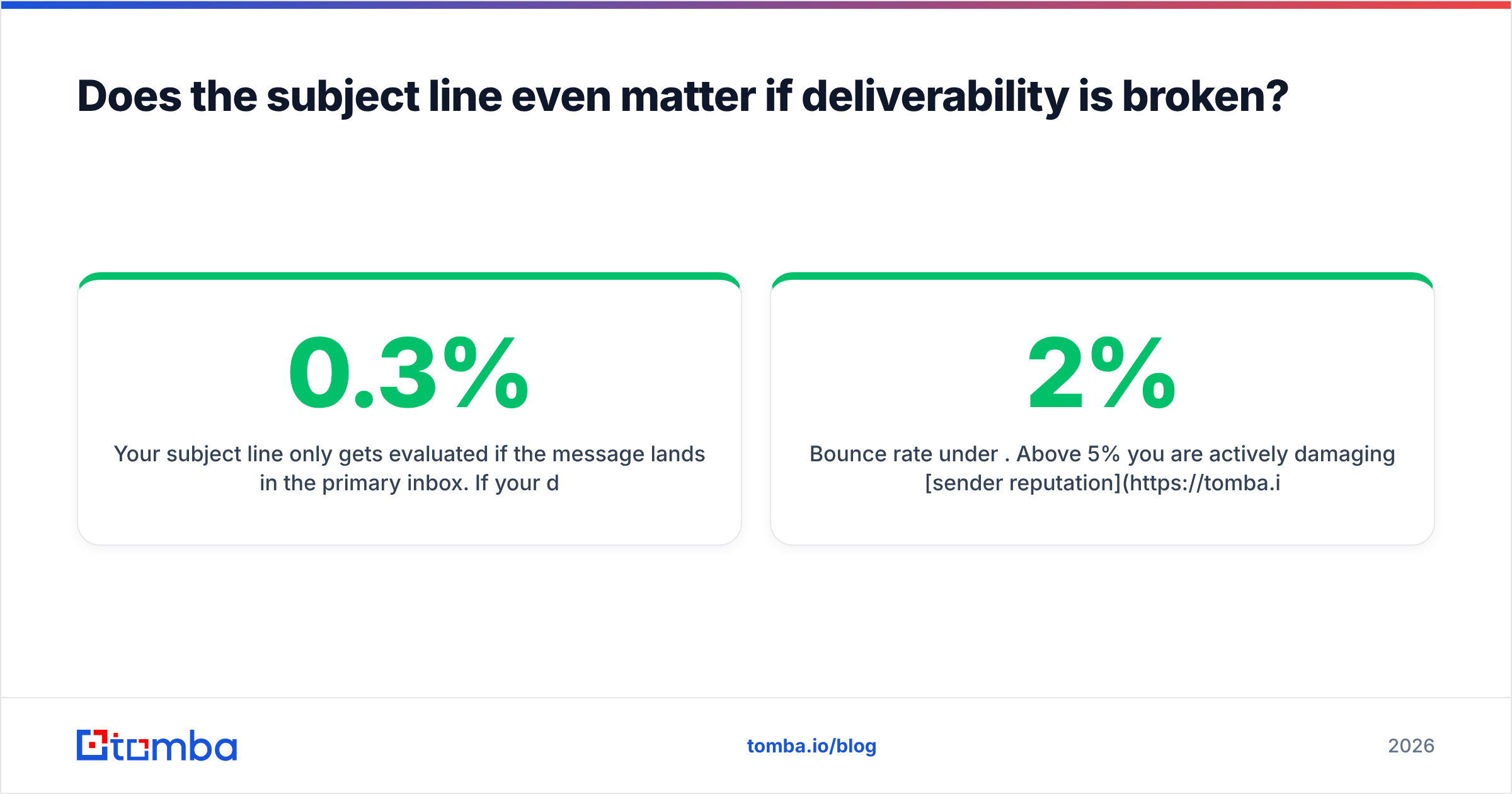
Your subject line only gets evaluated if the message lands in the primary inbox. If your domain is sending to dead addresses, spam traps, or role accounts at scale, mailbox providers route you to spam and the world's best subject line gets seen by nobody. Google and Yahoo's bulk-sender requirements — documented in Google's own sender guidelines — put a hard spam-complaint threshold at 0.3% and require authenticated sending. That's an infrastructure bar, not a copy bar.
The prerequisite checklist before you optimize a single word:
- SPF, DKIM, and DMARC all passing. Run an SPF checker if you haven't confirmed in the last quarter.
- Bounce rate under 2%. Above 5% you are actively damaging sender reputation.
- Verified list. Every address in the send should have passed an SMTP-level check, with catch-all domains flagged separately rather than blindly included.
- Warmed domain. New sending domains need weeks of ramp, not days.
- Volume matched to reputation. 500 cold sends/day from a two-week-old domain is a filtering event waiting to happen.
The cheapest reply-rate improvement most teams can make isn't rewriting subject lines — it's running the list through an email verifier so the sends that do go out actually land. A 3-point bounce reduction typically outperforms a 3-point open-rate improvement, because bounce reduction compounds across every future campaign.
How do the tools compare for building the list behind the subject line?#
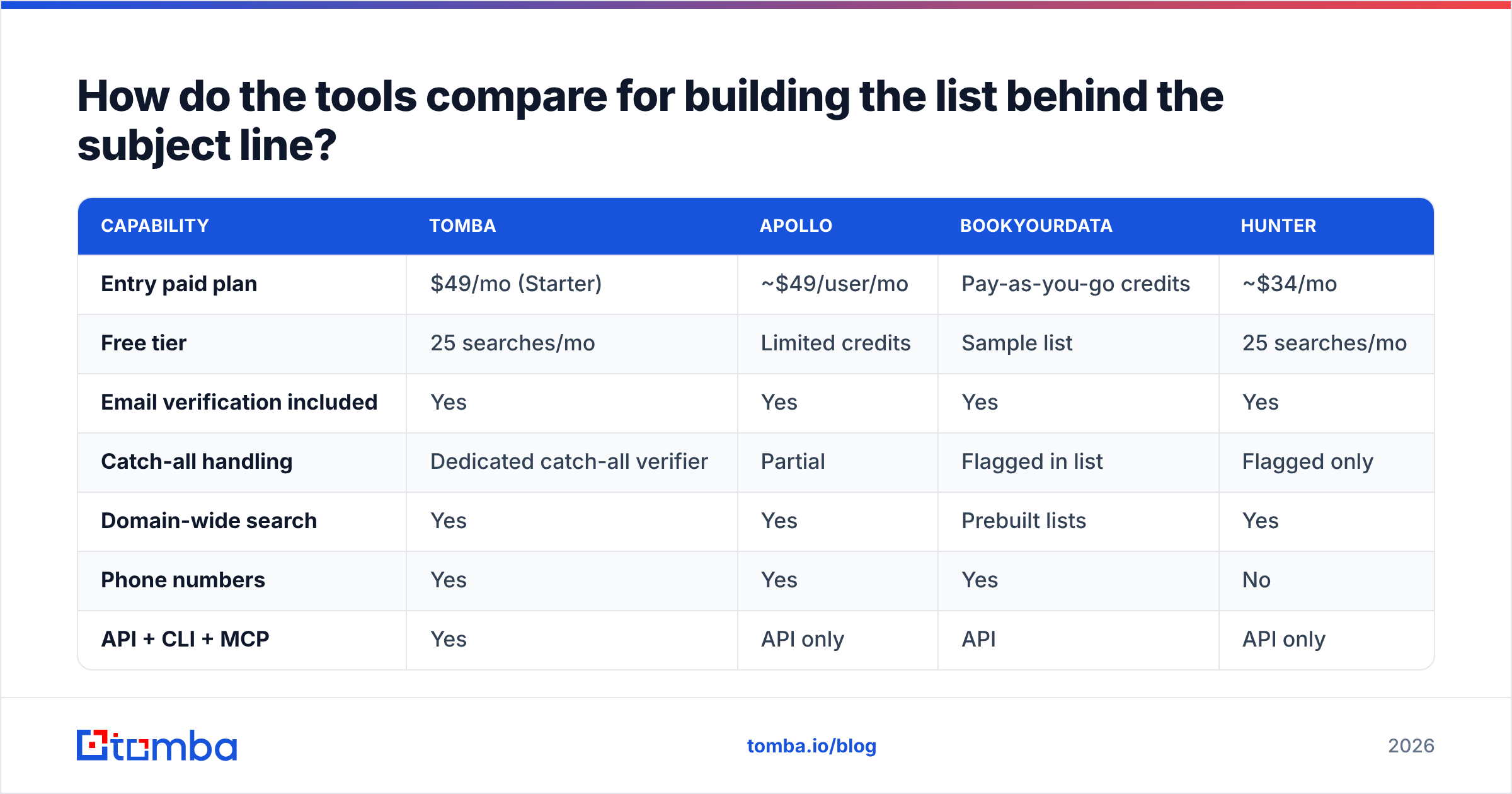
Subject lines are copy; the list is infrastructure. Here's how the common options stack up for sourcing and validating the contacts you're writing to.
| Capability | Tomba | Apollo | BookYourData | Hunter |
|---|---|---|---|---|
| Entry paid plan | $49/mo (Starter) | ~$49/user/mo | Pay-as-you-go credits | ~$34/mo |
| Free tier | 25 searches/mo | Limited credits | Sample list | 25 searches/mo |
| Email verification included | Yes | Yes | Yes | Yes |
| Catch-all handling | Dedicated catch-all verifier | Partial | Flagged in list | Flagged only |
| Domain-wide search | Yes | Yes | Prebuilt lists | Yes |
| Phone numbers | Yes | Yes | Yes | No |
| API + CLI + MCP | Yes | API only | API | API only |
| Best for | Precision finding + verifying | All-in-one sales engagement | Buying prebuilt targeted lists | Simple domain lookup |
Each of these has a real lane. Apollo bundles sequencing with data, which suits teams who want one vendor for the whole motion. BookYourData is strong when you'd rather purchase a pre-built, filtered list than assemble one — useful for teams testing a new segment fast. Tomba sits on the precision side: find, verify, enrich, then export into whatever sending tool you already use. If you're already committed to a sequencer, that separation is usually the cheaper path.
For teams sourcing at volume, the bulk email finder route — upload a company list, get verified contacts back — removes the manual step where most subject-line testing programs stall out. You can't A/B test with 40 contacts.
What subject lines should you never send?#
Some patterns are actively negative-EV. They don't just underperform — they trigger filtering, get you marked as spam, or torch the relationship.
Re:orFwd:on a first touch. It's a lie, recipients notice, and Gmail increasingly detects the mismatch.- Anything with
URGENT,ACT NOW, orLAST CHANCE. Classic spam-filter weights. Run copy through a spam checker if you're unsure where the line is. - Full-name subjects (
John Smith). Reads as a data breach notification. - Emoji in cold B2B. Fine in ecommerce marketing, wrong signal in enterprise outbound.
{{first_name}}, quick question— the most-sent cold subject line on earth. If your line could be sent by 50,000 other reps unchanged, it carries no information.- Subject lines longer than the first body sentence. If the subject already said everything, there's no reason to open.
How should you build a subject line library?#
Treat subject lines as a versioned asset, not a one-off creative act.
- Categorize by formula, not by campaign. Store lines under "bare noun," "trigger," "number," etc., so you can rotate patterns rather than recycling exact strings.
- Log reply rate and sample size next to every line. A line with 8% reply on n=60 is not better than 5% on n=900.
- Retire lines after ~5,000 sends. Overused patterns decay — the same line that worked in Q1 gets filtered by Q4 as it spreads across the ecosystem.
- Keep a "burned" list. Anything that spiked complaints goes in permanently, with a note on why.
- Pair each line with its intended first sentence. A subject and an opener are one unit; testing them separately makes both look worse than they are.
- Review quarterly against actual pipeline, not opens. The line that generates the most meetings is often not the one with the highest open rate.
If you want a starting bank, a cold email template library plus a subject line generator will get you 30 candidate lines in an afternoon. Then cut it to the five that fit your ICP's vocabulary and test those properly.
The bottom line#
Great email subject lines for sales are short, specific, and incomplete on purpose. They borrow the shape of internal mail, name something the prospect actually recognizes, and hand the persuasion job to the first line of the body where it belongs. Everything else — the puns, the emoji, the value-prop compression — is optimizing the wrong layer.
And none of it matters if the address is wrong. Before you spend another week rewriting five words, make sure the emails behind them are real, deliverable, and pointed at the right person. Start with the Tomba Email Finder to build a verified list by domain, name, or company — free tier gives you 25 searches a month to test the workflow, and Tomba pricing starts at $49/mo when you're ready to scale. Fix the list first, then the subject lines have something worth landing in.
Related guides#
Ready to find emails that actually work?
Join 150,000+ professionals who stopped guessing and started sending. Free credits on signup — no credit card required.
Get the Tomba newsletter
Practical outbound tactics and product updates — once every two weeks.
About the author