Email Validator Free: 9 Tools Tested for Accuracy in 2026
Free email validators all promise clean lists. Most cap you at 100 credits, skip catch-all domains, and stay quiet about accuracy. Here is what each free tier really gives you in 2026 — and when paying starts to make sense.
TL;DR
- An email validator free plan is fine for spot-checking a handful of addresses. It is not built to clean a 5,000-row list, and every vendor caps you somewhere between 25 and 1,000 credits per month.
- The single biggest quality gap between free tools is catch-all handling. Cheap validators mark catch-all domains "unknown" and hand the risk back to you.
- Syntax-only checkers (regex validators, "is this email valid" web forms) prove nothing about deliverability. They only prove the string looks like an email.
- Expect 95–98% accuracy from a serious validator on standard domains. Expect much less on catch-all, role-based, and disposable addresses.
- Free stops making sense at roughly 1,000 verifications a month. Past that, one blown sending domain costs more than a year of a paid plan.
What does an email validator free plan actually do?#
Think of email validation like checking whether a street address exists before you mail a package. You can look at the envelope and confirm the format is right. That is syntax. You can check the street exists on a map. That is domain and MX record checking. Or you can knock on the door and see if anyone answers. That is the SMTP handshake.
Free tools usually do the first two well and the third one badly. A full validation pass runs four layers:
- Syntax check — does the string match RFC 5322? It catches typos like
john@@acme.comand trailing spaces. It costs nothing, and it proves nothing about whether mail arrives. - Domain and MX check — does
acme.comresolve, and does it publish mail exchange records? This kills dead domains and parked pages right away.
The last two layers are where the money goes:
- SMTP handshake — the validator opens a conversation with the receiving mail server and asks whether the mailbox exists, without sending a message. Real accuracy lives here. Free tiers get stingy here too, because each probe costs the vendor money and IP reputation.
- Risk classification — is the address disposable (
mailinator.com), role-based (info@,sales@), a spam trap pattern, or sitting on a catch-all domain that accepts everything?
Layers 1 and 2 are cheap, and every free tool does them. Layers 3 and 4 separate a real email verifier from a regex form with a nice landing page. When you weigh up any email validator free plan, ask one question: how far down this stack does it go before it asks for a credit card?

Which email validator free plans are worth using in 2026?#
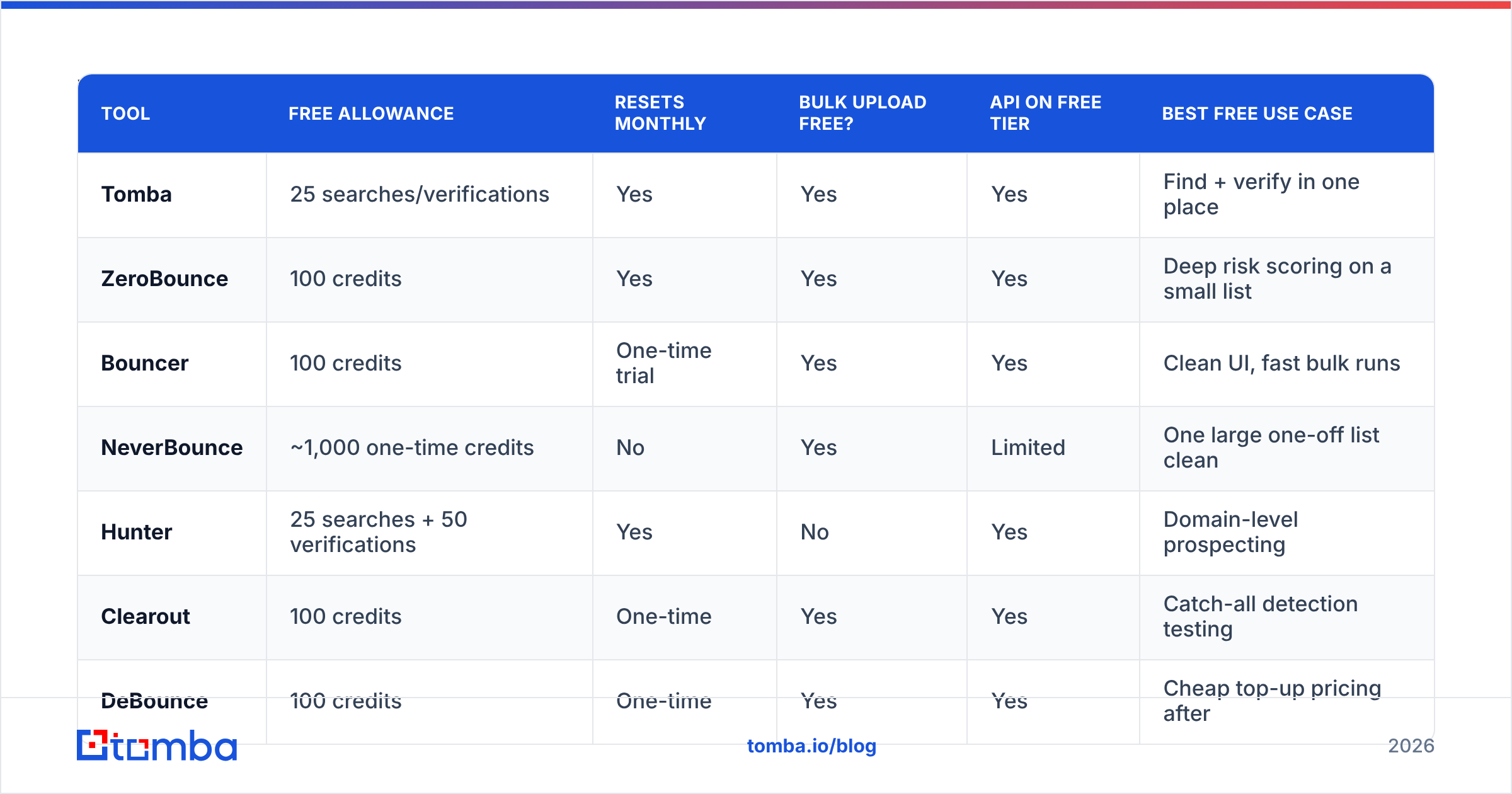
Free tiers change often, so treat the credit numbers below as a snapshot to check on each vendor's pricing page rather than a contract. What changes far more slowly is the shape of each offer: whether credits reset monthly, whether bulk upload is included, and whether the API is locked behind a paid plan.
| Tool | Free allowance | Resets monthly | Bulk upload free? | API on free tier | Best free use case |
|---|---|---|---|---|---|
| Tomba | 25 searches/verifications | Yes | Yes | Yes | Find + verify in one place |
| ZeroBounce | 100 credits | Yes | Yes | Yes | Deep risk scoring on a small list |
| Bouncer | 100 credits | One-time trial | Yes | Yes | Clean UI, fast bulk runs |
| NeverBounce | ~1,000 one-time credits | No | Yes | Limited | One large one-off list clean |
| Hunter | 25 searches + 50 verifications | Yes | No | Yes | Domain-level prospecting |
| Clearout | 100 credits | One-time | Yes | Yes | Catch-all detection testing |
| DeBounce | 100 credits | One-time | Yes | Yes | Cheap top-up pricing after |
| Verifalia | Small daily quota | Daily | Yes | Yes | Trickle validation, not batches |
| BookYourData | Free sample credits | One-time | N/A | N/A | Buying pre-verified contacts outright |
Two patterns jump out. First, "free" almost always means a one-time trial rather than a recurring monthly allowance. NeverBounce, Clearout, and DeBounce all front-load their generosity.
Second, the tools that reset monthly — Tomba, ZeroBounce, Hunter — give you smaller buckets, but you can keep using them for as long as you like. That is what you actually want for ongoing hygiene rather than a single cleanup.
BookYourData sits in a different category worth flagging. Instead of validating a list you already own, it sells contact records that have already been through verification, with an accuracy guarantee attached. If your problem is "my list is small," a validator does not solve that. A data provider does.

How accurate is an email validator free tier?#
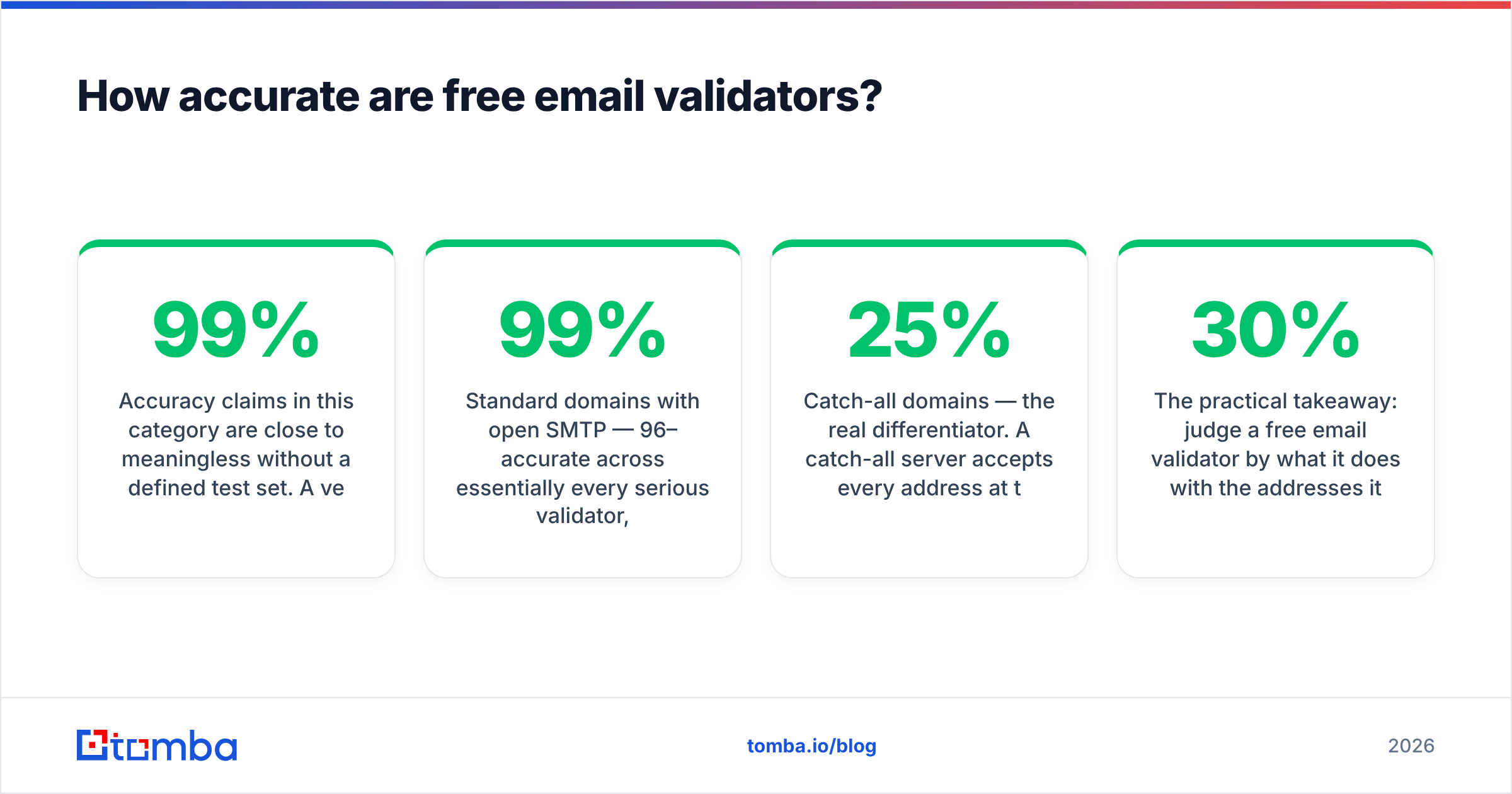
Accuracy claims in this category mean little without a defined test set. A vendor that advertises "99% accuracy" is usually measuring against a benchmark list of clean corporate domains, where almost any tool scores well. The number that matters is accuracy on the hard 20%: catch-all domains, aliases, staff who left last month, and Microsoft 365 tenants that block SMTP probing.
Here is what to expect in practice, based on how these engines behave across mixed B2B lists:
- Standard domains with open SMTP — 96–99% accurate on essentially every serious validator, free or paid. This one is a solved problem.
- Microsoft 365 / Exchange Online tenants — accuracy drops, because Microsoft refuses to confirm whether a mailbox exists. Good validators fall back to pattern and historical data. Weak ones return "unknown."
- Catch-all domains — the real split. A catch-all server accepts every address at the domain, so a naive SMTP check returns "valid" for
asdkjh@company.com. Roughly 20–25% of B2B domains are catch-all. - Role and disposable addresses — every tool flags these, but they label them differently. Some mark
sales@as invalid. Others mark it valid but risky. Decide which behaviour you want before you compare hit rates.

The practical takeaway: judge a free validator by what it does with the addresses it cannot confirm. A tool that returns 30% "unknown" and shrugs has pushed the decision back onto you.
A tool with a dedicated catch-all verifier does extra work — pattern inference, past sends, secondary signals — to shrink that unknown bucket into a confidence score you can act on.
What do free tiers actually limit?#
Credit count is the headline restriction, but it is rarely the one that bites first. Watch for these five.
- Credit expiry — one-time trial credits that vanish after 14 or 30 days turn "1,000 free" into "1,000 free if you clean your list this week."
- API access gating — several vendors let you use the web UI free but charge for API keys. If you plan to validate at signup or inside a workflow, check this before you build. Tomba opens the email verification API on the free tier, which helps if you are prototyping.
- Result detail — free tiers often return a plain valid/invalid flag. Paid tiers return sub-status codes (
mailbox_full,role_based,disposable,catch_all). Those codes are how you decide whether to send, sequence, or drop.
The last two are easy to miss until a job fails:
- Bulk file size — a 100-credit allowance with a 50-row upload cap is not usable for list cleaning, however the marketing page frames it.
- Rate limits — free API tiers commonly throttle to a few requests per second. That is fine for form validation and painful for batch jobs.
If you only need to check one address right now, skip the signup entirely and use a browser-based free email checker. No credits, no account, one answer.
Is an email validator free tier enough for cold outreach?#
Usually not, and the maths explains why better than any feature table.
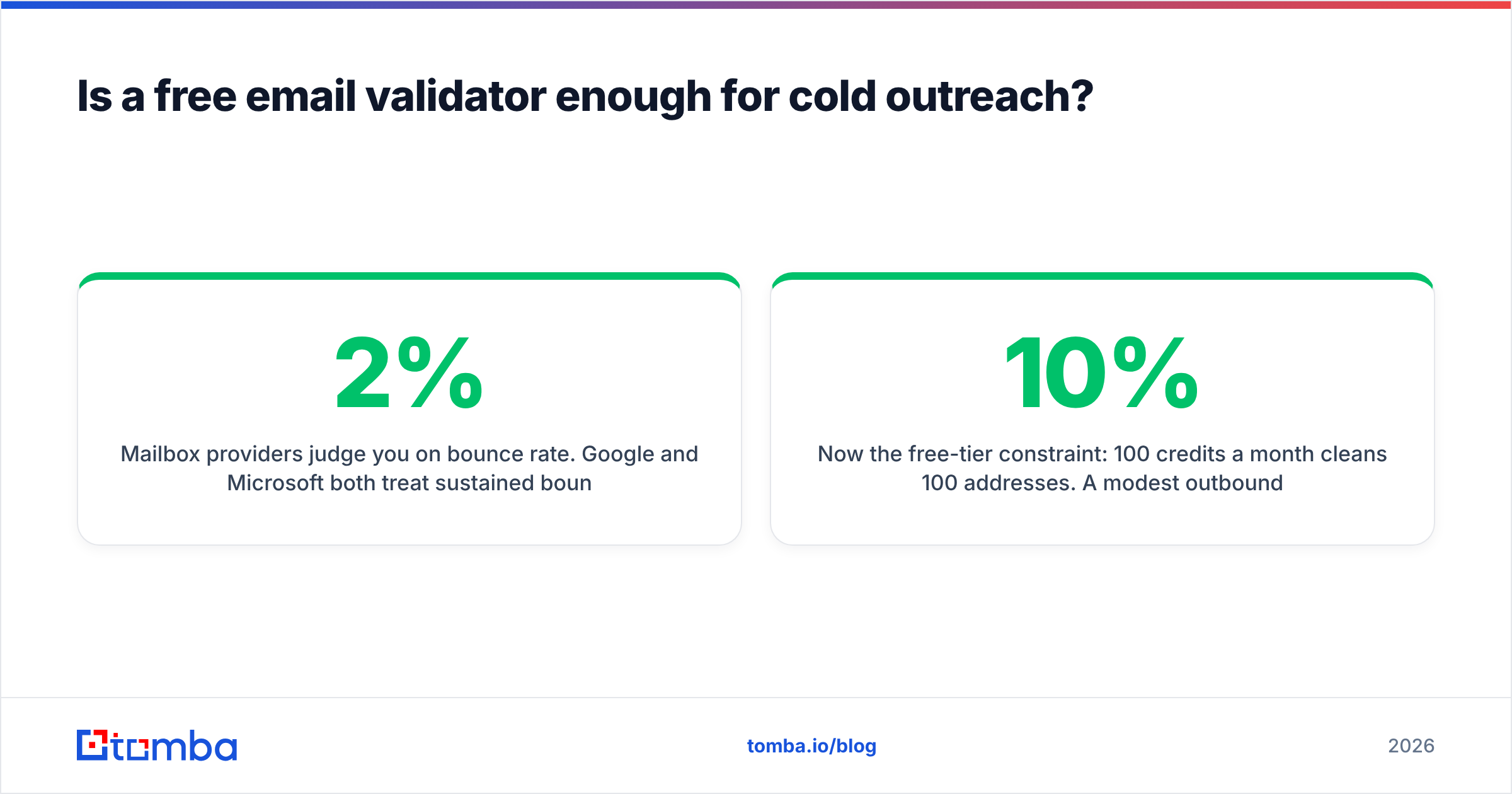
Mailbox providers judge you on bounce rate. Google and Microsoft both treat a sustained bounce rate above roughly 2% as a spam signal. Google's Email sender guidelines are blunt about it, and they put bulk senders under clear complaint and authentication rules.
Send 1,000 emails to an unvalidated B2B list and 8–15% will typically bounce. That single send can suppress your sender reputation for weeks.
Now the free-tier constraint. 100 credits a month cleans 100 addresses. A modest outbound motion touches 1,000–3,000 contacts a month. So you cover 3–10% of your risk surface and send the rest blind. The free validator is not wrong. It is just the wrong size of tool for the job, like using a kitchen scale to weigh furniture.
Free validation genuinely works for three cases:
- Signup form validation at low volume — catching typos before a fake address enters your CRM.
- Spot-checking a single high-value prospect before a hand-written email to a VP.
- Sampling — validate a random 100 of your 3,000-row list, measure the invalid rate, then decide whether a full paid clean is worth it. This is the smartest use of a free tier, and almost nobody does it.

How do you validate a list without paying full price?#
You can stretch free and low-cost tooling further than most people assume. The trick is to sequence the work so the expensive step handles the smallest possible set.
- Deduplicate first. Duplicate rows burn credits at full price. Run the list through a remove duplicates pass before anything touches a validator. On a typical scraped list this alone cuts 5–12% of volume.
- Strip the obvious junk locally. Free-mail domains, role addresses, and known disposable domains can be filtered with a spreadsheet formula. No credits required, no API call.
- Kill dead domains with DNS. An MX lookup is free and instant. If a domain has no mail records, every address at it is dead.
Now you are down to the addresses that need a real check:
- Sample before committing. Validate 100 random addresses. If 4% come back invalid, your list is healthy and a full clean is optional. If 22% come back invalid, you have a sourcing problem that no validator will fix.
- Validate the remainder in bulk. Only now does it make sense to run the full file through a bulk verify job, and the file is 30–40% smaller than when you started.
- Re-validate on a schedule, not once. B2B data decays at roughly 22–30% a year as people change jobs. A list cleaned in January is stale by July.
Step 5 is where the free-versus-paid decision actually lands, and by then you know exactly how many credits you need.
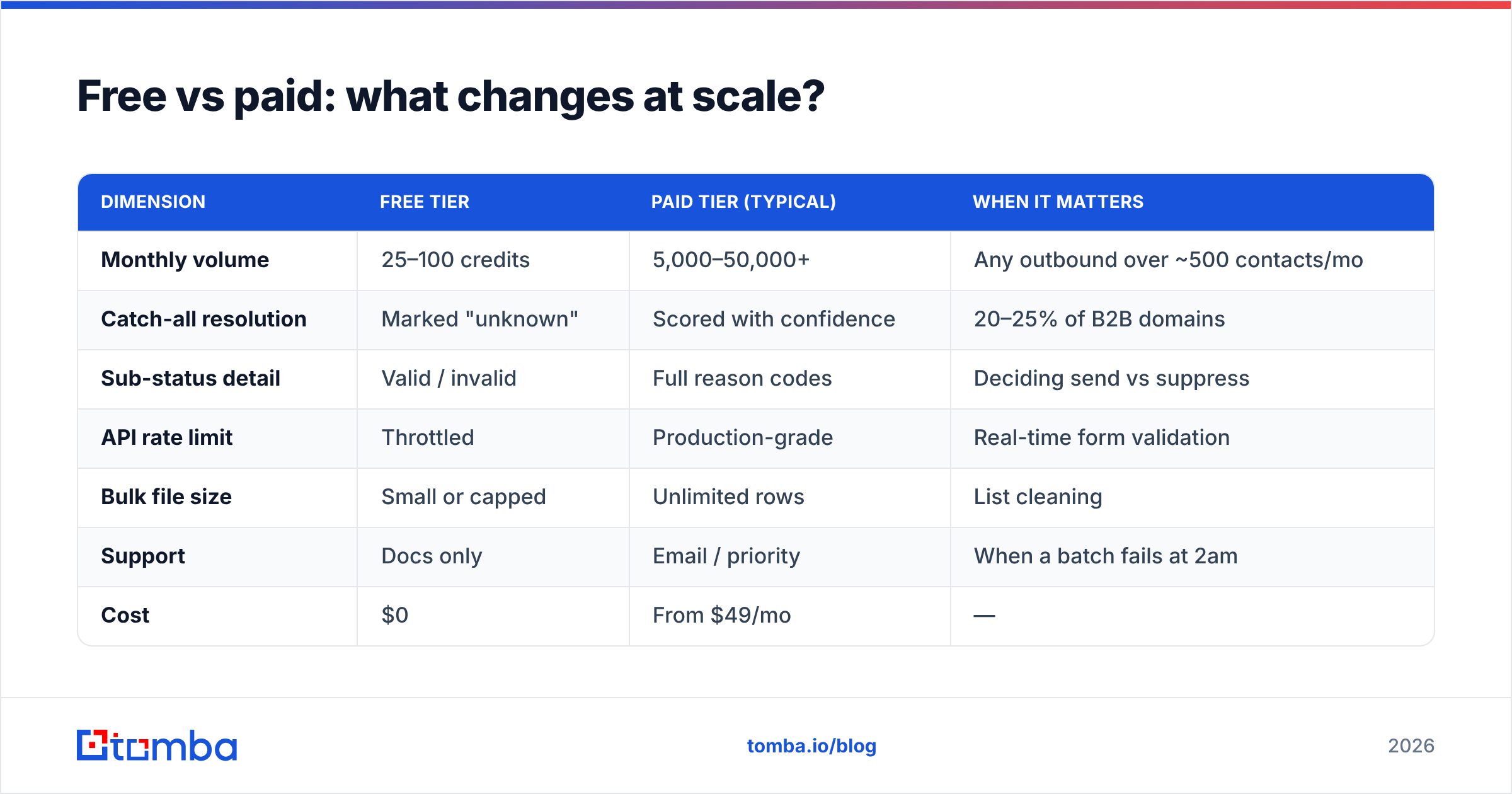
Free vs paid: what changes at scale?#
| Dimension | Free tier | Paid tier (typical) | When it matters |
|---|---|---|---|
| Monthly volume | 25–100 credits | 5,000–50,000+ | Any outbound over ~500 contacts/mo |
| Catch-all resolution | Marked "unknown" | Scored with confidence | 20–25% of B2B domains |
| Sub-status detail | Valid / invalid | Full reason codes | Deciding send vs suppress |
| API rate limit | Throttled | Production-grade | Real-time form validation |
| Bulk file size | Small or capped | Unlimited rows | List cleaning |
| Support | Docs only | Email / priority | When a batch fails at 2am |
| Cost | $0 | From $49/mo | — |
For reference on the paid side, Tomba pricing starts with a free tier at 25 searches per month. Starter is $49/mo, Growth is $99/mo, and Pro is $249/mo, with Enterprise negotiated.
Competitors in the verification-only space price in the same range per thousand credits. You can sanity-check the current market on G2's email verification category rather than taking any single vendor's word for it, including ours.
The honest framing: if you verify fewer than a few hundred addresses a month, an email validator free plan is genuinely enough and you should not pay. If you run outbound, the paid tier is not buying you accuracy. It is buying you coverage, which is the thing free tiers hold back on purpose.
What should you look for in an email validator free plan?#
Five criteria, in priority order:
- Does it run a real SMTP check, or just syntax and MX? If results come back instantly for every address, it is not knocking on any doors.
- How does it label catch-all domains? "Unknown" is an honest answer. "Valid" is a dangerous one.
- Do credits reset, or expire? Recurring beats one-time for anything ongoing.
- Is the API open without an upgrade? This decides whether you can automate later without moving vendors.
- Does it also find addresses? Verification and discovery are two halves of the same job. Tools that do both — a combined email finder plus verifier — save you a second vendor, a second API key, and a second set of numbers to reconcile.
That last point is underrated. Most teams start by verifying a list someone else built, then find that the list itself is the constraint. A domain search that returns already-verified addresses skips the whole clean-up cycle, because the data was never dirty.
Ready to stop guessing which addresses bounce?#
Start with the free tier and test it on your own data before you spend anything. Tomba's Email Finder gives you 25 searches a month at no cost, with verification built into the same result. Every address you pull back already carries a confidence score, a catch-all flag, and a source.
No separate validator, no second subscription, no exporting CSVs between two tools. Run your hardest 25 prospects through it, compare the output against whatever you use today, and decide from there.
Related guides#
Ready to find emails that actually work?
Join 150,000+ professionals who stopped guessing and started sending. Free credits on signup — no credit card required.
Get the Tomba newsletter
Practical outbound tactics and product updates — once every two weeks.
About the author