Emailable vs Leadzenai: Which Tool Wins in 2026?
Emailable verifies emails. Leadzen.ai finds them. We compare accuracy, pricing, and API depth to show which one belongs in your stack — and when you need neither.
TL;DR
- These are not the same product. Emailable is a bulk email verifier. Leadzen.ai is a prospecting and lead-intelligence platform with a heavy India-market focus. Comparing them head-to-head only makes sense if you're unsure which half of the problem you're solving.
- Emailable wins on verification depth: pay-as-you-go credits, a fast bulk API, SMTP-level checks, and clean deliverability reporting. It does not find emails from a name and domain.
- Leadzen.ai wins on discovery breadth — company and contact search, intent signals, and phone data — but reviewers consistently flag data freshness and support responsiveness outside its core geography.
- Neither covers the full find → verify → enrich loop alone. Running both means two contracts, two credit pools, and two APIs to reconcile.
- If you want one API for finding, verifying, and enriching, Tomba's Free tier (25 searches/mo) and $49/mo Starter are the cheaper way to test that consolidation before you commit.
What are Emailable and Leadzen.ai actually built for?#
Start with the category, not the feature list. Buying the wrong category is the expensive mistake here — like hiring a proofreader when you needed a writer. Both do work with words. Only one produces the thing you're missing.
Emailable is a deliverability tool. You bring a list — exported from a CRM, scraped from a webinar signup, inherited from a departed SDR — and Emailable tells you which addresses are safe to mail. It runs syntax checks, MX record lookups, SMTP handshakes, role-account detection, disposable-domain flags, and catch-all identification. Its output is a verdict per row: deliverable, undeliverable, risky, unknown.
Leadzen.ai is a prospecting platform. You bring a target profile — "heads of finance at Indian SaaS companies with 50-200 employees" — and it returns contacts with emails, phone numbers, and firmographics. It also layers on intent and trigger signals so you can prioritize accounts showing buying behavior.
The distinction matters for your budget. Verification credits are cheap and consumed once per address. Prospecting credits are expensive and consumed on discovery, whether or not the record turns out to be usable.
How the two categories differ in practice#
- Input requirement — Emailable needs an existing address; Leadzen.ai needs only a persona description.
- Failure mode — Emailable's failure is a wrong verdict (a good address marked risky). Leadzen.ai's failure is a stale or missing record.
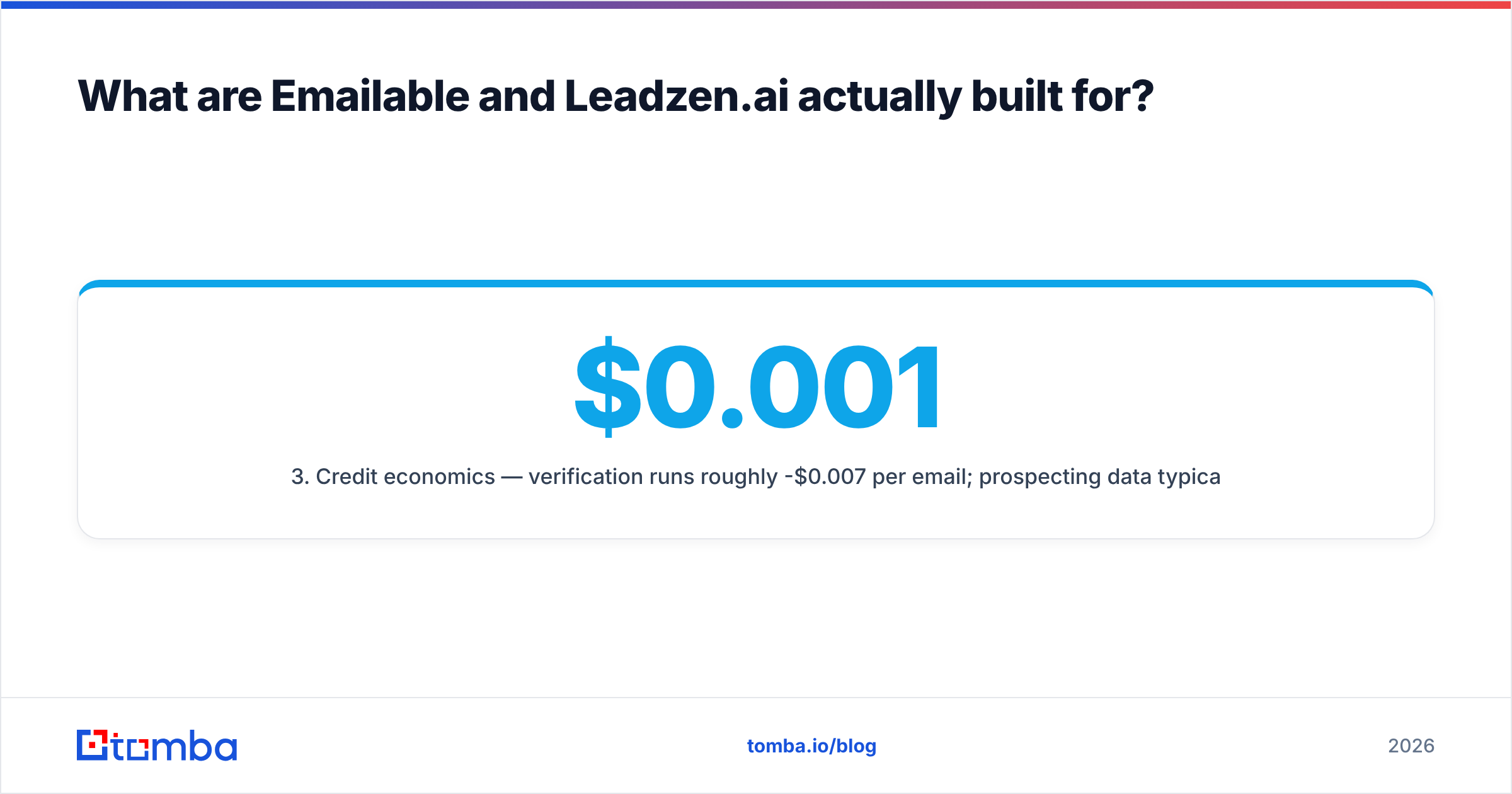
- Credit economics — verification runs roughly $0.001-$0.007 per email; prospecting data typically costs 10-50x more per usable contact.
- Who owns it internally — verification is usually a RevOps or email-ops responsibility; prospecting sits with SDR leadership.
- Replacement risk — verifiers are commoditized and easy to swap; prospecting databases create lock-in through saved lists and workflows.
- Compliance surface — prospecting data carries the heavier GDPR/DPDP burden because you're sourcing personal data, not validating what you already hold.

How accurate is each tool in real use?#
Accuracy means two different things depending on which side you're on.
For Emailable, accuracy is verdict correctness. The vendor markets 99%+ accuracy, which is a defensible claim for standard mailbox providers where SMTP responses are honest. Where every verifier — Emailable included — gets softer is catch-all domains. A catch-all server accepts mail for any address at the domain, so SMTP tells you nothing. Emailable flags these as "risky" or "unknown" rather than guessing, which is the honest behavior but leaves you with a bucket of undecided rows. If catch-alls are a large share of your list (common in enterprise and .edu targets), you'll want a dedicated catch-all verifier to resolve them rather than deleting perfectly good contacts.
For Leadzen.ai, accuracy is record freshness. Public reviews on G2 and comparable directories describe a familiar pattern for regional data providers: strong coverage in the home market, thinner and staler coverage in North America and Western Europe. Job-change churn runs roughly 20-25% annually in B2B, so any database that isn't re-verified continuously drifts. Leadzen.ai does not publish a re-verification cadence, which is worth asking about directly in a demo.

The practical takeaway: never trust a prospecting tool's email verdict as final. Even excellent databases return addresses that bounced last week. Run discovered contacts through an independent email verifier before they enter a sequence. That single step is usually worth more to your sender reputation than switching data vendors.
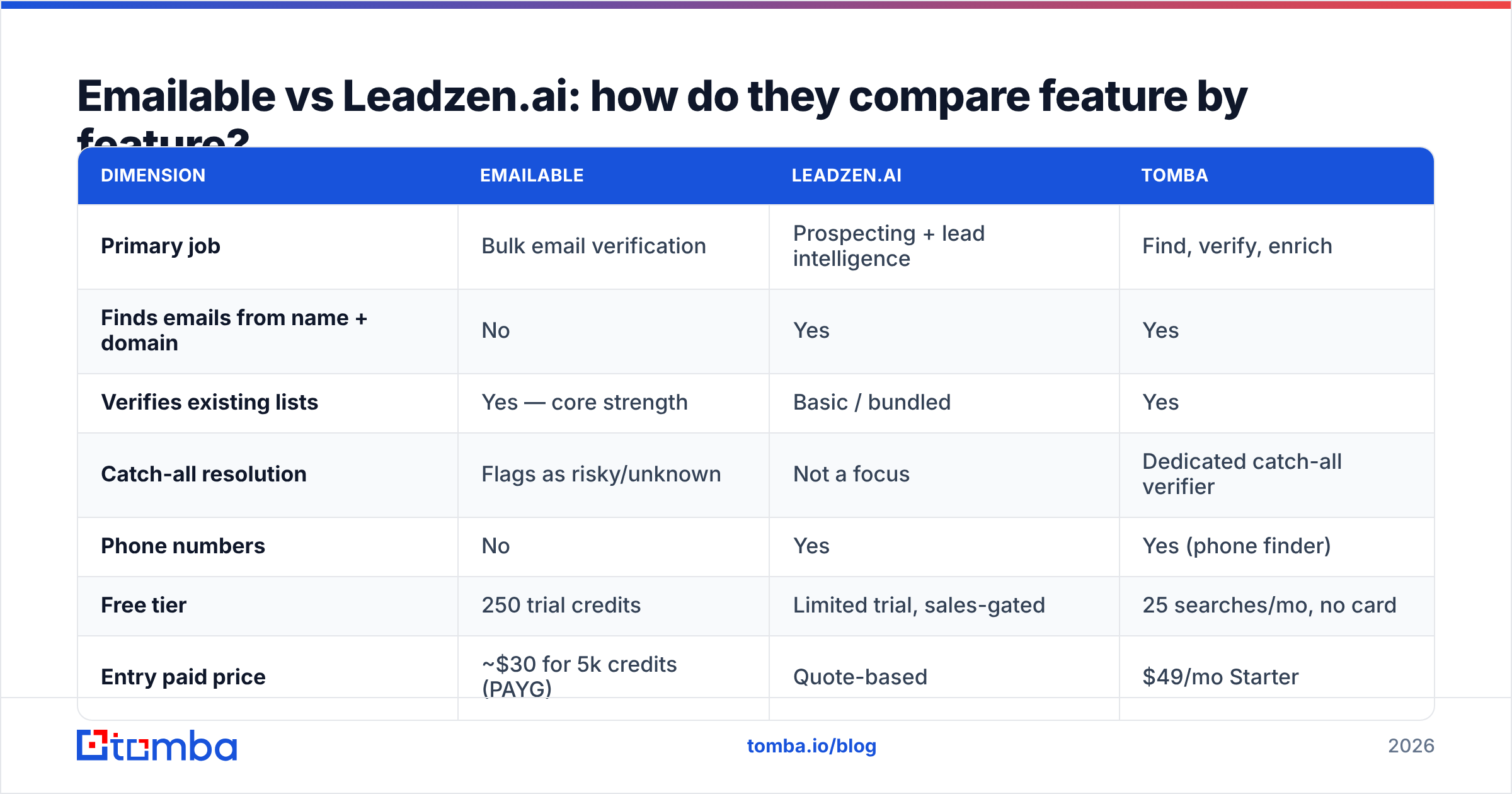
Emailable vs Leadzen.ai: how do they compare feature by feature?#
Pricing below reflects publicly listed plans at the time of writing. Prospecting platforms in particular change packaging often and gate real numbers behind sales calls, so confirm before you sign.
| Dimension | Emailable | Leadzen.ai | Tomba |
|---|---|---|---|
| Primary job | Bulk email verification | Prospecting + lead intelligence | Find, verify, enrich |
| Finds emails from name + domain | No | Yes | Yes |
| Verifies existing lists | Yes — core strength | Basic / bundled | Yes |
| Catch-all resolution | Flags as risky/unknown | Not a focus | Dedicated catch-all verifier |
| Phone numbers | No | Yes | Yes (phone finder) |
| Free tier | 250 trial credits | Limited trial, sales-gated | 25 searches/mo, no card |
| Entry paid price | ~$30 for 5k credits (PAYG) | Quote-based | $49/mo Starter |
| Mid tier | ~$100+ monthly volume plans | Quote-based | $99/mo Growth |
| Public API | Yes — well documented | Yes, plan-dependent | Yes, plus CLI + MCP |
| Native integrations | Zapier, Mailchimp, HubSpot | CRM connectors | 20+ including Salesforce, Sheets |
| Strongest geography | Global (provider-agnostic) | India / APAC | Global |
| Best for | Cleaning lists you already own | Building lists in APAC | One-stack outbound |

Two rows deserve emphasis.
The API row is where teams get surprised. Emailable's verification API is genuinely good — predictable latency, clear response schema, sensible batching. Leadzen.ai's API access is tied to plan tier, which means the workflow you prototype on a trial may not be available at the price you budgeted. Ask for the API docs before the contract, not after.
The geography row is the single biggest decision driver. If your ICP is US or EU mid-market, a regional database will underperform against generalist providers regardless of how good its UI is. If your ICP is Indian SMB or enterprise, the reverse is true and Leadzen.ai's local depth is a real advantage that global vendors struggle to match.
Which one should you buy for your use case?#
Buy Emailable if you already have volume — an inherited list, a CRM with years of accumulated contacts, a newsletter with rising bounce rates. Pay-as-you-go credits mean you're not paying a monthly subscription for a quarterly cleanup job. Pair it with a blacklist checker and an SPF checker and you've covered the mechanical side of deliverability.
Buy Leadzen.ai if your target market is India or broader APAC and your bottleneck is finding contacts at all. Regional depth is not something you can compensate for with better tooling elsewhere. Negotiate on re-verification frequency and get the API tier in writing.
Buy neither if your actual problem is that you're running three tools to accomplish one workflow. This is the most common situation we see. A team buys a prospecting database, discovers the emails bounce, buys a verifier, then discovers neither enriches records for scoring — and now RevOps maintains three credit pools with three renewal dates and no single source of truth.
It's worth naming an adjacent option honestly: if what you actually want is a pre-built, pre-verified contact list rather than a search tool, a database vendor like BookYourData solves a different shape of the problem well — you buy records outright rather than metering searches. That's a legitimate third path, not a worse one. Choose it when your ICP is stable and broad; choose a search API when your targeting changes weekly.
What does the consolidated alternative look like?#
The consolidation argument is simple arithmetic. Count your current line items, then count how many of them exist because your primary tool couldn't finish the job.
A single-stack approach handles the whole chain:
- Discovery — find email addresses from a name and company domain, or pull every public address at a company with domain search.
- Verification — validate before sending, including the catch-all cases most tools abandon.
- Enrichment — attach job titles, company size, and social profiles via data enrichment so scoring models have something to work with.
- Scale — bulk email finder jobs for list building, plus a Tomba API that covers all of the above under one key.
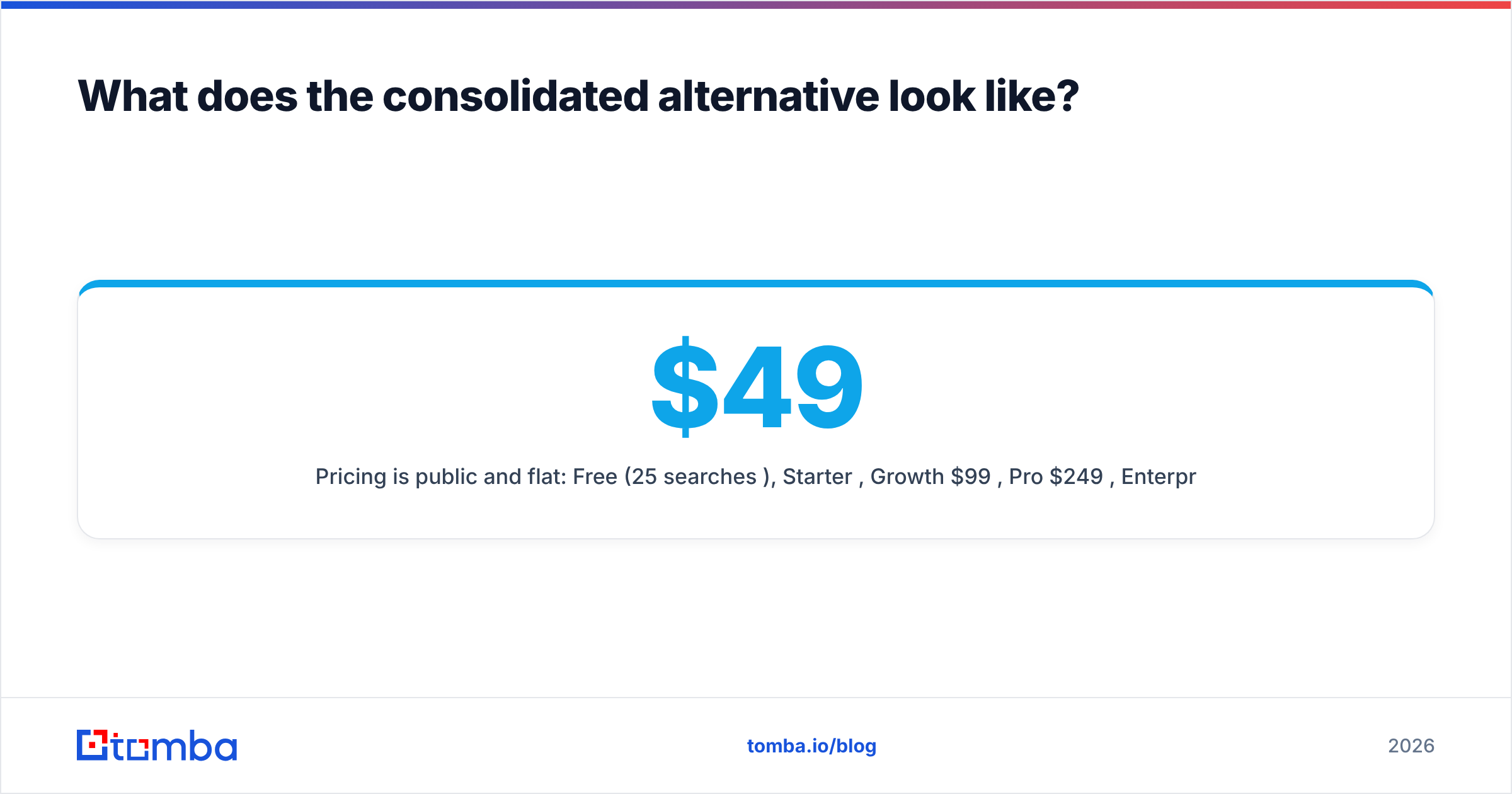
Pricing is public and flat: Free (25 searches/mo), Starter $49/mo, Growth $99/mo, Pro $249/mo, Enterprise custom. Full Tomba pricing has the credit breakdowns. The point isn't that one vendor beats two on every individual feature — a dedicated verifier will always have more verification-specific knobs than a generalist. The point is that most teams don't need those knobs, and the operational cost of two contracts, two rate limits, and two support queues is real.
If you're validating the "one tool" hypothesis, the honest test is a 100-contact bake-off. Take a list of 100 real targets in your ICP. Run them through your current stack and through a single-vendor alternative. Compare: hit rate on discovery, bounce rate after verification, and how many fields came back populated. That measurement takes an afternoon and settles arguments that otherwise run for quarters.
What should you ask before signing either contract?#
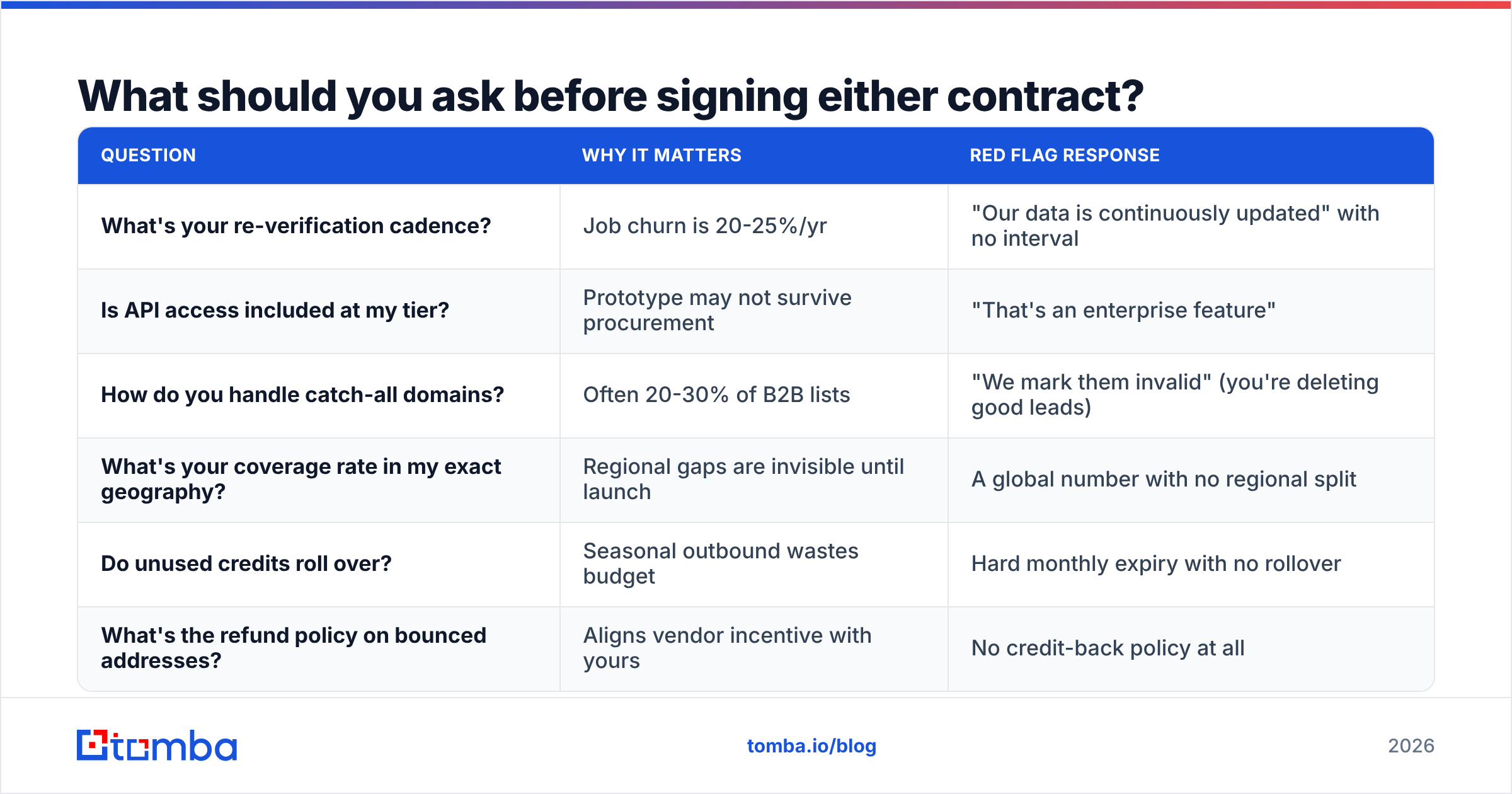
Bring these to the demo. Vague answers are answers.
| Question | Why it matters | Red flag response |
|---|---|---|
| What's your re-verification cadence? | Job churn is 20-25%/yr | "Our data is continuously updated" with no interval |
| Is API access included at my tier? | Prototype may not survive procurement | "That's an enterprise feature" |
| How do you handle catch-all domains? | Often 20-30% of B2B lists | "We mark them invalid" (you're deleting good leads) |
| What's your coverage rate in my exact geography? | Regional gaps are invisible until launch | A global number with no regional split |
| Do unused credits roll over? | Seasonal outbound wastes budget | Hard monthly expiry with no rollover |
| What's the refund policy on bounced addresses? | Aligns vendor incentive with yours | No credit-back policy at all |
For deeper context on why bounce rates matter beyond the immediate campaign, see how email deliverability compounds — a 5% bounce rate doesn't just lose 5% of your sends, it degrades inbox placement for the other 95%. HubSpot's research on email benchmarks is a reasonable public reference point for what healthy looks like.
Is there a clear winner between Emailable and Leadzen.ai?#
No — and any post that declares one is comparing tools that don't compete.
The honest verdict:
- For list hygiene at volume, Emailable is a strong, fairly priced choice with a clean API. Its main limitation is scope: it will never build your list.
- For prospecting in India and APAC, Leadzen.ai has genuine regional advantage. Its main limitation is verification depth and geographic reach beyond its core market.
- For teams tired of stitching tools together, neither is the answer, because the answer is fewer tools rather than better ones.
Run the 100-contact test. Whatever wins on hit rate, bounce rate, and field completeness — with pricing you can read on a public page — is the right call for your team. Ignore feature-count comparisons, including this one, in favor of your own numbers.
Ready to test the consolidated path? Start with the Tomba Email Finder — 25 free searches a month, no card required. Drop in a name and a company domain, and see what confidence score comes back on the contacts you actually care about. If the hit rate holds on your ICP, Starter at $49/mo replaces both a prospecting seat and a verification subscription; if it doesn't, you've lost an afternoon and learned something concrete about your market's data availability.
Related guides#
Ready to find emails that actually work?
Join 150,000+ professionals who stopped guessing and started sending. Free credits on signup — no credit card required.
Get the Tomba newsletter
Practical outbound tactics and product updates — once every two weeks.
About the author