EmailBison vs LeadEngineAI: Which Cold Email Platform Wins in 2026?
EmailBison sells sending infrastructure at scale. LeadEngineAI sells AI-run outbound. They solve different halves of the same problem — here is which one actually fits your team, and the data layer both of them assume you already have.
TL;DR
- EmailBison is infrastructure. It exists to send high volumes of cold email across many mailboxes and domains without the per-seat tax of legacy sequencers. Agencies and lead-gen shops are its core buyer.
- LeadEngineAI is an AI outbound layer. It leans on AI agents to research accounts, draft copy, and run the follow-up logic so a small team can behave like a large one.
- They overlap less than the "vs" framing implies. One is a sending engine; the other is a decision engine. Several teams run something like both.
- Neither fixes bad data. Both platforms assume you arrive with verified contacts. Bounce rates above 3% will sink either one — that is a data problem, not a sending problem.
- Pick by constraint: volume and mailbox sprawl → EmailBison. Headcount and research time → LeadEngineAI. Deliverability → fix your list first with an email verifier, then argue about tools.
What are EmailBison and LeadEngineAI, actually?#
Short version: EmailBison is a cold email sending platform built for volume; LeadEngineAI is an AI-driven outbound platform built for leverage. Confusing them costs you a quarter.
EmailBison came out of the agency world, and it shows. The product is organized around mailboxes, domains, warmup, and campaign throughput. You connect dozens — sometimes hundreds — of sending accounts, spread volume across them, rotate inboxes, and monitor reply health. White-label options let agencies resell the whole thing under their own brand. Pricing is built around sending capacity rather than seats, which is exactly what you want when your "team" is four people running outbound for eleven clients.
LeadEngineAI sits at the other end. Its pitch is that the bottleneck in outbound is not sending — SMTP is a solved problem — but the human hours spent deciding who to contact and what to say. So the product wraps AI agents around account research, ICP scoring, message drafting, and reply triage. You give it a target definition; it produces campaigns.
Here is the honest tension. EmailBison will happily send 40,000 emails a month for you and will not have an opinion about whether those emails are any good. LeadEngineAI will have opinions about your copy and targeting, but you still need somewhere reliable to send from and a list that is real. That's why the head-to-head is more useful as a diagnostic than as a horse race: whichever gap is bigger in your operation is the one you should buy against.

How do EmailBison and LeadEngineAI compare feature by feature?#
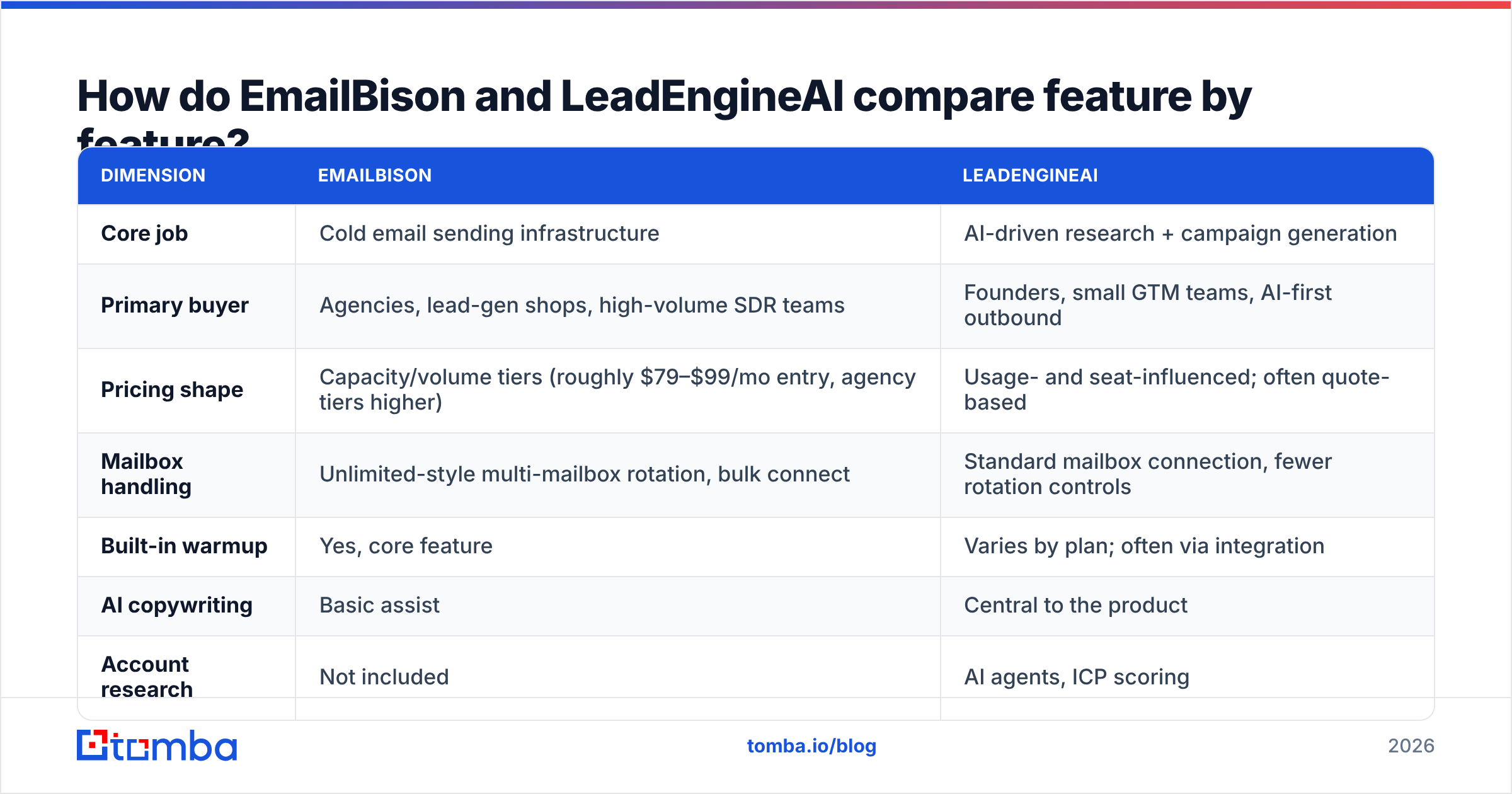
Vendors move fast and pricing pages change, so treat the numbers below as directional and confirm on the vendor's own site before you sign anything. What matters more than the exact dollar figure is the shape of the pricing — capacity-based versus usage/seat-based — because that determines whether the tool gets cheaper or more expensive as you grow.
| Dimension | EmailBison | LeadEngineAI |
|---|---|---|
| Core job | Cold email sending infrastructure | AI-driven research + campaign generation |
| Primary buyer | Agencies, lead-gen shops, high-volume SDR teams | Founders, small GTM teams, AI-first outbound |
| Pricing shape | Capacity/volume tiers (roughly $79–$99/mo entry, agency tiers higher) | Usage- and seat-influenced; often quote-based |
| Mailbox handling | Unlimited-style multi-mailbox rotation, bulk connect | Standard mailbox connection, fewer rotation controls |
| Built-in warmup | Yes, core feature | Varies by plan; often via integration |
| AI copywriting | Basic assist | Central to the product |
| Account research | Not included | AI agents, ICP scoring |
| White label / reseller | Yes — a headline feature | Not a core positioning |
| Contact data included | No — bring your own | Partial/enrichment-assisted, still bring your own |
| Best when | Volume and client count are the constraint | Headcount and research time are the constraint |
Two rows in that table do the most work.
"Contact data included: No." This is the row people skim past and then regret. Neither platform is a data vendor in the way Apollo or ZoomInfo is. You still need a source of verified, deliverable addresses — which is why a lot of teams pair either tool with a dedicated email finder and push clean contacts in via API rather than uploading whatever a scraper coughed up.
"White label: Yes." If you run an agency, that single row may decide the whole evaluation. Reselling under your own brand changes your margin structure in a way no AI feature does.
Which one is better for deliverability?#
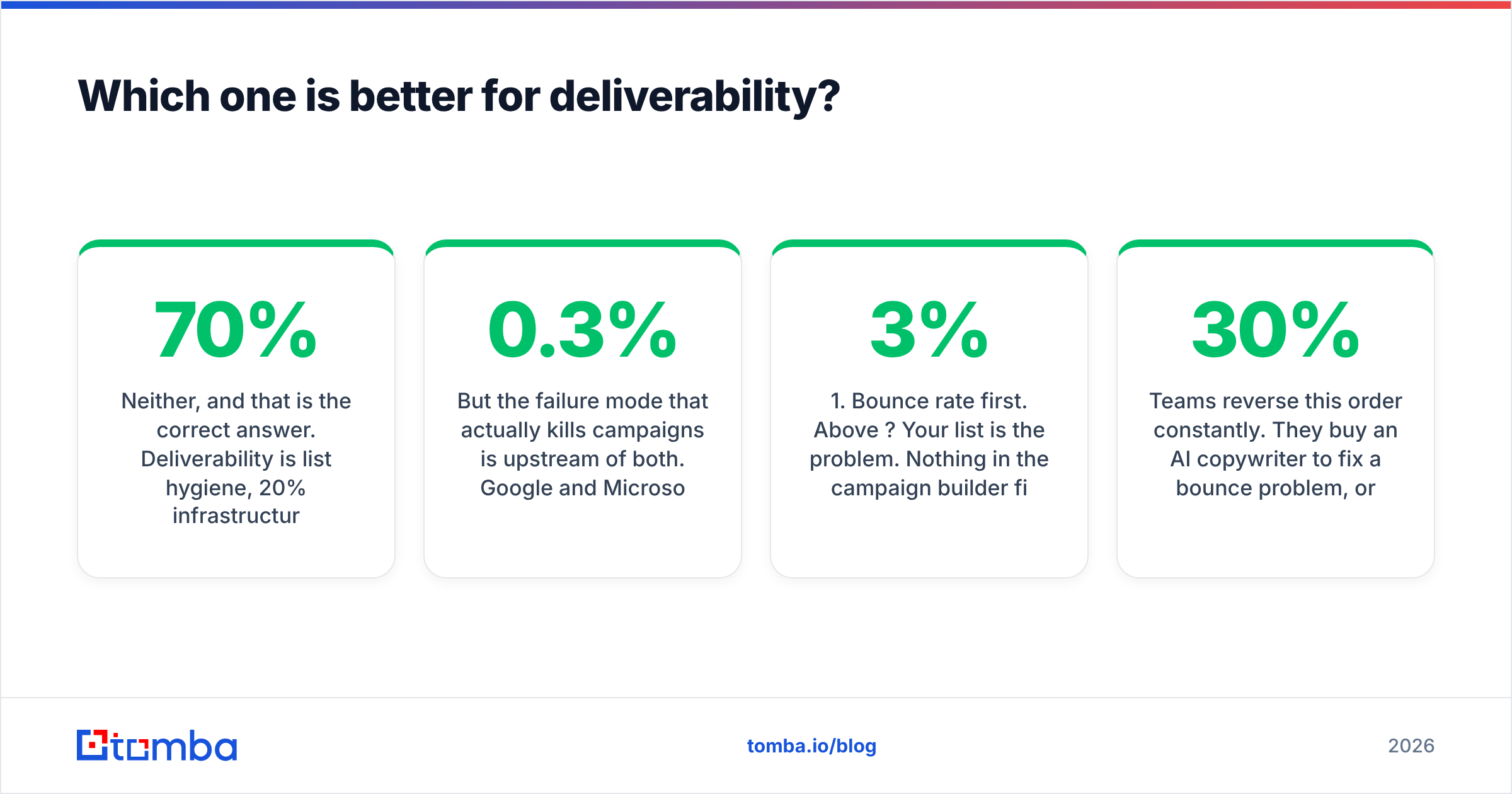
Neither, and that is the correct answer. Deliverability is 70% list hygiene, 20% infrastructure setup, and 10% platform features — and only the middle chunk is what these tools sell.
Both platforms give you the standard hygiene kit: SPF/DKIM/DMARC guidance, warmup, sending limits, and rotation. EmailBison is more opinionated about the infrastructure layer because that's its whole reason to exist — mailbox rotation, per-domain caps, and volume ramping are first-class controls, not settings buried in a submenu. LeadEngineAI generally assumes you have sane infrastructure and focuses its energy upstream.
But the failure mode that actually kills campaigns is upstream of both. Google and Microsoft tightened bulk-sender enforcement in 2024 and have not loosened since; sustained spam complaint rates above 0.3% and high hard-bounce volumes get domains throttled quickly. The HubSpot deliverability research and most vendor guidance converge on the same threshold: keep hard bounces under 2–3% or expect reputation damage that no warmup tool undoes.
Run the diagnostic in this order before you blame either platform:
- Bounce rate first. Above 3%? Your list is the problem. Nothing in the campaign builder fixes it. Run the list through verification and re-check.
- Authentication second. SPF, DKIM, and DMARC on every sending domain, not just the primary. Check with an SPF checker rather than assuming your DNS provider got it right.
- Catch-all handling third. Catch-all domains accept everything and tell you nothing. Treat them as a separate risk bucket using a catch-all verifier instead of letting them inflate your "valid" count.
- Volume ramp fourth. New domains need weeks, not days. EmailBison's ramping controls help here; so does simply sending less.
- Content and complaint rate last. This is where LeadEngineAI's copy tooling earns its keep — but only after the first four are clean.
Teams reverse this order constantly. They buy an AI copywriter to fix a bounce problem, or add fifty mailboxes to compensate for a list that is 30% dead. Both are expensive ways to avoid a $49 verification run.
Is EmailBison worth it for agencies?#
If you run outbound for multiple clients, EmailBison's economics are hard to argue with — and that is the specific case it was built for.
The math is simple. Legacy sequencers charge per seat and often per mailbox. Run five clients with ten mailboxes each and you are paying for fifty mailbox slots plus seats for everyone who touches them. Capacity-based pricing collapses that. Add white-label and the tool stops being a cost line and starts being part of what you sell.
Where it gets uncomfortable:
- You own the strategy. EmailBison does not tell you who to email or what to say. If your differentiator was supposed to be targeting, you still have to build that.
- Mailbox sprawl is real operational work. Hundreds of inboxes means hundreds of DNS records, renewals, and reputation curves. The platform manages them; it does not eliminate them.
- Volume amplifies data errors. At 40,000 sends a month, a 6% bad-data rate is 2,400 bounces. That is a reputation event, not a rounding error. This is where a bulk email finder workflow — find, verify, then load — pays for itself in a single campaign.
Is LeadEngineAI worth it for small teams?#
Yes, if your bottleneck is hours rather than sending capacity — and no, if you expect it to invent a market for you.
The strongest case for an AI outbound layer is the two-person GTM team that cannot afford a researcher. Account research, persona-specific angles, and reply triage genuinely consume 15–25 hours a week at moderate volume. Automating 60% of that is real leverage, and it compounds because the system keeps working while you sleep.
The weakest case is the team hoping AI substitutes for positioning. AI-generated copy trends toward the median of everything it has seen — and everyone else's AI is drawing from the same well. G2 reviewers across the sales engagement category repeat a version of this critique about nearly every AI outbound tool: the output is competent and forgettable unless a human injects a real point of view. Use it to draft, not to decide.
The other caveat is grounding. AI research agents are only as good as the records they start from. Feed one a contact with the wrong company or a stale title and it will confidently write three paragraphs of personalization about a job the prospect left in 2024. Pairing the AI layer with reliable data enrichment is not optional — it is what keeps the personalization from becoming a liability.
How do you choose between EmailBison and LeadEngineAI?#
Answer three questions honestly and the choice usually makes itself.
1. What breaks first when you double volume tomorrow? If the answer is "mailboxes, domains, deliverability" → EmailBison. If it is "nobody has time to research or write" → LeadEngineAI.
2. Are you selling outbound, or doing outbound? Selling it — as an agency or reseller — pushes hard toward EmailBison's white-label model. Doing it in-house for one company makes the white-label premium irrelevant.
3. How good is your contact data right now? If you cannot state your current bounce rate from memory, neither tool is your next purchase. Fix the list.
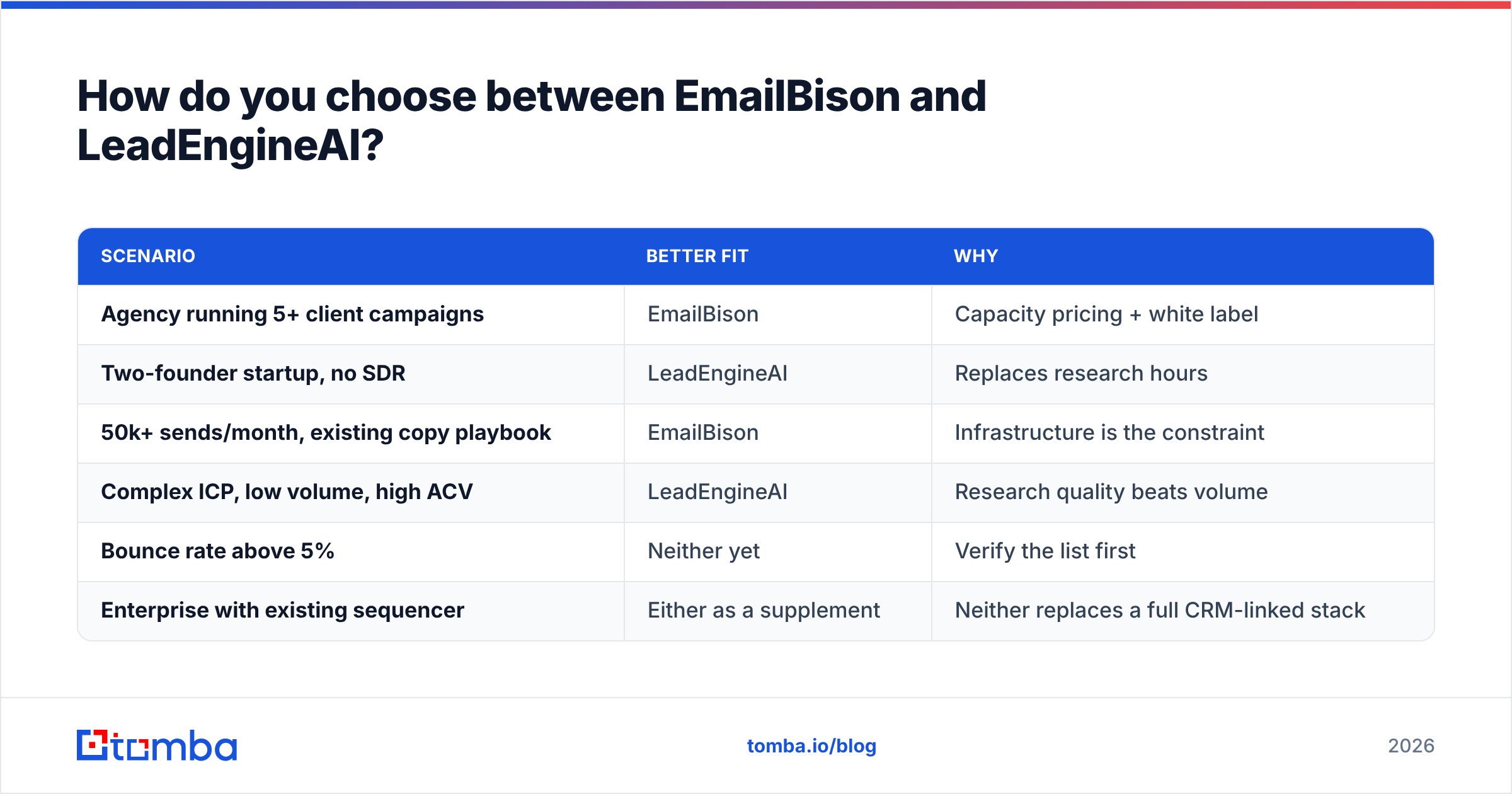
| Scenario | Better fit | Why |
|---|---|---|
| Agency running 5+ client campaigns | EmailBison | Capacity pricing + white label |
| Two-founder startup, no SDR | LeadEngineAI | Replaces research hours |
| 50k+ sends/month, existing copy playbook | EmailBison | Infrastructure is the constraint |
| Complex ICP, low volume, high ACV | LeadEngineAI | Research quality beats volume |
| Bounce rate above 5% | Neither yet | Verify the list first |
| Enterprise with existing sequencer | Either as a supplement | Neither replaces a full CRM-linked stack |
The uncomfortable truth for a "vs" article: a meaningful share of teams that evaluate both end up running an AI research layer and a volume sending layer, because they solve different problems. Budget accordingly rather than forcing a single winner.
What does the full outbound stack actually look like in 2026?#
Four layers, and most teams underinvest in the first one.
- Data layer — finding and verifying contacts. This is where campaigns are won or lost, and it is the layer neither EmailBison nor LeadEngineAI owns.
- Intelligence layer — ICP scoring, research, message generation. LeadEngineAI's home turf.
- Sending layer — mailboxes, domains, warmup, rotation, throughput. EmailBison's home turf.
- Measurement layer — reply classification, pipeline attribution, and the feedback loop back into layer one.
When outbound underperforms, teams instinctively swap the sending layer, because it is the most visible. In practice the data layer is the usual culprit. A 92%-accurate list and a 70%-accurate list run through the identical platform produce results that look like two different companies.
That is also the cheapest layer to fix. Verifying a 10,000-contact list costs less than one month of most sending platforms and typically moves reply rate more than any feature comparison you will read this year — including this one.
Getting the data layer right before you pick a platform#
Whichever way the EmailBison vs LeadEngineAI decision goes, both platforms start working the moment you feed them contacts that actually exist. That is the part you control today.
Tomba's Email Finder finds professional addresses by domain, name, or company, with SMTP-level verification built into the same workflow — so contacts arrive deliverable rather than "probably fine." The free tier gives you 25 searches a month to test the accuracy on your own target accounts before spending anything; paid plans start at $49/mo (Starter), with Growth at $99/mo and Pro at $249/mo. Full Tomba pricing is public, and the Tomba API drops straight into whichever sending or AI layer you land on.
Verify the list first. Then argue about platforms.
Related guides#
Ready to find emails that actually work?
Join 150,000+ professionals who stopped guessing and started sending. Free credits on signup — no credit card required.
Get the Tomba newsletter
Practical outbound tactics and product updates — once every two weeks.
About the author