Emailchaser Pricing in 2026: Plans, Real Costs, and Limits
Emailchaser sells simplicity and flat per-user pricing. Here is what each tier actually covers in 2026, the costs that sit outside the invoice, and when a cheaper stack does the same job.
TL;DR
- Emailchaser is a deliberately simple cold email sending tool: sequences, inbox rotation, reply detection, and Gmail/Outlook connections — priced per user rather than per contact.
- Published list pricing starts in the ~$29/user/month range and scales with seats and contact volume. Confirm live numbers on emailchaser.com before you commit; vendors in this category re-price often.
- The sticker price is never the real price. A working cold email stack also needs mailboxes, domains, warmup, verified contact data, and usually a CRM. Sending software is typically 20–30% of the total.
- Emailchaser does not sell you a contact database or a serious verification layer. That gap is where most teams overspend — or where their bounce rate quietly kills the domain.
- Best fit: small teams and agencies who want a low-drama sender and already have a data source. Poor fit: teams expecting an all-in-one Apollo-style platform.
What is Emailchaser and who is it actually for?#
Emailchaser is cold email outreach software. You connect mailboxes, upload a list, write a sequence, and it sends and follows up until someone replies. Think of it as a very well-behaved mail merge with a reply detector attached — not a revenue platform, not a database, not a CRM.
That narrow scope is the product strategy. Where Instantly, Smartlead, and Apollo keep bolting on features (lead databases, AI writers, inbox marketplaces, dialers), Emailchaser stays close to the original job: get a personalized sequence out of a real mailbox without tripping spam filters.
Who it suits:
- Agencies running client campaigns who need per-client separation and don't want to pay per contact.
- Founder-led sales teams of 1–5 people sending a few hundred emails a day, not tens of thousands.
- Consultants and recruiters with a hand-built list who need follow-up automation more than they need scale.
- Teams already paying for data elsewhere — a database subscription, a scraping stack, or an email finder API.
- Anyone burned by credit-based pricing who wants a predictable monthly line item.
Who it doesn't suit: outbound teams that want prospecting, enrichment, dialing, and sending under one login. That's a different product category and a different budget.
How does Emailchaser pricing work in 2026?#
Emailchaser prices per user seat, with plan tiers gating contact volume and team features. This matters more than the headline number: seat-based pricing punishes headcount and rewards volume, which is the exact inverse of credit-based tools like Apollo or Lusha.
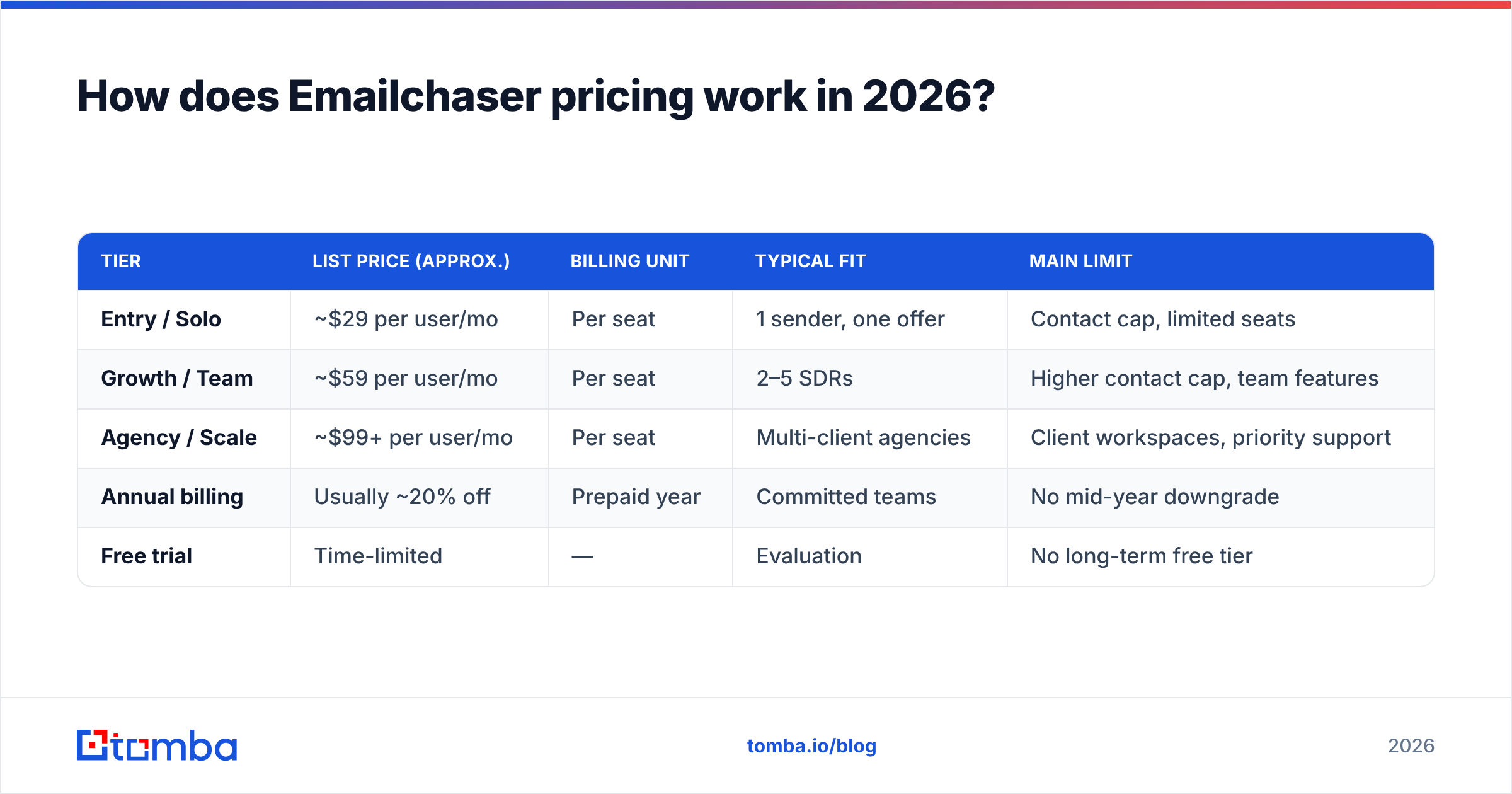
Here's the shape of the pricing model as published at the time of writing. Treat the dollar figures as directional — always verify on the vendor's own pricing page, since cold email tools re-price and re-package plans several times a year.
| Tier | List price (approx.) | Billing unit | Typical fit | Main limit |
|---|---|---|---|---|
| Entry / Solo | ~$29 per user/mo | Per seat | 1 sender, one offer | Contact cap, limited seats |
| Growth / Team | ~$59 per user/mo | Per seat | 2–5 SDRs | Higher contact cap, team features |
| Agency / Scale | ~$99+ per user/mo | Per seat | Multi-client agencies | Client workspaces, priority support |
| Annual billing | Usually ~20% off | Prepaid year | Committed teams | No mid-year downgrade |
| Free trial | Time-limited | — | Evaluation | No long-term free tier |
Two structural things to note.
Per-seat, not per-contact. If you send 50,000 emails from two seats, seat pricing is a bargain. If you have eight people each sending 500 emails a month, it's expensive. Do the arithmetic on your own team shape before comparing to a credit-based tool.
Mailbox connections are usually generous but not free in real terms. Even when a plan allows many connected inboxes, each Google Workspace or Microsoft 365 mailbox costs $6–$12/month from the provider. Ten sending mailboxes is $60–$120/month on top of your Emailchaser invoice.

What is not included in Emailchaser pricing?#
This is the section most pricing posts skip. Sending software is one line in a five-line budget.
- Contact data. Emailchaser is not a B2B database. You bring the list. That means an email finder, a data vendor, or a scraping workflow — a separate spend.
- Email verification. Sending to unverified addresses is the fastest way to burn a domain. A dedicated email verifier is not optional in 2026; Google and Microsoft both enforce bounce and complaint thresholds on bulk senders. Google's own bulk sender guidelines spell out the spam-rate ceiling you have to stay under.
- Mailboxes and domains. Expect $6–$12/mailbox/month plus ~$10–$15/domain/year for each secondary sending domain.
- Warmup. Some senders bundle it, some sell it as an add-on, some assume you'll use a third-party service. Budget $20–$50/month if it isn't included.
- CRM sync. If you need reply data flowing into HubSpot or Salesforce, check whether it's native, via Zapier, or not at all. Zapier tasks add up.
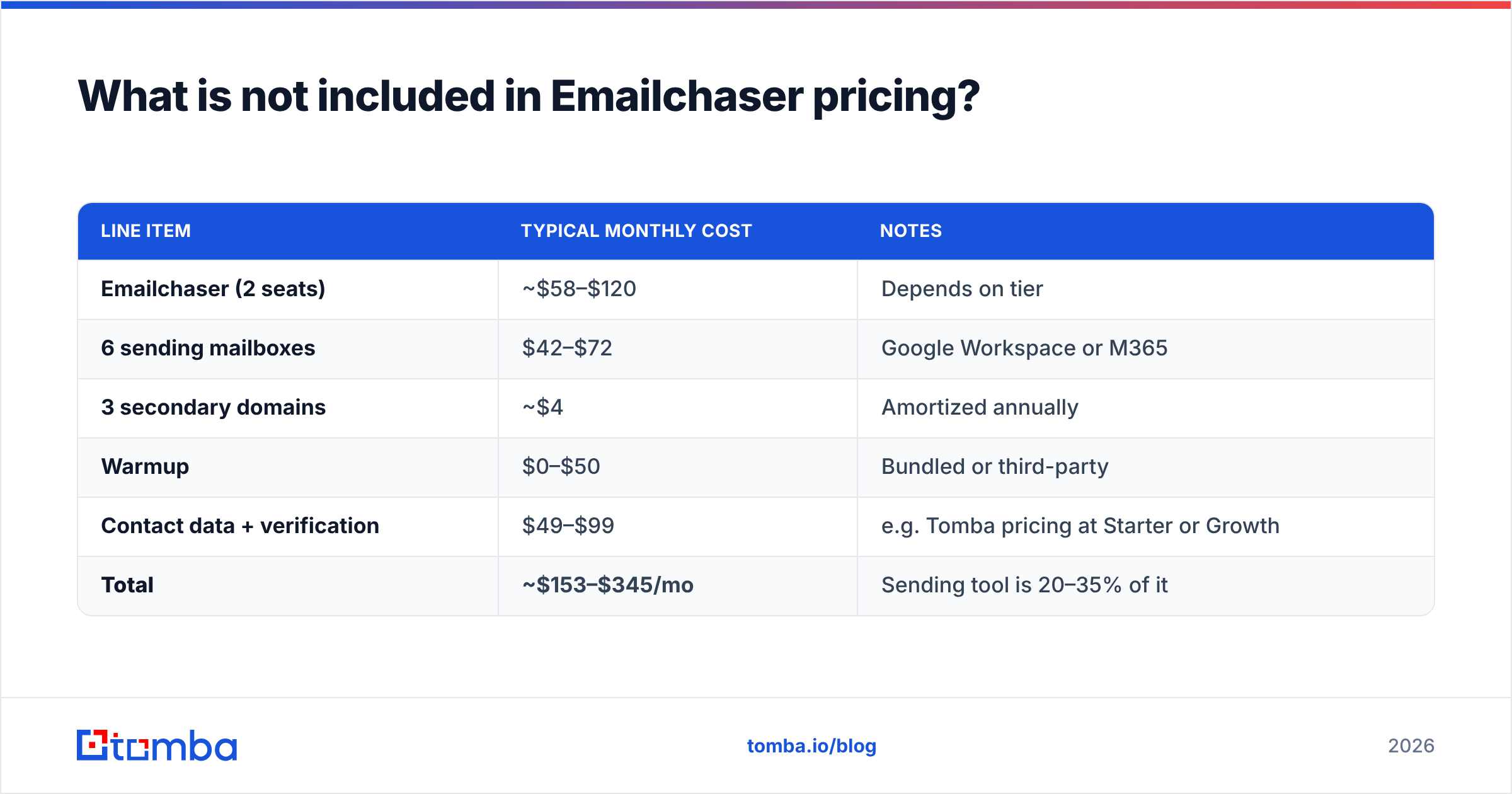
Here's a realistic monthly stack cost for a two-person outbound team sending ~6,000 emails a month:
| Line item | Typical monthly cost | Notes |
|---|---|---|
| Emailchaser (2 seats) | ~$58–$120 | Depends on tier |
| 6 sending mailboxes | $42–$72 | Google Workspace or M365 |
| 3 secondary domains | ~$4 | Amortized annually |
| Warmup | $0–$50 | Bundled or third-party |
| Contact data + verification | $49–$99 | e.g. Tomba pricing at Starter or Growth |
| Total | ~$153–$345/mo | Sending tool is 20–35% of it |
The lesson isn't that Emailchaser is expensive. It's that comparing sender A at $29 to sender B at $37 is arguing over 5% of your outbound budget while ignoring the 40% you spend on data quality.
Is Emailchaser worth it versus the alternatives?#
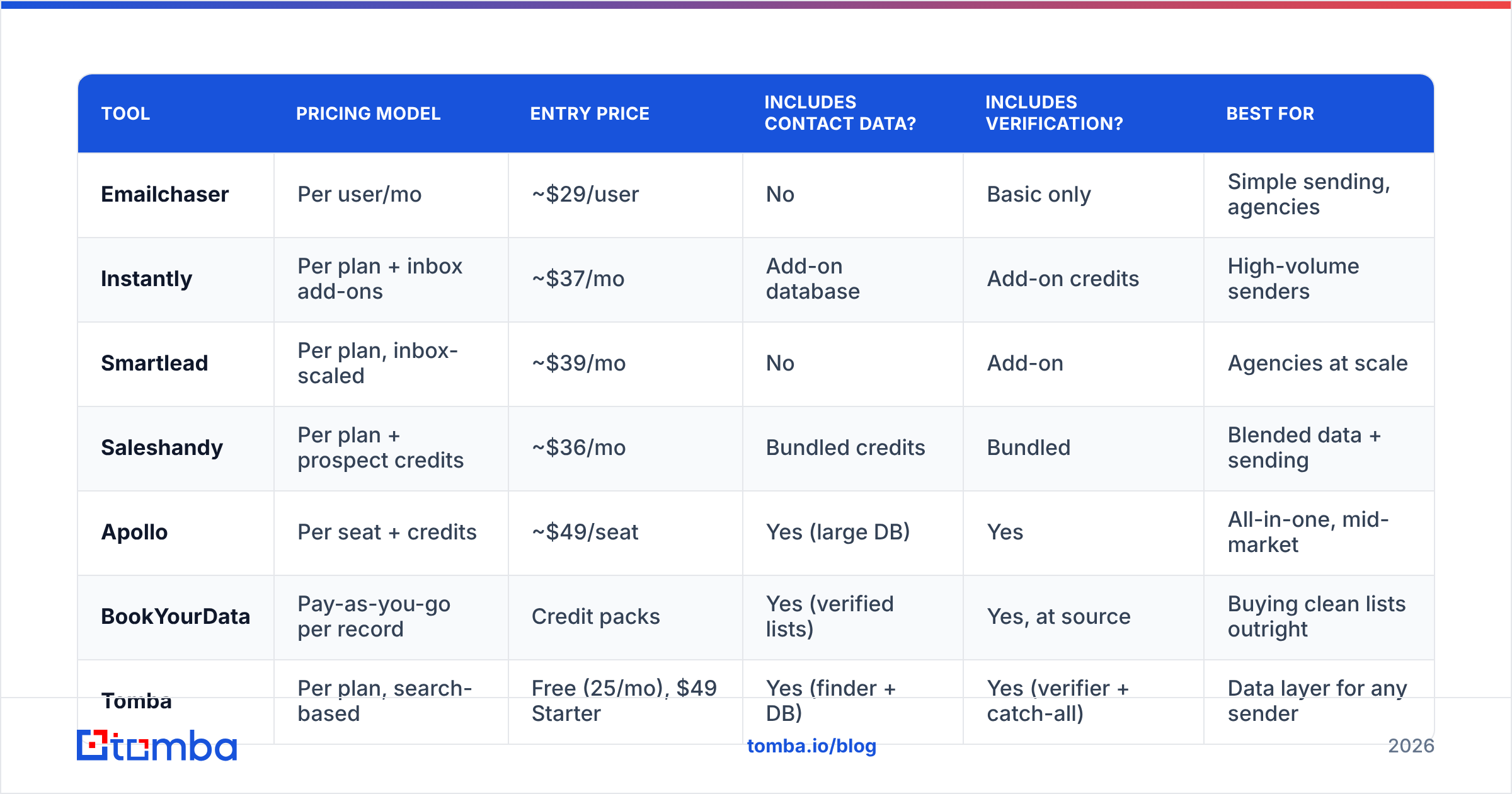
Depends entirely on which problem you're solving. Here's how the main options line up on pricing model — the axis that actually determines your bill.
| Tool | Pricing model | Entry price | Includes contact data? | Includes verification? | Best for |
|---|---|---|---|---|---|
| Emailchaser | Per user/mo | ~$29/user | No | Basic only | Simple sending, agencies |
| Instantly | Per plan + inbox add-ons | ~$37/mo | Add-on database | Add-on credits | High-volume senders |
| Smartlead | Per plan, inbox-scaled | ~$39/mo | No | Add-on | Agencies at scale |
| Saleshandy | Per plan + prospect credits | ~$36/mo | Bundled credits | Bundled | Blended data + sending |
| Apollo | Per seat + credits | ~$49/seat | Yes (large DB) | Yes | All-in-one, mid-market |
| BookYourData | Pay-as-you-go per record | Credit packs | Yes (verified lists) | Yes, at source | Buying clean lists outright |
| Tomba | Per plan, search-based | Free (25/mo), $49 Starter | Yes (finder + DB) | Yes (verifier + catch-all) | Data layer for any sender |
A few honest reads on that table.
Emailchaser vs Instantly / Smartlead. These are close substitutes. Instantly and Smartlead win on scale features (inbox rotation at volume, deliverability tooling, marketplace inboxes). Emailchaser wins on simplicity and predictable seat cost. If your campaigns are under ~10,000 sends/month, the extra machinery is overhead you pay for and don't use. If you're an agency running 40 clients, the scale tools earn their keep. Cross-check current user sentiment on G2 before you decide — this category's feature parity shifts fast.
Emailchaser vs Apollo. Not really competitors. Apollo bundles the database, so the seat price hides a data cost you'd otherwise pay separately. If Apollo's data covers your ICP, the bundle can be cheaper than buying pieces. If your ICP is niche — regional SMBs, non-English markets, technical roles — bundled databases thin out fast and you end up paying for coverage you can't use.
Emailchaser vs BookYourData. Also not competitors, and worth understanding as complements. BookYourData sells verified contact records on a pay-as-you-go basis; Emailchaser sends to them. If your buying pattern is "one big list, twice a year," a per-record purchase is often cleaner than a monthly data subscription. If it's "fresh contacts every week," subscription data with an API wins.
Emailchaser vs a data-layer subscription. This is the pairing most teams land on. You keep a cheap, simple sender and put your money into contact quality — because deliverability is downstream of list quality far more than it is of sending software.
What actually drives your cold email cost — features or data?#
Data. It isn't close.
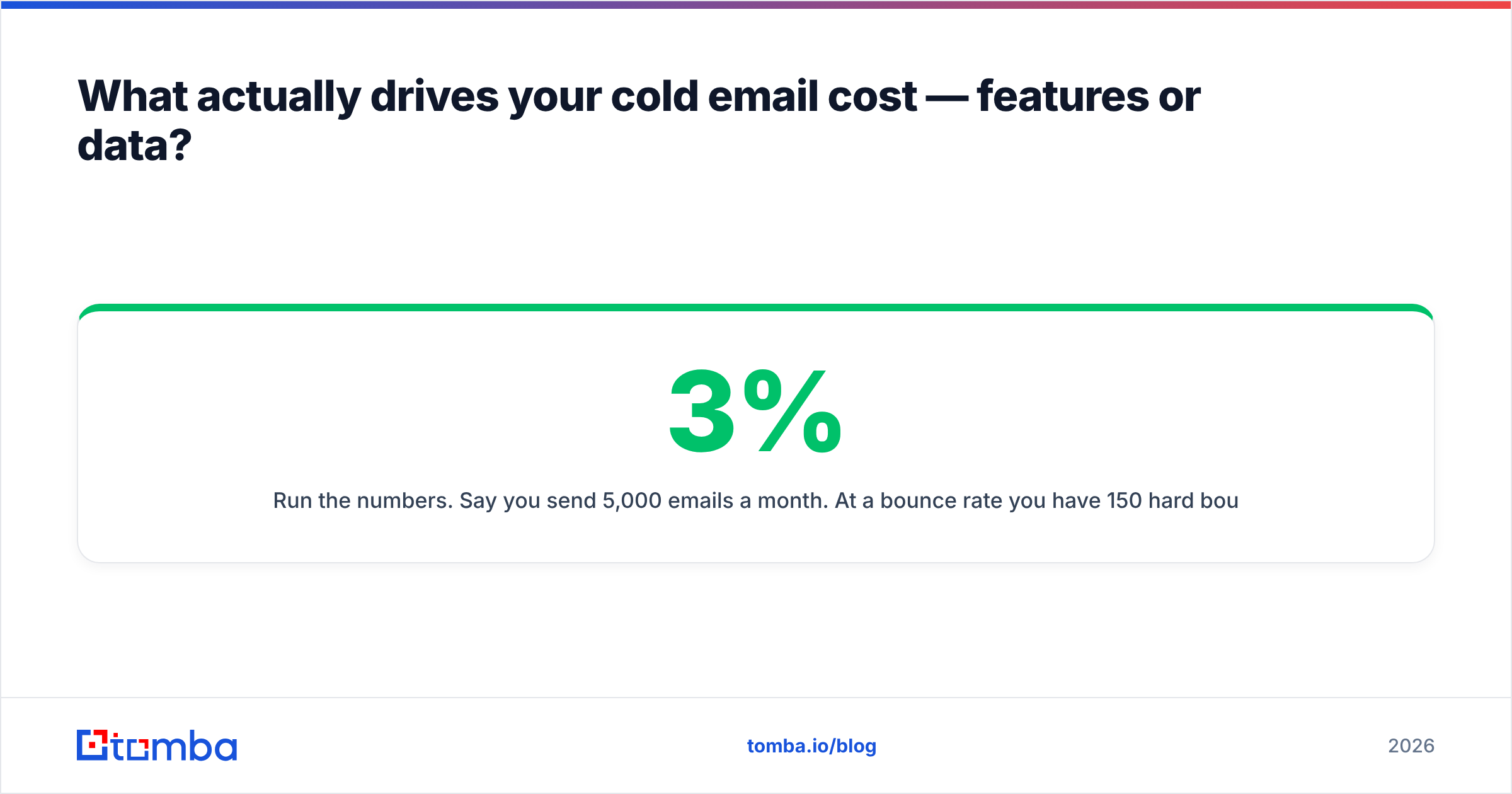
Run the numbers. Say you send 5,000 emails a month. At a 3% bounce rate you have 150 hard bounces — annoying but survivable. At a 15% bounce rate (typical for an unverified scraped list) you have 750, and both Google and Microsoft start throttling you. The tool that sent those emails cost you $29. The domain reputation you just spent three weeks rebuilding cost you a month of pipeline.
Concretely, the cost drivers ranked:
- List accuracy. Every 10 points of bounce rate is roughly one sending domain you'll eventually have to replace and re-warm.
- Catch-all handling. Catch-all domains accept everything at SMTP time and bounce later, or never — they're invisible risk. A catch-all verifier is the difference between a "verified" list and an actually verified list.
- Mailbox count. More inboxes means more spend and more warmup, but lower per-inbox volume and better deliverability. This is a real trade-off, not a free lunch.
- Personalization depth. Enrichment costs money. Generic sequences are cheap and convert at a rate that makes them expensive.
- Sending software. Last, and smallest. Feature differences between the top five senders are marginal for most teams.
- Seat count. Under per-user pricing, adding a junior SDR who sends 200 emails a month costs the same as adding your best closer. Consolidate seats where you can.
If your outbound isn't working, the fix is almost never a different sending tool. It's a better list, a tighter ICP, and a message that earns a reply.
When should you pick Emailchaser — and when should you skip it?#
Pick it if:
- You send moderate volume (under ~10,000/month) and value predictable billing.
- You're an agency who needs clean client separation without per-contact metering.
- You already have a data source and don't want to pay twice for a bundled database you won't use.
- You've been burned by credit systems where "1,000 credits" turned out to mean 300 usable contacts.
Skip it if:
- You need prospecting, enrichment, dialing, and sending in one place — buy an all-in-one and accept the seat price.
- Your team is large and each person sends very little. Per-seat pricing will punish you.
- You need enterprise controls: SSO, granular permissions, audit logs, procurement-friendly contracts.
- You expect the sender to fix your deliverability. No sender does that. Your list, your domains, and your warmup do.
Before you buy, run this check: take 200 contacts from your current list, run them through a verifier, and look at what percentage comes back valid. Under 85%? Fix your data before you shop for a sender. That single test predicts campaign performance better than any feature comparison you'll read — including this one.
How do you build the cheapest stack that actually works?#
A minimum viable outbound stack in 2026 looks like this:
- Sender: Emailchaser, or any comparable tool at $29–$60/month. Pick on ergonomics; they're all competent.
- Mailboxes: 3 secondary domains, 2–3 mailboxes each, 30–50 sends per mailbox per day. Never send from your primary domain.
- Warmup: 3–4 weeks before your first campaign. Use a warmup calculator to set a ramp schedule instead of guessing.
- Data: a finder plus a verifier, run as one step. Find the address, verify it, resolve catch-alls, then load it.
- Tracking: reply-based, not open-based. Open tracking pixels hurt deliverability and lie to you anyway.
That stack runs $150–$350/month for a two-person team and outperforms a $500/month all-in-one that's fed a dirty list. The constraint was never the software.
The bottom line on Emailchaser pricing#
Emailchaser is fairly priced for what it is: a focused, per-seat cold email sender for small teams and agencies who don't need a database bolted on. The entry tier is genuinely affordable, the billing model is predictable, and the absence of credit-counting is a real quality-of-life win. Its limitation is also its design — it won't find your contacts, and it won't tell you which of them are real.
So budget accordingly. Give the sender its $29–$99, and give the data layer at least as much. That's the allocation that produces replies.
Ready to fix the expensive half of the equation? Tomba's Email Finder finds verified professional addresses by domain, name, or company, with catch-all resolution built in — so the list you load into Emailchaser (or any sender) doesn't torch your domain in week two. Start free with 25 searches a month, or move to Starter at $49/month when the campaigns start working.
Related guides#
Ready to find emails that actually work?
Join 150,000+ professionals who stopped guessing and started sending. Free credits on signup — no credit card required.
Get the Tomba newsletter
Practical outbound tactics and product updates — once every two weeks.
About the author