EmailListValidation vs ApolloIO (2026): Which One Wins?
EmailListValidation vs ApolloIO: one cleans lists, the other builds them. We break down pricing, accuracy, bounce rates, and where each tool falls short in 2026.
EmailListValidation vs ApolloIO is the wrong fight to pick until you know which half of the job you need. One tool cleans lists. The other builds them. Here is the short version, then the detail.
TL;DR
- EmailListValidation is a verification-only tool. ApolloIO is a contact database plus sequencer. They solve different halves of the same problem. So "which is better" depends on whether you already have a list.
- Apollo's 275M+ contact database is its moat. Its built-in email verification is the weak link. Plenty of teams export Apollo data and re-verify it elsewhere before sending.
- EmailListValidation's pay-as-you-go credits start around $0.0045/email at volume. That beats most subscription verifiers if you clean lists in bursts rather than nonstop.
- Want find + verify in one place, without a per-seat sales-engagement price tag? A dedicated finder like Tomba covers both jobs at $49/mo.
- The expensive mistake is buying Apollo for data and skipping a second verification pass. You still need one.
EmailListValidation vs ApolloIO: What Is Each Tool?#
They are not rivals in the strict sense. They are neighbors in the same workflow.
EmailListValidation (emaillistvalidation.com) is a bulk email verification service. You upload a CSV of addresses you already have. It returns a status for each one: valid, invalid, disposable, role-based, or catch-all/unknown. It runs syntax checks, MX record lookups, SMTP handshakes, disposable-domain matching, and spam-trap flags. It will not find you a single new contact.
Apollo.io (apollo.io) is a go-to-market platform. Its core asset is a B2B contact and company database — Apollo advertises 275M+ contacts and 73M+ companies. Around it sit filters, a Chrome extension, sequences, a dialer, and CRM sync. Verification exists inside Apollo, but it is a byproduct, not the product.
So here is the honest framing. EmailListValidation is a quality gate. ApolloIO is a supply source. Compare them head-to-head on one metric and you will pick wrong.
How Do They Compare on Features and Pricing?#
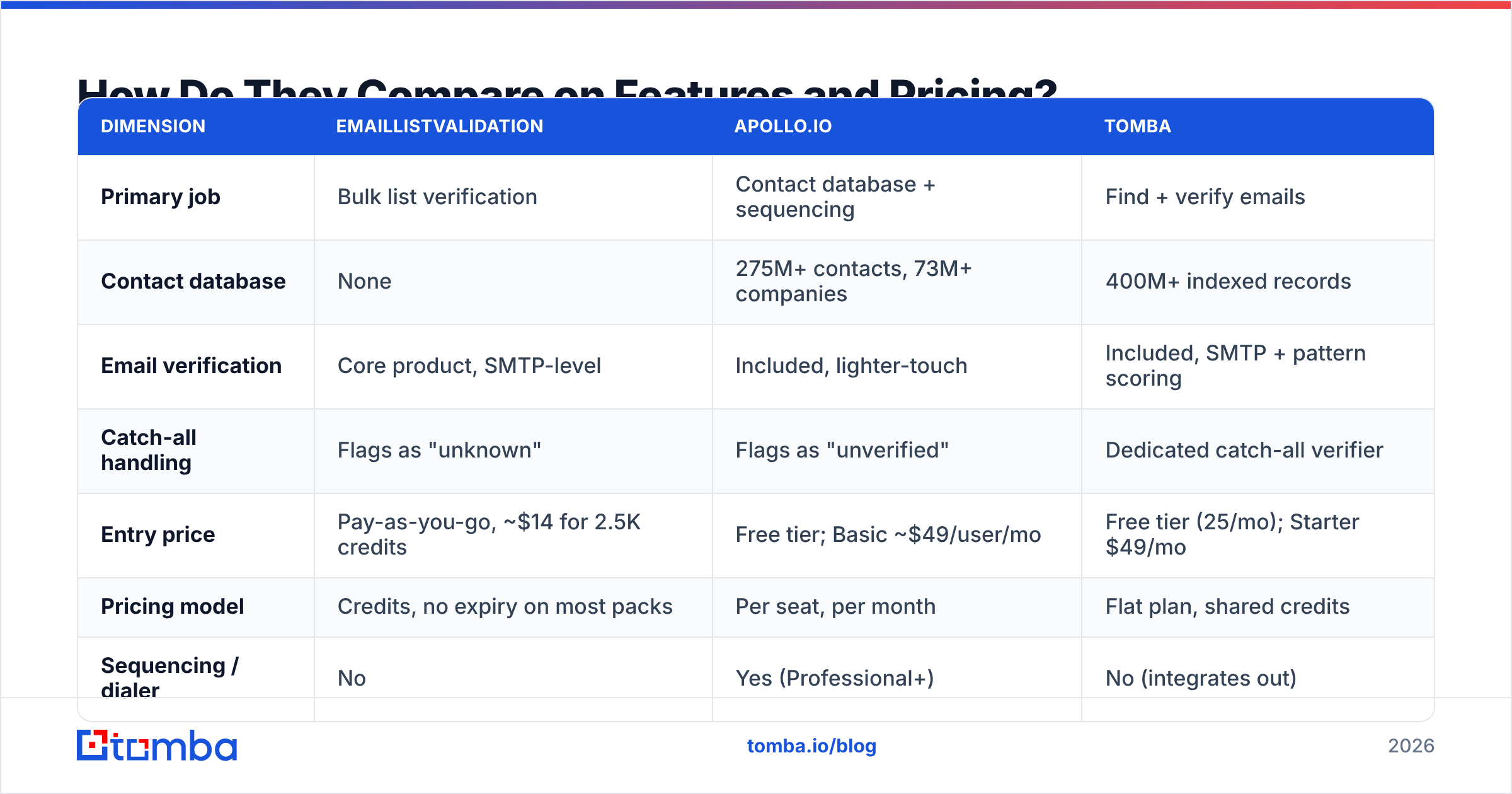
Here is the side-by-side that matters when you decide where the budget goes.
| Dimension | EmailListValidation | Apollo.io | Tomba |
|---|---|---|---|
| Primary job | Bulk list verification | Contact database + sequencing | Find + verify emails |
| Contact database | None | 275M+ contacts, 73M+ companies | 400M+ indexed records |
| Email verification | Core product, SMTP-level | Included, lighter-touch | Included, SMTP + pattern scoring |
| Catch-all handling | Flags as "unknown" | Flags as "unverified" | Dedicated catch-all verifier |
| Entry price | Pay-as-you-go, ~$14 for 2.5K credits | Free tier; Basic ~$49/user/mo | Free tier (25/mo); Starter $49/mo |
| Pricing model | Credits, no expiry on most packs | Per seat, per month | Flat plan, shared credits |
| Sequencing / dialer | No | Yes (Professional+) | No (integrates out) |
| API | Yes | Yes | Yes — Tomba API |
| Free tier | 100 test credits | 10K credits/mo, limited exports | 25 searches/mo |
| Best for | Cleaning lists you already own | Building lists from scratch | Targeted find-and-verify |
The pricing model is the real split, and it decides more than people expect. EmailListValidation charges per email verified. Most credit packs do not expire, which suits sporadic, campaign-driven cleaning. Apollo charges per seat, per month. A five-person SDR team on the Professional tier is a very different line item than a one-off 50K-record verification job.
Where the money actually goes#
- Seat count multiplies Apollo fast. One user at ~$49/mo is cheap. Five users on Professional is not. Verification tools skip this problem — one API key serves the whole team.
- Apollo's export limits are the real constraint. The headline credit count looks generous. The per-plan export caps and enrichment credit rules are where teams hit a wall mid-quarter. Read the current Apollo pricing page before you model spend.
- You pay for verification twice if you verify at export and again before send. Budget for one clean pass, not two.
- Bounce cost stays invisible until it isn't. A 6% bounce rate on a warm domain wastes credits. Worse, it dents sender reputation, and no refund covers that.
Which One Is More Accurate?#
Accuracy means something different for each tool. So answer the two questions one at a time.
For EmailListValidation, accuracy means: did it label the addresses I gave it correctly? Verifiers of this class usually land in the 95–98% range on standard corporate domains. Catch-all domains are the failure mode. The mail server accepts every address, so no verifier can give you a firm yes. EmailListValidation is honest about this and returns "unknown" instead of guessing. That is the right call. It also means part of your list stays in limbo. Many enterprise targets sit on catch-all setups, and so does a lot of Microsoft 365 with loose config. Plan a separate catch-all verification step for them.
For Apollo.io, accuracy means: is the contact record itself correct and current? That is a harder problem. Apollo pulls data from public sources, contributory networks, and its own crawling. Independent G2 reviews flag the same pattern again and again. Coverage is excellent in US tech and mid-market SaaS. It thins out fast outside North America. Job titles go stale in fast-moving orgs. Community-reported bounce rates on unverified Apollo exports often sit in the 8–15% range. The "verified" subset does much better, but it shrinks your usable list.
The practical takeaway: Apollo's verified filter is a floor, not a ceiling. Export the verified subset. Then run it through a real verifier before it touches your sending domain. That is not a knock on Apollo. It is how most mature outbound teams work.
Do You Actually Need Both?#
Often yes. That is the uncomfortable part of this comparison.
The classic stack runs like this: Apollo for sourcing, export to CSV, EmailListValidation for cleaning, then Instantly or Smartlead for sending. Three vendors, three bills, three places for data to drift. It works, and plenty of teams run it. But you pay a database price and a verification price for one outcome: a list of addresses that land.
The alternative is one tool that finds and verifies in a single pass. That is the slot Tomba sits in. Use domain search to pull every public address at a company. Use the email verifier to confirm deliverability before export. Use bulk processing for the list-level work. One $49/mo Starter plan, shared credits, no per-seat math. You do give up Apollo's sequencer and dialer. If your reps live inside a sequencer all day, Apollo (or a dedicated sender) still earns its slot.
One more path is worth naming. If you would rather not build lists at all, prebuilt databases like BookYourData sell pre-verified contacts with a bounce guarantee. That skips the sourcing-then-cleaning loop. The economics differ, and so does the workflow. Price it out if your ICP is stable and well defined.

What Are the Real Downsides of Each?#
No tool review is useful without this section.
EmailListValidation's weak points:
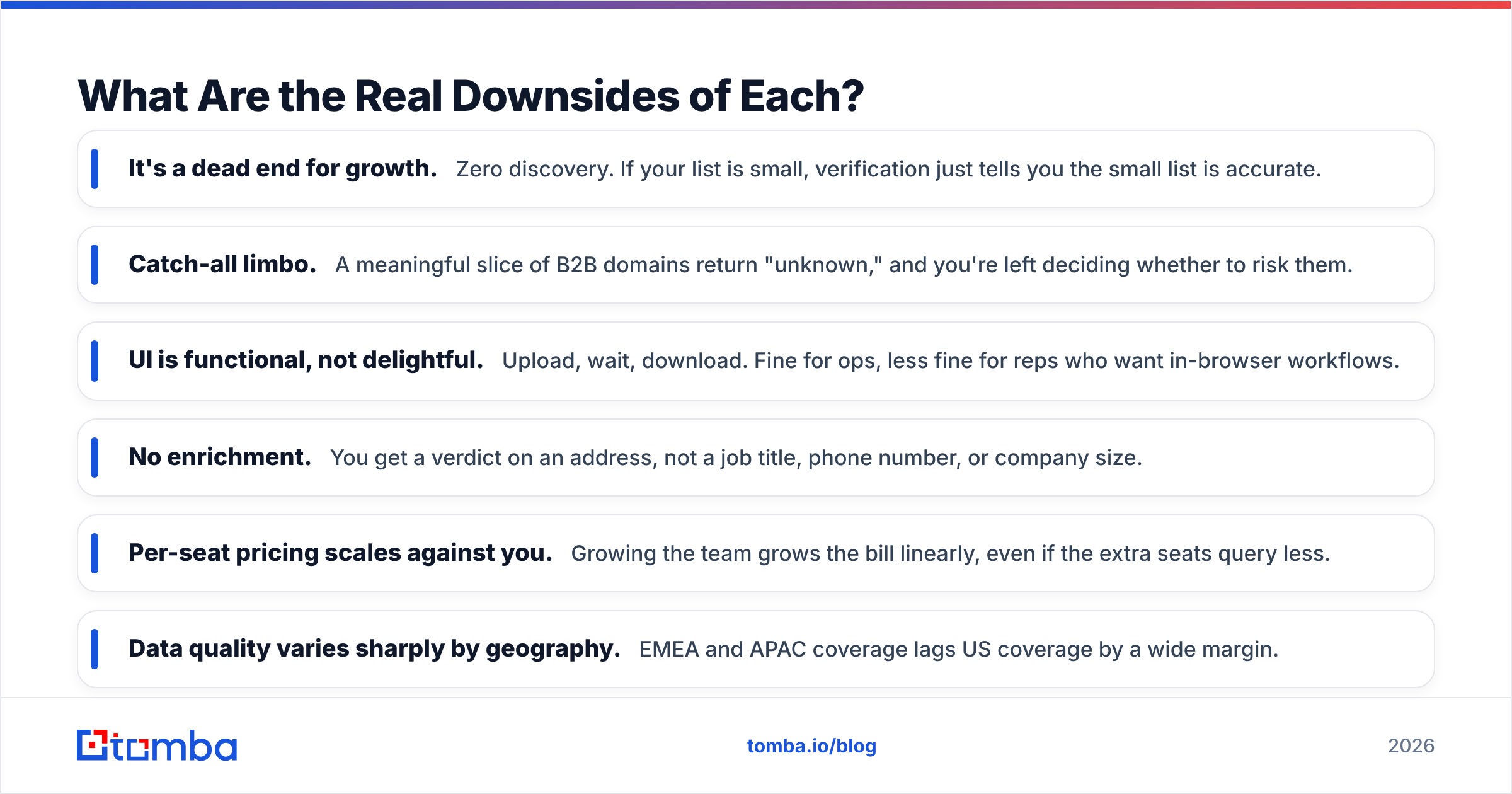
- It is a dead end for growth. No discovery at all. If your list is small, verification only tells you the small list is clean.
- Catch-all limbo. A real slice of B2B domains come back "unknown." You are left deciding whether to risk them.
- The UI is functional, not delightful. Upload, wait, download. Fine for ops. Less fine for reps who want in-browser workflows.
- No enrichment. You get a verdict on an address. Not a job title, a phone number, or a company size.
Apollo.io's weak points:
- Per-seat pricing scales against you. Each new rep adds cost, even if that rep barely queries the database.
- Data quality varies sharply by region. EMEA and APAC coverage lags the US by a wide margin.
- Verification is not a substitute for a verifier. Treat "verified" as a strong hint, not a promise.
- Feature sprawl. Sequencer, dialer, meeting scheduler, CRM-lite, AI writer. You pay for all of it, used or not.
- Contributory data model. Apollo has enriched its database partly through user-connected mailboxes. Check what that means for your email deliverability and your privacy posture before you connect anything.
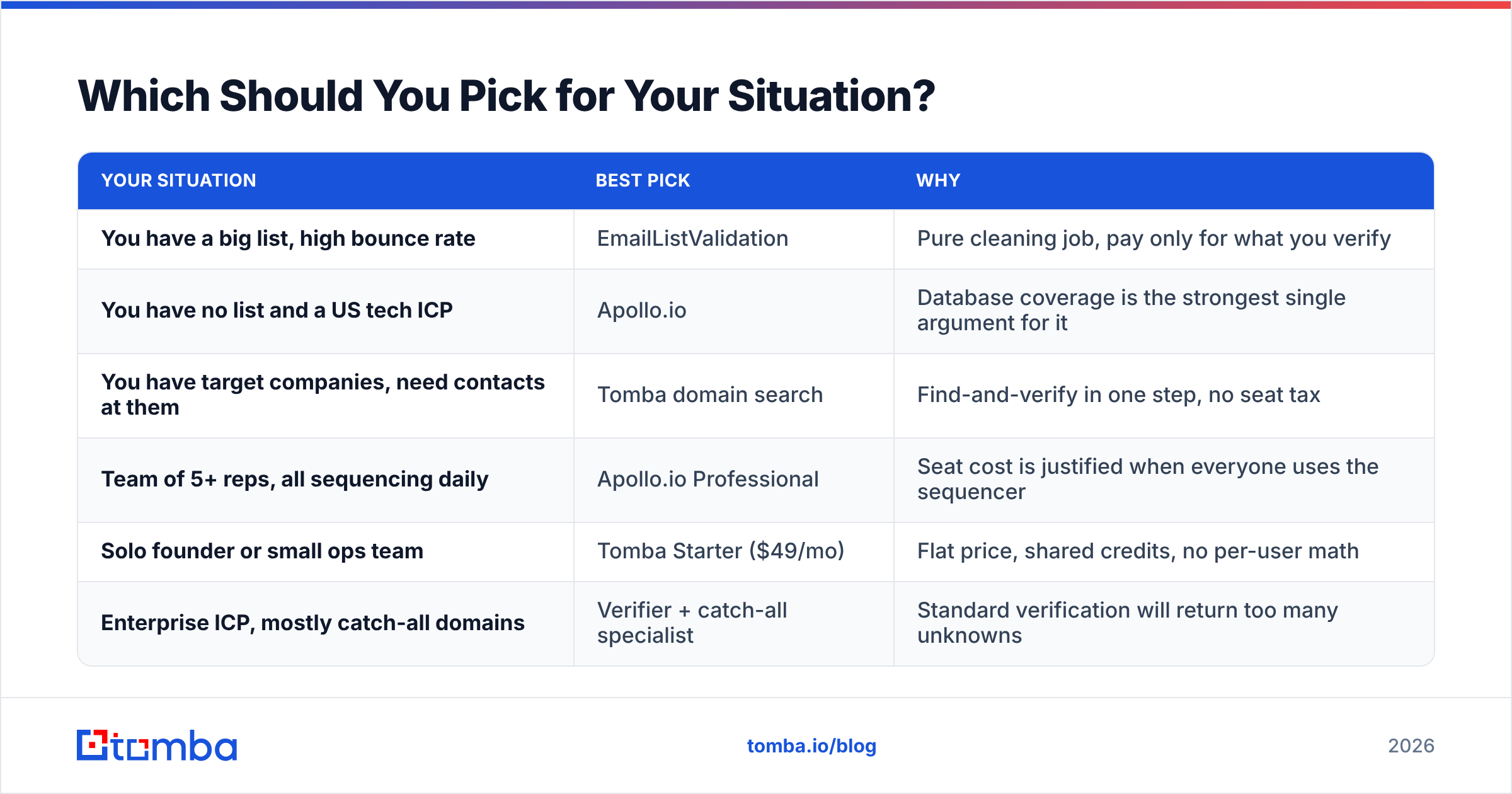
Which Should You Pick for Your Situation?#
Match the tool to the actual bottleneck.
| Your situation | Best pick | Why |
|---|---|---|
| You have a big list, high bounce rate | EmailListValidation | Pure cleaning job, pay only for what you verify |
| You have no list and a US tech ICP | Apollo.io | Database coverage is the strongest single argument for it |
| You have target companies, need contacts at them | Tomba domain search | Find-and-verify in one step, no seat tax |
| Team of 5+ reps, all sequencing daily | Apollo.io Professional | Seat cost is justified when everyone uses the sequencer |
| Solo founder or small ops team | Tomba Starter ($49/mo) | Flat price, shared credits, no per-user math |
| Enterprise ICP, mostly catch-all domains | Verifier + catch-all specialist | Standard verification will return too many unknowns |
A simple decision rule. If more than half your prospecting time goes into finding people, you have a data problem. Buy a database or a finder. If more than half goes into fixing a list you already have, you have a hygiene problem. Buy a verifier. Buy the wrong one and it costs you a quarter.
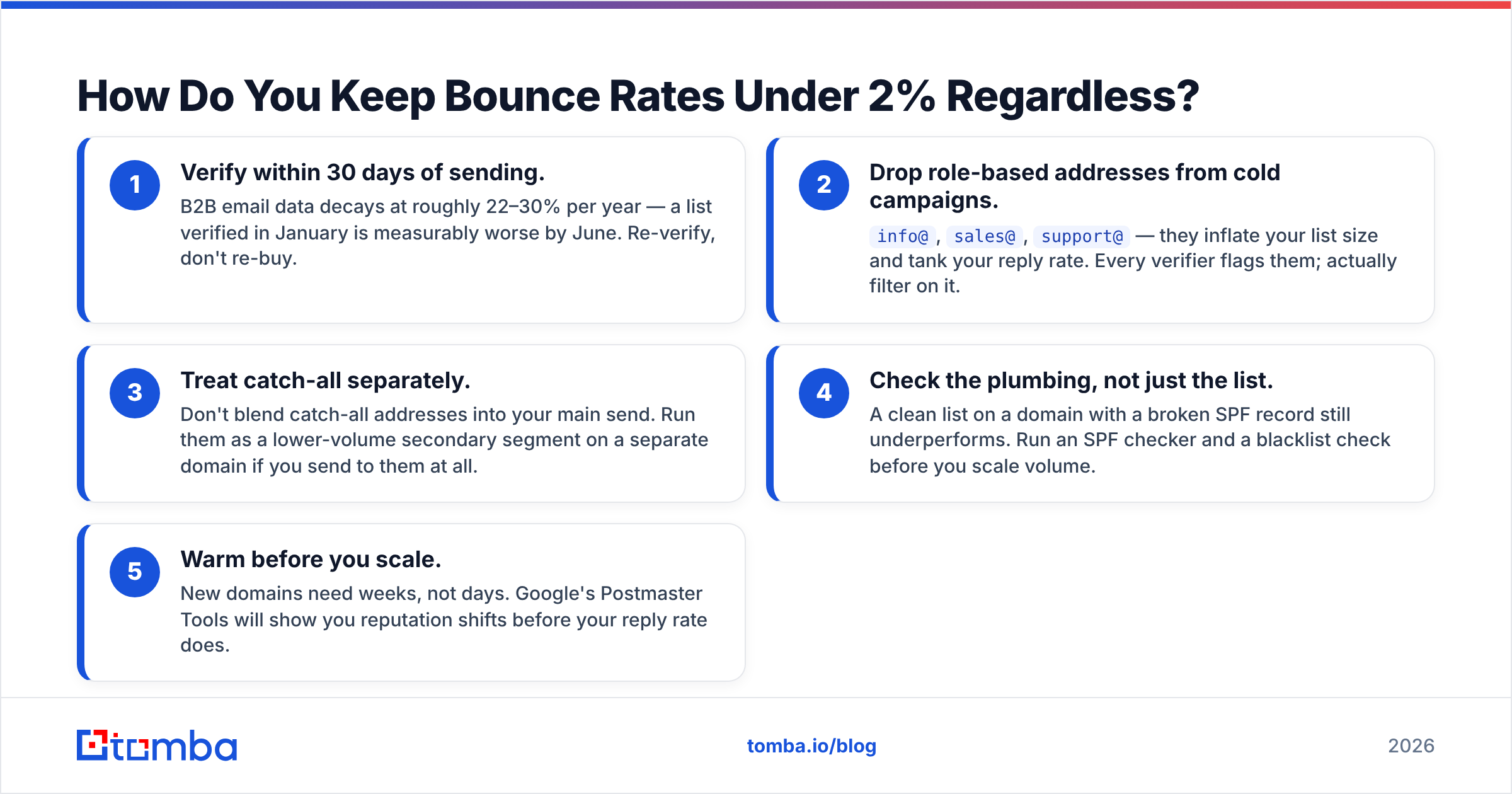
How Do You Keep Bounce Rates Under 2% Regardless?#
The tool choice matters less than the process around it. Five things move the number:
- Verify within 30 days of sending. B2B email data decays 22–30% a year. A list verified in January is measurably worse by June. Re-verify, don't re-buy.
- Drop role-based addresses from cold campaigns.
info@,sales@, andsupport@pad your list size and sink your reply rate. Every verifier flags them. Actually filter on it. - Treat catch-all separately. Keep catch-all addresses out of your main send. Run them as a smaller second segment on a separate domain, if you send to them at all.
- Check the plumbing, not just the list. A clean list on a domain with a broken SPF record still underperforms. Run an SPF checker and a blacklist check before you scale volume.
- Warm before you scale. New domains need weeks, not days. Google's Postmaster Tools shows reputation shifts before your reply rate does.
Do these five things and a 1–2% bounce rate is within reach with either tool. Skip them and no verifier can save you.
What's the Verdict for 2026?#
EmailListValidation wins if your problem is a dirty list. It is focused, priced per unit, and it does not ask you to buy a platform. For an ops person cleaning quarterly imports, it is the cheaper, simpler answer.
ApolloIO wins if your problem is an empty pipeline and your ICP is US-centric. The database plus sequencer combo removes real vendors from your stack. Just accept that you still want a verification pass on the way out.
Neither wins if what you need is targeted find-and-verify at a flat price. That is the gap in EmailListValidation vs ApolloIO. Apollo overshoots on features and price for teams that just want accurate addresses at known companies. EmailListValidation undershoots because it cannot source anything.
Start with the Tomba Email Finder free tier. You get 25 searches a month, no card. Run it against ten companies already in your CRM. Compare what comes back with what your current stack gives you. If the addresses match and the verification holds, you have collapsed two line items into one at $49/mo. If they don't, you lost twenty minutes and learned something concrete about your data. Check the full Tomba pricing tiers when you are ready to scale past the free plan.
Related guides#
Ready to find emails that actually work?
Join 150,000+ professionals who stopped guessing and started sending. Free credits on signup — no credit card required.
Get the Tomba newsletter
Practical outbound tactics and product updates — once every two weeks.
About the author