EmailListValidation vs ZoomInfo: Which One Do You Actually Need?
One cleans lists for fractions of a cent. The other sells you a database for five figures a year. Here is the honest breakdown of which problem each tool actually solves, what they cost, and when neither is the right answer.
TL;DR
- EmailListValidation and ZoomInfo are not competitors. One verifies email addresses you already have; the other sells you contacts you do not have yet.
- EmailListValidation is priced per email (fractions of a cent at volume) with no contract. ZoomInfo is an annual, seat-based platform that typically lands in the five-figure range.
- If your problem is bounce rate, buy verification. If your problem is empty pipeline, buy data. Buying the wrong one wastes the entire budget.
- ZoomInfo's data breadth is genuinely hard to match, but you pay for coverage you will not use, and credit caps bite fast on high-volume outbound.
- A cheaper middle path exists: a find-and-verify tool like Tomba covers discovery and validation for $49/mo, and pairs fine with a dedicated bulk cleaner when you inherit a messy list.
What do EmailListValidation and ZoomInfo actually do?#
Start here, because half the people searching "emaillistvalidation vs zoominfo" are comparing a wrench to a hammer.
EmailListValidation is a bulk email verification service. You upload a CSV of addresses you already own — from a signup form, a scraped list, an old CRM export — and it tells you which ones will bounce. It runs syntax checks, MX record lookups, SMTP handshakes, disposable-domain detection, role-account flagging, and catch-all identification. It does not find you a single new contact. Its entire job is subtraction.
ZoomInfo is a B2B data platform. It maintains a database of hundreds of millions of business contacts and company profiles, and layers on org charts, technographics, buying-intent signals, conversation intelligence, and workflow automation. You search by filters (industry, headcount, title, tech stack) and it hands you contacts. Its job is addition.
So the honest framing is:
- Verification is a hygiene layer. It protects email deliverability and your sending domain. It creates zero new pipeline.
- Data platforms are a supply layer. They fill the top of the funnel. They do not guarantee the addresses they hand you are still deliverable.
- Most teams need both functions, but almost never from these two specific vendors at the same time — the price gap is too wide to justify.
- Overlap does exist: ZoomInfo validates its own records internally, and EmailListValidation will tell you a catch-all domain is unverifiable. Neither covers the other's core job.
- The buying decision is really a budget decision. One is a line item you can expense on a personal card. The other requires a procurement cycle.

How do EmailListValidation and ZoomInfo compare feature by feature?#
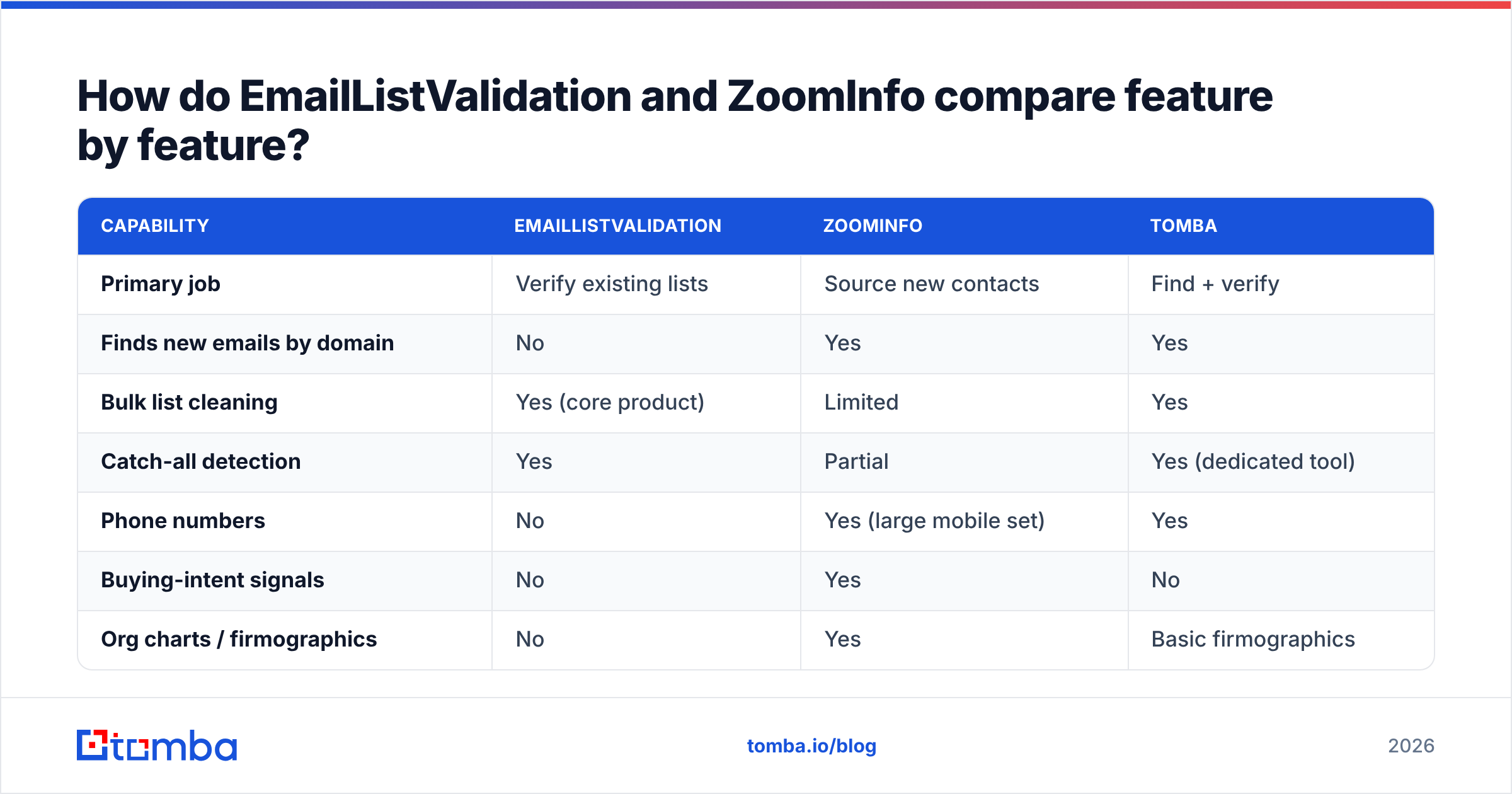
Here is the head-to-head, with Tomba included as a third reference point since it straddles both categories.
| Capability | EmailListValidation | ZoomInfo | Tomba |
|---|---|---|---|
| Primary job | Verify existing lists | Source new contacts | Find + verify |
| Finds new emails by domain | No | Yes | Yes |
| Bulk list cleaning | Yes (core product) | Limited | Yes |
| Catch-all detection | Yes | Partial | Yes (dedicated tool) |
| Phone numbers | No | Yes (large mobile set) | Yes |
| Buying-intent signals | No | Yes | No |
| Org charts / firmographics | No | Yes | Basic firmographics |
| Chrome extension | No | Yes | Yes |
| Public API | Yes | Yes (add-on) | Yes |
| Free tier | 100 test credits | Demo only | 25 searches/mo |
| Contract | Pay as you go | Annual, seat-based | Monthly, no contract |
| Entry price | ~$20 one-off credits | Quote only (five figures typical) | $49/mo |
Two things jump out. First, the feature sets barely intersect — there are only three rows where both vendors score a real "yes." Second, the commercial models could not be further apart. EmailListValidation sells consumable credits with no salesperson involved. ZoomInfo sells seats, tiers, and annual commitments through a sales team, and pricing is not published.

Which one is more accurate — and accurate at what?#
You cannot compare accuracy directly because they measure different things.
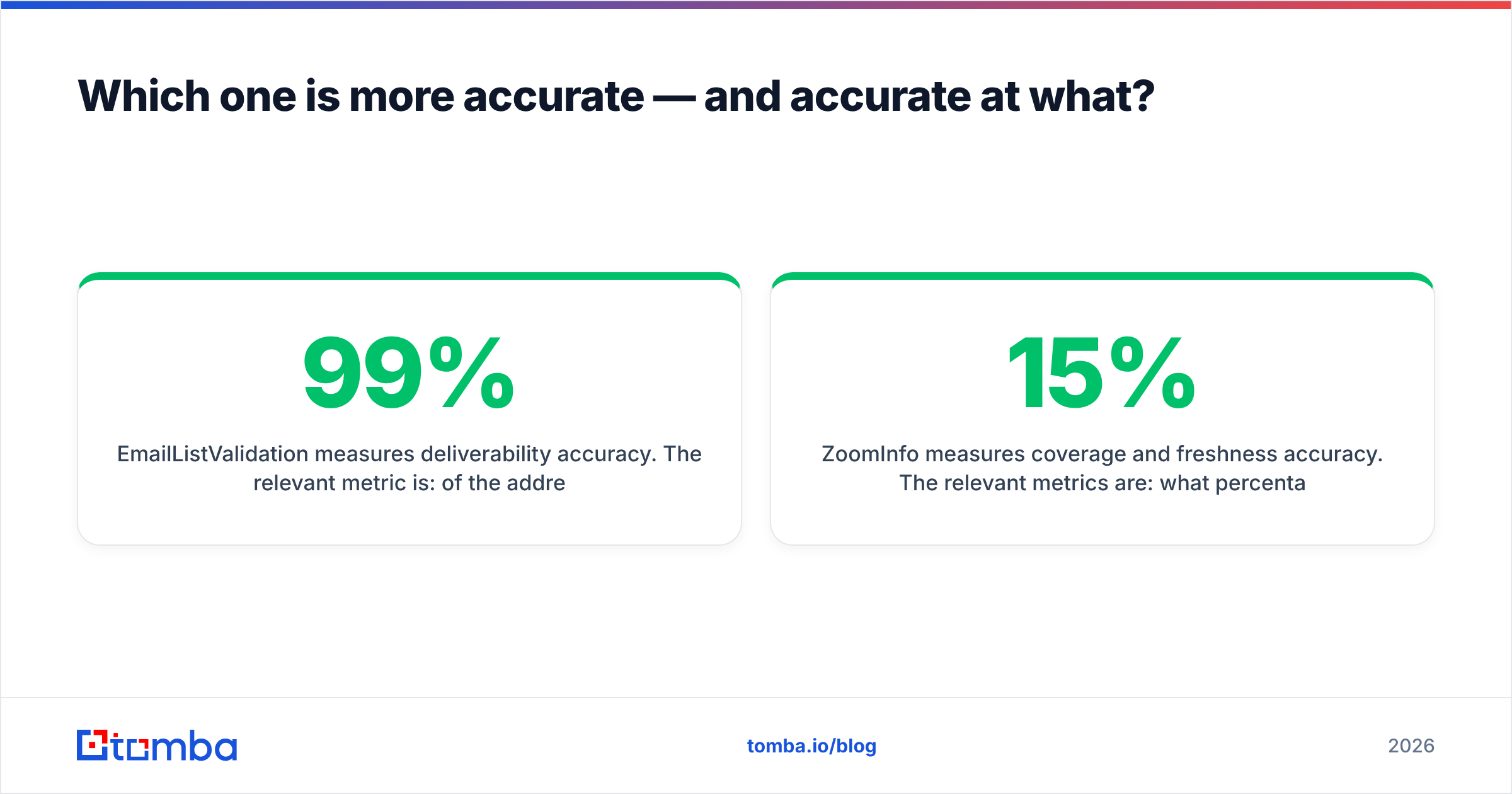
EmailListValidation measures deliverability accuracy. The relevant metric is: of the addresses it marked "valid," how many actually bounced? Vendors in this category advertise 98–99% accuracy, and in practice the good ones land around 97–99% on non-catch-all domains. EmailListValidation is competitive here. Where every verifier gets soft is catch-all domains, which accept all mail at the SMTP layer and reveal nothing. If a meaningful chunk of your list sits behind Microsoft 365 catch-alls, expect a large "unknown" bucket. That is not a vendor failing, it is physics — though tools with a dedicated catch-all verifier resolve more of that bucket using pattern and historical evidence rather than giving up on it.
ZoomInfo measures coverage and freshness accuracy. The relevant metrics are: what percentage of the accounts you care about have a contact record, and how stale is that record? ZoomInfo's coverage in North American mid-market and enterprise is excellent. Its weak spots, consistently flagged in G2 reviews, are European contacts (GDPR pressure has thinned the set), SMB and startup coverage, and job-change decay — people move roles faster than any database refreshes. Users routinely report bounce rates of 5–15% on exported ZoomInfo lists, which is exactly why so many ZoomInfo customers also buy a verifier.
That last point deserves emphasis, because it reframes the whole comparison: ZoomInfo customers are a major customer segment for verification tools. These products are complements far more often than substitutes.

What does each one actually cost in 2026?#
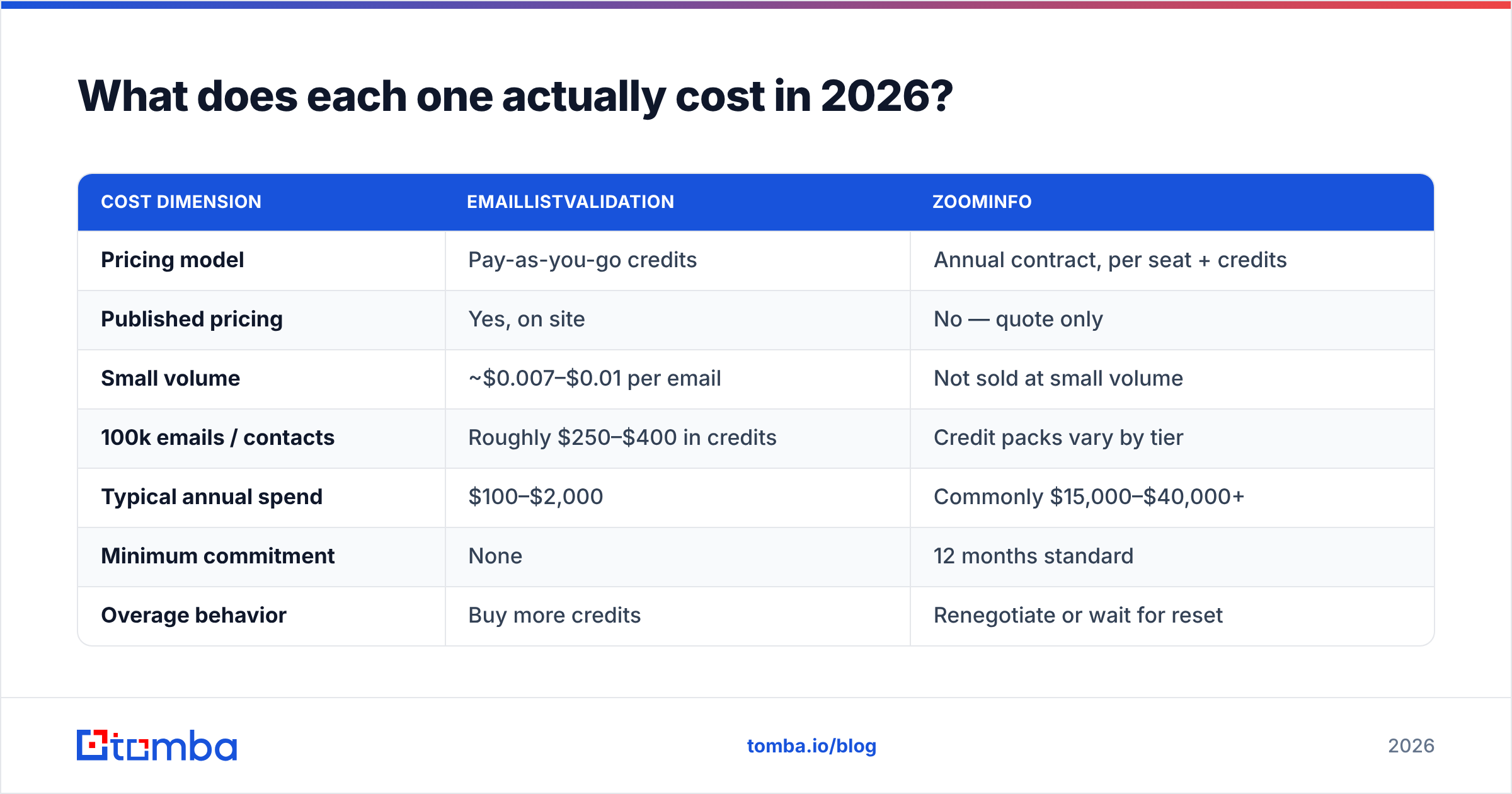
| Cost dimension | EmailListValidation | ZoomInfo |
|---|---|---|
| Pricing model | Pay-as-you-go credits | Annual contract, per seat + credits |
| Published pricing | Yes, on site | No — quote only |
| Small volume | ~$0.007–$0.01 per email | Not sold at small volume |
| 100k emails / contacts | Roughly $250–$400 in credits | Credit packs vary by tier |
| Typical annual spend | $100–$2,000 | Commonly $15,000–$40,000+ |
| Minimum commitment | None | 12 months standard |
| Overage behavior | Buy more credits | Renegotiate or wait for reset |
| Cancellation | Stop buying credits | Auto-renew clauses are common |
Treat the numbers as directional and confirm current list prices with each vendor — EmailListValidation adjusts its credit tiers, and no two ZoomInfo quotes are alike.
The structural differences matter more than the exact figures:
- Credit expiry. Verification credits typically do not expire, so an unused balance carries forward. Platform credits on annual data contracts usually reset, and unused allocation is simply gone.
- Seat math. ZoomInfo pricing scales with users. Adding three SDRs can move the quote substantially even if total data usage does not change.
- Export caps. Most data platform contracts cap how many records you can export per year, separately from how many you can view. Teams regularly hit the export ceiling in month seven.
- The renewal ratchet. Multi-year data contracts commonly include annual uplift clauses. Budget for the renewal, not just year one.
If a five-figure annual commitment is not realistic, that is a completely normal position to be in — and it is why the alternatives market for both products is so active. Buyers comparing options often shortlist Apollo alternatives or a self-serve B2B database with monthly billing, and providers like BookYourData occupy a useful middle ground for teams that want a purchased, pre-verified list without an annual platform contract.
Who should choose EmailListValidation?#
Pick it when your problem is measurably a hygiene problem:
- You inherited a list. A 200,000-row export from a defunct marketing tool, an event lead scan, an acquired database. Verification before first send is non-negotiable.
- Your bounce rate crossed 3%. Mailbox providers treat sustained hard bounces as a sender-quality signal. Cleaning is the fastest fix. Pair it with an SPF checker run so authentication is not compounding the problem.
- You send newsletters or lifecycle email, not cold outbound. Your addresses come from signups. You need them clean, not expanded.
- You need a one-time job done cheaply. No contract, no seat, no onboarding call. Upload, download, done.
Where it falls short: it will never tell you who to email. If your pipeline is thin, a perfectly clean list of the wrong 500 people does not help.

Who should choose ZoomInfo?#
Pick it when your problem is a coverage problem and you have the budget to solve it properly:
- You run account-based outbound at enterprise scale. You need org charts, direct dials, and multiple contacts per account, not one email per company.
- Intent data changes your prioritization. If your team genuinely works intent signals — and most teams that buy them do not — ZoomInfo's signal set is among the strongest available.
- You sell into North American mid-market and enterprise. That is where coverage is deepest and the price is easiest to justify.
- You have RevOps to operate it. Enrichment rules, CRM sync, dedupe logic, and territory routing all need an owner. Without one, an expensive platform decays into an expensive search box.
Where it falls short: cost transparency, contract flexibility, EU coverage, and the persistent need to verify exports before sending. It is a serious platform for teams with serious revenue operations maturity, and an expensive disappointment for a two-person startup.
What does a realistic stack look like for most teams?#
Most companies searching this comparison are not choosing between these two products. They are trying to assemble a working outbound stack for a sane budget. A practical build looks like this:
- Discovery layer. Find contacts at the accounts you have selected, using an email finder that works by domain and name rather than requiring a full database subscription. For account-list building, a domain search pass over your target list is usually faster than filter-browsing a giant database.
- Verification layer. Validate every address before it enters a sequence. Whether that is a dedicated bulk verifier or a built-in email verifier, the rule is the same: nothing unverified gets sent.
- Enrichment layer. Add job title, company size, and phone where you need multi-channel touches. This is where a platform subscription earns its cost — or where a per-record API call does the same job for a fraction of the price.
- Sending layer. Warmed domains, authentication configured, volume ramped gradually. No amount of data quality survives a cold domain blasting 800 emails on day one.
- Feedback loop. Push bounce and reply data back into your source of truth so bad records get suppressed rather than re-imported next quarter.
Notice that steps 1 and 2 are the ones EmailListValidation and ZoomInfo each solve in isolation. A find-and-verify tool covers both, which is why the total-cost comparison so often favors the consolidated option for teams under 20 reps.
Is there a cheaper option that covers both jobs?#
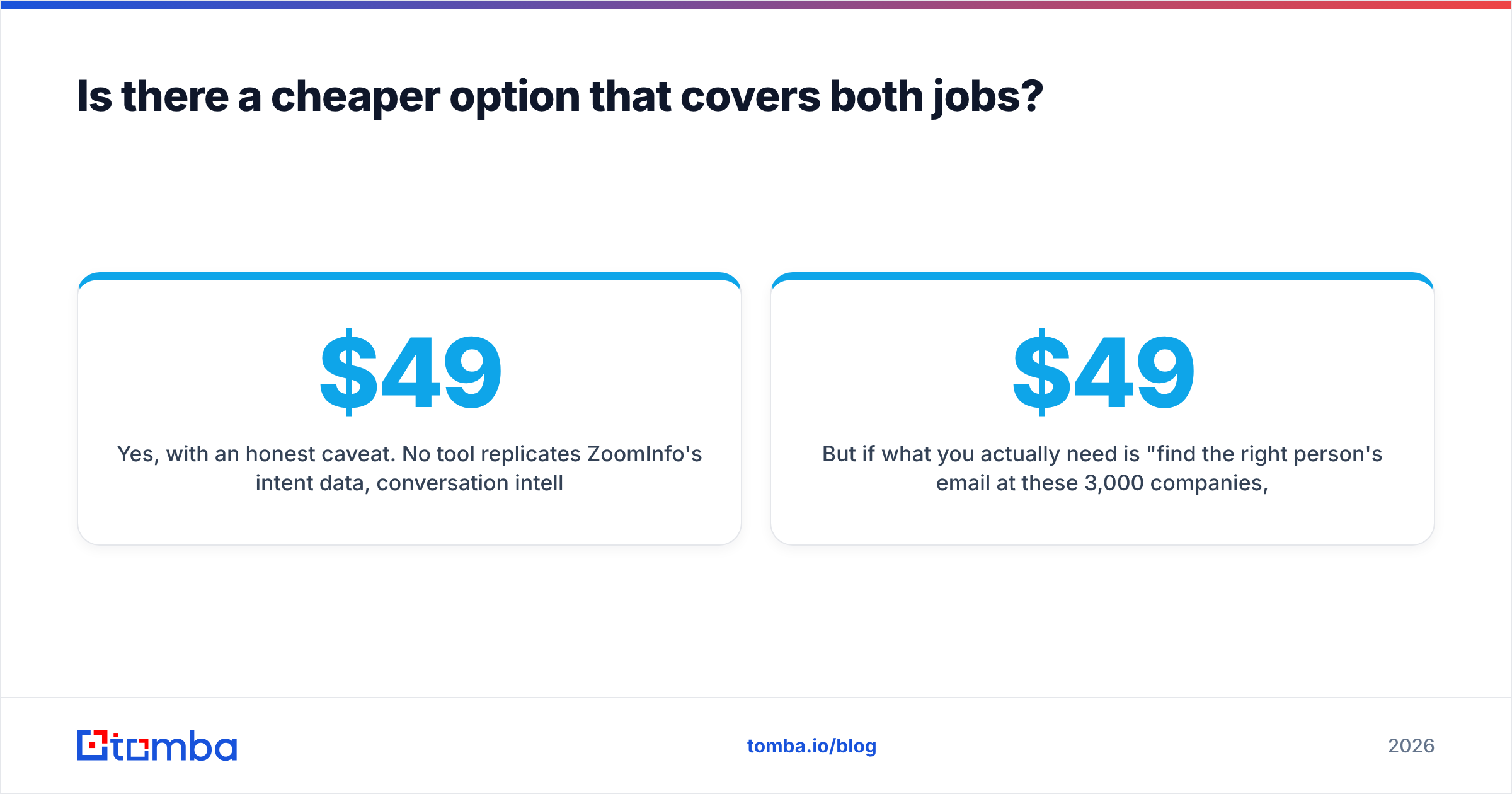
Yes, with an honest caveat. No $49/mo tool replicates ZoomInfo's intent data, conversation intelligence, or org charts. If those features are load-bearing for your go-to-market, pay for the platform.
But if what you actually need is "find the right person's email at these 3,000 companies, confirm it is deliverable, and push it to my CRM," that is a solved problem at a much lower price point. Tomba covers discovery and validation in one place: find email addresses by domain or name, verify them in the same workflow, resolve catch-all domains, pull B2B phone numbers where available, and run the whole thing through the Tomba API or in bulk. Tomba pricing starts with a free tier of 25 searches per month, then Starter at $49/mo, Growth at $99/mo, and Pro at $249/mo — monthly, no annual commitment, no seat negotiation.
The comparison that matters is not EmailListValidation vs ZoomInfo. It is: what is the cheapest stack that reliably puts a deliverable address for the right person in front of your reps?
Frequently asked questions#
Can EmailListValidation replace ZoomInfo? No. It has no contact database and cannot source new prospects.
Can ZoomInfo replace a verifier? Partially. Its records are validated internally, but exported lists still bounce often enough that most heavy senders run a separate verification pass.
Which is better for cold outbound? Neither alone. Cold outbound needs discovery and verification. ZoomInfo plus a verifier works if you have the budget; a combined find-and-verify tool works if you do not.
Does ZoomInfo publish pricing? No. Expect a discovery call, a quote, and an annual contract.
What about GDPR? Both vendors publish compliance documentation, but responsibility for lawful basis sits with you as the sender. European contact coverage is thinner across every US-based data provider.
The bottom line#
Diagnose before you buy. If your bounce rate is the symptom, buy verification and spend under $500. If your pipeline is the symptom and you have real budget plus a RevOps owner, ZoomInfo is a defensible purchase. If both are the symptom and neither budget nor headcount is large, consolidate.
Start with the Tomba Email Finder — find verified professional email addresses by domain, name, or company, with catch-all handling and bulk processing built in, on a free tier that costs nothing to test. Run it against 25 of your target accounts this week and compare the deliverable-contact yield against whatever quote is sitting in your inbox.
Related guides#
Ready to find emails that actually work?
Join 150,000+ professionals who stopped guessing and started sending. Free credits on signup — no credit card required.
Get the Tomba newsletter
Practical outbound tactics and product updates — once every two weeks.
About the author