EmailListVerify vs Apollo.io: Which One Do You Actually Need?
One tool cleans lists you already have. The other builds lists from scratch and charges per seat. Here is the honest EmailListVerify vs Apollo.io breakdown, with pricing, accuracy, and the setups where neither is the right answer.
TL;DR
- EmailListVerify vs Apollo.io is not a fair fight. EmailListVerify cleans lists you already own. Apollo.io is a contact database with sequencing and a light CRM on top.
- If your only problem is bounce rate, EmailListVerify is cheap and pay-as-you-go. If your problem is "I have no leads," it cannot help you at all.
- Apollo.io charges per seat ($49–$119/user/mo at list price). That scales badly for small teams. Its verification is bundled, not best-in-class.
- Most outbound teams pay for two tools: a data source and a verifier. A finder with built-in verification collapses that stack.
- Test both on 500 known-good contacts before you commit. Vendor accuracy numbers are marketing. Your own bounce log is not.
What are EmailListVerify and Apollo.io, actually?#
The two tools sit at opposite ends of the outbound pipeline. That is why EmailListVerify vs Apollo.io is an odd matchup until you know what each one does.
EmailListVerify is a bulk email verification service. You upload a CSV of addresses — from a webinar signup, a scraped list, or an old CRM export. It labels each address valid, invalid, catch-all, disposable, or unknown. It runs syntax checks, MX record lookups, SMTP handshakes, disposable-domain matching, and role-account detection. It does not find email addresses. There is no sequencer, no CRM, and no intent data.
Apollo.io is a go-to-market platform. It sells access to a database of a few hundred million business contacts. You also get a Chrome extension for LinkedIn, a cold email sequencer, a dialer, meeting scheduling, and light CRM features. Apollo verifies addresses too. But verification is a side feature here, not the product itself.
Here is the practical split:
- Job to be done. EmailListVerify answers "will this address bounce?" Apollo answers "who should I email, and how do I reach them at scale?"
- Input required. EmailListVerify needs a list to start. Apollo needs only a filter: industry, headcount, job title, or tech stack.
- Pricing model. EmailListVerify charges per email checked, and credits don't expire on most plans. Apollo charges per seat per month, with credit caps on top.
- Where it breaks. EmailListVerify is useless without a source of contacts. Apollo gets expensive once you add people who only need the odd lookup.
- Who buys it. EmailListVerify: email marketers, agencies cleaning client lists, ops teams doing quarterly CRM hygiene. Apollo: SDR teams that want database, dialer, and sequencing on one contract.
- Replaceability. Verification is a commodity. A dozen vendors do it well. Apollo's bundle is harder to swap for one tool, but easy to swap for two or three cheaper ones.
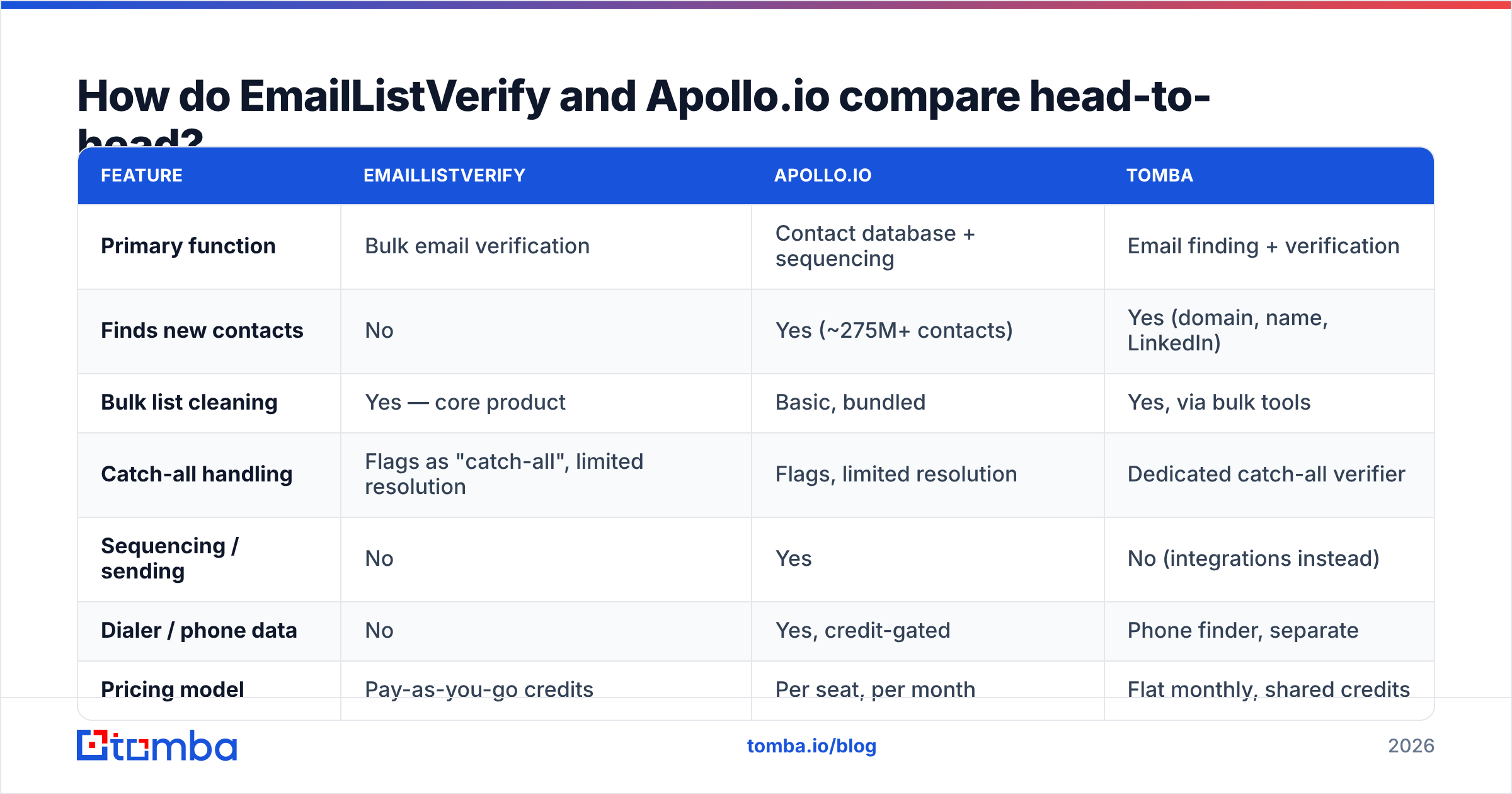
EmailListVerify vs Apollo.io: head-to-head comparison#
The table below reflects listed features and pricing at the time of writing. Both vendors change plans often. Check their pricing pages before you sign anything.
| Feature | EmailListVerify | Apollo.io | Tomba |
|---|---|---|---|
| Primary function | Bulk email verification | Contact database + sequencing | Email finding + verification |
| Finds new contacts | No | Yes (~275M+ contacts) | Yes (domain, name, LinkedIn) |
| Bulk list cleaning | Yes — core product | Basic, bundled | Yes, via bulk tools |
| Catch-all handling | Flags as "catch-all", limited resolution | Flags, limited resolution | Dedicated catch-all verifier |
| Sequencing / sending | No | Yes | No (integrations instead) |
| Dialer / phone data | No | Yes, credit-gated | Phone finder, separate |
| Pricing model | Pay-as-you-go credits | Per seat, per month | Flat monthly, shared credits |
| Entry price | ~$24 for 5,000 credits | Free tier; $49/user/mo Basic | Free 25 searches; $49/mo |
| API | Yes | Yes, plan-gated | Yes, all paid plans |
| Best for | Cleaning lists you own | Full SDR motion in one tool | Building + verifying lists |
The honest read on EmailListVerify vs Apollo.io: EmailListVerify wins on cost per check and on simplicity. Apollo wins on breadth. Neither wins the job most outbound teams actually have. That job is turning a list of target companies into verified addresses, without paying per seat.

How accurate is EmailListVerify vs Apollo.io in practice?#
Accuracy splits into two very different numbers. Vendors love to blur them.
Verification accuracy is the share of addresses labelled correctly as valid or invalid. EmailListVerify advertises 98–99%. Any competent SMTP-based verifier hits that range on normal domains. The headline number is not the difference. How each vendor handles the hard cases is.
Data accuracy is the share of addresses in a database that are still real and still belong to the stated person. This is where Apollo takes criticism on G2 and in practitioner threads.
A big database built partly from user-contributed contacts ages fast. People change jobs. Domains migrate. Employees leave. A record verified 14 months ago tells you very little today. Apollo re-verifies at export, but that check is a bundled feature rather than a dedicated engine.
Three specific failure modes are worth testing:
- Catch-all domains. Roughly 15–20% of B2B domains accept every address at the SMTP layer. A handshake proves nothing there. EmailListVerify flags these honestly and stops. Apollo often ships them as "verified." Neither one resolves them well. That is why a dedicated catch-all verifier exists as its own product category.
- Greylisting and rate limits. Microsoft 365 and Google Workspace throttle verification traffic. A verifier that retries too hard gets its IPs blocked and starts returning "unknown." Compare the unknown rate, not just the valid rate.
- Role accounts.
info@,sales@, andsupport@are valid but worthless for one-to-one outbound. Both tools flag them. Make sure your workflow actually excludes them.
Run your own test. Take 500 addresses whose status you already know: 250 that replied, and 250 that bounced. Push them through each tool. The one that mislabels fewer of your known-bad addresses is the one to buy. Anything else means trusting a marketing page.
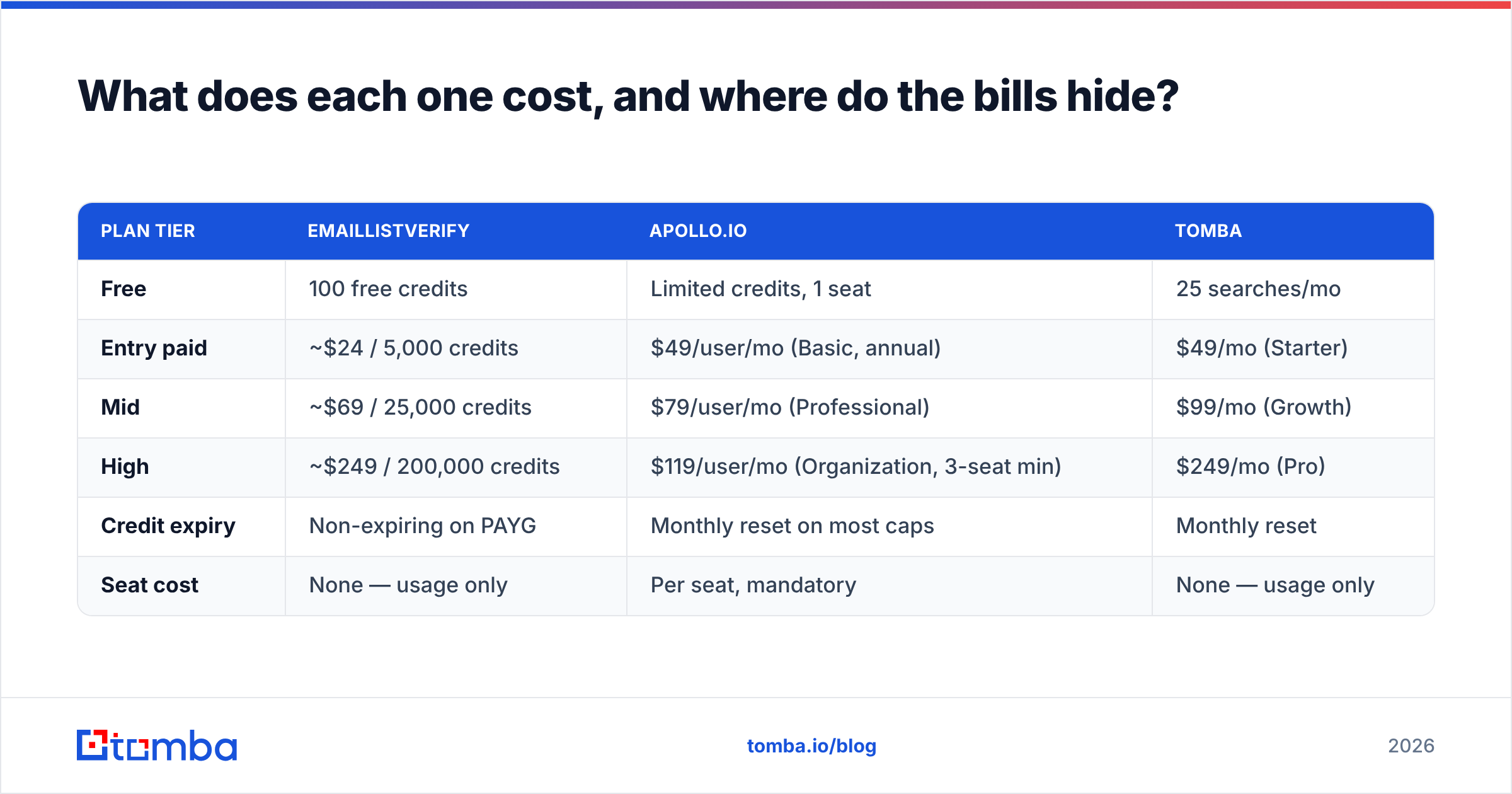
What does EmailListVerify vs Apollo.io cost, and where do the bills hide?#
| Plan tier | EmailListVerify | Apollo.io | Tomba |
|---|---|---|---|
| Free | 100 free credits | Limited credits, 1 seat | 25 searches/mo |
| Entry paid | ~$24 / 5,000 credits | $49/user/mo (Basic, annual) | $49/mo (Starter) |
| Mid | ~$69 / 25,000 credits | $79/user/mo (Professional) | $99/mo (Growth) |
| High | ~$249 / 200,000 credits | $119/user/mo (Organization, 3-seat min) | $249/mo (Pro) |
| Credit expiry | Non-expiring on PAYG | Monthly reset on most caps | Monthly reset |
| Seat cost | None — usage only | Per seat, mandatory | None — usage only |
Two hidden costs are worth naming.
Apollo's per-seat multiplication. A five-person sales team on Professional costs $395 a month. That is before anyone opens the dialer. Add a marketing ops person who needs exports, plus a founder who wants to browse the database. Now you are at seven seats. The database does not get better. You are simply paying for access rights.
EmailListVerify's dependency cost. The credits really are cheap. But they only clean what you bring. Say you also pay for a scraper, a database subscription, and an enrichment tool to feed it. The "cheap verifier" is now line item four in a stack that costs more than either tool alone. This is the most common reason teams weighing an Apollo alternative end up consolidating instead of picking a winner.
Which one should you choose for your use case?#
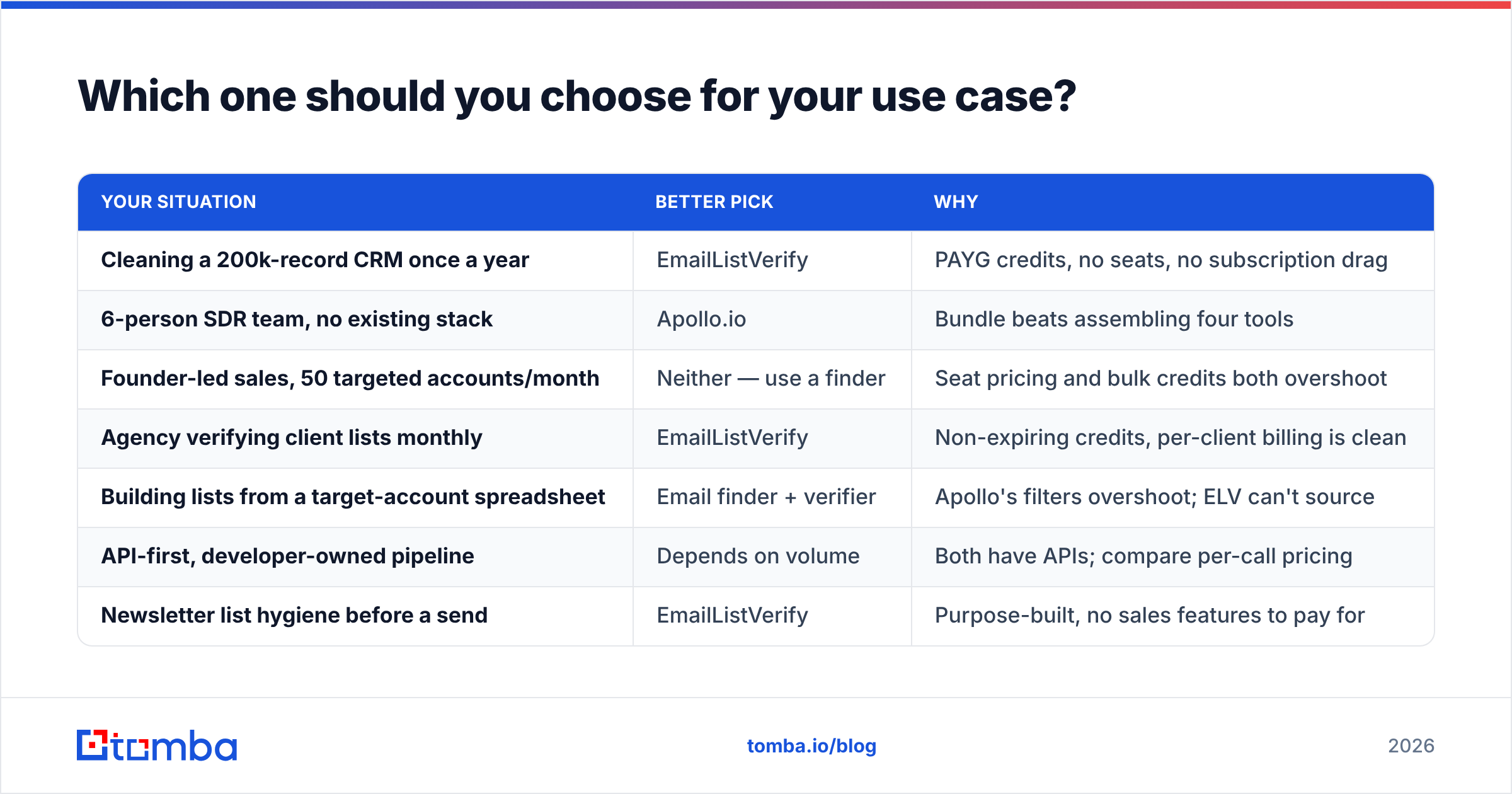
| Your situation | Better pick | Why |
|---|---|---|
| Cleaning a 200k-record CRM once a year | EmailListVerify | PAYG credits, no seats, no subscription drag |
| 6-person SDR team, no existing stack | Apollo.io | Bundle beats assembling four tools |
| Founder-led sales, 50 targeted accounts/month | Neither — use a finder | Seat pricing and bulk credits both overshoot |
| Agency verifying client lists monthly | EmailListVerify | Non-expiring credits, per-client billing is clean |
| Building lists from a target-account spreadsheet | Email finder + verifier | Apollo's filters overshoot; ELV can't source |
| API-first, developer-owned pipeline | Depends on volume | Both have APIs; compare per-call pricing |
| Newsletter list hygiene before a send | EmailListVerify | Purpose-built, no sales features to pay for |
One pattern runs through that table. EmailListVerify is right when you have data and a deliverability problem. Apollo is right when you have budget and a full-motion problem. There is a large middle ground between them. A team that needs 500–5,000 verified contacts a month, and nothing else, is served badly by both.
Can you replace both with one tool?#
Partly. It depends which half of the stack you care about.
You cannot replace Apollo's sequencer and dialer with a data tool. If you need those, you need a sending platform. That could be Apollo, Instantly, Smartlead, or your own SMTP setup. What you can replace is the expensive part: paying per seat for database access, then paying again for verification.
That is the case for pairing a finder with a verifier. Tomba's email verifier runs the same SMTP, MX, syntax, disposable, and role-account checks EmailListVerify does. It also sits right next to the finder. So an address is sourced and validated in one pass. You skip the export, upload, clean, and re-import loop.
Tomba pricing is flat monthly rather than per seat: $49/mo Starter, $99/mo Growth, $249/mo Pro. Adding a second or third person costs nothing extra.
The trade-off is real, and worth stating plainly. You give up Apollo's intent signals, its dialer, its CRM, and its sequencing. If those are essential to your team, Apollo's bundle does work a finder cannot. If they are not, and you already sequence in a dedicated tool and log in a real CRM, then you are paying Apollo seat prices for a database lookup.

What does a sane 2026 stack look like?#
Four parts. You should be able to name the tool filling each one.
- Sourcing — where target contacts come from. A database, a domain search, a LinkedIn extraction, or a manual account list. Apollo covers this. EmailListVerify does not.
- Verification — the bounce filter before anything hits a sequencer. EmailListVerify covers this. Apollo covers it partly. Never skip it. Never trust "verified" from a source you have not tested.
- Sending and deliverability — warmed domains, SPF/DKIM/DMARC, and volume ramping. Neither tool solves this. Apollo sends mail. It does not get you into the inbox.
- Logging — the CRM of record. Apollo offers one. Most teams already run HubSpot or Salesforce and treat Apollo's as a duplicate.
Teams waste money by buying steps 1 and 2 twice. They pay for a database that claims verification, then pay again for a standalone verifier because they don't trust that claim. Pick one tool that does both credibly, or accept that you are paying twice on purpose.
One more practical note: keep a bounce log per source. Tag every contact with where it came from. Check the bounce rate by tag each month. That single habit tells you more about EmailListVerify vs Apollo.io than any review, including this one. It measures your ICP, your domains, and your own sending setup rather than someone else's benchmark set.
The verdict#
If you already have lists and just need them clean, buy EmailListVerify. It is focused and cheap per record. There is no reason to pay platform prices for a utility.
If you are starting an outbound motion from zero, Apollo.io is a defensible choice. You get the database, the sequencer, and the dialer on one invoice. Go in knowing two things. Per-seat pricing is the real cost driver. And "verified" in the export still needs your own spot-check.
If you sit in the middle, buy neither. You know who you want to reach. You need their addresses, and you need them to be real. Source and verify in the same step.
That is the gap Tomba Email Finder fills. Search by domain, name, or company. Get the address with a confidence score and verification already applied. Then export straight into whatever you sequence with. Start on the free tier — 25 searches a month, no card — and run it against 20 accounts where you already know the right contact. If the match rate holds up on your own data, the rest of the EmailListVerify vs Apollo.io debate is academic.
Related guides#
Ready to find emails that actually work?
Join 150,000+ professionals who stopped guessing and started sending. Free credits on signup — no credit card required.
Get the Tomba newsletter
Practical outbound tactics and product updates — once every two weeks.
About the author