EmailOversight vs Apollo.io: Which One Do You Need in 2026?
EmailOversight vs Apollo.io: one tool cleans the list you already have, the other builds a new one. An honest head-to-head on accuracy, pricing, and the overlap nobody warns you about.
Short answer first: EmailOversight vs Apollo.io is not a fair fight, because the two tools do different jobs. One cleans the list you own. The other builds a new one.
TL;DR
EmailOversight and Apollo.io are not really rivals. EmailOversight is a multi-method email validation and list-hygiene platform. Apollo.io is a contact database plus a sales engagement suite. One cleans data. The other creates it.
Is your bounce rate 9%? Is your domain getting throttled? Then EmailOversight is the closer fit. Have no list at all? Apollo is the closer fit.
Apollo prices per seat and leans annual. EmailOversight sells credits and prices by volume. Compare sticker prices without normalising by usage and you will pick the wrong tool.
Apollo's built-in check is convenience-grade, not hygiene-grade. Plenty of teams run Apollo exports through a dedicated verifier anyway. That means paying twice.
There is a third path. Pair a finder with a verifier (Tomba, for example) so both jobs share one credit pool and one API.
What is EmailOversight, and what problem does it solve?#
EmailOversight is a data-hygiene company. Its core product checks email addresses with several methods stacked together: syntax and domain checks, mailbox-level SMTP probing, spam-trap and honeypot detection, complainer and litigator lists, and hard-bounce history. The pitch is simple. A single-method verifier misses the addresses that quietly wreck sender reputation. Think recycled spam traps, chronic complainers, and throwaway domains that still resolve.
Around that core it sells extra services: email append (turn a name and a company into an address), reverse append, list scoring, and a real-time API you can drop into a signup form. The current service list is on the EmailOversight site.
What it does not do is prospecting. You cannot ask it for every VP of Engineering at a 200-person SaaS firm in Berlin. You bring the list. EmailOversight tells you what is safe to send to. That split matters more than any feature scorecard, because it decides whether these two tools are rivals or teammates.
Trap detection is the genuinely different part. Most verifiers return valid, invalid, or unknown. Traps are a separate discipline. Finding them relies on private honeypot networks and complaint feeds, not on SMTP handshakes. Inherited a list of unknown origin — a bought file, an old CRM export, a webinar list from 2021? Trap detection is the check that saves you.
What is Apollo.io, and where does it fit?#
Apollo.io is a go-to-market platform built on a huge contact and company database. The company reports hundreds of millions of contacts. On top sit sequences, a dialer, CRM sync, a LinkedIn extension, intent signals, and AI writing. The current plan structure is on Apollo's site.
The workflow is end-to-end. Filter the database. Save a list. Enrich it. Push it into a sequence. Dial from the same tab. Sync activity back to HubSpot or Salesforce. For an SDR team that wants one login, that is a real win. Apollo also checks emails before serving them, and marks them "verified" or "likely."
Here is the catch, and every heavy Apollo user learns it. "Verified" in a database means "verified at some point, by us, against our own rules." It is not a fresh mailbox check run on the morning you send. B2B contact data decays fast. Common industry estimates put yearly decay near 25–30%, and job-change churn spiked after 2023. A record verified in January can be dead by June.

EmailOversight vs Apollo.io: how do they compare head to head?#
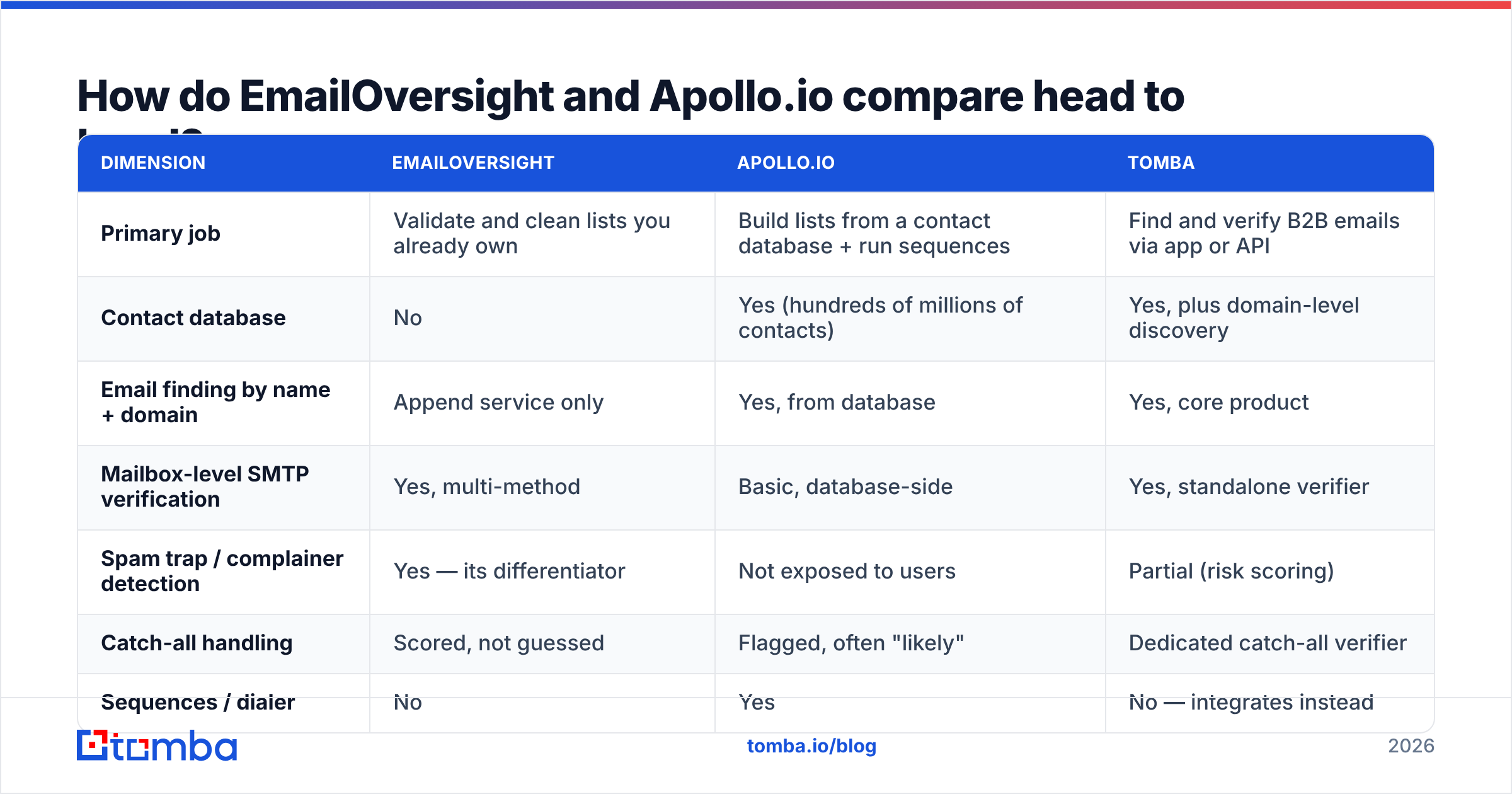
Here is the honest side-by-side. Prices reflect publicly listed plans at the time of writing and change often. Always check the vendor page before you budget.
| Data and features | EmailOversight | Apollo.io | Tomba |
|---|---|---|---|
| Primary job | Clean lists you own | Build lists, run sequences | Find and verify B2B emails |
| Contact database | No | Yes (hundreds of millions) | Yes, plus domain discovery |
| Find email by name + domain | Append service only | Yes, from database | Yes, core product |
| Mailbox-level SMTP check | Yes, multi-method | Basic, database-side | Yes, standalone verifier |
| Spam trap / complainer detection | Yes — its differentiator | Not exposed to users | Partial (risk scoring) |
| Catch-all handling | Scored, not guessed | Flagged, often "likely" | Dedicated catch-all verifier |
| Sequences / dialer | No | Yes | No — integrates instead |
Now the commercial side, which is where most buyers get surprised.
| Pricing and fit | EmailOversight | Apollo.io | Tomba |
|---|---|---|---|
| Pricing model | Credit / volume based | Per seat, annual-leaning | Flat monthly, credit pool |
| Entry paid price | Volume quote, low per record | ~$49/user/mo (annual) | $49/mo, no seat minimum |
| Free tier | Trial credits | Yes, limited credits | 25 searches/mo |
| API | Yes, real-time validation | Yes, enrichment + engagement | Yes, finder + verifier |
| Best for | Deliverability teams | SDR teams wanting one tool | Lean teams and developers |

Read both tables as three columns of jobs, not three rival products. EmailOversight is quality control. Apollo is supply plus workflow. A focused finder-verifier is supply plus quality control, without the seat tax.
Which one is more accurate — and what does "accurate" mean here?#
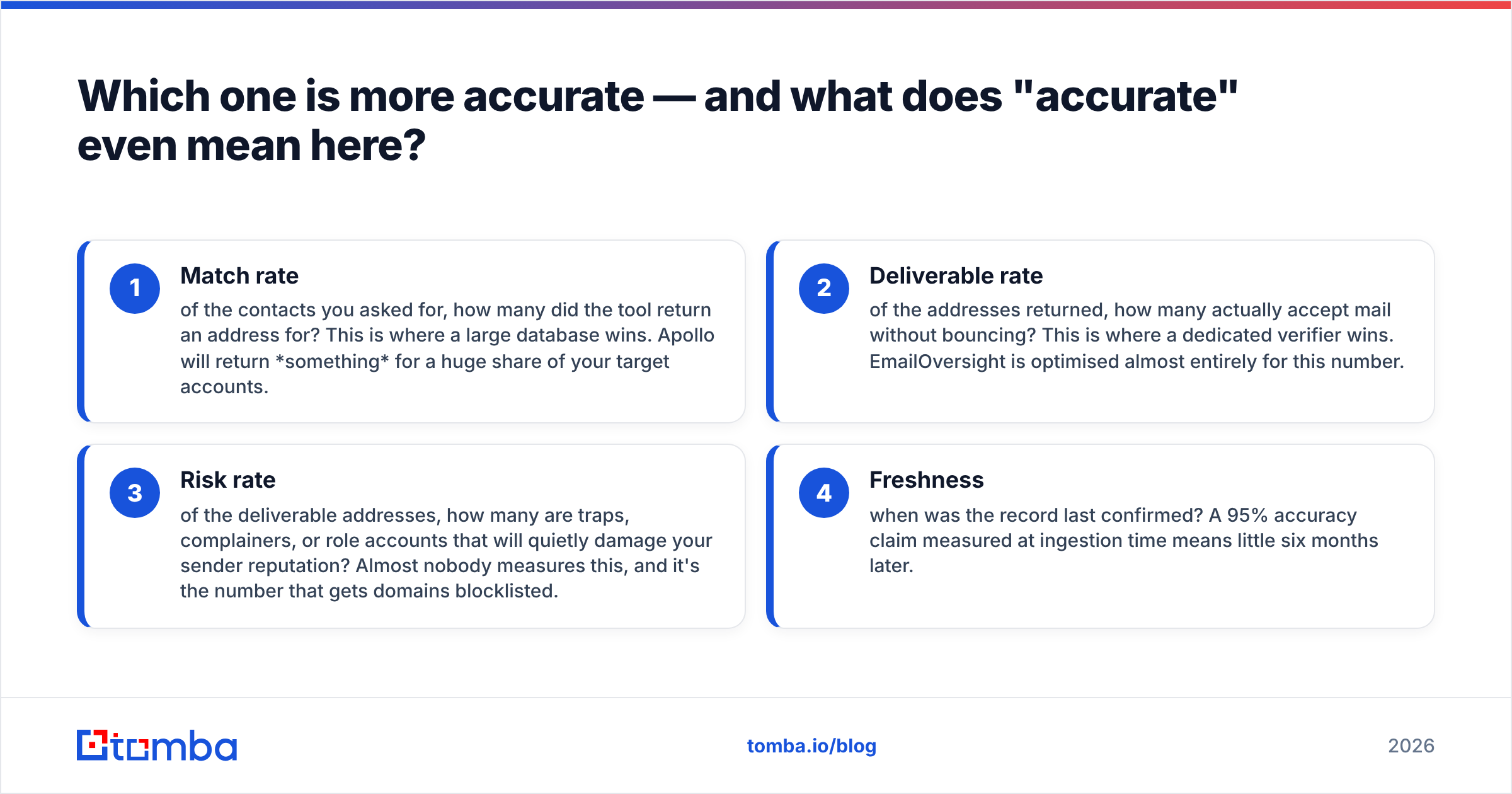
Accuracy is really two metrics, and vendors blur them on purpose.
- Match rate — of the contacts you asked for, how many came back with an address? A large database wins here. Apollo returns something for a huge share of your target accounts.
- Deliverable rate — of the addresses returned, how many accept mail without bouncing? A dedicated verifier wins here. EmailOversight is tuned almost entirely for this number.
- Risk rate — of the deliverable addresses, how many are traps, complainers, or role accounts? These quietly damage your sender reputation. Almost nobody measures this, and it is the number that gets domains blocklisted.
- Freshness — when was the record last confirmed? A 95% accuracy claim measured at ingestion means little six months later.
A tool can ace one metric and flunk another. Apollo optimises for match rate, because coverage is what sells a database. EmailOversight optimises for risk rate, because that is what deliverability managers get fired over. Neither is lying. They measure different things.
The practical takeaway is blunt. Export 5,000 Apollo contacts, blast them with no fresh check, and expect a bounce rate high enough to hurt. Mailbox providers tightened bulk-sender rules in 2024. Google's guidance is explicit: keep spam complaints under 0.3%. Bounces and complaints are the two levers you control before you write a word of copy.
Run any exported list through a standalone email verifier before it enters a sequence. It takes minutes. It costs a fraction of a cent per record. Skipping it is the most expensive shortcut in outbound.
How does pricing really compare in 2026?#
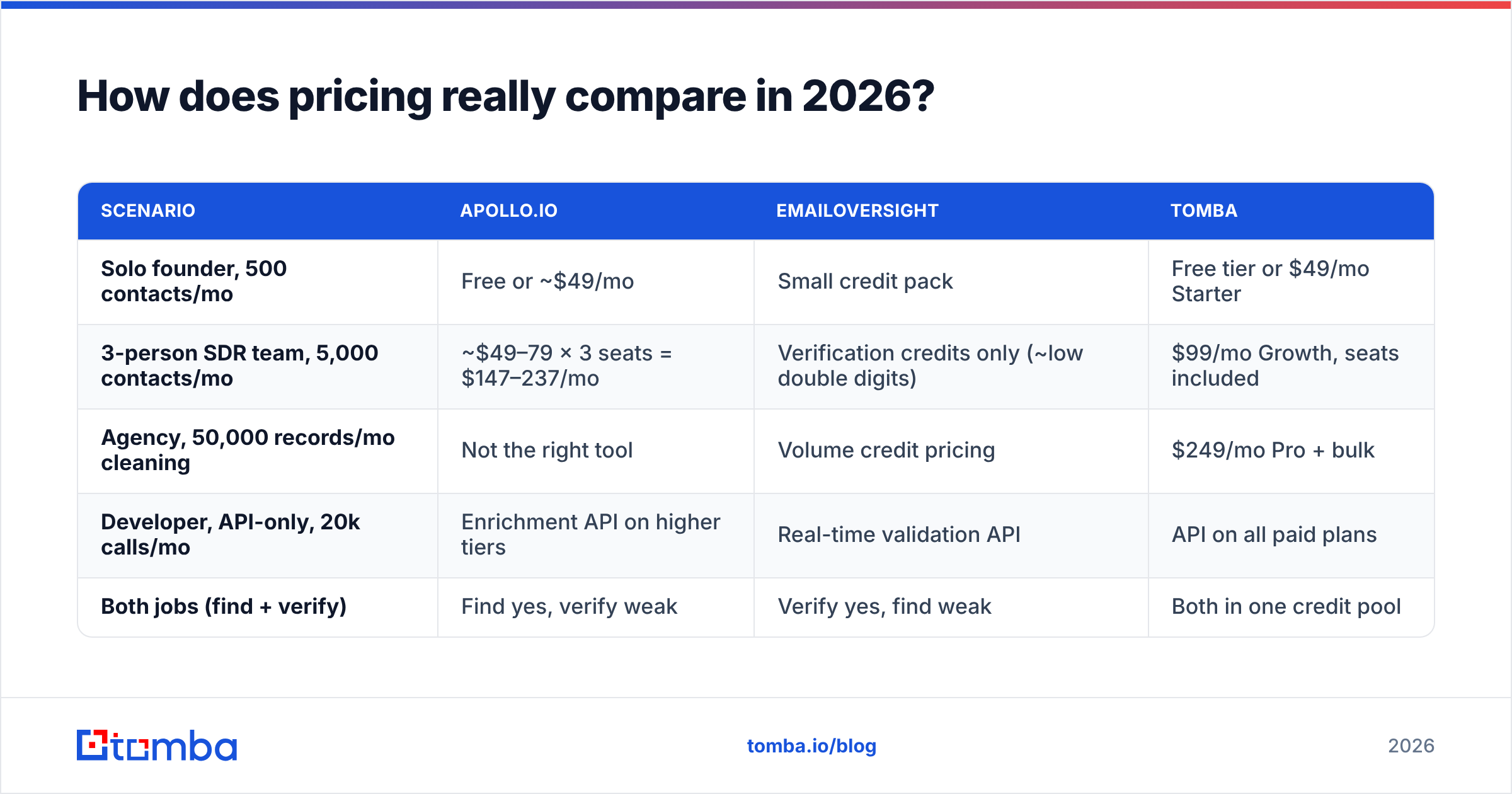
In EmailOversight vs Apollo.io, the two vendors price on different axes. A fair comparison needs normalising first.
| Scenario | Apollo.io | EmailOversight | Tomba |
|---|---|---|---|
| Solo founder, 500 contacts/mo | Free or ~$49/mo | Small credit pack | Free tier or $49/mo Starter |
| 3-person SDR team, 5,000 contacts/mo | ~$49–79 × 3 seats = $147–237/mo | Credits only (low double digits) | $99/mo Growth, seats included |
| Agency, 50,000 records/mo cleaning | Not the right tool | Volume credit pricing | $249/mo Pro + bulk |
| Developer, API-only, 20k calls/mo | Enrichment API on higher tiers | Real-time validation API | API on all paid plans |
| Both jobs (find + verify) | Find yes, verify weak | Verify yes, find weak | Both in one credit pool |
Three things fall out of this.
Apollo's cost scales with headcount, not usage. Add two SDRs and the bill grows, whether or not you send more email. That is fine when every seat produces pipeline. It hurts when half the team logs in twice a month. Teams hitting that wall often start looking at an Apollo alternative built on flat pricing.
EmailOversight's cost scales with list size. Clean quarterly and your spend is lumpy but low. Validate every form submission in real time, and you should model it per submission instead.
Running both means paying twice for verification. You pay Apollo partly for verified data, then pay again to re-verify it. That is not irrational — the second check really is better — but it should be a choice, not an accident. Tomba's pricing folds both jobs into one pool: Free (25 searches/mo), Starter $49/mo, Growth $99/mo, Pro $249/mo, Enterprise custom.
Who should pick which?#
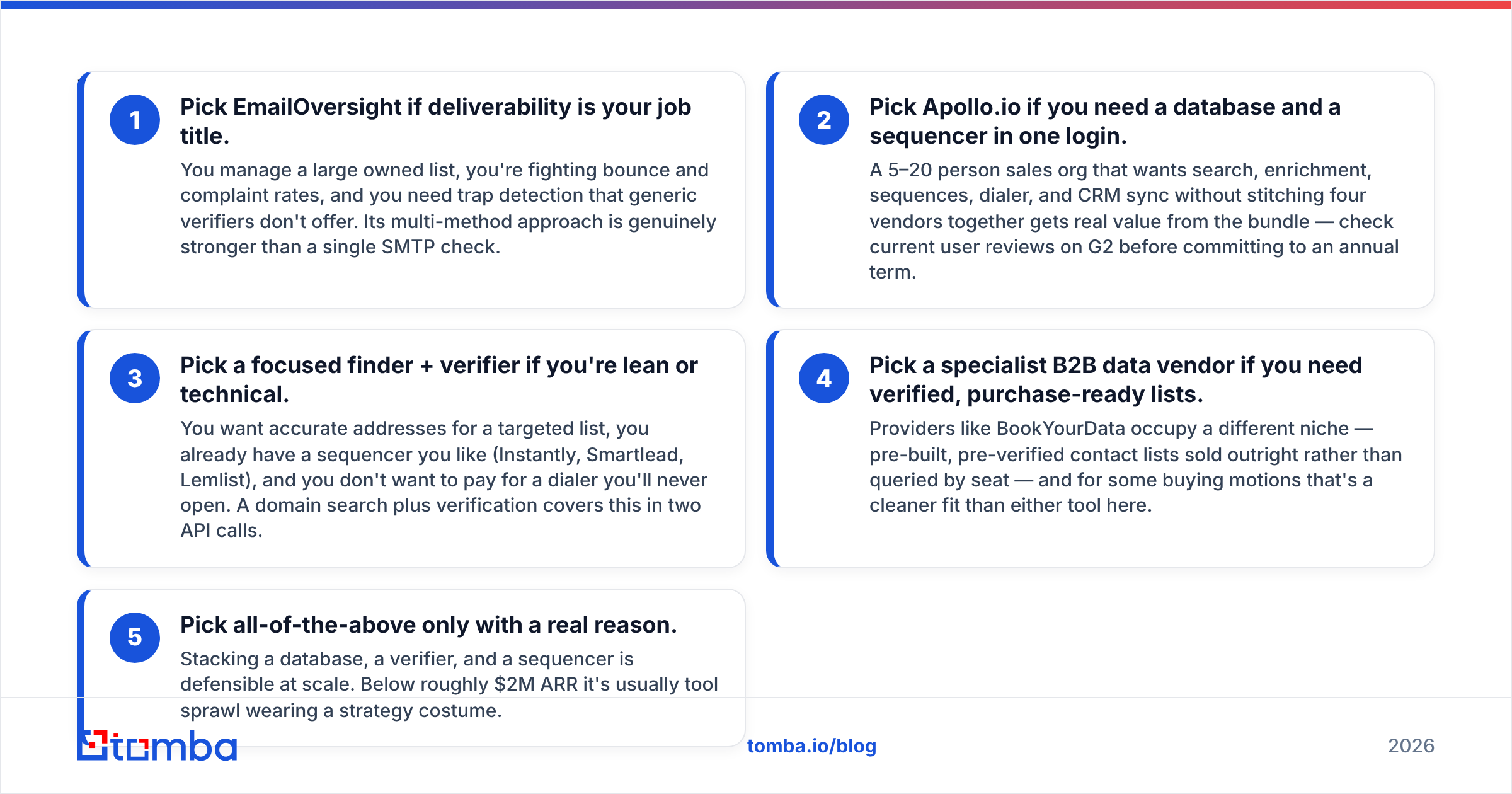
- Pick EmailOversight if deliverability is your job title. You manage a large owned list. You are fighting bounce and complaint rates. You need trap detection that generic verifiers do not offer. Its multi-method approach beats a single SMTP check.
- Pick Apollo.io if you want a database and a sequencer in one login. A 5–20 person sales org gets real value from the bundle. Check current user reviews on G2 before you sign an annual term.
- Pick a focused finder plus verifier if you are lean or technical. You want accurate addresses for a targeted list. You already like your sequencer (Instantly, Smartlead, Lemlist). You do not want to pay for a dialer you will never open. A domain search plus verification covers this in two API calls.
- Pick a specialist B2B data vendor if you need purchase-ready lists. Providers like BookYourData sell pre-built, pre-verified lists outright rather than by seat. For some buying motions, that is a cleaner fit than either tool here.
- Pick all of the above only with a real reason. Stacking a database, a verifier, and a sequencer is defensible at scale. Below roughly $2M ARR it is usually tool sprawl in a strategy costume.
Where does each one fall short?#
EmailOversight's limits. It cannot help when the list does not exist yet. Append can fill gaps, but append is only a matching exercise against known records. It will not discover the head of procurement at a 40-person manufacturer with a thin web footprint. The UI is functional rather than delightful. Pricing is quote-driven at volume, which slows self-serve buyers down.
Apollo's limits. Data quality swings by segment: strong in US tech, thinner in non-English European SMBs, spotty in trades and manufacturing. Seat pricing punishes teams with occasional users. The "verified" label also carries less weight than it implies. The fresher your own check, the fewer surprises you get. Several teams report that annual contracts and credit rollover rules deserve a careful read before signing.
The shared blind spot: catch-all domains. When a domain accepts everything, SMTP checks return "unknown," and every tool guesses. Apollo tends to mark these "likely." Generic verifiers dump them in an unusable bucket. If catch-alls are a big slice of your market — and in enterprise they are — a catch-all verifier that scores them beats a percentage point on headline accuracy.
Can one tool replace both?#
Partly. It depends on which half of the job dominates.
Is your workflow find → verify → export to your sequencer? One platform can cover it. That is the case for a combined email finder with verification attached. Search by domain, name, or LinkedIn profile. Verify in the same call. Push the result to your outreach tool. You lose Apollo's dialer and sequences. You lose EmailOversight's trap-detection depth. You gain one bill, one API, and no seat math.
Is your workflow ingest owned lists → clean → mail from your own ESP? No finder replaces a specialist hygiene vendor. Buy the specialist.
Is your workflow research → multichannel sequence → dial → close in-app? No verifier replaces Apollo's suite. Buy Apollo, and re-verify exports before they hit a sequence.
The failure mode to avoid is simple. You buy the all-in-one because it is convenient. Then the data half turns out to be the weak link. Then you quietly bolt on a second vendor anyway.
What's the verdict?#
EmailOversight vs Apollo.io comes down to which problem you actually have, because the two tools solve different ones.
Have a list and a bounce problem? EmailOversight. Have no list and a headcount to arm? Apollo. Have a targeted list to build and a sequencer you already pay for? Neither. A focused finder plus verifier is cheaper, and it does the two things you need.
Start with the smallest tool that clears your current bottleneck. Outbound stacks grow much faster than the pipeline that pays for them.
Ready to test the middle path? The Tomba Email Finder finds professional addresses by domain, name, or company, and verifies them in the same request. No seat minimums. No annual lock-in. The free tier gives you 25 searches a month, enough to benchmark match rate and deliverable rate against whatever you use now. Run 100 of your hardest target accounts through all three and let the bounce report pick the winner.
Related guides#
Ready to find emails that actually work?
Join 150,000+ professionals who stopped guessing and started sending. Free credits on signup — no credit card required.
Get the Tomba newsletter
Practical outbound tactics and product updates — once every two weeks.
About the author