EmailValidation.io vs Apollo.io: Which Tool Fits Your Stack?
One tool verifies emails at scale for fractions of a cent. The other sells you a 275M-contact database with sequencing on top. Here's which one your pipeline actually needs — and when you need neither.
EmailValidation.io vs Apollo.io comes up as a head-to-head every week. It shouldn't be one. One tool checks whether an email will bounce. The other sells you contacts, plus a place to email them from. Here's how to pick.
TL;DR
- EmailValidation.io is a verification API, not a data provider. It tells you whether an address is deliverable. It will never hand you a new contact.
- Apollo.io is a full go-to-market platform. You get a large B2B contact database, plus sequencing, a dialer, and light CRM features. Verification is a side feature, not the product.
- They are not really competitors. The comparison only helps if you ask "what do I actually need to buy?" That's the real question.
- The price gap is huge. Verification costs fractions of a cent per check. Apollo seats start near $49/user/month and climb fast with credit top-ups.
- The common mistake: buy Apollo for data, then find you still need a separate verifier. Apollo's own checks are optimistic on catch-all domains.
What is EmailValidation.io and what does it actually do?#
EmailValidation.io is a single-purpose API. You send it an email address. It sends back a verdict.
That verdict covers syntax, MX records, and SMTP acceptance. It also flags disposable domains, free providers (Gmail, Outlook), role accounts (info@, sales@), and catch-all domains.
That's the whole product. There's a dashboard, a bulk upload, and an API key. No contact database. No sequencing. No CRM sync unless you build it yourself.
The narrow scope is a feature. Verification should be fast, cheap, and stateless. Say you push 200,000 addresses through a cleaning job before a quarterly campaign. You don't want a platform. You want an endpoint that returns JSON in under 400ms and bills you a fraction of a cent.
Where it fits in a real stack:
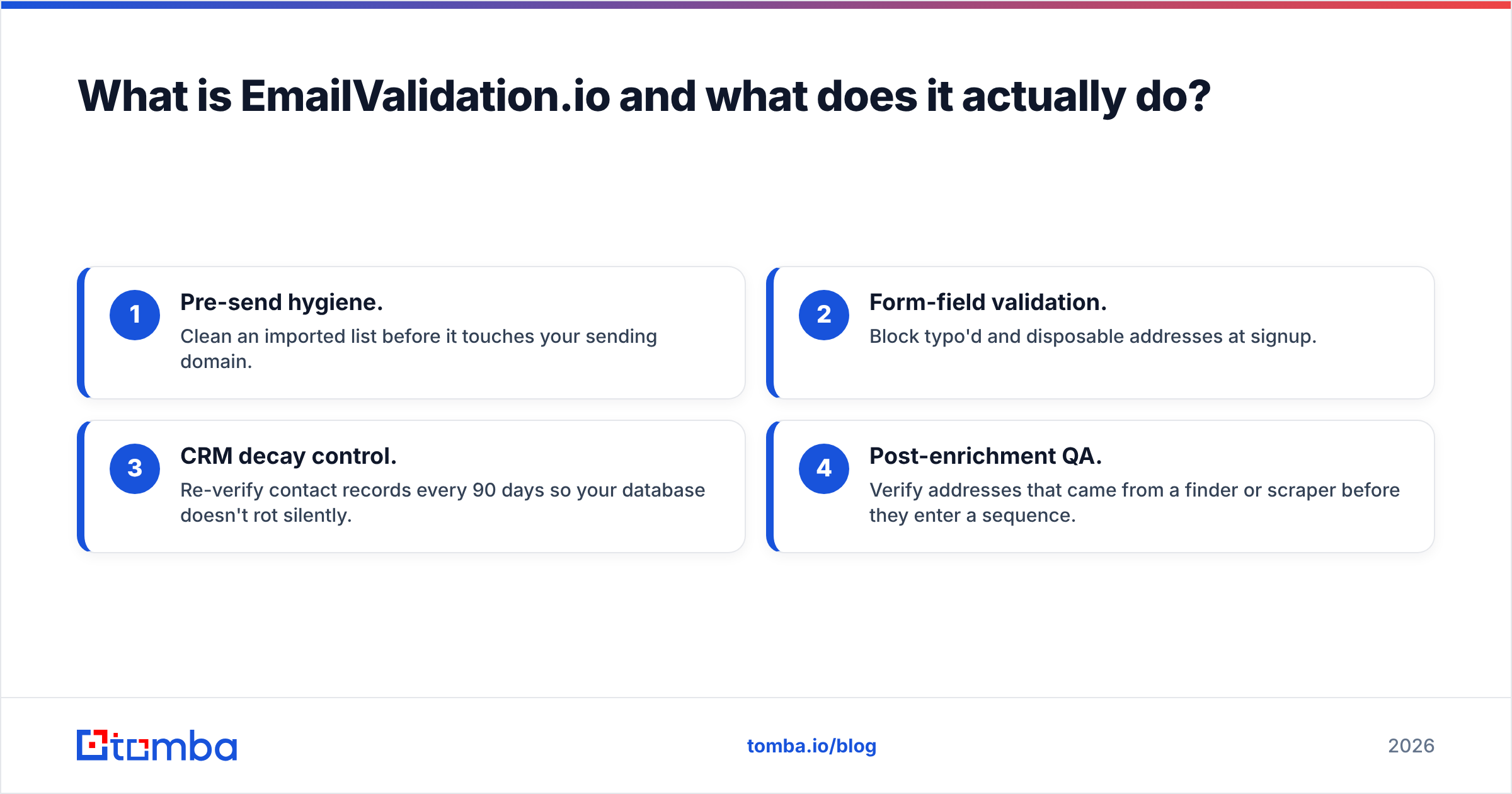
- Pre-send hygiene. Clean an imported list before it touches your sending domain.
- Form-field validation. Block typos and disposable addresses at signup.
- CRM decay control. Re-check contact records every 90 days so your database doesn't rot.
- Post-enrichment QA. Verify addresses from a finder or scraper before they enter a sequence.
What it can't do: find an address you don't have. Maybe you know the company and the person, but not the email. That's a different job. You want an email finder first, then verification second.

What is Apollo.io and who is it built for?#
Apollo.io takes the opposite bet: cover everything. One subscription bundles a B2B contact and company database (hundreds of millions of contacts, per its marketing), list building, email sequencing, a dialer, a LinkedIn extension, light CRM features, and reply analytics.
The pitch is simple. A rep can live in one tab: build a list, enrich it, sequence it, call from it, and track replies. For a five-person team with no other sales tooling, that bundle is genuinely useful. You can check the current plans on Apollo's own pricing page.
The tradeoffs are just as real:
- Per-seat pricing scales badly. Every rep needs a seat. Ten reps on a mid-tier plan is a real line item before you send a single email.
- Credit systems confuse people. Export, email, and mobile credits sit in separate pools with separate limits. Running out mid-quarter is a common complaint in Apollo's G2 reviews.
- Data quality varies by segment. Coverage is strong in US tech and mid-market SaaS. It thins out in EMEA SMB, non-English markets, and regulated industries.
- Native verification is optimistic. Apollo marks addresses as verified using its own signals. Those signals are decent. They are not the same as a dedicated SMTP check, especially on catch-all domains.
EmailValidation.io vs Apollo.io: how do they compare directly?#
Here's the honest side-by-side. Notice how few rows actually overlap. That's the finding, not a formatting accident.
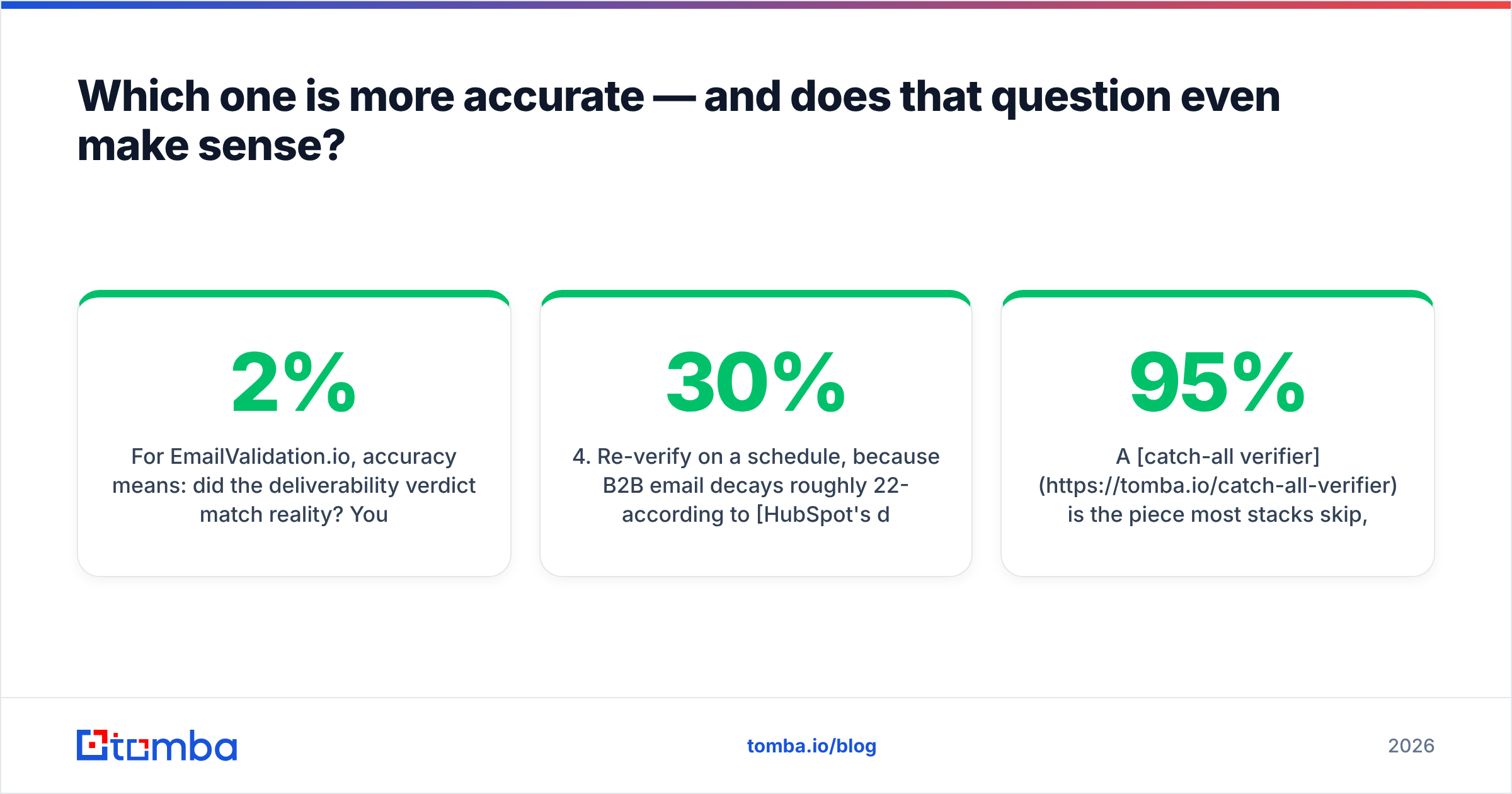
| Dimension | EmailValidation.io | Apollo.io | Tomba |
|---|---|---|---|
| Primary job | Verify existing addresses | Find + sequence + call | Find and verify addresses |
| Contact database | None | 200M+ contacts (claimed) | B2B database + domain search |
| Email finder | No | Yes (inside platform) | Yes (core product) |
| Catch-all handling | Flags catch-all, no verdict | Marks as "verified" often | Dedicated catch-all verifier |
| Sequencing / dialer | No | Yes | No (integrates instead) |
| Pricing model | Per-verification credits | Per seat + credit pools | Flat monthly credits |
| Entry paid price | ~$15/mo tier | ~$49/user/mo | $49/mo (not per seat) |
| Free tier | Limited monthly checks | Limited credits | 25 searches/mo |
| API-first | Yes | API exists, secondary | Yes — full REST API |
| Best for | Engineers cleaning lists | Small SDR teams | Teams needing accurate contacts |

The pattern matters more than any single cell. EmailValidation.io competes on cost per check and speed. Apollo competes on how much of the workflow it covers. Neither one is chasing the other's category.
Which one is more accurate — and does that question even make sense?#
Accuracy means two different things here. Mixing them up is where most buying decisions go wrong.
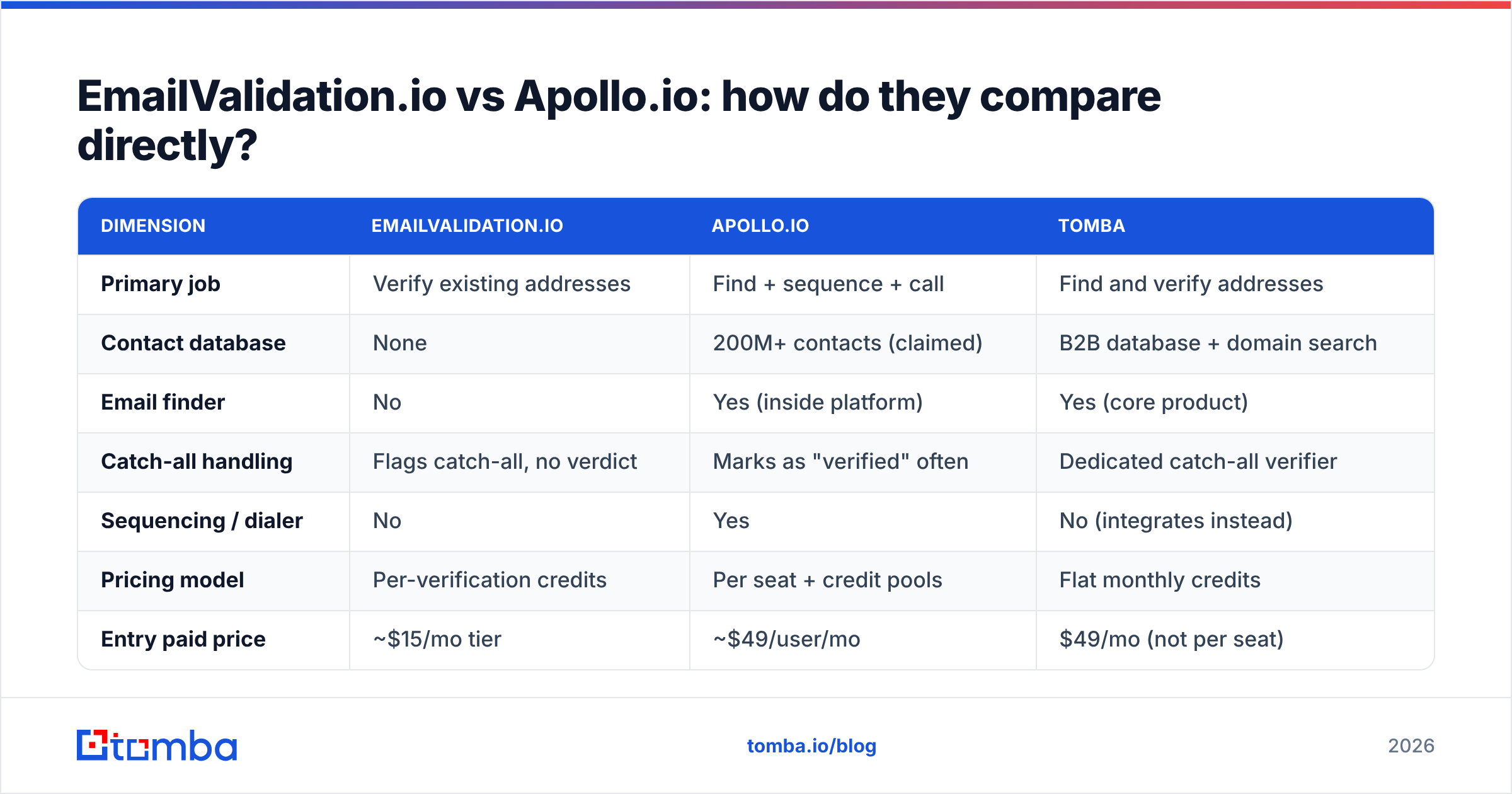
For EmailValidation.io, accuracy means one thing: did the verdict match reality? You measure it by bounce rate after you send. A good service keeps hard bounces under 2% on a cleaned list. The weak spot is catch-all domains. The receiving server accepts everything at SMTP time, then drops the message later.
For Apollo, accuracy means the contact record is correct and current. Is Sarah still the VP of Marketing? Is that still her work email? The weak spot is stale data. A record scraped 18 months ago can survive a job change, a rebrand, or a domain move.
These are different problems with different fixes. Verification can't spot stale data. An address at a company Sarah left six months ago still passes every SMTP check. You waste the send anyway. A fresh database record with a guessed email pattern has the opposite problem. It looks great in the CRM and bounces on first contact.
So the strongest stacks keep the two jobs separate:
- Source the contact from a finder or database with recent crawl dates.
- Verify deliverability with an SMTP check at send time, not at import time.
- Handle catch-alls on their own instead of dumping them into "valid" or "invalid."
- Re-verify on a schedule. B2B email decays roughly 22-30% per year, according to HubSpot's database decay research.
- Track bounce rate by source. Then you know whether the data or the verifier is at fault.
A catch-all verifier is the piece most stacks skip. It's also the piece that quietly decides whether your "95% verified" list performs.
How does pricing really compare at realistic volumes?#
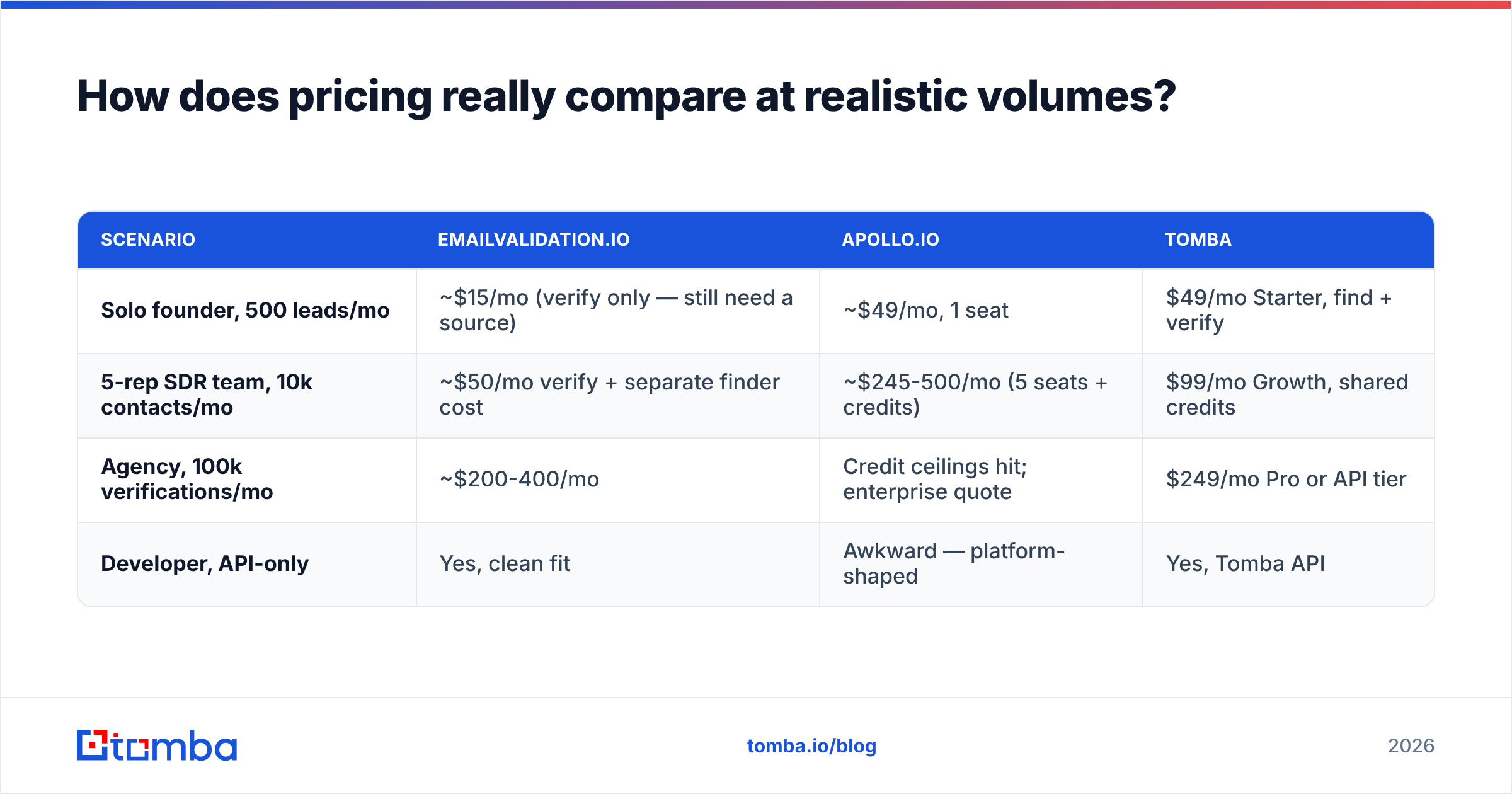
Skip the sticker prices. Run three concrete scenarios instead.
| Scenario | EmailValidation.io | Apollo.io | Tomba |
|---|---|---|---|
| Solo founder, 500 leads/mo | ~$15/mo (verify only — still need a source) | ~$49/mo, 1 seat | $49/mo Starter, find + verify |
| 5-rep SDR team, 10k contacts/mo | ~$50/mo verify + separate finder cost | ~$245-500/mo (5 seats + credits) | $99/mo Growth, shared credits |
| Agency, 100k verifications/mo | ~$200-400/mo | Credit ceilings hit; enterprise quote | $249/mo Pro or API tier |
| Developer, API-only | Yes, clean fit | Awkward — platform-shaped | Yes, Tomba API |
Two things stand out.
First, Apollo's per-seat model punishes teams and rewards solo users. Credit pools do the reverse. They punish volume spikes and reward steady use. Say your outbound is seasonal, heavy in Q1 and Q3 and quiet the rest of the year. With per-seat pricing you still pay full price during the quiet months.
Second, EmailValidation.io's low price is real but incomplete. You're buying half a solution. Add a finder or a database, and your true cost lands much closer to the alternatives. Compare that with Tomba pricing. Finding and verification share one credit pool: $49/mo for Starter, $99/mo for Growth, and not per seat.

When should you pick EmailValidation.io?#
Pick it when all of these are true:
- You already have a contact source. A CRM, an inbound funnel, a partner list, or a scraper you maintain.
- Your problem is hygiene, not discovery. You bounce too much, or your sender reputation is slipping.
- You want an API, not a UI. Your team can wire an endpoint into a job queue.
- Volume is high and unit cost matters. At six figures of checks a month, fractions of a cent add up.
Skip it when your real bottleneck is "I don't have enough contacts." Verification never creates a pipeline.
When should you pick Apollo.io?#
Pick it when:
- You have no outbound stack at all. One purchase covers list building, sending, and tracking.
- Your buyers sit in US mid-market tech, where Apollo's coverage is strongest.
- Your team is still small, so per-seat pricing hasn't started to hurt. Roughly under 8-10 reps.
- Fewer vendors beats best-of-breed for your org. Fewer integrations, fewer invoices.
Skip it in three cases. You already run a sequencing tool you like. Your buyers are European SMB or non-English. Or you're an engineer who wants an API, and the platform layer is just overhead. In those cases an Apollo alternative built around API-first contact data usually costs less and integrates cleaner.
One more option: BookYourData sits in a third spot. It sells curated, pre-verified B2B lists outright instead of metering them. That suits teams who want a fixed dataset with no credit management. Different problem, different answer.
What's the third option most buyers miss?#
"Verification tool vs sales platform" hides the middle: a contact data API that finds and verifies in one call.
Say your workflow is "I have a domain and a name, give me a deliverable address." The EmailValidation.io path makes you bolt two vendors together. The Apollo path makes you pay for sequencing you don't use.
A combined approach looks like this:
- Domain search returns every discoverable address at a company, plus the email pattern it detects.
- Email verifier runs SMTP checks on each result before it leaves the API.
- Bulk email finder handles list-scale jobs with no separate upload step.
- Enrichment adds job title, LinkedIn, and company details, so your sequencing tool has something to personalize with.
One credit pool. One API key. One bill. That's the practical case for consolidating at the data layer instead of the workflow layer. You keep your sequencer, your CRM, and your dialer. You just stop paying two vendors for one job.
EmailValidation.io vs Apollo.io: what should you do next?#
Run this decision in order:
- Diagnose the bottleneck. Are you short on contacts, or bouncing on the ones you have? Pull the bounce rate and reply rate from your last campaign. High bounce means verification. Low volume means discovery.
- Test on your own target list, not a demo list. Take 200 real accounts and run them through each free tier. Compare match rate and bounce rate, not marketing claims.
- Price the whole stack, not the part. EmailValidation.io plus a finder, versus Apollo, versus a combined API. Include seats.
- Check catch-all behavior. Ask each vendor what it returns for a known catch-all domain. "Valid" is the wrong answer.
- Re-run the test in 90 days. Coverage shifts constantly. A Q1 winner isn't always a Q4 winner.
The honest verdict on EmailValidation.io vs Apollo.io: if you treat them as direct swaps, you've probably mis-read the problem. EmailValidation.io is a well-built tool for a narrow job. Apollo is a broad platform with real coverage strengths and real pricing friction. Most teams weighing the two actually need accurate, verified contact data over an API. Neither product is built for exactly that.
Start with the Tomba Email Finder if that sounds like you. The free tier gives you 25 searches a month, so you can test match rate on your own target accounts. Starter is $49/mo flat, not per seat. Every address is verified before it hits your list, so you don't pay two vendors to solve one problem.
Related guides#
Ready to find emails that actually work?
Join 150,000+ professionals who stopped guessing and started sending. Free credits on signup — no credit card required.
Get the Tomba newsletter
Practical outbound tactics and product updates — once every two weeks.
About the author