EmailValidation.io vs Warpleads: Which One Do You Need?
One cleans lists, the other builds them. Here is an honest breakdown of EmailValidation.io vs Warpleads — pricing, accuracy, API depth, and which one earns your budget first.
TL;DR
- EmailValidation.io vs Warpleads is not a normal head-to-head. EmailValidation.io is a verification API: you feed it addresses you already have. Warpleads is a lead source: it hands you addresses you did not have.
- If your list already exists (CRM export, webform signups, scraped CSV), EmailValidation.io is the cheaper, faster fix.
- If your problem is "I have no one to email," Warpleads' bulk export model solves that, but you still need a verification layer before you send.
- Buying both means two vendors, two dashboards, two credit systems — and no guarantee the exported records were sourced recently.
- A single platform that finds, enriches, and verifies in one API call removes the seam. That is the case we make for Tomba at the end, honestly and with the trade-offs stated.
What are EmailValidation.io and Warpleads?#
Think of it like a restaurant supply chain. Warpleads is the wholesaler that delivers crates of produce to your kitchen door. EmailValidation.io is the prep cook who inspects every item and throws out the bruised ones. You can hire one without the other, but you cannot serve dinner if the crate never arrives — and you should not serve dinner if nobody inspected it.
EmailValidation.io is a single-purpose email verification service with a REST API. Send it an address, get back a structured verdict: syntax validity, MX records present, SMTP response, disposable-domain flag, role-account flag, free-provider flag, and a quality score. It does not find emails. It does not know who works at a company. It grades addresses you supply.
Warpleads (warpleads.com) sits at the other end of the pipeline. It is a B2B lead-generation platform built around bulk export — filter by industry, headcount, geography, job title, and pull records out in volume. Its pitch is "unlimited exports" rather than metered per-contact pricing, which is what draws outbound teams running high-volume sequences. Some plans include intent signals; the core value is list volume.
So the real question is not "which tool is better." It is which layer of your pipeline is currently broken.

EmailValidation.io vs Warpleads: how do they actually differ?#
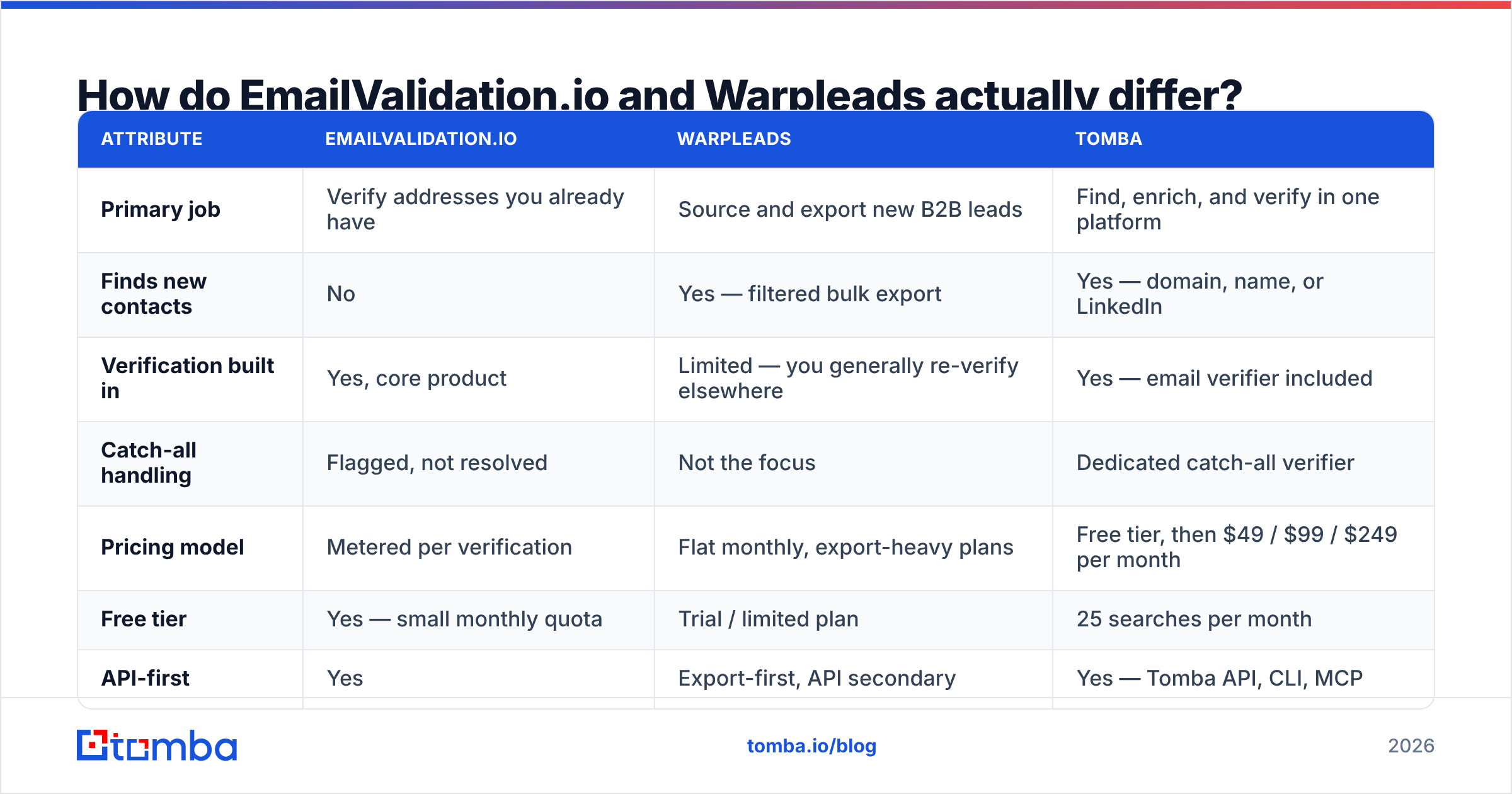
Here is the side-by-side. Prices and limits shift, so treat these as directional and confirm on each vendor's page before you commit budget.
| Attribute | EmailValidation.io | Warpleads | Tomba |
|---|---|---|---|
| Primary job | Verify addresses you already have | Source and export new B2B leads | Find, enrich, and verify in one platform |
| Finds new contacts | No | Yes — filtered bulk export | Yes — domain, name, or LinkedIn |
| Verification built in | Yes, core product | Limited — you generally re-verify elsewhere | Yes — email verifier included |
| Catch-all handling | Flagged, not resolved | Not the focus | Dedicated catch-all verifier |
| Pricing model | Metered per verification | Flat monthly, export-heavy plans | Free tier, then $49 / $99 / $249 per month |
| Free tier | Yes — small monthly quota | Trial / limited plan | 25 searches per month |
| API-first | Yes | Export-first, API secondary | Yes — Tomba API, CLI, MCP |
| Best fit | Devs cleaning inbound signups | Teams needing raw volume fast | Teams wanting one pipeline end to end |
Read that table as three different shapes of company, not three ranked options:
- A product team with a signup form. You need real-time syntax and disposable-domain rejection at the point of entry. EmailValidation.io is built for exactly this and nothing else. That is why it is cheap and fast.
- An SDR team with an empty CRM. No verifier fixes an empty database. You need a source. Warpleads' flat-rate export model is legitimately attractive here compared to per-credit vendors that punish volume.
- A growth team running outbound weekly. You need both, continuously, and the handoff between them is where hours leak. This is the seam a combined platform closes.
Which one is more accurate — and what does "accuracy" even mean here?#
In an EmailValidation.io vs Warpleads accuracy debate, the two sides do not measure the same thing. A single accuracy number is misleading.
For a verifier, accuracy means: of the addresses it marked deliverable, how many actually accepted mail? Good verification services land in the low-to-mid 90s on real-world lists. The failure mode sits in catch-all domains, where the receiving server accepts everything at SMTP time and bounces later. EmailValidation.io flags catch-alls honestly rather than guessing. That is the correct engineering choice, but it leaves you with a bucket of "unknown" addresses and a decision to make.
For a lead source, accuracy means: of the records exported, how many are current? B2B contact data decays at roughly 22–30% per year, and job-change churn accelerated after 2023. Any large static database will contain people who left the role. The relevant question for Warpleads — and for every bulk-export vendor, including the ones with bigger logos — is when the record was last observed, not how many total records exist. A 200-million-row database refreshed quarterly is worse than a 40-million-row database refreshed weekly.
That distinction matters more than either vendor's marketing page admits. Independent user reviews on G2 are the fastest sanity check here; look specifically for reviews mentioning bounce rate after import, not overall star ratings.
Practical rule: never trust a bulk export's own deliverability claim. Run any exported list through a verifier before the first send, no matter who sold it to you. That is true of Warpleads, true of Apollo, true of every list vendor on the market. It is also why the two categories in this comparison keep getting bought together.
How does pricing compare in practice?#
The models are structurally different, which makes direct per-unit comparison awkward.
EmailValidation.io charges per verification with a small free monthly allowance — good for testing, workable for a signup form doing a few thousand checks a month. Costs scale linearly with volume, so a one-time 500,000-row cleanup is a real line item.
Warpleads charges a flat monthly fee with generous or unlimited export allowances depending on plan. The economics flip: if you export 50,000 leads a month, the per-lead cost is trivial. If you export 500, you are overpaying badly.
Tomba's pricing sits in the middle as a bundled model — Free (25 searches/mo), Starter $49/mo, Growth $99/mo, Pro $249/mo, Enterprise custom — with finding, verification, data enrichment, and bulk processing drawing from one credit pool.
Run the arithmetic for your actual volume before deciding. Three scenarios:
- 5,000 inbound signups/month, no outbound. EmailValidation.io wins on cost. You do not need a lead database at all.
- 2,000 net-new prospects/month, targeted. A bundled finder+verifier is cheaper than paying two vendors, and the targeting is tighter than mass export.
- 50,000+ exports/month, spray-and-refine. Warpleads' flat rate is hard to beat on raw cost per record. Budget separately for verification, because you will need it.
What about API depth and developer experience?#
If you are wiring this into a product or an internal RevOps pipeline, the API matters more than the dashboard.
EmailValidation.io is genuinely API-first: one endpoint, predictable JSON, straightforward auth. That simplicity is the feature. There is little to learn and little to break.
Warpleads is export-first. The workflow centers on building a filtered list in the UI and pulling a CSV, then loading it into your sequencer. That fits how most outbound teams actually work, but it is a human-in-the-loop step, not an automated one.
Tomba's approach is to expose everything programmatically: domain search, email finder, verification, and phone finder all live behind the same key, with a CLI and an MCP server for agent-driven workflows plus native Google Sheets and HubSpot connections. If your team writes code, that consolidation is worth more than any single feature comparison.
Worth naming honestly: neither EmailValidation.io nor Warpleads is trying to be a platform. They are pointed tools. Pointed tools are often the right answer — right up until you own four of them.

Who should pick EmailValidation.io?#
Pick it when all of these are true:
- You already have the addresses. Form signups, CRM records, an inherited list, event registrations.
- You need real-time checks. Blocking disposable domains at signup is a product requirement, not a marketing one.
- Volume is modest and predictable. Metered pricing is fine when you can forecast it.
- You want one dependency, not a suite. Fewer moving parts, fewer failure modes.
Where it falls short: it will not tell you who to email, it will not enrich a record with a job title or company size, and catch-all domains come back as a shrug. For a pure verifier that is acceptable scope. Just do not expect it to grow with you into prospecting.
Who should pick Warpleads?#
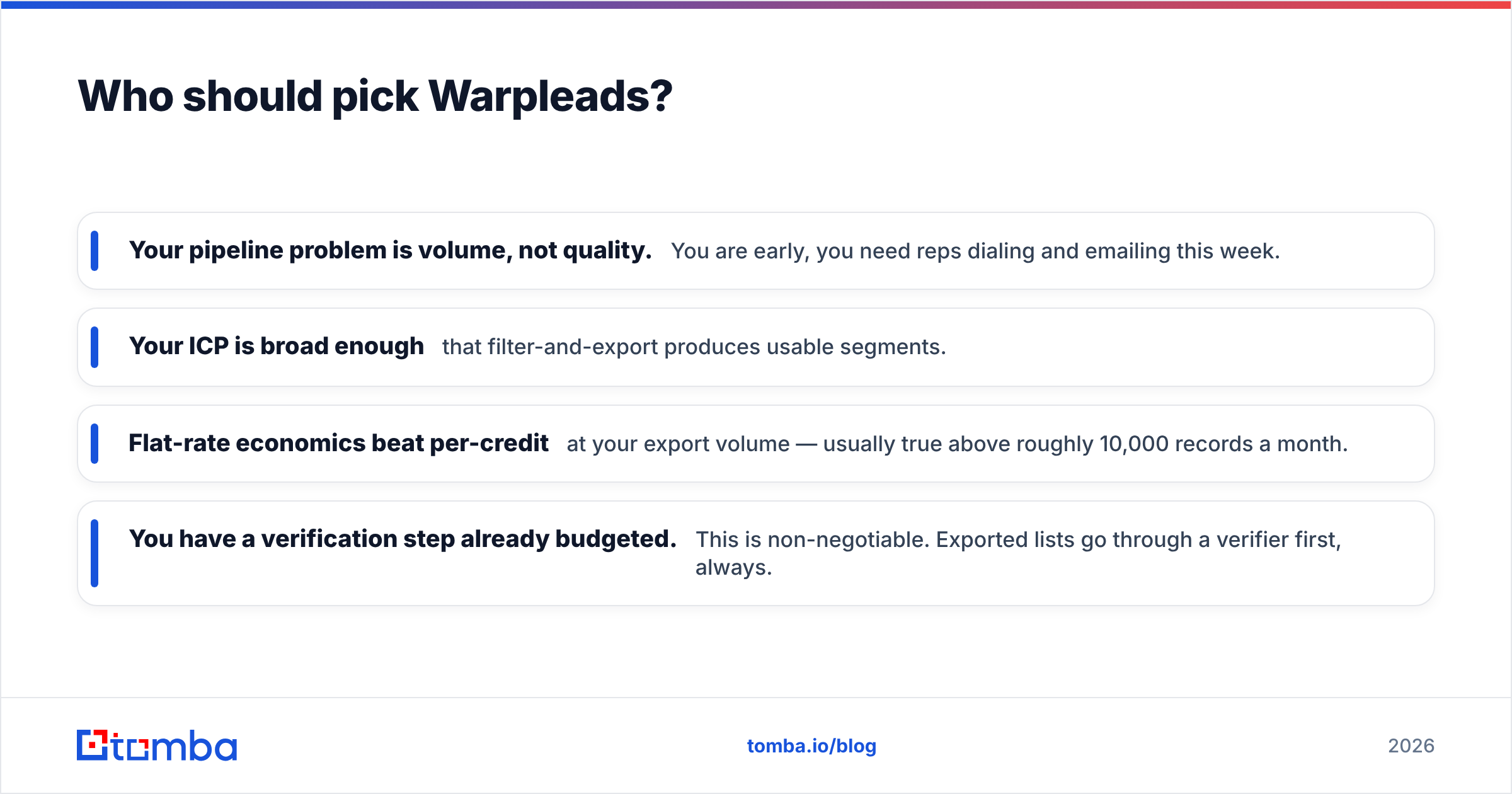
Pick it when all of these are true:
- Your pipeline problem is volume, not quality. You are early, you need reps dialing and emailing this week.
- Your ICP is broad enough that filter-and-export produces usable segments.
- Flat-rate economics beat per-credit at your export volume — usually true above roughly 10,000 records a month.
- You have a verification step already budgeted. This is non-negotiable. Exported lists go through a verifier first, always.
Warpleads is a reasonable choice in its lane, and the unlimited-export framing is a real differentiator against credit-metered incumbents. Just go in clear-eyed: bulk export optimizes for reach, and reach without a filter is how domains get burned. Pair it with a verifier and warm your sending domain properly — if you have not, start with an email warmup calculator before you touch a 50,000-row list.
For teams evaluating this category more broadly, BookYourData is another well-regarded option with a pay-as-you-go model and a verified-on-download guarantee — a different trade-off worth pricing out alongside flat-rate exports.
Do you actually need both — or something else?#
For a lot of teams, the EmailValidation.io vs Warpleads answer is "both." Here is what that really costs:
- Two contracts and two renewal dates
- Two credit or quota systems that do not talk to each other
- A manual CSV handoff between them, usually owned by whoever has the least leverage to refuse it
- Two support queues when a record looks wrong, each pointing at the other
That is survivable. Plenty of teams run it. But the seam costs real hours every month, and the handoff is where data quality quietly degrades — the export is fresh on Monday, verified on Thursday, sequenced the following Tuesday, and by then a slice of it has churned.
The alternative is a platform where finding and verifying are the same transaction. Tomba's email finder returns a confidence score and verification status in the same response as the address, so there is no window between sourcing and validation. Domain search pulls every discoverable address at a company with role and department context. The catch-all finder does the thing most verifiers refuse to attempt — resolving addresses at accept-all domains rather than returning "unknown."
Is Tomba the right call for everyone? No. If you only need real-time signup validation, a dedicated verifier is simpler and cheaper. If you genuinely need 50,000 raw exports a month and cost per record is the only metric that matters, a flat-rate export platform wins on math. Tomba's argument is for the large middle: teams doing targeted outbound who want one credit pool, one API key, and no CSV handoff.
What should you do next?#
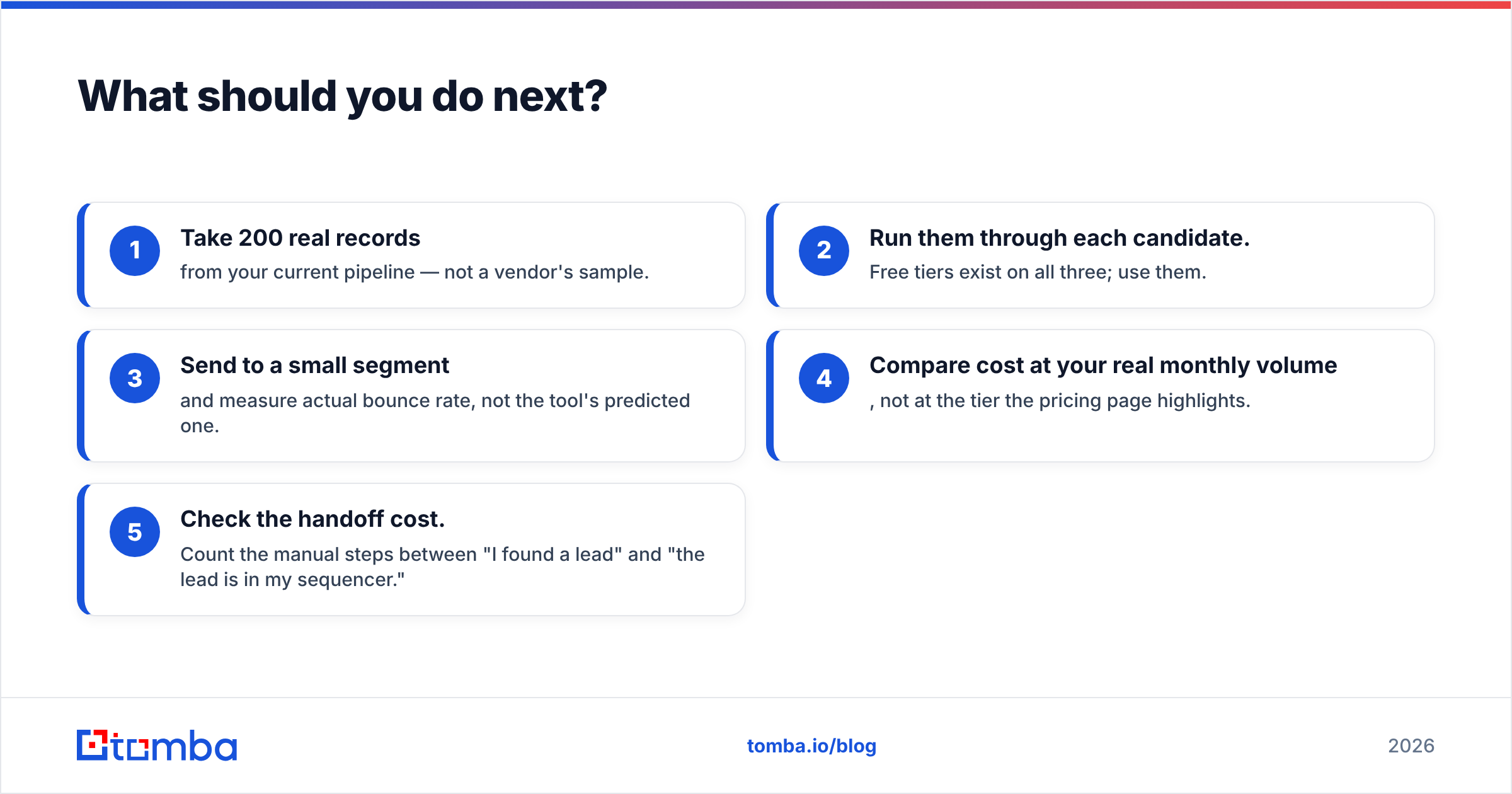
Run the cheapest possible test before committing to anything.
- Take 200 real records from your current pipeline — not a vendor's sample.
- Run them through each candidate. Free tiers exist on all three; use them.
- Send to a small segment and measure actual bounce rate, not the tool's predicted one.
- Compare cost at your real monthly volume, not at the tier the pricing page highlights.
- Check the handoff cost. Count the manual steps between "I found a lead" and "the lead is in my sequencer."
Step five is the one teams skip, and it usually decides the answer.
If the EmailValidation.io vs Warpleads choice still feels like a coin flip, your real bottleneck is probably the seam between them. Start with the Tomba Email Finder. The free tier gives you 25 searches a month — enough to test against your own ICP, compare hit rate and bounce rate head-to-head with whatever you run today, and decide with data instead of a comparison table. Paid plans start at $49/mo when you are ready to scale, with verification, enrichment, and bulk processing drawing from the same pool.
Related guides#
Ready to find emails that actually work?
Join 150,000+ professionals who stopped guessing and started sending. Free credits on signup — no credit card required.
Get the Tomba newsletter
Practical outbound tactics and product updates — once every two weeks.
About the author