EmailVerify.io vs Apollo.io: Which Tool Do You Need in 2026?
One cleans the list you already have, the other builds the list from scratch. Here is an honest breakdown of EmailVerify.io vs Apollo.io on pricing, accuracy, data ownership and stack fit.
TL;DR
- EmailVerify.io and Apollo.io are not really competitors. EmailVerify.io cleans a list you already have; Apollo.io builds the list, sequences it, and reports on it.
- If your bounce rate is the problem, a verifier fixes it for a few dollars per thousand records. If your pipeline is empty, a verifier cannot help you at all.
- Apollo's cost scales per seat, not per record, which gets expensive fast for teams that only need data — and its exported contacts are locked to your plan's export limits.
- Most outbound teams end up running three layers: a finder (to source), a verifier (to clean), and a sequencer (to send). Buying one tool that pretends to do all three usually means paying for two you barely use.
- Our pick: use a dedicated finder plus verifier if data quality and cost-per-contact matter; use Apollo if you want a single-vendor CRM-adjacent workflow and can absorb the seat pricing.
What are EmailVerify.io and Apollo.io, actually?#
Different categories, same shopping cart. That is the whole confusion.
EmailVerify.io is a single-purpose email validation service. You upload a CSV or hit an API with an address, and it returns a verdict: valid, invalid, risky, catch-all, disposable, role-based. It does syntax checks, MX record lookups, SMTP handshakes, and maintains suppression lists for known spam traps and complainers. It does not know who works at a company. It only knows whether the mailbox you already found will accept mail.
Apollo.io is a go-to-market platform. It bundles a B2B contact database (hundreds of millions of contacts by its own marketing), filters for building lists, a Chrome extension, email sequencing, dialer, and basic deal tracking. Verification is included as a background feature, not the product. You can read Apollo's own positioning on apollo.io — it sells itself as an end-to-end sales engine, not a data-hygiene utility.
So the honest framing of EmailVerify.io vs Apollo.io is not "which is better." It is: do you have a sourcing problem or a hygiene problem?
How do the two tools differ in job-to-be-done?#
Five practical differences that decide the purchase:
- Direction of data flow. EmailVerify.io takes data in and hands it back cleaner. Apollo.io generates data from its own database. One is a filter, one is a faucet.
- Unit of pricing. Verifiers charge per credit consumed, usually fractions of a cent at volume. Apollo charges per user seat per month, with credit caps layered on top. A 5-person team pays 5× for Apollo even if only one person exports lists.
- Depth of verification. A dedicated verifier invests in catch-all handling, greylisting retries, and role-account detection because that is the entire business. Platform-bundled verification is usually a single-pass check optimised for speed, not for the last 5% of ambiguous mailboxes.
- Data freshness vs data breadth. Apollo's strength is breadth — titles, headcount, tech stack, intent signals. Its weakness is staleness on contacts that haven't been re-crawled recently. A verifier tells you nothing about the person, only whether the mailbox is alive right now, which is arguably the more time-sensitive fact.
- Lock-in. Verification output is a plain CSV you own forever. Apollo contacts are subject to export limits and terms that restrict redistribution — check your plan before you assume you can dump the whole database into your CRM.
How do EmailVerify.io and Apollo.io compare feature by feature?#
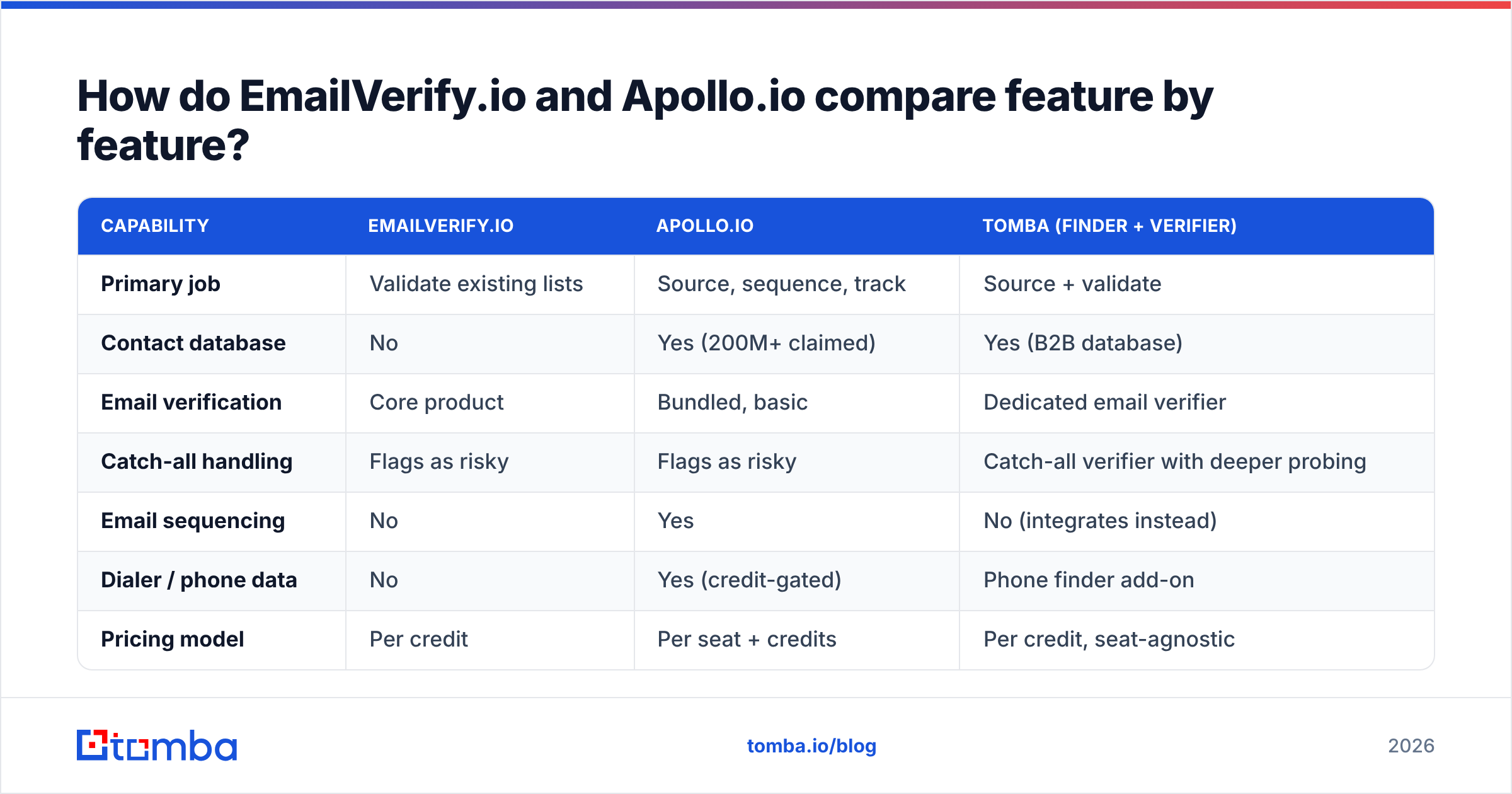
Here is the side-by-side, with a dedicated finder-plus-verifier stack as a third column for context.
| Capability | EmailVerify.io | Apollo.io | Tomba (finder + verifier) |
|---|---|---|---|
| Primary job | Validate existing lists | Source, sequence, track | Source + validate |
| Contact database | No | Yes (200M+ claimed) | Yes (B2B database) |
| Email verification | Core product | Bundled, basic | Dedicated email verifier |
| Catch-all handling | Flags as risky | Flags as risky | Catch-all verifier with deeper probing |
| Email sequencing | No | Yes | No (integrates instead) |
| Dialer / phone data | No | Yes (credit-gated) | Phone finder add-on |
| Pricing model | Per credit | Per seat + credits | Per credit, seat-agnostic |
| Free tier | Small trial credits | Yes, limited exports | 25 searches/mo |
| API access | Yes | Yes, plan-gated | Yes on all paid plans |
| Best for | Cleaning bought or scraped lists | Full-stack SDR teams | Data-first outbound and RevOps |
Note the row that decides most deals: pricing model. Per-seat pricing punishes teams where only one or two people actually touch the data. Per-credit pricing punishes nobody until volume climbs — and then it is predictable.
Which one is more accurate?#
Accuracy means two different things here, and vendors love to blur them.
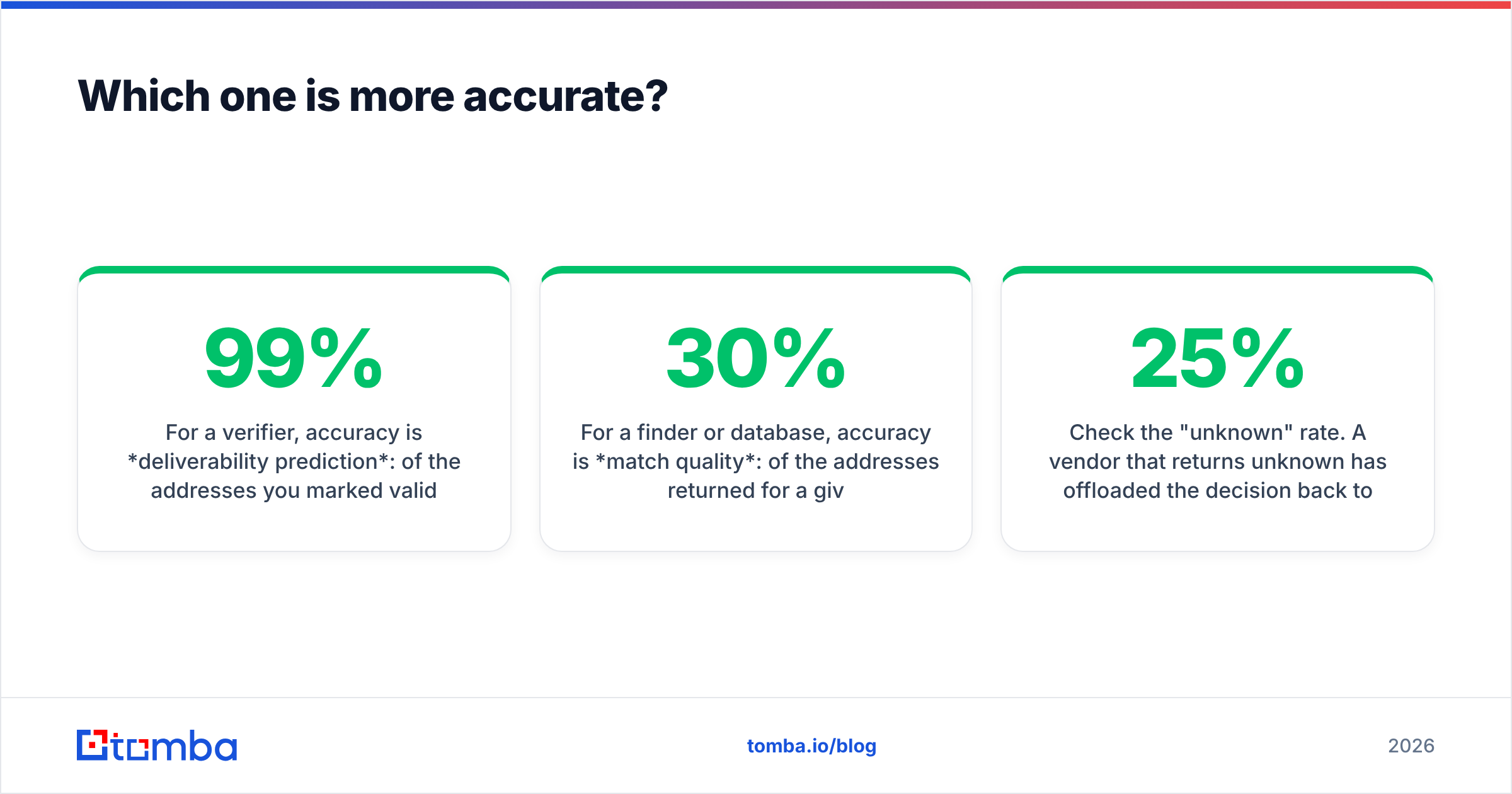
For a verifier, accuracy is deliverability prediction: of the addresses you marked valid, how many actually landed? Good verifiers sit in the 96–99% range on clean, non-catch-all domains. The number collapses on catch-all domains, where the receiving server accepts everything at SMTP time and rejects later. Any vendor claiming 99% accuracy on catch-all domains is selling you a guess dressed as a verdict.
For a finder or database, accuracy is match quality: of the addresses returned for a given name and domain, how many are the real, current mailbox for that person? This is where large aggregated databases wobble. A contact record crawled 14 months ago on a company with 30% annual churn is a coin flip.

Three things to test before you trust either vendor:
- Run a known-good control set. Take 100 addresses you have personally emailed in the last 30 days that all delivered. Push them through the verifier. Anything marked invalid is a false negative, and false negatives cost you pipeline silently.
- Run a known-bad set. Use addresses that hard-bounced. Anything marked valid is a false positive, and false positives are what get your domain throttled. The mechanics of what actually happens are documented well in the general reference on bounce messages.
- Check the "unknown" rate. A vendor that returns 25% unknown has offloaded the decision back to you. Compare that number, not just the headline accuracy claim.
Peer-review aggregators are useful for spotting patterns vendors do not publish. The email verification category on G2 is a reasonable place to see where support and billing complaints cluster.
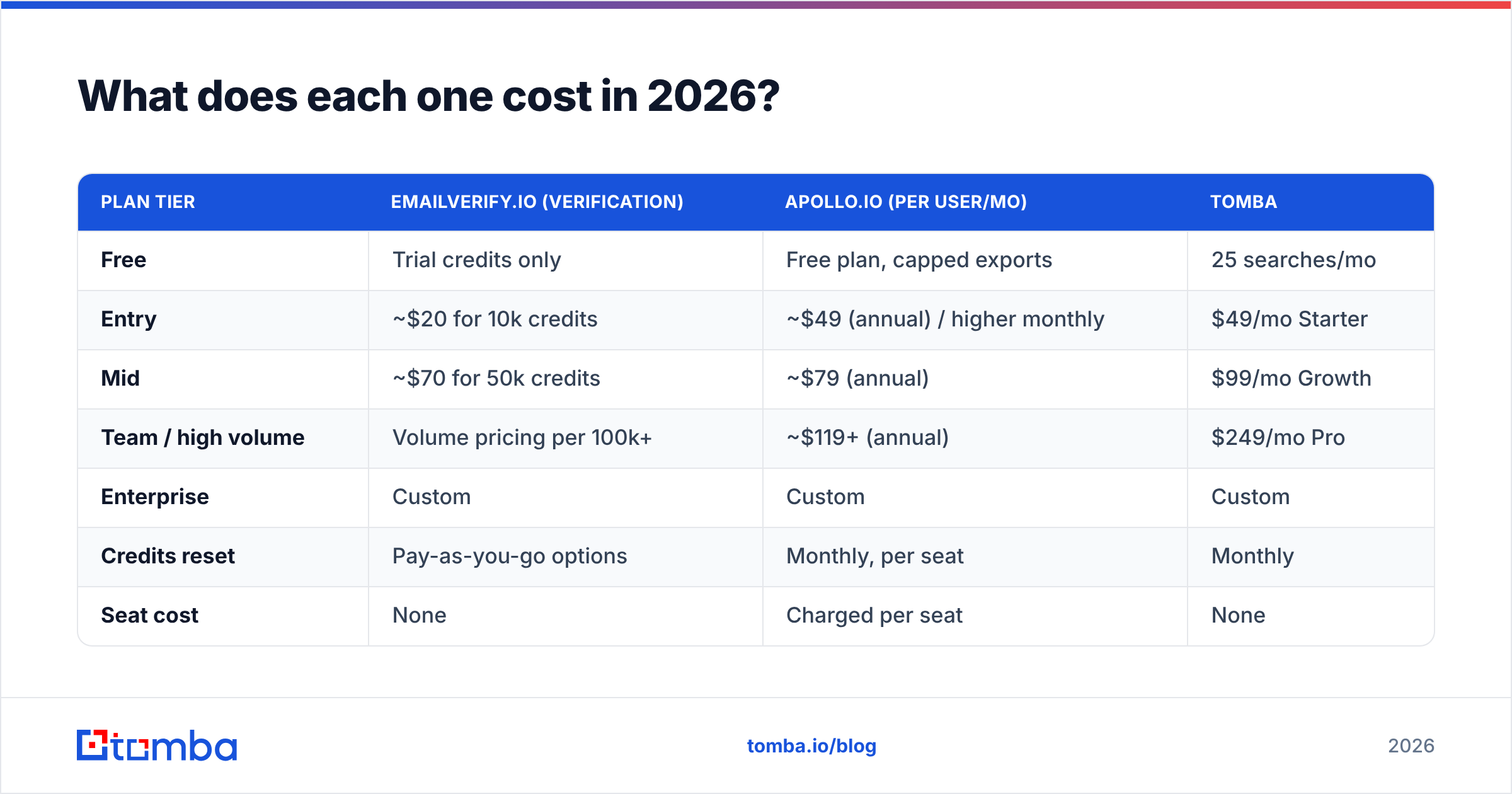
What does each one cost in 2026?#
Prices move; treat these as the shape of the pricing rather than a quote. Always confirm on the vendor's own page before you commit.
| Plan tier | EmailVerify.io (verification) | Apollo.io (per user/mo) | Tomba |
|---|---|---|---|
| Free | Trial credits only | Free plan, capped exports | 25 searches/mo |
| Entry | ~$20 for 10k credits | ~$49 (annual) / higher monthly | $49/mo Starter |
| Mid | ~$70 for 50k credits | ~$79 (annual) | $99/mo Growth |
| Team / high volume | Volume pricing per 100k+ | ~$119+ (annual) | $249/mo Pro |
| Enterprise | Custom | Custom | Custom |
| Credits reset | Pay-as-you-go options | Monthly, per seat | Monthly |
| Seat cost | None | Charged per seat | None |
The real number to compute is cost per usable contact, not cost per credit. Take the plan price, divide by the number of contacts you actually sent to after verification and deduplication. A cheap verifier that flags 30% of your list as unknown and a database plan where you burn credits on stale records can both end up costing more per usable contact than the sticker price implies.
Two cost traps specific to this matchup:
- Apollo seat multiplication. If you have 6 SDRs and 1 RevOps person, you may be paying 7 seats for what is functionally one data pipeline. Compare that to a per-credit tool at Tomba pricing where seats are not the billing unit.
- Double-paying for verification. If you buy Apollo and a standalone verifier because you do not trust Apollo's built-in check, you are paying twice for one outcome. Pick a lane.

Is Apollo.io's built-in verification good enough to skip a verifier?#
Sometimes. Here is the decision rule we would actually use.
Skip the standalone verifier if: you are sending under roughly 2,000 emails a month, mostly to large well-known domains with standard MX records, from a mature sending domain with months of positive reputation. The marginal bounce risk is small enough to absorb.
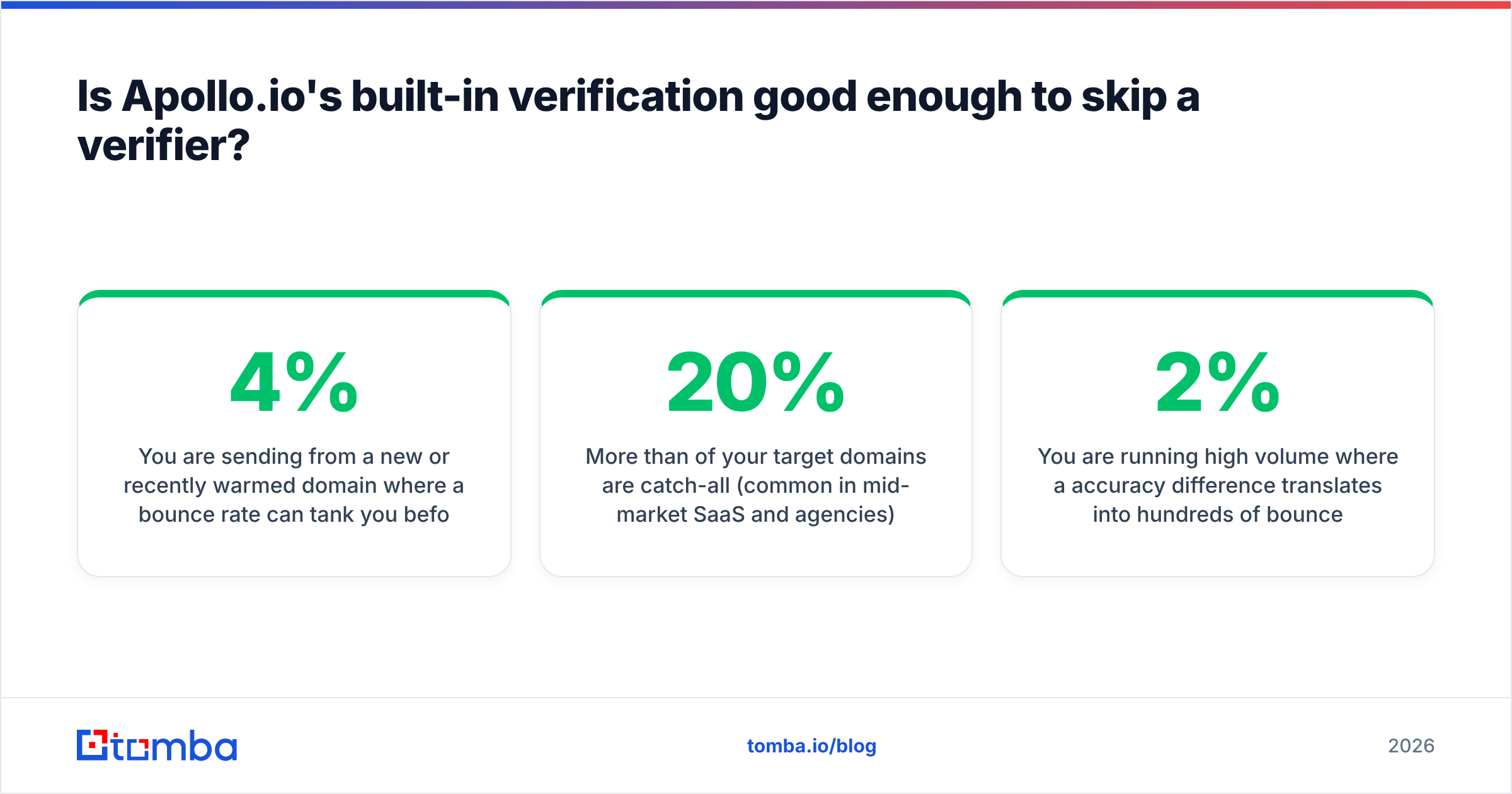
Add a standalone verifier if: any of the following is true —
- You are sending from a new or recently warmed domain where a 4% bounce rate can tank you before you recover.
- More than 20% of your target domains are catch-all (common in mid-market SaaS and agencies).
- Your list has any imported, purchased, or scraped origin — third-party lists decay faster than anything you source yourself.
- You are running high volume where a 2% accuracy difference translates into hundreds of bounces per send.
The cost asymmetry is the point. Verification runs somewhere in the range of a few dollars per thousand records. A suspended sending domain costs you weeks of pipeline. That is not a close call.
Where does a dedicated email finder fit into this?#
There is a third position in the EmailVerify.io vs Apollo.io debate that most comparison posts skip: you may not need either as your primary tool.
If your motion is "I know exactly which companies and people I want, I just need their contact details," you do not need Apollo's full sequencing suite and you do not need a verifier as a separate purchase. You need a finder that verifies at the point of discovery.
That is the design of the Tomba Email Finder: you supply a domain plus a name (or just a domain), it returns the pattern-matched address with a confidence score and a verification verdict in one call. No separate cleaning step, no per-seat tax, and the API is available on every paid tier rather than gated behind an enterprise plan.
Where each approach genuinely wins:
- EmailVerify.io wins when your only job is hygiene — you inherited a 200k-record CRM and need to know what is still deliverable before a re-engagement campaign.
- Apollo.io wins when you want one vendor, one login, and one invoice covering sourcing through sequencing, and you have enough seats using it daily to justify the per-seat cost. Teams that have outgrown that model often look at an Apollo alternative once seat count outpaces actual usage.
- A finder-first stack wins when data quality and cost-per-contact are the metrics you are judged on, and you already have a sequencer you like (Instantly, Smartlead, Lemlist, or your CRM's native sending).
How do you actually test all three before buying?#
Run the same 200-row benchmark through each. Nothing else settles it.
- Build the control set. 200 real target contacts across a mix of domain types: 60 large enterprise, 60 mid-market SaaS, 40 known catch-all domains, 40 small business. Record the company domain and full name for each.
- Measure coverage. How many of the 200 does each tool return an address for at all? Coverage gaps are invisible in accuracy stats because a tool that returns nothing never gets a wrong answer.
- Measure verdict distribution. Count valid / invalid / risky / unknown. High unknown rates are a hidden cost.
- Send a real, small campaign. 50 addresses, plain text, from a warmed domain. Count hard bounces after 48 hours. This is the only number that is not a vendor claim.
- Compute cost per delivered contact. Total spend divided by contacts that received the message. Compare across all three.
- Check the integration path. Does it push cleanly into your CRM and sequencer without a manual CSV round-trip? A tool that wins on accuracy but loses two hours a week to exports is not actually cheaper.

What is the verdict on EmailVerify.io vs Apollo.io?#
They solve different problems, so pick based on which problem you have this quarter.
Choose EmailVerify.io if your lists come from somewhere else and you need them clean. It is cheap, focused, and does not try to sell you a sales platform.
Choose Apollo.io if you want a single system of record for prospecting activity and your team size makes per-seat pricing rational. It is a legitimately broad product; the question is whether you use enough of that breadth to justify the bill.
Choose neither as your primary if what you actually need is accurate contact discovery at a predictable cost per record. That is a finder's job, and paying a platform tax or a hygiene-only tool to approximate it is the most common budget leak we see in outbound stacks.
Start with the free tier and run the 200-row benchmark above against your own target accounts — 25 searches a month is enough to prove or disprove the accuracy claims on your specific ICP. If the numbers hold up, the Tomba Email Finder gives you sourcing and verification in one call, on per-credit pricing that does not multiply with headcount, with API access from the $49/mo Starter plan up. Run it against whatever you use today and let the bounce report decide.
Related guides#
Ready to find emails that actually work?
Join 150,000+ professionals who stopped guessing and started sending. Free credits on signup — no credit card required.
Get the Tomba newsletter
Practical outbound tactics and product updates — once every two weeks.
About the author