EmailVerify.io vs Leadzen.ai: Which One Wins in 2026?
One tool cleans lists, the other builds them. We put EmailVerify.io and Leadzen.ai side by side on accuracy, pricing, coverage and API depth — and name the setup that beats both.
EmailVerify.io vs Leadzen.ai is the wrong fight, and that is the useful part. One tool cleans lists. The other builds them. Here is how to pick the right half.
TL;DR
- EmailVerify.io vs Leadzen.ai is not a like-for-like race. EmailVerify.io is a bulk email checker. Leadzen.ai is a lead search platform. Comparing them straight across is like comparing a water filter to a well.
- Pick EmailVerify.io if you already have lists and your only problem is bounce rate. Webforms, events, scrapers, an aging CRM — all fair game.
- Pick Leadzen.ai if you need to build lists from scratch. Its India and APAC coverage is deep. You pay in credits.
- Neither one closes the loop of find → verify → enrich → export in a single API. That gap is where a combined platform like Tomba fits, at $49/mo for Starter.
- Rework is the real cost. Cleaning a bad list beats mailing it. Not buying junk data beats both.
EmailVerify.io vs Leadzen.ai: what does each tool do?#
Start here. Most people who search "EmailVerify.io vs Leadzen.ai" were handed two tool names by a colleague and told to pick one. The two products solve different halves of the same funnel.
EmailVerify.io is a list hygiene tool. You upload a CSV, or you call an API with one address. It then runs a chain of checks. Syntax. DNS and MX lookup. Disposable domains. Role accounts such as info@, sales@ and support@. Last comes an SMTP handshake. That step asks the mail server whether the mailbox exists, without sending any mail.
You get back a verdict: valid, invalid, catch-all, or unknown. A few flags come with it. The tool does not know who works at a company. It only knows whether an address you already own will accept mail.
Leadzen.ai sits on the other side. It is a prospecting platform with a contact database and a Chrome extension for LinkedIn. You filter by industry, region, company size and job title. It answers a different question. Who should I email here, and what is their address and phone number? Its coverage of Indian companies runs deep. That is a real edge in that market, and a non-issue outside it.
So the honest framing is short. EmailVerify.io cleans. Leadzen.ai sources. Buy one when you needed the other, and you will feel it within two weeks.

EmailVerify.io vs Leadzen.ai: the head-to-head table#
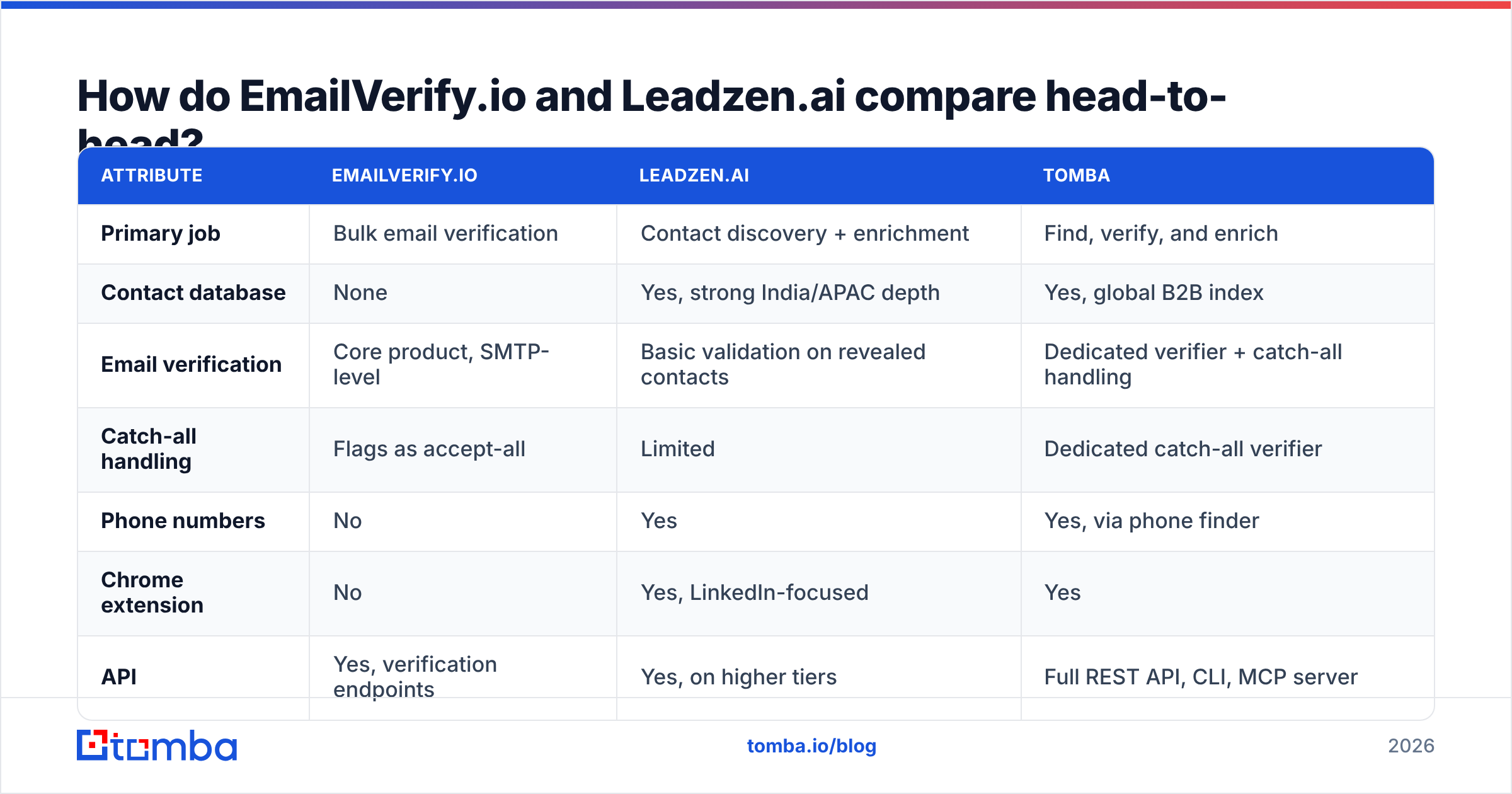
Here is the practical breakdown. Treat pricing as directional. Both vendors move their plans. Credits also mean different things. At a verifier, one credit checks one address. At a prospecting tool, one credit usually reveals one contact.
| Attribute | EmailVerify.io | Leadzen.ai | Tomba |
|---|---|---|---|
| Primary job | Bulk email verification | Contact discovery + enrichment | Find, verify, and enrich |
| Contact database | None | Yes, strong India/APAC depth | Yes, global B2B index |
| Email verification | Core product, SMTP-level | Basic validation on revealed contacts | Dedicated verifier + catch-all handling |
| Catch-all handling | Flags as accept-all | Limited | Dedicated catch-all verifier |
| Phone numbers | No | Yes | Yes, via phone finder |
| Chrome extension | No | Yes, LinkedIn-focused | Yes |
| API | Yes, verification endpoints | Yes, on higher tiers | Full REST API, CLI, MCP server |
| Pricing model | Pay-as-you-go credits + subscriptions | Subscription + credit packs | Free tier, then $49 / $99 / $249 per month |
| Free entry point | Small trial credit allocation | Trial with limited reveals | 25 searches/month, no card |
| Best fit | Cleaning lists you already own | Building lists in India/APAC | Teams that need both in one API |
Two things stand out in that table.
First, the overlap is thin. Only one row is a real contest: email verification. Even there, a verifier tends to win. Checking mail is its whole business. For a prospecting platform, it is a side feature.
Second, neither vendor closes the loop. You can source with one tool and clean with the other. Plenty of teams do just that. But then you pay two bills, track two credit systems, and write glue code between two APIs. Those APIs have different rate limits and different error formats.
Which one is more accurate in EmailVerify.io vs Leadzen.ai?#
"Accurate" means something different for each tool. That is why vendor numbers are close to useless side by side.
For EmailVerify.io, the test is simple. Of the addresses it called valid, how many took the mail? A good checker lands between 95% and 99% on normal domains. The number falls apart on catch-all domains. Those servers accept everything up front, then sort it out later. Any tool that calls a catch-all address "valid" is guessing. Honest ones flag it and let you decide.
For Leadzen.ai, the test is about the data itself. Of the people it surfaced, how many have a current email and the right job title? That is a freshness problem, not a protocol problem. Contact data decays by 22–30% a year as people switch jobs. Coverage also swings by region. India is strong. Mid-market German manufacturers, much less so.

Here is the part of EmailVerify.io vs Leadzen.ai that trips teams up. A verifier cannot fix bad sourcing. Say Leadzen.ai returns a person who left eight months ago. Their old mailbox still forwards. EmailVerify.io will mark it valid. That is correct on the wire and useless in a pipeline. The reverse holds too. More contacts will never fix a bounce problem.
So treat find and verify as one pipeline, not two purchases. Tomba runs email verification on results at discovery time. A separate catch-all verifier handles domains where SMTP gives no useful signal. What lands in your CSV has already passed both checks.
EmailVerify.io vs Leadzen.ai pricing: what do you really pay?#
Compare cost per usable contact, not cost per credit. A $0.004 check is worthless if the contact under it was never real.
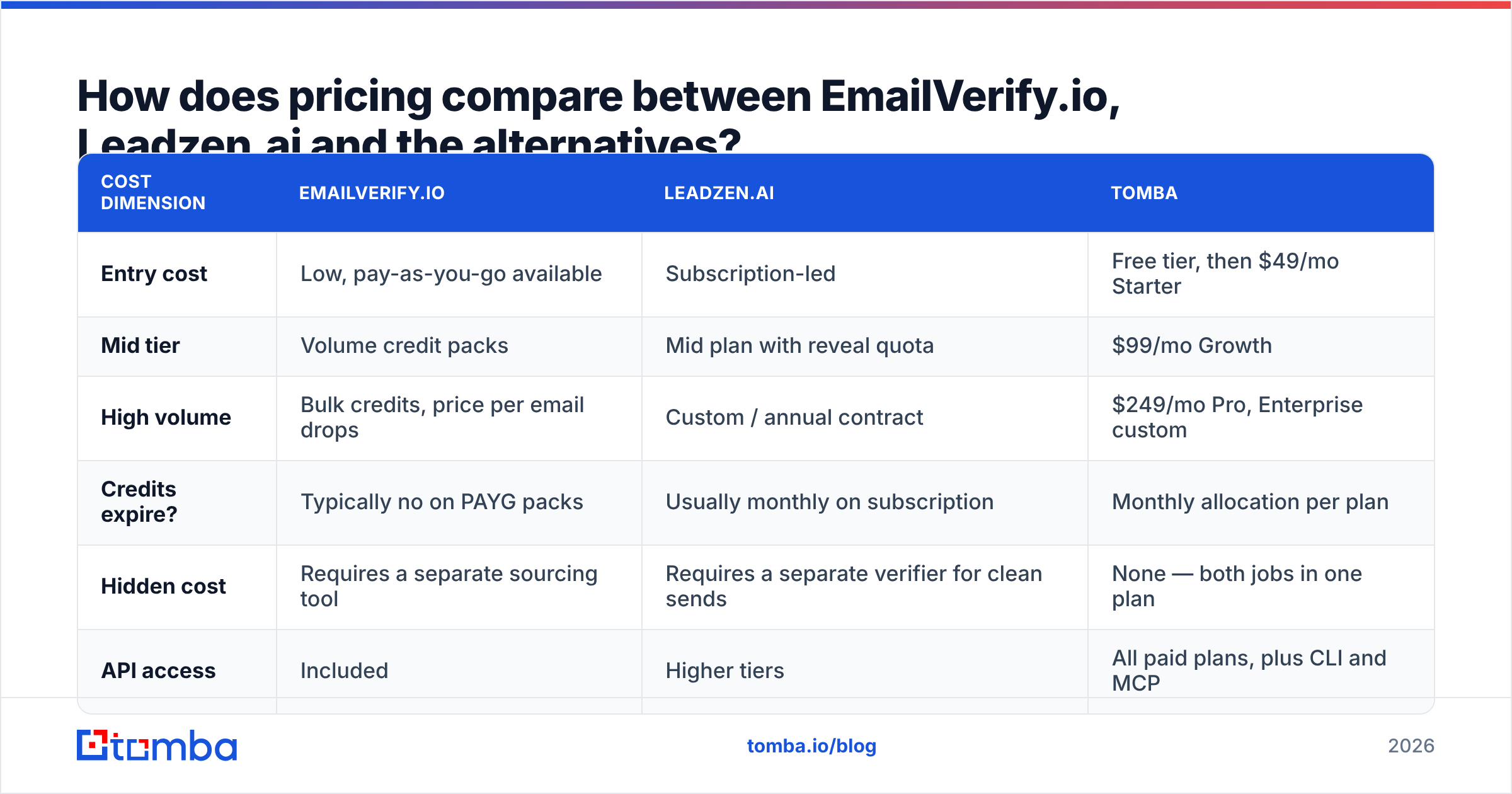
| Cost dimension | EmailVerify.io | Leadzen.ai | Tomba |
|---|---|---|---|
| Entry cost | Low, pay-as-you-go available | Subscription-led | Free tier, then $49/mo Starter |
| Mid tier | Volume credit packs | Mid plan with reveal quota | $99/mo Growth |
| High volume | Bulk credits, price per email drops | Custom / annual contract | $249/mo Pro, Enterprise custom |
| Credits expire? | Typically no on PAYG packs | Usually monthly on subscription | Monthly allocation per plan |
| Hidden cost | Requires a separate sourcing tool | Requires a separate verifier for clean sends | None — both jobs in one plan |
| API access | Included | Higher tiers | All paid plans, plus CLI and MCP |
Check the vendor pages before you commit, since both change tiers. The structure holds anyway. Buy one of these tools and you should budget for the other one too. Two subscriptions at roughly $50–$150 each land you in the same monthly range as one platform that does both. You also keep the integration work.

Price this out properly. Run the numbers against Tomba pricing before you assume a bundled tool costs more. Once you count both line items, it usually does not.

Who should choose EmailVerify.io?#
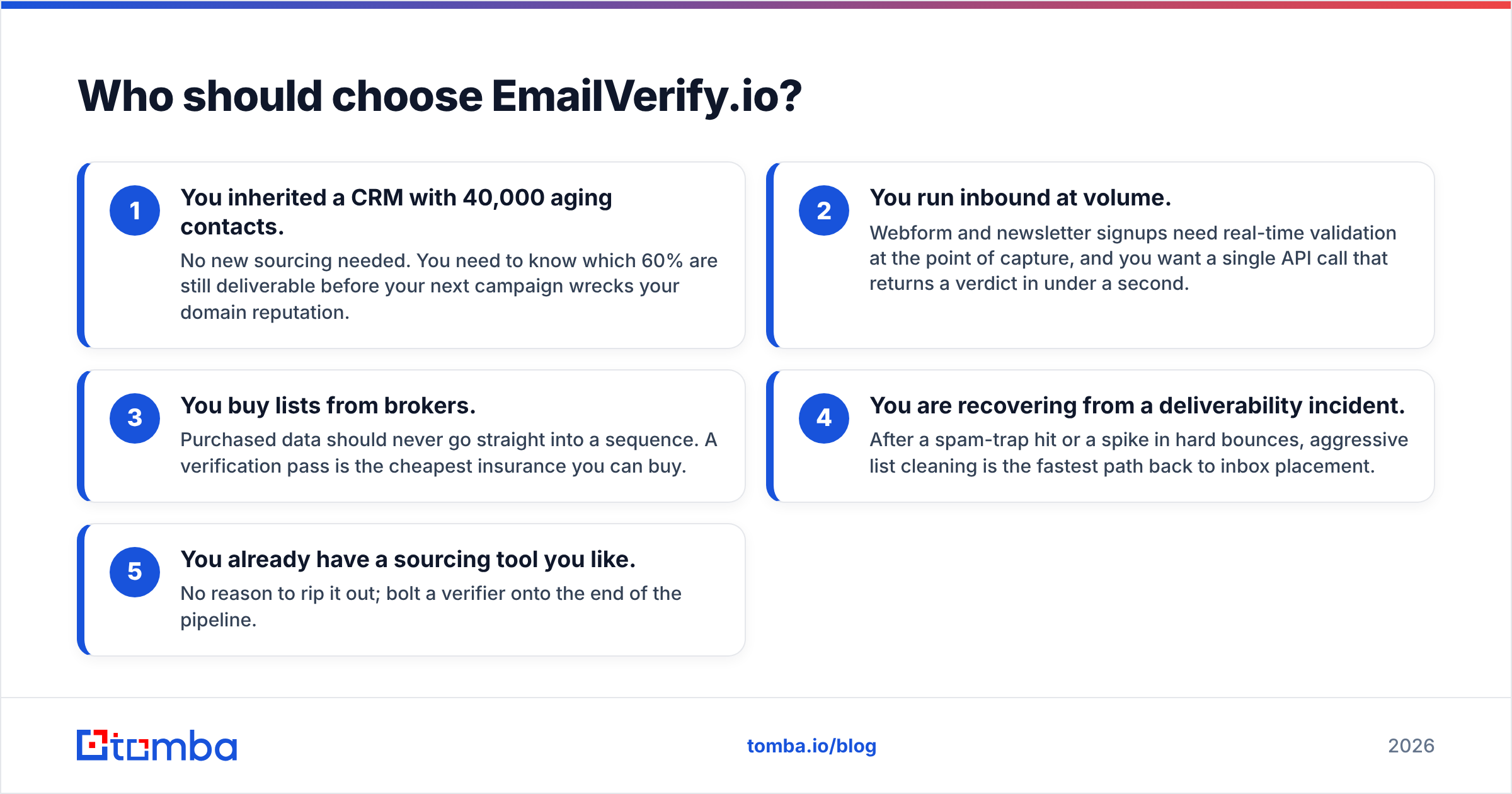
Pick it when checking addresses is your only open problem. Five clear cases:
- You inherited a CRM with 40,000 aging contacts. You need no new names. You need to know which 60% still work, before the next send hurts your domain.
- You run inbound at volume. Webform and newsletter signups need a check at the point of capture. One API call, one verdict, under a second.
- You buy lists from brokers. Bought data should never go straight into a sequence. A cleaning pass is cheap insurance.
- You are recovering from a bad send. After a spam-trap hit or a bounce spike, hard cleaning is the fastest way back to the inbox.
- You already like your sourcing tool. Keep it. Bolt a verifier onto the end of the pipeline.
What it will not do: hand you a single new prospect. If your problem is "not enough names," a verifier only makes that clearer.
Who should choose Leadzen.ai?#
Pick it when discovery is your bottleneck, above all in its strongest regions.
- India and APAC is your main market. Western databases often run thin on Indian mid-market firms. This is Leadzen's clearest win.
- You prospect on LinkedIn daily. Open a profile, reveal the contact, push it to a list. For an SDR who lives in Sales Navigator, nothing is faster.
- You need phone numbers as well as emails. In markets where the phone still beats email, one source for both is worth paying for.
- You want filters, not lookups. Building a list by industry, headcount and title is a different job. It needs real filter depth.
What it will not do: promise that today's export is deliverable. Plan on a cleaning pass anyway.
Is there a tool that does both jobs in one place?#
Yes. This is where the two-tool stack starts to look like an accident of buying, not a design choice.
Tomba's core product is the email finder. Give it a name and a company domain. Get a verified work address back. Around it sit the parts you would otherwise buy separately:
- Domain search — pull every discoverable address at a company, with role and department context. Map a buying committee instead of guessing one name.
- Email verifier — SMTP-level checks with real catch-all handling, run before results reach you.
- Bulk email finder — upload a company list, get contacts back. No per-row scripting.
- Tomba API — one key, one rate limit, one error format for find, verify and enrich. There is a CLI and an MCP server too, for AI agent workflows.
- A free tier you can actually use — 25 searches a month, no card. Enough to test coverage in your niche before you spend.
One honest caveat. If your whole market is Indian SMBs, depth may beat consolidation. Test both against 50 target accounts where you already know the answers. Whichever tool returns more correct, current contacts wins. No comparison table beats that result.
How do you build a stack that covers both jobs?#
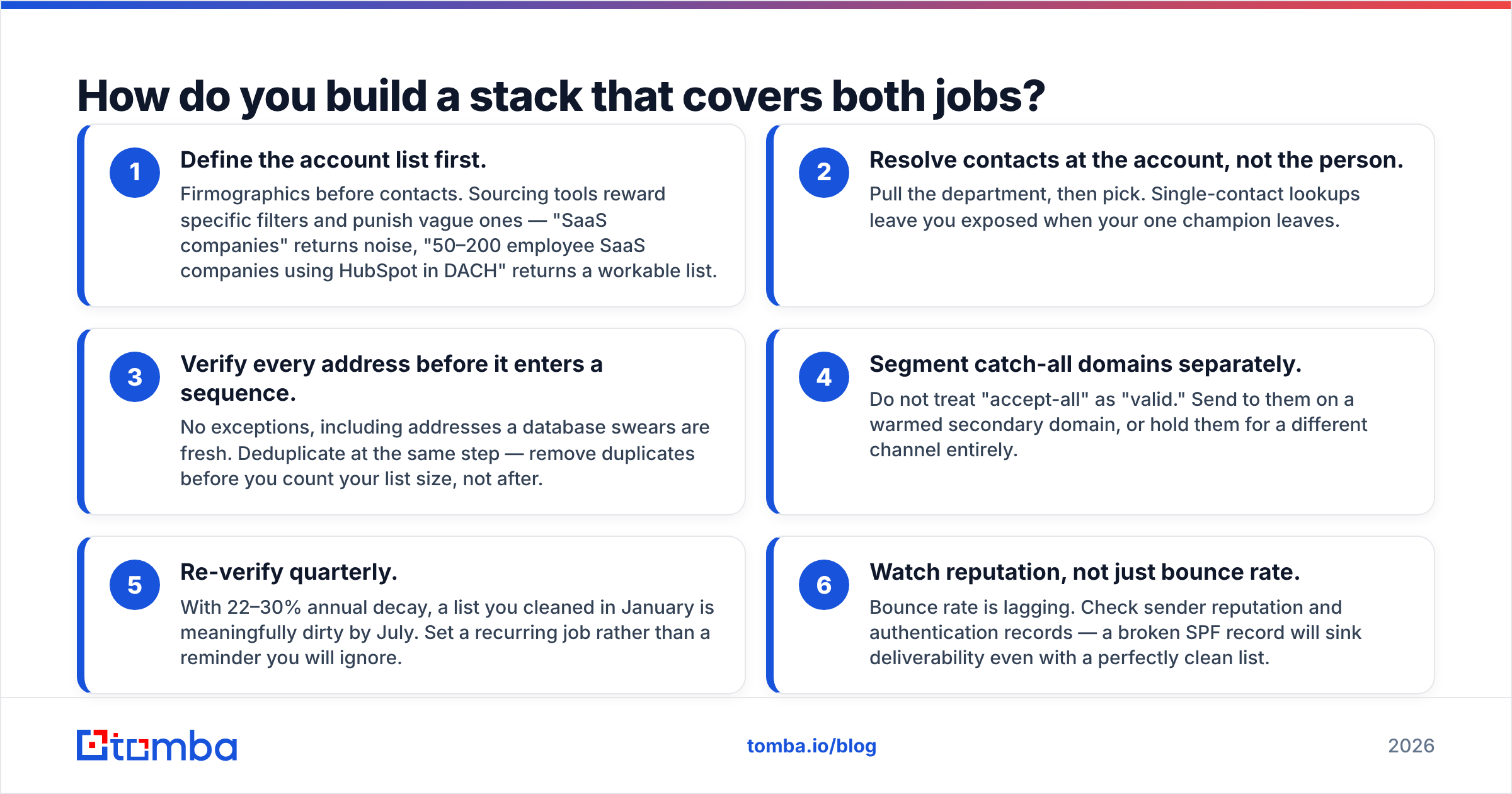
An EmailVerify.io vs Leadzen.ai decision only covers half of this list. The order matters more than the logos. This is the pipeline that keeps bounce rates under 2%:
- Define the account list first. Company traits come before contacts. Vague filters return noise. "50–200 employee SaaS firms using HubSpot in DACH" returns a list you can work.
- Resolve contacts at the account, not the person. Pull the department, then choose. One-contact lookups fail when your champion quits.
- Verify every address before it enters a sequence. No exceptions, even for data a vendor calls fresh. Dedupe in the same step — remove duplicates before you count the list.
- Split catch-all domains out. "Accept-all" is not "valid." Mail them from a warmed second domain.
- Re-verify every quarter. At 22–30% decay a year, a list you cleaned in January is dirty by July. Set a recurring job.
- Watch reputation, not just bounces. Bounce rate lags. Check sender reputation and your auth records. A broken SPF record sinks a clean list.
Review sites help you sanity-check both vendors. G2 carries user reviews in both categories. They surface the support and billing gripes that marketing pages skip.
The verdict on EmailVerify.io vs Leadzen.ai#
If you must pick one, pick by which half of the funnel is broken. Bouncing sends → EmailVerify.io. Empty pipeline → Leadzen.ai. Anyone who says one replaces the other is selling something.
If you can pick a stack instead of a tool, put find and verify behind one API. That kills a whole class of problems. Credit math. Mismatched formats. Dead contacts that still pass a check. Two bills for one job.
Start with the Tomba Email Finder free tier. It is 25 searches a month, no card. Run it on 25 accounts where you already know the right contact. Then compare hit rate and bounce rate with the EmailVerify.io vs Leadzen.ai results on the same set. The test takes an afternoon. It settles the argument with your own data, not someone else's chart.
Related guides#
Ready to find emails that actually work?
Join 150,000+ professionals who stopped guessing and started sending. Free credits on signup — no credit card required.
Get the Tomba newsletter
Practical outbound tactics and product updates — once every two weeks.
About the author