Emotional Intelligence in Sales: The 2026 Playbook for Reps
High-EQ reps do not "read minds" — they run a repeatable loop of noticing, naming, and adjusting. Here is what emotional intelligence in sales actually looks like, how to score it, and how to coach it without a fluffy workshop.
TL;DR
- Emotional intelligence in sales is not charisma. It is a four-part loop: notice the signal, name it accurately, regulate your own reaction, then adjust the next sentence.
- The measurable version beats the vibes version. Score reps on talk-listen ratio, question depth, objection recovery, and post-call notes about the buyer's situation — not their own pitch.
- EQ pays off hardest in three moments: discovery, the first hard objection, and the silence after you send pricing.
- Low EQ shows up as data, not personality: high meeting-to-opportunity drop-off, single-threaded deals, and "went dark" as the most common closed-lost reason.
- Tooling does not create empathy, but bad data destroys it. Nothing kills rapport faster than emailing the wrong person at the wrong company with the wrong title.
What is emotional intelligence in sales?#
Emotional intelligence in sales is the ability to accurately read a buyer's emotional state, manage your own reaction to it, and change what you do next based on both. That is it. It is not being likeable, and it is not "building rapport" by asking about someone's golf handicap.
Think of it like driving in bad weather. A low-EQ driver keeps the same speed and grip they always use, because that is what worked yesterday. A high-EQ driver feels the tires slip, registers it without panicking, and adjusts steering input before the skid becomes a spin. Same road, same car — different feedback loop.
The psychological framework comes from Daniel Goleman's work, which splits emotional intelligence into self-awareness, self-regulation, motivation, empathy, and social skill. That model was built for leadership, not quota. In sales, the useful translation is narrower and more mechanical:
- Signal detection — hearing the hesitation in "that's interesting" versus "that's interesting."
- Accurate labeling — distinguishing skepticism (needs proof) from anxiety (needs safety) from disinterest (needs to end the call).
- Self-regulation — not filling silence, not getting defensive when a prospect says your competitor is cheaper.
- Response adjustment — changing the next question, not the next deck.
Most sales training stops at step one and calls it "active listening." The revenue actually sits in steps three and four, because those are the ones that break under pressure at the end of a quarter.
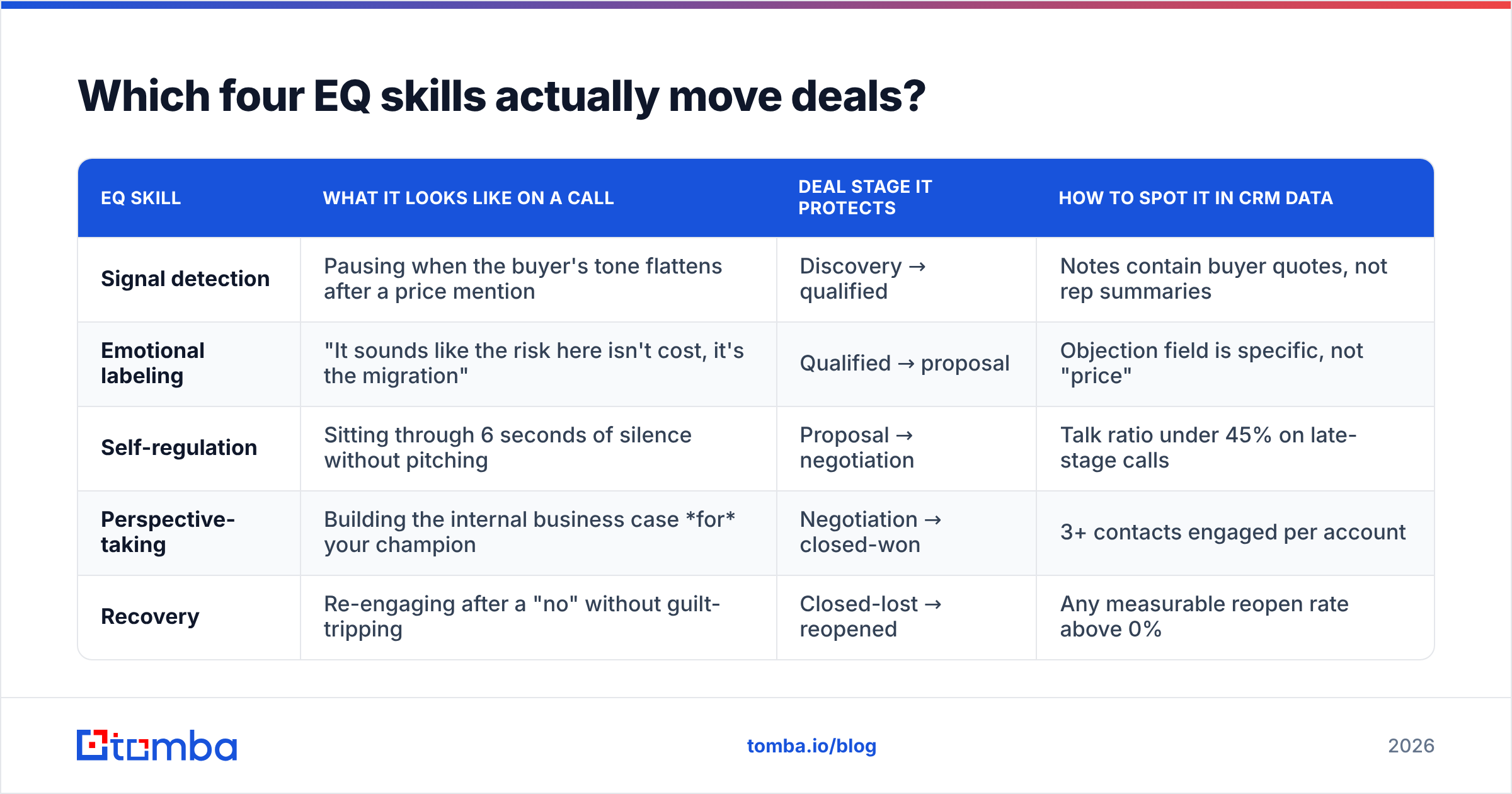
Which four EQ skills actually move deals?#
Not every emotional skill affects pipeline equally. If you rank them by how often they touch a deal stage, the list narrows fast.
| EQ skill | What it looks like on a call | Deal stage it protects | How to spot it in CRM data |
|---|---|---|---|
| Signal detection | Pausing when the buyer's tone flattens after a price mention | Discovery → qualified | Notes contain buyer quotes, not rep summaries |
| Emotional labeling | "It sounds like the risk here isn't cost, it's the migration" | Qualified → proposal | Objection field is specific, not "price" |
| Self-regulation | Sitting through 6 seconds of silence without pitching | Proposal → negotiation | Talk ratio under 45% on late-stage calls |
| Perspective-taking | Building the internal business case for your champion | Negotiation → closed-won | 3+ contacts engaged per account |
| Recovery | Re-engaging after a "no" without guilt-tripping | Closed-lost → reopened | Any measurable reopen rate above 0% |
The last row is the one nearly every team ignores. Reps treat a "no" as a verdict on themselves rather than a data point about timing, so they never follow up. Deals that could have reopened in two quarters get archived forever.

Does emotional intelligence really beat product knowledge?#
No — and anyone selling you that framing is selling a workshop.
Product knowledge is table stakes. If you cannot answer a technical question, no amount of empathy saves you. What EQ does is decide whether you ever get asked the technical question in the first place. Buyers do not reveal their real constraint to someone who has spent 20 minutes talking at them.
The honest hierarchy looks like this:
- Product knowledge determines whether you can be trusted with the answer.
- Domain knowledge determines whether you understand why the question was asked.
- Emotional intelligence determines whether the buyer tells you the real question instead of a polite proxy for it.
Gartner's research on B2B buying behavior repeatedly lands on the same point: buyers spend a minority of their time with any single vendor, and the deciding factor is often how much a rep reduces the buyer's internal difficulty — building consensus, defusing risk, making them look competent to their boss. That is a perspective-taking problem, not a feature problem. You can read Gartner's ongoing coverage of the B2B buying journey for the underlying data.
Product knowledge without EQ produces a very specific failure: technically flawless demos that end in "let me take this to the team" and then nothing. You answered every question and learned nothing.
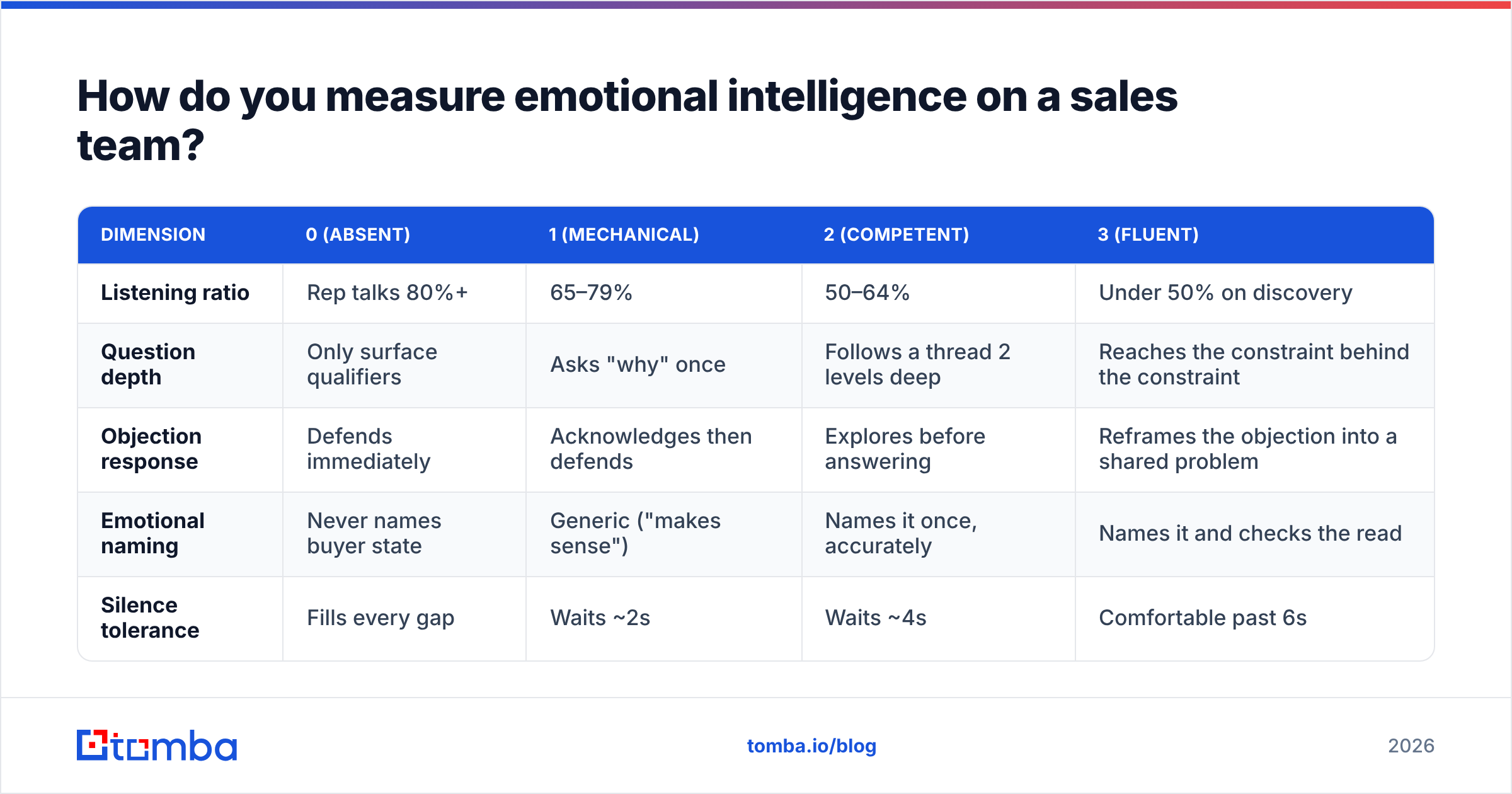
How do you measure emotional intelligence on a sales team?#
You cannot manage what you score with adjectives. Replace "Sarah is great with people" with a rubric that a second manager could apply to the same call recording and land within a point.
Here is a workable five-dimension rubric. Score each 0–3 on a random sample of three calls per rep per month.
| Dimension | 0 (absent) | 1 (mechanical) | 2 (competent) | 3 (fluent) |
|---|---|---|---|---|
| Listening ratio | Rep talks 80%+ | 65–79% | 50–64% | Under 50% on discovery |
| Question depth | Only surface qualifiers | Asks "why" once | Follows a thread 2 levels deep | Reaches the constraint behind the constraint |
| Objection response | Defends immediately | Acknowledges then defends | Explores before answering | Reframes the objection into a shared problem |
| Emotional naming | Never names buyer state | Generic ("makes sense") | Names it once, accurately | Names it and checks the read |
| Silence tolerance | Fills every gap | Waits ~2s | Waits ~4s | Comfortable past 6s |
A rep scoring 12–15 is a coach for the rest of the team. A rep scoring under 7 is not a bad person — they are almost always over-indexed on fear of losing the deal, which is a management problem as much as a skill gap.
Pair the rubric with two lagging indicators you already have. Your win rate tells you whether the adjustments are working on late-stage deals. Your response rate tells you whether your first touch reads as human or as a mail-merge. If the rubric score climbs and neither number moves in a quarter, your scoring is generous.
What does high-EQ selling look like on a real call?#
Compare two responses to the same objection: "Honestly, this feels expensive for where we are right now."
Low EQ: "I hear you. But when you factor in the time savings, most customers see ROI in under four months. Can I walk you through the calculator?"
That answer treats the sentence as a pricing objection. It might be. It also might be a budget-cycle problem, an internal-credibility problem, or a soft way of saying "I am not the one who decides this."
High EQ: "That's fair. When you say 'where we are right now' — is that a budget timing thing, or does it feel early relative to the problem?"
One question, and you have split a vague objection into two very different deals. If it is timing, you know when to come back. If it is sequencing, you have a chance to reposition scope. Neither answer required a discount.
The other high-EQ move is what happens after the call. Low-EQ follow-up recaps what the rep said. High-EQ follow-up recaps what the buyer said, in the buyer's words, and hands them something they can forward internally without editing. That is perspective-taking made operational.
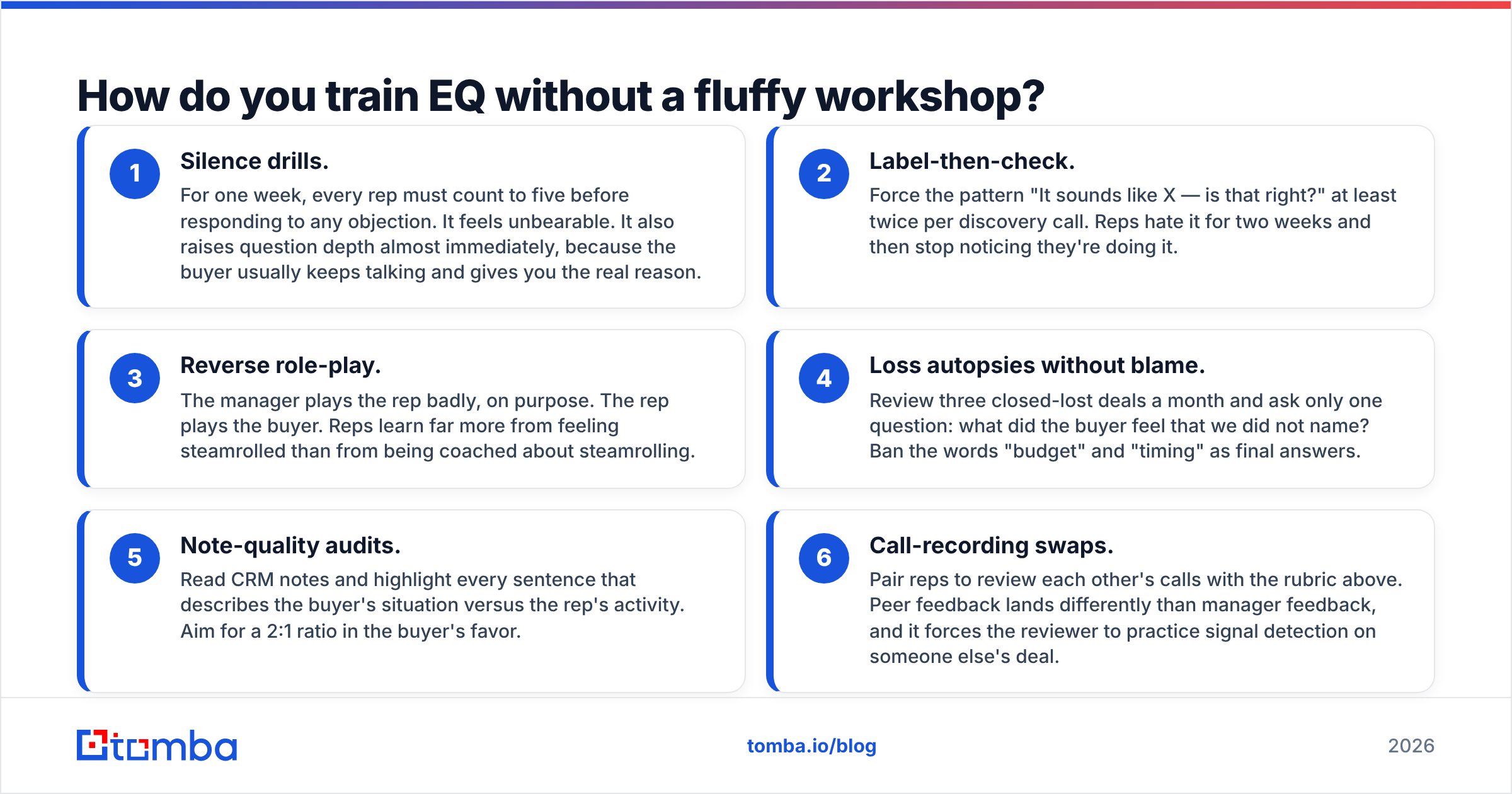
How do you train EQ without a fluffy workshop?#
Emotional intelligence is trainable, but not through a slide deck about "the four quadrants." It responds to reps like any skill: constrained practice, immediate feedback, small reps.
- Silence drills. For one week, every rep must count to five before responding to any objection. It feels unbearable. It also raises question depth almost immediately, because the buyer usually keeps talking and gives you the real reason.
- Label-then-check. Force the pattern "It sounds like X — is that right?" at least twice per discovery call. Reps hate it for two weeks and then stop noticing they're doing it.
- Reverse role-play. The manager plays the rep badly, on purpose. The rep plays the buyer. Reps learn far more from feeling steamrolled than from being coached about steamrolling.
- Loss autopsies without blame. Review three closed-lost deals a month and ask only one question: what did the buyer feel that we did not name? Ban the words "budget" and "timing" as final answers.
- Note-quality audits. Read CRM notes and highlight every sentence that describes the buyer's situation versus the rep's activity. Aim for a 2:1 ratio in the buyer's favor.
- Call-recording swaps. Pair reps to review each other's calls with the rubric above. Peer feedback lands differently than manager feedback, and it forces the reviewer to practice signal detection on someone else's deal.
Salesforce's own enablement research consistently points to coaching frequency, not coaching content, as the differentiator — their sales coaching guidance is a reasonable free starting point if you need a structure to steal.
Where does emotional intelligence break down in outbound?#
Cold outbound is where EQ dies first, because there is no live feedback loop. You cannot read a tone of voice in an email that has not been opened. So reps default to volume, and volume punishes empathy.
The break points are predictable:
- Wrong person. Emailing a developer about procurement savings is not a targeting error, it is an empathy error made at scale. You have told the recipient you did not look.
- Wrong company context. Referencing a funding round from three years ago reads worse than sending nothing.
- Wrong assumed pain. Opening with "I know you're struggling with X" when they are not is the fastest way to earn a spam complaint.
- Wrong cadence emotion. The fourth follow-up that opens with "just bumping this to the top of your inbox" communicates entitlement, not persistence.
None of these are fixed by better copywriting. They are fixed by better inputs. Personalization that is factually wrong is worse than no personalization, because it proves the effort was automated and the attention was fake.
This is the unglamorous overlap between emotional intelligence and data hygiene. Verified contact data does not make you empathetic — but unverified data makes empathy impossible to express. If you are building lists, a clean email verifier pass before send protects both your sender reputation and the basic dignity of the first impression. And enriching records with real role, seniority, and company signals through data enrichment is what lets a rep write one sentence that proves they actually looked.
Does AI kill or amplify emotional intelligence in sales?#
Both, depending on where you put it.
AI amplifies EQ when it removes the mechanical work that crowds out attention. Research, list building, note-taking, call summarization, drafting the boring parts of a follow-up — every minute saved there is a minute a rep can spend actually thinking about the buyer. A rep who spends 90 minutes a day building lists manually is not a more empathetic rep; they are a more tired one.
AI kills EQ when it generates the judgment rather than the inputs. An AI-written "personalized" opener based on a scraped LinkedIn headline is the textual equivalent of a stranger using your first name six times. Buyers have gotten very good at detecting it, and the detection threshold keeps dropping.
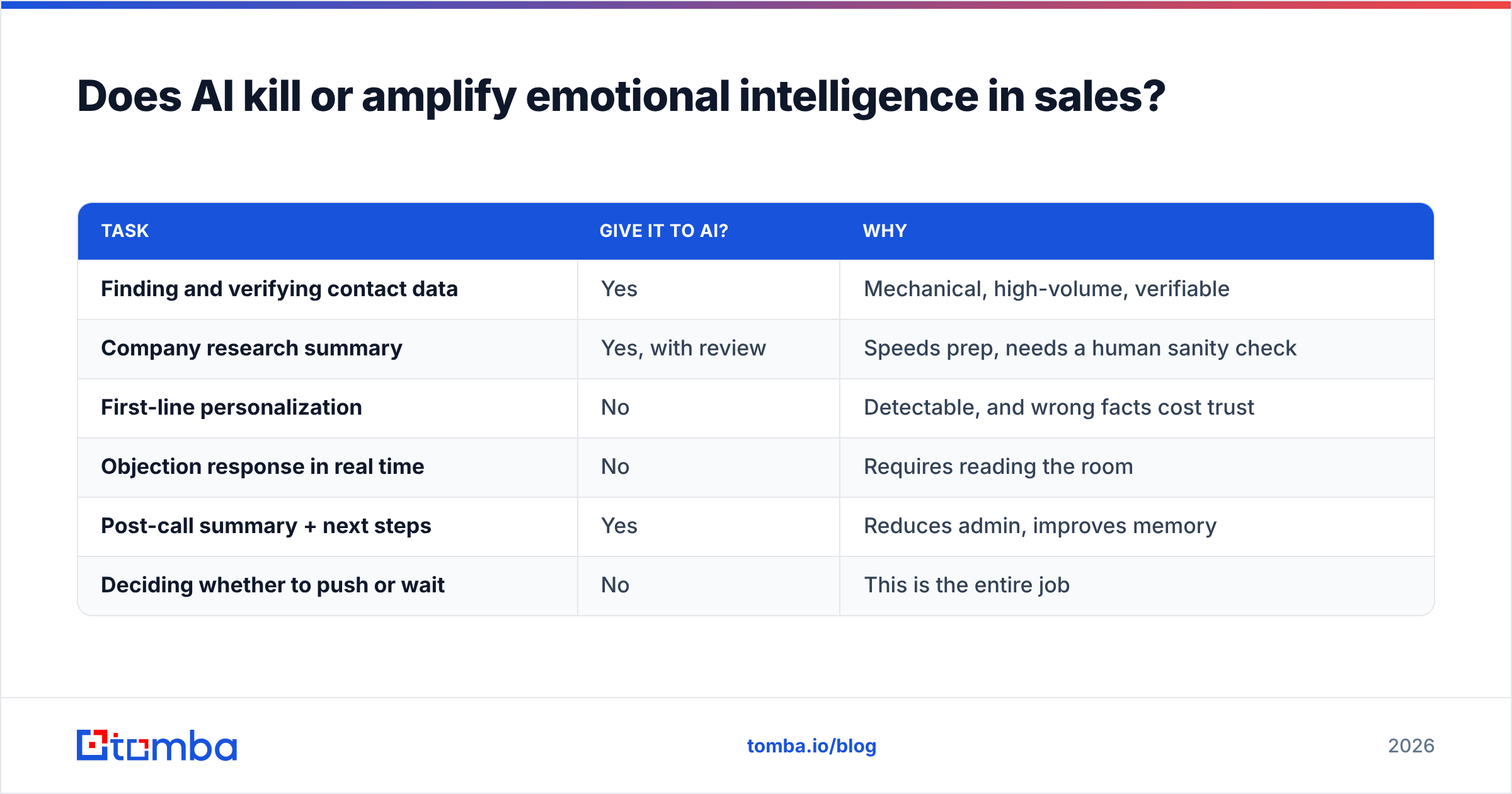
The practical split:
| Task | Give it to AI? | Why |
|---|---|---|
| Finding and verifying contact data | Yes | Mechanical, high-volume, verifiable |
| Company research summary | Yes, with review | Speeds prep, needs a human sanity check |
| First-line personalization | No | Detectable, and wrong facts cost trust |
| Objection response in real time | No | Requires reading the room |
| Post-call summary + next steps | Yes | Reduces admin, improves memory |
| Deciding whether to push or wait | No | This is the entire job |
Use a cold email AI tool to get a structural draft, then rewrite the first and last lines yourself. The middle of a cold email is commodity. The edges are where the human shows up.
Can you hire for emotional intelligence?#
Partially, and better than most teams try.
Standard interview questions ("tell me about a difficult customer") reward storytelling, not EQ. Candidates rehearse them. Swap them for live simulation:
- Give the candidate a 10-minute discovery call against a hiring manager playing a guarded, slightly annoyed buyer. Score with the rubric above.
- Then ask them to summarize what the buyer cares about. The gap between what they heard and what was said is your signal.
- Finally, tell them one thing they got wrong and watch how they take it. Self-regulation under mild criticism predicts coachability better than any question about weaknesses.
Look for candidates who ask you good questions about the buyer, not about the comp plan. Curiosity about other people's constraints is the closest thing to a leading indicator of emotional intelligence in sales that a 45-minute interview can surface.
One caution: do not conflate EQ with agreeableness. The highest-EQ reps are frequently the ones most willing to tell a prospect the product is a bad fit. Reading a room accurately sometimes means saying the uncomfortable thing early instead of the comfortable thing for three months.
What should you do this quarter?#
Pick two things, not ten.
- Run the rubric on three calls per rep. You will find your coaching priorities in one afternoon.
- Ban one phrase from your follow-up sequences ("just checking in" is the usual first casualty) and replace it with a sentence that gives the buyer something.
- Audit whether your outbound data is good enough for personalization to be honest. If a third of your list has stale titles, no amount of empathy training fixes your reply rate.
Emotional intelligence in sales compounds quietly. It does not show up as a spike in one month's number. It shows up as fewer deals going dark, more multi-threaded accounts, and reps who come back from a lost deal with information instead of an excuse.
Give your reps something real to be empathetic about. Empathy needs accurate inputs — the right person, the right role, the right company. Tomba's Email Finder gets you verified professional contacts by name, domain, or company so your first sentence lands on someone who actually owns the problem. Start free with 25 searches a month, or move to Starter at $49/mo when your outbound gets serious — full Tomba pricing is public, no sales call required.
Related guides#
Ready to find emails that actually work?
Join 150,000+ professionals who stopped guessing and started sending. Free credits on signup — no credit card required.
Get the Tomba newsletter
Practical outbound tactics and product updates — once every two weeks.
About the author