What Is Sales Enablement? The 2026 Guide That Actually Works
Most sales enablement programs die as a content library nobody opens. Here's how enablement actually works in 2026 — the stack, the 90-day build, the metrics that prove it, and the data layer everyone forgets.
TL;DR
- Sales enablement is the system that gets reps the skills, content, data, and tooling they need to move a deal forward — not a folder of decks.
- Most programs fail on adoption, not creation. The average enablement library gets used by under half the team, and reps still rebuild collateral themselves.
- The most under-funded layer is contact data. Perfect battlecards do nothing if the rep is emailing an address that bounced in 2023.
- Build in 90 days: audit → fix onboarding → fix the data layer → ship a small, versioned content set → instrument it.
- Measure ramp time, win rate by segment, and content-influenced pipeline. If you can't tie enablement to one of those, you're running a training budget, not an enablement function.
What is sales enablement, exactly?#
Sales enablement is the ongoing process of equipping revenue-facing teams — AEs, SDRs, CSMs, sometimes solutions engineers — with the training, content, data, and tools that let them have better buyer conversations, faster.
The useful mental model: enablement is the pit crew, not the driver. The car still has to be driven by the rep. But if the tires are bald, the fuel is low, and nobody told the driver the third corner is wet, the lap time is not a rep problem.
That framing matters because most companies define enablement by its artifacts (decks, one-pagers, playbooks, LMS courses) instead of its outcome (shorter ramp, higher win rate, more consistent execution). Artifacts are the output. They're not the job.
In 2026, the scope has widened again. A modern enablement charter usually covers five areas:
- Onboarding and ramp — getting a new hire to first closed-won in the shortest defensible time.
- Ongoing skill development — call coaching, objection handling, discovery frameworks, negotiation.
- Content and messaging — battlecards, case studies, sequences, pricing narratives, and the governance that keeps them current.
- Data and tooling — CRM hygiene, contact data quality, sequencer configuration, AI assistants, and the integrations that stitch them together.
- Measurement — attribution back to pipeline and revenue, not just course-completion percentages.
Skip any one of those five and the program leaks. Skip the fourth and it leaks fastest, because a rep with a bad contact list can execute your messaging flawlessly into an empty inbox.
Why do most enablement programs fail?#
They fail on adoption, and adoption fails for boringly predictable reasons.
Reason one: content is produced for the org chart, not the deal. Product marketing ships a 42-slide platform overview because leadership asked for it. The rep needs three slides for a security review. Neither party is wrong; the translation layer is missing.
Reason two: nothing is versioned or retired. After eighteen months the shared drive has four "current" pricing decks. Reps stop trusting the library and rebuild from scratch, which is exactly the waste enablement was hired to eliminate.
Reason three: enablement is measured by activity. "We ran 14 sessions and published 60 assets" is a description of effort. It tells you nothing about whether Q3 ramp got shorter.
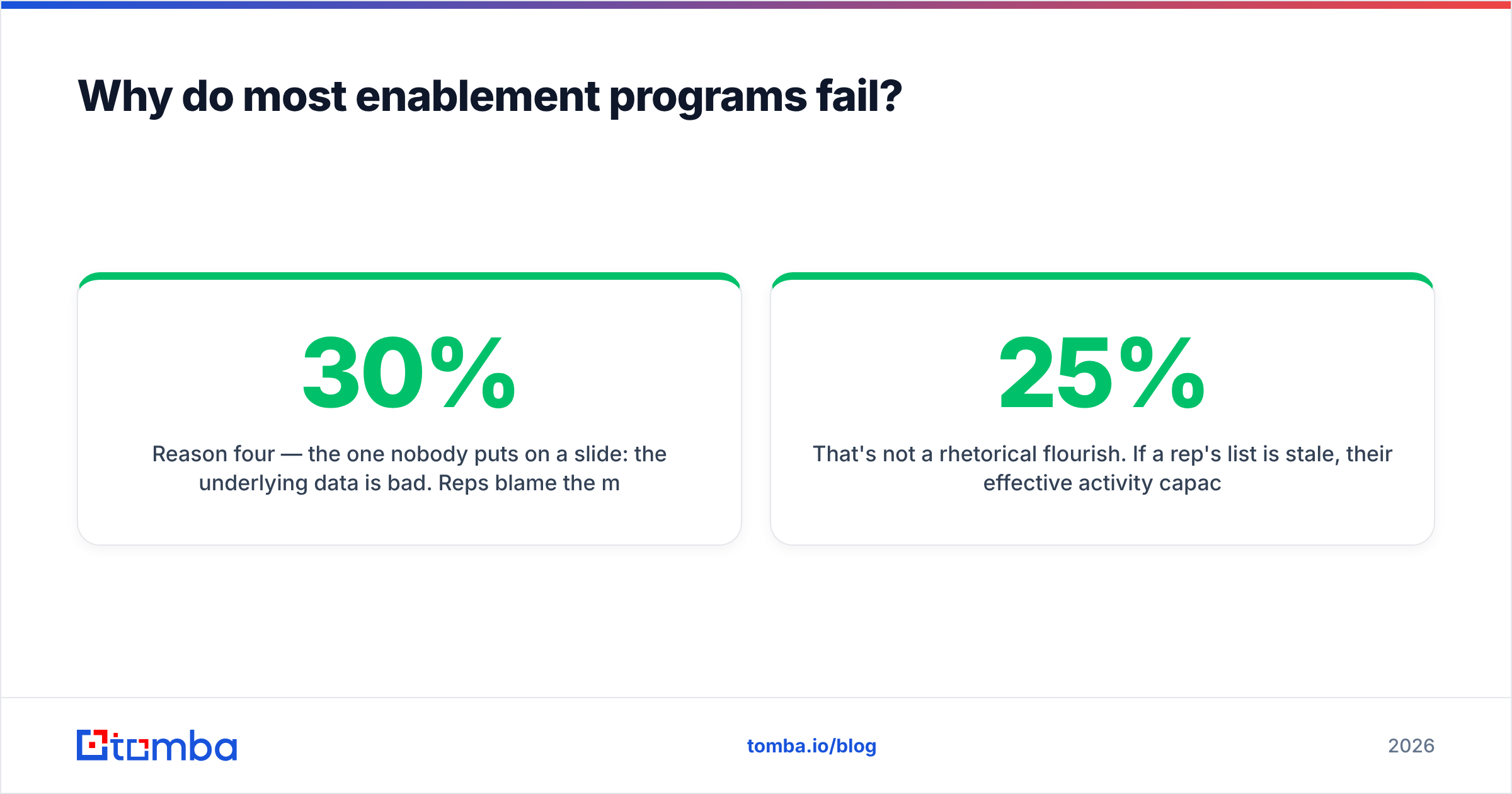
Reason four — the one nobody puts on a slide: the underlying data is bad. Reps blame the messaging when the real issue is that 20-30% of their target list is undeliverable, out of role, or attributed to the wrong company. Enablement teams rarely own data quality, so it stays orphaned between RevOps and marketing.

That's not a rhetorical flourish. If a rep's list is 25% stale, their effective activity capacity dropped 25% before a single word of your messaging was tested. You cannot coach your way out of that.
Is enablement a content problem or a data problem?#
Both — but they fail in a specific order, and most teams work them in the wrong sequence.
Here's the honest hierarchy of what breaks a sales motion, worst first:
- Wrong account — the ICP definition is loose, so reps work accounts that will never buy. No content fixes this.
- Wrong person — right company, wrong title or a contact who left nine months ago. Enrichment and title-level targeting fix this.
- Unreachable person — right person, dead email or unverified catch-all address. An email verifier and disciplined list hygiene fix this.
- Wrong message — right person, reachable, but the pitch doesn't match their trigger or role. This is where content and messaging finally matter.
- Wrong execution — right message, poorly delivered. This is where coaching and call review matter.
Notice that layers 1-3 are data problems and layers 4-5 are content and skill problems. Most enablement teams spend 80% of their budget on layers 4-5. That's why the ROI feels ambiguous: you're optimizing the last two steps of a five-step chain while the first three quietly cap the ceiling.
A practical test: pull last quarter's outbound. What percentage of sends bounced or hit a catch-all domain you never resolved? If it's above 4%, your deliverability — and by extension your sender reputation — is the constraint, not your subject lines. Fix the list before you rewrite the sequence.
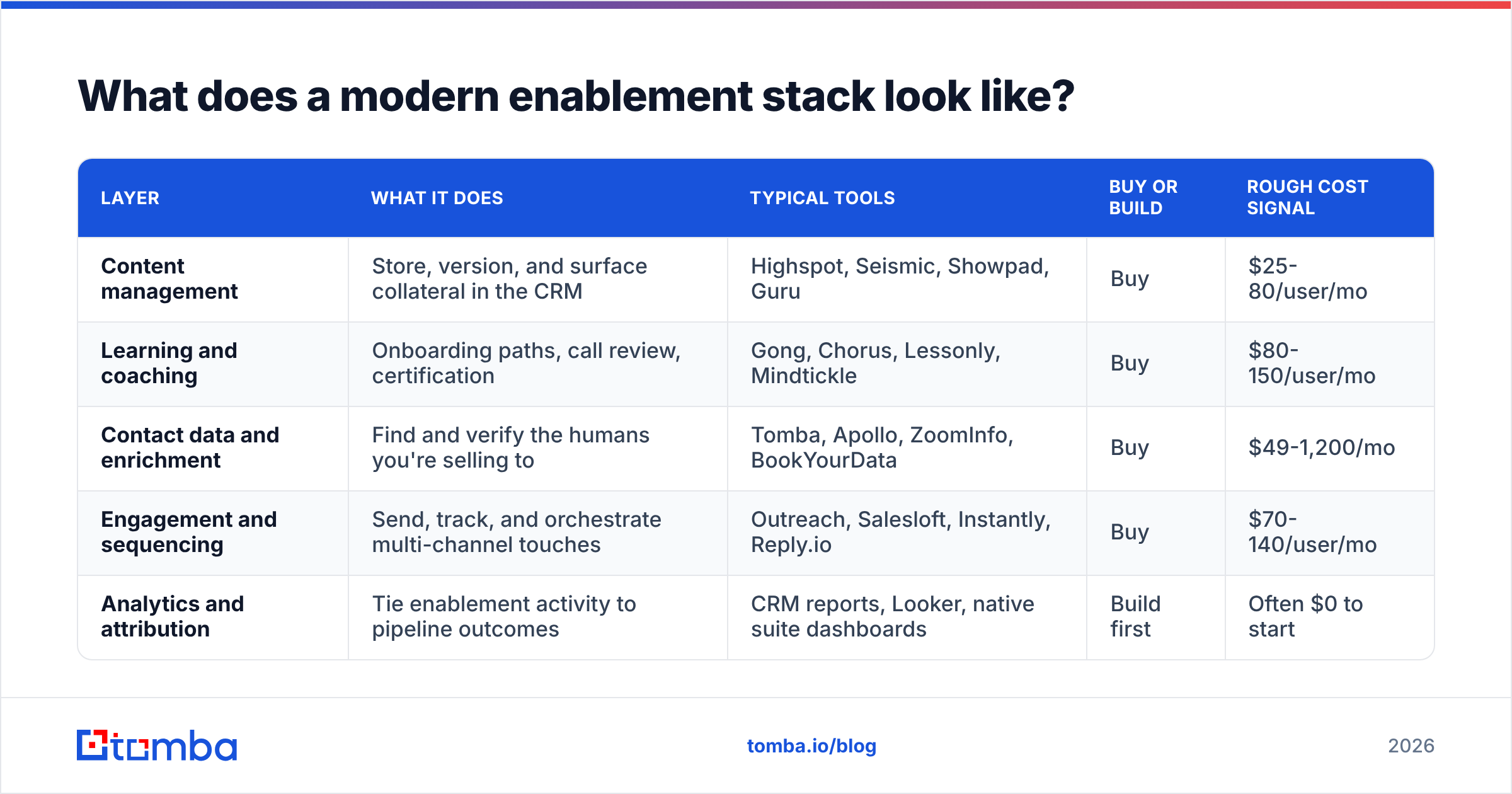
What does a modern enablement stack look like?#
There's no single correct stack, but there are four functional slots that every working program fills. What varies is whether you buy one suite or assemble best-of-breed.
| Layer | What it does | Typical tools | Buy or build | Rough cost signal |
|---|---|---|---|---|
| Content management | Store, version, and surface collateral in the CRM | Highspot, Seismic, Showpad, Guru | Buy | $25-80/user/mo |
| Learning and coaching | Onboarding paths, call review, certification | Gong, Chorus, Lessonly, Mindtickle | Buy | $80-150/user/mo |
| Contact data and enrichment | Find and verify the humans you're selling to | Tomba, Apollo, ZoomInfo, BookYourData | Buy | $49-1,200/mo |
| Engagement and sequencing | Send, track, and orchestrate multi-channel touches | Outreach, Salesloft, Instantly, Reply.io | Buy | $70-140/user/mo |
| Analytics and attribution | Tie enablement activity to pipeline outcomes | CRM reports, Looker, native suite dashboards | Build first | Often $0 to start |
Two notes on that table.
First, the data layer is the cheapest slot and the highest leverage. A ten-person team can run credible outbound on a $99/mo data plan while spending $1,400/mo on a sequencer. The asymmetry is worth questioning.
Second, do not buy analytics before you've defined the two or three metrics that matter. Dashboards bought early become dashboards nobody opens.
How do you build a sales enablement program in 90 days?#
Assume you're the first enablement hire, or the first person to take it seriously. Here's a sequence that survives contact with reality.
Days 1-15: Audit before you build. Shadow six calls across your top and bottom performers. Inventory every asset reps actually send — pull it from their sent folders, not from the shared drive. Ask each rep one question: "What do you rebuild by hand every week?" That list is your first backlog, and it's usually short.
Days 16-30: Fix onboarding first. Onboarding is the highest-ROI enablement surface because the cost of a slow ramp compounds across every future hire. Write a 30/60/90 with explicit competency gates — not "shadow calls," but "delivers the discovery framework unaided, scored by manager." HubSpot's sales resources are a reasonable free baseline if you're starting from nothing.
Days 31-50: Repair the data layer. Before you write a single new battlecard, audit list quality. Run a sample of 500 target contacts through verification. Establish a standing rule: nothing enters a sequence unverified. Wire your email finder into the CRM so reps aren't copy-pasting between tabs, and set a bounce-rate ceiling that triggers a list rebuild.
Days 51-70: Ship a minimum viable content set. Six assets, not sixty: one discovery guide, two objection battlecards for your top competitors, one ROI narrative, one security/procurement FAQ, one customer proof deck. Every asset gets an owner and a review date. Anything without both gets deleted.
Days 71-90: Instrument and report. Tag content in the CRM. Baseline ramp time, win rate by segment, and average deal cycle. Publish one page monthly. Resist the urge to report on course completions.

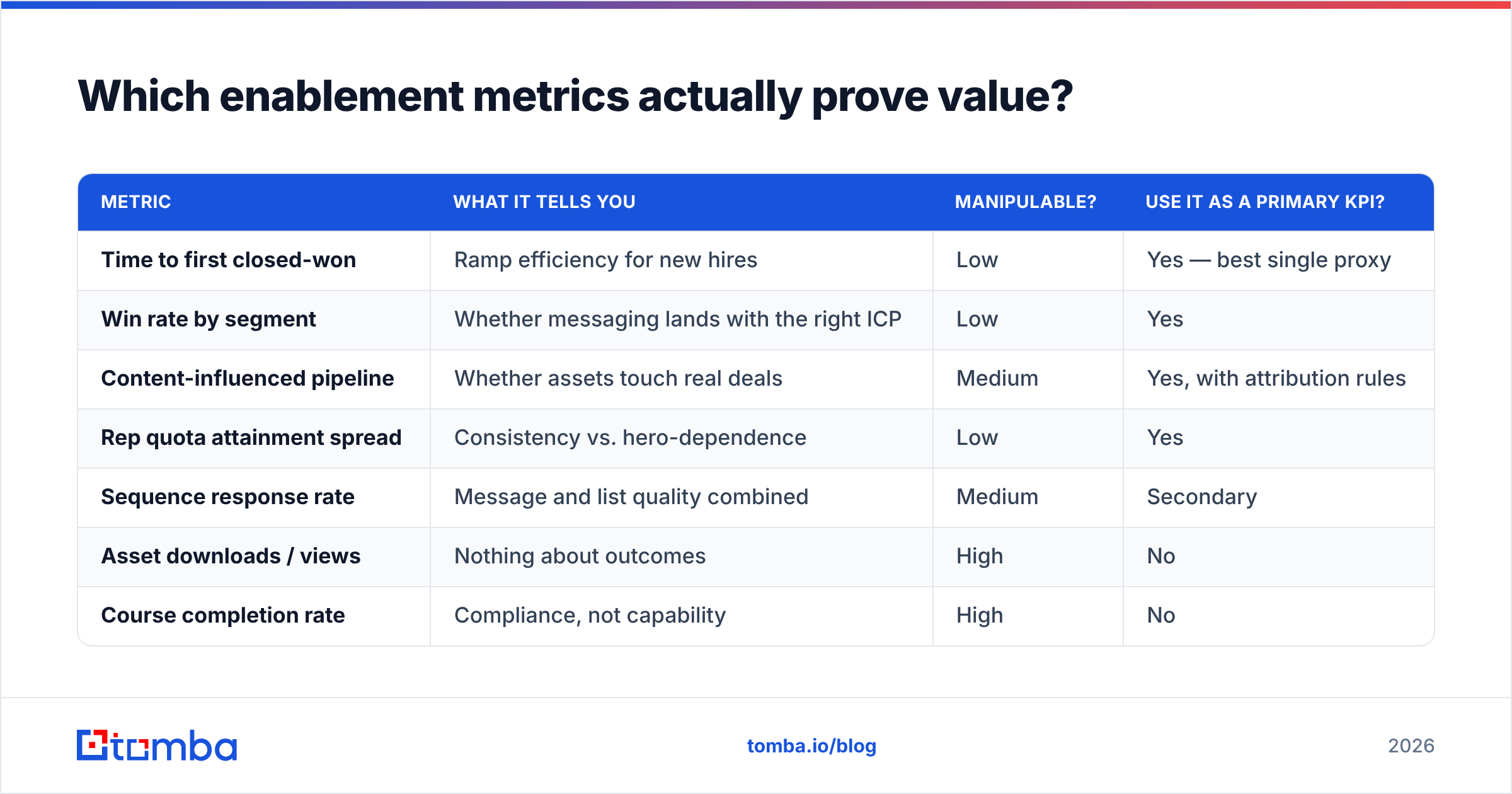
Which enablement metrics actually prove value?#
The difference between an enablement function that survives budget season and one that doesn't is usually the metric set. Here's how the common ones stack up.
| Metric | What it tells you | Manipulable? | Use it as a primary KPI? |
|---|---|---|---|
| Time to first closed-won | Ramp efficiency for new hires | Low | Yes — best single proxy |
| Win rate by segment | Whether messaging lands with the right ICP | Low | Yes |
| Content-influenced pipeline | Whether assets touch real deals | Medium | Yes, with attribution rules |
| Rep quota attainment spread | Consistency vs. hero-dependence | Low | Yes |
| Sequence response rate | Message and list quality combined | Medium | Secondary |
| Asset downloads / views | Nothing about outcomes | High | No |
| Course completion rate | Compliance, not capability | High | No |
| Number of assets published | Team activity | Very high | Never |
The trap is that the useless metrics are the easy ones to collect. Your content platform reports downloads out of the box; nobody reports ramp time unless you build it. Gartner's sales research has been making a version of this point for years: buyers spend a fraction of their journey with any single vendor's reps, so enablement's job is to make those minutes count — not to maximize asset volume.
One practical attribution rule that avoids arguments: an asset is "influenced" if it was shared with a contact on the opportunity within 30 days before a stage advance. It's imperfect. It's also defensible, consistent, and better than nothing.
How is AI changing sales enablement in 2026?#
Less than the vendor pitches claim, and more than the skeptics allow.
What's genuinely working:
- Call summarization and coaching signals. Automated scorecards across every call instead of the three a manager listens to. This is the clearest win.
- Content assembly. Generating a first-draft, account-specific one-pager from an existing library in seconds rather than hours.
- Research compression. Pre-call briefs assembled from public signals, funding news, and tech stack detection.
- Data completion. Filling missing titles, domains, and phone numbers programmatically instead of by hand.
What's still overpromised: fully autonomous prospecting agents that pick accounts, write messaging, and book meetings without oversight. They produce volume. Volume against a stale list is how you burn a sending domain. You can browse the current field on G2's sales enablement category — note how many "AI-first" entries are wrappers on the same underlying data.
The durable principle: AI multiplies whatever your inputs are. Good ICP definition plus verified contacts plus AI equals leverage. Fuzzy ICP plus stale contacts plus AI equals a faster way to get blocked.
What should enablement cost, and when should you hire for it?#
Rough benchmarks from how teams actually staff this:
- Under 10 reps: no dedicated hire. A sales manager owns it part-time. Spend on data and one sequencer; skip the content platform.
- 10-30 reps: first dedicated enablement hire, usually a former top rep. Budget roughly $1,000-2,000/rep/year in tooling.
- 30-100 reps: a small team with split ownership — onboarding, content, and analytics as separate lanes.
- 100+ reps: enablement reports into RevOps or a Chief Revenue Officer with its own roadmap and headcount plan.
The mistake at every stage is buying the content platform first. It's the most visible purchase and the least likely to move a number in year one. Data quality, onboarding structure, and a small versioned asset set will beat a $60k content suite deployed on top of a broken list.
Where should you start this week?#
Pick the layer that's actually capping you, not the one that's easiest to buy.
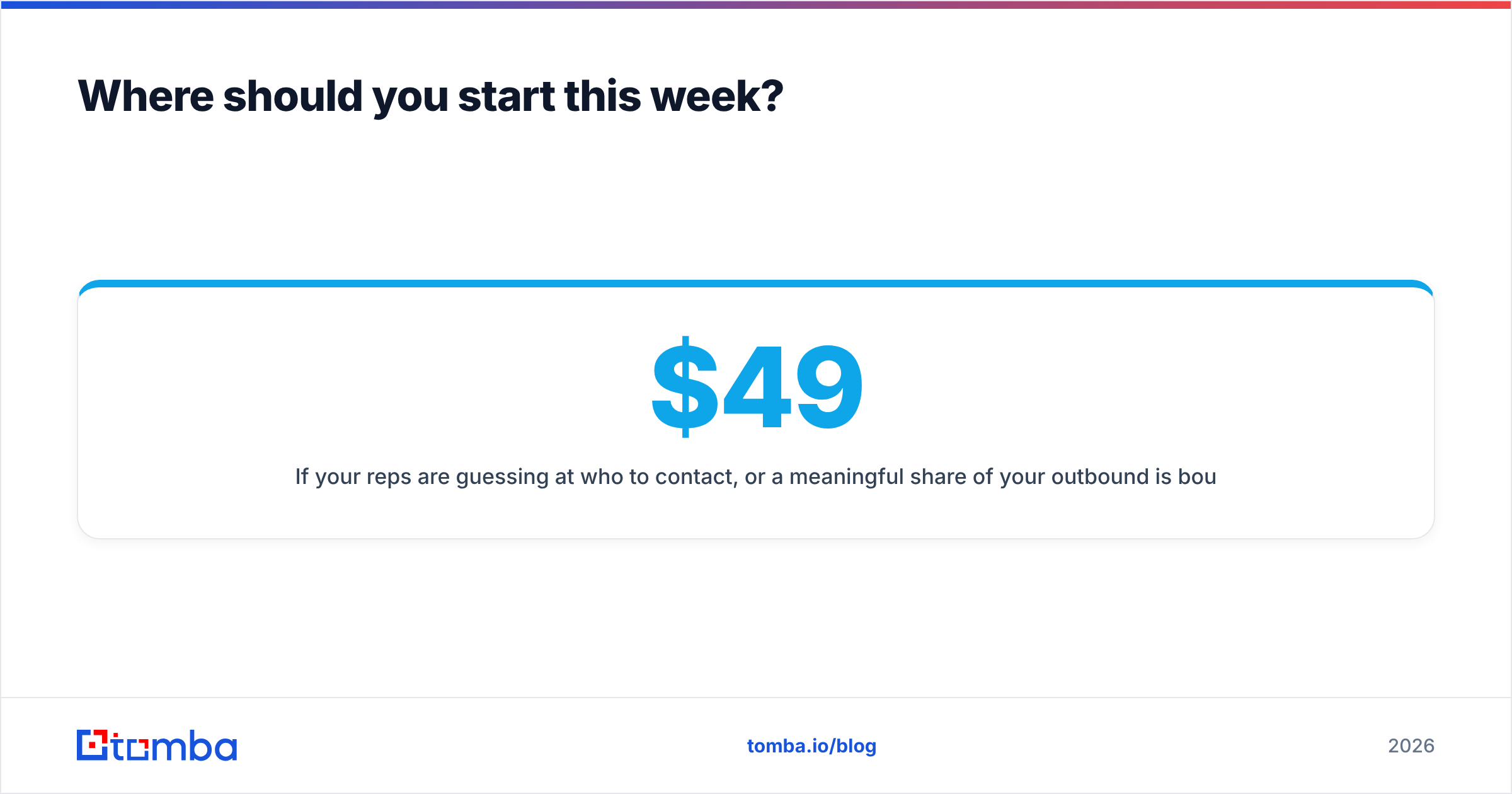
If your reps are guessing at who to contact, or a meaningful share of your outbound is bouncing, start at the data layer — that's the constraint underneath everything else. Use Tomba Email Finder to find and verify decision-maker addresses by domain, name, or company before anything enters a sequence, so your battlecards land in inboxes that exist. The free tier gives you 25 searches a month to sanity-check your current list quality, and Tomba pricing starts at $49/mo for Starter, $99/mo for Growth, and $249/mo for Pro when you're ready to run it at team scale.
Fix the list first. Then the messaging you've been rewriting for six months will finally get a fair test.
Related guides#
Ready to find emails that actually work?
Join 150,000+ professionals who stopped guessing and started sending. Free credits on signup — no credit card required.
Get the Tomba newsletter
Practical outbound tactics and product updates — once every two weeks.
About the author