9 Best Enablix Alternatives for 2026 (Compared & Priced)
Enablix is a solid mid-market content hub, but it is not the right fit for every revenue team. Here are nine Enablix alternatives compared on pricing model, analytics depth, rollout effort, and the buyer each one actually serves.
TL;DR
- Enablix is a content-first sales enablement platform aimed at mid-market teams that want a searchable, governed content hub without a six-figure Highspot or Seismic contract.
- Teams usually leave Enablix for one of four reasons: they need deeper coaching and readiness features, richer buyer-side analytics, tighter CRM-native workflows, or a cheaper per-seat model as headcount grows.
- The strongest Enablix alternatives in 2026 split into three buckets: enterprise revenue enablement suites (Highspot, Seismic, Mindtickle), lightweight content-sharing tools (Paperflite, Dock, Guru), and knowledge-plus-coaching hybrids (Allego, Showpad, Bigtincan).
- Per-seat pricing dominates this category, which means your real cost is driven by how many reps actually log in — not by feature checklists.
- Enablement software only pays off when reps have someone to send content to. Pair whatever platform you pick with a reliable contact-data layer like the Tomba Email Finder so your polished assets reach real inboxes.
What is Enablix, and who is it built for?#
Enablix is a sales enablement platform built around content management. It ingests decks, one-pagers, case studies, battlecards, and video, tags them by persona and deal stage, and surfaces them inside Salesforce, HubSpot, Gmail, and Slack so reps can find the right asset without digging through a shared drive.
Its positioning is deliberate: Enablix targets marketing and enablement teams at mid-market B2B companies — roughly 50 to 500 employees — who have outgrown Google Drive but do not want a nine-month enterprise rollout. Content tracking, shareable "digital sales rooms," and usage analytics are the core value.
That focus is also the source of most complaints. Enablix does content well. It does not attempt to be a full readiness platform with certification paths, AI role-play, or conversation intelligence, and its analytics stop at asset-level engagement rather than deal-level attribution. If your enablement charter has expanded past "help reps find stuff," you will start shopping.
Why do teams look for Enablix alternatives?#
From vendor-switch conversations and public reviews on G2's sales enablement category, the reasons cluster tightly:
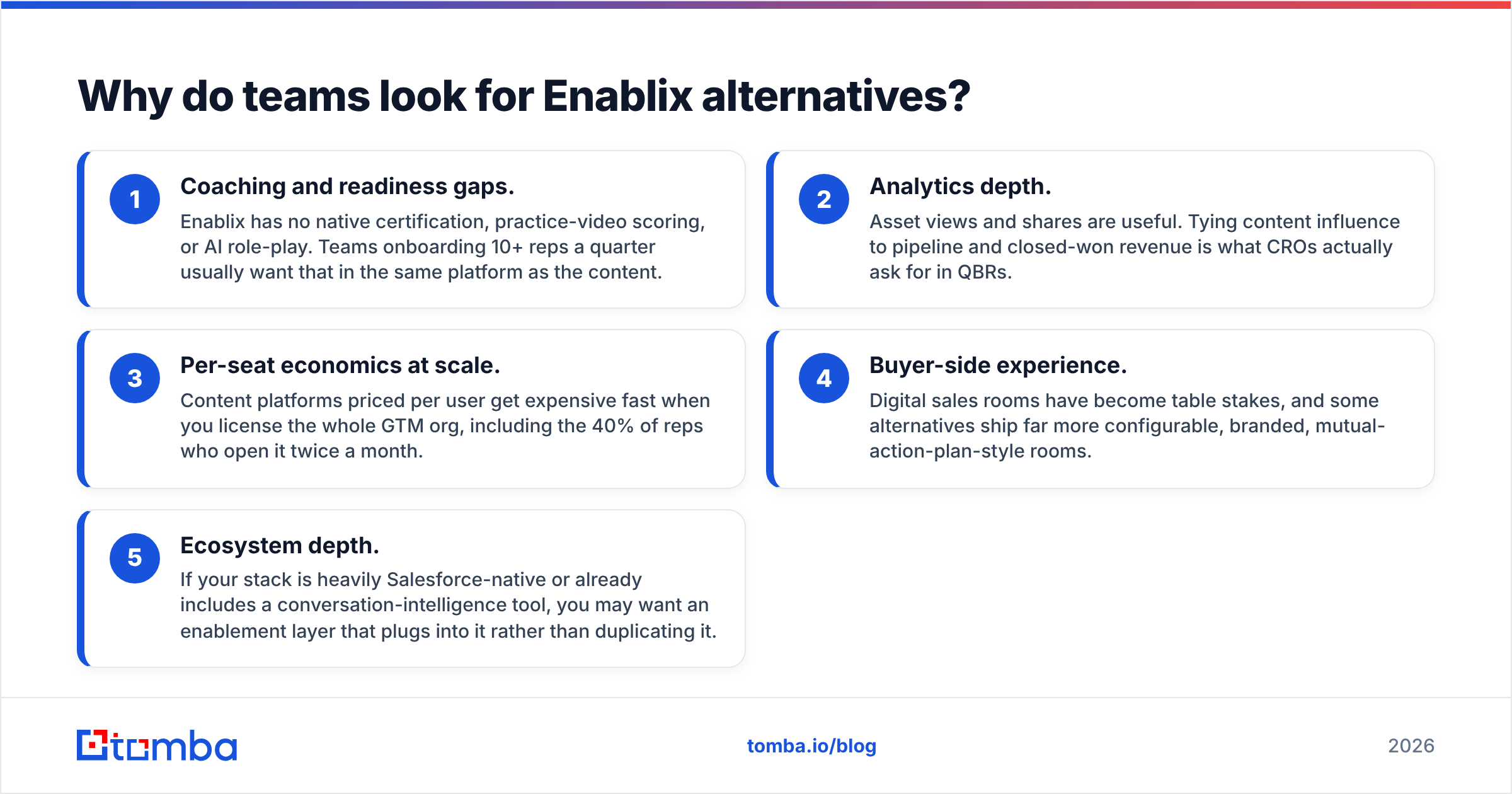
- Coaching and readiness gaps. Enablix has no native certification, practice-video scoring, or AI role-play. Teams onboarding 10+ reps a quarter usually want that in the same platform as the content.
- Analytics depth. Asset views and shares are useful. Tying content influence to pipeline and closed-won revenue is what CROs actually ask for in QBRs.
- Per-seat economics at scale. Content platforms priced per user get expensive fast when you license the whole GTM org, including the 40% of reps who open it twice a month.
- Buyer-side experience. Digital sales rooms have become table stakes, and some alternatives ship far more configurable, branded, mutual-action-plan-style rooms.
- Ecosystem depth. If your stack is heavily Salesforce-native or already includes a conversation-intelligence tool, you may want an enablement layer that plugs into it rather than duplicating it.
None of these make Enablix a bad product. They make it a specific product. The question is whether your 2026 enablement charter matches that specification.
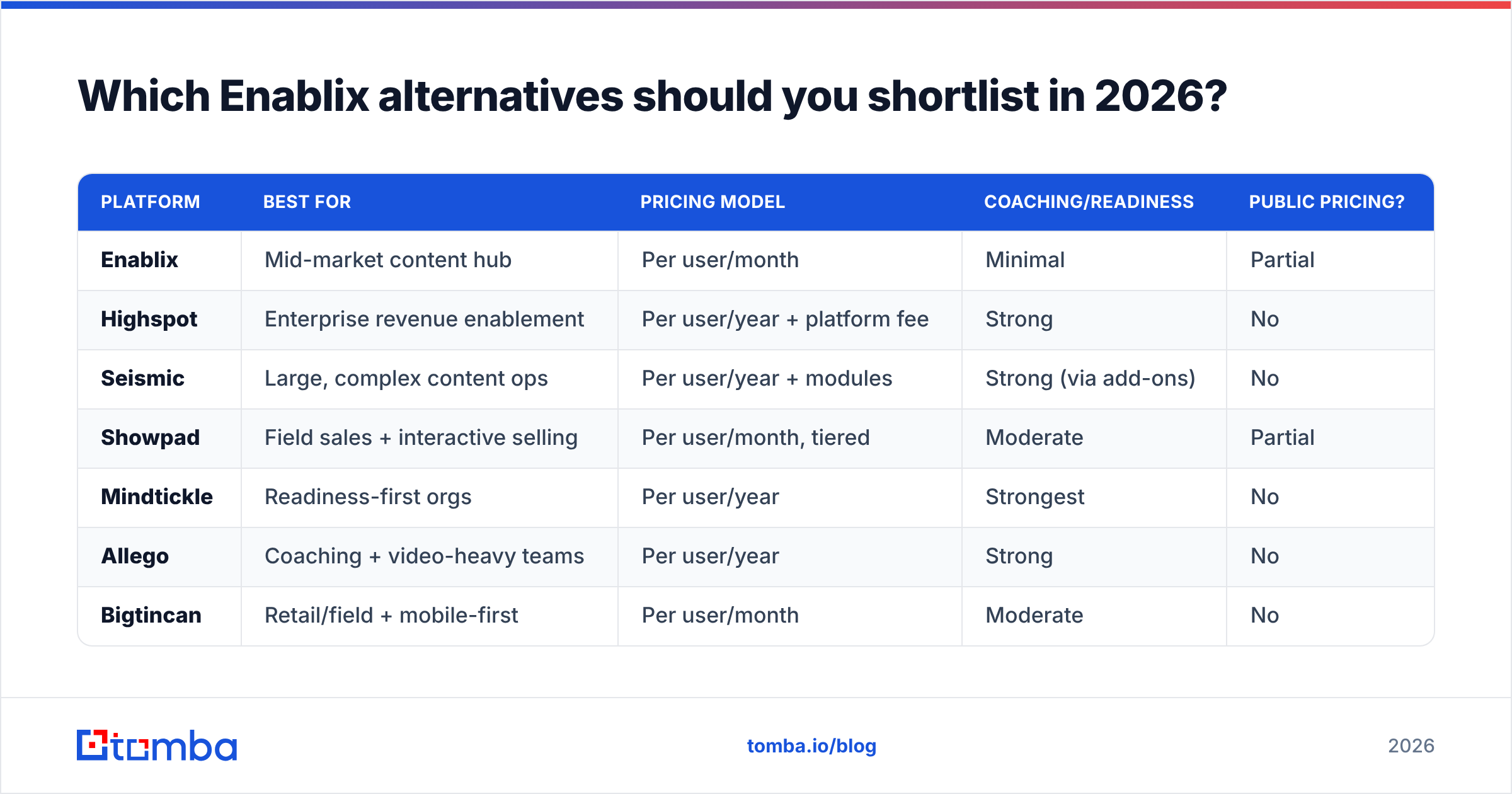
Which Enablix alternatives should you shortlist in 2026?#
Here is the head-to-head view. Pricing reflects publicly quoted ranges and buyer-reported figures; enterprise enablement vendors negotiate heavily, so treat these as directional and confirm in your own quote.
| Platform | Best for | Pricing model | Coaching/readiness | Public pricing? |
|---|---|---|---|---|
| Enablix | Mid-market content hub | Per user/month | Minimal | Partial |
| Highspot | Enterprise revenue enablement | Per user/year + platform fee | Strong | No |
| Seismic | Large, complex content ops | Per user/year + modules | Strong (via add-ons) | No |
| Showpad | Field sales + interactive selling | Per user/month, tiered | Moderate | Partial |
| Mindtickle | Readiness-first orgs | Per user/year | Strongest | No |
| Allego | Coaching + video-heavy teams | Per user/year | Strong | No |
| Bigtincan | Retail/field + mobile-first | Per user/month | Moderate | No |
| Guru | Internal knowledge, not decks | Per user/month, free tier | None | Yes |
| Paperflite | Content sharing on a budget | Per user/month | None | Yes |
| Dock | Digital sales rooms + onboarding | Per seat/month, free tier | None | Yes |
Two patterns jump out. First, the enterprise tier hides its pricing — which in practice means a platform fee plus per-seat cost, and an annual commitment. Second, the tools that publish pricing are almost all lighter-weight than Enablix on governance and analytics. There is very little that is both cheaper and deeper.
Highspot#
The default enterprise answer. Highspot pairs content management with training, coaching, and buyer engagement analytics, and its "scorecards" tie content usage to rep behavior in a way Enablix does not attempt. Expect a real implementation project, an annual contract, and a platform fee on top of seats. Pick it when enablement is a funded function with a dedicated team — not when one marketing manager owns it part-time.
Seismic#

The most content-operations-heavy option in the market. Seismic's LiveDocs and LiveSocial modules let you assemble personalized documents from component blocks at scale, which matters if you produce regulated, highly-templated collateral (financial services, insurance, medtech). It is also the heaviest lift to configure. Choose Seismic when your content volume is the problem; skip it if your library is 300 assets.
Showpad#
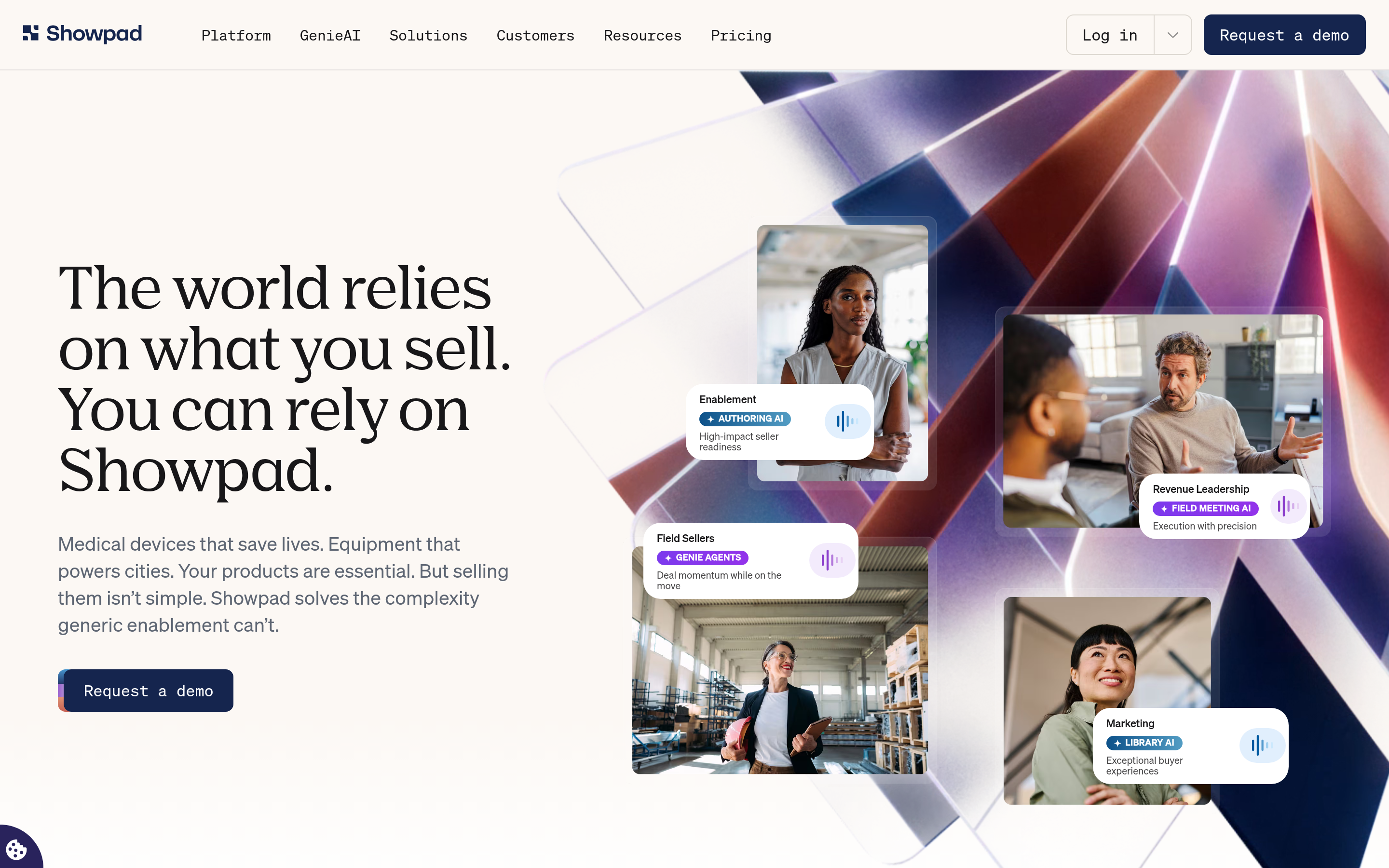
Showpad sits between Enablix and Highspot. Strong interactive content experiences, decent coaching, good offline mobile behavior for field teams. Reviewers consistently praise the seller UX and flag the admin side as fiddlier than expected. A reasonable step up from Enablix if you want more buyer-facing polish without a Seismic-scale rollout.
Mindtickle#
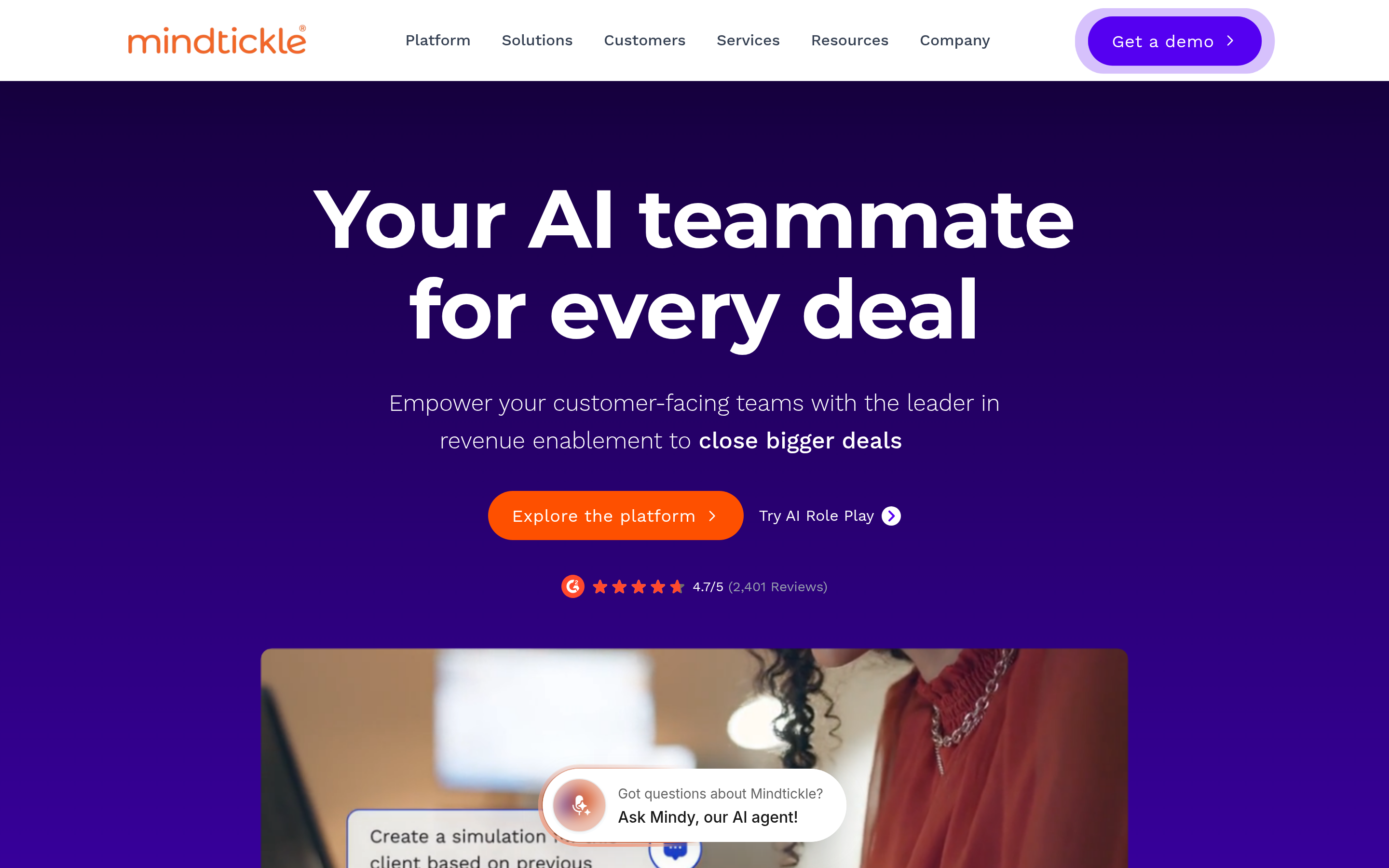
If you are leaving Enablix because onboarding ramp time is your bottleneck, Mindtickle is the direct answer. It is readiness-first: certifications, AI role-play, call scoring, competency models. Content management exists but is not the centerpiece. Many teams run Mindtickle alongside a lighter content tool rather than replacing one with the other.
Allego#
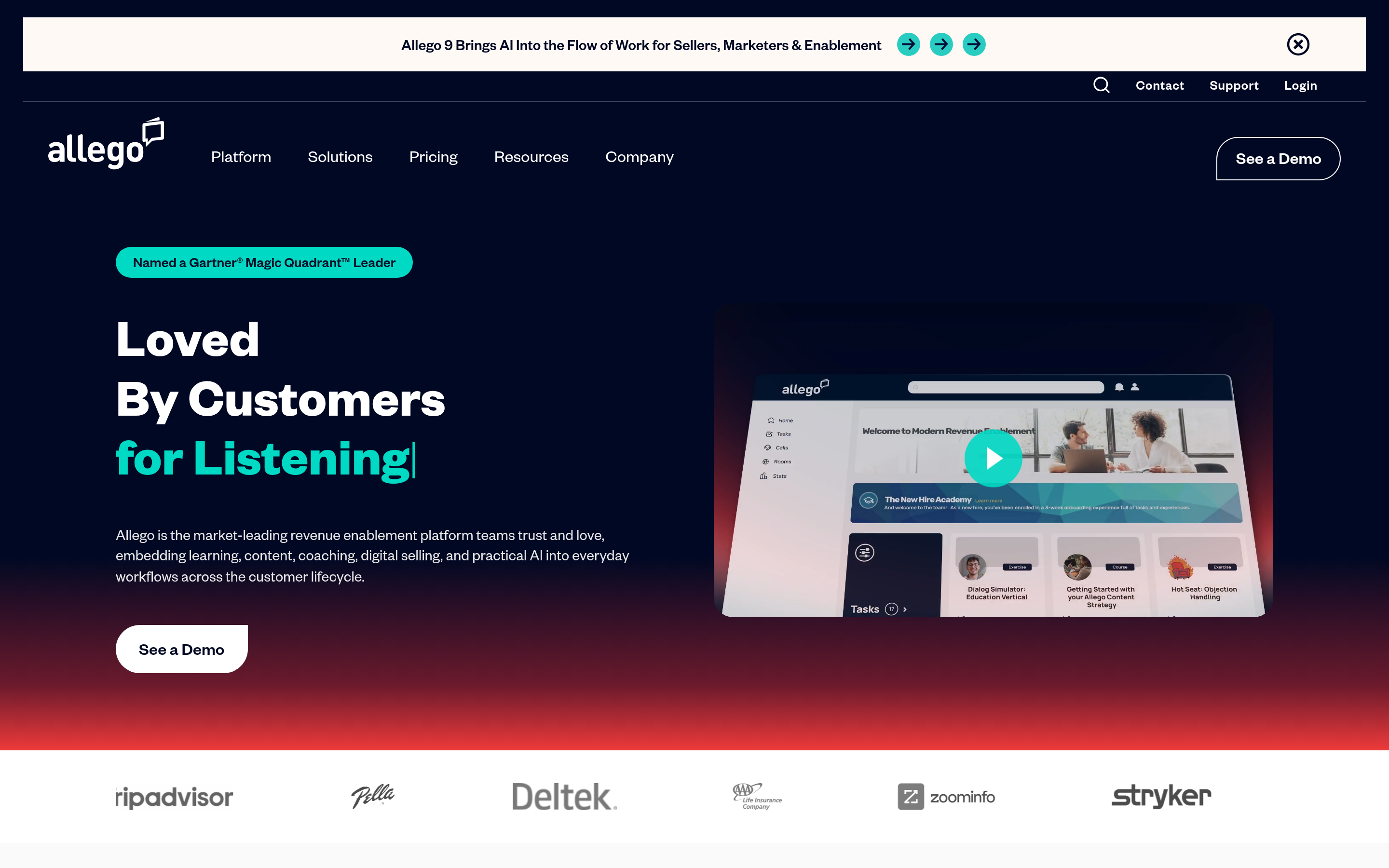
Allego's origin is video coaching, and it shows. Peer-learning feeds, practice video with feedback, and conversation intelligence sit next to a competent content library. It is the best fit for teams where "enablement" mostly means "make our reps better on calls," with content as a secondary need.
Bigtincan#
Mobile-first, with unusually strong offline capability and a footprint in retail and field-service sales. Its acquisition-heavy history means the suite can feel like several products stitched together. Evaluate the specific modules you need rather than the platform story.
Guru#
Not a like-for-like replacement — Guru is internal knowledge management with AI search, browser-extension delivery, and verification workflows that force content owners to re-confirm accuracy on a schedule. If your actual pain is "our answers are stale and scattered" rather than "our decks are scattered," Guru is cheaper and better at it, and it publishes pricing including a free tier.
Paperflite#
The budget content-sharing pick. Paperflite does collections, branded microsites, and per-recipient engagement tracking at a fraction of enterprise pricing. Governance, permissions, and analytics are thinner. Good for a 10–30 rep team that wants tracked content links without a platform contract.
Dock#
Dock focuses on the buyer-facing side: digital sales rooms, mutual action plans, onboarding portals. It is the cleanest option if what you liked about Enablix was the shareable room and you never used the content governance layer. Free tier available, transparent per-seat pricing above it.
How do pricing models actually compare?#
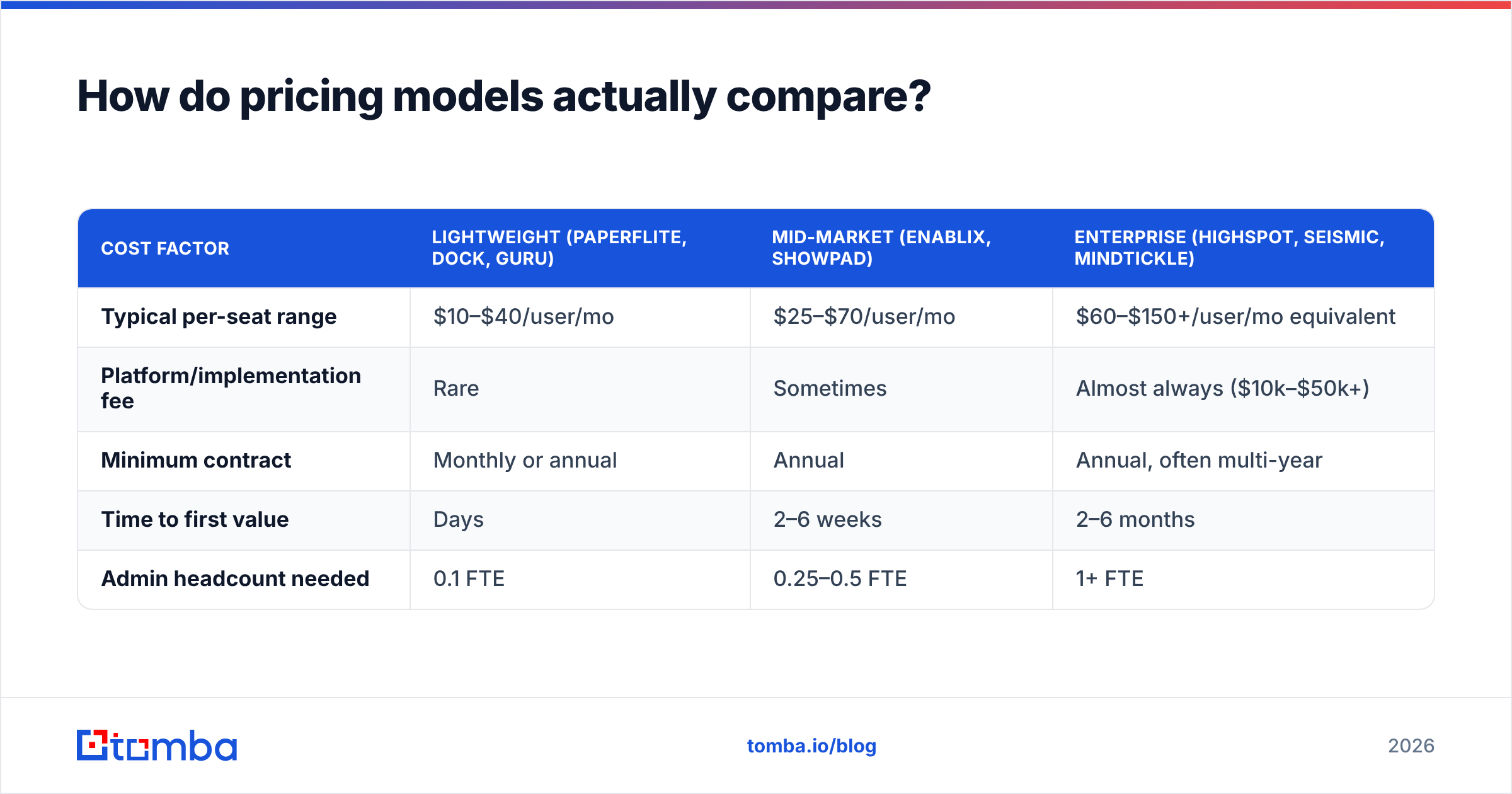
Feature grids mislead in this category because cost is driven by seat count and contract structure, not capabilities. Here is the more useful comparison:
| Cost factor | Lightweight (Paperflite, Dock, Guru) | Mid-market (Enablix, Showpad) | Enterprise (Highspot, Seismic, Mindtickle) |
|---|---|---|---|
| Typical per-seat range | $10–$40/user/mo | $25–$70/user/mo | $60–$150+/user/mo equivalent |
| Platform/implementation fee | Rare | Sometimes | Almost always ($10k–$50k+) |
| Minimum contract | Monthly or annual | Annual | Annual, often multi-year |
| Time to first value | Days | 2–6 weeks | 2–6 months |
| Admin headcount needed | 0.1 FTE | 0.25–0.5 FTE | 1+ FTE |
The line that catches most buyers is the last one. An enterprise enablement platform without a dedicated admin decays into an expensive file share within two quarters. If you cannot name the person who will own tagging, governance, and quarterly content audits, buy down a tier — not up.
A second trap: licensing every seat. Enablement platforms bill for provisioned users, not active users. Before you sign, pull login data from your current tool. If 45% of your reps have not opened it in 60 days, you are negotiating against a headcount number that does not reflect reality.
Is a content platform enough to fix your pipeline?#
No — and this is where most enablement rollouts quietly underperform.
Enablement tools optimize what happens after a rep has a conversation. They make sure the follow-up deck is on-brand, current, and tracked. They do nothing about whether the rep has enough qualified contacts to have that conversation in the first place. A team with beautiful, perfectly governed content and a stale contact list still misses quota.
That is why the healthier stack pairs an enablement layer with a data layer:
- Contact discovery — verified work emails and direct dials for the accounts in your ICP, sourced through an email finder or domain search rather than a scraped list of unknown vintage.
- Verification before send — running addresses through an email verifier so your carefully tracked content link does not bounce and drag down sender reputation.
- Enrichment into CRM — filling role, seniority, and company fields via data enrichment so the enablement platform's persona-based content rules actually fire correctly.
- Multichannel reach — pulling B2B phone numbers for accounts where email engagement stalls.
The dependency runs one direction: persona-tagged content is only as good as the persona data in your CRM. Garbage titles in, wrong battlecard out.
Which Enablix alternative fits which team?#
Use this as a shortlist filter before you sit through five demos:
- Under 25 reps, budget-sensitive, want tracked links — Paperflite or Dock. Skip the platform tier entirely; you will not use 70% of it.
- Onboarding is the bottleneck, ramp time exceeds 5 months — Mindtickle or Allego. Content management is secondary to certification and practice.
- Enablement is a funded function with a dedicated owner — Highspot. It is the safest enterprise choice and the one most reps adopt without a fight.
- High-volume, templated, regulated content — Seismic. Nothing else automates document assembly at that level.
- Field or retail sellers, offline-heavy, mobile-first — Bigtincan or Showpad.
- The real problem is stale internal answers, not decks — Guru, at roughly a third of the cost of the platforms above.
If none of these six describes you and Enablix is broadly working, the honest answer may be to stay and fix your content operations process instead. Most enablement platform churn is a process problem wearing a software costume: no owner, no archive policy, no naming convention, no quarterly audit. Switching vendors does not fix any of that.
What should you ask in every demo?#
Bring these five questions to each vendor call. They surface differences that feature pages hide.
- "Show me the analytics screen a CRO would look at." If the answer is asset views, you are getting Enablix-class reporting at a higher price.
- "What is the platform fee separate from seats, and is it waived in year one only?" Year-two renewal shock is the most common complaint in this category.
- "Who at your customers administers this day to day, and how many hours a week?" Ask for a reference with your headcount, not their flagship logo.
- "How does content get retired?" Governance is the difference between a library and a landfill. Ask about expiration dates, owner re-verification, and automated archiving.
- "What breaks if we churn?" Confirm you can export content, metadata, and engagement history in a usable format.
Run the same five questions past Enablix before you leave. Vendors renegotiate, and a mid-market platform that solves 80% of your need at 40% of the enterprise price is often the correct answer even when it is not the exciting one.
The layer most enablement stacks are missing#
Pick the enablement platform that matches your charter, your headcount, and the admin time you can genuinely commit. Then make sure your reps have someone to send that content to.
Tomba's Tomba Email Finder gives your team verified business email addresses by name, company, or domain, with a REST API and native integrations for HubSpot, Salesforce, and Google Sheets so enriched contacts land where your enablement rules can act on them. Start free with 25 searches a month, or scale up through Tomba pricing — Starter at $49/mo, Growth at $99/mo, and Pro at $249/mo — and give your newly organized content library an audience worth reaching.
Related guides#
Ready to find emails that actually work?
Join 150,000+ professionals who stopped guessing and started sending. Free credits on signup — no credit card required.
Get the Tomba newsletter
Practical outbound tactics and product updates — once every two weeks.
About the author