Enablix Pricing, Reviews, Pros and Cons (2026 Guide)
Enablix does not publish a public price list. Here is what buyers actually report paying in 2026, where the platform earns its keep, and the three cost lines that surprise teams after signature.
Enablix pricing, reviews, pros and cons, in one place — with real numbers instead of a sales pitch. Enablix keeps its rate card behind a demo call. So this guide collects what buyers report paying in 2026, what they praise, and what they wish they had known first.
TL;DR
- Enablix does not publish pricing. Buyers report roughly $25–$45 per user per month on annual contracts, with platform minimums that push most deals into the $12,000–$40,000/year range.
- The product is genuinely good at one thing: putting the right content in front of a rep inside Salesforce, HubSpot, Gmail, or a Slack channel, and telling you which asset actually influenced revenue.
- The cons are consistent across review sites: opaque pricing, an onboarding/content-migration effort most teams underestimate, and analytics that only get useful once your library is tagged properly.
- It is a sales enablement platform, not a data provider. If your real problem is "we don't have contacts to send anything to," Enablix will not solve it and you should not buy it.
Verdict: worth it for 15–150 rep teams with a real content problem and someone who owns enablement. Overkill for teams under 10 reps or anyone still building pipeline from scratch.
What is Enablix and who actually buys it?#
Enablix is a sales content management and enablement platform. Think of it as a well-organized pantry for your revenue team. Instead of five people digging through Google Drive for the current pricing one-pager, everything sits in one indexed library. It surfaces where reps already work. And it reports back on which jar actually got used.
Technically, it does four things:
- Content hub — a searchable library for decks, one-pagers, case studies, battlecards, and recorded demos, with version control so the 2024 pricing sheet stops circulating in 2026.
- Digital sales rooms — buyer-facing microsites where a rep shares a curated bundle with a prospect and gets engagement telemetry back (who opened, what they scrolled, how long).
- In-workflow surfacing — Chrome extension, Gmail/Outlook sidebar, Slack, and CRM embeds so reps never leave the tab they're in.
- Content analytics — usage, engagement, and influenced-pipeline attribution tied back to opportunities in your CRM.
The typical buyer is a product marketing manager or an enablement lead. The company profile: 50–500 employees, B2B software, 15–150 quota-carrying reps, and a content library that has outgrown a shared drive. Below that headcount, the ROI math gets thin fast.

What does Enablix pricing actually cost in 2026?#
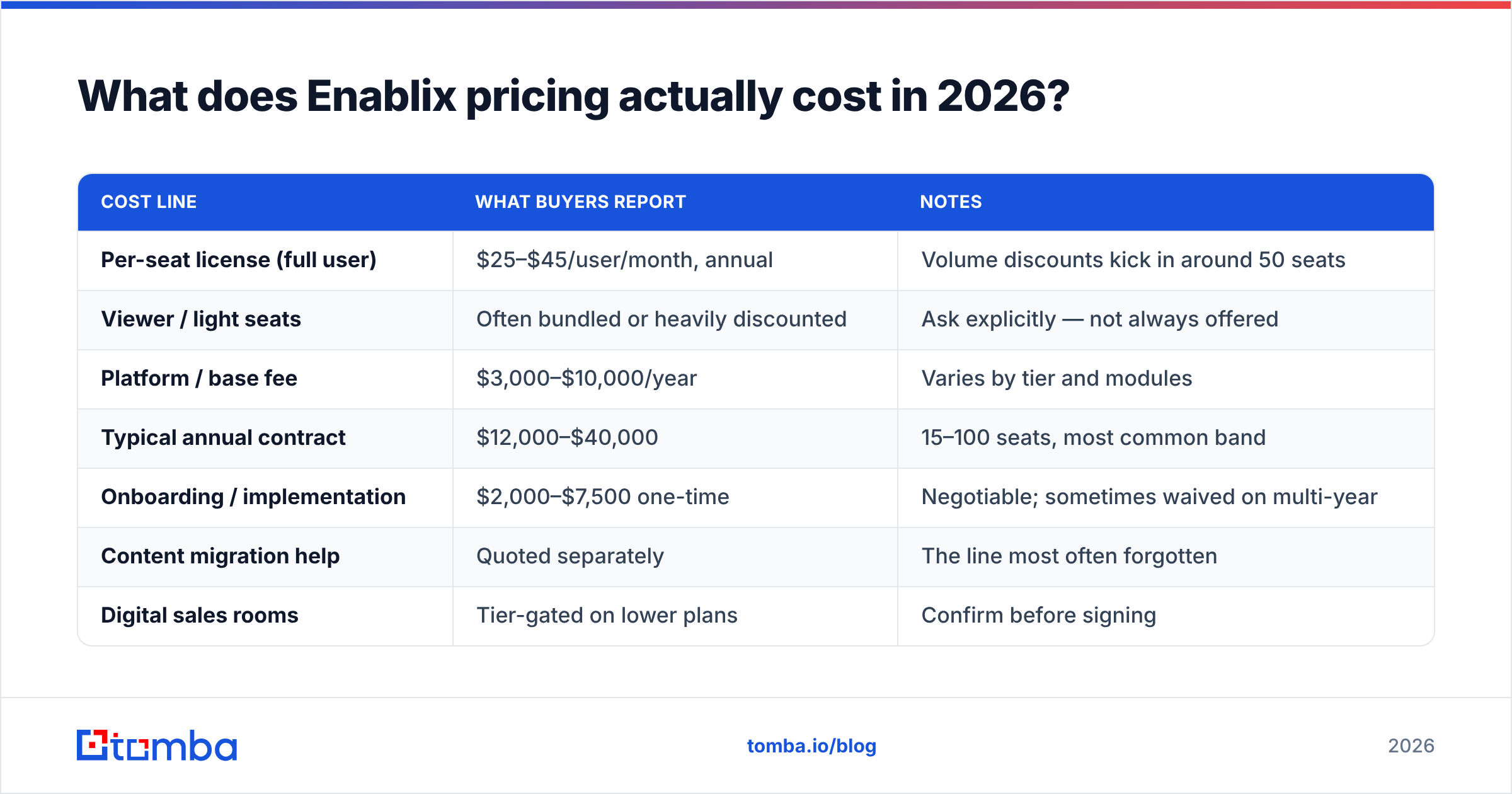
Conclusion first: expect $25–$45 per user per month billed annually, with a platform floor. Enablix publishes no rate card on its site. So every number below comes from buyers. The sources are reported figures on review marketplaces like G2 and Capterra, plus quotes shared in enablement communities.
Here is the shape of the deal as buyers describe it:
| Cost line | What buyers report | Notes |
|---|---|---|
| Per-seat license (full user) | $25–$45/user/month, annual | Volume discounts kick in around 50 seats |
| Viewer / light seats | Often bundled or heavily discounted | Ask explicitly — not always offered |
| Platform / base fee | $3,000–$10,000/year | Varies by tier and modules |
| Typical annual contract | $12,000–$40,000 | 15–100 seats, most common band |
| Onboarding / implementation | $2,000–$7,500 one-time | Negotiable; sometimes waived on multi-year |
| Content migration help | Quoted separately | The line most often forgotten |
| Digital sales rooms | Tier-gated on lower plans | Confirm before signing |
| Monthly billing option | Rarely offered | Annual prepay is the norm |
Two things matter more than the headline seat price. First, the platform fee. A 12-rep team pays a much higher effective per-seat rate than a 60-rep team, because the floor does not scale down. Second, annual prepay is the default. So "we'll try it for a quarter" is usually not on the table.

Where the hidden costs live#
- Content migration. Moving 400 assets out of Drive, Highspot, or SharePoint, deduping them, and tagging them so search actually works is 20–60 hours of human effort. Enablix will quote services for this; you can also do it internally, but budget the time either way.
- Taxonomy design. The analytics are only as good as your tags. Teams that skip taxonomy get a pretty dashboard reporting on garbage.
- Ongoing ownership. Someone has to archive stale assets monthly. Without an owner, the library rots in nine months and you're paying $20k/year for a search box.
- Integration scope. Standard CRM connectors are included. Bespoke API work is not.
How does Enablix compare to other enablement platforms?#
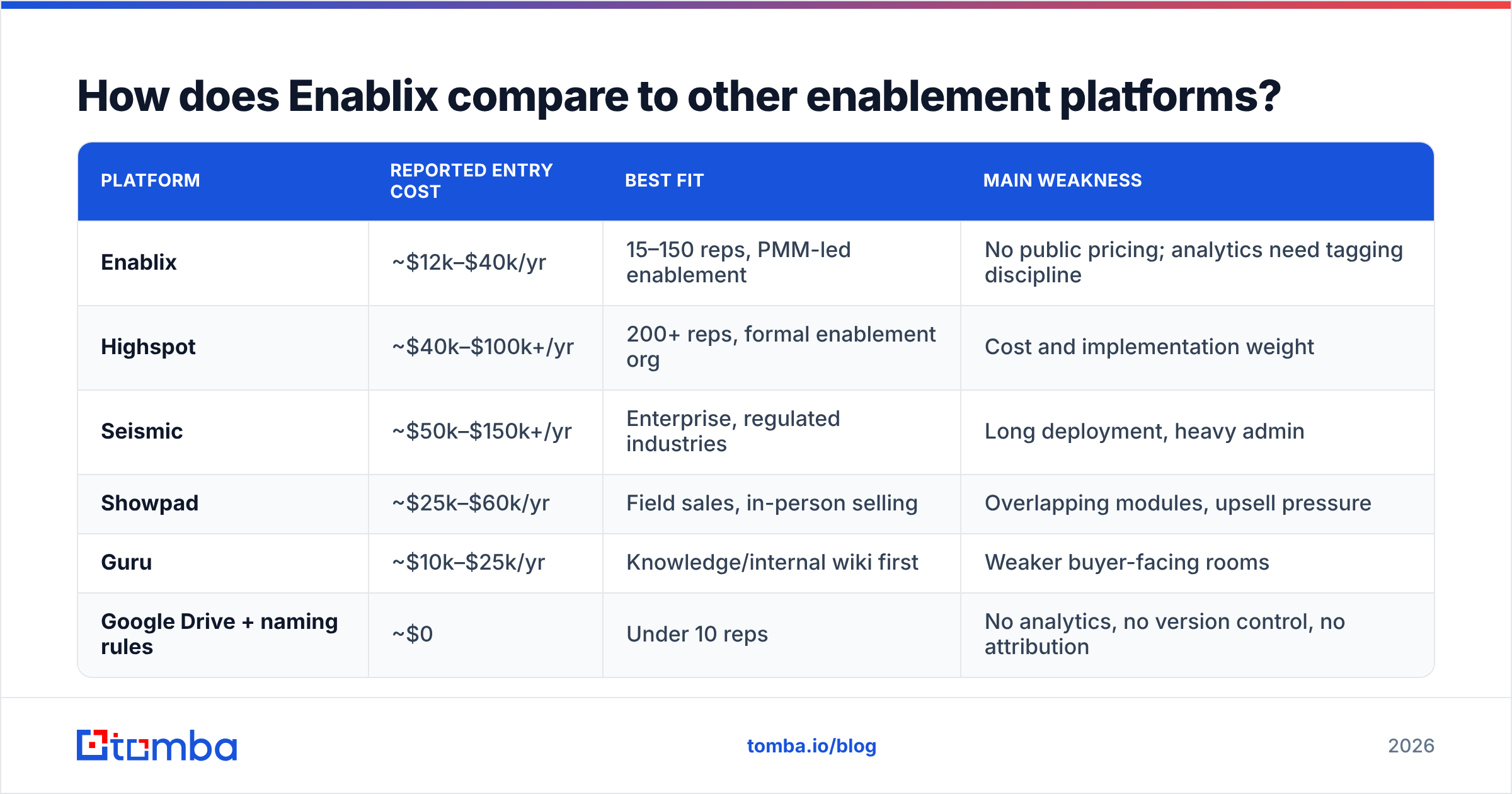
Enablix sits in the mid-market slot: more structured than a shared drive, far cheaper than Highspot or Seismic, and narrower than either. Here's the honest positioning against the platforms it most often gets shortlisted alongside.
| Platform | Reported entry cost | Best fit | Main weakness |
|---|---|---|---|
| Enablix | ~$12k–$40k/yr | 15–150 reps, PMM-led enablement | No public pricing; analytics need tagging discipline |
| Highspot | ~$40k–$100k+/yr | 200+ reps, formal enablement org | Cost and implementation weight |
| Seismic | ~$50k–$150k+/yr | Enterprise, regulated industries | Long deployment, heavy admin |
| Showpad | ~$25k–$60k/yr | Field sales, in-person selling | Overlapping modules, upsell pressure |
| Guru | ~$10k–$25k/yr | Knowledge/internal wiki first | Weaker buyer-facing rooms |
| Google Drive + naming rules | ~$0 | Under 10 reps | No analytics, no version control, no attribution |
The realistic comparison for most mid-market teams is Enablix vs. Guru vs. doing nothing. If your pain is "reps can't find the right deck," Enablix wins. If your pain is "reps can't find the right internal answer," Guru is closer. If your pain is "we have no consistent messaging at all," buy neither yet. Fix the messaging first, because tooling amplifies whatever you feed it.
What do Enablix reviews say — the honest pros?#
Across G2 and Capterra, the praise clusters tightly, which is usually a good sign. The same four things come up:
- Setup speed relative to enterprise tools. Teams report being live in two to four weeks, not two quarters. Compared with a Seismic rollout, this is the single most cited advantage.
- Support quality. Reviewers repeatedly name specific CSMs. Small-vendor attentiveness is real here, and it is the thing you lose when you buy the enterprise incumbent.
- Digital sales rooms that reps actually use. Engagement data flowing back into the CRM ("your champion re-opened the security doc twice on Tuesday") is the feature that converts skeptical AEs.
- Search that works. Full-text search across PDF and deck contents, not just filenames, is table stakes that many cheaper tools still fail.
There's a fifth, quieter pro: the platform doesn't try to be your sequencer, your dialer, and your CRM. It stays in its lane. Tools that stay in their lane are easier to rip out and easier to justify.
What are the real cons buyers report?#
- No public pricing. Every evaluation starts with a sales call. For a mid-market buyer running a three-vendor bake-off in two weeks, that's friction, and it's the most common complaint in reviews.
- Analytics depend entirely on your hygiene. Attribution reports look impressive in the demo because the demo data is clean. Yours won't be until you do the tagging work.
- Mobile experience trails desktop. Field reps who live on tablets report a gap versus Showpad, which was built mobile-first for exactly that use case.
- Reporting customization has ceilings. Teams wanting bespoke dashboards hit limits and end up exporting to a BI tool.
- Adoption is not automatic. The tool surfaces content; it does not make reps use it. Every review that says "we didn't get value" traces back to no internal owner.
That last point is the real risk, and it's not Enablix-specific. Enablement platforms fail for the same reason CRM rollouts fail: nobody owned the data. Budget for a person, not just a license.
Is Enablix worth it for your team?#
Use this as a decision filter rather than a feature checklist:
- Do you have 15+ quota-carrying reps? Below that, a well-structured Drive plus a Notion index gets you 80% of the value for $0. The platform fee alone makes small deployments expensive per seat.
- Do you have a named content owner? If enablement is nobody's job, the library will decay and you'll churn at renewal. This is the single strongest predictor of outcome.
- Is content the actual bottleneck? If reps close fine but can't find the ROI calculator, yes. If reps have no one to call, the bottleneck is upstream — pipeline, not content.
The next three are logistics, not strategy:
- Can you commit annually? Monthly is rarely offered. If your runway or headcount is uncertain, that's a real constraint.
- Do you need buyer-facing rooms? If yes, confirm which tier includes them before you fall in love with the demo.
- Is your CRM clean enough for attribution? Content-influenced-revenue reporting is only as trustworthy as the opportunity records underneath it.
Three or more yeses: get the quote. Fewer than three: fix the upstream problem first.
What should you fix before buying any enablement platform?#
Here's the uncomfortable part. A large share of teams shopping for enablement software are actually solving the wrong problem. Content tooling improves conversion on conversations you're already having. It does nothing for volume.
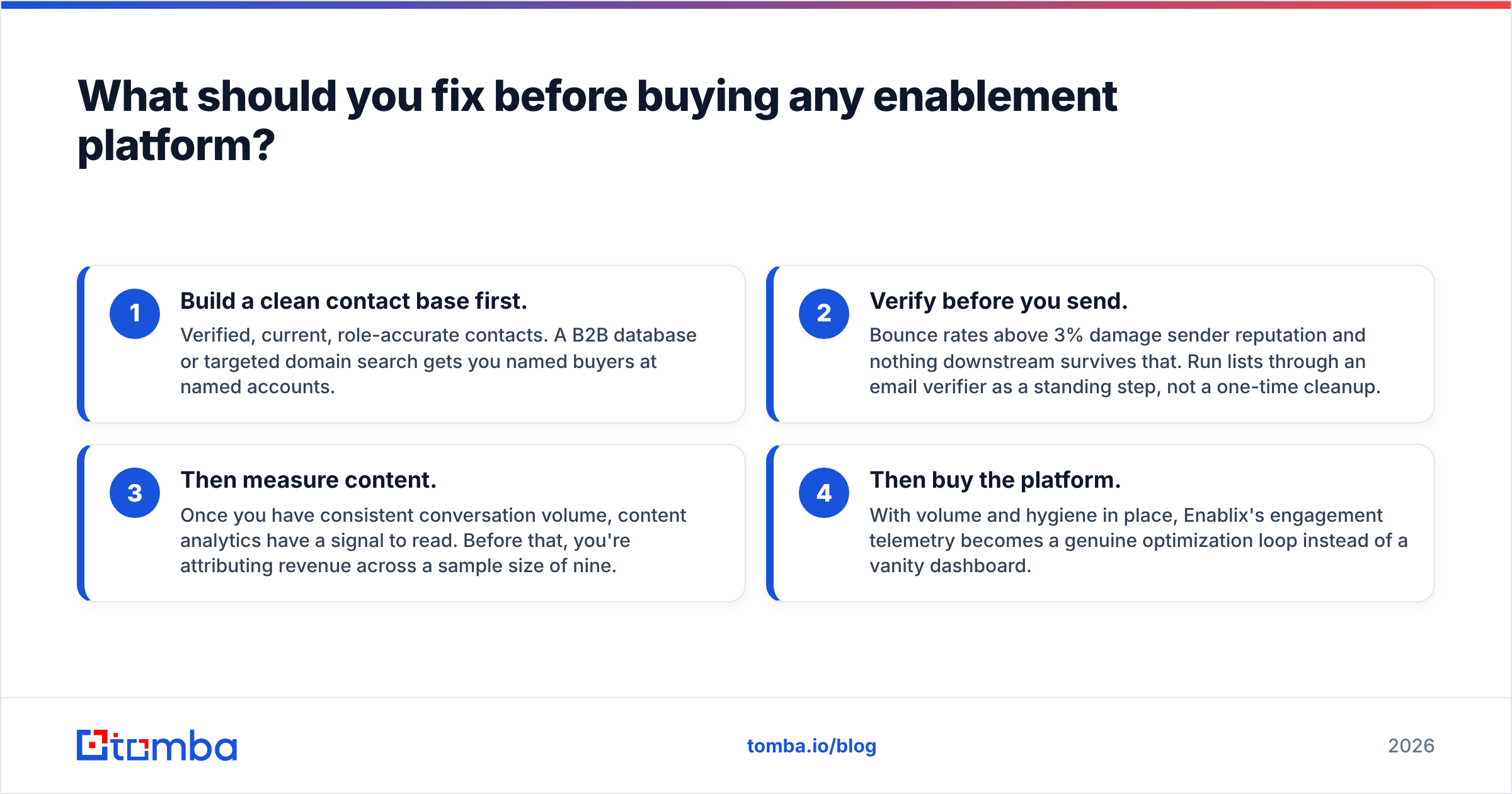
If your reps have great decks and no one to send them to, spend the $20k somewhere else. The sequence that actually works:
- Build a clean contact base first. Verified, current, role-accurate contacts. A B2B database or targeted domain search gets you named buyers at named accounts.
- Verify before you send. Bounce rates above 3% damage sender reputation and nothing downstream survives that. Run lists through an email verifier as a standing step, not a one-time cleanup.
- Then measure content. Once you have consistent conversation volume, content analytics have a signal to read. Before that, you're attributing revenue across a sample size of nine.
- Then buy the platform. With volume and hygiene in place, Enablix's engagement telemetry becomes a genuine optimization loop instead of a vanity dashboard.
Peer platforms in the contact-data layer solve a different problem than Enablix. BookYourData, for example, sells verified B2B lists on a pay-as-you-go model. Teams often buy both, not one instead of the other. The mistake is buying the enablement layer first and wondering why the dashboards are empty.
How do you negotiate a better Enablix contract?#
Since pricing is quote-based, the number is negotiable. What buyers report working:
- Ask for the platform fee to be folded into seats. Vendors would rather grow seat count than defend a base fee.
- Trade term for discount. A two-year commitment typically buys 10–20% off, plus waived implementation.
- Buy at their quarter end. Predictable, and it works.
- Start with fewer full seats. Buy 20 full licenses and expand mid-term rather than buying 60 on optimism. Get the expansion rate locked in writing at signature.
- Get migration scoped in the MSA. "We'll help you get set up" is not a deliverable. Hours are.
- Request a documented success criterion. Define what adoption looks like at day 90, in writing. It makes renewal conversations factual instead of emotional.
Frequently asked questions#
Does Enablix have a free trial? There's no self-serve free tier. Guided pilots and sandbox access are typically arranged through sales, and length is negotiable.
Is Enablix cheaper than Highspot? Materially, yes — most reported Enablix contracts land well under half of a comparable Highspot deal. You're trading enterprise governance features and a larger partner ecosystem for cost and speed.
Does it integrate with my CRM? Salesforce and HubSpot are the well-trodden paths, alongside Slack, Gmail, and Outlook. Confirm your specific edition during evaluation.
How long is implementation? Two to four weeks for the platform. Content migration and taxonomy are the long poles, and they scale with library size, not vendor speed.
Enablix pricing, reviews, pros and cons: the verdict#
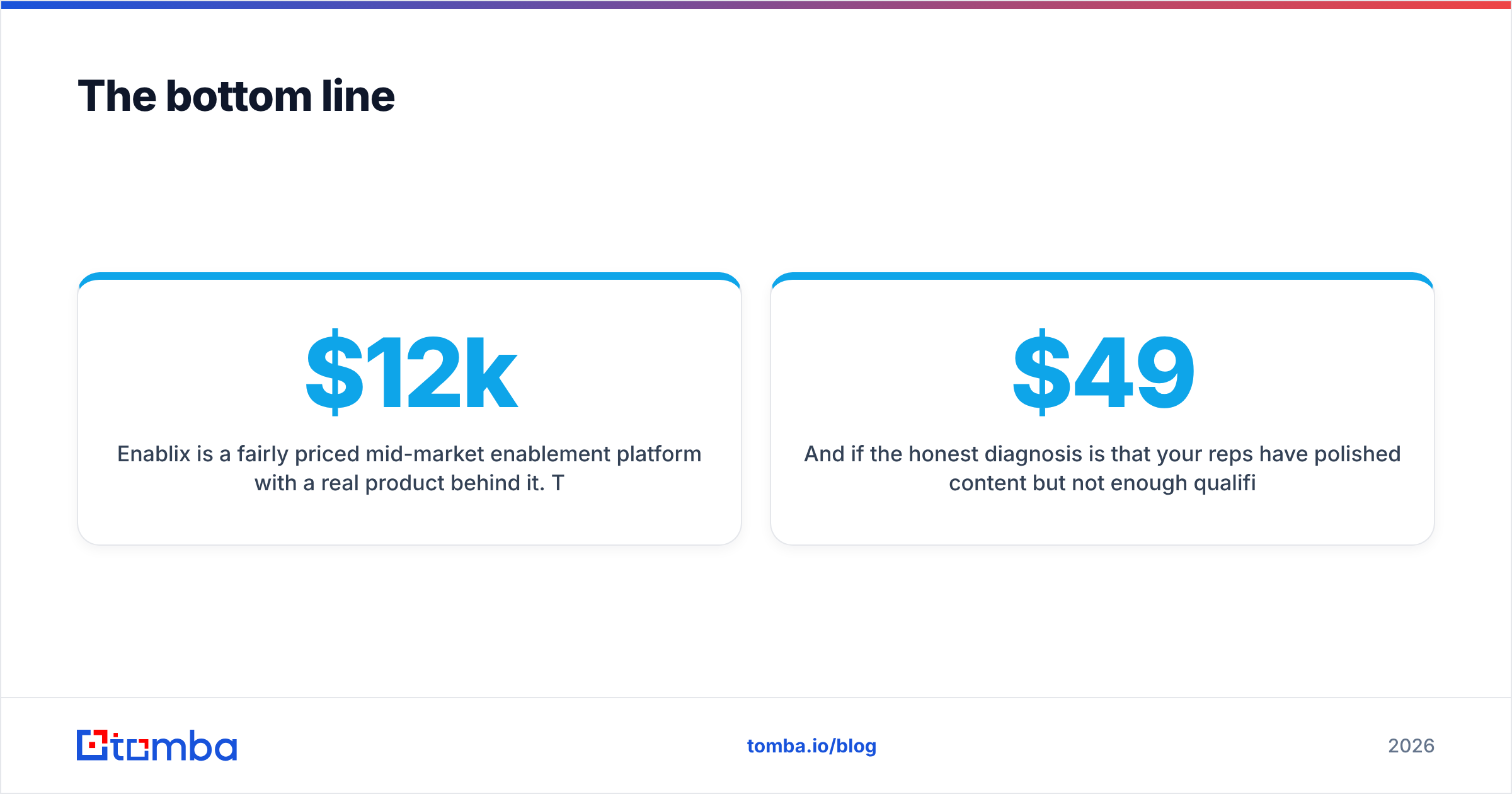
Here is the short version. Enablix is a fairly priced mid-market enablement platform with a real product behind it. The pricing opacity is annoying but not disqualifying, and the reported $12k–$40k annual range is defensible against Highspot and Seismic. Buy it if you have reps, content chaos, and an owner. Skip it if any of those are missing.
And if the honest diagnosis is that your reps have polished content but not enough qualified conversations, fix that layer first. Use the Tomba Email Finder to turn target accounts into verified, reachable decision-makers. Start free with 25 searches a month, then move to the $49/mo Starter plan when volume picks up. Full Tomba pricing is published on the site, no sales call required. Build the pipeline first; then the content platform has something to measure.
Related guides#
// get started
Find, verify and enrich your first contacts today
Start on the free plan with 25 searches a month, then scale when your team is ready.
Free plan · No credit card required · GDPR & CCPA
// about the author