Enlyft Pricing Reviews Pros and Cons: 2026 Buyer Guide
Enlyft sells technographic account intelligence behind a quote-only paywall. Here is what buyers actually pay, what reviewers praise and complain about, and when a cheaper stack beats it.
Short answer up front: this Enlyft pricing reviews pros and cons guide shows what buyers really pay in 2026, what the platform does well, and where it falls short.
TL;DR
- Enlyft does not publish prices. Every plan is quote-only, priced per seat and per data volume. Your cost depends on how well you negotiate, not on a public rate card.
- Buyers on review sites report annual contracts in the low five figures for small teams. Add seats, API access, or CRM sync and the deal moves into the mid five figures.
- The strongest praise is for technographic intelligence: knowing which companies run Salesforce, AWS, Shopify, or SAP, and how likely they are to switch.
- The most common complaints are contact-level data gaps, stale install records for smaller companies, and onboarding that assumes you already have a RevOps function.
- If you mostly need verified contact emails rather than install-base intelligence, a $49/mo tool covers 80% of the job at 5% of the cost.
What is Enlyft and who is it actually for?#
Enlyft is a technographic and account intelligence platform. Its core claim: it tells you what software a company already uses, how much they spend on it, and how likely they are to buy something adjacent. Think of it as a home inspector for a company's tech stack. It walks through the building and reports the plumbing, the wiring, and the age of the furnace. You then know whether to pitch a repair or a replacement.
That framing matters for the pricing conversation. Enlyft is not an email finder, a sequencer, or a CRM. It is a data layer that sits upstream of those tools. You buy it to answer "which accounts should we target and why", not "what is this person's email address".
The typical Enlyft buyer is:
- A mid-market or enterprise software vendor selling into a specific install base — for example, a company that only sells to organizations already running NetSuite.
- A demand-gen or ABM team building target account lists scored by technology fit rather than firmographics alone.
- A RevOps team enriching an existing CRM with technographic attributes to drive routing, scoring, and territory design.
- A partner or channel team mapping which accounts already run a partner's platform.
If you are a two-person outbound team trying to book meetings next quarter, Enlyft is aimed above you. That is not a criticism. It is a fit question, and fit is the single biggest driver of whether the price feels fair.
How much does Enlyft pricing actually cost in 2026?#
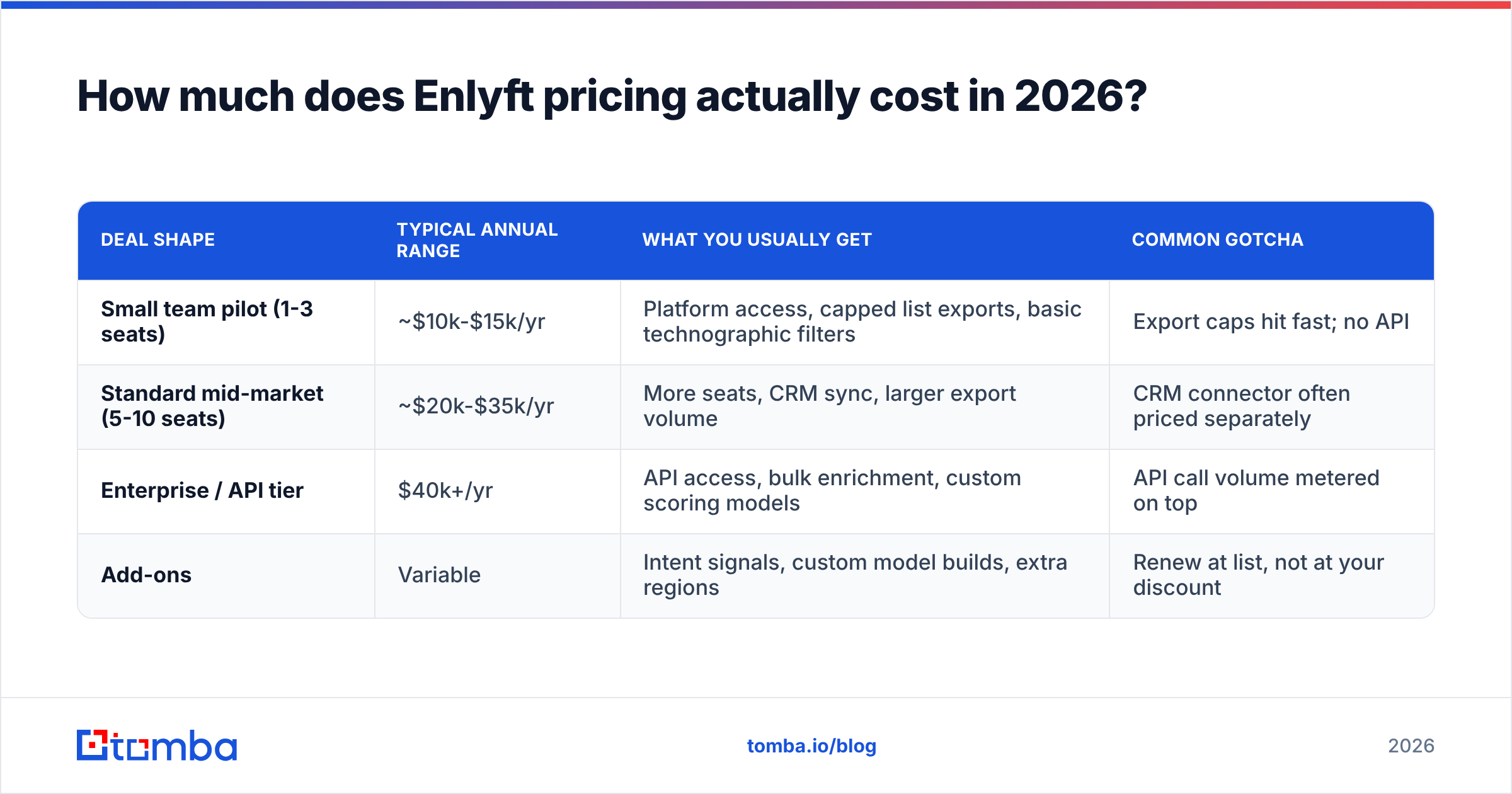
There is no public price list. The official Enlyft site routes you to a demo form rather than a pricing page. That is standard for account intelligence vendors, but it is frustrating if you are building a budget before you talk to a rep.
Based on patterns buyers report on G2 and in procurement conversations, here is the realistic shape of a deal. Treat these as ranges to negotiate against, not quotes:
| Deal shape | Typical annual range | What you usually get | Common gotcha |
|---|---|---|---|
| Small team pilot (1-3 seats) | ~$10k-$15k/yr | Platform access, capped list exports, basic technographic filters | Export caps hit fast; no API |
| Standard mid-market (5-10 seats) | ~$20k-$35k/yr | More seats, CRM sync, larger export volume | CRM connector often priced separately |
| Enterprise / API tier | $40k+/yr | API access, bulk enrichment, custom scoring models | API call volume metered on top |
| Add-ons | Variable | Intent signals, custom model builds, extra regions | Renew at list, not at your discount |
A few structural things to understand before you get on a call:
- Annual commitments are the default. Month-to-month is rarely offered, and when it is, the effective rate is much higher.
- Seats and volume are separate levers. Adding a fourth seat and adding 20,000 records are two different line items.
- Discounts cluster at quarter-end. This is true of every enterprise data vendor, and Enlyft is no exception.
- The first quote is not the price. Buyers routinely report 20-30% movement between the first quote and the signed contract, especially on multi-year terms.

The honest read: quote-only pricing is neither a scam nor a red flag. It signals that the vendor's cost-to-serve varies a lot by customer. They want to price on your perceived value rather than on a unit of data. So never accept the first number, and always ask for the export cap and API limits in writing.
What do Enlyft reviews say about the data quality?#
Reviews split cleanly along one axis: account-level data versus contact-level data.
On account-level technographics, sentiment is strong. Reviewers describe finding install-base segments they could not build anywhere else. "Companies running Workday with more than 500 employees in DACH" is the kind of query Enlyft handles well. The predictive scoring, which estimates likelihood-to-buy, gets credit for narrowing a 10,000-account TAM to a 600-account working list.
On contact-level data, sentiment drops. Common threads in reviews:
- Coverage thins outside the enterprise mid-band. Companies under roughly 50 employees show sparse or missing install data.
- Install records can lag reality. A company that moved off a platform six months ago may still be tagged as a user, which burns credibility on the first call.
- Email and phone coverage is a secondary strength, not a primary one. Most teams end up pairing Enlyft with a dedicated contact-data tool.
- Regional coverage is uneven. North America is dense; APAC and parts of EMEA are thinner.
That last point is the practical takeaway. Very few teams run Enlyft alone. The standard stack has three layers: Enlyft (or a peer) for account selection, a contact-data layer for email verification and outreach-ready records, then a sequencer. If you budget for Enlyft as if it replaces your contact database, you will be unpleasantly surprised.
Enlyft pricing reviews pros and cons: the full ledger#
Here is the balanced ledger, stated plainly.
Pros
- Technographic depth is genuinely differentiated. For install-base plays, the segmentation beats generic firmographic filters.
- Predictive scoring saves list-building time. Teams report cutting target-list construction from days to hours.
- CRM enrichment is clean when configured well. Salesforce and HubSpot syncs push technographic attributes into fields you can route and score on.
- Useful for TAM sizing and board reporting. The market-share views make a credible slide, not just a prospecting list.
- Sales engineering support is responsive during onboarding. Multiple reviewers call out hands-on setup help.
Cons
- Quote-only pricing blocks fast evaluation. You cannot compare it on a spreadsheet without booking a call first.
- Annual lock-in with limited proration. Downsizing mid-term is hard.
- Contact data is not the strength. Expect to buy a second tool for emails and direct dials.
- SMB and long-tail coverage is weak. If your ICP is under 50 employees, run a hard trial before signing.
- Onboarding assumes RevOps maturity. Without someone owning field mapping and scoring logic, the platform underdelivers.
- Renewal pricing tends to drift upward. Lock multi-year caps if you plan to stay.
How does Enlyft compare to the alternatives?#
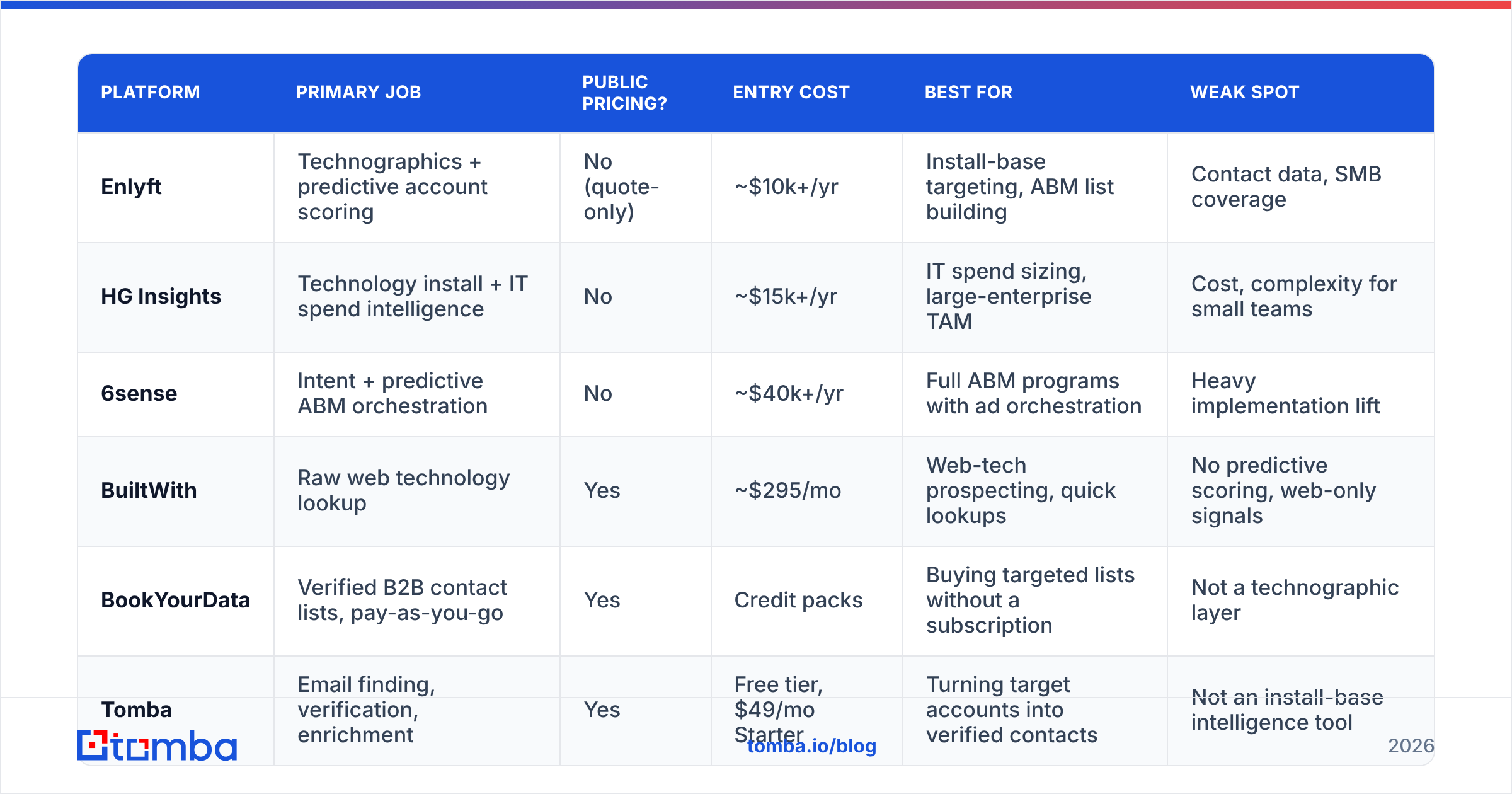
The competitive set depends on what you are actually buying. If the job is "which accounts", you are comparing against technographic and intent vendors. If the job is "which people, and how do I reach them", you are comparing against contact-data vendors. There, the price gap is enormous.
| Platform | Primary job | Public pricing? | Entry cost | Best for | Weak spot |
|---|---|---|---|---|---|
| Enlyft | Technographics + predictive account scoring | No (quote-only) | ~$10k+/yr | Install-base targeting, ABM list building | Contact data, SMB coverage |
| HG Insights | Technology install + IT spend intelligence | No | ~$15k+/yr | IT spend sizing, large-enterprise TAM | Cost, complexity for small teams |
| 6sense | Intent + predictive ABM orchestration | No | ~$40k+/yr | Full ABM programs with ad orchestration | Heavy implementation lift |
| BuiltWith | Raw web technology lookup | Yes | ~$295/mo | Web-tech prospecting, quick lookups | No predictive scoring, web-only signals |
| BookYourData | Verified B2B contact lists, pay-as-you-go | Yes | Credit packs | Buying targeted lists without a subscription | Not a technographic layer |
| Tomba | Email finding, verification, enrichment | Yes | Free tier, $49/mo Starter | Turning target accounts into verified contacts | Not an install-base intelligence tool |
Notice that the table does not have a single winner. Enlyft and HG Insights answer the same question in slightly different ways. BuiltWith answers a narrower version of it for far less money. BookYourData is a simple way to buy verified contacts without committing to a platform subscription. That is a different purchase motion, and it suits teams who want list volume without an annual contract. Tomba sits at the other end of the funnel: once you know which accounts matter, it finds and verifies the people inside them.
For a broader view of how contact-data vendors stack up, the Apollo alternative breakdown covers the overlapping territory in more detail.
What hidden costs should you budget for?#
The subscription is rarely the whole bill. Budget for these:
- Implementation time. Two to six weeks of RevOps attention for field mapping, scoring logic, and CRM hygiene. That is a real cost even if no invoice is attached.
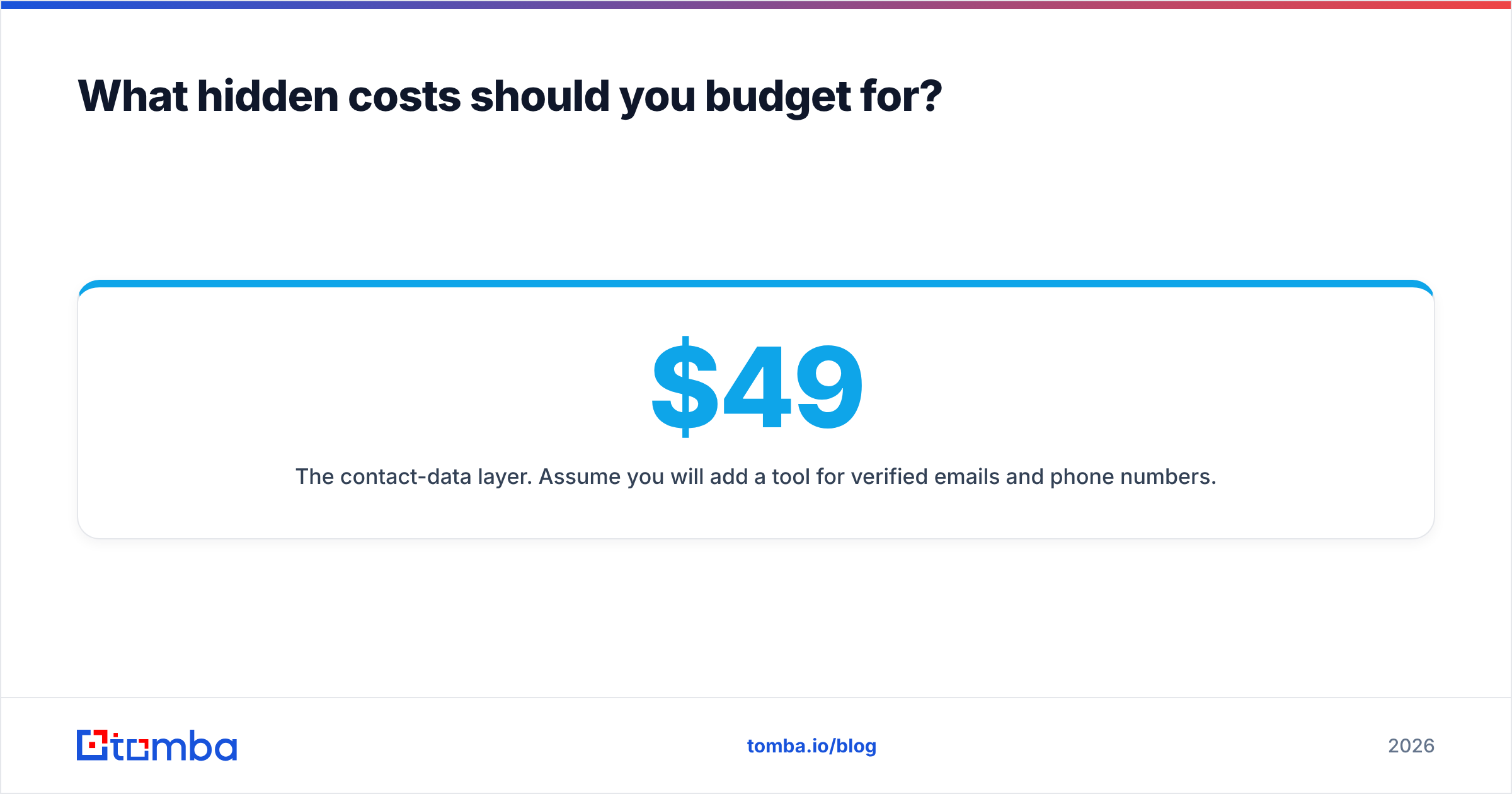
- The contact-data layer. Assume you will add a tool for verified emails and phone numbers. At Tomba's pricing — free for 25 searches/mo, $49/mo Starter, $99/mo Growth, $249/mo Pro — this is a rounding error next to the Enlyft line, but it needs to exist in the plan.
- API overage. If you enrich in bulk, metered calls can add a lot to the annual figure.
- Data decay. Technographic records age. If you sync once and never refresh, year two of your contract delivers less value than year one.
- Seat creep. Marketing asks for a seat, then partnerships does. Each one is priced at the margin, and margins are where vendors make their year.
Is Enlyft worth it in 2026?#
Yes — if your whole go-to-market depends on knowing what software a prospect already runs, and you have someone to operationalize the data. For an integration-led vendor selling into a specific install base, the technographic layer is hard to replicate with anything cheaper. A five-figure contract that lifts win rates a few points pays for itself.
No — if you are buying it to fill a contact database, or if your ICP skews small. In that case you are paying enterprise money for a signal you cannot act on, and you still need a contact tool on top.
A practical sequence before you sign:
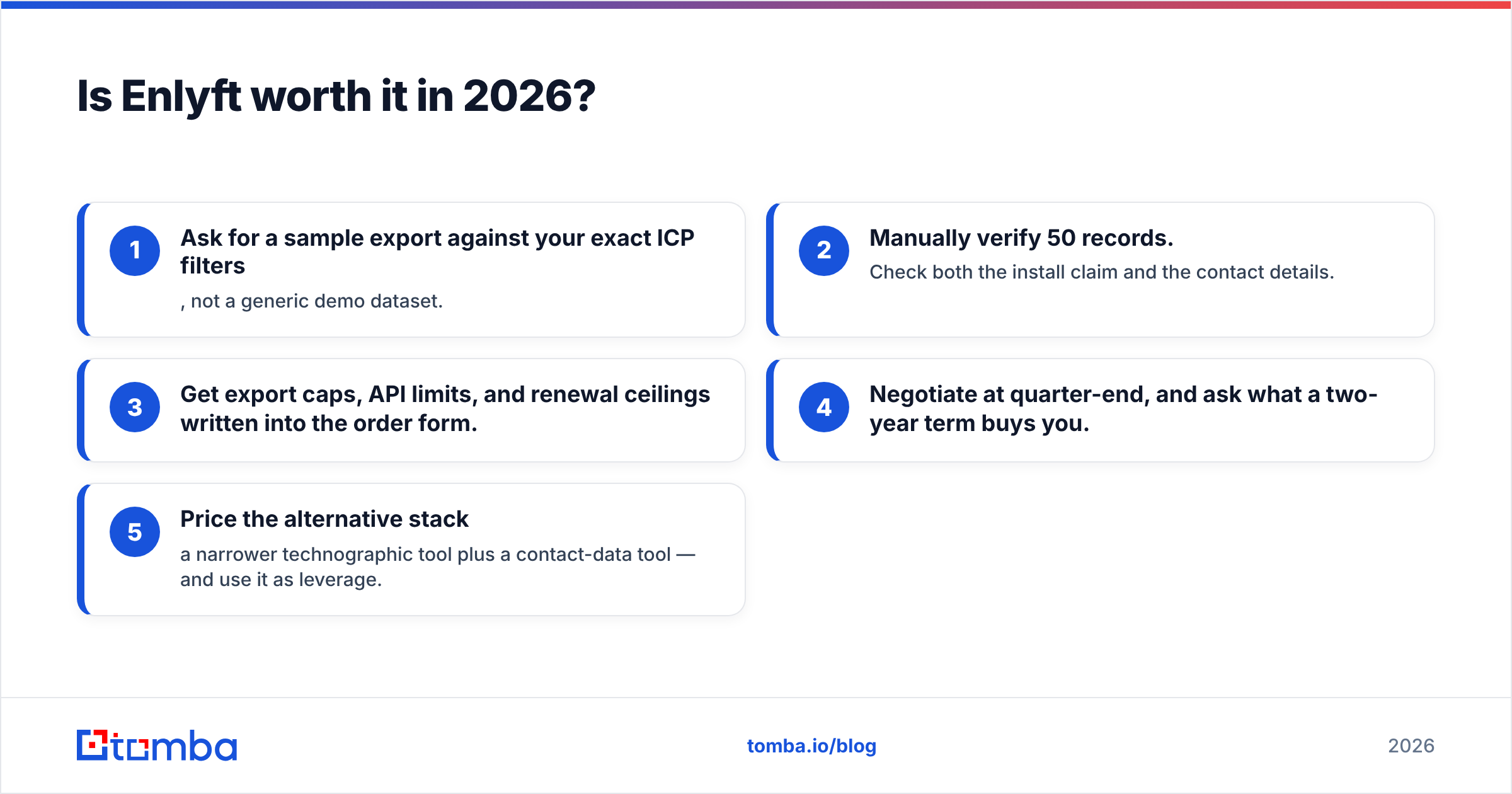
- Ask for a sample export against your exact ICP filters, not a generic demo dataset.
- Manually verify 50 records. Check both the install claim and the contact details.
- Get export caps, API limits, and renewal ceilings written into the order form.
- Negotiate at quarter-end, and ask what a two-year term buys you.
- Price the alternative stack — a narrower technographic tool plus a contact-data tool — and use it as leverage.
Weigh the Enlyft pricing reviews pros and cons above against your own ICP before you sign anything. If step 2 reveals what most buyers find — solid account intelligence, patchy contact records — then your real project is building the contact layer that turns those accounts into conversations. That is a much cheaper problem to solve. Run your target domains through Tomba's Email Finder to get verified, deliverable addresses for the decision-makers inside every account you just paid to identify. Start on the free tier with 25 searches a month, and move to $49/mo Starter only when the volume justifies it. No demo call, no annual lock-in, no quote required.
Related guides#
Ready to find emails that actually work?
Join 150,000+ professionals who stopped guessing and started sending. Free credits on signup — no credit card required.
Get the Tomba newsletter
Practical outbound tactics and product updates — once every two weeks.
About the author