Enrichley vs Sparklane: Which B2B Data Tool Wins in 2026?
Enrichley sells enrichment waterfalls. Sparklane sells predictive account intelligence. They solve different problems at very different prices — here is the honest breakdown, plus where a cheaper email-first stack beats both.
Enrichley vs Sparklane looks like a straight fight. It is not. One tool picks the accounts for you. The other fills the gaps in data you already hold. Here is how to tell which problem you have.
TL;DR
- They are not the same category. Enrichley is an enrichment layer. You feed it records, and it adds emails, phones and firmographics. Sparklane is a predictive prospecting platform. It tells you which accounts to target, then hands you contacts.
- Sparklane wins on European account data and intent signals. Think French, Benelux and UK mid-market. If your ICP sits there, its account graph is hard to copy with US-first tools.
- Enrichley wins on fill rate per record. It runs multi-provider waterfalls. You pay for breadth of sources, not for account intelligence.
- Price shapes this call more than features do. Sparklane sells seats and quotes. Expect low-to-mid four figures a year. Enrichley sells credits. Neither posts a public price sheet.
- Do you just need verified work emails and phones at volume? Then both are overbuilt. A finder like Tomba Email Finder starts at $49/mo. It serves the same data through an API you can wire into either workflow.
What are Enrichley and Sparklane?#
Think of it like buying groceries. Sparklane is the shop that tells you what to cook tonight. Enrichley is the delivery service that fills the gaps in your recipe. You already know you need eggs. It finds the eggs.
Sparklane is a European B2B sales intelligence platform. The pitch is predictive. It scores accounts against your closed-won history. It watches business signals such as funding, hiring, leadership changes, filings and news. Then it ranks accounts before you have built a list.
Contact data comes bundled, but it is the second act. The account layer is the product. You can see how it frames itself on the official Sparklane site. Its home turf is French and Western European mid-market. Company registry coverage there is a real moat.
Enrichley sits at the other end of the pipeline. You bring a list. It can be CRM records, form fills, LinkedIn exports, or a CSV from a conference.
Enrichley then enriches each row. It queries several upstream providers in turn until it gets a hit. That waterfall is now standard, because no single vendor wins every region or seniority band. You pay per successful match, not per seat.
So the honest way to frame Enrichley vs Sparklane is simple. Do you have a targeting problem, or a data-completeness problem? Buy the wrong one and you get a $12k annual contract that repeats what a $99/mo tool already did.

How do Enrichley and Sparklane compare head-to-head?#
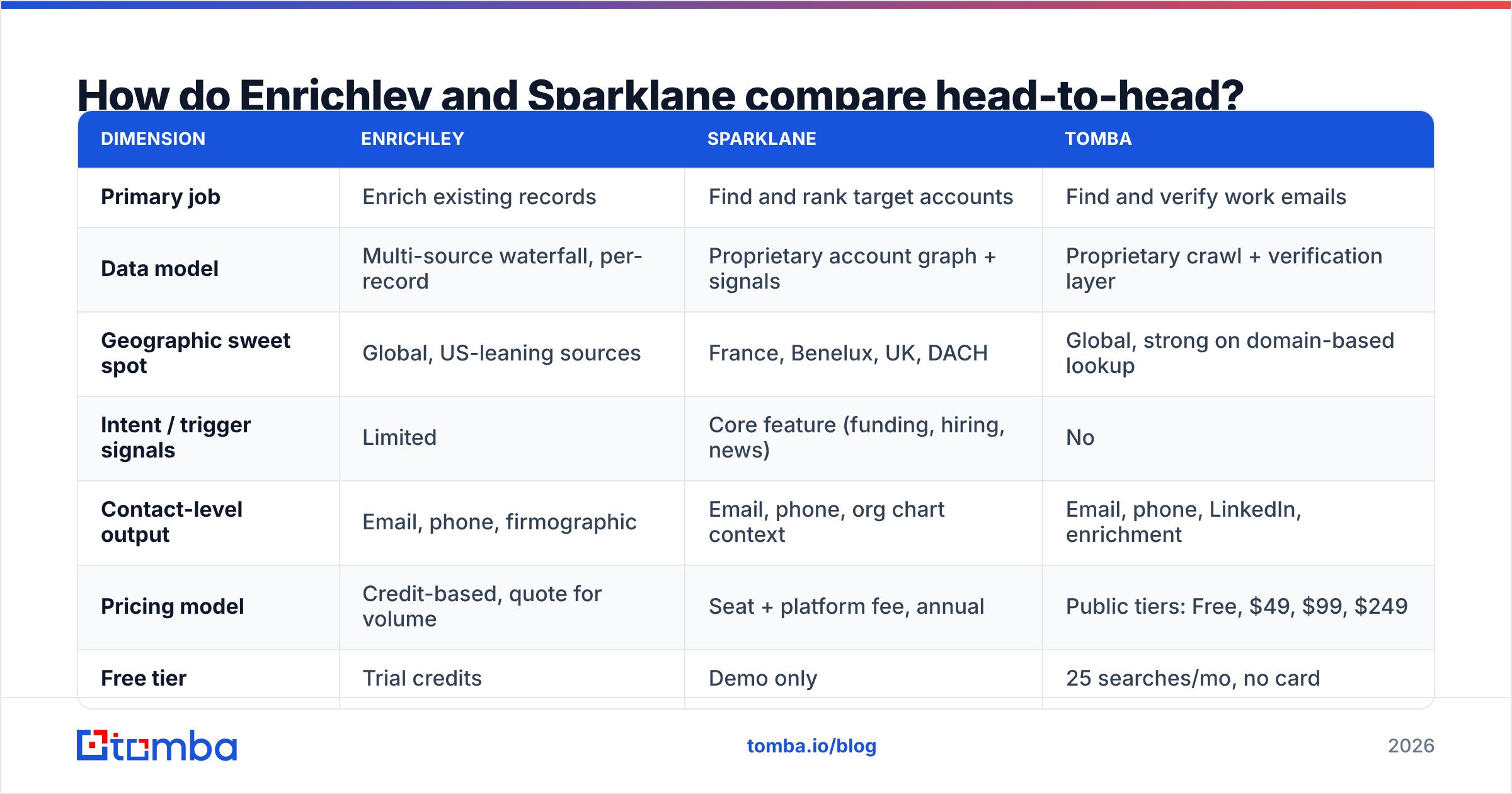
Here is the practical Enrichley vs Sparklane comparison. Treat the pricing rows as directional. Both vendors quote rather than publish, and both change packaging each year. Confirm on their own pages before you sign.
| Dimension | Enrichley | Sparklane | Tomba |
|---|---|---|---|
| Primary job | Enrich existing records | Find and rank target accounts | Find and verify work emails |
| Data model | Multi-source waterfall, per-record | Proprietary account graph + signals | Proprietary crawl + verification layer |
| Geographic sweet spot | Global, US-leaning sources | France, Benelux, UK, DACH | Global, strong on domain-based lookup |
| Intent / trigger signals | Limited | Core feature (funding, hiring, news) | No |
| Contact-level output | Email, phone, firmographic | Email, phone, org chart context | Email, phone, LinkedIn, enrichment |
| Pricing model | Credit-based, quote for volume | Seat + platform fee, annual | Public tiers: Free, $49, $99, $249 |
| Free tier | Trial credits | Demo only | 25 searches/mo, no card |
| API access | Yes | Yes, on higher plans | Yes, on every paid tier |
| Best for | RevOps cleaning a database | AEs prospecting EU mid-market | SDRs and devs needing volume email data |
| Typical time to value | Hours (upload a CSV) | 2-4 weeks (ICP modeling) | Minutes |
The table shows the real trade-off. Sparklane asks for onboarding time and returns targeting leverage. Enrichley asks for a credit budget and returns fill rate. One is a strategy buy. The other is an infrastructure buy.
Which one has better data coverage and accuracy?#
Neither wins outright. Any vendor that claims a flat "95% accuracy" across all regions is quoting marketing, not measurement.
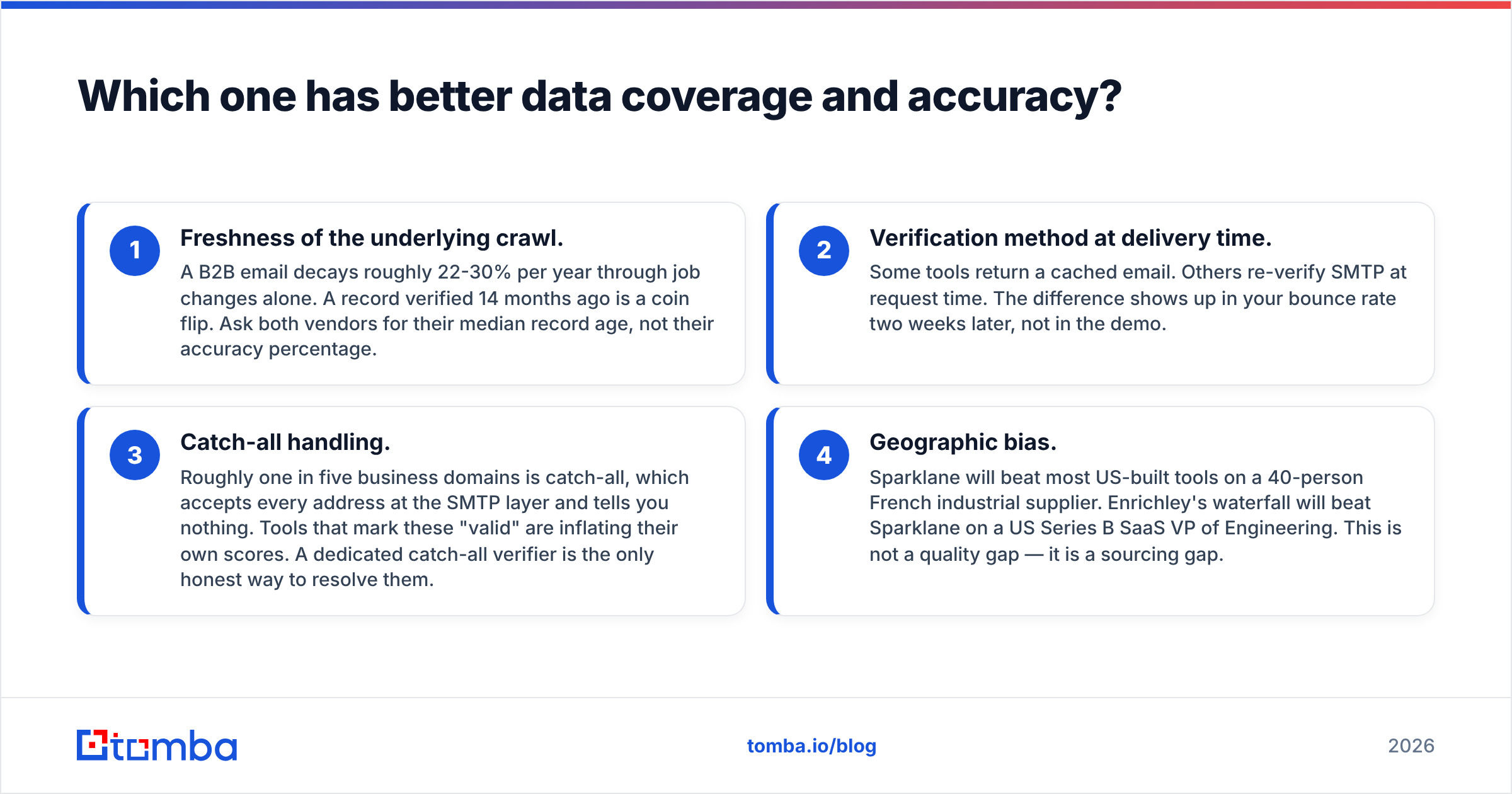
Four things drive accuracy in this category:
- Crawl freshness. A B2B email decays 22-30% a year through job changes alone. A record checked 14 months ago is a coin flip. Ask for median record age, not an accuracy percentage.
- Verification at delivery time. Some tools return a cached email. Others re-check SMTP when you ask. You see the gap in your bounce rate two weeks later, not in the demo.
- Catch-all handling. About one in five business domains is catch-all. It accepts every address at the SMTP layer and tells you nothing. Tools that mark these "valid" inflate their own scores. A catch-all verifier is the only honest fix.
- Regional bias. Sparklane beats most US-built tools on a 40-person French supplier. Enrichley's waterfall beats Sparklane on a US Series B VP of Engineering. That is a sourcing gap, not a quality gap.

The only test that counts is your own. Take 200 accounts from your real ICP. Run them through both trials. Then push every returned address through an independent email verifier that has no reason to grade its own homework.
Score three numbers. Fill rate is how many rows got an email. Validity rate is how many survive verification. Bounce rate comes after a live send. Vendors sell fill rate because they can advertise it. You should optimize for the third one.
Expect a duller result than the sales decks suggest. Credible vendors usually land within 8-12 points of each other on validity. The gap in cost per valid contact ends up wider than the gap in quality.
How does pricing actually work for each?#
This is where most Enrichley vs Sparklane decisions resolve.
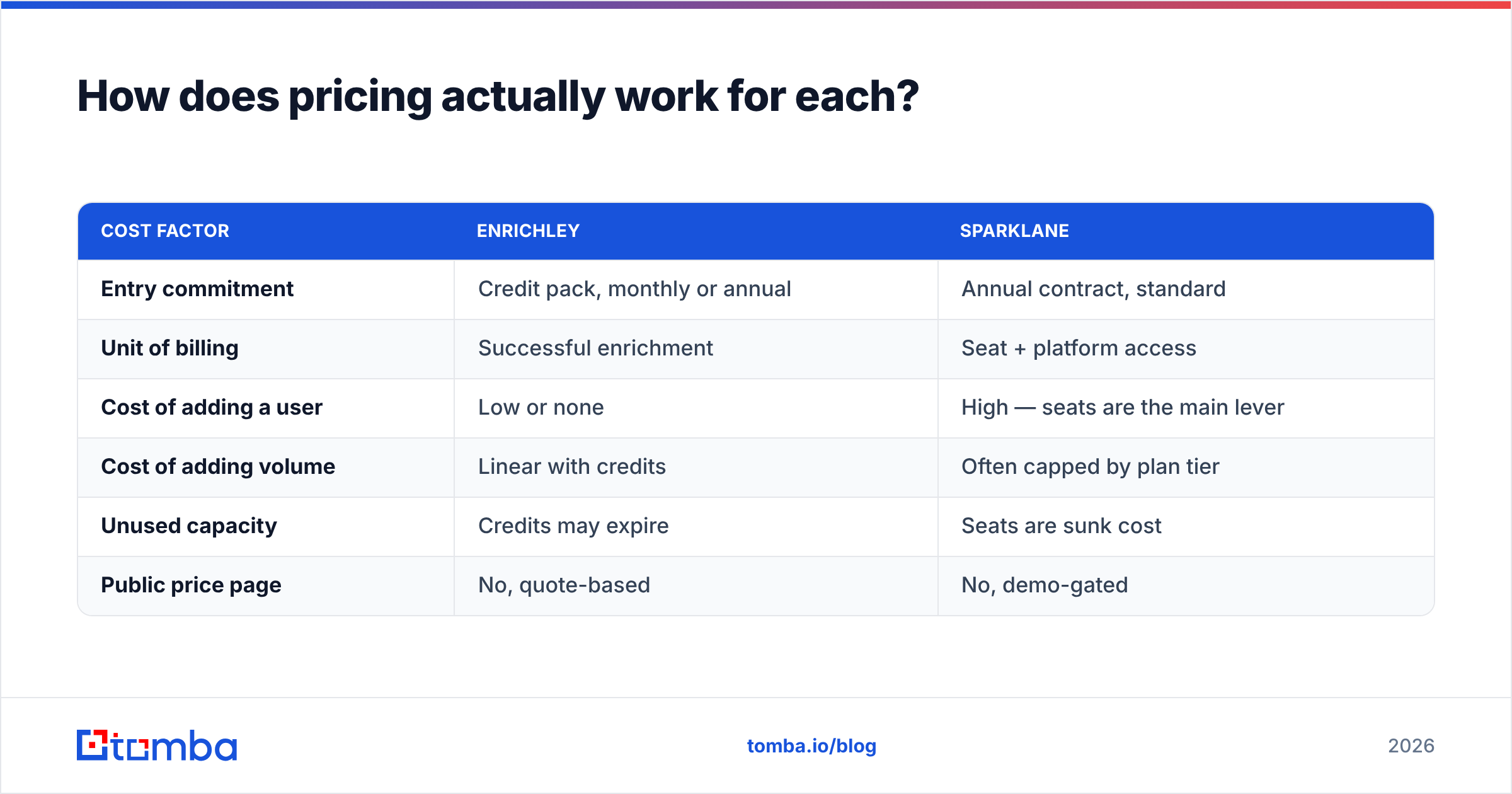
| Cost factor | Enrichley | Sparklane |
|---|---|---|
| Entry commitment | Credit pack, monthly or annual | Annual contract, standard |
| Unit of billing | Successful enrichment | Seat + platform access |
| Cost of adding a user | Low or none | High — seats are the main lever |
| Cost of adding volume | Linear with credits | Often capped by plan tier |
| Unused capacity | Credits may expire | Seats are sunk cost |
| Public price page | No, quote-based | No, demo-gated |
The structural difference is short. Sparklane costs more as your team grows. Enrichley costs more as your list grows.
A five-person AE team working 300 accounts each is a good Sparklane fit. A two-person growth team enriching 80,000 CRM rows a quarter is a bad one. You would pay for intelligence you never open.
Budget for the hidden lines too. Neither price covers sending infrastructure, warmup or a sequencer. Compare them with an all-in-one such as an Apollo alternative and the sticker prices do not match. Apollo bundles sequencing. These two do not.
One more honest note. Quote-based pricing means your rate depends on timing, logo value, and how close the rep is to quota. Two firms can buy the same Sparklane setup and pay very different sums.
So ask for the price per contact record at your committed volume. Compare that single number across vendors. Use Tomba pricing as your published baseline. It makes quoted numbers much easier to sanity-check.
Which one fits your GTM motion?#
Match the tool to how your team sells. Set the feature grid aside for a moment.
- Enterprise ABM with a named account list — Sparklane. Signal tracking on 200 named accounts is what the product was built for.
- High-volume outbound to a broad ICP — Enrichley, or a pure finder. Cost per valid contact has to stay low. Account scores on 20,000 companies are noise you will never action.
- Inbound lead enrichment on form fill — Enrichley, via API. It appends in under a second at submit time, and needs no seats.
- Expansion into France, Benelux or DACH — Sparklane, clearly. US-first tools get European firmographics wrong again and again.
- Developer-owned data pipeline — neither, most likely. If an engineer builds the step, you want a clean, cheap endpoint like the Tomba API. You do not want a UI nobody logs into.
- Under $500/mo for data — neither. Both target teams that outgrew that budget. Below it, a self-serve finder plus a verifier does 80% of the job.

Where does each tool fall short?#
Sparklane's weak points. The account layer is strong. The contact layer is average, above all outside Europe. Predictive scoring also needs real closed-won volume to calibrate. If you have closed 15 deals in total, the model is guessing with extra steps.
Onboarding is a project, not a signup. Seat pricing punishes the motion most teams are moving toward: fewer people, more automation.
Enrichley's weak points. A waterfall is only as good as the providers behind it. Those contracts change without notice. Your fill rate can swing month to month for reasons nobody will explain.
Credit accounting gets murky too. A partial match — company data but no email — can still burn a credit. Read that clause closely. And with no targeting layer, garbage in stays garbage out. You get accurate details for the wrong people.
Shared weak point. Neither tool decides who to contact for you. Tools amplify list quality. They do not create it. Buyers often blame data vendors for what is really a segmentation problem. You can see the pattern in sales intelligence reviews on G2, where the worst-rated rollouts skipped ICP work.
Are there better-value alternatives to both?#
Yes. It depends on which half of the job you need.
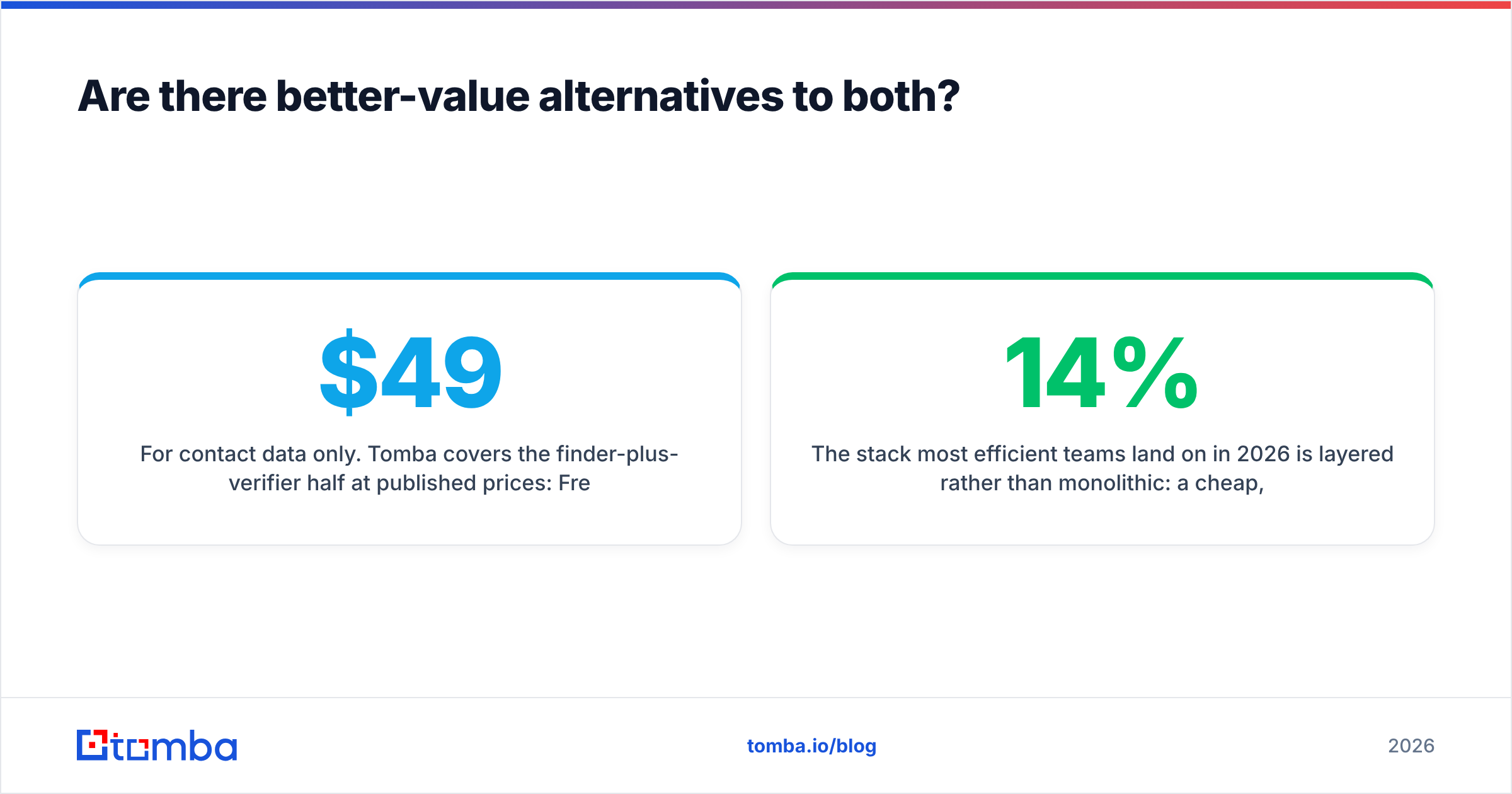
For contact data only. Tomba covers the finder and verifier half at listed prices: Free (25 searches/mo), Starter $49/mo, Growth $99/mo, Pro $249/mo, Enterprise custom. Domain search pulls every address it can find at a company. Bulk email finder handles list-scale jobs. Verification runs on the same credits. No seats, no annual lock-in, no demo call to see a price.
For pre-built lists by industry and region. BookYourData takes a different and legitimate route. You pay as you go for a curated B2B database, with filters by role, industry and region, plus a bounce guarantee. Do you want a clean list handed to you rather than a pipeline to run? Then it is a fair third option in the Enrichley vs Sparklane debate, and often cheaper than an annual platform contract.
For account signals on a budget. You can copy a useful slice of Sparklane's trigger tracking by hand. Use funding alerts, job-board scraping and a saved search. It is more manual and less complete. For a sub-100-account list, it costs close to nothing. HubSpot's sales research on buyer behavior is a good start for picking triggers that match your closed-won deals.

Most efficient teams land on a layered stack in 2026. First, a cheap, API-first finder for contact data. Second, a verifier gate before every send. Third, an intelligence platform on top — but only if targeting is the real bottleneck. Buying the platform first, then finding a 14% bounce rate, is the costly mistake.
What's the verdict on Enrichley vs Sparklane?#
Choose Sparklane if you sell to European mid-market accounts. It suits a named-account motion with a small AE team. You need enough closed-won history to calibrate scoring, plus a few weeks for onboarding. You are buying targeting, and it targets well.
Choose Enrichley if you have a database problem. Think stale CRM records, thin form fills, and imported lists full of holes. You want fill rate without seat fees. You are buying completeness, and it is good at completeness.
Choose neither if you just need verified work emails at volume with a predictable bill. That is a narrower job, and narrow tools solve it cheaper. Run the 200-record test before you sign anything longer than a month. It costs a few hours and often saves five figures.
Start with the free tier of Tomba Email Finder. You get 25 searches a month, and no card is required. Then benchmark it against the quotes Enrichley and Sparklane put in front of you. If a $49/mo tool returns the same valid contacts, that is the most useful number in your whole Enrichley vs Sparklane evaluation.
Related guides#
Ready to find emails that actually work?
Join 150,000+ professionals who stopped guessing and started sending. Free credits on signup — no credit card required.
Get the Tomba newsletter
Practical outbound tactics and product updates — once every two weeks.
About the author