Enrow vs Apollo.io: Which Tool Wins for B2B Email Data?
Enrow sells verified emails by the credit. Apollo.io sells a whole GTM platform by the seat. Here's how the two actually compare on accuracy, cost per valid contact, and workflow fit in 2026.
TL;DR
- Enrow is a verification-first email finder. You bring the names and domains, it runs a waterfall across providers and charges you only for emails it believes are valid. No database, no sequencer, no CRM.
- Apollo.io is an all-in-one GTM platform. A 200M+ contact database, filters, sequences, dialer, and CRM sync — sold per seat, which is where the bill grows.
- They are not really substitutes. Enrow replaces the enrichment step in your stack. Apollo tries to replace the whole stack. Comparing them on "accuracy" alone misses the point.
- Cost per valid email is the honest metric. A $79/user/mo seat with wasted credits can cost more per usable contact than a $29/mo credit pack — or far less, if you actually use the database.
- Pick Enrow if you already have target lists. Pick Apollo if you need to find who to target. Pick a credit-based finder like Tomba if you want both search and verification without per-seat billing.
What is Enrow, and what does it actually do?#
Enrow is a French-built email finder and verifier that positions itself around one promise: you only pay for emails it can validate. You feed it a first name, last name, and company domain (via CSV, the dashboard, or the API), and it runs a waterfall — querying multiple data providers and SMTP checks in sequence — until it either returns a verified address or tells you it found nothing.
That "valid or free" model is the whole pitch. Traditional finders burn a credit whether the result is real, guessed, or a catch-all shrug. Enrow's billing is tied to outcomes, which changes how you budget: your spend scales with the number of reachable people, not the number of rows you upload.
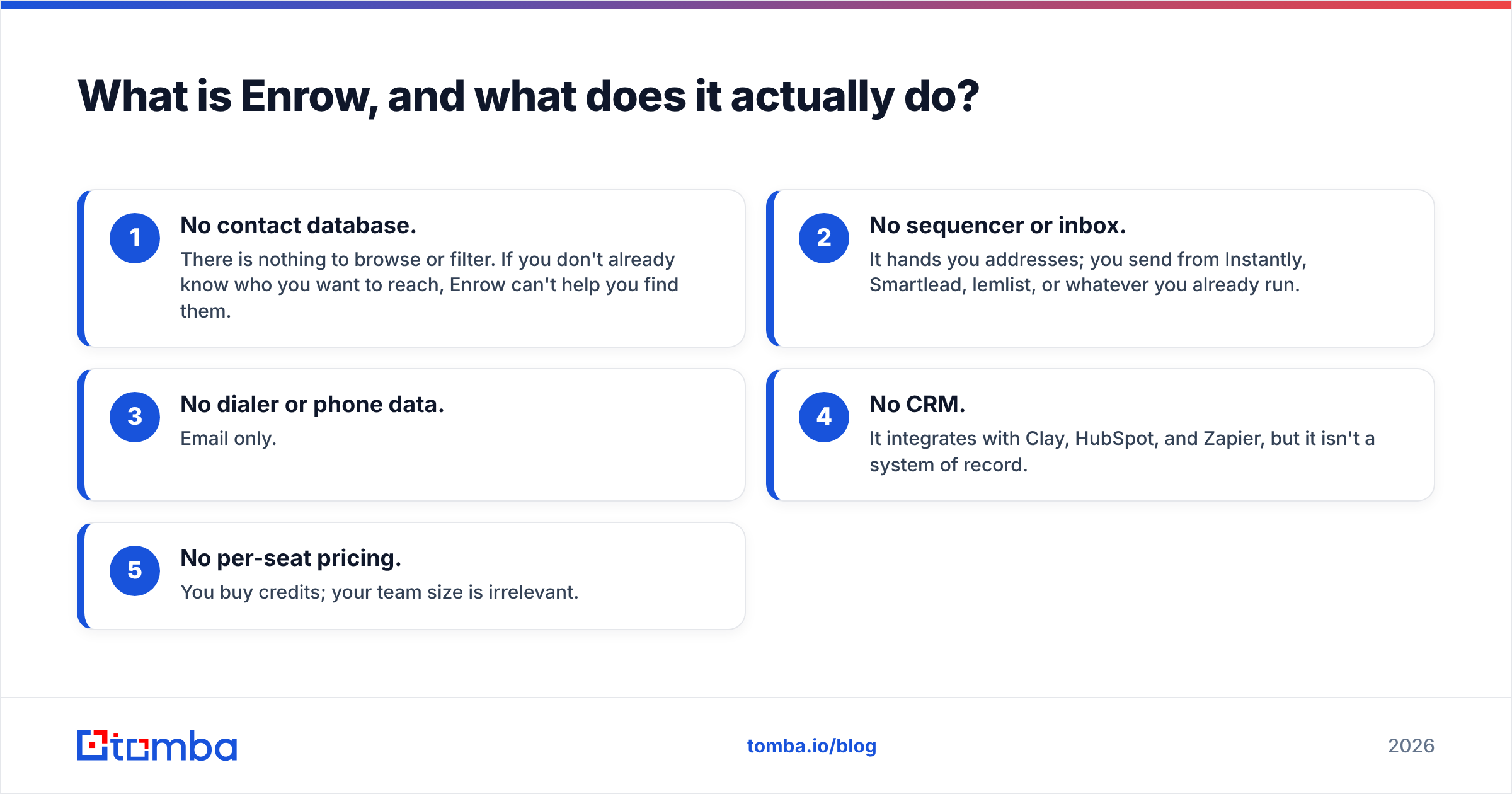
What Enrow deliberately does not do:
- No contact database. There is nothing to browse or filter. If you don't already know who you want to reach, Enrow can't help you find them.
- No sequencer or inbox. It hands you addresses; you send from Instantly, Smartlead, lemlist, or whatever you already run.
- No dialer or phone data. Email only.
- No CRM. It integrates with Clay, HubSpot, and Zapier, but it isn't a system of record.
- No per-seat pricing. You buy credits; your team size is irrelevant.
That narrow scope is a feature, not a gap. Enrow is a component, and it's priced like one. You can see the current tiers on enrow.io — entry plans start in the ~$29/month range for roughly a thousand verified finds, with volume discounts as you scale into the tens of thousands.
What is Apollo.io, and how is it different?#
Apollo.io is the opposite architectural bet. It's a full go-to-market platform built on top of a claimed 200M+ contact, 35M+ company database, with buyer-intent signals, saved-search filters, email sequencing, a dialer, LinkedIn extension, meeting scheduler, deal management, and two-way sync with Salesforce and HubSpot.
The workflow is inverted. With Enrow you start from a list. With Apollo you start from a filter — "VP of Engineering, 200–1000 employees, US, uses Snowflake, hiring for data roles" — and the platform produces the list, the contact data, and the sending mechanism in one place. For an SDR team that doesn't have an existing prospect universe, that's genuinely valuable.
The trade-offs are equally real, and Apollo's own pricing page makes them visible if you read carefully:
- Seats, not just credits. Every rep who needs access pays. A five-person team on the Professional tier is a materially different invoice than one person on a credit pack.
- Credit types are separate. Email credits, mobile credits, and export credits are metered differently, and the generous-sounding "unlimited email credits" on paid plans comes with fair-use export caps.
- Database freshness varies by segment. Apollo is strong on US tech and mid-market SaaS. It thins out fast in non-English SMB, European mid-market, and niche verticals.
- Everyone else is prospecting the same list. A shared database means your ICP is being emailed by every other Apollo customer targeting the same filters.
Enrow vs Apollo.io: how do the core features compare?#
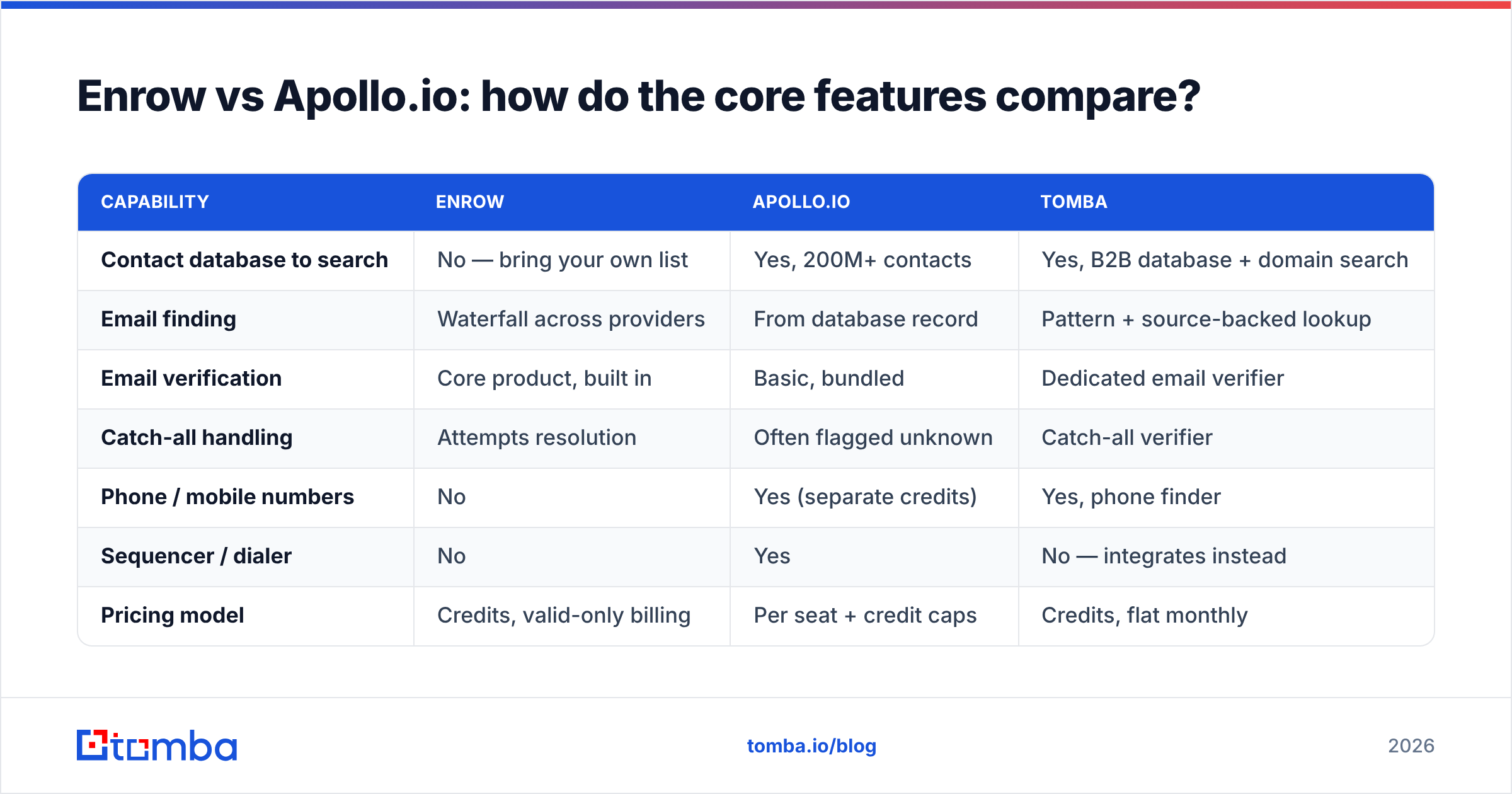
Here's the head-to-head on what each platform actually ships. Figures are list prices at the time of writing — both vendors revise tiers, so re-check before you buy.
| Capability | Enrow | Apollo.io | Tomba |
|---|---|---|---|
| Contact database to search | No — bring your own list | Yes, 200M+ contacts | Yes, B2B database + domain search |
| Email finding | Waterfall across providers | From database record | Pattern + source-backed lookup |
| Email verification | Core product, built in | Basic, bundled | Dedicated email verifier |
| Catch-all handling | Attempts resolution | Often flagged unknown | Catch-all verifier |
| Phone / mobile numbers | No | Yes (separate credits) | Yes, phone finder |
| Sequencer / dialer | No | Yes | No — integrates instead |
| Pricing model | Credits, valid-only billing | Per seat + credit caps | Credits, flat monthly |
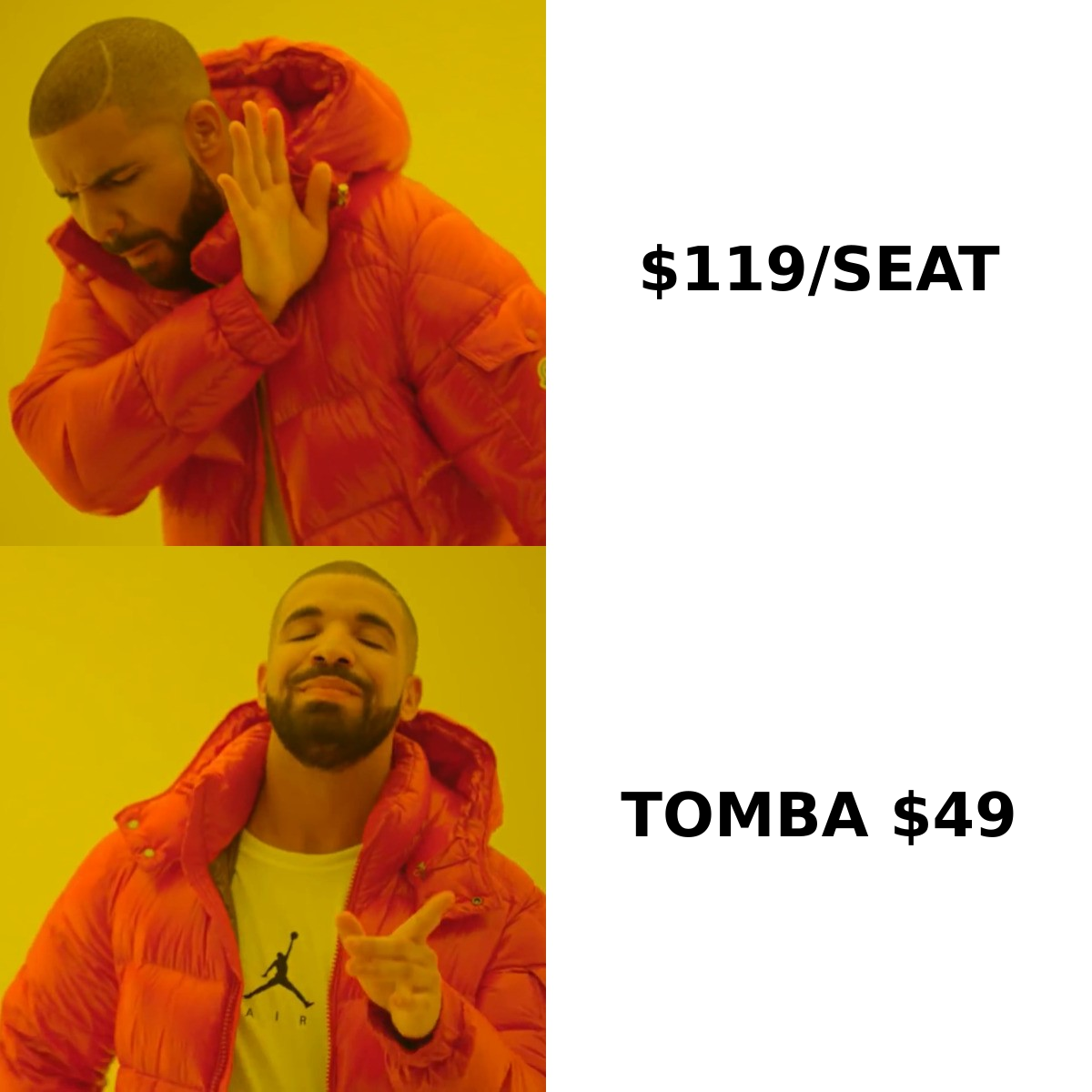
| Entry paid price | ~$29/mo | ~$49/user/mo (annual) | $49/mo, unlimited users |
| Free tier | Trial credits | Yes, limited credits | 25 searches/mo |
| API access | Yes | Yes (higher tiers) | Yes, all paid plans |
| Best for | Enriching existing lists | Building lists from scratch | Both, without seat fees |
The table makes the structural point better than prose can: Enrow and Apollo barely overlap except in the single column labelled "email finding." If your evaluation spreadsheet has them competing row-for-row, you're probably solving the wrong problem.
How accurate is each one in practice?#
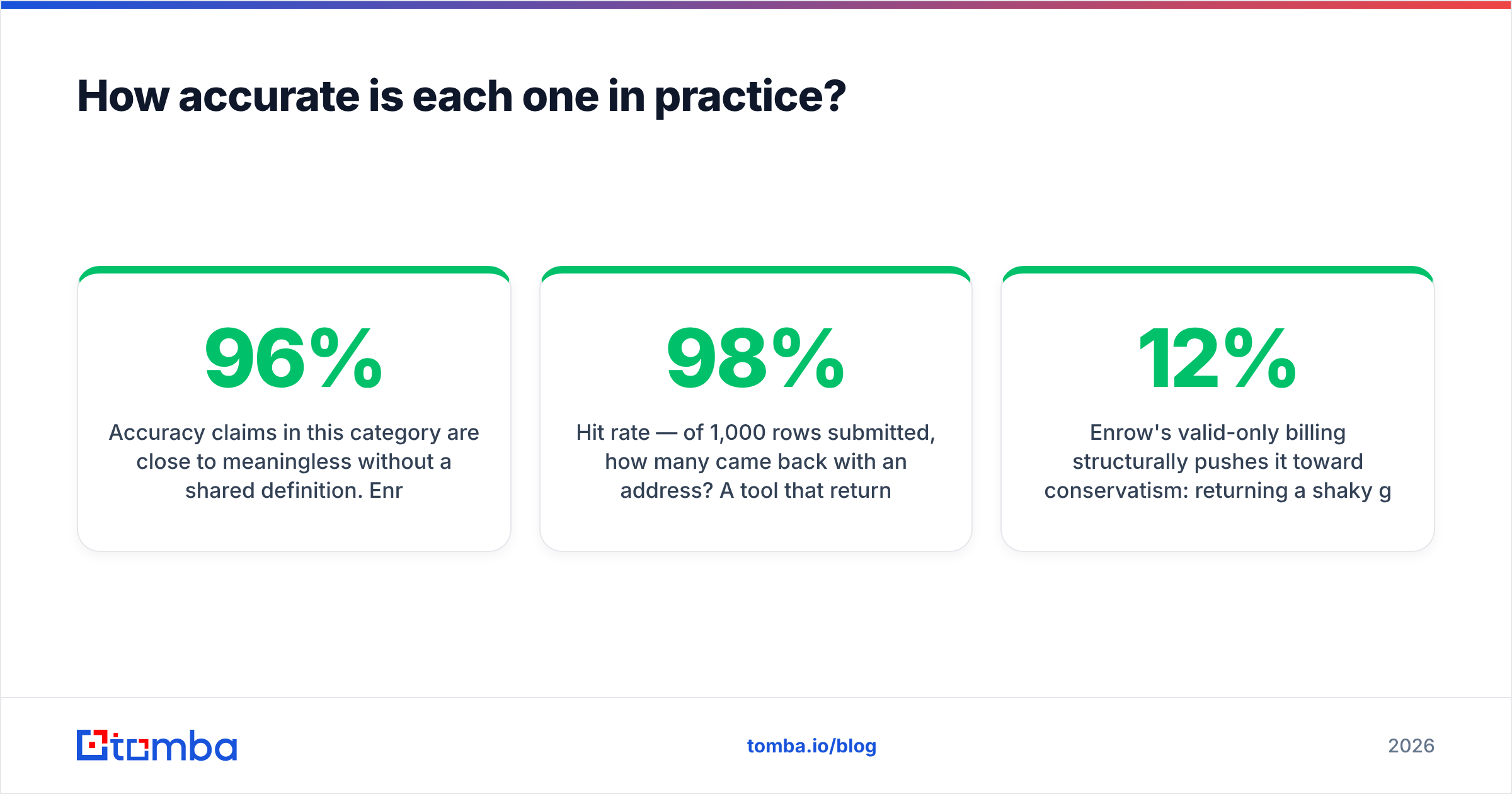
Accuracy claims in this category are close to meaningless without a shared definition. Enrow advertises 96%+ accuracy, Apollo cites 91%+ on emails. Both numbers are measured on the subset the vendor chose to return — which is exactly the thing that differs between them.

Three definitions get conflated constantly:
- Hit rate — of 1,000 rows submitted, how many came back with an address? A tool that returns 400 addresses at 98% validity has a lower hit rate than one returning 750 at 92%, but the second gives you 290 more people to email.
- Validity rate — of the addresses returned, how many pass SMTP and don't bounce? This is what vendors quote.
- Deliverable rate — of the valid addresses, how many actually reach a monitored inbox rather than a role account, a catch-all black hole, or a dormant alias? Nobody publishes this, and it's the number that decides your campaign.
Enrow's valid-only billing structurally pushes it toward conservatism: returning a shaky guess costs it revenue, so it withholds. That produces excellent validity rates and a lower hit rate. Apollo's incentive runs the other way — a record that exists in the database gets served, and confidence scoring is your problem. This is why teams routinely report bounce rates in the 5–12% range on raw Apollo exports and near-zero on Enrow output, while also noting that Enrow found fewer people overall.
The practical answer for either tool is the same: run a second, independent verification pass before you send. Cross-checking exports with a separate email verifier catches stale records that the source system still believes in, and it costs a fraction of what a burned sending domain costs. If a large share of your targets sit on catch-all domains, resolve those separately rather than treating "unknown" as "send it anyway."
What does each one actually cost per valid email?#
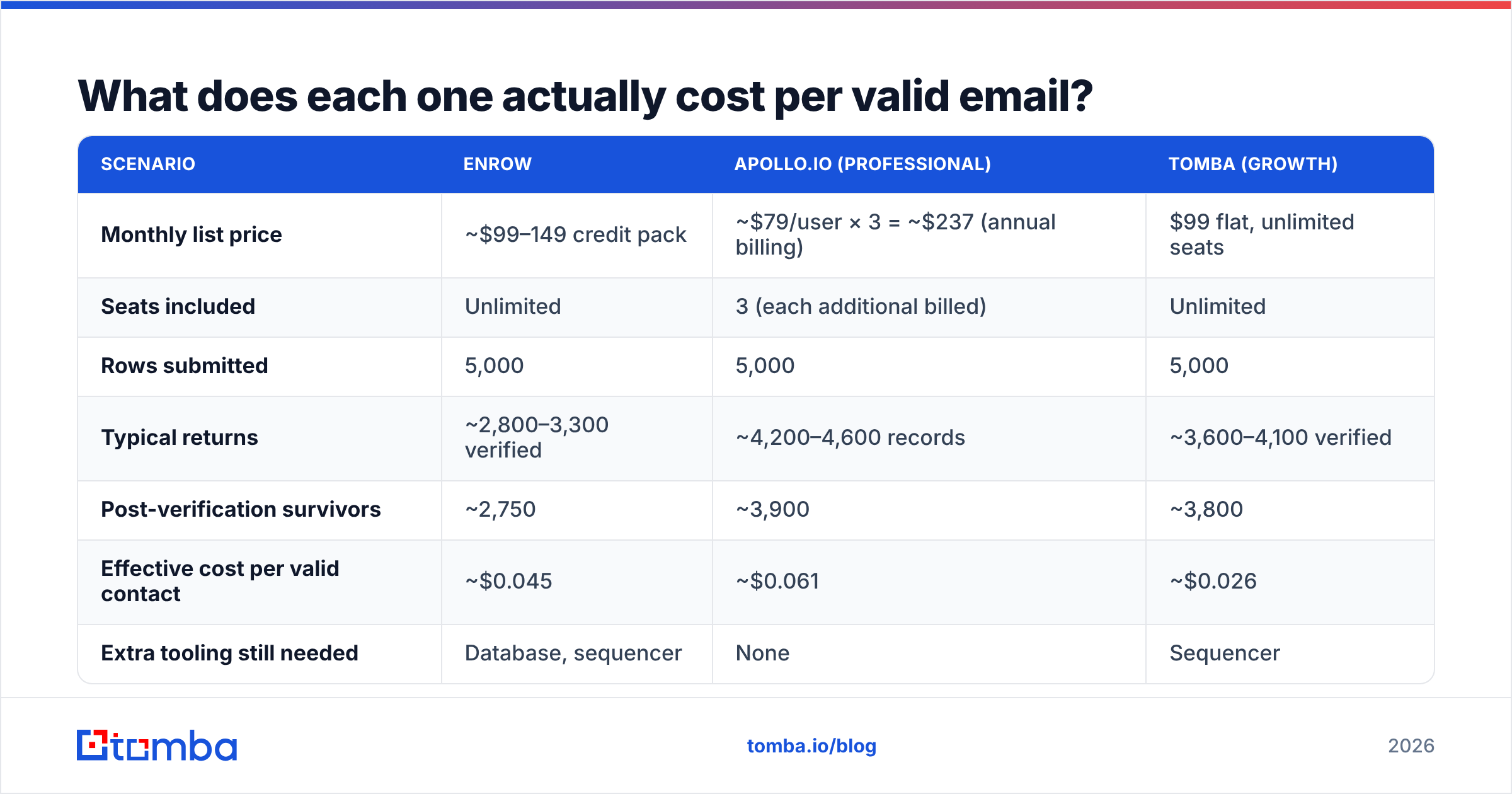
Sticker price is the wrong comparison. Cost per usable contact is the right one. Here's the arithmetic on a realistic scenario: a three-person outbound team needing 5,000 verified contacts per month.
| Scenario | Enrow | Apollo.io (Professional) | Tomba (Growth) |
|---|---|---|---|
| Monthly list price | ~$99–149 credit pack | ~$79/user × 3 = ~$237 (annual billing) | $99 flat, unlimited seats |
| Seats included | Unlimited | 3 (each additional billed) | Unlimited |
| Rows submitted | 5,000 | 5,000 | 5,000 |
| Typical returns | ~2,800–3,300 verified | ~4,200–4,600 records | ~3,600–4,100 verified |
| Post-verification survivors | ~2,750 | ~3,900 | ~3,800 |
| Effective cost per valid contact | ~$0.045 | ~$0.061 | ~$0.026 |
| Extra tooling still needed | Database, sequencer | None | Sequencer |
Two things fall out of that math. First, Apollo's per-contact cost looks reasonable if you use the database heavily — you're paying for discovery, not just enrichment, and no credit-based finder gives you filters over 200M records. Second, Apollo's cost scales with headcount rather than usage, so a team that doubles from three to six reps doubles the bill without touching a single extra contact. That's the moment most teams start pricing out an Apollo alternative.
Enrow's model has the opposite failure mode: it's cheap per contact and stays cheap as you add people, but it does nothing until you've already solved list building. If you're paying a data provider and Enrow and a sequencer, add all three lines before you call it the cheap option.
Which should you choose for your team?#
Match the tool to the bottleneck, not to the feature list.
Choose Enrow when:
- You already generate target lists — from LinkedIn Sales Navigator, scraped events, G2 category pages, funding announcements, or your own CRM.
- Deliverability is your binding constraint and you'd rather email 300 people who definitely exist than 500 maybes.
- You bill an agency client per campaign and need predictable, usage-based data costs.
- Your team is larger than your data budget and per-seat pricing is a non-starter.
Choose Apollo.io when:
- You need discovery, not just enrichment. You genuinely don't know the 5,000 companies you should be talking to.
- Your ICP sits squarely in US tech and mid-market SaaS, where Apollo's coverage is strongest.
- You want sequences, dialer, and CRM sync consolidated on one invoice with one admin.
- Your team is small enough that seat count isn't the dominant cost line.
Choose neither when: you need both search and verification but refuse to pay per seat, or you need programmatic access from day one. That's the gap credit-based platforms with a real database occupy — domain search to enumerate a company's contacts, an email finder API to wire it into your own pipeline, and flat monthly pricing regardless of how many people log in.
How do they fit into a modern outbound stack?#
Neither tool is the stack. Both are components, and the difference is how many neighbouring components they absorb.
A typical 2026 stack has four layers: targeting (who), enrichment (how to reach them), activation (sequencer or dialer), and measurement (CRM plus attribution). Apollo attempts layers one through three and syncs into four. Enrow does exactly layer two, with an API clean enough that engineering teams route it through Clay or their own orchestration.
The consolidation question is a real trade-off with no universal answer. One vendor means one invoice, one support contact, and no data-mapping work — but it also means your list quality, your sending reputation, and your pipeline data all inherit the same vendor's weaknesses, and migration means rebuilding everything at once. Best-of-breed means better components and easy swaps, at the cost of integration work and multiple renewals. Reviews on G2 show both patterns succeeding; what fails is buying an all-in-one and then bolting three point tools on anyway.
One workflow detail that matters more than it should: whichever you choose, keep enrichment separate from sending in your data flow. Verify, then stage, then send. Teams that pipe a finder directly into a sequencer with no gate are one bad export away from a blacklisted domain — and no accuracy percentage protects you from that.

What are the common objections to each?#
"Enrow's hit rate is too low." Often true, and usually the intended behaviour. Test it by measuring finds-per-1,000-rows on your own list, not the vendor's demo. If your ICP is European SMB or a non-tech vertical, run the test before committing — waterfall providers skew toward the same sources everyone else uses.
"Apollo's data is stale." Partly true, and unevenly so. Job-change velocity in tech means any database decays around 25–30% annually. Apollo re-verifies continuously, but export timing matters: a record exported in January and emailed in April is a different risk profile than one emailed the same week. Re-verify anything older than 30 days.
"Apollo's free tier is enough." It's enough to evaluate, not to run on. The export caps and credit limits bind quickly once you're sending at volume, and the upgrade path goes straight to per-seat billing.
"I'll just use a permutator and SMTP check." You can generate candidate patterns with a email permutator and validate them, and for a handful of high-value targets that's fine. At list scale it fails: aggressive SMTP probing from one IP gets you rate-limited, catch-all domains return false positives, and you'll spend more engineering hours than the credits would have cost.
The bottom line#
Enrow wins on data hygiene and pricing sanity for teams that already know who to contact. Apollo.io wins on breadth for teams that need the list built for them and want sequencing in the same tab. The comparison only becomes a real contest when you're paying for both a database and Enrow — at which point the consolidated option is worth pricing honestly, seat fees included.
If what you actually need is accurate contact data without a per-seat tax, start with the Tomba Email Finder. The free tier gives you 25 searches a month to benchmark against your own list, paid plans start at $49/month with unlimited team members, and domain search, verification, and catch-all handling are in the same account rather than three separate invoices. Run 200 of your real prospects through all three tools, count the bounces, and let the numbers decide — see full Tomba pricing before you commit to anyone's annual contract.
Related guides#
Ready to find emails that actually work?
Join 150,000+ professionals who stopped guessing and started sending. Free credits on signup — no credit card required.
Get the Tomba newsletter
Practical outbound tactics and product updates — once every two weeks.
About the author