Enrow vs RocketReach 2026: Verification vs Contact Data
Enrow verifies emails. RocketReach sells contact records. Comparing them head-to-head only makes sense once you know which half of the pipeline you're actually missing — here's the honest breakdown, with pricing, accuracy limits, and a cheaper third option.
TL;DR
- Enrow and RocketReach are not really competitors. Enrow is an email verification engine (including catch-all resolution); RocketReach is a contact database you search for emails and phone numbers.
- If your list already exists and bounces too much, Enrow is the relevant purchase. If you have no list at all, Enrow cannot help you — you need RocketReach or a similar data provider.
- RocketReach wins on breadth (hundreds of millions of profiles, phone numbers, LinkedIn-driven search). It loses on cost predictability and on verification depth.
- Enrow wins on catch-all accuracy and bounce control. It loses on scope — it will not generate a single new prospect for you.
- Most teams that buy both are paying twice for one job. A single platform that does discovery and verification — Tomba's email finder plus its email verifier on the same credits — usually replaces the pair for less.
What are Enrow and RocketReach, actually?#
Start here, because half the "Enrow vs RocketReach" comparisons online treat these tools as interchangeable. They are not.
Enrow (enrow.io) is a French email verification service built around one hard problem: catch-all domains. A catch-all mail server accepts everything sent to it, so a standard SMTP check returns "valid" for asdfgh@company.com just as happily as for the real CMO. Enrow's pitch is that it resolves those unknowns into real verdicts instead of dumping them in a "risky" bucket you then have to guess about. It also does standard syntax, MX, and mailbox checks, plus a light email-finding feature, and it sells via credits with an API and a bulk uploader.
RocketReach (rocketreach.co) is a contact data platform. You search a person or a company, and it returns work emails, personal emails, and — on higher tiers — direct-dial and mobile phone numbers. It's best known for its Chrome extension over LinkedIn and for a database it markets in the hundreds of millions of professionals. Verification exists, but it's a byproduct: RocketReach labels confidence, it doesn't specialize in resolving hard cases.
So the honest framing is:
- Enrow answers "will this email bounce?" — a data-quality tool.
- RocketReach answers "who works there and how do I reach them?" — a data-supply tool.
- Neither answers both well. Enrow's finder is thin. RocketReach's verification is shallow.
- Both charge per record, so running one after the other means paying twice per contact.

How do Enrow and RocketReach compare feature by feature?#
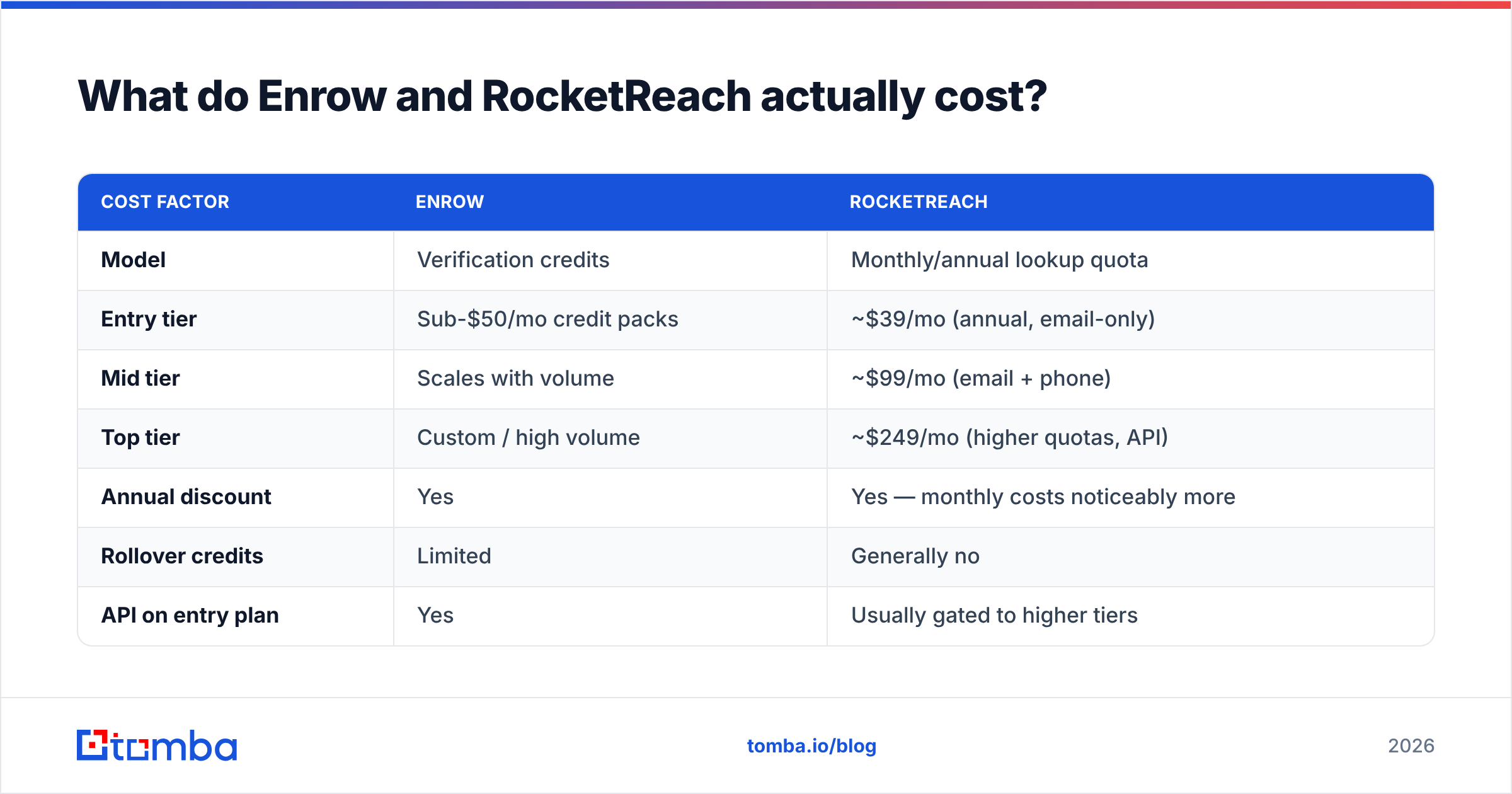
Here's the side-by-side that actually matters, with Tomba added because it sits across both columns.
| Capability | Enrow | RocketReach | Tomba |
|---|---|---|---|
| Primary job | Email verification | Contact database search | Find + verify in one place |
| Contact database | No standalone database | Hundreds of millions of profiles | B2B database + live discovery |
| Email finding | Basic finder | Core feature | Core feature (domain, name, company) |
| Catch-all handling | Specialist strength | Flagged, not resolved | Dedicated catch-all verifier |
| Phone numbers | No | Yes (higher tiers) | Yes, via phone finder |
| LinkedIn workflow | Limited | Chrome extension over LinkedIn | Extension + LinkedIn finder |
| Bulk processing | Yes (CSV + API) | Yes (lookups quota) | Yes (bulk + API) |
| API access | Yes | Yes, higher tiers | Yes, all paid plans |
| Free tier | Trial credits | Limited free lookups | 25 searches/mo, no card |
| Entry paid price | Under $50/mo range | ~$39/mo annual (email only) | $49/mo Starter |
| Best for | Cleaning lists you already have | Sourcing net-new contacts | Teams that need both |
Two things jump out of that table.
First, the overlap is smaller than the marketing suggests. There is exactly one row where they compete directly — email finding — and it's a secondary feature for Enrow and a primary one for RocketReach.
Second, the "and Tomba" column exists because the two-tool pattern is so common. Teams buy RocketReach for supply, watch bounce rates climb, then bolt on a verifier. That's two subscriptions, two credit pools, two API integrations, and two vendors to renegotiate every year.
Which one is more accurate — and accurate at what?#
Accuracy is the wrong single question. Ask accuracy at which step.
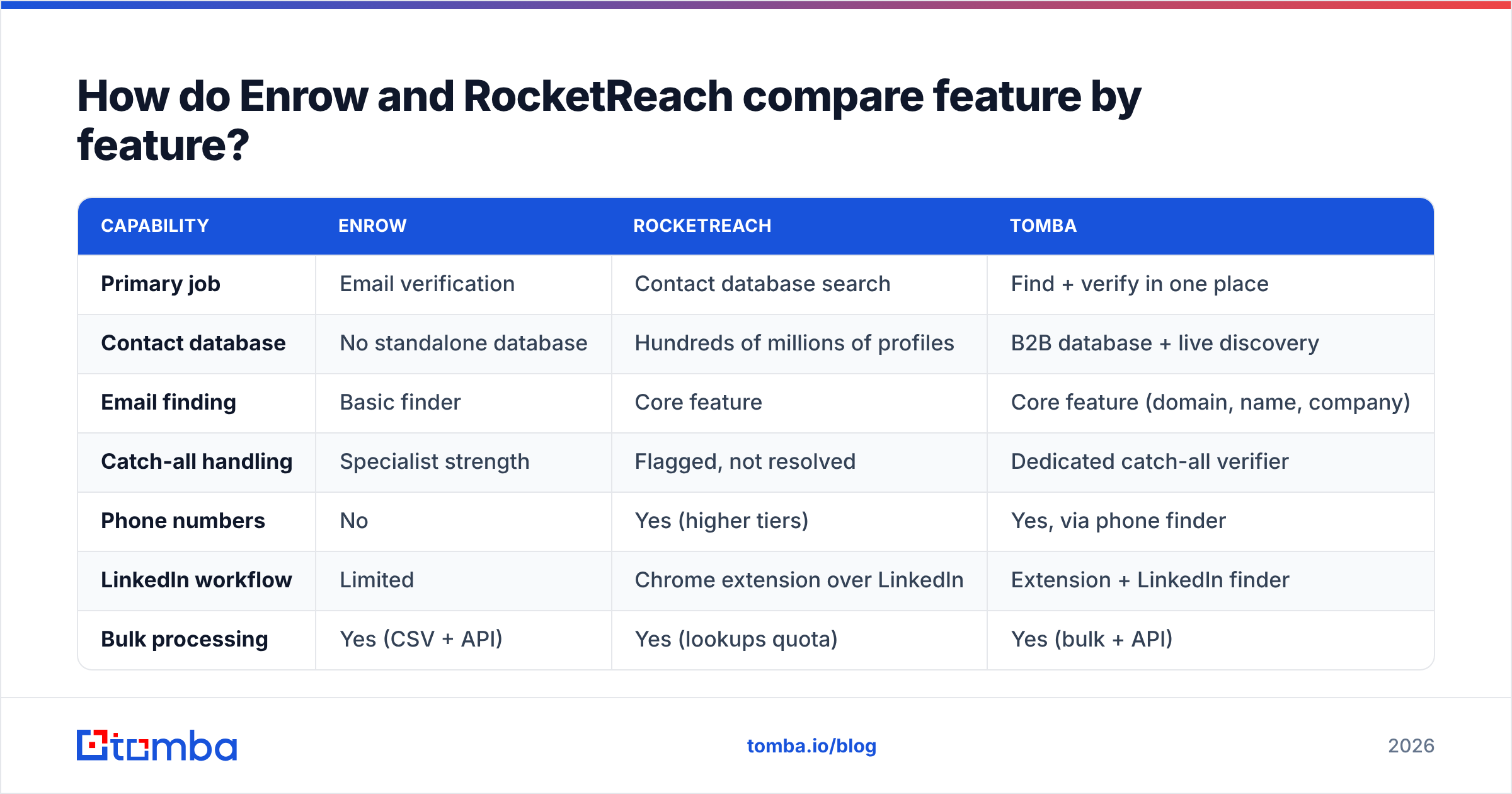
Discovery accuracy is the share of returned emails that are real and current. This is RocketReach's game. Large databases are strong on well-covered segments — US tech, mid-market and enterprise, senior titles — and noticeably weaker on small European companies, non-English markets, and roles with high churn. Database records also decay: research consistently puts B2B data decay in the 25–30% per year range, which means a record pulled from a static index in January can be dead by autumn.
Verification accuracy is the share of "valid" verdicts that actually deliver. This is Enrow's game, and its catch-all focus is the right thing to specialize in, because catch-alls are where every verifier quietly fails. Depending on the segment, 15–25% of B2B domains are catch-all — Microsoft 365 tenants with a permissive accept-all policy are the usual culprit. A verifier that returns "unknown" on a quarter of your list has handed the decision back to you.

The practical consequence: a high-accuracy verifier cannot rescue a low-accuracy database, and a large database cannot compensate for weak verification. If RocketReach returns a plausible-looking address for someone who left the company eight months ago, Enrow may well verify it as deliverable — the mailbox still exists, forwarded to a shared inbox. Technically valid. Commercially worthless.
That's why the honest evaluation method is a blind sample test, not a vendor spec sheet:
- Pull 200 real target accounts from your ICP, not from a vendor's demo list. Mix company sizes and countries so you surface coverage gaps instead of hiding them.
- Run each tool on the same list and export raw results with confidence labels intact.
- Measure hit rate, not just accuracy — a tool that verifies 100% of the 40 emails it found is worse than one that finds 140 and verifies 92%.
- Send a real warmup-paced campaign to each set and record hard bounces after 72 hours. Bounce rate is the only ground truth.
- Divide total spend by delivered emails. Cost per usable contact is the number that belongs in your decision doc — not the price per credit.
Skip step 5 and you'll pick the cheapest sticker price and pay for it in domain reputation.
What do Enrow and RocketReach actually cost?#
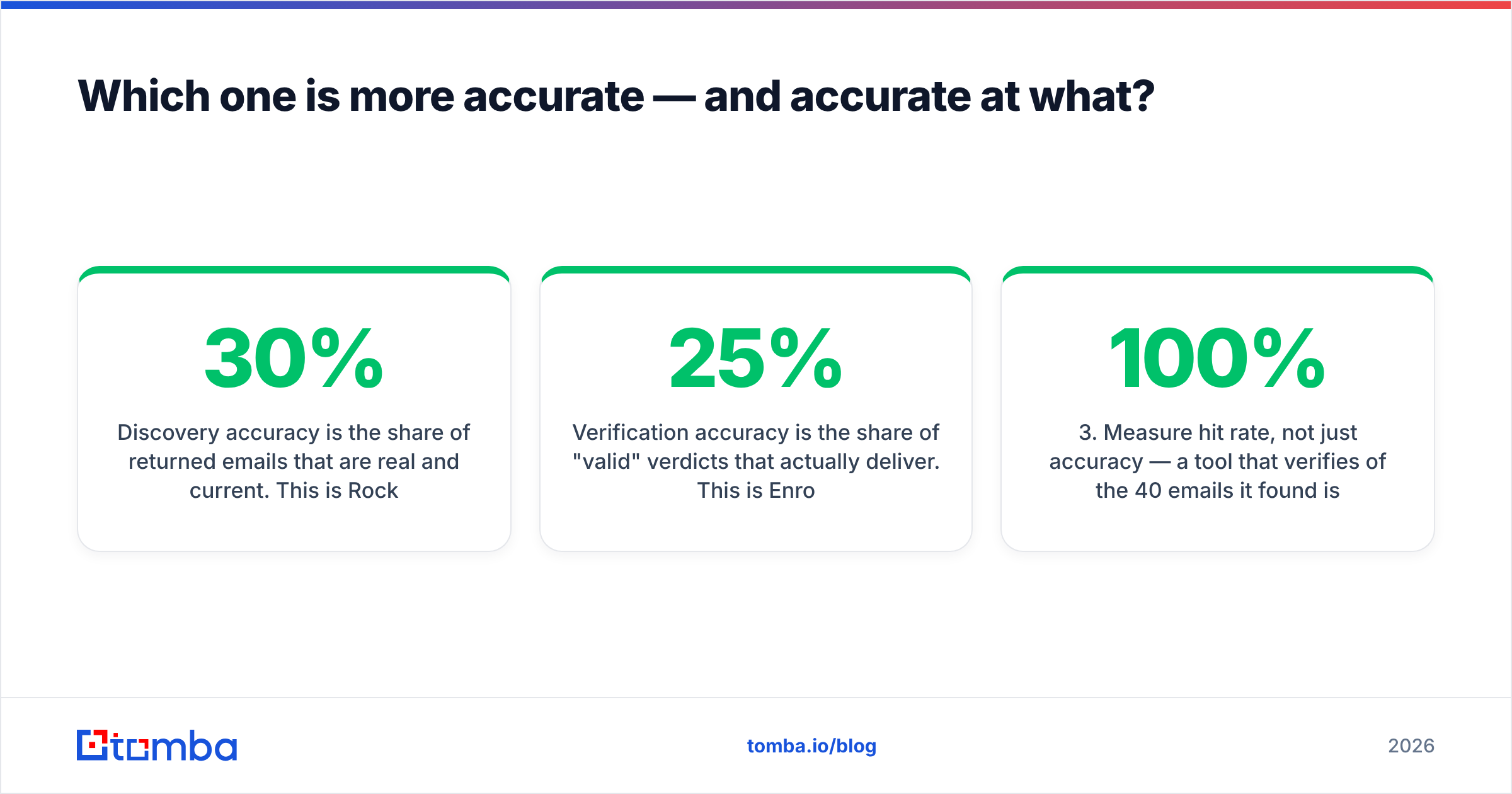
Both use consumption pricing, and both have the same trap: the sticker price tells you nothing about the cost per usable contact.
| Cost factor | Enrow | RocketReach |
|---|---|---|
| Model | Verification credits | Monthly/annual lookup quota |
| Entry tier | Sub-$50/mo credit packs | ~$39/mo (annual, email-only) |
| Mid tier | Scales with volume | ~$99/mo (email + phone) |
| Top tier | Custom / high volume | ~$249/mo (higher quotas, API) |
| Annual discount | Yes | Yes — monthly costs noticeably more |
| Rollover credits | Limited | Generally no |
| API on entry plan | Yes | Usually gated to higher tiers |
| Hidden cost | Doesn't source contacts | Phone + API behind upgrades |
Treat those figures as directional and check Enrow's pricing and RocketReach's current plan page before you sign — both have repriced in the last two years, and RocketReach's advertised numbers are annual-billing rates.
Three cost patterns worth knowing:
Unused quota is a real expense. Lookup quotas reset. If your SDR team burns 400 of 1,500 monthly lookups in a slow quarter, you paid for 1,100 of nothing. Credit systems that roll over — or usage that draws from a single shared pool — behave better against uneven pipeline.
Paying twice per contact is the norm, not the exception. Source at RocketReach, verify at Enrow, and each contact costs you a lookup and a credit. On 5,000 contacts a month that stacking is where the budget quietly goes.
API gating changes the math. If you're enriching inside your CRM or a workflow tool, an API-locked entry plan forces an upgrade you didn't budget for. Compare Tomba pricing here: Starter at $49/mo includes API access, Growth is $99/mo, Pro $249/mo, and the free tier gives 25 searches a month so you can run the sample test above before paying anything.
Who should choose Enrow?#
Pick Enrow when your list problem is quality, not quantity.
- You already have a source of contacts — an existing CRM, a scraped dataset, event lists, inbound sign-ups — and your bounce rate is above 3%.
- Your ICP skews toward Microsoft 365 / Google Workspace tenants with catch-all configs, and your current verifier keeps returning "risky" or "unknown".
- You send high volumes from domains you cannot afford to burn, so bounce prevention has direct revenue impact.
- You want a focused vendor rather than a suite, and you're comfortable running verification as a discrete pipeline step.
Do not buy Enrow expecting a prospecting solution. Its finder exists, but if net-new contact discovery is your bottleneck you'll be disappointed within a week.
Who should choose RocketReach?#
Pick RocketReach when your list problem is supply.
- You're building outbound from zero and need volume across many accounts fast.
- Your reps live in LinkedIn and want an extension that reveals contact details in-flow.
- You need phone numbers alongside emails — cold calling is part of the motion, not an afterthought.
- Your ICP sits in RocketReach's strong coverage zones: US-heavy, tech-heavy, mid-market and up.
Budget for verification on top. RocketReach's confidence labels are a starting point, not a deliverability guarantee, and sending unverified database exports at volume is the fastest way to wreck sender reputation. Check recent reviews on G2 and you'll see the same two themes repeatedly: good coverage, mixed freshness.

Where does Tomba fit between Enrow and RocketReach?#
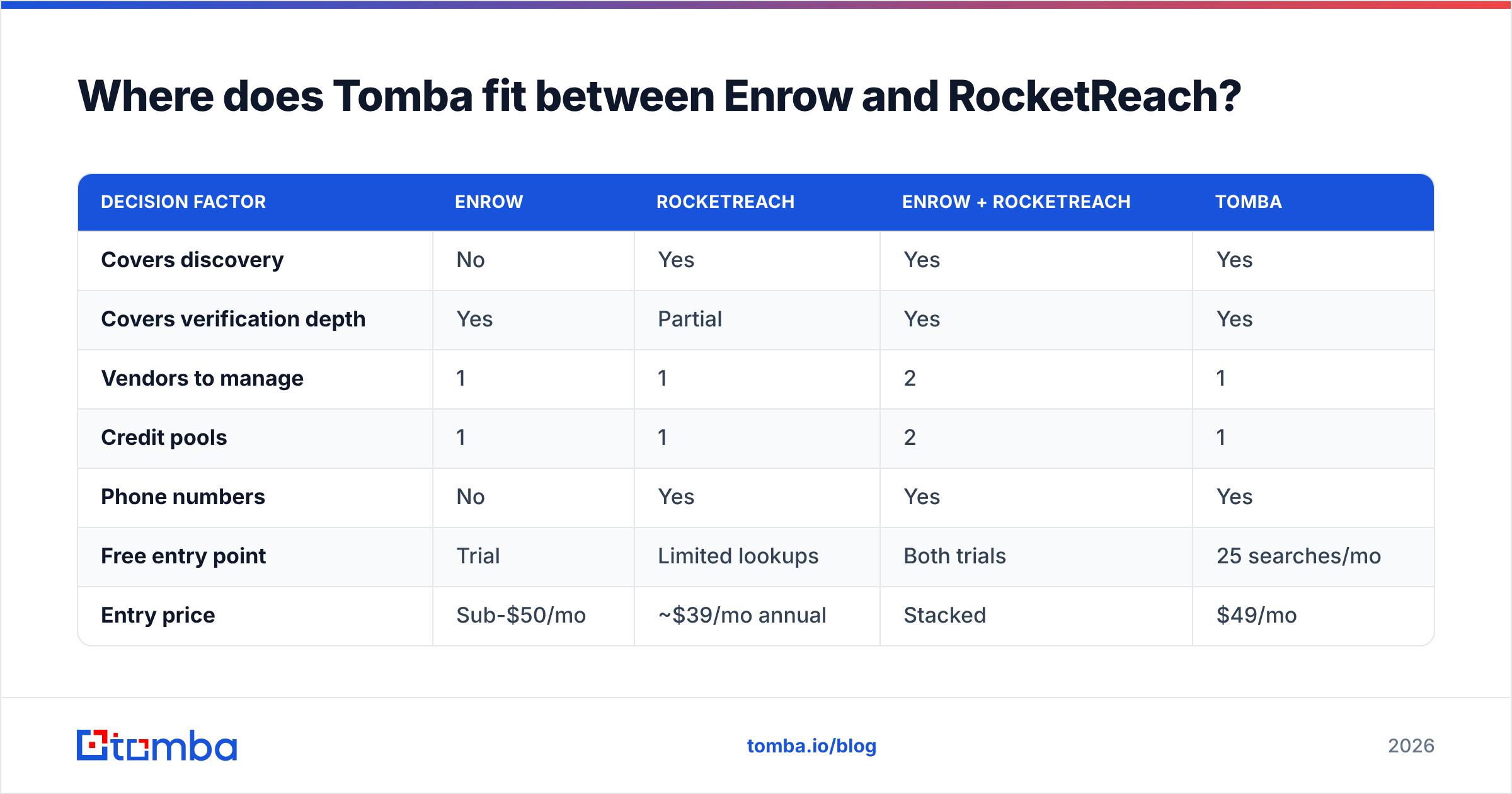
Tomba's relevance to this comparison is structural, not just competitive: it does both jobs on one credit pool.
You get discovery — domain search for every published address at a company, name-plus-domain lookup, LinkedIn extraction, author finder for content-led outbound — and verification in the same request path, including a dedicated catch-all verifier for the exact cases Enrow specializes in. One vendor, one API key, one invoice.

| Decision factor | Enrow | RocketReach | Enrow + RocketReach | Tomba |
|---|---|---|---|---|
| Covers discovery | No | Yes | Yes | Yes |
| Covers verification depth | Yes | Partial | Yes | Yes |
| Vendors to manage | 1 | 1 | 2 | 1 |
| Credit pools | 1 | 1 | 2 | 1 |
| Phone numbers | No | Yes | Yes | Yes |
| Free entry point | Trial | Limited lookups | Both trials | 25 searches/mo |
| Entry price | Sub-$50/mo | ~$39/mo annual | Stacked | $49/mo |
| API on entry plan | Yes | Typically no | Mixed | Yes |
Where Tomba is not the answer: if you need a full sales-engagement platform with sequencing, dialers, and conversation intelligence, that's a different category — look at Apollo alternatives or an outreach suite instead. Tomba is a data layer, deliberately.
If you're specifically shopping RocketReach's category, the RocketReach alternative breakdown covers coverage and pricing in more depth than fits here.
How should you actually run the evaluation?#
Give yourself two weeks and follow this order.
- Define the segment before touching a tool. 200 accounts, real ICP, with deliberate coverage stress: include non-US companies and sub-50-headcount firms.
- Start on free tiers. Tomba gives 25 searches/mo with no card. RocketReach offers limited free lookups. Enrow offers trial credits. That's enough for a directional read before any spend.
- Score hit rate and bounce rate separately. Log both per tool. A tool with a 78% hit rate and a 1.2% bounce rate beats one with a 55% hit rate and a 0.4% bounce rate for almost every outbound team.
- Test the integration you'll live in. Sheets, Excel, CRM, or raw API — a tool that wins on paper and loses in your HubSpot integration workflow is a tool your reps will stop using in month two.
- Compute cost per delivered email. Total monthly spend ÷ verified-and-delivered contacts. Compare that single number across the three options.
- Recheck decay after 60 days. Re-verify a 50-contact sample from each tool. The one whose records rot slowest is the one to sign annually.
That process takes real effort, and it's still cheaper than a year on the wrong vendor plus a scorched sending domain.
The bottom line#
Enrow vs RocketReach isn't a fair fight, because they're built for different halves of the same pipeline. Enrow is the better verifier — its catch-all resolution is a genuine specialty, and if your only problem is bounce rate it's a defensible buy. RocketReach is the better database — broader coverage, phone numbers, and a LinkedIn workflow reps adopt without training. Neither replaces the other, and buying both means paying per contact twice while managing two integrations.
If you'd rather solve discovery and verification in one place, start free with the Tomba Email Finder — 25 searches a month, no card, with domain search, catch-all verification, and API access on the same credits. Run your 200-account sample test against whatever you're using now, compare cost per delivered email, and let the bounce report make the decision instead of the pricing page.
Related guides#
Ready to find emails that actually work?
Join 150,000+ professionals who stopped guessing and started sending. Free credits on signup — no credit card required.
Get the Tomba newsletter
Practical outbound tactics and product updates — once every two weeks.
About the author