Enterprise Sales Management in 2026: A Practical Guide
Enterprise sales management fails in predictable places: forecast accuracy, territory design, and data decay. Here is the operating model, the metrics that matter, and the stack that holds up at 200+ reps.
TL;DR
- Enterprise sales management is not "SMB management with bigger numbers." The unit of work shifts from the rep to the deal team, and the manager's job shifts from coaching calls to removing structural friction.
- The three failure points at scale are forecast accuracy, territory and quota design, and contact-data decay. Everything else is downstream noise.
- Run a two-tier metric system: leading indicators owned by frontline managers (multithreading depth, stage-entry criteria met), lagging indicators owned by the VP (win rate, cycle length, net revenue retention).
- Your CRM is a system of record, not a system of truth. Enterprise contact data decays roughly 2-3% per month, so enrichment has to be a scheduled job, not a one-time import.
- Tooling matters less than the operating cadence. But bad data makes a good cadence useless.
What is enterprise sales management?#
Enterprise sales management is the discipline of running a sales organization that sells high-ACV, multi-stakeholder deals into large accounts — typically 1,000+ employee companies, six- to seven-figure contract values, and 6-18 month sales cycles.
The distinction from mid-market or SMB management is structural, not cosmetic. In SMB, one rep owns one deal end-to-end and the manager's leverage comes from coaching individual behavior. In enterprise, a single opportunity involves an AE, a solutions engineer, a value consultant, sometimes a partner rep, and an executive sponsor. The manager's leverage comes from orchestration: making sure the right person is in the right conversation at the right time, and that the deal has enough internal champions to survive a budget review.
Think of it like the difference between running a food truck and running a hotel restaurant. The food truck owner's job is to cook faster. The restaurant GM's job is scheduling, supply chain, and making sure the line cook and the sommelier are not working against each other. Both sell food. Almost none of the daily work overlaps.
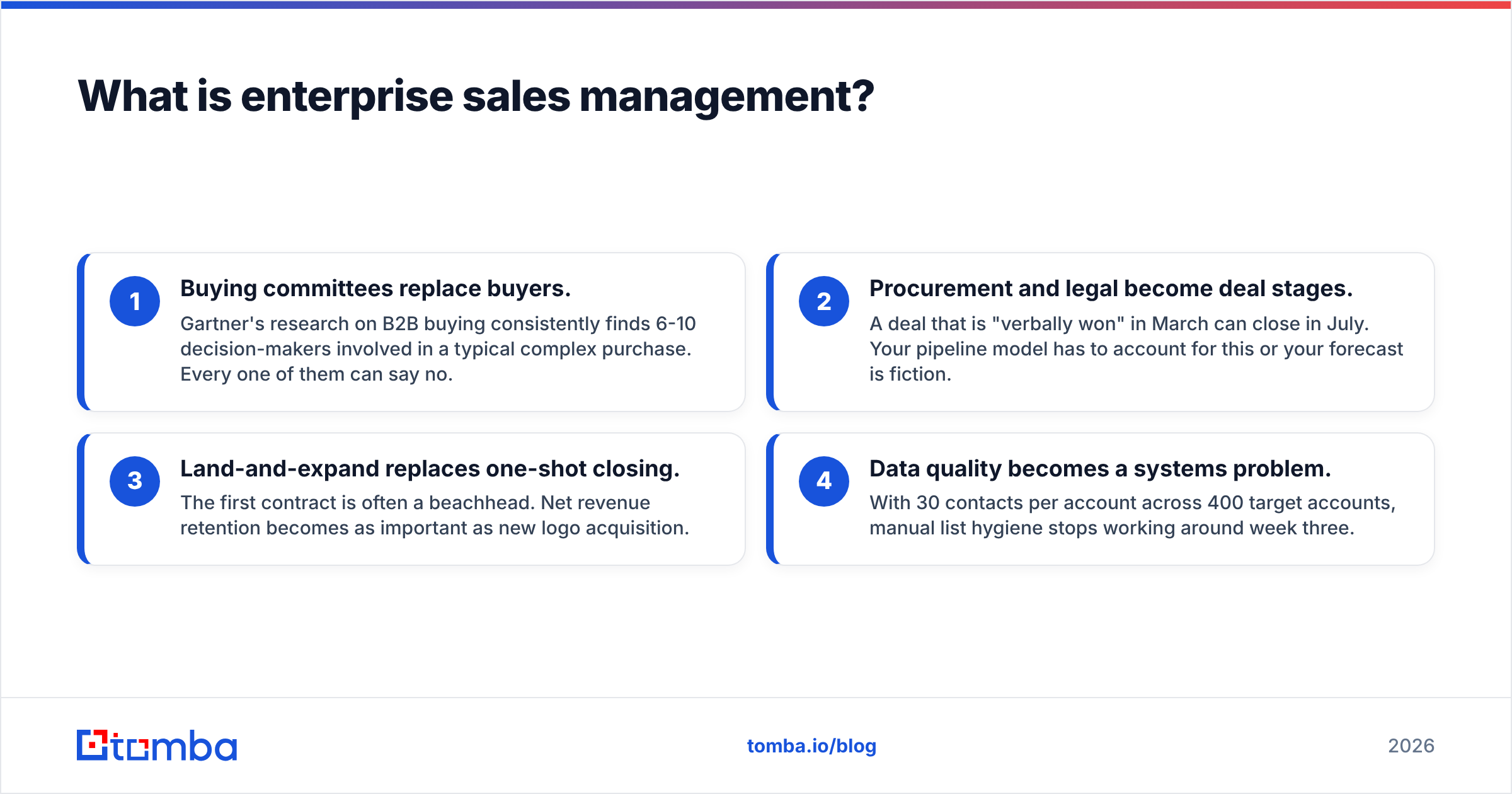
Four things change when you cross into enterprise:
- Buying committees replace buyers. Gartner's research on B2B buying consistently finds 6-10 decision-makers involved in a typical complex purchase. Every one of them can say no.
- Procurement and legal become deal stages. A deal that is "verbally won" in March can close in July. Your pipeline model has to account for this or your forecast is fiction.
- Land-and-expand replaces one-shot closing. The first contract is often a beachhead. Net revenue retention becomes as important as new logo acquisition.
- Data quality becomes a systems problem. With 30 contacts per account across 400 target accounts, manual list hygiene stops working around week three.

Why does enterprise sales management break at scale?#
It breaks in three specific places. Not ten. Three.
Forecast accuracy collapses first. Most enterprise teams forecast by asking reps for a commit number and rolling it up. That produces a number shaped by rep optimism, quota pressure, and whatever the manager said in last week's one-on-one. Salesforce's own State of Sales research has repeatedly shown that sales leaders lack confidence in their forecast accuracy — and the gap widens as deal complexity rises. The fix is not a better spreadsheet. It is stage-entry criteria that are objectively verifiable: "economic buyer identified and met" is verifiable, "customer is excited" is not.
Territory and quota design fails second. Enterprise territories built on gut feel produce a small number of reps sitting on all the winnable accounts and a long tail of reps grinding through accounts that were never going to buy. If your top quartile hits 140% and your bottom quartile hits 45%, you probably do not have a talent problem — you have a territory problem.
Contact data decays third, and quietly. People change jobs. Companies get acquired. Titles shift after reorgs. A target account list built in January is materially wrong by July. And unlike a bad forecast, nobody notices data decay until a rep tells you they spent two hours on a sequence that bounced.
How do you structure an enterprise sales org?#
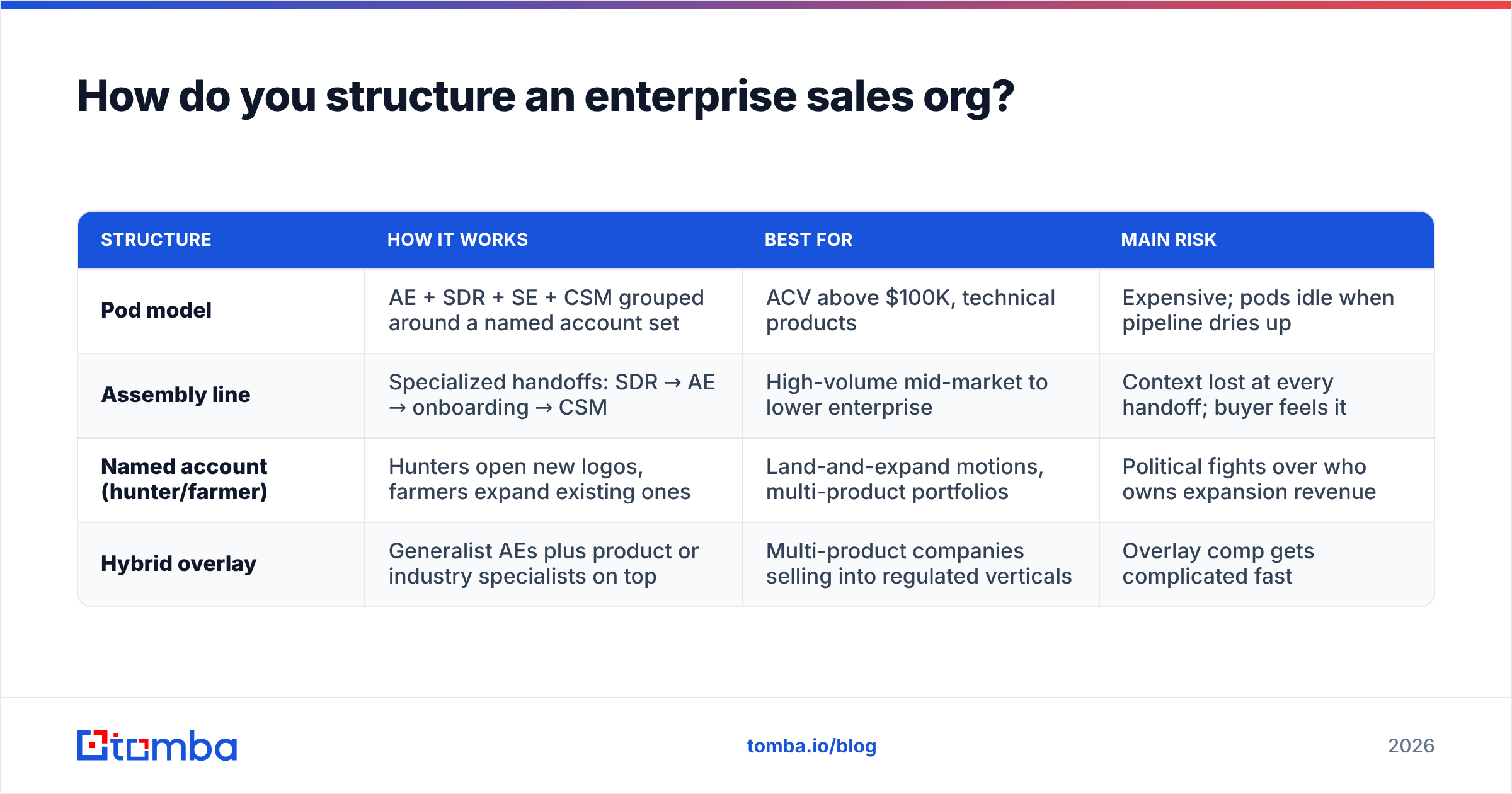
There is no single correct structure, but there are three common patterns and each has a clear tradeoff. Pick based on your average deal size and how technical your product is.
| Structure | How it works | Best for | Main risk |
|---|---|---|---|
| Pod model | AE + SDR + SE + CSM grouped around a named account set | ACV above $100K, technical products | Expensive; pods idle when pipeline dries up |
| Assembly line | Specialized handoffs: SDR → AE → onboarding → CSM | High-volume mid-market to lower enterprise | Context lost at every handoff; buyer feels it |
| Named account (hunter/farmer) | Hunters open new logos, farmers expand existing ones | Land-and-expand motions, multi-product portfolios | Political fights over who owns expansion revenue |
| Hybrid overlay | Generalist AEs plus product or industry specialists on top | Multi-product companies selling into regulated verticals | Overlay comp gets complicated fast |
The pod model wins in true enterprise more often than not, because the deal team stays constant across a 12-month cycle and the buying committee sees consistent faces. That continuity is worth the extra headcount cost.
Whichever structure you pick, define these four things in writing before your next quarter starts:
- Account ownership rules. Who owns a lead that comes inbound from an account another rep is working? Write the tiebreaker down. Arguments about this consume more management time than anything else.
- Stage-entry criteria. Each pipeline stage needs a binary test. Not "discovery complete" — "we have documented the metric they will be measured on and confirmed it with a second stakeholder."
- Escalation paths. When does a deal get executive sponsorship? When does legal get pulled in? Pre-agree the triggers so nobody is negotiating internally mid-deal.
- Deal review cadence. Weekly on late-stage, biweekly on mid-stage, monthly on the whole book. Anything more frequent turns into theater.
What metrics actually matter in enterprise sales management?#
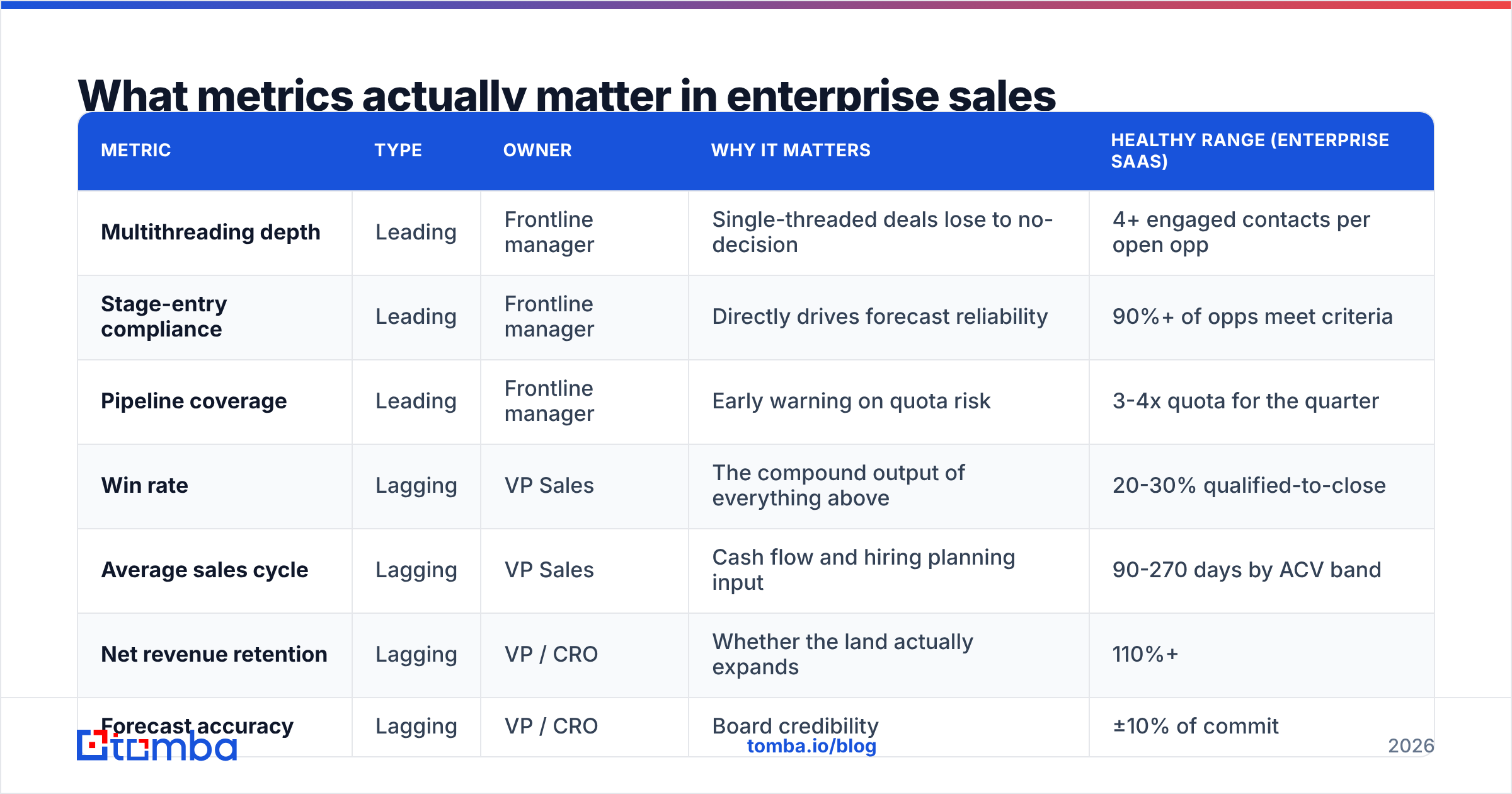
Split them into leading and lagging, and assign different owners. Frontline managers cannot influence a lagging metric this quarter; VPs should not be micromanaging leading ones.
| Metric | Type | Owner | Why it matters | Healthy range (enterprise SaaS) |
|---|---|---|---|---|
| Multithreading depth | Leading | Frontline manager | Single-threaded deals lose to no-decision | 4+ engaged contacts per open opp |
| Stage-entry compliance | Leading | Frontline manager | Directly drives forecast reliability | 90%+ of opps meet criteria |
| Pipeline coverage | Leading | Frontline manager | Early warning on quota risk | 3-4x quota for the quarter |
| Win rate | Lagging | VP Sales | The compound output of everything above | 20-30% qualified-to-close |
| Average sales cycle | Lagging | VP Sales | Cash flow and hiring planning input | 90-270 days by ACV band |
| Net revenue retention | Lagging | VP / CRO | Whether the land actually expands | 110%+ |
| Forecast accuracy | Lagging | VP / CRO | Board credibility | ±10% of commit |
Two notes on this table. First, multithreading depth is the single most predictive leading indicator most teams do not track. A deal with one contact is not a deal; it is a conversation that ends when that person changes jobs. Second, if your forecast accuracy is worse than ±20%, stop optimizing anything else. Nothing downstream of an unreliable forecast can be planned.
For definitions and how these connect to the broader revenue org, the revenue operations function typically owns metric definitions so that "win rate" means the same thing in every dashboard. That sounds trivial. It is not — most metric disputes at the VP level are definitional, not analytical.
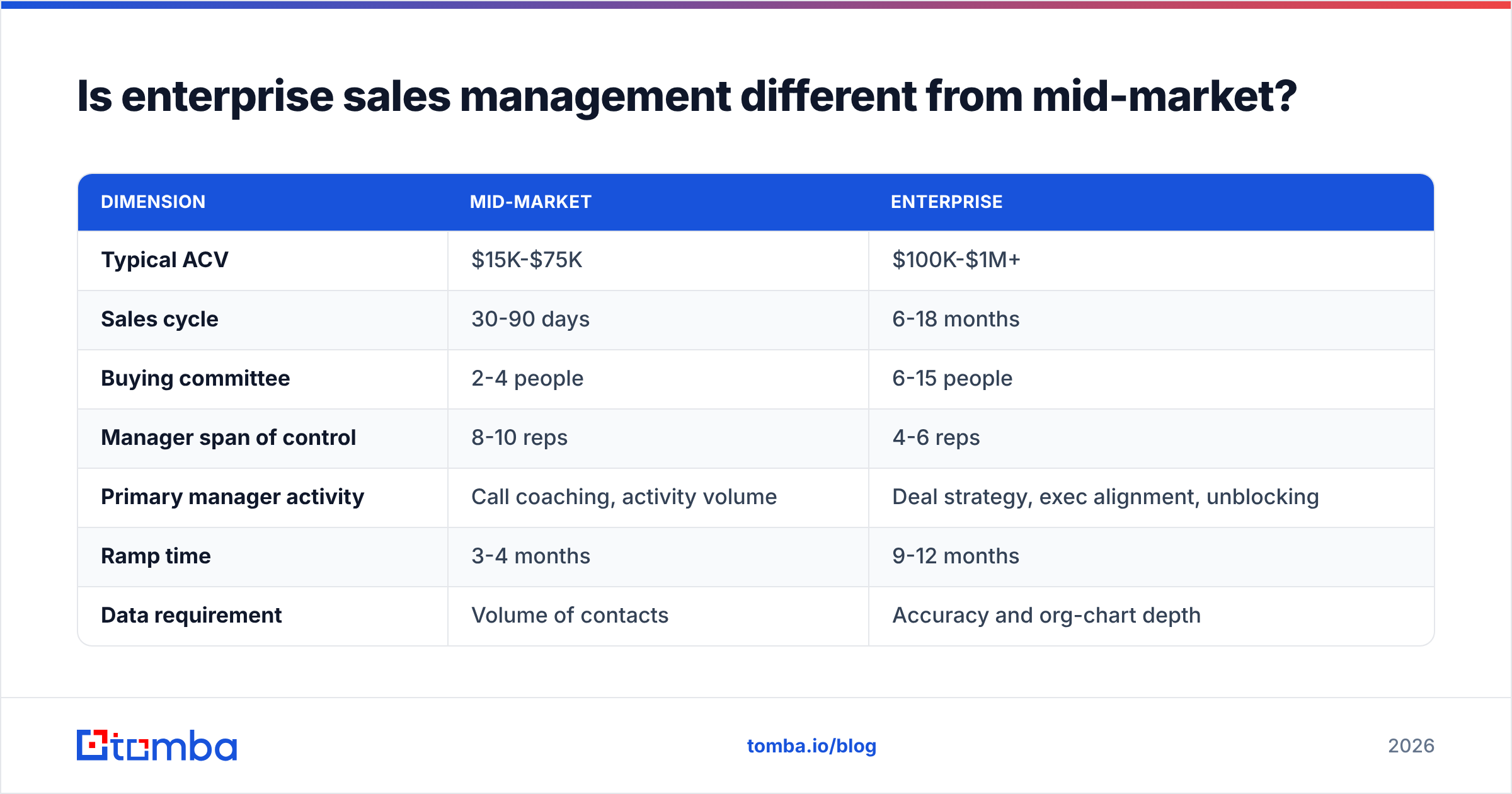
Is enterprise sales management different from mid-market?#
Yes, and treating them the same is the most common structural mistake growing companies make.
| Dimension | Mid-market | Enterprise |
|---|---|---|
| Typical ACV | $15K-$75K | $100K-$1M+ |
| Sales cycle | 30-90 days | 6-18 months |
| Buying committee | 2-4 people | 6-15 people |
| Manager span of control | 8-10 reps | 4-6 reps |
| Primary manager activity | Call coaching, activity volume | Deal strategy, exec alignment, unblocking |
| Ramp time | 3-4 months | 9-12 months |
| Data requirement | Volume of contacts | Accuracy and org-chart depth |
| Forecast method | Historical conversion rates | Deal-by-deal inspection + weighted stages |
The span-of-control line is the one leaders resist most. Promoting a mid-market manager with ten reports into an enterprise role with ten reports produces a manager who cannot do deal strategy on any of them. Four to six is the ceiling if you expect real deal involvement.
The ramp time line has a hiring implication: if enterprise ramp is nine months, a rep you hire in October is not producing until the following summer. Plan headcount against that, not against the optimistic number in the offer letter.
How does data quality affect enterprise sales performance?#
More than any tool in your stack. Here is the arithmetic.
Say you run 400 target accounts with an average of 8 relevant contacts each — 3,200 contacts. B2B contact data decays at roughly 2-3% per month through job changes, reorgs, and departures. After twelve months, somewhere between a quarter and a third of that list is wrong. Your reps do not know which third. So they burn hours on bounced emails, wrong-title outreach, and sequences aimed at someone who left in Q1.
The second-order damage is worse than the wasted time. Bounce rates above 2-3% degrade your sending domain reputation, which means the emails to your correct contacts start landing in spam. One bad list quietly taxes every campaign you run afterward.
The fix is procedural, not heroic:
- Verify before you send, every time. Run the list through an email verifier as a pipeline step, not as a cleanup task after bounces spike.
- Re-enrich on a schedule. Quarterly at minimum for tier-1 accounts, monthly if your cycle is short. Data enrichment should be a cron job in your RevOps stack.
- Map the org chart, not just the contact. Multithreading requires knowing who reports to whom. A domain search across a target account surfaces the adjacent stakeholders your rep has not thought to contact.
- Automate the sync. Manual CSV round-trips do not survive contact with a 200-rep org. Wire enrichment into the CRM directly through the Tomba API or a native connector so records update without anyone remembering to do it.

What does the enterprise sales stack look like in 2026?#
Five layers. Most companies over-buy in layers 3 and 4 and under-invest in layer 1, which is exactly backwards.
Layer 1 — Data and enrichment. Contact discovery, verification, org mapping, firmographic enrichment. This is the foundation; everything above it inherits its error rate.
Layer 2 — CRM. Salesforce or HubSpot for most enterprise teams. System of record for opportunities, not a source of truth for contact data.
Layer 3 — Engagement. Sequencing, dialers, and email orchestration. Outreach, Salesloft, and the newer AI-native players.
Layer 4 — Revenue intelligence. Conversation recording, deal scoring, forecast modeling. Gong and its competitors.
Layer 5 — Enablement and CPQ. Content management, onboarding, quoting, contract lifecycle.
The buying advice: spend on layer 1 first and evaluate layers 3-5 on integration depth, not feature lists. A conversation-intelligence tool that does not write back to your CRM cleanly will generate insights nobody acts on. Check peer reviews on G2 for integration complaints specifically — they are the most reliable signal in vendor reviews because they are hard to fake.
On budget allocation, HubSpot's sales research and similar industry surveys consistently show reps spending under a third of their time actually selling. Every tool purchase should be justified against that number: does this give a rep back selling hours, or does it add another tab to check?
How do you run an effective enterprise deal review?#
Deal reviews are where enterprise sales management either creates value or wastes four hours a week. The difference is structure.
A bad deal review is a status update — the rep narrates what happened, the manager nods, everyone leaves. A good one is a stress test. Run it in four passes:
- Champion test. Who inside the account will argue for this deal when we are not in the room? Name them. If nobody, the deal is a lead, not an opportunity.
- Economic buyer test. Has anyone on our team met the person who controls the budget? Not emailed — met. If no, that is the next action, full stop.
- Competitive and status-quo test. What happens if they do nothing? "Do nothing" wins more enterprise deals than any named competitor. Have a documented answer.
- Close-plan test. Working backwards from the target date, list every step including procurement, security review, and legal. If the plan has fewer than eight steps, it is not real.
Deals that fail two or more tests come out of the commit forecast. That single rule does more for forecast accuracy than any modeling tool you can buy.
Where should you start if you are building this from scratch?#
In order, and do not skip ahead:
- Fix stage-entry criteria. Write binary tests for each stage. One week of work.
- Clean and verify the account and contact data. You cannot territory-plan on a list you do not trust.
- Redesign territories using the clean data.
- Install the deal-review structure above.
- Only then evaluate new tooling.
Most teams do this in reverse — they buy a forecasting tool first and feed it unreliable stage data. The tool then produces confident, precise, wrong numbers.
Start with the data layer#
Enterprise sales management is an operating system, and every operating system inherits the quality of its inputs. Territories, forecasts, multithreading, and account planning all depend on knowing who actually works at your target accounts right now.
That is the problem Tomba Email Finder is built for: finding verified professional email addresses by domain, name, or company, so your account maps reflect reality instead of last year's org chart. The free tier gives you 25 searches a month to test accuracy against accounts you already know, and paid plans start at $49/mo — see Tomba pricing for the full breakdown, including the API access most enterprise teams end up wiring straight into their CRM.
Verify the list first. Everything else in enterprise sales management gets easier from there.
Related guides#
Ready to find emails that actually work?
Join 150,000+ professionals who stopped guessing and started sending. Free credits on signup — no credit card required.
Get the Tomba newsletter
Practical outbound tactics and product updates — once every two weeks.
About the author