How to Build an Enterprise Sales Team That Closes in 2026
Enterprise deals fail on team design, not on pitch quality. Here is the role mix, headcount ratio, comp structure, and data stack that actually move six-figure contracts in 2026.
TL;DR
- An enterprise sales team is not a bigger SMB team. It is a different org shape: fewer reps, more support roles, longer cycles, and a named-account model instead of a lead queue.
- The working ratio in 2026 is roughly 1 AE : 1 SDR : 0.5 solutions engineer : 0.25 deal desk, with one manager per 6–8 AEs.
- Fully loaded cost per enterprise AE runs $280k–$420k/year. If your ACV is under $50k, you cannot afford this motion yet.
- Territory and account data quality decides more outcomes than rep talent. Bad contact data burns 20–30% of prospecting hours before anyone dials.
- Measure enterprise teams on pipeline coverage, stage conversion, and multi-threading depth — not on activity counts.
What is an enterprise sales team, and how is it different from SMB?#
An enterprise sales team sells high-value, multi-stakeholder contracts — typically $50k+ annual contract value, 4–12 month cycles, and 6 to 15 people involved in the buying decision. SMB sales is a volume game: many small deals, short cycles, one or two decision-makers, and a rep who owns the whole thing end to end.
The structural difference is where the work sits. In SMB, roughly 80% of the work sits with the account executive. In enterprise, the AE is closer to a project manager who orchestrates a cast: an SDR opening doors, a solutions engineer proving the technical case, security and legal review, a procurement negotiation, and often an executive sponsor from your own leadership.
Think of it like the difference between running a food truck and running a restaurant kitchen. The food truck operator does everything and moves fast. The kitchen has stations, a pass, and an expediter — and if you staff a kitchen like a food truck, the tickets pile up and everything comes out cold.
That is the single most common failure mode: companies hire five enterprise AEs, give them no SE support, no data, and no deal desk, then conclude "enterprise doesn't work for us" after two quarters. The motion did not fail. The staffing did.
Gartner's research on B2B buying behavior has consistently shown that enterprise buying groups spend the majority of their cycle not talking to any vendor. Your team structure has to account for a process you mostly do not control.
What roles does an enterprise sales team actually need?#
Here is the minimum viable cast for a functioning enterprise motion. Skip any of these and the load lands on your AEs, who then spend their week doing everything except selling.
- Enterprise Account Executive (AE) — Owns 20–40 named accounts, not a lead queue. Runs discovery, builds the business case, orchestrates internal resources, negotiates commercials. Quota is typically 4–6x fully loaded cost.
- Enterprise SDR / Outbound Researcher — Not a dialer. This person researches org charts, identifies the buying committee, finds verified contact details, and books meetings with specific named humans. In enterprise, one great meeting beats 40 generic ones.
- Solutions Engineer (SE) — Owns the technical win: demos, architecture reviews, security questionnaires, proof-of-concept scoping. One SE typically supports 2–3 AEs. Under-staffing SEs is the fastest way to lose deals at the evaluation stage.
- Deal Desk / Revenue Operations — Owns pricing approvals, contract structuring, forecast hygiene, and CRM data integrity. Part-time at first, dedicated past ~$10M ARR. Also see revenue operations for how this function scales.
- Customer Success Manager (CSM) — Enterprise revenue is renewal revenue. A land without a credible expansion path is a one-year contract you will lose. Bring the CSM into the deal before signature, not after.
- Sales Manager / Director — One per 6–8 AEs. Their job is deal inspection and coaching, not pipeline reporting. If your manager spends Monday building forecast decks, you have a RevOps gap, not a management gap.
Roles 1 through 3 are non-negotiable from day one. Roles 4 through 6 can be shared or fractional until you have three or more AEs.
How many reps do you need, and what does the team cost?#
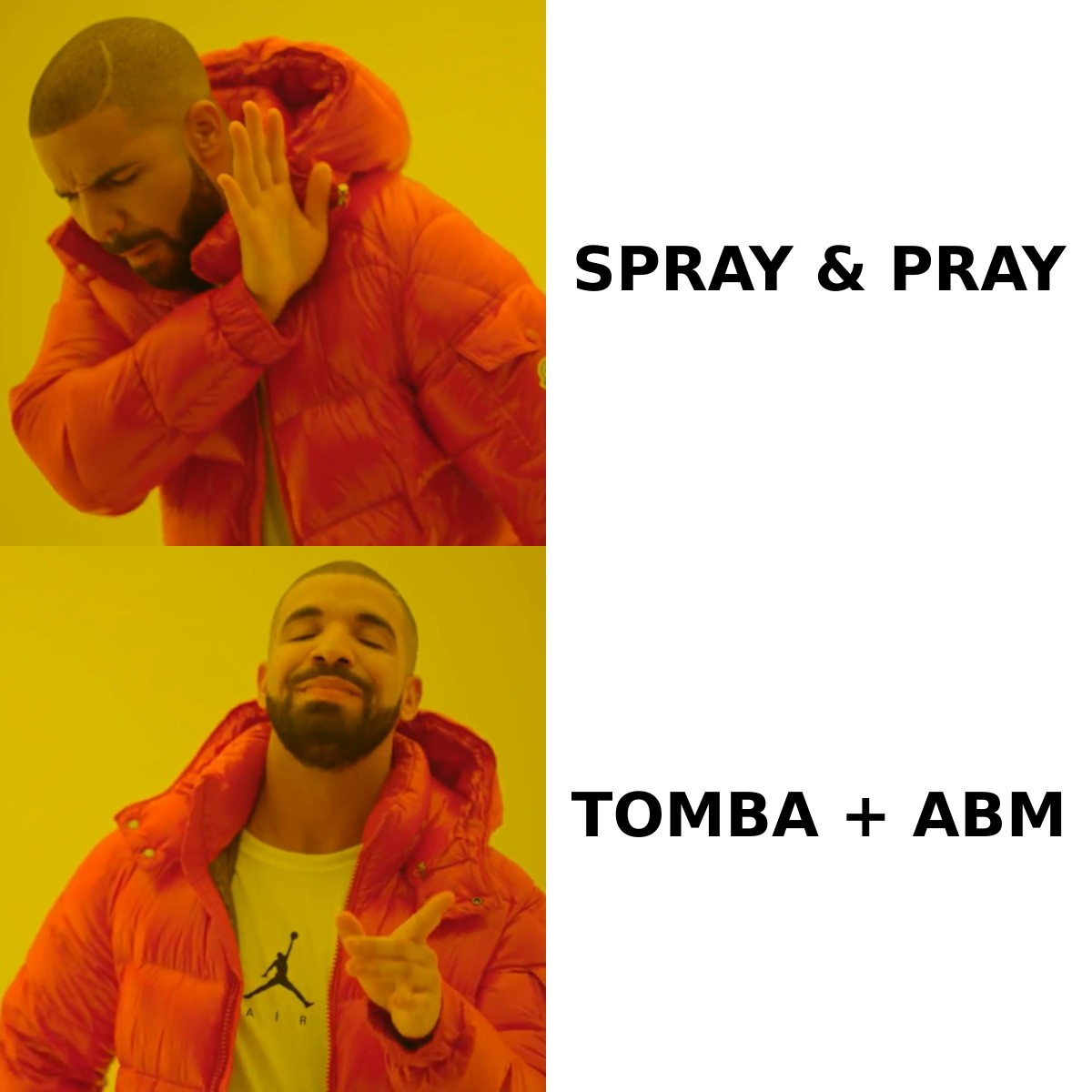
Model the cost before the headcount. The math is unforgiving and it is the fastest way to find out whether you are ready for this motion.
| Role | Base salary (US, 2026) | OTE / total | Fully loaded cost | Ratio per AE |
|---|---|---|---|---|
| Enterprise AE | $130k–$160k | $260k–$320k | $310k–$400k | 1.0 |
| Enterprise SDR | $65k–$80k | $90k–$110k | $115k–$140k | 0.75–1.0 |
| Solutions Engineer | $140k–$170k | $175k–$215k | $210k–$260k | 0.4–0.5 |
| Deal Desk / RevOps | $95k–$125k | $105k–$140k | $130k–$175k | 0.25 |
| Sales Manager | $150k–$180k | $260k–$310k | $310k–$380k | 0.15 |
| Tooling + data per seat | — | — | $4k–$9k/yr | 1.0 |
Fully loaded means salary plus benefits, taxes, equipment, and tooling — roughly 1.25x OTE. A single-AE enterprise pod with SDR, half an SE, and shared RevOps lands around $520k–$650k per year all-in.
To justify that pod at a healthy 4x return, it needs to produce roughly $2.1M–$2.6M in new ARR. At $80k ACV, that is 26–33 closed deals. At a 22% opportunity win rate, that is 120–150 qualified opportunities. At a 12% meeting-to-opportunity rate, that is over 1,000 first meetings a year — for one pod.
Run this arithmetic before you post the job ad. If the numbers do not clear, the answer is not "hire harder." It is either raise ACV, improve win rate, or stay in the mid-market for another year.
Is a pod model better than a pooled model?#
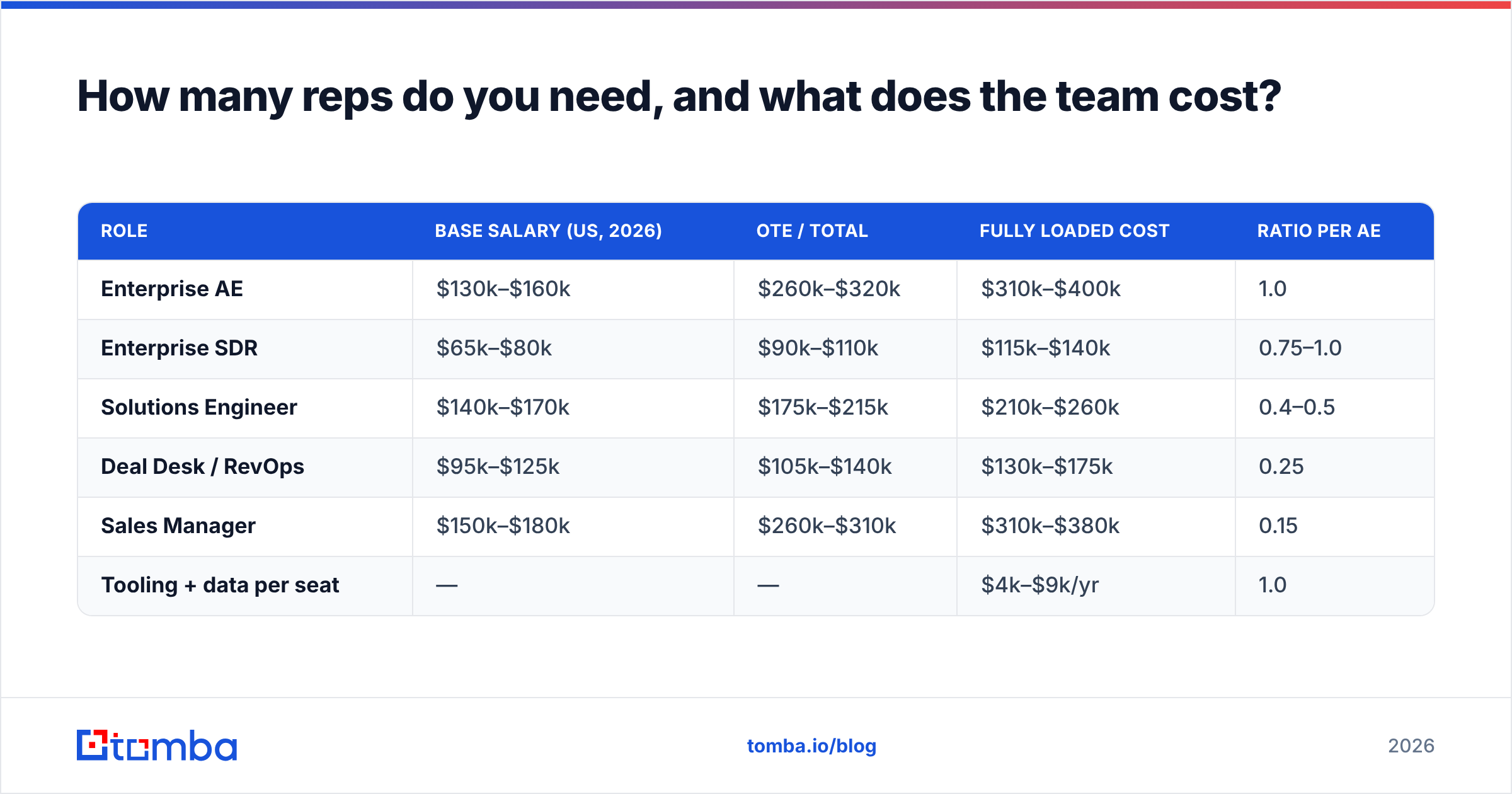
Two structures dominate in 2026, and the choice depends on your ACV and account count more than on philosophy.
| Dimension | Pod model (AE + SDR + SE bundled) | Pooled model (shared SDR/SE bench) |
|---|---|---|
| Best for | ACV $75k+, named-account ABM | ACV $40k–$75k, wider territory |
| Account count per AE | 20–40 | 60–150 |
| Ramp time to full quota | 6–9 months | 4–6 months |
| Coordination overhead | Low — same team, same accounts | High — routing and priority conflicts |
| Cost per AE | Higher (dedicated support) | Lower (shared support) |
| Risk | Pod goes cold if one member underperforms | Nobody owns the account narrative |
| Forecast accuracy | Higher — one shared account view | Lower — context fragments across people |
The pod model wins on deal quality; the pooled model wins on cost efficiency. Most teams that scale past $20M ARR end up hybrid: pods on the top 50 target accounts, pooled coverage on everything below.
One caveat nobody puts in the org chart deck: pods create single points of failure. If the SDR in a pod is weak, that AE's pipeline dies quietly for two quarters before anyone notices, because there is no pooled average to compare against. Inspect pods monthly at the pipeline-created level, not quarterly at the closed-won level.
How do you feed an enterprise sales team with accurate data?#
Data quality is the highest-leverage input to an enterprise team and the one most companies get wrong. Here is why: enterprise prospecting is not "find 5,000 contacts." It is "find the exact seven people on the buying committee at 40 named accounts, and be right about their titles and reachability."
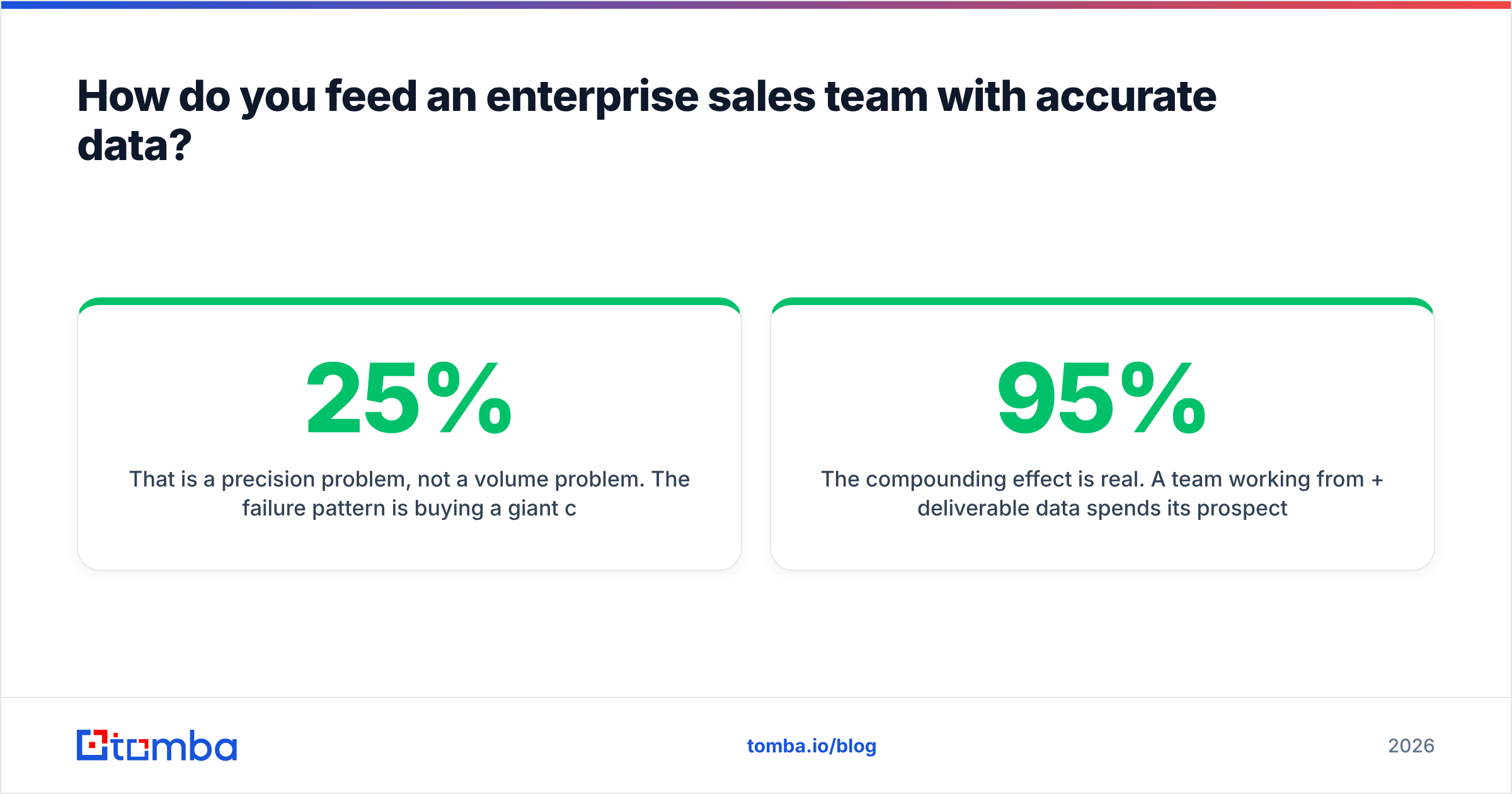
That is a precision problem, not a volume problem. The failure pattern is buying a giant contact database, discovering a 25% bounce rate, and torching sender reputation in week three.
Build the data layer in this order:
Account layer. Fix your ICP first — firmographics, tech stack signals, headcount growth, funding. Tools like BookYourData and similar verified B2B providers do solid work here on pre-verified account lists, and they are a reasonable starting point when you need coverage fast.
Contact layer. For named accounts you already know, work domain-first rather than list-first. A domain search returns the known email pattern and mapped contacts at a target company, which is exactly the shape of enterprise research — you know the company, you need the people. From there, a targeted email finder resolves specific first-name/last-name/domain combinations for the committee members you identified on LinkedIn.
Verification layer. Every address goes through email verification before it enters a sequence. Enterprise domains are heavily catch-all configured, so a dedicated catch-all verifier matters more here than in SMB, where consumer-grade providers give clean SMTP responses.
Enrichment layer. Push verified contacts into your CRM with role, seniority, and department attached so routing and reporting actually work. Broken enrichment is why your "VP+ engaged" dashboard reports numbers nobody believes.
The compounding effect is real. A team working from 95%+ deliverable data spends its prospecting hours on messaging and multi-threading. A team working from 70% deliverable data spends a fifth of its week discovering bounces — that is roughly one full working day per rep, every week, spent on nothing.
What compensation plan keeps enterprise reps?#
Enterprise comp is usually 50/50 base-to-variable, versus 60/40 or 70/30 in SMB. Longer cycles need more base to survive, but the variable has to stay meaningful or you attract people who are comfortable not closing.
Four rules that hold up across most enterprise teams:
- Quota at 4–6x fully loaded cost. Below 4x, unit economics break. Above 6x, attainment collapses and you churn reps — which costs more than the quota gap you were trying to close.
- Accelerators above 100%. Pay 1.5x–2x on every dollar past quota. In an enterprise motion, one over-attaining rep frequently subsidizes two who are still ramping.
- Multi-year and multi-product kickers. If you want three-year contracts, pay explicitly for three-year contracts. Reps optimize for exactly what the plan pays.
- Ramped quota over 2–3 quarters. A new enterprise AE closing in month four is closing deals someone else sourced. Quota them honestly, or you will pay for luck and punish for cycle length.
HubSpot's ongoing sales research and peer-review data on G2 both point in the same direction: comp complexity is inversely correlated with rep understanding. If a rep cannot compute their own commission on a napkin, the plan will not drive the behavior you designed it for.
How do you measure an enterprise sales team?#
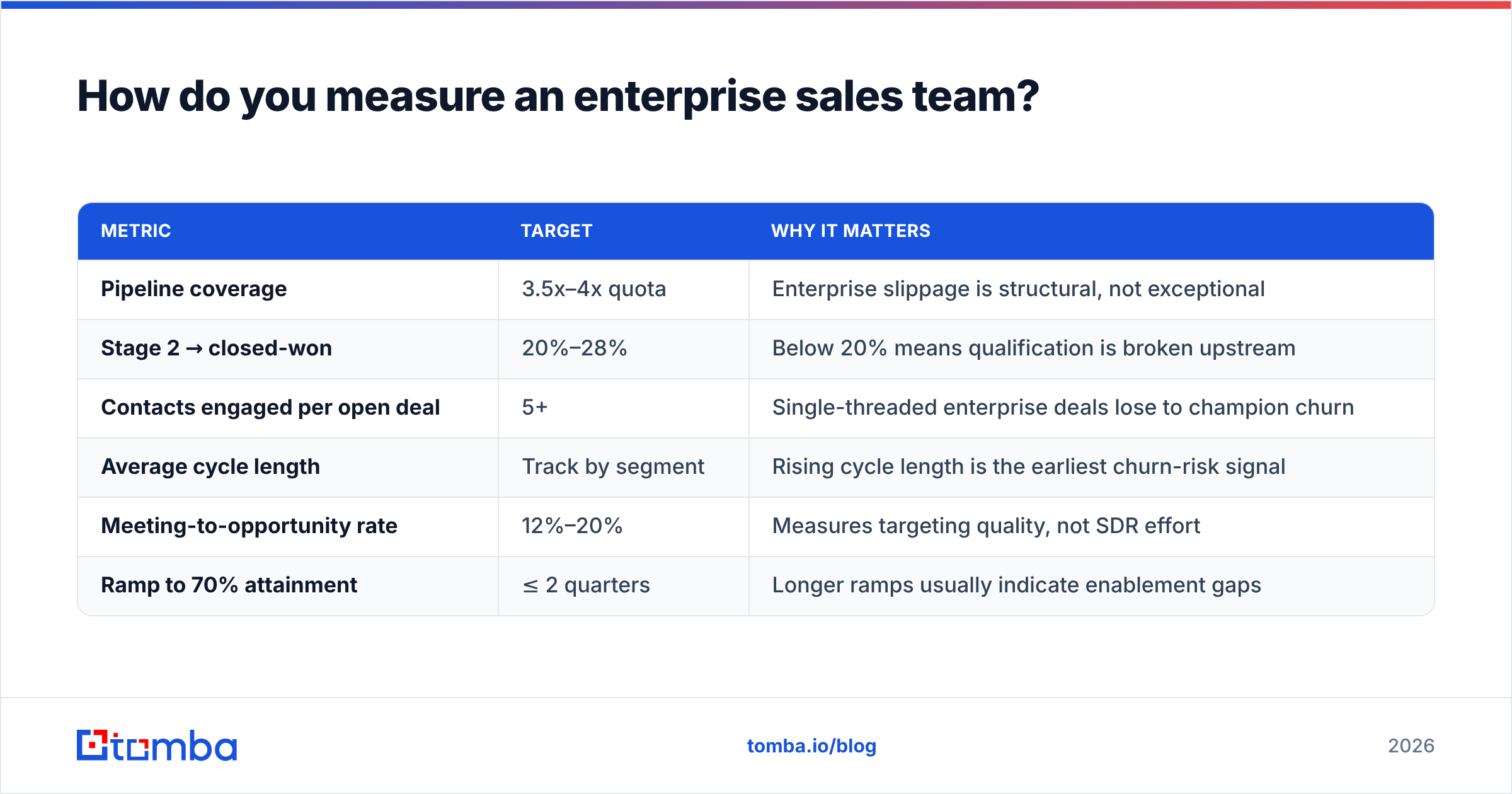
Activity metrics are noise in enterprise. A rep who sends 400 emails a week to the wrong accounts looks excellent on a dashboard and produces nothing for two quarters.
| Metric | Target | Why it matters |
|---|---|---|
| Pipeline coverage | 3.5x–4x quota | Enterprise slippage is structural, not exceptional |
| Stage 2 → closed-won | 20%–28% | Below 20% means qualification is broken upstream |
| Contacts engaged per open deal | 5+ | Single-threaded enterprise deals lose to champion churn |
| Average cycle length | Track by segment | Rising cycle length is the earliest churn-risk signal |
| Meeting-to-opportunity rate | 12%–20% | Measures targeting quality, not SDR effort |
| Ramp to 70% attainment | ≤ 2 quarters | Longer ramps usually indicate enablement gaps |
Multi-threading depth is the metric most teams under-weight. When your champion changes jobs — and in 2026 roughly one in five will, mid-cycle — a deal with one contact evaporates and a deal with six contacts survives. Track it weekly and inspect any open opportunity above $50k with fewer than three engaged contacts.
Watch your response rate by persona too. Falling response rates at a specific seniority level usually mean a messaging problem, not a data problem — and the fix is a rewrite, not more volume.
What mistakes kill enterprise sales teams in year one?#
- Hiring AEs before SEs. Your reps will lose at the technical evaluation stage and you will misdiagnose it as a hiring problem.
- Giving enterprise AEs an inbound queue. Named accounts and inbound leads are different jobs. Reps default to the easier one, which is inbound, and your target accounts stay untouched.
- Promoting your best SMB rep. Different skill set entirely. Some make the jump; most need six months of deliberate coaching, and nobody tells them that on day one.
- Skipping the data foundation. Reps building lists manually in spreadsheets are not selling. That is 8–10 hours per rep per week you are paying $150/hour for.
- Forecasting on rep optimism. Use stage-based, evidence-gated criteria. "They said they love it" is not a stage.
- Measuring too early. Enterprise cycles are 6–12 months. Judging a team at month five means judging noise.
Where to start this quarter#
Pick 40 named accounts. Map the buying committee at each one — five to seven people with real titles, not guesses. Verify every contact before it touches a sequence. Then staff one complete pod against that list and give it three quarters.
That is a far better first move than hiring four AEs and hoping the pipeline appears.
For the data layer underneath it, Tomba's Email Finder resolves verified business emails from a name and company domain, with domain search for mapping whole buying committees and built-in verification so nothing unverified enters your sequences. The free tier covers 25 searches a month for testing your ICP assumptions; the Starter plan is $49/mo and Growth is $99/mo when you scale to full team coverage — full Tomba pricing is public, with no seat minimums to negotiate before you know the motion works.
Build the account list first. Hire against it second.
Related guides#
Ready to find emails that actually work?
Join 150,000+ professionals who stopped guessing and started sending. Free credits on signup — no credit card required.
Get the Tomba newsletter
Practical outbound tactics and product updates — once every two weeks.
About the author