Enterprise Sales Training in 2026: The Complete Playbook
Most enterprise sales training is forgotten within 90 days. This guide breaks down what to teach, what providers charge, how to measure ROI, and why bad contact data quietly sinks even the best program.
TL;DR
- Enterprise sales training only pays back when it is a system — curriculum, reinforcement, manager coaching, and CRM-observable behavior change — not a two-day offsite.
- Expect $1,200–$3,500 per rep for off-the-shelf programs, $50k–$250k+ for custom enterprise engagements, plus 20–40% of that again in internal manager time.
- The single biggest hidden killer of training ROI is bad data: reps trained on perfect discovery still stall if 30% of their contacts bounce or are the wrong buyer.
- Measure ramp time, win rate on qualified deals, multi-threading depth, and stage-conversion — not "satisfaction scores."
- Build vs buy is usually a false choice: buy the methodology, build the reinforcement.
What is enterprise sales training?#
Enterprise sales training is the structured development of reps who sell high-value, multi-stakeholder deals into large organizations — typically $50k+ ACV, 6–18 month cycles, 6–12 buying-committee members, and a procurement gate at the end.
Think of it like flight school versus learning to drive. SMB selling is driving: one person decides, the route is short, and mistakes are cheap. Enterprise selling is flying a commercial aircraft: multiple systems, a checklist culture, a co-pilot (your champion), weather you can't control (org reprioritization), and a crash that costs two quarters of pipeline.
That difference is why generic "sales skills" courses fail at the enterprise level. Objection-handling drills don't help when the deal dies because a VP of Security you never met vetoed the vendor review in week 14.
Enterprise programs have to cover four layers that SMB training skips entirely:
- Account strategy — territory design, whitespace mapping, account tiering, and where to spend the 40 hours you actually have per account per quarter.
- Buying-committee navigation — identifying economic buyer, technical evaluator, champion, blocker, and legal/procurement, then multi-threading before you're forced to.
- Business-case construction — quantified value hypotheses, CFO-legible ROI models, and the ability to survive a finance review without you in the room.
- Deal orchestration — mutual action plans, internal resource pull (SE, security, legal), and forecast hygiene against a defined qualification framework.
- Commercial and legal fluency — MSAs, security questionnaires, redlines, and knowing which concessions cost nothing versus which set precedent.
- Data and tooling discipline — how reps source contacts, verify them, log activity, and keep the CRM trustworthy enough that coaching is possible.
Skip layer six and everything above it degrades quietly. You can teach flawless discovery and still watch a rep send 40 emails to addresses that bounce.
Why does most enterprise sales training fail?#
Because it is delivered as an event, and behavior change is a schedule.
The research on this is consistent and old: without reinforcement, most of what's taught in a classroom setting is lost within weeks. Sales leaders re-learn this every year. Gartner's sales research has repeatedly found that enablement investments underperform when they're decoupled from the deals reps are actually working on this quarter.
Here are the failure patterns worth naming, because you will recognize at least two:
The offsite spike. Two days of high energy, a binder, a hoodie, and a 6% lift that decays to zero by the following quarter. Nothing in the rep's weekly routine changed, so nothing in their behavior changed.
Training the reps, not the managers. Front-line managers are the compounding mechanism. If your directors can't run a deal review using the same framework the training taught, reps correctly conclude the framework is optional.
Methodology theater. The org adopts MEDDICC (or Challenger, or Command of the Message), adds the fields to Salesforce, and nobody enforces them. Six months later the CRM has "Metrics" populated with "TBD" on 70% of open pipeline.
Ignoring the top of funnel. Enterprise training obsesses over late-stage deal mechanics while reps struggle to get first meetings at all. If a rep can't reliably reach a VP of Operations at a 4,000-person manufacturer, no amount of MEDDICC training generates pipeline.
Measuring the wrong thing. Smile sheets and completion rates measure attendance. Ramp time and win rate measure capability.
What should an enterprise sales training curriculum cover?#
Structure the curriculum around the deal lifecycle, not around skills in the abstract. A rep doesn't need "communication skills" — they need to run a 45-minute discovery call with a skeptical CIO and leave with a next step on the calendar.
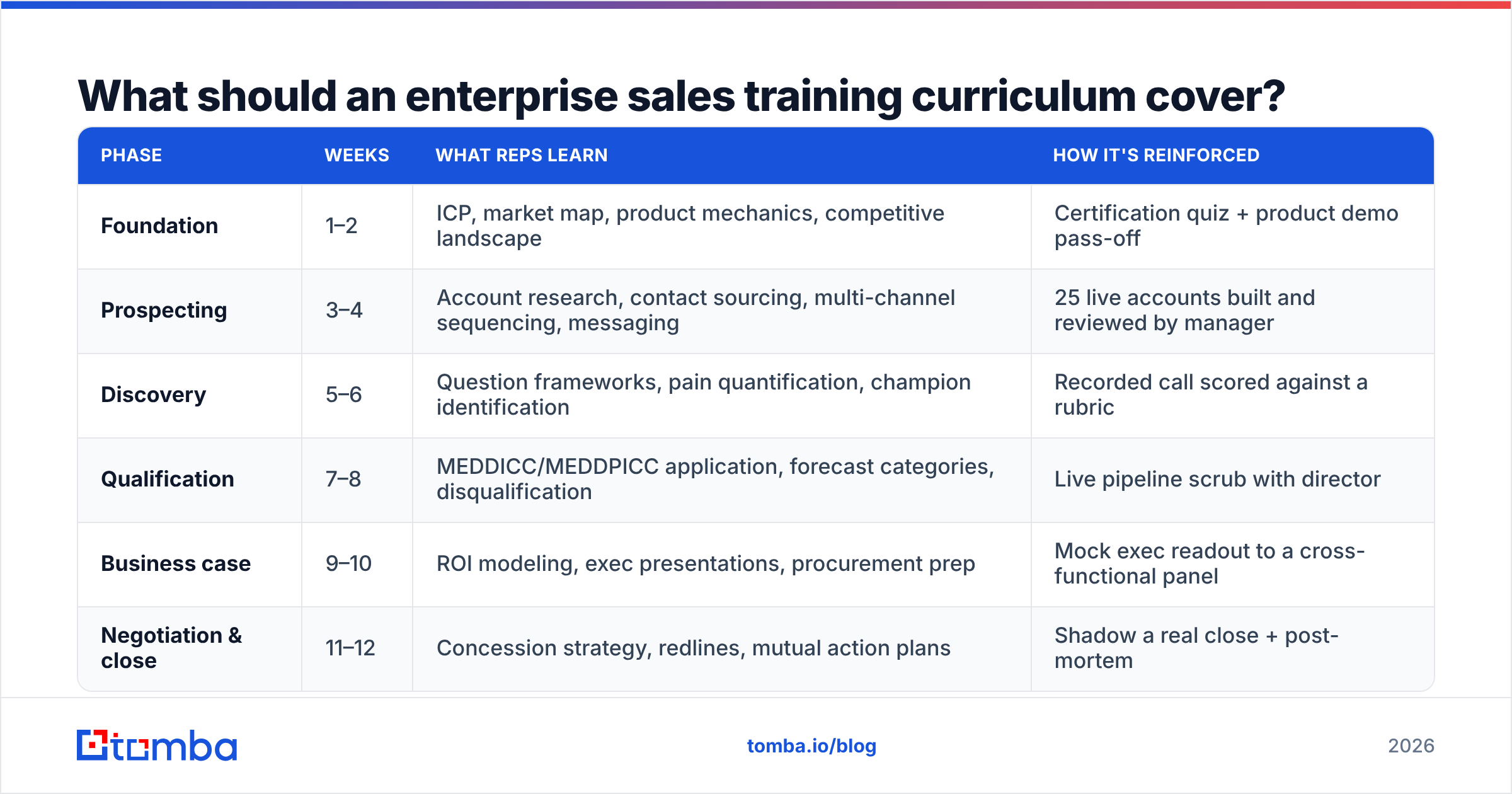
A defensible 12-week core looks like this:
| Phase | Weeks | What reps learn | How it's reinforced |
|---|---|---|---|
| Foundation | 1–2 | ICP, market map, product mechanics, competitive landscape | Certification quiz + product demo pass-off |
| Prospecting | 3–4 | Account research, contact sourcing, multi-channel sequencing, messaging | 25 live accounts built and reviewed by manager |
| Discovery | 5–6 | Question frameworks, pain quantification, champion identification | Recorded call scored against a rubric |
| Qualification | 7–8 | MEDDICC/MEDDPICC application, forecast categories, disqualification | Live pipeline scrub with director |
| Business case | 9–10 | ROI modeling, exec presentations, procurement prep | Mock exec readout to a cross-functional panel |
| Negotiation & close | 11–12 | Concession strategy, redlines, mutual action plans | Shadow a real close + post-mortem |
Two rules make this work. First, every phase ends in an observable artifact — a call recording, a filled account plan, a business case doc — not a completion checkbox. Second, the artifact is reviewed by the rep's actual manager, not by enablement. Enablement builds the machine; managers run it.
Which enterprise sales training providers should you compare in 2026?#
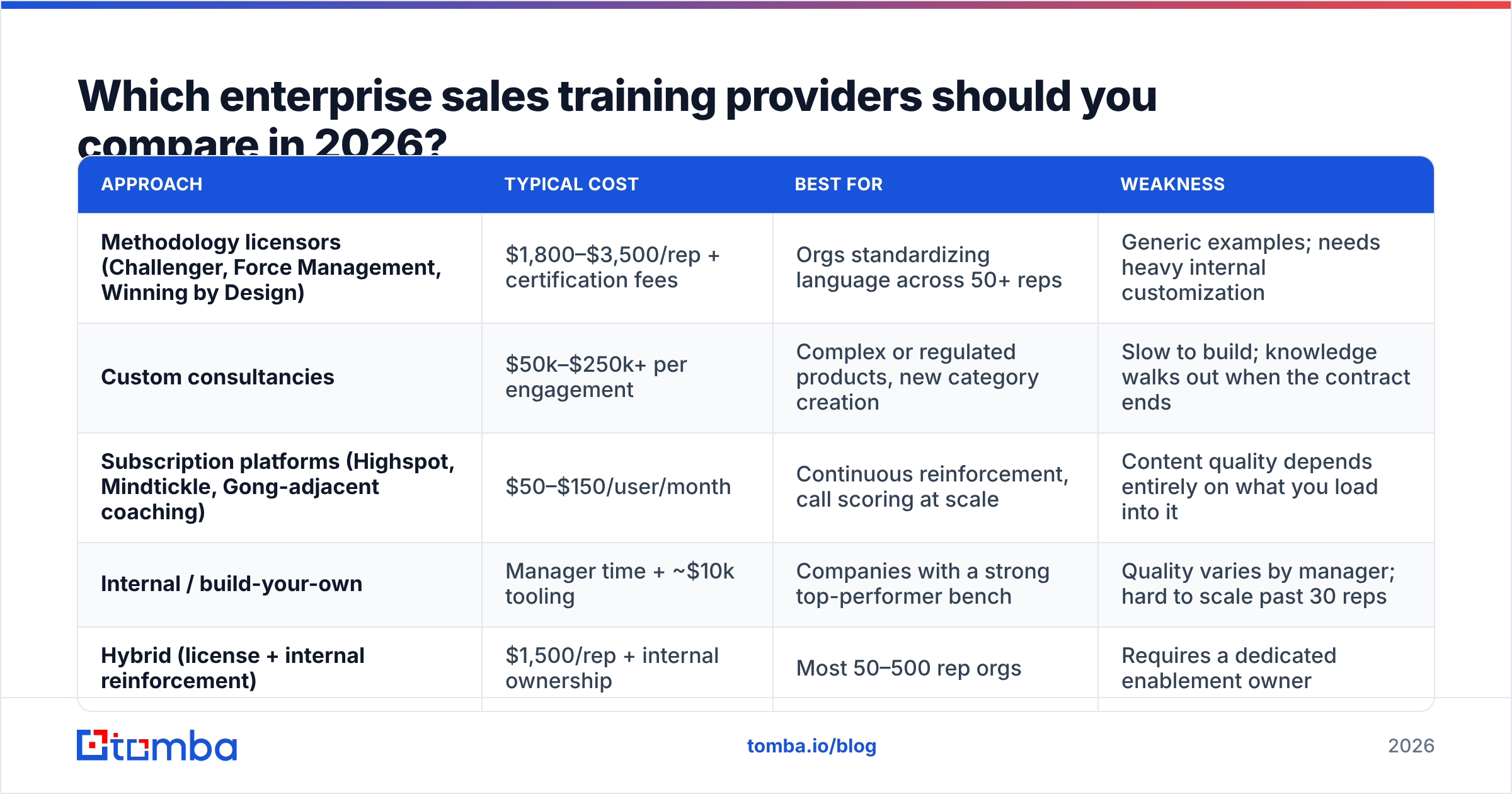
The market splits into four buckets: methodology licensors, custom consultancies, subscription platforms, and internal programs. Most enterprise orgs end up running a hybrid.
| Approach | Typical cost | Best for | Weakness |
|---|---|---|---|
| Methodology licensors (Challenger, Force Management, Winning by Design) | $1,800–$3,500/rep + certification fees | Orgs standardizing language across 50+ reps | Generic examples; needs heavy internal customization |
| Custom consultancies | $50k–$250k+ per engagement | Complex or regulated products, new category creation | Slow to build; knowledge walks out when the contract ends |
| Subscription platforms (Highspot, Mindtickle, Gong-adjacent coaching) | $50–$150/user/month | Continuous reinforcement, call scoring at scale | Content quality depends entirely on what you load into it |
| Internal / build-your-own | Manager time + ~$10k tooling | Companies with a strong top-performer bench | Quality varies by manager; hard to scale past 30 reps |
| Hybrid (license + internal reinforcement) | $1,500/rep + internal ownership | Most 50–500 rep orgs | Requires a dedicated enablement owner |
Before you sign anything, read verified buyer reviews rather than vendor case studies — the sales training category on G2 is a reasonable starting point, and pay particular attention to reviews from companies with your deal size and cycle length. A program tuned for $15k deals will teach the wrong reflexes to a team selling $400k platforms.
Three vendor questions that separate serious providers from slide vendors:
- "Show me the reinforcement cadence for weeks 5 through 52." If the answer is a refresher webinar, walk.
- "How do your managers' coaching guides map to our CRM stages?" If they can't map, adoption won't happen.
- "What happens to pipeline sourced in the first 90 days?" Providers who won't be measured on pipeline are selling comfort.
How much does enterprise sales training actually cost?#
Budget three lines, not one.
Direct program cost. $1,200–$3,500 per rep for licensed methodology, or $50k–$250k+ for a custom build. A 60-rep org running a hybrid typically lands between $120k and $180k in year one.
Internal time. This is the line finance forgets. Twelve weeks of onboarding at roughly 6 hours/week of manager involvement per rep, times a loaded manager cost, adds 20–40% on top of the direct spend.
Opportunity cost. A rep in training is a rep not selling. If your average rep produces $80k in pipeline per month, three weeks of heavy training is real money — which is exactly why the program must be measured.
The counter-math: if enterprise sales training cuts ramp time from 7 months to 5 months on a $1.2M annual quota, you recover roughly $200k of productive capacity per rep. Two reps pay for the entire program. That's the ROI case to bring to your CFO, and it's the one that survives scrutiny — as long as your ramp baseline is real and not remembered.
How does data quality quietly decide training ROI?#
Here's the part most enablement plans never address: you can train perfect selling behavior on top of broken inputs and see zero lift.
Consider a rep who completes a flawless 12-week program. Week 13, they build a 50-account target list. They identify the right personas. They write a sharp, quantified, well-researched first-touch email. Then:
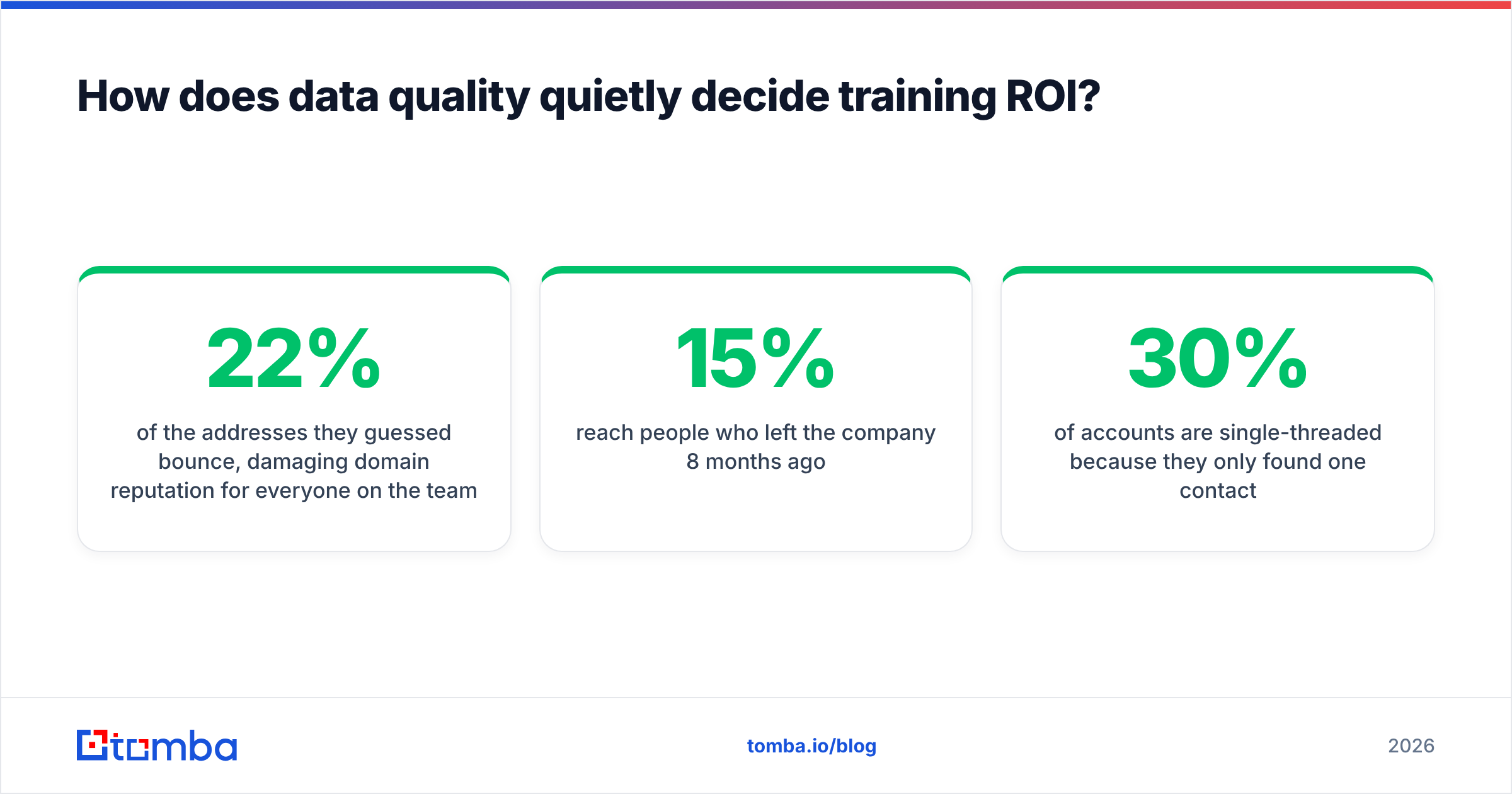
- 22% of the addresses they guessed bounce, damaging domain reputation for everyone on the team.
- 15% reach people who left the company 8 months ago.
- 30% of accounts are single-threaded because they only found one contact.
Their sequence "underperforms." The natural conclusion is that the training didn't work, or the rep can't write. Neither is true — the pipeline was contaminated before the first send.
Multi-threading is where this bites hardest. Enterprise training universally teaches reps to engage 4–6 stakeholders per account. That instruction is unactionable if the rep can only find one email address. A rep with verified contacts for the VP of Ops, the Director of IT, the CFO's chief of staff, and two end-user managers can execute what they were taught. A rep with one guessed address cannot.
This is why data hygiene belongs inside the curriculum, not in a separate tooling onboarding session:
- Teach reps to run a domain search on every target account during account planning, so the org chart is populated before outreach begins, not after.
- Require every list to pass through an email verifier before it enters a sequence. Make bounce rate a coachable metric, the same way you'd coach talk-to-listen ratio.
- Use data enrichment to attach role, seniority, and company signals to CRM records, so managers can actually inspect whether a rep is multi-threading or just adding contacts.
- Define a shared standard for what "a complete account plan" means: minimum 5 verified contacts across at least 3 functions. Now it's inspectable.
When contact quality is a scored part of the program, response rate becomes a real signal about messaging rather than noise from dead addresses.
How do you measure enterprise sales training ROI?#
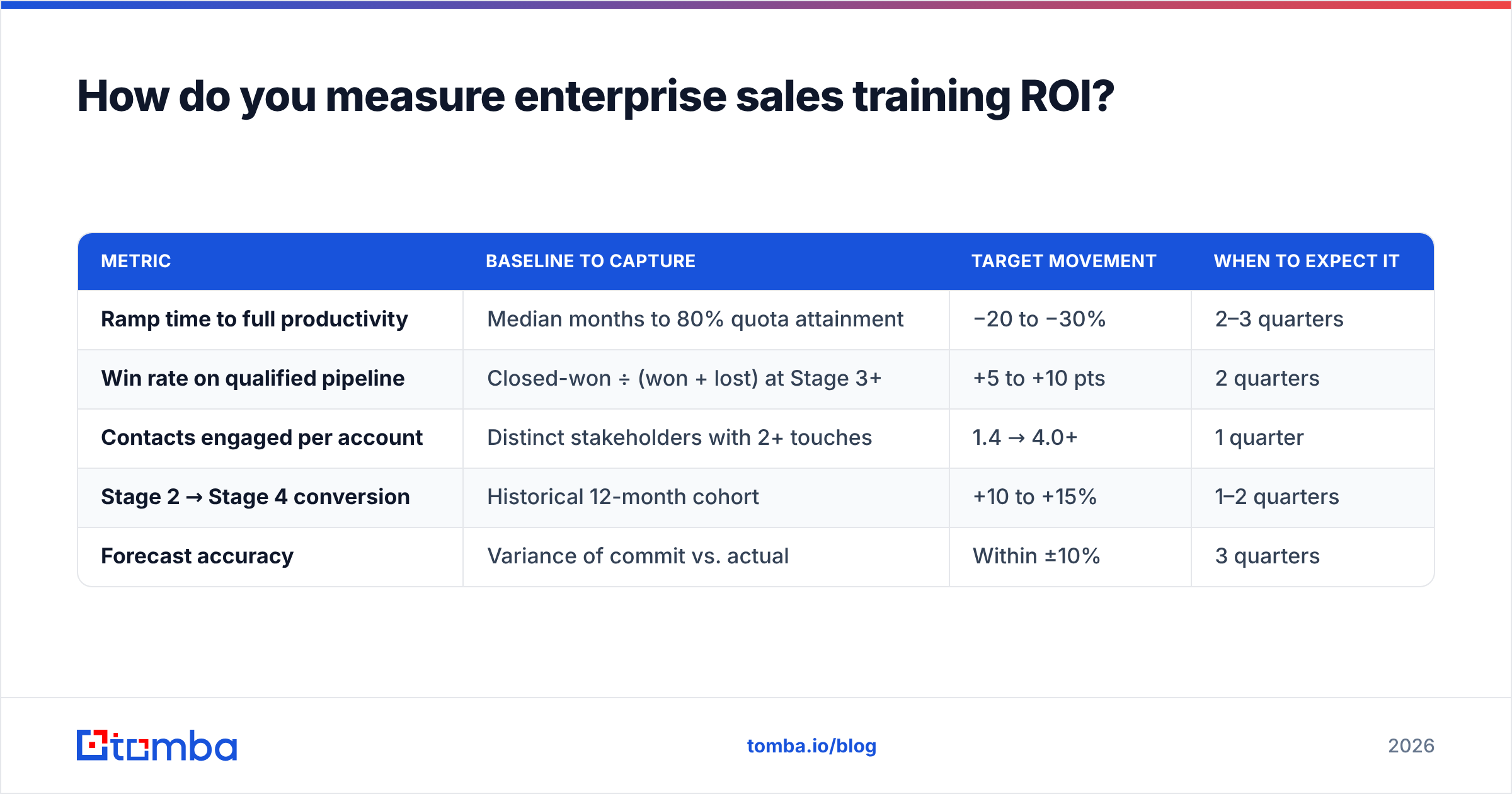
Pick four metrics before the program starts and instrument them in the CRM. Retrofitting measurement after launch produces numbers nobody believes.
| Metric | Baseline to capture | Target movement | When to expect it |
|---|---|---|---|
| Ramp time to full productivity | Median months to 80% quota attainment | −20 to −30% | 2–3 quarters |
| Win rate on qualified pipeline | Closed-won ÷ (won + lost) at Stage 3+ | +5 to +10 pts | 2 quarters |
| Contacts engaged per account | Distinct stakeholders with 2+ touches | 1.4 → 4.0+ | 1 quarter |
| Stage 2 → Stage 4 conversion | Historical 12-month cohort | +10 to +15% | 1–2 quarters |
| Forecast accuracy | Variance of commit vs. actual | Within ±10% | 3 quarters |
Note what's absent: NPS of the training, hours completed, certification pass rate. Those are inputs. They tell you the program ran, not that it worked.
Two measurement cautions. First, use cohorts, not company averages — compare reps who completed the program against reps hired the previous two quarters, or your read will be swamped by seasonality and territory changes. Second, guard against attribution theft; a pricing change or a new product launch mid-program will move win rate more than any curriculum. Note those events in the record.
For broader benchmarking context on how enterprise buying behavior is shifting, Salesforce's State of Sales research is a useful external reference point when you're arguing for budget.
Should you build or buy your enterprise sales training?#
Buy the methodology. Build the reinforcement. That's the answer for roughly 80% of organizations between 20 and 300 reps.
Buying gets you a battle-tested framework, shared vocabulary, and instructor-quality delivery in weeks instead of quarters. Building from scratch means your best sales leader spends a full quarter writing curriculum instead of closing deals — and produces something that's usually a worse version of a program you could license for $2k per rep.
But nobody can outsource reinforcement. The weekly deal review, the call scored against a rubric, the account plan sent back for a second pass — those have to live inside your management chain. Vendors can supply the rubric. They cannot supply the accountability.
A practical split:
- Buy: core methodology, qualification framework, negotiation module, certification assessments.
- Build: product-specific discovery questions, competitive battlecards, your ICP's actual pain language, prospecting workflows tied to your data stack, manager coaching cadence.
The build half is where your competitive advantage lives anyway. Every competitor can license the same framework. Nobody else has your win/loss data.
What does a 30-60-90 rollout look like?#
Days 1–30 — baseline and design. Pull the numbers you'll be judged on: ramp time, stage conversion, win rate by segment, current bounce rate on outbound. Interview your top three and bottom three reps; the gap between them is your curriculum. Select the vendor. Get the front-line managers certified first — they go through the program before the reps do.
Days 31–60 — deliver and instrument. Run the core curriculum with observable artifacts at each phase. Update CRM fields to match the framework. Set the data standard: minimum verified contacts per account, mandatory verification before sequencing. Start scoring calls.
Days 61–90 — reinforce and inspect. Weekly deal reviews using the shared framework. Monthly call-scoring sessions. Publish a scoreboard on the four metrics you chose in month one. Kill anything nobody uses — an unused field is worse than no field, because it teaches reps the system is decorative.
Then repeat the inspection loop indefinitely. The organizations that get compounding returns from enterprise sales training are the ones that treat month four the same as month one. For ongoing tactical reading on cadence design and messaging, HubSpot's sales blog publishes reliably practical material worth circulating to managers.
Where should you start?#
Start with the input layer, because it's the cheapest thing to fix and it changes what every other investment is worth.
Before you sign a six-figure training contract, run one diagnostic: take 100 contacts your reps sourced last month and verify them. If more than 10% are invalid, your reps aren't underperforming — your data is. Fix that first and you'll get a cleaner read on what training actually needs to solve.
Tomba's Email Finder is built for exactly the moment in enterprise training where reps move from account plan to outreach: find verified professional email addresses by domain, name, or company, build a full stakeholder map instead of a single guessed contact, and push clean records into your CRM. The free tier gives you 25 searches a month to run that diagnostic today, and paid plans start at $49/month — see Tomba pricing for the full breakdown. Train the behavior, then give reps data worth applying it to.
Related guides#
Ready to find emails that actually work?
Join 150,000+ professionals who stopped guessing and started sending. Free credits on signup — no credit card required.
Get the Tomba newsletter
Practical outbound tactics and product updates — once every two weeks.
About the author