EspoCRM vs SugarCRM 2026: Which Open CRM Wins?
EspoCRM is cheap, fast, and self-hostable. SugarCRM is heavier, pricier, and built for enterprise process. Here is the honest cost, feature, and data comparison for 2026.
EspoCRM vs SugarCRM comes down to one trade-off: own your stack, or buy a finished one. This guide compares both on price, hosting, automation, and contact data. All numbers are for 2026.
TL;DR
- EspoCRM is the cheaper, lighter option: free self-hosted open-source core, cloud from roughly $15/user/month, and a codebase small enough that one developer can extend it.
- SugarCRM is the enterprise suite: per-seat pricing that starts around $19/user/month for Sugar Market-adjacent tiers and climbs past $85/user/month for Sugar Sell Premier, with minimum seat counts.
- Choose EspoCRM if you have technical capacity and want to own your data. Choose SugarCRM if you need vendor-backed SLAs, native forecasting, and audited compliance workflows.
- Neither tool fills your pipeline. Both are containers — you still need a contact-data source feeding verified emails and phone numbers into them.
- The real cost gap over three years for a 20-person team is roughly $2,000–$6,000 (EspoCRM self-hosted, including sysadmin time) versus $40,000–$60,000 (SugarCRM Sell Advanced).
What Are EspoCRM and SugarCRM?#
Both descend from the same open-source lineage, but they went in opposite directions.
EspoCRM launched in 2014 as a lightweight PHP/MySQL CRM under the GPLv3 license. You download it, drop it on a $20/month VPS, and run it. There is a paid cloud version and paid extensions (advanced pack, sales pack, VoIP integrations), but the core is genuinely free forever. The entity manager lets you build custom objects, fields, and links from the admin UI. No code needed. That one feature keeps small teams from outgrowing it.
SugarCRM started in 2004 as the original open-source CRM alternative to Salesforce. It dropped its community edition in 2018 and became a fully commercial platform. Today it sells three product lines: Sugar Market (marketing automation), Sugar Sell (sales CRM), and Sugar Serve (customer service). Sugar Sell is the direct EspoCRM rival. It ships with predictive analytics, revenue forecasting, and a mature workflow engine called SugarBPM.
The shorthand: EspoCRM is a toolkit, SugarCRM is a system. A toolkit gives you parts and expects you to assemble them. A system gives you a finished machine and charges you for the assembly you didn't do.
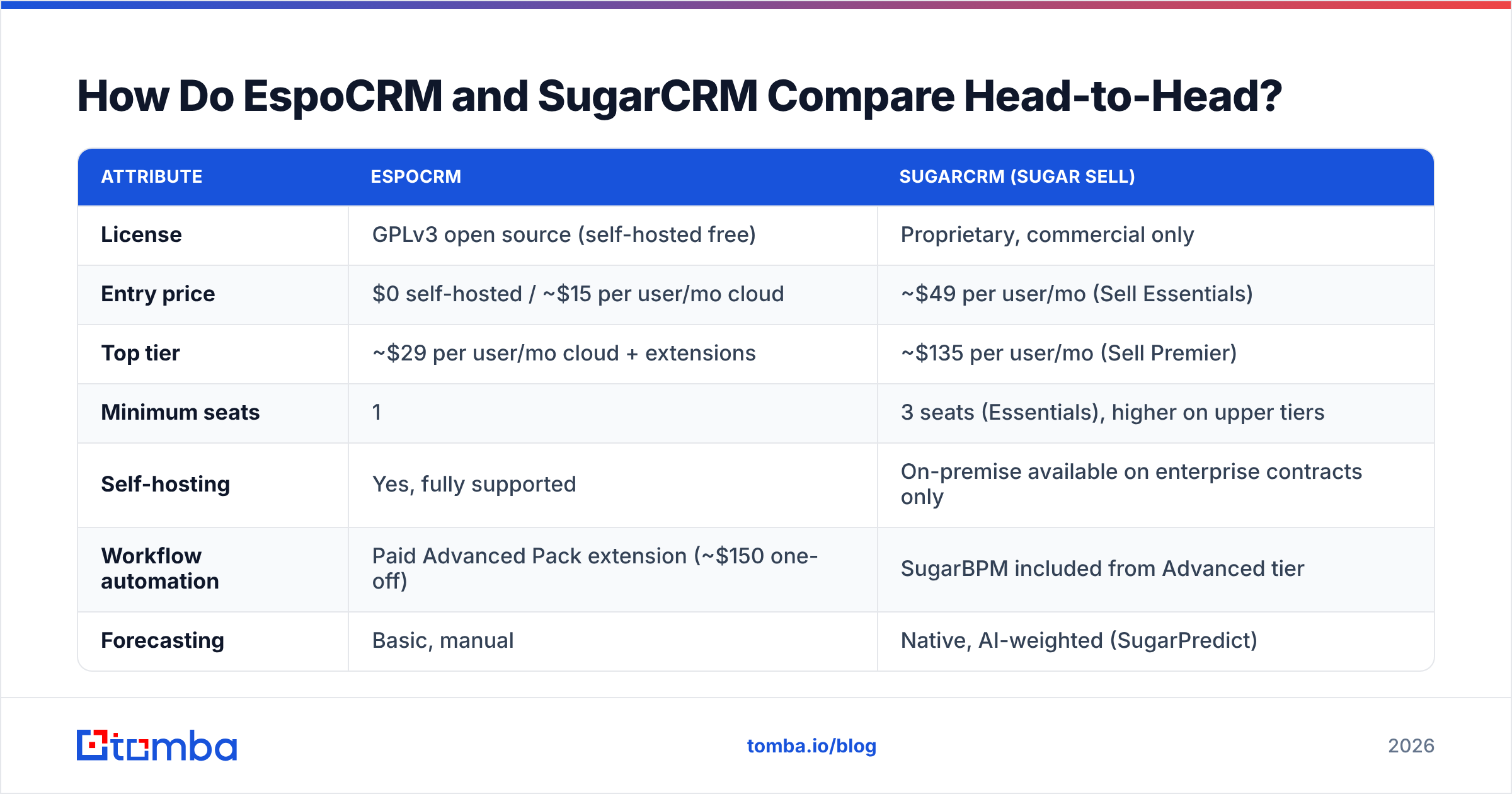
EspoCRM vs SugarCRM: How Do They Compare Head-to-Head?#
| Attribute | EspoCRM | SugarCRM (Sugar Sell) |
|---|---|---|
| License | GPLv3 open source (self-hosted free) | Proprietary, commercial only |
| Entry price | $0 self-hosted / ~$15 per user/mo cloud | ~$49 per user/mo (Sell Essentials) |
| Top tier | ~$29 per user/mo cloud + extensions | ~$135 per user/mo (Sell Premier) |
| Minimum seats | 1 | 3 seats (Essentials), higher on upper tiers |
| Self-hosting | Yes, fully supported | On-premise available on enterprise contracts only |
| Workflow automation | Paid Advanced Pack extension (~$150 one-off) | SugarBPM included from Advanced tier |
| Forecasting | Basic, manual | Native, AI-weighted (SugarPredict) |
| Storage included | Your disk | 60 GB base, per-tier increases |
| API | REST, generous, no hard call cap self-hosted | REST v11, rate-limited by tier |
| Mobile app | Functional, basic | Polished, offline-capable |
| Implementation time | 1–3 days technical setup | 4–12 weeks typical with partner |
| Support | Community forum; paid support optional | Vendor SLA, dedicated CSM on Premier |
Prices move. Check SugarCRM's own pricing page and EspoCRM's pricing before you build a business case on these numbers. But the ratio — roughly 4x to 8x — has been stable for years.
Which One Is Actually Cheaper Over Three Years?#
Sticker price lies in both directions. Run the real math.
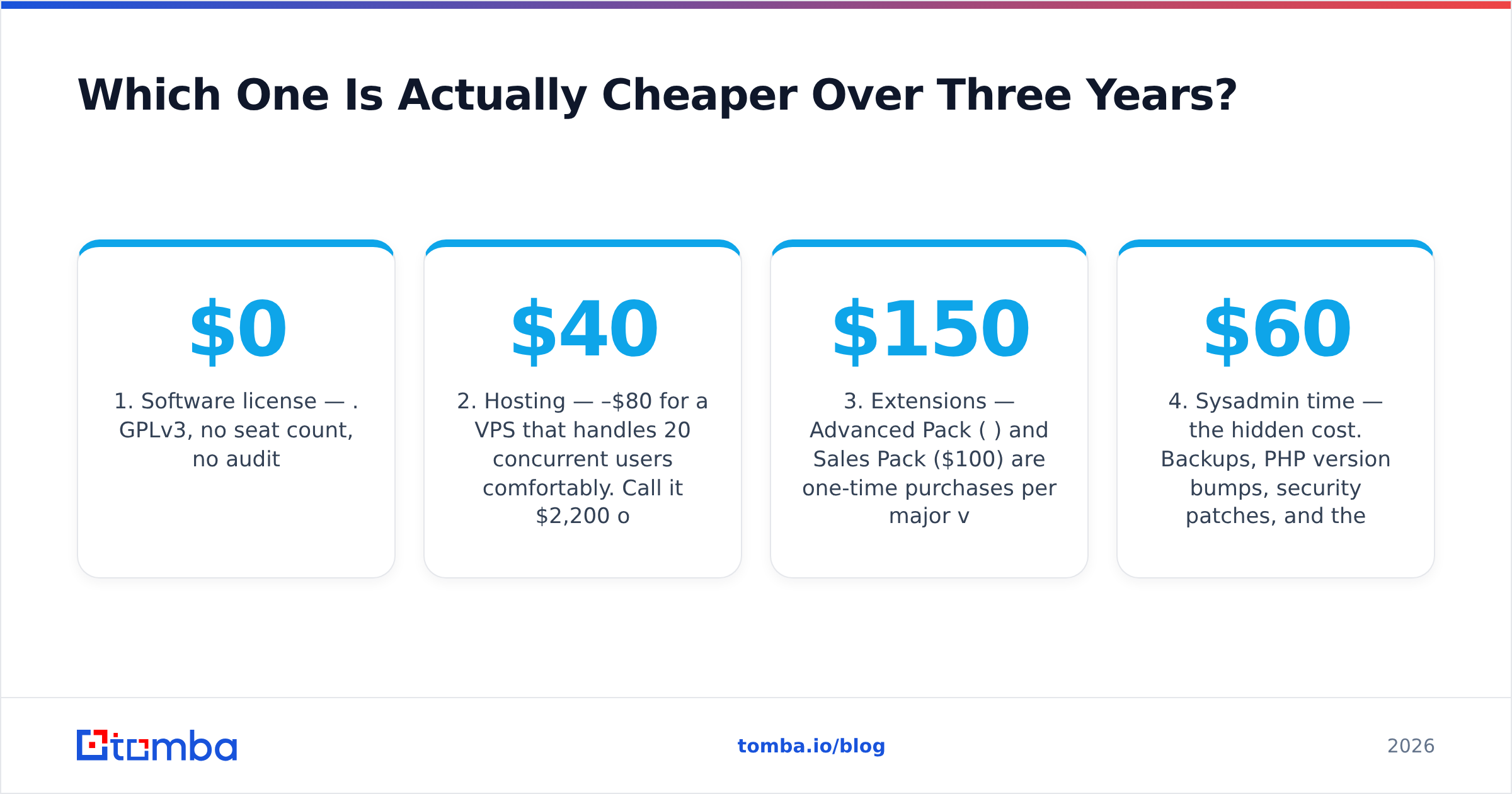
EspoCRM, 20 users, self-hosted, 3 years:
- Software license — $0. GPLv3, no seat count, no audit.
- Hosting — $40–$80/month for a VPS that handles 20 concurrent users comfortably. Call it $2,200 over three years.
- Extensions — Advanced Pack ($150) and Sales Pack ($100) are one-time purchases per major version. Budget $500 across three years including upgrades.
- Sysadmin time — the hidden cost. Backups, PHP version bumps, security patches, and the one weekend a year something breaks. Realistically 30–60 hours over three years. At a loaded internal rate of $60/hour, that is $1,800–$3,600.
- Total: roughly $4,500–$6,300.
SugarCRM Sell Advanced, 20 users, 3 years:
- Licenses — ~$85/user/month × 20 × 36 = $61,200.
- Implementation — partner-led onboarding typically runs $8,000–$25,000 for a mid-market rollout.
- Admin time — lower than EspoCRM but not zero; SugarBPM configuration is its own skill.
- Total: roughly $70,000–$85,000.
That is not proof that EspoCRM wins. It means SugarCRM has to deliver about $70,000 in extra value to break even. That value looks like better forecasting, fewer deals lost to process gaps, and faster ramp for new reps. For a 60-person sales org with a complex quote-to-cash motion, it often does. For a 12-person team selling a single product, it almost never does.
Is EspoCRM Powerful Enough for a Real Sales Team?#
Mostly yes, with three specific caveats.
Where EspoCRM holds up: contact and account management, deal pipelines with custom stages, email integration via IMAP/SMTP, activity logging, role-based permissions, custom entities, and a REST API that does not throttle you when self-hosted. The dynamic-logic system lets you show or hide fields based on conditions. That covers most of what teams actually want from "workflow."
Where it strains:
- Reporting. The free version has no report builder worth the name. The Advanced Pack adds one, and it is adequate rather than good. If your VP of Sales wants cohort analysis and weighted-pipeline waterfalls out of the box, you will end up piping data to Metabase or Looker Studio.
- Native integrations. SugarCRM has a marketplace with hundreds of validated connectors. EspoCRM has a much shorter list and leans on Zapier, Make, and its API for the rest. If you need a certified NetSuite or SAP connector on day one, this matters.
- Support. Community forums are responsive and the maintainers are active, but there is no phone number to call at 2 a.m. when the instance goes down mid-quarter.
The counter-argument is simple. Most CRM projects fail from over-configuration, not under-configuration. Gartner has repeatedly noted that CRM projects stall on adoption rather than capability. A lean tool your reps actually update beats a powerful one they route around.
When Is SugarCRM Worth the Premium?#
Four scenarios justify the invoice:
- Complex, multi-stage approval processes. SugarBPM handles quote approvals, discount thresholds, and legal review routing with visual process definitions. Rebuilding that in EspoCRM means custom formula scripts and hooks — doable, but you own the maintenance forever.
- Regulated industries. Audit trails, field-level change history, data residency options, and SOC 2 documentation come standard. If your security questionnaire is 400 rows long, you want a vendor who has answered it before.
- Forecast accuracy at scale. SugarPredict scores opportunities on historical patterns. It is not magic. But on a pipeline of 2,000+ open deals it beats gut-feel weighting, and revenue leadership will notice.
- You already run Sugar Market or Sugar Serve. Cross-module data sharing inside one vendor's suite is worth real money compared to stitching three tools together.
If none of those describe you, you are paying enterprise pricing for enterprise problems you don't have.
What About Data — Where Do Contacts Actually Come From?#
This is the question both vendors dodge in their marketing. It decides more outcomes than the CRM choice itself.
Neither EspoCRM nor SugarCRM ships a contact database. SugarCRM will happily sell you enrichment add-ons; EspoCRM expects you to bring your own. Either way, an empty CRM is a filing cabinet with nothing in it. And B2B contact data decays at roughly 22–30% per year as people change jobs — a figure HubSpot has documented in its own database research.
Practical stack for either CRM:
- Sourcing. Use a dedicated email finder to turn names and domains into verified work addresses before they hit the CRM. Unverified addresses pollute your reporting and your sender reputation at the same time.
- Bulk work. For list-based prospecting, a bulk email finder processes a CSV of companies into a contact list in one pass rather than one lookup at a time.
- Hygiene. Run a quarterly email verifier sweep over your existing CRM contacts. A 5,000-contact database that has not been verified in 18 months is typically 20–25% dead weight.
- Sync. Both CRMs can pull enriched records via API. Tomba's HubSpot integration and Zapier connector cover the common paths; for EspoCRM or SugarCRM specifically, the Tomba API is the direct route — one POST per record, mapped to whatever fields you defined.
Here is where teams get this wrong. They pick the CRM first, spend eight weeks on setup, then find in month three that nobody has a repeatable way to add new contacts. Sequence it the other way. Prove your sourcing motion works with a spreadsheet, then pick the container.
How Do the Two Handle Customization and Extensibility?#
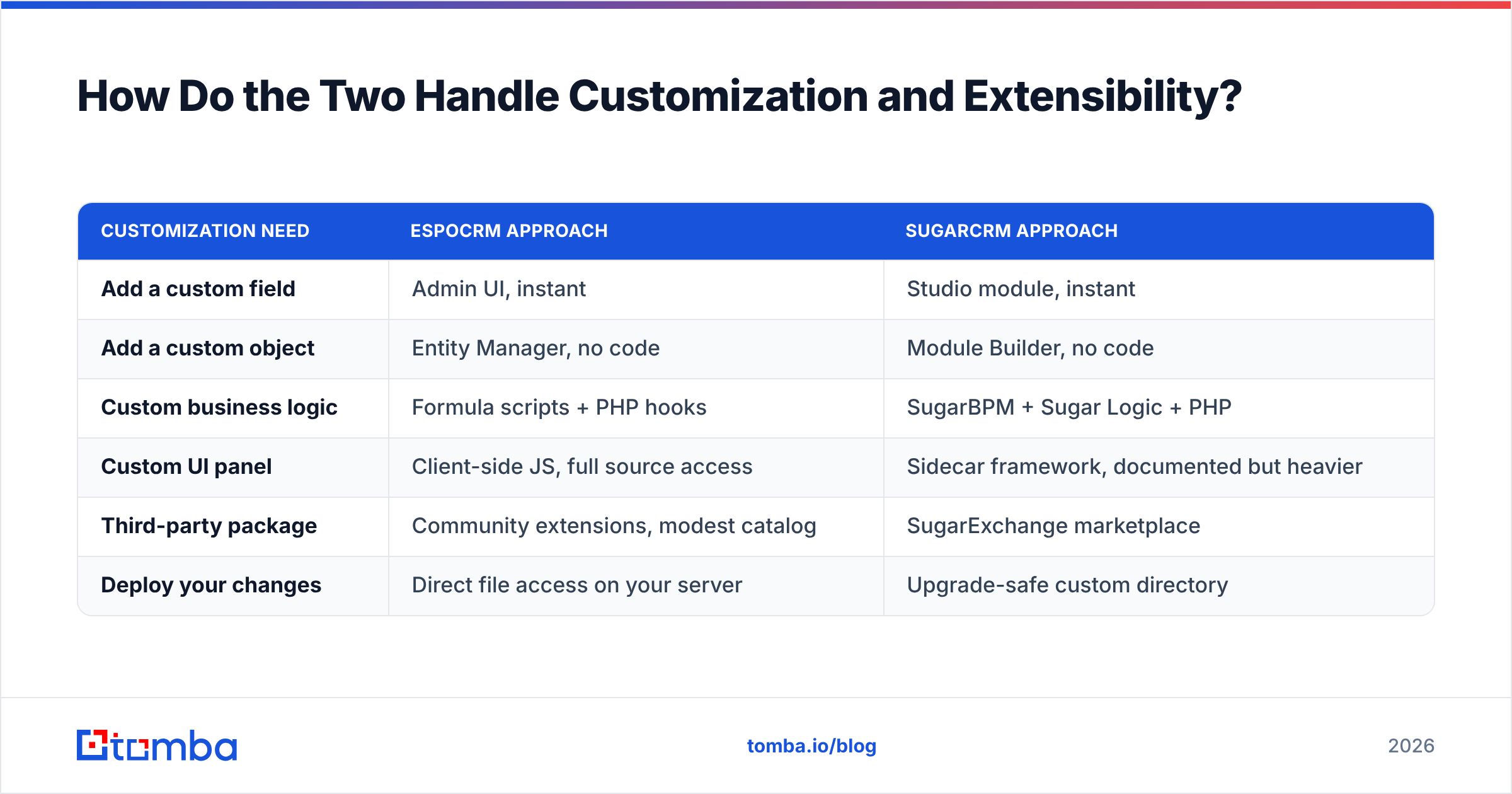
| Customization need | EspoCRM approach | SugarCRM approach |
|---|---|---|
| Add a custom field | Admin UI, instant | Studio module, instant |
| Add a custom object | Entity Manager, no code | Module Builder, no code |
| Custom business logic | Formula scripts + PHP hooks | SugarBPM + Sugar Logic + PHP |
| Custom UI panel | Client-side JS, full source access | Sidecar framework, documented but heavier |
| Third-party package | Community extensions, modest catalog | SugarExchange marketplace |
| Deploy your changes | Direct file access on your server | Upgrade-safe custom directory |
EspoCRM wins on speed of iteration because you have root on the box. You can read the source, patch it, and ship in an afternoon. That is also the risk: sloppy customization makes upgrades painful. SugarCRM's upgrade-safe model is slower but survives version bumps more gracefully — a genuine advantage on a five-year horizon.
Both platforms score respectably on G2's CRM category, with EspoCRM typically rated higher on value-for-money and SugarCRM higher on enterprise feature depth. That split is exactly what the pricing predicts.
Which Should You Pick?#
The EspoCRM vs SugarCRM decision comes down to five questions. Answer them in order:
- Do you have someone who can run a Linux server? No → SugarCRM cloud, or EspoCRM cloud as a middle path.
- Is your sales process linear or does it branch through approvals? Linear → EspoCRM. Branching → SugarCRM.
- What is your seat count in 24 months? Under 25 → EspoCRM's economics are hard to argue with. Over 75 → SugarCRM's implementation cost amortizes.
- Do you face compliance audits? Yes → SugarCRM, unless you have the internal capacity to document a self-hosted stack yourself.
- Is data ownership a strategic requirement? Yes → EspoCRM self-hosted, full stop. Nothing else in this comparison matters.
The honest default for most teams reading this: start with EspoCRM cloud at $15–$29 per user, run it for two quarters, and move to SugarCRM only when you hit a wall you can name. Migrating a 4,000-record CRM is a two-week project, not a two-year one. Overbuying a CRM before you have process to put in it is a far more expensive mistake than switching later.
One more thing worth checking before you commit: how each tool handles duplicate detection. Both have it. Both implement it differently. And both will make your life miserable if you import a messy list without configuring it first. Clean your data before import — deduplicate the list and verify it — and you avoid the most common post-migration cleanup project.
Fill Whichever CRM You Pick#
The EspoCRM vs SugarCRM debate matters less than what you put in the winner. Whether you land on EspoCRM's self-hosted flexibility or SugarCRM's enterprise process engine, the pipeline only moves when verified contacts flow in consistently.
Tomba's Email Finder turns names and company domains into verified professional email addresses. The free tier covers 25 searches per month, and paid plans start at $49/month for Starter, $99/month for Growth, and $249/month for Pro. Push results into either CRM via the API, the Chrome extension, or a bulk CSV run — and see full Tomba pricing for team volumes. Get the sourcing right, and the CRM debate becomes a much smaller decision.
Related guides#
Ready to find emails that actually work?
Join 150,000+ professionals who stopped guessing and started sending. Free credits on signup — no credit card required.
Get the Tomba newsletter
Practical outbound tactics and product updates — once every two weeks.
About the author