Ethics in Sales: The 2026 Guide to Selling Without Lying
Sales ethics stopped being a values-page slogan and became a legal, data, and pipeline problem. Here is where the line actually sits in 2026 — and how honest reps still hit quota.
TL;DR
- Ethics in sales is no longer a poster in the break room. In 2026 it is enforced by privacy regulators, mailbox providers, procurement teams, and review sites — all of which punish deception faster than any ethics committee ever did.
- The two failure modes that cost the most money are false urgency (fake deadlines, invented scarcity) and dirty data (scraped lists, invented consent, contacts nobody can source).
- The line between persuasion and manipulation is testable: if the buyer would feel misled after seeing exactly how you got their attention, you crossed it.
- Cold outreach is legal and ethical in most B2B contexts — but the rules differ sharply between the US, EU, Canada, and the UK, and "I bought a list" is not a defense anywhere.
- Ethical prospecting is mostly an operational problem: verified contacts, documented sources, honest claims, and an easy opt-out. Tools solve about 70% of it.
What Does "Ethics in Sales" Actually Mean in 2026?#
Ethics in sales means the buyer would make the same decision if they could see everything you know. That is the whole test, compressed.
Everything else is elaboration. If your pricing page says "3 seats left at this rate" and there is no seat limit, the buyer would not have hurried had they known. If your prospect list came from a scrape that stripped an unsubscribe flag, they would not have wanted your email had they known. If your demo skipped the integration that breaks their workflow, they would not have signed had they known.
The reason this framing matters is that most sales ethics training fails by being abstract. Reps nod along to "act with integrity," then get on a call where the deal slips a quarter and the manager asks what happened. Abstract values lose to concrete quota pressure every time. A concrete test — would this survive full disclosure? — holds up under pressure because you can answer it in three seconds while the prospect is still typing.
There is also a harder version of the question that most teams skip: is the product right for this buyer at all? Selling a $40k platform to a five-person company that will never use 80% of it is not illegal, and it will book. It also produces a churn event, a bad G2 review, and a rep who learns that closing beats fit. Gartner's research on B2B buying has consistently found that buyers who feel confident in their decision — not buyers who felt pushed — are the ones who complete high-quality purchases without regret.
Why Do Sales Ethics Matter More Now Than in 2020?#
Because the punishment got automated. Four things changed:
- Mailbox providers became judges. Google and Yahoo's bulk-sender requirements made complaint rate a hard gate. Send to people who did not want you and your domain reputation degrades — not in a quarterly review, but in days. Ethics and email deliverability now share the same scoreboard.
- Privacy law grew teeth outside the EU. GDPR was the opening act. State-level US privacy laws, Canada's CASL enforcement, and the UK's PECR regime all now carry penalties large enough to appear in a board deck.
- Buyers research you before you reach them. Review sites, Reddit threads, and Slack communities mean a manipulative sales motion becomes public knowledge inside one sales cycle. G2 reviews mentioning aggressive sales tactics rank for your brand name.
- AI made deception cheap and therefore suspicious. When anyone can generate 10,000 personalized-looking emails an hour, buyers' default assumption flipped to "this is fake until proven otherwise." Honest signals — a real name, a verifiable source, a specific reason for reaching out — became the scarce thing.

The practical consequence: the unethical path is now also the expensive path. Bad data burns sending domains. Fake urgency produces refund requests. Overselling produces churn. The old trade-off — "be ruthless and win short-term, be honest and win long-term" — has collapsed into a much shorter time horizon.
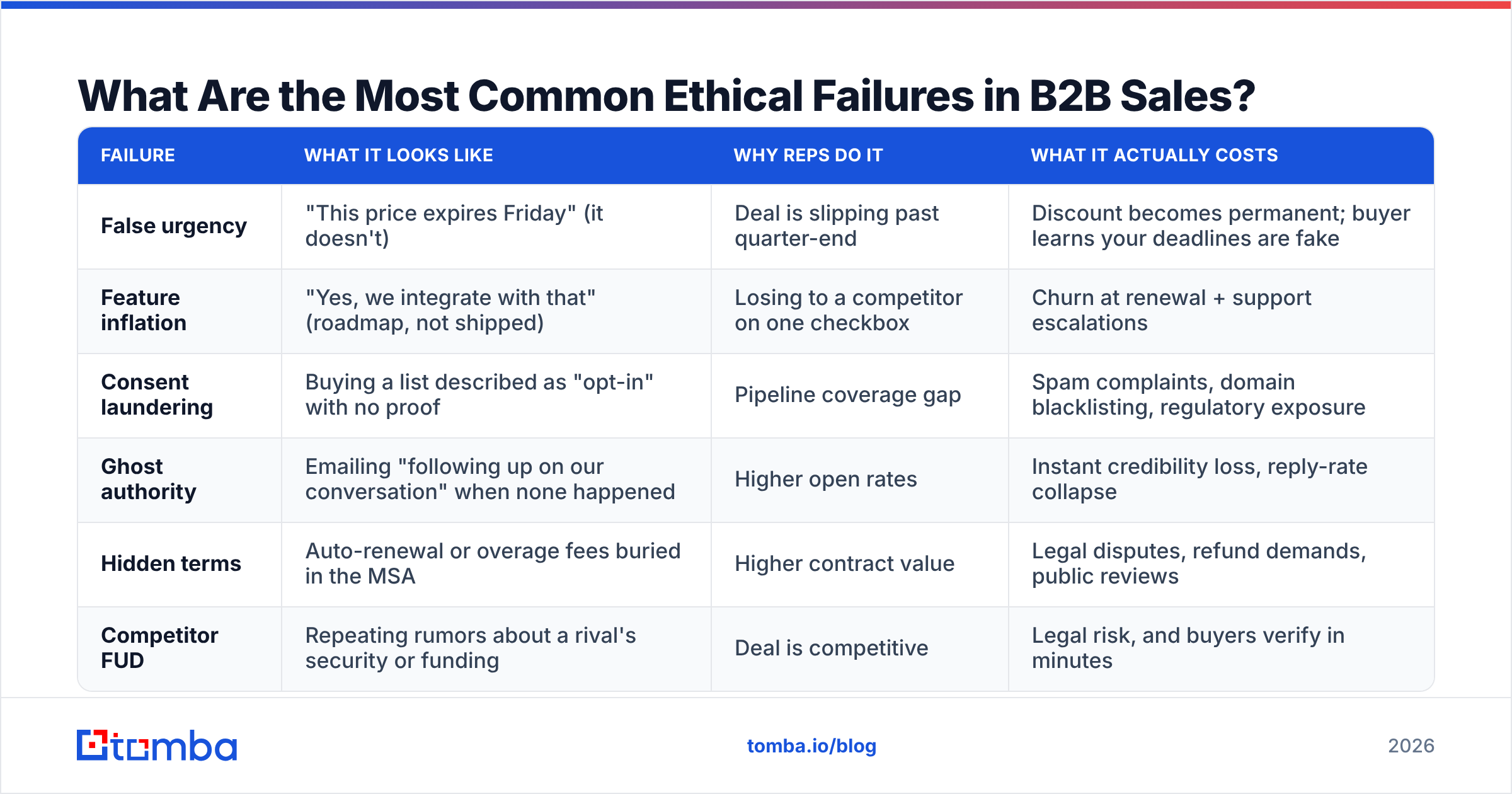
What Are the Most Common Ethical Failures in B2B Sales?#
Not fraud. Fraud is rare and obvious. The common failures are small, deniable, and cumulative.
| Failure | What it looks like | Why reps do it | What it actually costs |
|---|---|---|---|
| False urgency | "This price expires Friday" (it doesn't) | Deal is slipping past quarter-end | Discount becomes permanent; buyer learns your deadlines are fake |
| Feature inflation | "Yes, we integrate with that" (roadmap, not shipped) | Losing to a competitor on one checkbox | Churn at renewal + support escalations |
| Consent laundering | Buying a list described as "opt-in" with no proof | Pipeline coverage gap | Spam complaints, domain blacklisting, regulatory exposure |
| Ghost authority | Emailing "following up on our conversation" when none happened | Higher open rates | Instant credibility loss, reply-rate collapse |
| Hidden terms | Auto-renewal or overage fees buried in the MSA | Higher contract value | Legal disputes, refund demands, public reviews |
| Competitor FUD | Repeating rumors about a rival's security or funding | Deal is competitive | Legal risk, and buyers verify in minutes |
The pattern across all six: each one converts a future cost into a present number. That is why they survive in teams with good people. Nobody wakes up wanting to lie about a deadline — they want the forecast to hold.
Managers create most of these. If your comp plan pays full commission on a deal that churns in 90 days, you have built a machine that rewards feature inflation. If your only pipeline metric is emails sent, you have built a machine that rewards buying lists. Fix the incentive before you write the ethics policy.
Where Is the Line Between Persuasion and Manipulation?#
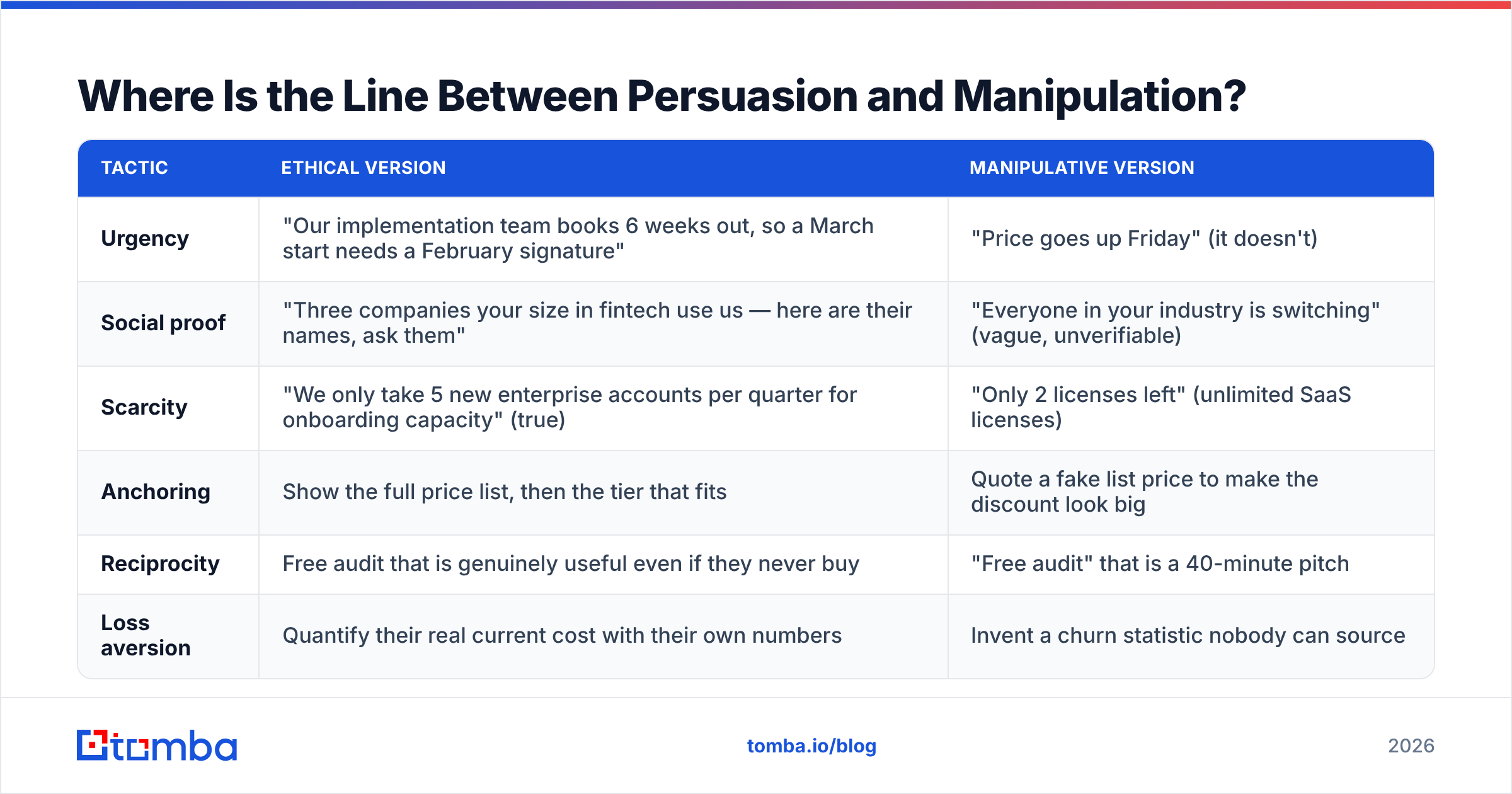
Persuasion gives the buyer more accurate information. Manipulation gives them less. Same tactic, different direction.
| Tactic | Ethical version | Manipulative version |
|---|---|---|
| Urgency | "Our implementation team books 6 weeks out, so a March start needs a February signature" | "Price goes up Friday" (it doesn't) |
| Social proof | "Three companies your size in fintech use us — here are their names, ask them" | "Everyone in your industry is switching" (vague, unverifiable) |
| Scarcity | "We only take 5 new enterprise accounts per quarter for onboarding capacity" (true) | "Only 2 licenses left" (unlimited SaaS licenses) |
| Anchoring | Show the full price list, then the tier that fits | Quote a fake list price to make the discount look big |
| Reciprocity | Free audit that is genuinely useful even if they never buy | "Free audit" that is a 40-minute pitch |
| Loss aversion | Quantify their real current cost with their own numbers | Invent a churn statistic nobody can source |
Every ethical version is more persuasive to a sophisticated buyer, not less. "Our implementation team books six weeks out" is checkable and therefore credible. "Price goes up Friday" is the sentence every buyer has heard from every vendor, which is why it now reads as noise.
If you want a single heuristic to hand a new rep: never make a claim you could not put in writing in the contract. Feature claim? Then it can be a warranty. Deadline? Then it goes in the quote with an expiry date you will actually honor. Statistic? Then it comes with a source link. Claims that cannot survive being written down should not be spoken.
Is Cold Outreach Ethical — and Is It Even Legal?#
Cold outreach to a business contact about something relevant to their job is ethical and, in most jurisdictions, legal. Cold outreach to a personal address, or to someone who told you to stop, is neither.
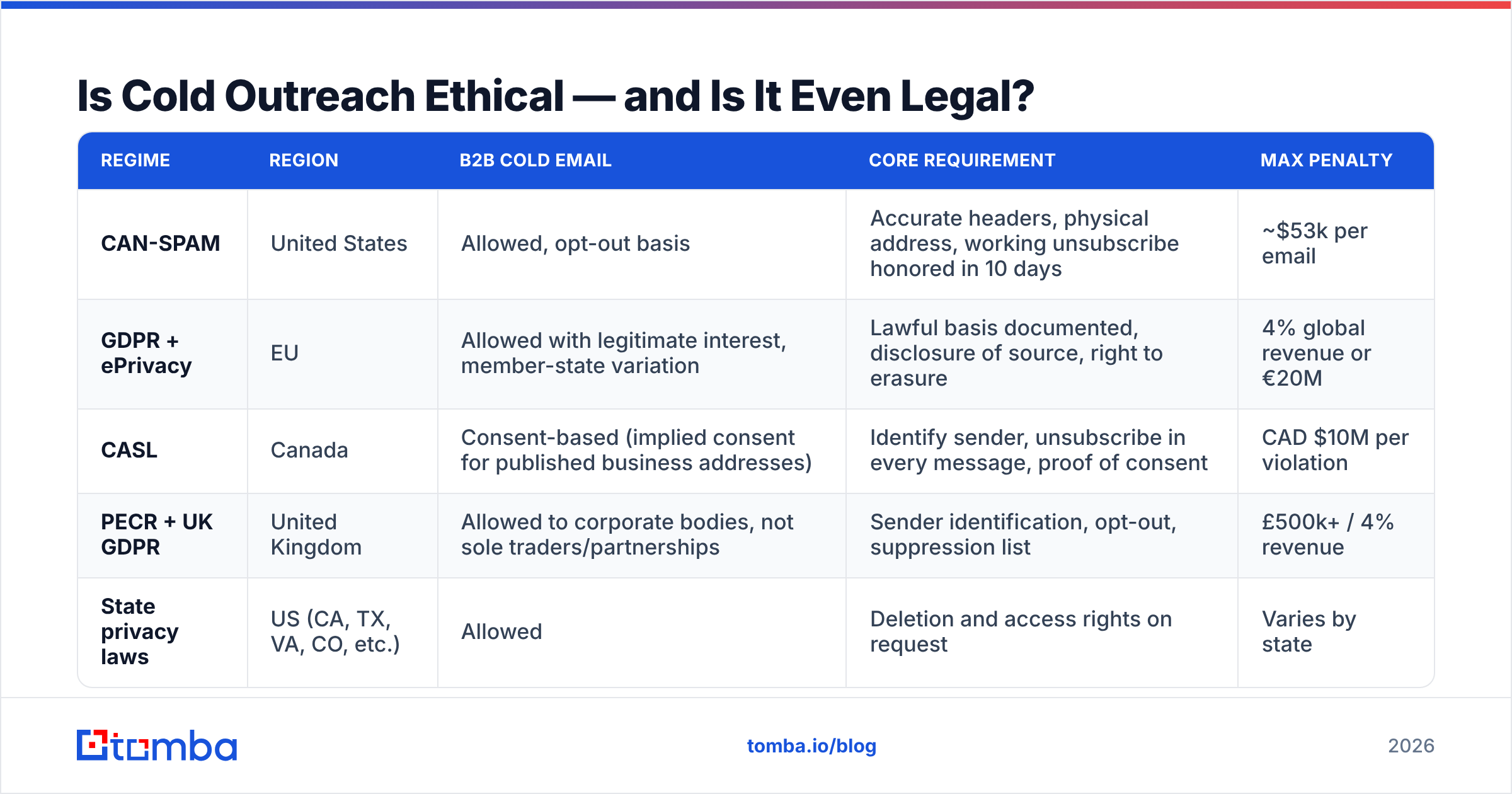
The regulatory picture differs by region more than most teams realize:
| Regime | Region | B2B cold email | Core requirement | Max penalty |
|---|---|---|---|---|
| CAN-SPAM | United States | Allowed, opt-out basis | Accurate headers, physical address, working unsubscribe honored in 10 days | ~$53k per email |
| GDPR + ePrivacy | EU | Allowed with legitimate interest, member-state variation | Lawful basis documented, disclosure of source, right to erasure | 4% global revenue or €20M |
| CASL | Canada | Consent-based (implied consent for published business addresses) | Identify sender, unsubscribe in every message, proof of consent | CAD $10M per violation |
| PECR + UK GDPR | United Kingdom | Allowed to corporate bodies, not sole traders/partnerships | Sender identification, opt-out, suppression list | £500k+ / 4% revenue |
| State privacy laws | US (CA, TX, VA, CO, etc.) | Allowed | Deletion and access rights on request | Varies by state |
Two practical takeaways. First, "we're B2B so GDPR doesn't apply" is wrong — a work email tied to a named person is personal data under GDPR. What B2B gets you is a plausible legitimate interest basis, not an exemption. Second, every regime in that table requires you to identify yourself honestly and honor opt-outs. That is not a coincidence. Regulators converged on the same two rules because those are the two that buyers actually care about.
How Do You Source Contact Data Ethically?#
This is where ethics stops being philosophy and becomes procurement. Your outbound is exactly as ethical as your data supplier.
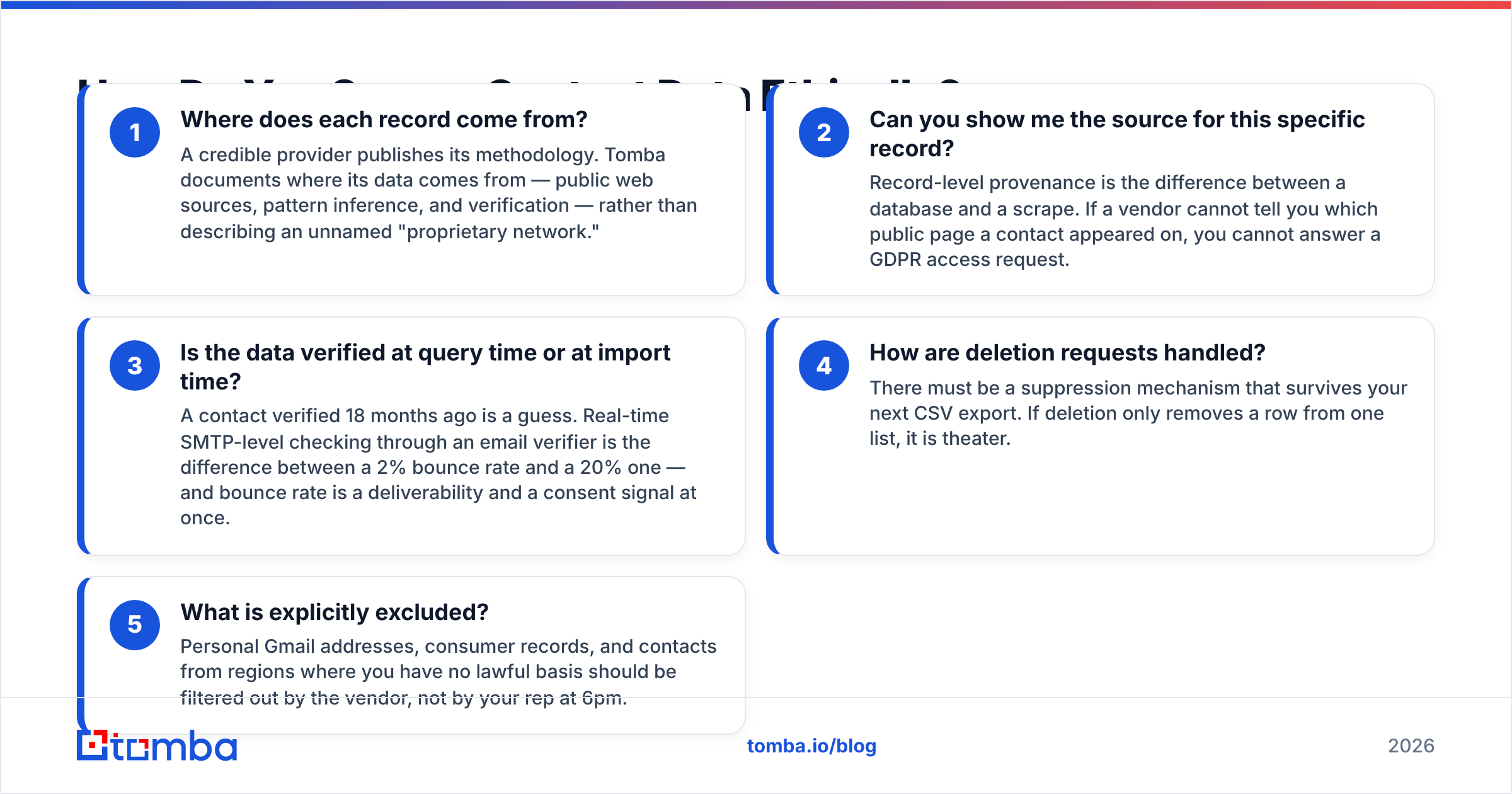
Ask any vendor these five questions before you send a single email through their data:
- Where does each record come from? A credible provider publishes its methodology. Tomba documents where its data comes from — public web sources, pattern inference, and verification — rather than describing an unnamed "proprietary network."
- Can you show me the source for this specific record? Record-level provenance is the difference between a database and a scrape. If a vendor cannot tell you which public page a contact appeared on, you cannot answer a GDPR access request.
- Is the data verified at query time or at import time? A contact verified 18 months ago is a guess. Real-time SMTP-level checking through an email verifier is the difference between a 2% bounce rate and a 20% one — and bounce rate is a deliverability and a consent signal at once.
- How are deletion requests handled? There must be a suppression mechanism that survives your next CSV export. If deletion only removes a row from one list, it is theater.
- What is explicitly excluded? Personal Gmail addresses, consumer records, and contacts from regions where you have no lawful basis should be filtered out by the vendor, not by your rep at 6pm.
The uncomfortable truth for a lot of teams: a smaller, verified, well-sourced list outperforms a bigger dirty one on every metric that matters. Fewer sends, higher reply rate, intact domain reputation, no legal exposure. The ethical choice is the one that also produces the better funnel — which makes it a much easier sell internally than "because it's right."
What Does an Ethical Sales Process Look Like, Stage by Stage?#
Ethics has to be embedded in the motion, not bolted onto it. Here is what changes at each stage:
- Sourcing — Use documented, verifiable sources. Keep the provenance field on the record so anyone can answer "where did this come from?" months later. Verify before sending, not after bouncing.
- First touch — Say who you are, what company you work for, and why you are reaching out to this person specifically. No fake threads, no "re:" on a first email, no invented prior conversation. Include a real opt-out even when the law does not force one.
- Discovery — Ask questions whose answers could disqualify the deal, and mean it. A discovery call that cannot produce a "no" is a pitch with a question mark.
- Demo and proposal — Show the product as it ships today. Roadmap items get labeled as roadmap, in writing. If a competitor is genuinely better for their use case, say so — you will lose that deal and win the referral.
- Negotiation — One price logic, applied consistently. Discounts tied to real trade-offs (term length, volume, case study rights), not to how hard the buyer pushed or how close it is to quarter-end.
- Handoff and renewal — Everything promised in the sales cycle gets written into the onboarding brief. The fastest way to detect an unethical sales team is to ask customer success what they inherit.
Salesforce's own guidance on building trust in the sales process lands in the same place from a different angle: the operational cost of undoing a mis-set expectation is far higher than the cost of setting it correctly the first time.
How Do You Actually Enforce Sales Ethics on a Team?#
Policies do nothing. Four mechanisms do:
- Change the comp plan. Claw back commission on deals that churn inside 90–120 days. This single change kills feature inflation faster than any training module, because it moves the cost of overselling back onto the person doing it.
- Audit outbound at random. Pull ten sent emails per rep per month. Check every factual claim and every implied prior relationship. Reps behave differently when they know sequences get read by a human.
- Make disqualification a celebrated metric. Track and reward "disqualified for fit" as a real outcome. If the only good outcome is a closed-won, reps will manufacture closed-wons.
- Give a clean escalation path. A rep who is being pushed by a manager to fake a deadline needs somewhere to take that. If the only path runs through the person applying the pressure, you do not have a path.
And then measure the thing that ethics is supposed to protect: complaint rate, bounce rate, unsubscribe rate, 90-day churn, and win-rate-by-honest-loss. HubSpot's ongoing sales research shows trust-related factors dominating buyer selection criteria — but you do not need the study. Look at your own renewal cohort and ask which reps' customers stay.
Where Should You Start?#
Start with data, because it is the one place where ethics is a solvable engineering problem rather than a judgment call. Documented sources, verified addresses, working suppression lists, and honest sender identity handle the majority of the real-world ethical failures in B2B outbound — the ones that generate complaints, blacklistings, and regulatory letters.
Then work outward: rewrite the sequences that imply relationships that do not exist, fix the comp plan that rewards bad-fit deals, and put a written source next to every statistic in your pitch deck.
If you want the data layer sorted first, Tomba's Email Finder finds professional addresses from documented public sources, verifies them in real time before you send, and keeps provenance on the record so you can answer "where did you get this?" without guessing. The free tier includes 25 searches a month; paid Tomba plans start at $49/mo. Build the list you would be comfortable showing the person on it — then go sell honestly, and let the reply rate make the argument for you.
Related guides#
Ready to find emails that actually work?
Join 150,000+ professionals who stopped guessing and started sending. Free credits on signup — no credit card required.
Get the Tomba newsletter
Practical outbound tactics and product updates — once every two weeks.
About the author