Everest (Return Path) by Validity Alternatives: 8 Picks
Everest absorbed Return Path and 250ok, and the price went with it. Here are 8 Everest by Validity alternatives compared on seed testing, reputation data, list hygiene, and real cost.
TL;DR — the short version for anyone weighing Everest by Validity alternatives:
- Everest is Validity's deliverability platform. It absorbed Return Path in 2019 and 250ok in 2020. If you are searching for "Return Path alternatives," Everest is what Return Path became.
- Most teams shop for Everest by Validity alternatives for one reason: price. Contracts are annual and start in the four figures per month. Many buyers only wanted seed tests and blocklist alerts.
- The best-value swaps are GlockApps, Inbox Monster, Sinch Mailgun Optimize, Mailtrap, MailReach, and Folderly.
- Google Postmaster Tools and Microsoft SNDS cover the reputation basics for free. Start there before you pay anyone.
- No monitoring tool fixes a dirty list. Verifying contacts before you send removes more spam-folder risk than any dashboard.
What is Everest by Validity, and what happened to Return Path?#
Everest is Validity's all-in-one email deliverability platform. It bundles inbox placement tests, sender reputation data, blocklist alerts, design previews, and engagement reports. Its real moat is data from Validity's certification program and its Gmail-side partnerships.
The history explains the price. Return Path was the original sender-reputation company. Validity bought it in 2019. Validity then bought 250ok in 2020 and folded both into Everest. Two of the three serious independent vendors became one platform. Pricing moved to enterprise annual contracts.
That is why Everest by Validity alternatives is now a real search category, not idle shopping. Teams that paid $200–$400 a month for 250ok were later quoted five figures a year.
What Everest does well:
- Seed-list breadth. Placement panels for Gmail, Outlook, Yahoo, and many regional and B2B receivers.
- Reputation history. Trended sender data going back years. It helps when you are tracking a slow decline, not a sudden block.
- Certification. Validity Certified, the old Return Path Certification, still carries weight with some receivers.
- Design QA. Rendering previews across dozens of clients, plus link and accessibility checks.
- Enterprise support. Named deliverability consultants. Most alternatives do not offer this at all.
- One dashboard. Your CMO can read it without three logins.
Need all six? Everest is defensible. Need two? You are overpaying by a wide margin.
Why do teams look for Everest alternatives?#
Four complaints come up again and again in G2 reviews and in practitioner forums.
Price versus usage. Everest is sold as an annual platform. Most buyers use placement tests and blocklist alerts. The rest of the modules sit idle.
Contract friction. Annual terms mean procurement cycles and renewal talks. You cannot spin it up for a two-month migration and then walk away.
Seed lists have limits. A seed test shows where a message landed for a panel of test accounts. It does not show where it landed for your subscribers. Gmail filters per user, so panel results and real placement can drift apart. Every seed-based tool shares this limit. You just feel it more at enterprise prices.
Overlap with free data. Google Postmaster Tools shows domain reputation, spam rate, authentication results, and delivery errors. It costs nothing. Microsoft SNDS does much the same for Outlook IP reputation. A good slice of what Everest charges for is free if you open two tabs.

How do the main Everest by Validity alternatives compare?#
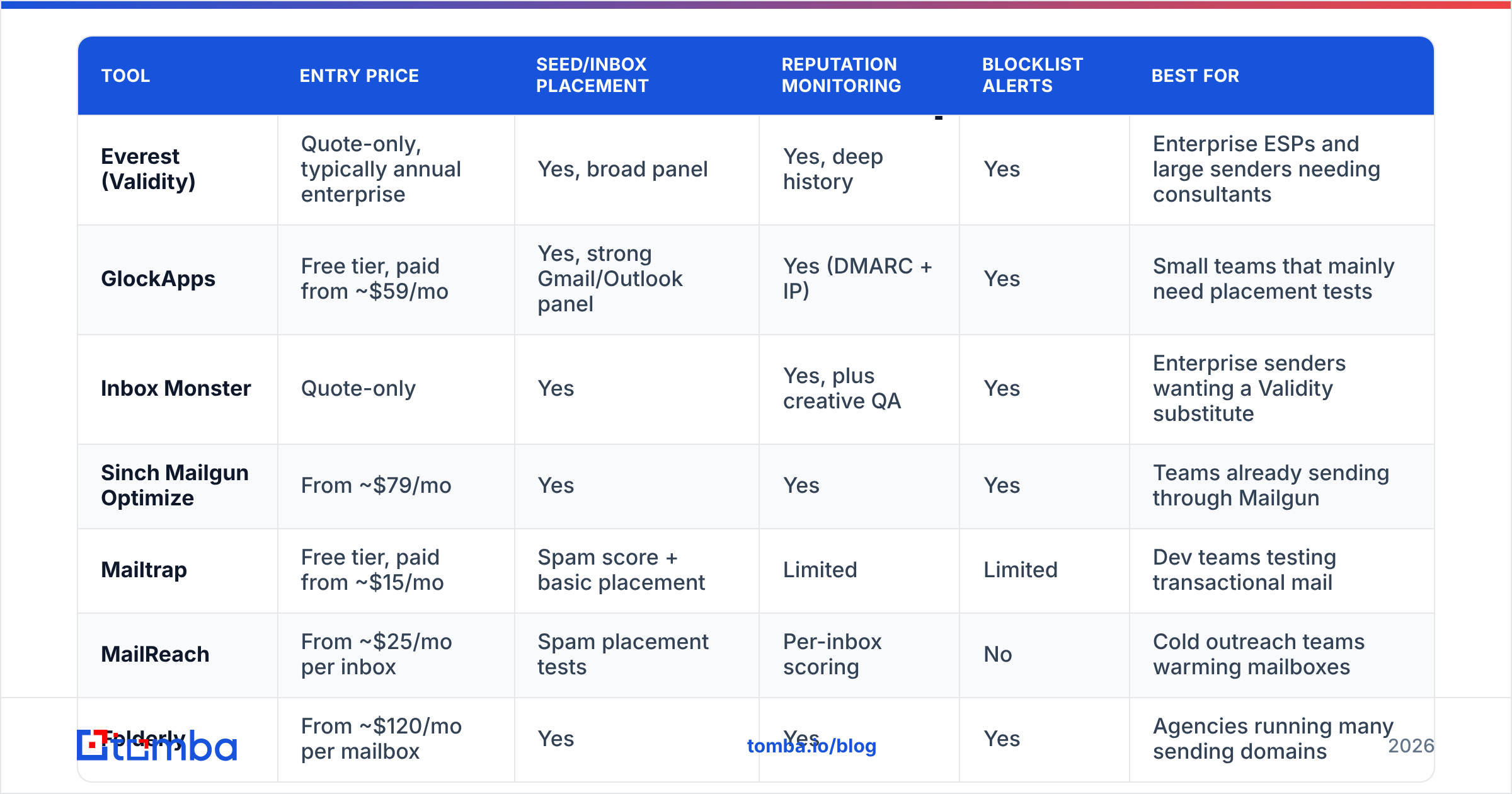
Prices below are public list prices seen in early 2026 for entry-level paid tiers. Vendors change packaging often, and most enterprise tiers are quote-only. Treat these as a starting point for your own quotes, not a contract.
| Tool | Entry price | Seed/inbox placement | Reputation monitoring | Blocklist alerts | Best for |
|---|---|---|---|---|---|
| Everest (Validity) | Quote-only, typically annual enterprise | Yes, broad panel | Yes, deep history | Yes | Enterprise ESPs and large senders needing consultants |
| GlockApps | Free tier, paid from ~$59/mo | Yes, strong Gmail/Outlook panel | Yes (DMARC + IP) | Yes | Small teams that mainly need placement tests |
| Inbox Monster | Quote-only | Yes | Yes, plus creative QA | Yes | Enterprise senders wanting a Validity substitute |
| Sinch Mailgun Optimize | From ~$79/mo | Yes | Yes | Yes | Teams already sending through Mailgun |
| Mailtrap | Free tier, paid from ~$15/mo | Spam score + basic placement | Limited | Limited | Dev teams testing transactional mail |
| MailReach | From ~$25/mo per inbox | Spam placement tests | Per-inbox scoring | No | Cold outreach teams warming mailboxes |
| Folderly | From ~$120/mo per mailbox | Yes | Yes | Yes | Agencies running many sending domains |
| Google Postmaster + SNDS | Free | No | Yes (domain/IP, first-party) | No | Every sender, as the baseline layer |
| Tomba | Free tier, paid from $49/mo | No (not a monitoring tool) | No | No | Removing invalid contacts before they hurt reputation |
Two things stand out. First, no single tool replaces all of Everest. The market has specialized. Second, the biggest cost driver is the pricing unit. Per-mailbox pricing and per-platform pricing flip the math. One marketing domain is cheap. Forty cold-outreach inboxes are not.
Which of the Everest by Validity alternatives fits your situation?#
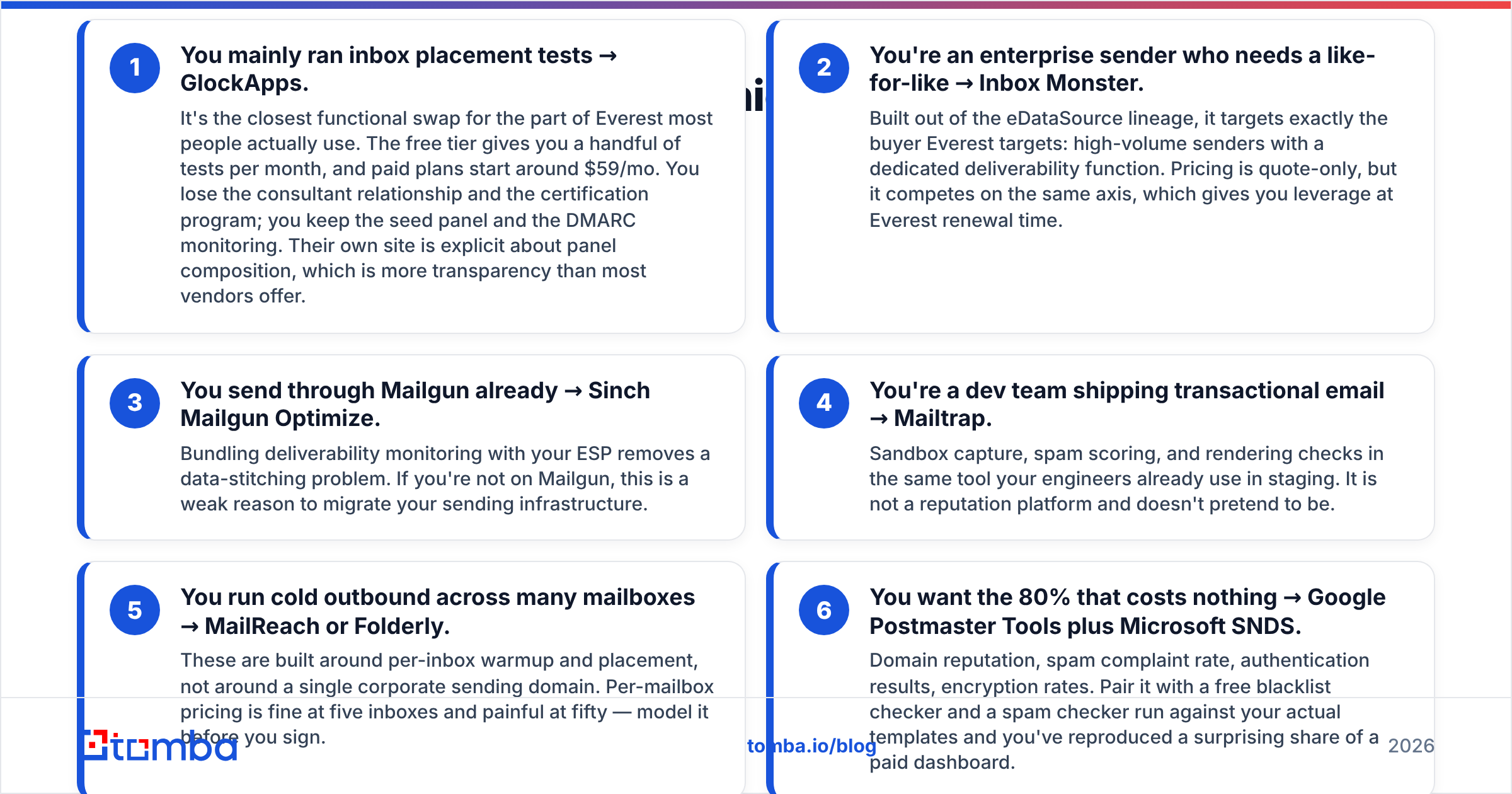
You mainly ran placement tests → GlockApps. It is the closest swap for the part of Everest most people use. The free tier gives you a few tests a month. Paid plans start near $59/mo. You lose the consultant and the certification program. You keep the seed panel and the DMARC monitoring. Their own site lists panel composition openly, which is rare.
You are an enterprise sender and need a like-for-like → Inbox Monster. It grew out of the eDataSource lineage. It targets the same buyer Everest targets: high-volume senders with a deliverability team. Pricing is quote-only. It competes on the same axis, so it gives you leverage at renewal time.
You already send through Mailgun → Sinch Mailgun Optimize. Bundling monitoring with your ESP removes a data-stitching problem. If you are not on Mailgun, this is a weak reason to move your sending stack.
You are a dev team shipping transactional email → Mailtrap. You get sandbox capture, spam scoring, and rendering checks in the tool your engineers already use. It is not a reputation platform, and it does not pretend to be.
You run cold outbound across many mailboxes → MailReach or Folderly. Both are built around per-inbox warmup and placement. Per-mailbox pricing is fine at five inboxes. It hurts at fifty. Model the cost before you sign.
You want the free 80% → Google Postmaster Tools and Microsoft SNDS. You get domain reputation, complaint rate, authentication results, and encryption rates. Add a free blacklist checker and a spam checker run against your real templates. That covers a surprising share of a paid dashboard.
What do the Everest by Validity alternatives cost?#
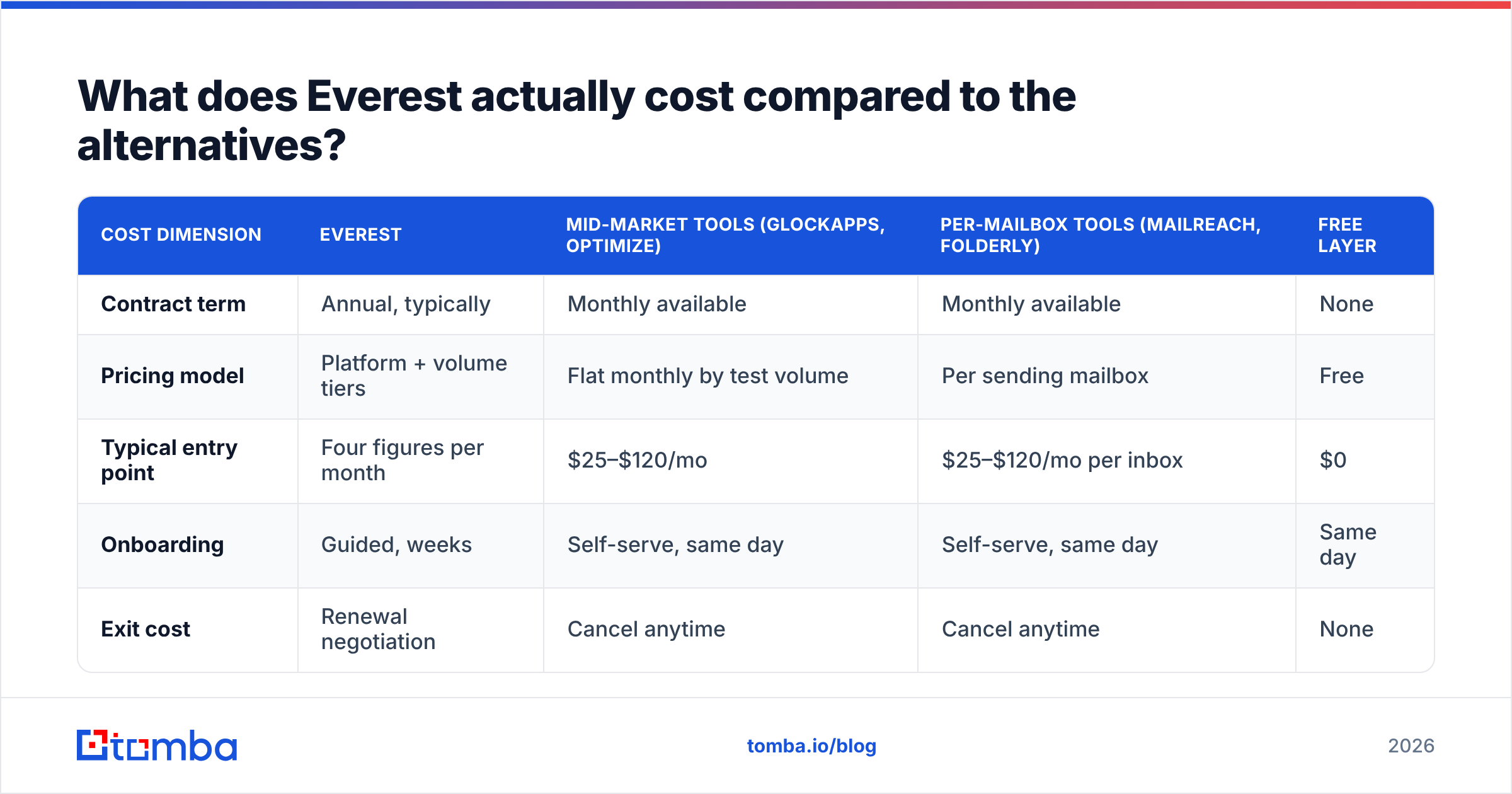
The honest answer: Everest does not publish pricing. Neither does Inbox Monster. What you can compare is the shape of the commitment. Here is how Everest by Validity alternatives differ on terms.
| Cost dimension | Everest | Mid-market tools (GlockApps, Optimize) | Per-mailbox tools (MailReach, Folderly) | Free layer |
|---|---|---|---|---|
| Contract term | Annual, typically | Monthly available | Monthly available | None |
| Pricing model | Platform + volume tiers | Flat monthly by test volume | Per sending mailbox | Free |
| Typical entry point | Four figures per month | $25–$120/mo | $25–$120/mo per inbox | $0 |
| Onboarding | Guided, weeks | Self-serve, same day | Self-serve, same day | Same day |
| Exit cost | Renewal negotiation | Cancel anytime | Cancel anytime | None |
Most teams land on the same pattern. Keep the free reputation layer forever. Add one seed-testing tool on a monthly plan. Buy consulting hours from a freelance deliverability expert when something breaks. That stack costs a fraction of an Everest contract, and it covers the same failure modes.
Is a monitoring tool even the right fix?#
Here is the part vendors do not lead with. Most deliverability problems are list problems in disguise.
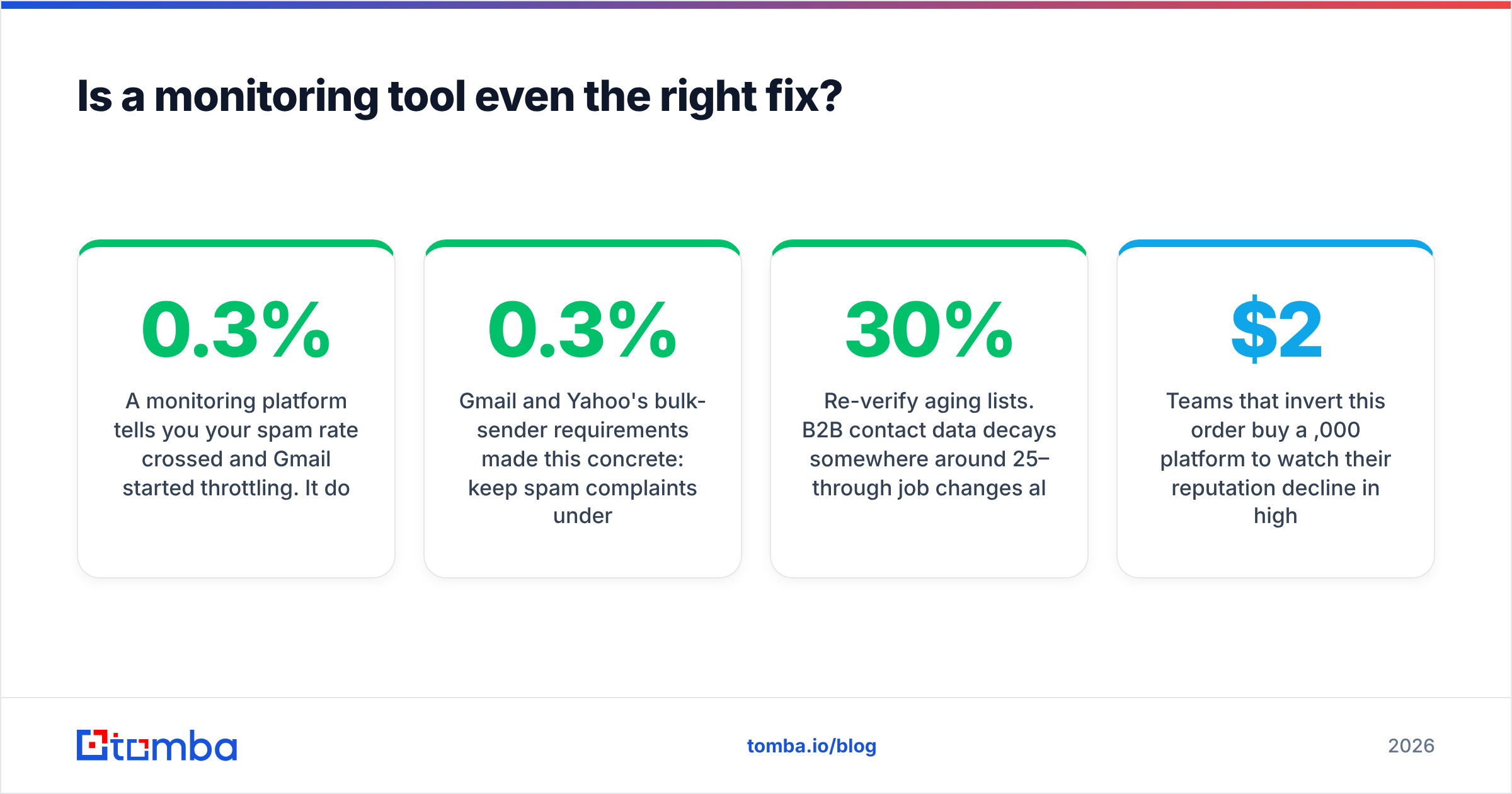
A monitoring platform tells you the spam rate crossed 0.3% and Gmail began throttling. It does not tell you why. Maybe 14% of last quarter's imported contacts were role accounts, typos, and dead mailboxes. Some of those now work as spam traps. The dashboard reports the symptom. The list caused it.
Gmail and Yahoo's bulk-sender rules made this concrete. Keep spam complaints under 0.3%. Authenticate with SPF and DKIM. Publish DMARC. Support one-click unsubscribe. Each rule is easier to meet when the list is clean at the point of entry. Hard bounces from invalid addresses hurt sender reputation directly. Every seed test sits downstream of that reputation.

So the order that actually works:
- Verify before you import. Run new contacts through an email verifier. Invalid addresses never enter the sending pool. That is cheap next to a blocklisting.
- Handle catch-all domains on purpose. Many B2B domains accept every address at the SMTP layer. A catch-all verifier gives you a confidence signal instead of a coin flip. Segment the risky ones into a smaller stream.
- Re-verify old lists. B2B contact data decays 25–30% a year from job changes alone. A list you cleaned 18 months ago is not clean.
- Bulk-clean before big sends. A bulk verify pass takes 20 minutes. A reputation recovery takes two weeks.
- Then monitor. With a clean list, seed tests point at content, authentication, and volume ramp. Those are signals you can act on.
Invert that order and you pay $2,000 a month to watch your reputation fall in high resolution.
How do you migrate off Everest without losing coverage?#
Run this before the renewal date, not after.
Export your history first. Pull reputation trends, past placement tests, and blocklist logs. Once the contract ends, that history is gone. So is your baseline.
Inventory what you used. Review the last 90 days of activity. Count logins per module. Most teams find three or four features carrying the whole contract.
Set up the free layer now. Verify your domain in Google Postmaster Tools. Register your IPs with Microsoft SNDS. Postmaster needs a few days of volume before data appears. Do it while Everest is still live so you can compare the two side by side.
Trial two paid options in parallel. Send the same campaign through both seed panels in one week. Panels differ, so the numbers will not match. Check whether they agree on direction.
Fix the input side. Clean the list. Confirm SPF, DKIM, and DMARC alignment. Confirm one-click unsubscribe headers. Use a free SPF checker to keep your record inside the ten-lookup limit. That limit quietly breaks authentication for large senders.
Decide about certification on its own. Is Validity Certified moving your placement with specific receivers? Then it is a standalone purchase, not a reason to keep the platform. Ask your rep to price it separately and see what happens.
Are Everest by Validity alternatives good enough in 2026?#
For a handful of senders, no. If you send nine figures of volume a year, staff a deliverability team, and lean on certification and named consultants, the Everest contract is rational.
For everyone else, the case has weakened. Mid-market marketing teams, B2B outbound teams, agencies, and SaaS senders now have real options. The free reputation layer got better. Seed testing became a commodity. The highest-leverage work moved upstream to data quality, and no monitoring vendor sells that.
Test the cheap stack for one quarter. Use Postmaster Tools and SNDS, one seed-testing tool, and steady list verification. If placement holds, you have your answer and a smaller line item. If it drops, you know which Everest feature you relied on. Buy that one thing back with a sharper negotiating position.
Start where deliverability actually starts#
The cheapest deliverability win is not a dashboard. It is not sending to addresses that do not exist. Use the Tomba Email Finder to source verified professional emails with confidence scoring at the point of discovery. Bad contacts never reach your sending pool. The free tier includes 25 searches a month. Paid plans start at $49/mo with bulk processing, an API, and native integrations. See Tomba pricing for the full breakdown. Clean the input first, then monitor. Every one of the Everest by Validity alternatives works better on a clean list.
Related guides#
Ready to find emails that actually work?
Join 150,000+ professionals who stopped guessing and started sending. Free credits on signup — no credit card required.
Get the Tomba newsletter
Practical outbound tactics and product updates — once every two weeks.
About the author