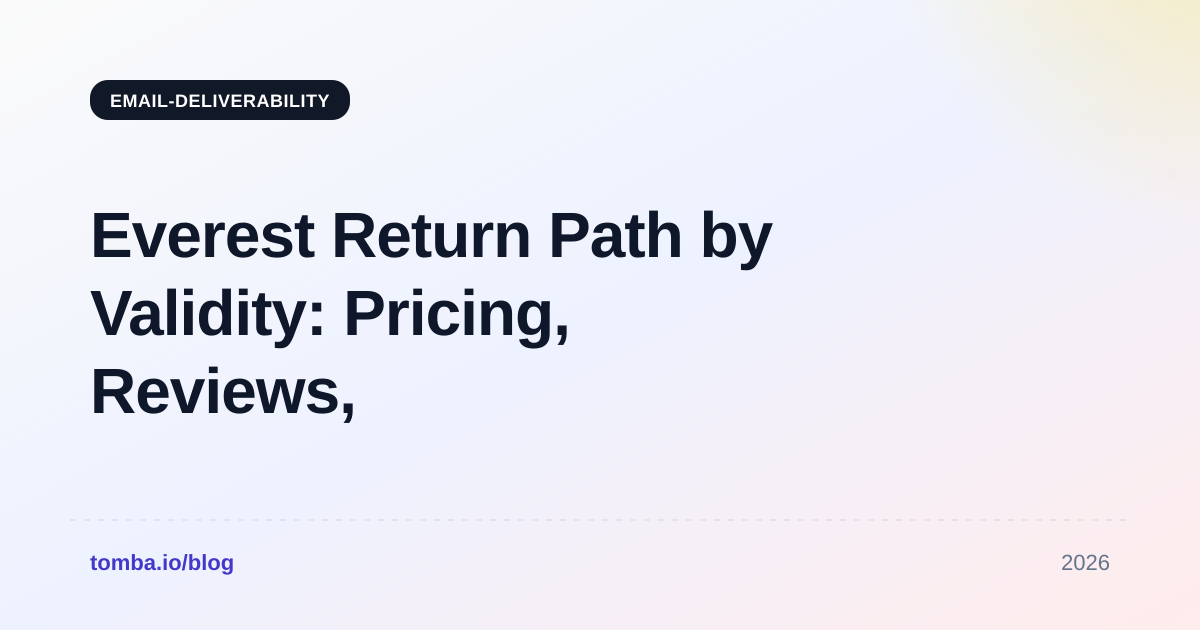
Everest Return Path by Validity: Pricing, Reviews, Pros and Cons
Validity never publishes a price for Everest. Here is what buyers actually pay, what the reviews agree on, and when a cheaper hygiene-first stack does the same job.
TL;DR — Everest Return Path pricing in one minute
- Everest is Validity's deliverability platform. It merges two older tools: Return Path and 250ok.
- Everest Return Path pricing is quote-only. There is no price page and no self-serve plan.
- Buyers report annual contracts. Entry deals start in the low four figures per year. Seed testing and Certification push deals much higher.
- Reviewers praise the data. They criticize the price, the renewal hikes, and the learning curve.
- Everest tells you that your inbox placement fell. It does not clean the list that caused the fall.
- If bad addresses are the real issue, a verify-first stack costs far less and fixes the cause.
What is Everest Return Path by Validity?#
Everest is a deliverability platform sold by Validity. It replaces two tools that senior email marketers know well. Validity bought Return Path in 2019 and 250ok in 2020. It merged both into one dashboard and called it Everest.
The pitch is simple. Your ESP tells you what it sent. Everest tells you what actually landed. It sits outside your sending setup. It pulls signal from sources your ESP cannot see.
Here are the core modules:
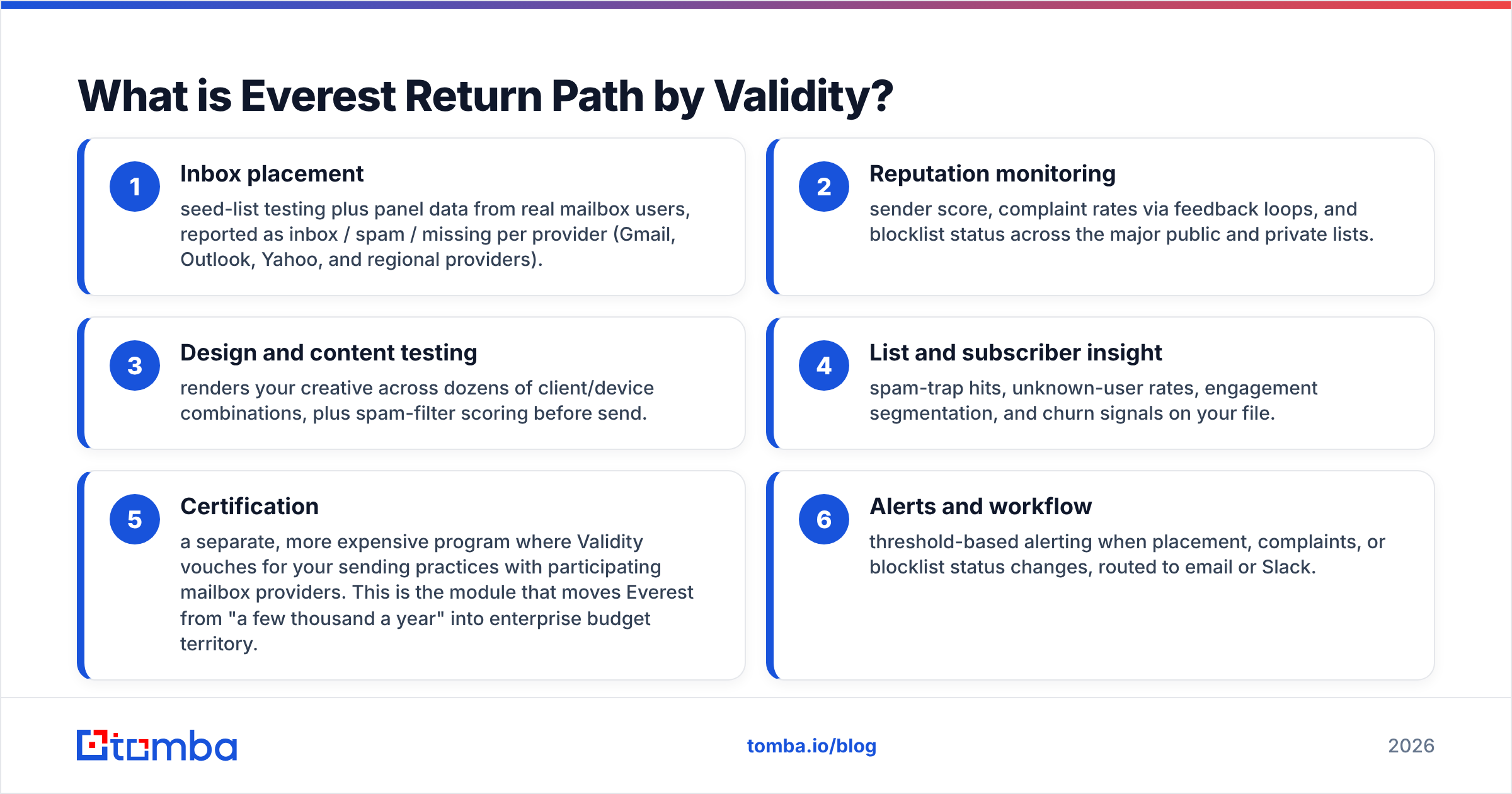
- Inbox placement — seed-list tests plus panel data from real users. You get inbox, spam, or missing rates per provider.
- Reputation monitoring — sender score, complaint rates from feedback loops, and blocklist status.
- Design and content testing — renders your email across dozens of clients and devices. It also scores spam risk before you send.
- List and subscriber insight — spam-trap hits, unknown-user rates, and churn signals on your file.
- Certification — a paid add-on. Validity vouches for you with partner mailbox providers. This module turns a few thousand a year into an enterprise invoice.
- Alerts — threshold alerts sent to email or Slack when something moves.
That is a deep toolkit. Everest works. The real question is whether your problem is big enough to justify the invoice.

Everest Return Path pricing in 2026: what does it cost?#
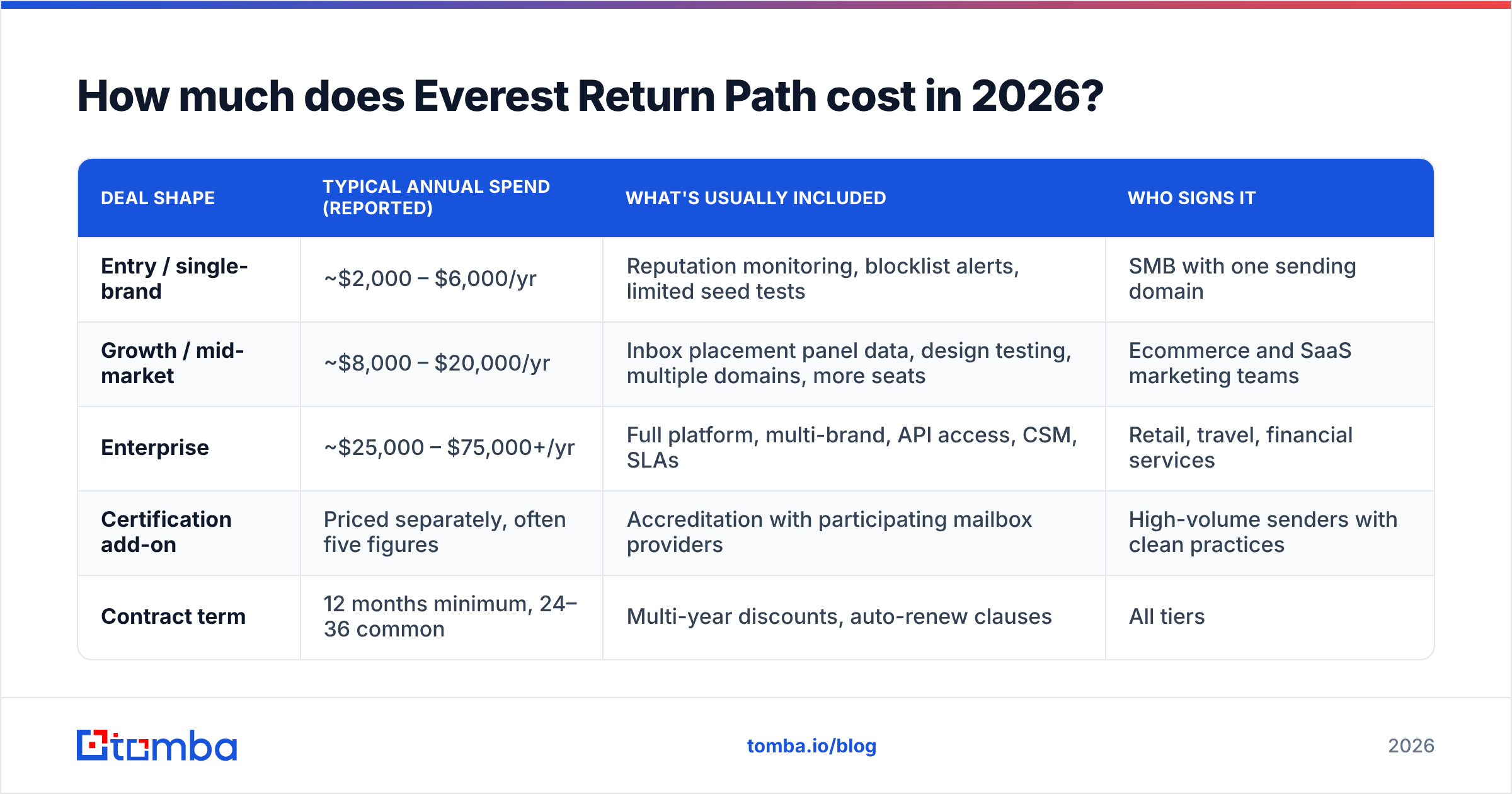
Short answer: nobody publishes it. That is on purpose. Validity sells through a sales team. There is no price page, no tier list, and no monthly plan. Everest Return Path pricing only arrives with a quote. The numbers below come from buyer reports, review sites, and reseller listings. Treat them as ranges.
| Deal shape | Typical annual spend (reported) | What's usually included | Who signs it |
|---|---|---|---|
| Entry / single-brand | ~$2,000 – $6,000/yr | Reputation monitoring, blocklist alerts, limited seed tests | SMB with one sending domain |
| Growth / mid-market | ~$8,000 – $20,000/yr | Inbox placement panel data, design testing, multiple domains, more seats | Ecommerce and SaaS marketing teams |
| Enterprise | ~$25,000 – $75,000+/yr | Full platform, multi-brand, API access, CSM, SLAs | Retail, travel, financial services |
| Certification add-on | Priced separately, often five figures | Accreditation with participating mailbox providers | High-volume senders with clean practices |
| Contract term | 12 months minimum, 24–36 common | Multi-year discounts, auto-renew clauses | All tiers |
Three things matter more than the numbers.
Every deal is annual. You will not test Everest for a month. Even a pilot tends to land as a 12-month deal. That changes the risk. You cannot cancel it in-app.
Volume and domain count set the price, not seats. Add a second sending domain or a new brand, and the deal is often repriced. Agencies get quoted very differently from a single-brand sender at the same volume.
Renewal is where the complaints pile up. The loudest review theme is not the first price. It is the jump at renewal, above all once your volume has grown. Ask for a capped uplift before you sign, not after.
What do Everest reviews actually say?#
Ratings on G2 and similar sites land near four stars. The split is consistent across reviewers.
What reviewers praise:
- Panel and provider data. This is the moat. Seed tests alone can be gamed. Blend them with real-user panel data and you get a number you can take to a QBR.
- Blocklist and complaint alerts. Reviewers often catch a Spamhaus listing hours before it would have hit revenue.
- Support quality. Larger contracts include a deliverability consultant. Several reviewers say the human beats the dashboard.
- One pane of glass. Teams that drop three or four small tools report real time savings.
What reviewers criticize:
- Price versus team size. The most repeated line: great data, hard to justify unless email is a primary revenue channel.
- Learning curve. Everest assumes you know email deliverability. If nobody can explain a pristine trap versus a recycled trap, half the dashboard is decoration.
- Rigid reporting. Custom reports and exports come up as friction, above all for agencies that need per-client views.
- Overlap with free tools. Google Postmaster Tools and Microsoft SNDS cover a slice of the same ground for free. That holds if your traffic sits mostly in those two ecosystems.
The honest read on Everest Return Path pricing: the tool is not overpriced for what it does. It is overbought for the problem most buyers actually have.
What are the real pros and cons?#
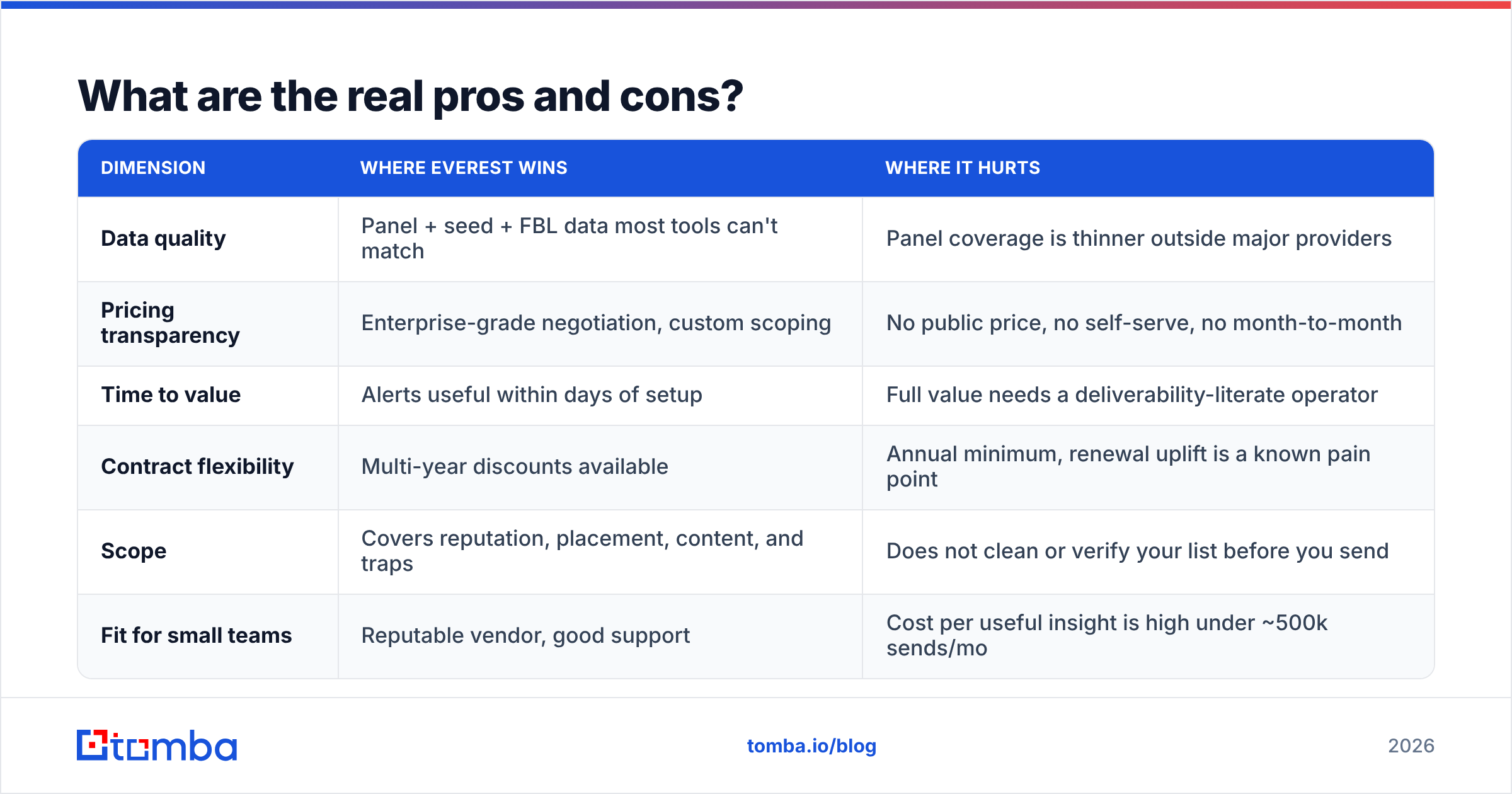
| Dimension | Where Everest wins | Where it hurts |
|---|---|---|
| Data quality | Panel + seed + FBL data most tools can't match | Panel coverage is thinner outside major providers |
| Pricing transparency | Enterprise-grade negotiation, custom scoping | No public price, no self-serve, no month-to-month |
| Time to value | Alerts useful within days of setup | Full value needs a deliverability-literate operator |
| Contract flexibility | Multi-year discounts available | Annual minimum, renewal uplift is a known pain point |
| Scope | Covers reputation, placement, content, and traps | Does not clean or verify your list before you send |
| Fit for small teams | Reputable vendor, good support | Cost per useful insight is high under ~500k sends/mo |
That last row deserves a pause. Everest is a diagnostic tool. It is very good at telling you your reputation is slipping. It is not a hygiene tool. It will not remove the 8% of dead addresses that caused the slip.
Is Everest worth it, or is your problem list quality?#
Here is the test that saves the most money.
Pull your last three campaigns. Look at the hard bounce rate and the unknown-user rate. Are hard bounces above 2%? Are unknown users climbing? Then you have a data problem, not a reputation problem. Reputation is only the symptom. Mailbox providers read your bounce and complaint rates and draw the obvious conclusion.
Pay Everest Return Path pricing at that point, and you buy a precise, costly description of a problem you already know about.
Fix the input first:
- Clean the file you have. Run the whole list through an email verifier before your next send. Drop hard bounces, role accounts, and throwaway domains. That step alone usually pushes bounce rate under 1%.
- Verify at capture. Check every address at signup and at import. The list then never re-rots. Teams skip this step, so they pay for monitoring twice.
- Fix authentication. Make sure SPF, DKIM, and DMARC line up. A free SPF checker takes two minutes and clears up many "mystery" placement issues.
Then, and only then, add monitoring:
- Check your blocklist status. A blacklist checker tells you if you are listed today, for free. Everest tells you the moment it happens.
- Watch the trend. Once bounces are under control, every alert is signal instead of noise. That is when a paid platform earns its keep.

How does Everest compare to the alternatives?#
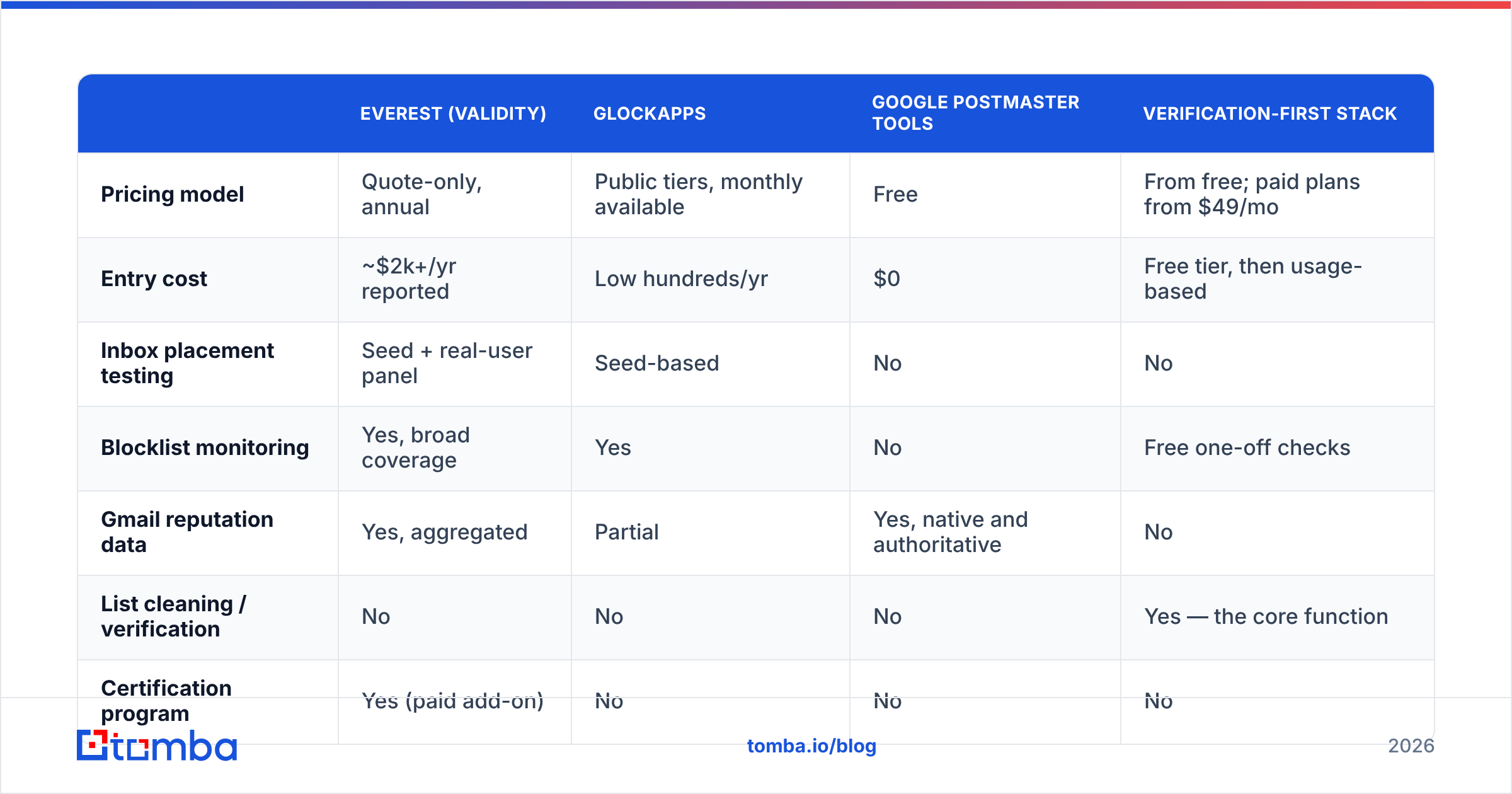
| Everest (Validity) | GlockApps | Google Postmaster Tools | Verification-first stack | |
|---|---|---|---|---|
| Pricing model | Quote-only, annual | Public tiers, monthly available | Free | From free; paid plans from $49/mo |
| Entry cost | ~$2k+/yr reported | Low hundreds/yr | $0 | Free tier, then usage-based |
| Inbox placement testing | Seed + real-user panel | Seed-based | No | No |
| Blocklist monitoring | Yes, broad coverage | Yes | No | Free one-off checks |
| Gmail reputation data | Yes, aggregated | Partial | Yes, native and authoritative | No |
| List cleaning / verification | No | No | No | Yes — the core function |
| Certification program | Yes (paid add-on) | No | No | No |
| Best for | Enterprise senders where email is primary revenue | Mid-market wanting placement tests cheaply | Any Gmail-heavy sender, as a baseline | Teams whose bounces are the root cause |
Two notes on reading that table fairly.
Google Postmaster Tools is free and authoritative for Gmail. Gmail is often 40–60% of a B2C list. Start there before you pay for anything. It will not cover Outlook, Yahoo, or corporate filters. That gap is where Everest earns its fee.
The last column is not a rival to Everest. It is a prerequisite. Verification and monitoring fix different problems. The mistake is buying the pricey one first.
Who should actually buy Everest?#
Buy it if:
- Email drives a big share of revenue, and a placement drop costs you five figures a week.
- You send high volume across many mailbox providers, not just Gmail.
- Someone owns deliverability as a real job and can act on the data.
- You need vendor-backed Certification for regulated or high-volume sending.
- You run several brands or domains, so free tools are hard to stitch together.
Skip it if:
- Your hard bounce rate is above 2%. Fix the list first, then look again.
- You send under a few hundred thousand emails a month.
- Nobody on the team can read trap-hit data or complaint trends.
- You do B2B cold outbound, not opt-in marketing. Everest is built for opt-in list health. Cold senders get more value per dollar from address accuracy.
- Your budget is monthly. Annual contracts and monthly budgets do not mix.
What should you ask before signing a quote?#
Bring this list to the call. It will move the number.
- What triggers a reprice? Volume, domains, brands, or seats. Get it in writing.
- Is renewal uplift capped? Ask for a set ceiling in years two and three.
- Is Certification included? It is almost always separate. Assume it is.
- How good is panel coverage for my regions and providers? Coverage varies by region. Thin coverage means you pay top rates for seed tests.
- Can I run a 30-day pilot on real data? Sometimes yes, usually late in a quarter.
- What happens to my data if I leave? Export terms matter more than buyers expect.
The bottom line on Everest Return Path pricing#
Everest is a good product with a hidden price tag. Most of its market needs something cheaper first. Is email your main revenue channel? Are your bounce rates already clean? Do you employ someone whose title says "deliverability"? Then it earns its contract. If you are shopping because open rates fell last quarter, you are treating a symptom at enterprise rates.
Start by removing the addresses that hurt your reputation. Run your file through Tomba's email verifier to strip hard bounces, role accounts, and throwaways. Use the Tomba Email Finder to build new lists from verified sources instead of scraped guesses. Plans start free at 25 searches a month, and Starter is $49/mo. See Tomba pricing for the full breakdown. Clean the input, and Everest Return Path pricing stops looking like a must-have.
Related guides#
Ready to find emails that actually work?
Join 150,000+ professionals who stopped guessing and started sending. Free credits on signup — no credit card required.
Get the Tomba newsletter
Practical outbound tactics and product updates — once every two weeks.
About the author