Exact Data vs Leadzenai: Which B2B Lead Source Wins in 2026?
Exact Data sells list files. Leadzen.ai sells real-time lookups. They fail in opposite ways — here's the honest breakdown of accuracy, pricing, and which one belongs in your stack.
Exact data vs Leadzenai is not a like-for-like fight. One sells you a static file. The other sells live lookups. This guide compares price, accuracy, coverage and refund terms, so you can pick the model your channel actually needs.
TL;DR
- Exact Data is a list broker. You buy a static file of records — consumer or business — priced per record, delivered as a CSV. Good for volume, bad for freshness.
- Leadzen.ai is a real-time lookup and enrichment platform aimed largely at the Indian market, with browser-extension prospecting and API access. Better freshness, narrower geography.
- They are not really the same product. One sells inventory, the other sells access. Picking between them before you know which model you need is the real mistake.
- Neither publishes a hard, independently audited deliverability guarantee. Assume 15–35% decay on any B2B list file older than six months and budget for verification.
- For most outbound teams in 2026: make a verification-first email finder the spine of the stack. Buy from a list broker only when you need an offline audience you cannot build yourself.
What is Exact Data and who actually buys it?#
Exact Data is a US-based list brokerage. Its model predates the SaaS era. You name an audience — industry, job title, revenue band, geography, sometimes consumer traits like homeowner status or age. Exact Data quotes a price per record, and you receive a file. Minimum orders are normal, and the per-record price drops as volume goes up.
The buyer profile is specific. Direct-mail agencies, event marketers, insurance and financial-services shops, and anyone running a channel where a postal address matters more than an email address. If your campaign needs 40,000 addresses of business owners in three states, a broker is a rational purchase.
The buyer profile it is wrong for is equally specific: a modern SDR team running sequences into a warmed inbox. Static files decay. A record that was right on compile day is a coin flip eighteen months later. In tech, people change jobs at roughly 20–25% a year, and the work email goes with them. Buying volume you cannot verify is buying bounces, and bounces wreck sender reputation.
The second thing to check with any broker is the refund posture. Most list vendors cap replacement at a percentage of undeliverables. That cap is often lower than the real bounce rate on a stale file. Read the terms before you read the sample.
What is Leadzen.ai and how is it different?#
Leadzen.ai is a lead-intelligence platform, not a broker. Instead of shipping you a file, it gives you search, filters, a Chrome extension for LinkedIn-adjacent prospecting, and API endpoints. You pull contact data at the moment you need it. Its data strength sits in India and South Asia, where coverage beats most US-centric platforms.
The architectural difference matters more than any feature list. A real-time lookup platform queries and validates when you ask. The record you receive reflects a recent check, not a compile date. That is why live lookup beats bulk-purchased inventory for outbound: recency is the whole game.
The trade-off is coverage. Narrow geographic strength means excellent hit rates inside the core market and thin results outside it. If your ICP is US mid-market SaaS, you will feel that ceiling fast. If your ICP is Indian manufacturing or fintech, Leadzen.ai is genuinely hard to replace.

Exact data vs Leadzenai: how do they compare head to head?#
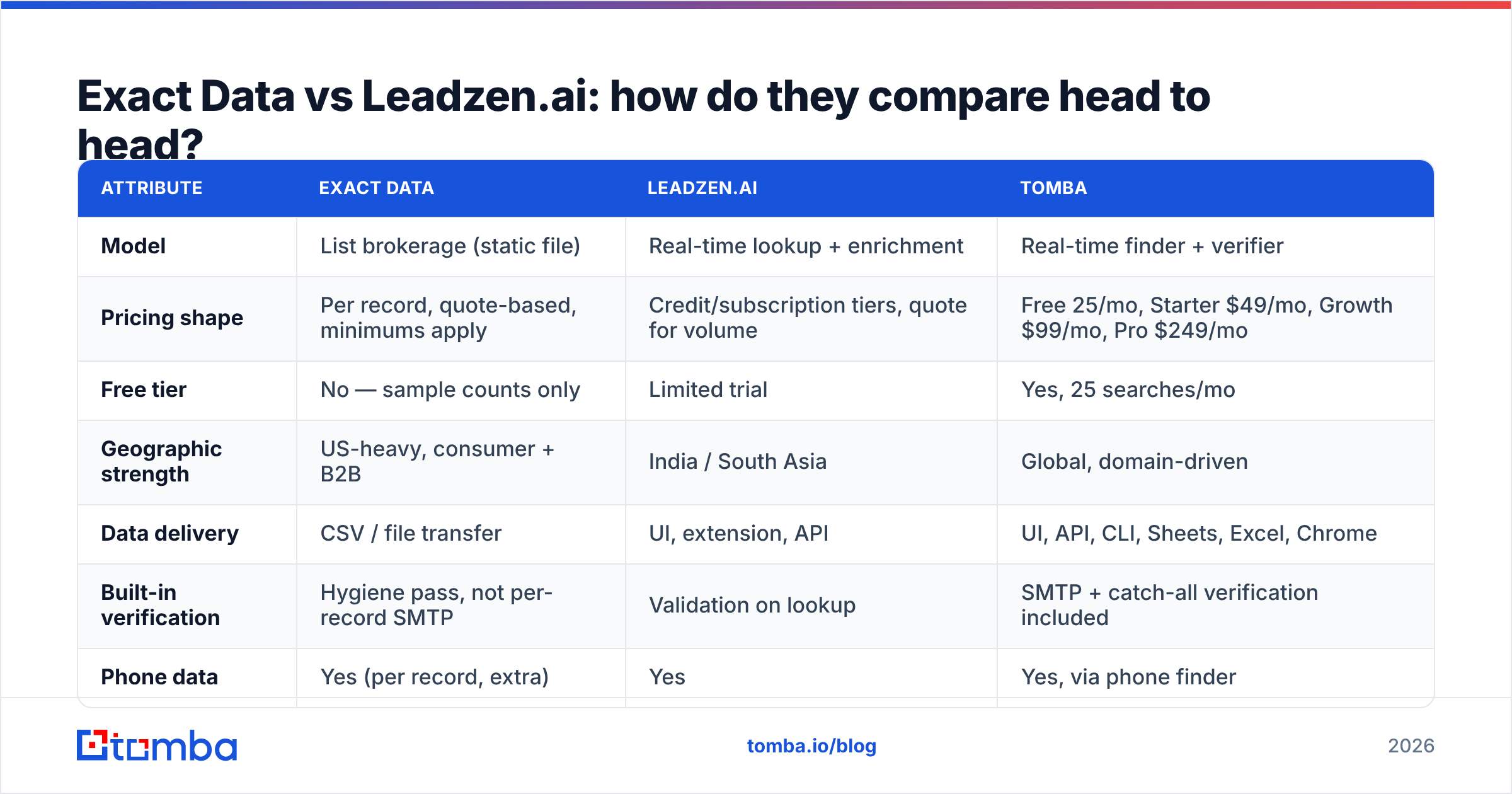
Here is the honest side-by-side. Where a vendor does not publish a number publicly, this says so rather than inventing one.
| Attribute | Exact Data | Leadzen.ai | Tomba |
|---|---|---|---|
| Model | List brokerage (static file) | Real-time lookup + enrichment | Real-time finder + verifier |
| Pricing shape | Per record, quote-based, minimums apply | Credit/subscription tiers, quote for volume | Free 25/mo, Starter $49/mo, Growth $99/mo, Pro $249/mo |
| Free tier | No — sample counts only | Limited trial | Yes, 25 searches/mo |
| Geographic strength | US-heavy, consumer + B2B | India / South Asia | Global, domain-driven |
| Data delivery | CSV / file transfer | UI, extension, API | UI, API, CLI, Sheets, Excel, Chrome |
| Built-in verification | Hygiene pass, not per-record SMTP | Validation on lookup | SMTP + catch-all verification included |
| Phone data | Yes (per record, extra) | Yes | Yes, via phone finder |
| Best for | Direct mail, offline channels, volume | India-focused B2B prospecting | Email-led outbound anywhere |
| Worst for | Cold email at scale | Non-APAC territories | Postal/consumer audiences |
Two conclusions fall out of that table. First, Exact Data and Leadzen.ai barely compete. They overlap only in the sense that both sell "leads." Second, if your channel is email, neither one is the natural spine of the stack. That role belongs to a tool that finds and verifies in one motion.
Which model wins on accuracy — static files or live lookups?#
Live lookups win. The reason is structural, not a matter of vendor quality.
A static file has one accuracy number: the one it had at compile time. From that moment it only degrades. Job changes, domain migrations after acquisitions, alias retirements, and email-policy shifts all erode it silently. Nobody emails you to say the CSV you bought last quarter is now 22% wrong.
A live lookup re-checks at request time. The record is validated against current DNS and SMTP behavior before it reaches you. You pay for a fresh answer, not a preserved one. That is why per-record cost on lookup platforms looks higher than broker pricing: you are comparing a fresh unit to a decayed one.

Three practical rules follow:
- Never send to an unverified purchased file. Run it through an email verifier first, no matter who sold it to you. A 20-minute verification pass costs less than one blacklisting.
- Treat catch-all domains separately. Catch-alls accept everything at the SMTP layer. A naive verifier marks them "valid," and you learn the truth from your bounce log. A dedicated catch-all verifier clears up most of that doubt before you send.
- Track your own bounce rate per source. Vendor accuracy claims are marketing. Your bounce log is data. After 500 sends you know more about a source than any G2 review does.
Google and Microsoft both tightened bulk-sender rules in 2024–2025. The practical effect: a spam-complaint rate above 0.3% now gets your mail throttled, not just deprioritized. That single change turned "buy a big list" from inefficient into actively dangerous. For the enforcement details straight from the source, Google's bulk sender guidelines are the canonical reference.
How does pricing really compare?#
Neither Exact Data nor Leadzen.ai publishes a clear public price for meaningful volume. Both route serious buyers through a quote. That is normal for brokers and common for enrichment platforms, but it hides your true cost per usable record until you have already spent money.
Here is the arithmetic that actually matters:
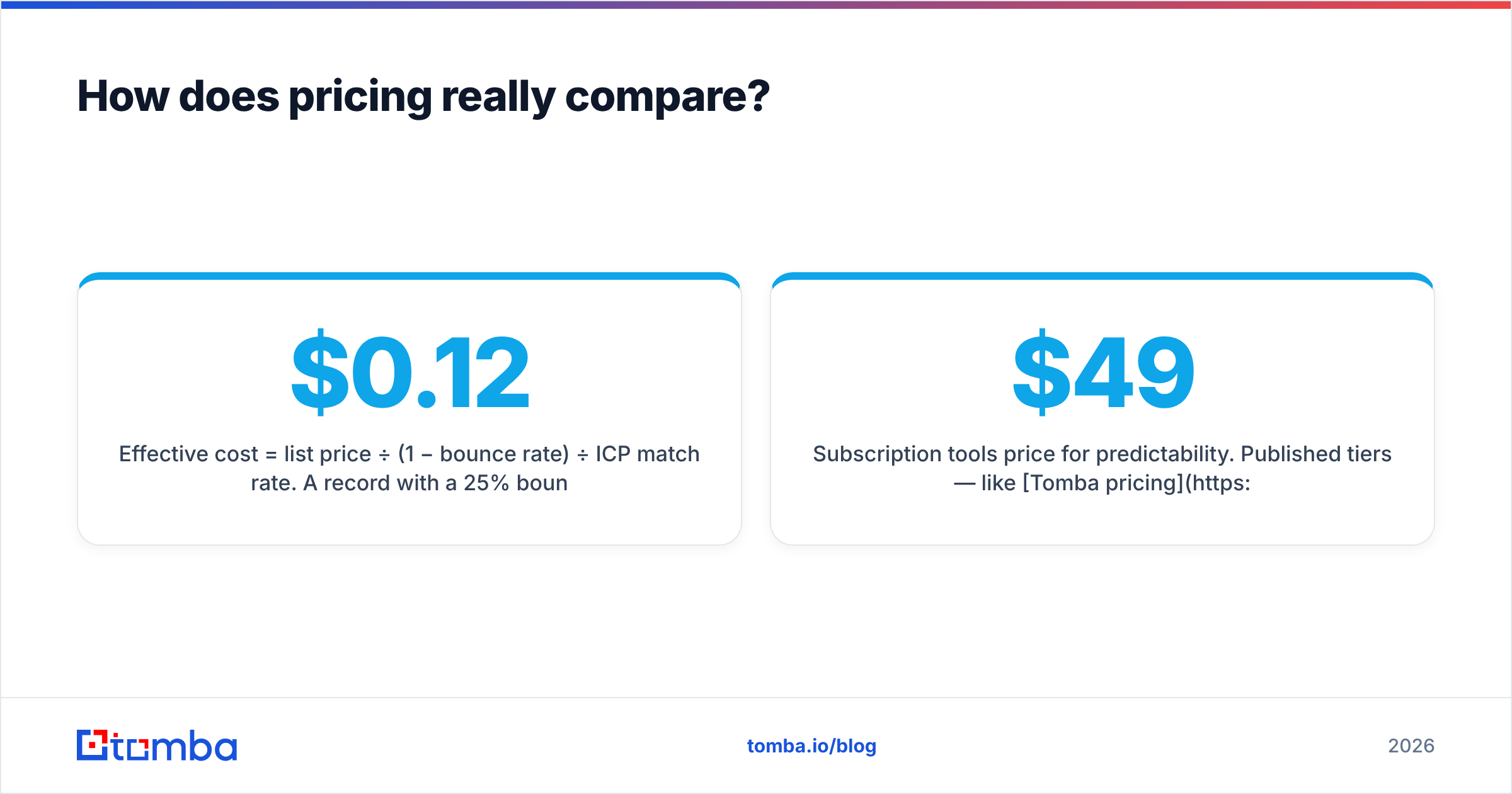
- Effective cost = list price ÷ (1 − bounce rate) ÷ ICP match rate. A $0.12 record with a 25% bounce rate and 60% ICP fit costs you $0.27 per usable contact, not $0.12.
- Verification is not optional overhead. It is the step that turns a raw record into a usable one, so include it in the denominator.
- Minimum-order commitments punish testing. If you cannot buy 500 records to sanity-check a source, you are being asked to trust the sample. Samples are curated.
- Subscription tools price for predictability. Published tiers — like Tomba pricing at $49, $99 and $249/mo — let you model cost before you commit. Quote-based pricing does not.
A transparent-tier finder gives you a public number and a free tier to test against. That is worth real money at the evaluation stage. You can run the same 100 target companies through several tools and compare hit rates on your own ICP, not on someone else's demo list.

Where does each one actually fit in a 2026 stack?#
Stop asking which is better and start asking which job you are hiring them for.
Hire Exact Data when: you need postal addresses, consumer attributes, or an offline audience you cannot build from public web data. Direct mail, event invitations, and regulated verticals with compliance-vetted sources are legitimate use cases. Confirm consent provenance and suppression handling before you buy, especially for anything touching EU or California residents.
Hire Leadzen.ai when: your target market is India or South Asia and you want live lookups plus a browser workflow. Its regional depth is the reason to choose it, and general-purpose global platforms will not match it there.
Hire a verification-first email finder when: your primary channel is email and your ICP is defined by company domains. This is most B2B teams. You start from a company list, run domain search to map the org, pull the specific roles you need, verify, and send. No file to decay, no minimum order, no quote call.
Use more than one when: your motion is multi-channel. A common healthy pattern is a finder for email, a broker for a once-a-year direct-mail push, and a regional specialist for one expansion market. These are complements, not rivals.

If you want peer signal rather than vendor copy, both G2's lead-intelligence category and Capterra's lead-generation listings show review volume and recency, which is a decent proxy for whether a vendor is still actively invested in the product.
What should you check before you buy from either?#
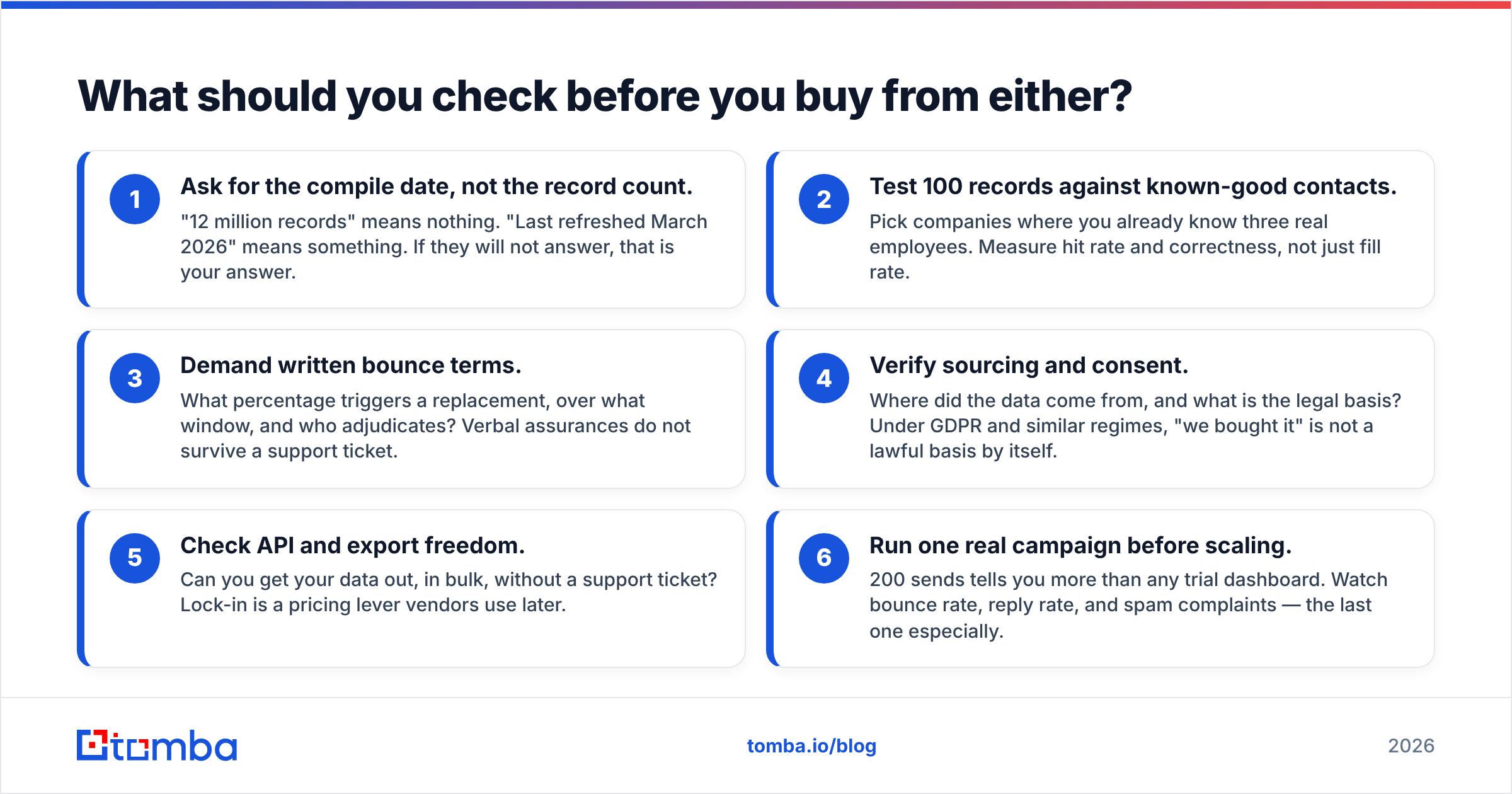
Run this checklist on any data vendor, broker or platform. It takes an afternoon and it has saved teams five-figure mistakes.
- Ask for the compile date, not the record count. "12 million records" means nothing. "Last refreshed March 2026" means something. If they will not answer, that is your answer.
- Test 100 records against known-good contacts. Pick companies where you already know three real employees. Measure hit rate and correctness, not just fill rate.
- Demand written bounce terms. What rate triggers a replacement, and over what window? Verbal promises do not survive a support ticket.
- Verify sourcing and consent. Where did the data come from, and what is the legal basis? Under GDPR, "we bought it" is not a lawful basis.
- Check API and export freedom. Can you get your data out, in bulk, without a support ticket? Lock-in is a pricing lever vendors use later.
- Run one real campaign before scaling. 200 sends tells you more than any trial dashboard. Watch bounce rate, reply rate, and spam complaints.
Worth noting that transparent peers exist across this market. BookYourData, for example, publishes per-record pricing openly and offers a pay-as-you-go path, which makes evaluation far easier than a quote-only process. Whatever you choose, pricing transparency correlates strongly with data confidence — vendors who trust their data are usually willing to name a number.
One last operational point: whichever source you pick, deduplicate before you import. Overlapping vendors produce overlapping records, and the fastest way to look unprofessional is to send the same person the same sequence from two different segments. A quick pass through a remove duplicates step costs nothing and prevents a real embarrassment.
The verdict#
Exact data vs Leadzenai is not a contest of better and worse. It is a choice of failure modes. Exact Data fails on staleness: you get volume that ages badly. Leadzen.ai fails on coverage: you get freshness inside one geography and thin air outside it.
If you are running email-led outbound and your ICP is defined by company domains, neither is the right foundation. You want a tool that finds the address and verifies it in the same request, with a published price you can model and a free tier you can test on before you commit.
That is exactly what the Tomba Email Finder is built for. Start on the free tier with 25 searches a month, run your own hit-rate test against companies you already know, and only scale when the numbers hold up on your data — not on a vendor's sample file.
Related guides#
Ready to find emails that actually work?
Join 150,000+ professionals who stopped guessing and started sending. Free credits on signup — no credit card required.
Get the Tomba newsletter
Practical outbound tactics and product updates — once every two weeks.
About the author