Exact Data vs Smarte: B2B Contact Data Compared for 2026
One sells lists by the record, the other sells a compliance-first data platform. Here is how Exact Data and Smarte actually differ on pricing, coverage, accuracy and refresh rate — plus when neither is the right buy.
TL;DR
- Exact Data is a list broker. You buy a static file of records — B2B or consumer — filtered by selects, priced per record, delivered as CSV. You own it forever, and it starts decaying the day it lands.
- Smarte is a data platform. Subscription access to an account-and-contact database with GDPR/CCPA-first positioning, CRM enrichment, and browser-based prospecting. Pricing is quote-based.
- The real decision is not "which vendor" — it's "static file or live lookup." Buying 50,000 records you never touch is the single most expensive mistake in this category.
- Neither publishes transparent self-serve pricing. Both route you through sales, which means your cost per usable contact is unknown until after a demo.
- Verify before you send, whatever you buy. A 20% bounce rate on a purchased file will damage your sending domain faster than any list will make you money.
What are Exact Data and Smarte, actually?#
They get compared because both sell B2B contact data. They should not be compared as if they're the same product — they sit at opposite ends of the data supply chain.
Exact Data is a Chicago-based list brokerage and compiler with roots in direct mail. Its catalogue spans consumer files, business files, specialty audiences (healthcare professionals, new movers, small-business owners), and it sells postal, email and phone appends. You pick a segment, apply selects — SIC code, employee count, revenue band, job function, geography — and buy the resulting count. Delivery is a file. The transaction is one-time.
Smarte is a SaaS B2B data platform. It positions around account intelligence and contact discovery with a heavy compliance story: GDPR- and CCPA-aware sourcing, opt-out handling, and data-processing terms designed for teams selling into the EU. You get a searchable database, CRM enrichment, and prospecting workflows rather than a one-off CSV.
That difference cascades into everything else — how you pay, how fresh the data is, what happens when a contact changes jobs, and whether your legal team signs off.

How do Exact Data and Smarte compare head to head?#
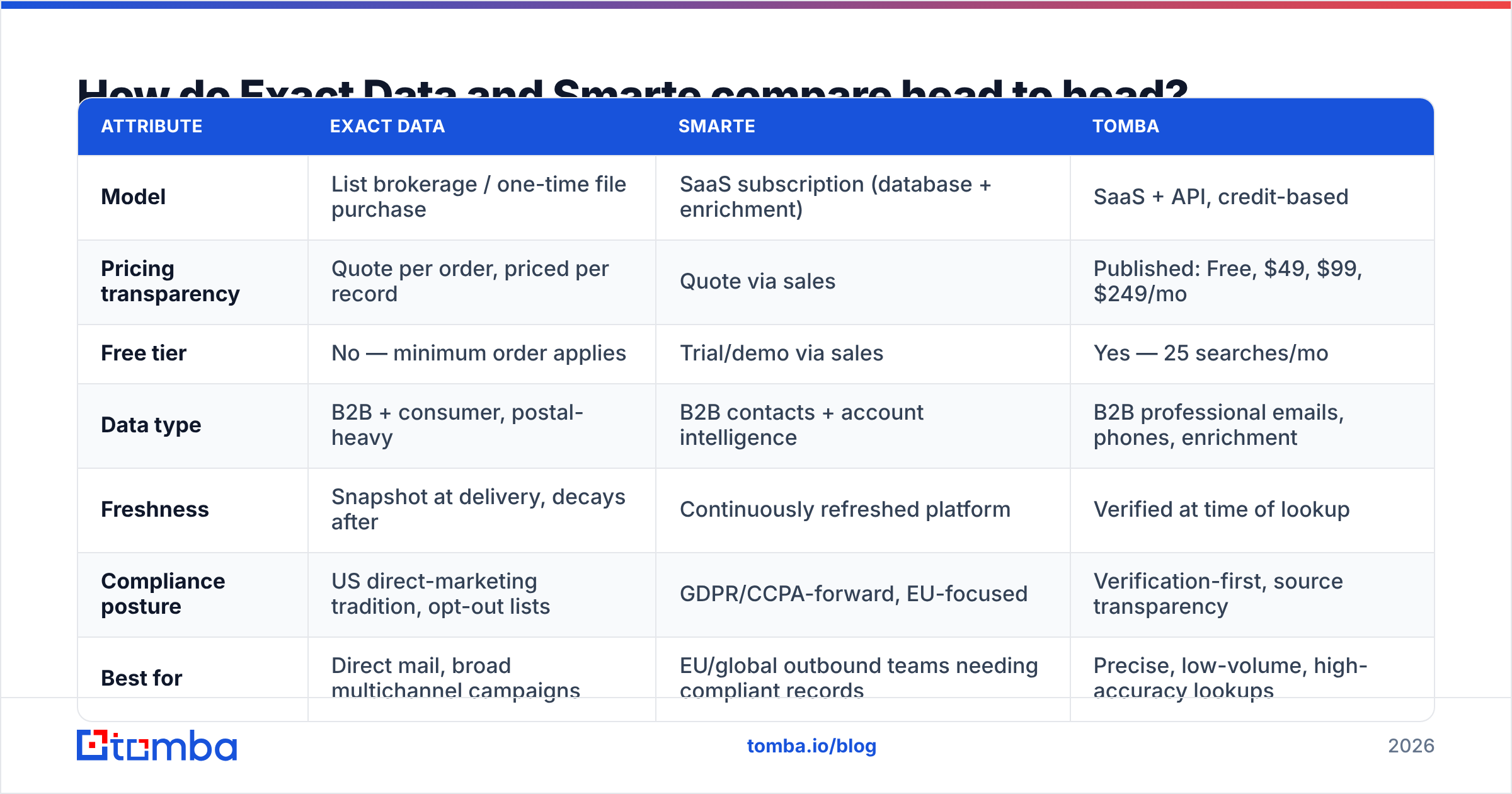
Here is the practical side-by-side. Treat pricing as directional — both vendors negotiate, and neither publishes a full rate card.
| Attribute | Exact Data | Smarte | Tomba |
|---|---|---|---|
| Model | List brokerage / one-time file purchase | SaaS subscription (database + enrichment) | SaaS + API, credit-based |
| Pricing transparency | Quote per order, priced per record | Quote via sales | Published: Free, $49, $99, $249/mo |
| Free tier | No — minimum order applies | Trial/demo via sales | Yes — 25 searches/mo |
| Data type | B2B + consumer, postal-heavy | B2B contacts + account intelligence | B2B professional emails, phones, enrichment |
| Freshness | Snapshot at delivery, decays after | Continuously refreshed platform | Verified at time of lookup |
| Compliance posture | US direct-marketing tradition, opt-out lists | GDPR/CCPA-forward, EU-focused | Verification-first, source transparency |
| Best for | Direct mail, broad multichannel campaigns | EU/global outbound teams needing compliant records | Precise, low-volume, high-accuracy lookups |
| API access | Limited / append services | Yes | Yes — full REST API |
| Ownership | You keep the file permanently | Access ends with subscription | Exported records are yours |
The row that matters most is freshness. B2B contact data decays at roughly 25–30% per year — people change roles, companies rebrand, mailboxes get deprovisioned. A purchased file is accurate on the day it's compiled and progressively less accurate every week after. A subscription database is re-crawled and re-verified continuously, which is what you're paying the recurring fee for.
Which one is cheaper — and is that the right question?#
Cost per record is the wrong metric. Cost per usable record is the only number that matters.
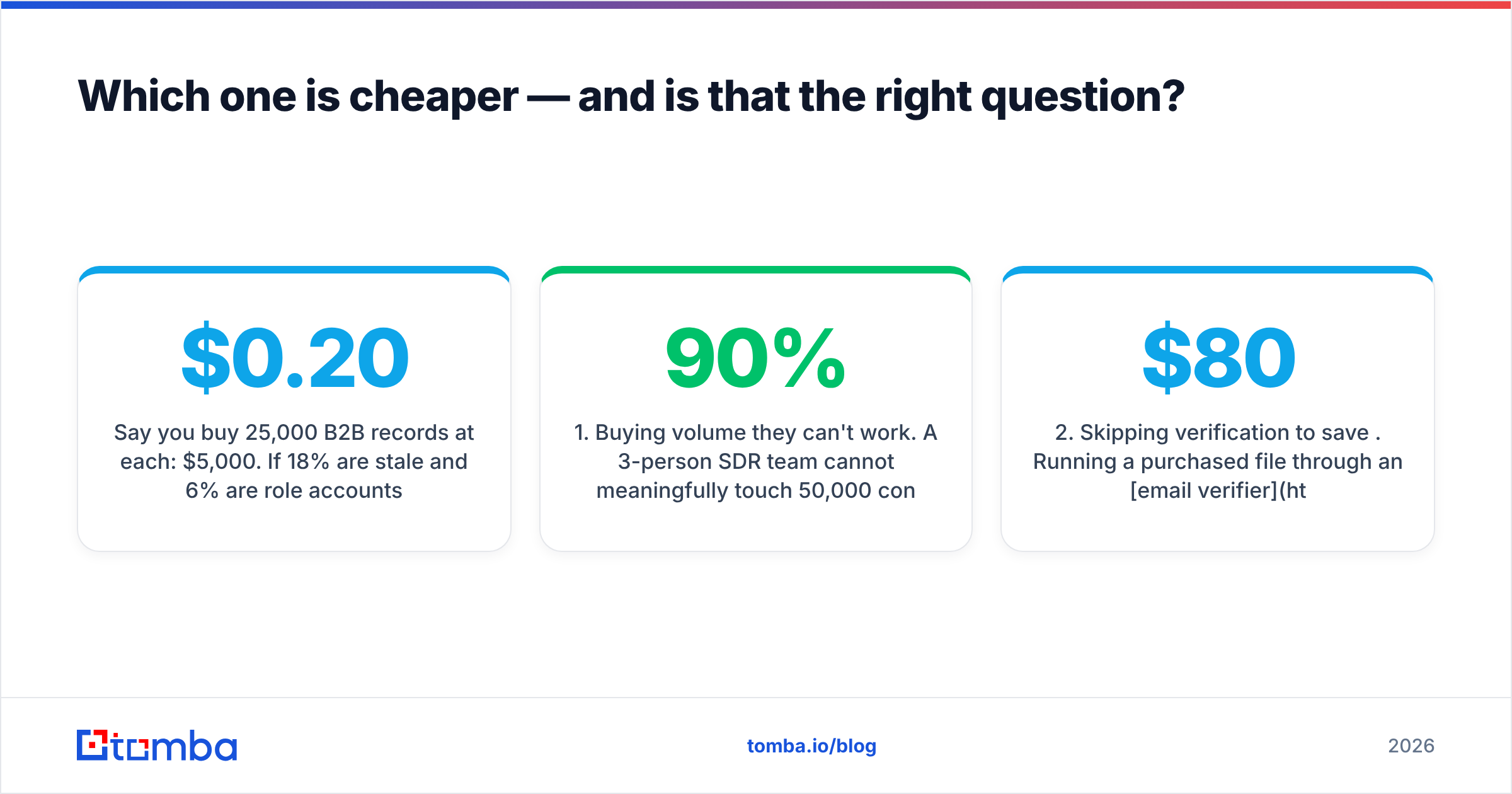
Say you buy 25,000 B2B records at $0.20 each: $5,000. If 18% are stale and 6% are role accounts you'd never email, your real cost per usable contact is closer to $0.26. Now factor in the 18% that bounce — those don't just waste money, they burn your sender reputation and reduce inbox placement for the 82% that were fine.
A subscription model inverts this. You pay a fixed monthly fee, look up contacts as you need them, and each lookup is verified at request time. You waste less, but you also can't hoard — the moment you stop paying, access ends.
Four ways teams get the economics wrong:
- Buying volume they can't work. A 3-person SDR team cannot meaningfully touch 50,000 contacts. Buying that file means 90% of it rots unused. Buy for your actual sending capacity over the next 60 days.
- Skipping verification to save $80. Running a purchased file through an email verifier costs a fraction of the list price and prevents the bounce cascade that gets your domain flagged.
- Ignoring the append trap. Email appends onto a postal file often produce guessed or pattern-matched addresses. Some are right. Some are catch-all domains that accept everything and confirm nothing.
- Treating list cost as the whole cost. Sending infrastructure, warmup, inbox rotation and the SDR hours spent on bad records typically exceed the data spend by 3–5x.

How accurate is the data from each?#
Neither vendor publishes independently audited accuracy figures, which is normal for this category and also the reason you should never take a marketing-page percentage at face value.
What you can do instead is test. Ask for a sample of 100–200 records in your exact ICP — not a generic sample, your segment — and run it yourself:
- Syntax and MX check. How many records fail basic validity before you even try to send?
- Catch-all rate. What percentage sit on domains that accept everything? Those are unverifiable without behavioural signals — a catch-all verifier narrows the risk, but a high catch-all share inflates any "deliverable" claim.
- Role-account rate. How many are info@, sales@, support@? These count as records but convert at near zero for personal outbound.
- Title accuracy. Spot-check 25 records against LinkedIn. If titles are more than 12 months stale, everything else likely is too.
- Duplicate rate. Run remove duplicates on the sample. Some brokered files carry 5–10% dupes across selects.
Exact Data's strength is breadth — specialty and consumer segments that pure B2B platforms simply don't hold. Its weakness is that breadth and depth trade off, and compiled files built for postal delivery carry weaker email hygiene than email-native sources.
Smarte's strength is that the data is maintained as a live product rather than sold as a snapshot, and the compliance layer is genuinely differentiated if you're prospecting into Germany, France or the Nordics. Its weakness is coverage depth in long-tail SMB segments and, like most quote-based vendors, opacity until you're in a sales cycle.
Check current buyer sentiment on G2 before either conversation — review recency tells you more about a data vendor's current state than any deck.
When should you use a static list versus live lookup?#
This is the actual fork in the road, and it has a clean answer.
Buy a static list when:
- You're running direct mail, where postal records don't decay as fast and email hygiene is irrelevant.
- You need a segment nobody maintains as a live database — specific licensure lists, niche consumer audiences, regional trade populations.
- You're building a total-addressable-market model and need volume for analysis, not for sending.
- You need to own the data permanently for internal modelling reasons.
Use live lookup when:
- Every contact you pull will be emailed within days, so verification-at-request beats verification-at-compile.
- Your ICP is defined by company signals — hiring, tech stack, funding — that only make sense against a current view.
- You're a small team with modest monthly volume and want predictable spend.
- You need programmatic access, e.g. enriching inbound signups through an email finder API rather than batch-buying.
Most outbound teams in 2026 sit firmly in the second bucket and buy lists anyway, out of habit inherited from 2015 direct marketing. The habit is expensive.
What are the alternatives to Exact Data and Smarte?#
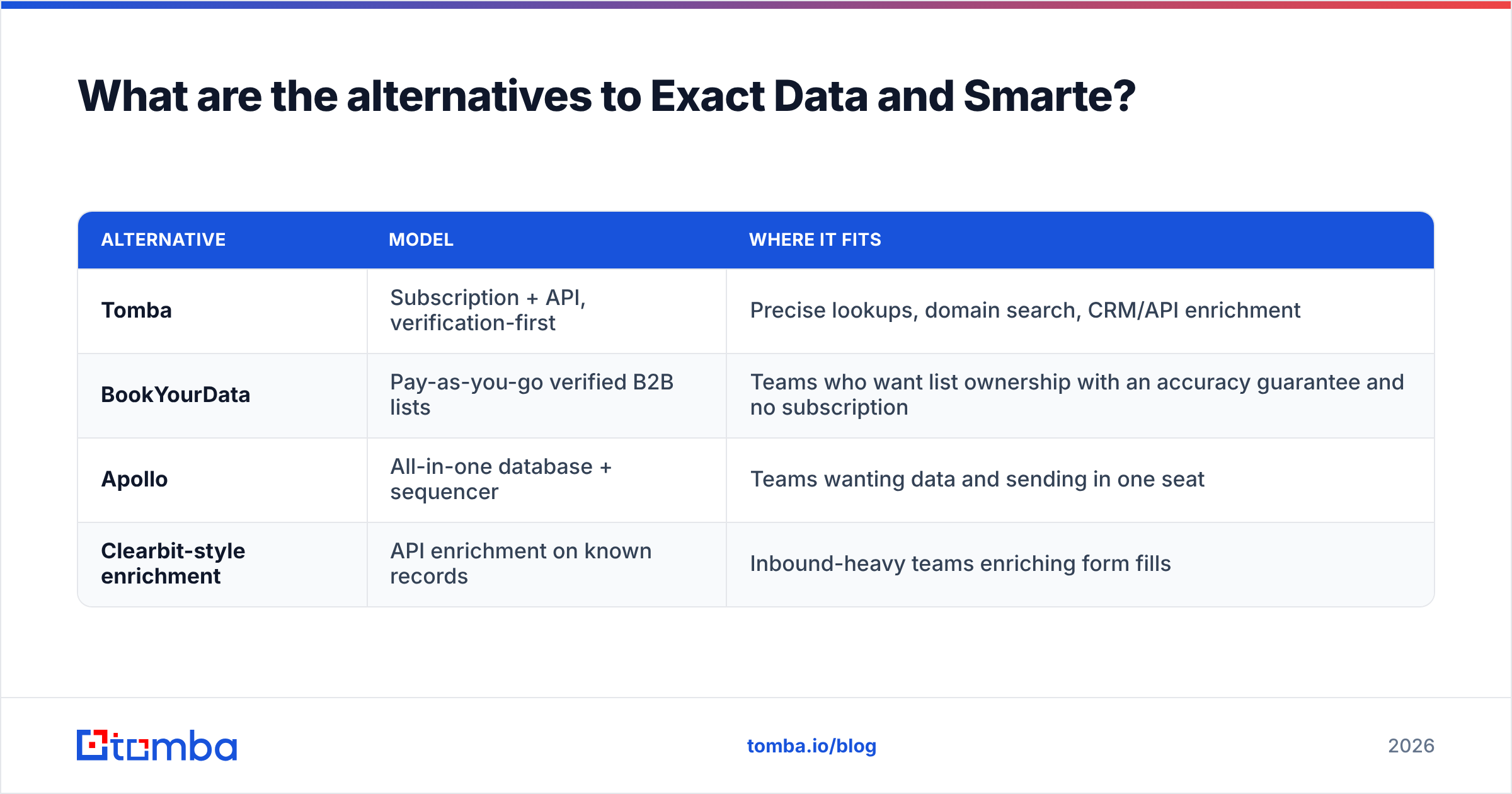
The category is wider than a two-way comparison suggests. Worth evaluating alongside:
| Alternative | Model | Where it fits |
|---|---|---|
| Tomba | Subscription + API, verification-first | Precise lookups, domain search, CRM/API enrichment |
| BookYourData | Pay-as-you-go verified B2B lists | Teams who want list ownership with an accuracy guarantee and no subscription |
| Apollo | All-in-one database + sequencer | Teams wanting data and sending in one seat |
| Clearbit-style enrichment | API enrichment on known records | Inbound-heavy teams enriching form fills |
BookYourData deserves a specific mention if the appeal of Exact Data is owning the file: it sells verified B2B contacts on a pay-as-you-go basis with a stated accuracy guarantee, which closes the main gap between brokered lists and live platforms. It's the closest thing to a middle path in this comparison.
If you came to this comparison from an Apollo evaluation, the Apollo alternative breakdown covers the all-in-one tradeoff — bundled sending is convenient until data quality and deliverability become the same vendor's problem to grade.
What does a sane data stack look like in 2026?#
Stop thinking in vendors and start thinking in layers. The teams with the lowest cost per meeting run something like this:
- Targeting layer. Define accounts first — firmographics, signals, intent — before touching contact data. Buying contacts before defining accounts is how you end up with 50,000 unusable records.
- Discovery layer. Pull contacts per target account on demand. A domain search on 200 target companies gives you a working list built from live data instead of a compiled snapshot.
- Verification layer. Every address gets checked before it enters the sequencer. Non-negotiable. Bounce rate above 3% is a deliverability emergency, not a data quality footnote.
- Enrichment layer. Fill in phone, LinkedIn, seniority and company attributes only for records that survive verification. Enriching junk is paying twice for nothing.
- Hygiene layer. Re-verify quarterly. Suppress hard bounces permanently. Track which source produced which bounce so you can drop underperforming vendors with evidence.
Run that loop and the Exact Data vs Smarte question mostly dissolves — you'll know exactly what a record from each is worth to you, in your segment, measured in replies rather than in vendor claims.
So which should you pick?#
Pick Exact Data if your campaign is postal-led or your audience is a specialty/consumer segment no B2B platform maintains, and you're comfortable running your own hygiene pass on delivery.
Pick Smarte if you're selling into Europe, your legal team asks hard questions about lawful basis, and you'd rather rent a maintained database than own a decaying file.
Pick neither if what you actually need is a few thousand accurate, verified business emails per month against a defined account list. That's not a brokerage problem or an enterprise-platform problem — it's a lookup problem, and paying enterprise quote-based pricing to solve it is overkill.
Ready to test data quality instead of taking a vendor's word for it?#
Start with the Tomba Email Finder. Give it a name and a domain, or run a full domain search across your target account list, and see verified results with confidence scores and the sources behind them. The free tier includes 25 searches a month — enough to benchmark Tomba against a sample from any list broker before you commit budget. Paid plans start at $49/mo, scale to $99 and $249, and every tier includes API access, so the same data flows into your CRM, your Google Sheets, or your enrichment pipeline without a separate contract. Run the head-to-head on your own ICP. The results will tell you more than any comparison post — including this one.
Related guides#
Ready to find emails that actually work?
Join 150,000+ professionals who stopped guessing and started sending. Free credits on signup — no credit card required.
Get the Tomba newsletter
Practical outbound tactics and product updates — once every two weeks.
About the author