ExactVerify vs Apollo.io: Which Email Data Tool Wins in 2026?
ExactVerify cleans lists. Apollo.io builds them. They are not really the same product — and picking the wrong one costs you either bounces or budget. Here is the honest breakdown.
TL;DR
- ExactVerify and Apollo.io are not direct competitors. ExactVerify is an email verification specialist; Apollo.io is a full sales platform with a contact database, sequencer, and dialer bolted together.
- If your problem is "my list bounces," you want a verifier. If your problem is "I have no list," you want a database. Buying the wrong one wastes an entire quarter.
- Apollo.io charges per seat, which punishes teams. Verification tools charge per email checked, which punishes volume. Model both against your actual monthly send.
- Apollo's database is enormous but noisy on smaller markets and non-US regions; verification-only tools tell you nothing about who to contact in the first place.
- Most teams end up needing both functions. A combined finder-plus-verifier like Tomba Email Finder at $49/mo covers the middle without a seat tax.
What are ExactVerify and Apollo.io, exactly?#
They solve different halves of the same problem.
ExactVerify is an email verification service. You upload a list — or hit an API — and it tells you whether each address is deliverable, invalid, risky, disposable, or a catch-all. It does syntax checks, MX record lookups, SMTP handshakes, role-account detection, and spam-trap screening. It does not find you new contacts. It grades the ones you already have.
Apollo.io is a go-to-market platform. Its core asset is a B2B contact database with hundreds of millions of records, wrapped in filters (title, headcount, tech stack, funding, intent signals), a sequencer for multi-step outreach, a Chrome extension, a dialer, and CRM sync. Verification exists inside Apollo, but it is a feature, not the product. You can read the full feature set on Apollo's own site.
The distinction matters because the failure modes are opposite. A team running Apollo alone ships thousands of emails to addresses Apollo never independently confirmed. A team running ExactVerify alone has a spotless list of 400 contacts and no way to get to 4,000.

How do ExactVerify and Apollo.io compare feature by feature?#
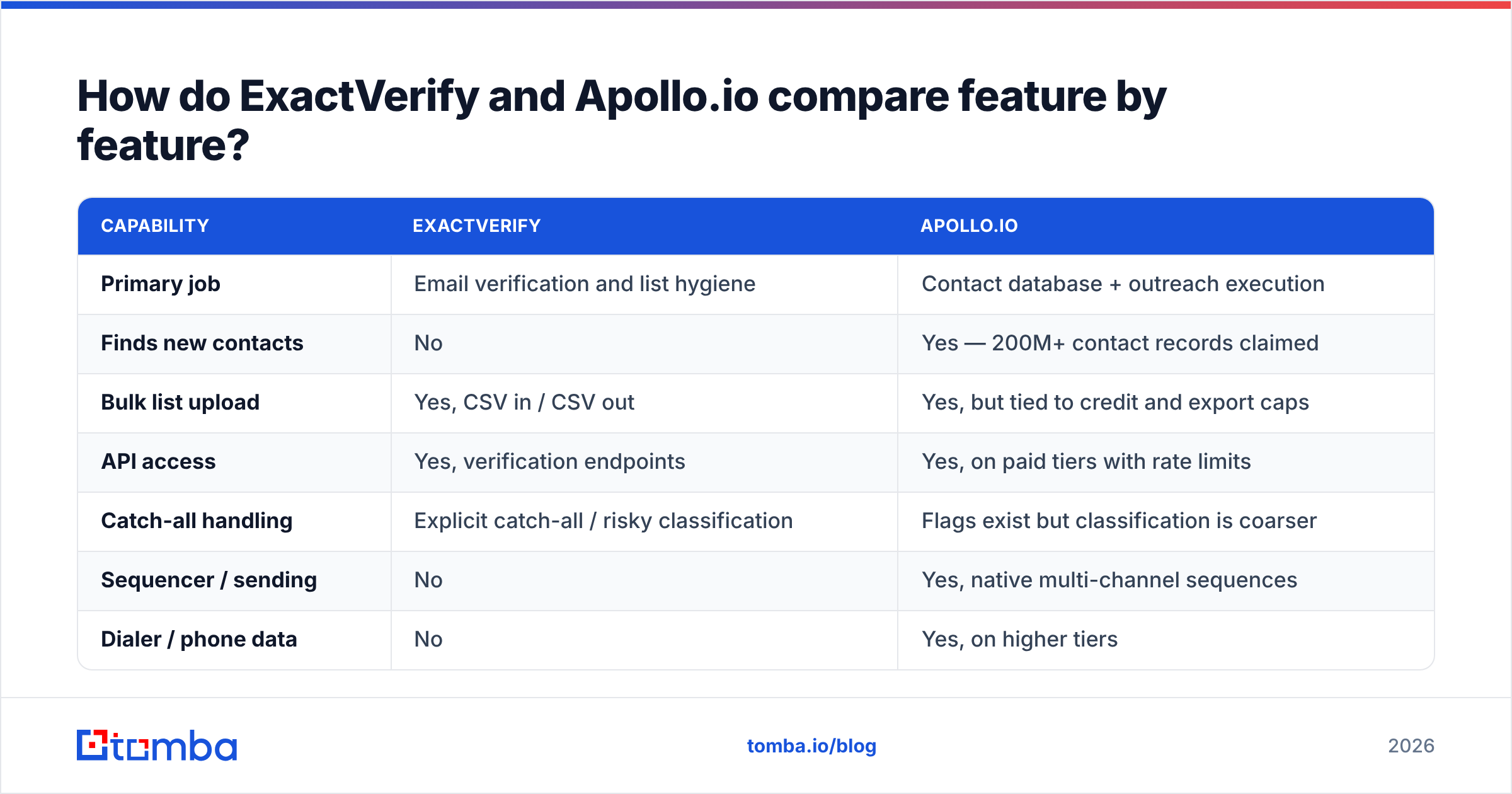
Here is the honest side-by-side. Treat any pricing figure as directional — both vendors adjust plans, and Apollo's published rates change with annual-versus-monthly billing.
| Capability | ExactVerify | Apollo.io |
|---|---|---|
| Primary job | Email verification and list hygiene | Contact database + outreach execution |
| Finds new contacts | No | Yes — 200M+ contact records claimed |
| Bulk list upload | Yes, CSV in / CSV out | Yes, but tied to credit and export caps |
| API access | Yes, verification endpoints | Yes, on paid tiers with rate limits |
| Catch-all handling | Explicit catch-all / risky classification | Flags exist but classification is coarser |
| Sequencer / sending | No | Yes, native multi-channel sequences |
| Dialer / phone data | No | Yes, on higher tiers |
| CRM sync | Via export or API | Native HubSpot and Salesforce sync |
| Pricing model | Pay per email verified, credit packs | Per user, per month, plus credit limits |
| Best fit | Cleaning imported or scraped lists | Teams wanting one tool for the whole motion |
Two things fall out of that table immediately.
First, Apollo's price scales with headcount, not usage. Five reps on a mid tier costs five times one rep, even if four of them barely log in. Verification tools scale with volume, which is usually the fairer curve for a small team running big lists.
Second, Apollo bundles things you may already own. If you run Instantly, Smartlead, or Salesloft for sending, you are paying for Apollo's sequencer twice. That is the single most common overspend we see in outbound stacks — and it is why the Apollo alternative search volume keeps climbing.
Which one is more accurate?#
Accuracy means two different things here, and vendors love to blur them.
Verification accuracy is: given an address, does the tool correctly predict whether it will bounce? Dedicated verifiers like ExactVerify optimize hard for this. They do full SMTP conversations, maintain disposable-domain lists, and keep separate models for catch-all domains where no SMTP answer is trustworthy.
Discovery accuracy is: given a person and a company, does the tool return the right address? That is the finder's job, and it is where Apollo's numbers get soft. Large aggregated databases carry stale records — people change jobs roughly every 2–3 years, so a database refreshed annually is wrong on a meaningful slice of records by definition. Apollo's own community threads and its G2 reviews repeatedly flag outdated contacts on smaller companies and non-US markets.

The practical consequence: running Apollo exports through a real verifier before sending is not paranoia, it is standard practice. Plenty of teams pull from Apollo, then push the file through a dedicated email verifier to strip the 8–15% that would have bounced. That combination is common precisely because neither tool alone closes the loop.
If you send to unverified lists at scale, bounce rate climbs, mailbox providers throttle you, and your sender reputation takes a hit that survives long after you fix the list. Google and Microsoft both tightened bulk-sender thresholds and the tolerance for sloppy lists is now close to zero.
What does each actually cost?#
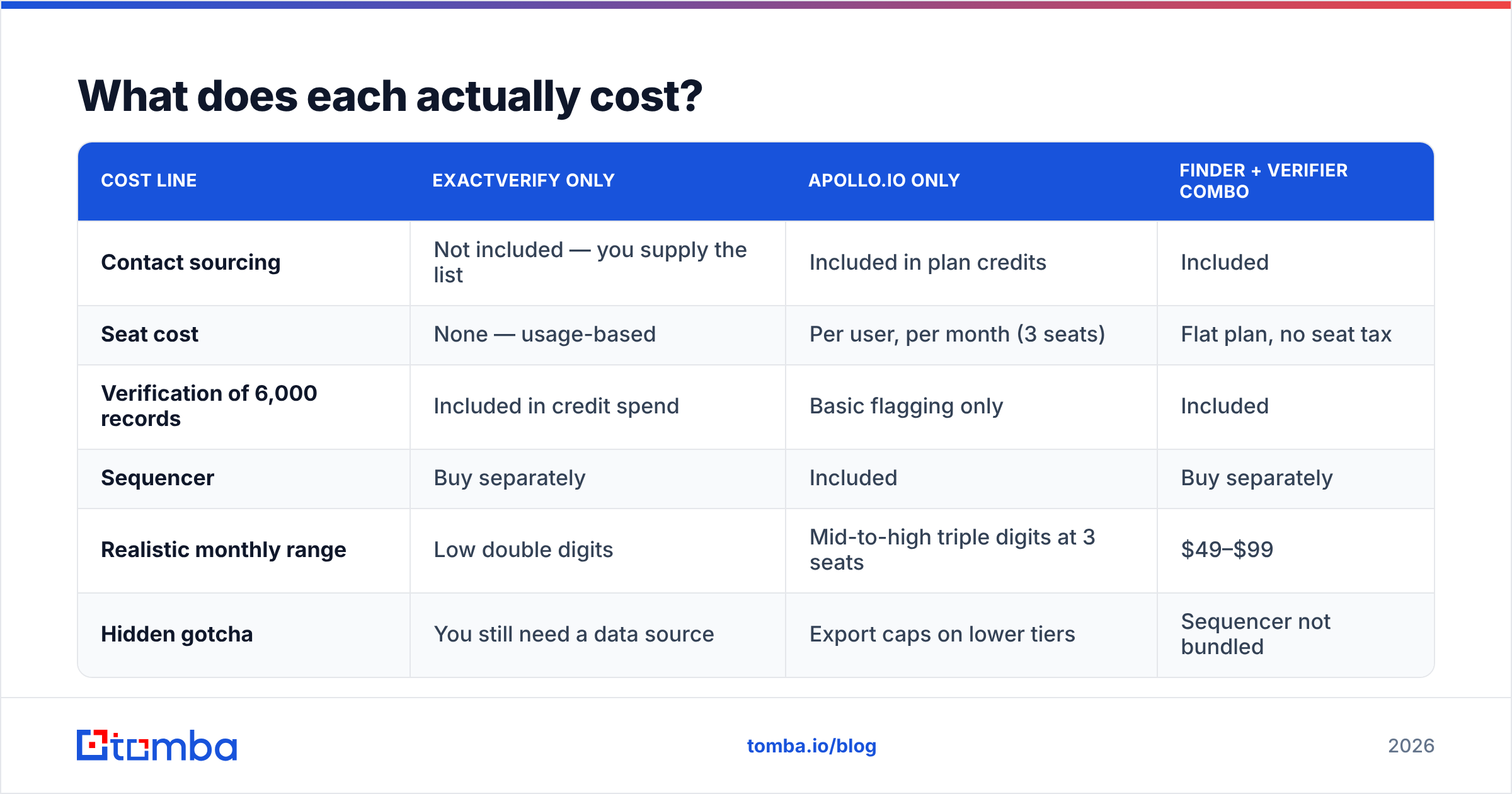
Model the real number, not the sticker price. Here is a realistic three-rep team sending 6,000 cold emails a month.
| Cost line | ExactVerify only | Apollo.io only | Finder + verifier combo |
|---|---|---|---|
| Contact sourcing | Not included — you supply the list | Included in plan credits | Included |
| Seat cost | None — usage-based | Per user, per month (3 seats) | Flat plan, no seat tax |
| Verification of 6,000 records | Included in credit spend | Basic flagging only | Included |
| Sequencer | Buy separately | Included | Buy separately |
| Realistic monthly range | Low double digits | Mid-to-high triple digits at 3 seats | $49–$99 |
| Hidden gotcha | You still need a data source | Export caps on lower tiers | Sequencer not bundled |
Apollo's export caps deserve a callout. On lower tiers, the number of contacts you can actually pull out of the platform per month is restricted, which is how a "unlimited email credits" headline coexists with a very finite workflow. Read the credit terms before you assume you can bulk-export a territory.
On the other side, verification-only spend looks cheap until you notice it is a line item on top of whatever you pay for data. Nobody buys verification in a vacuum.
For reference, Tomba pricing sits at Free (25 searches/mo), Starter $49/mo, Growth $99/mo, Pro $249/mo, and custom Enterprise — flat plans that include finding, verifying, and domain search together rather than metering them as separate products.
When is ExactVerify the better pick?#
Choose the verification specialist when these describe you:
- You already have a data source you trust. A scraped list, a conference roster, an old CRM export, a partner file. The addresses exist; you just do not know which ones are alive.
- Your bounce rate is the acute problem. If you are above 3% and mailbox providers are throttling you, hygiene is the fire. Fix it before you buy more data.
- You run high volume with low seat count. One ops person cleaning 200,000 records a quarter gets crushed by per-seat pricing and rewarded by per-email pricing.
- You need catch-all nuance. Roughly one in five B2B domains is catch-all, and how a tool classifies those addresses changes your usable list size dramatically. A dedicated catch-all verifier gives you a defensible call instead of a shrug.
- You are re-permissioning an old database. Lists older than 12 months decay fast; verification is the cheapest way to salvage what is left before a re-engagement campaign.
When is Apollo.io the better pick?#
Apollo earns its price when you are buying the whole motion, not a component:
- You have no data source at all. Starting from zero, a database beats a verifier every time. You cannot clean a list you do not have.
- You want one login for the team. SDRs prospecting, sequencing, dialing, and logging activity in one place has real operational value, even at a premium.
- You lean on filters and intent. Apollo's segmentation — headcount bands, tech stack, funding events, buying-intent signals — is genuinely strong and hard to reproduce with a finder plus a spreadsheet.
- Your CRM is HubSpot or Salesforce. Native bidirectional sync saves an ops hire's worth of glue work.
Where Apollo stumbles: mid-market European and APAC coverage, verification depth, per-seat economics for teams over four people, and the export limits that quietly cap your throughput.
Where does Tomba fit between the two?#
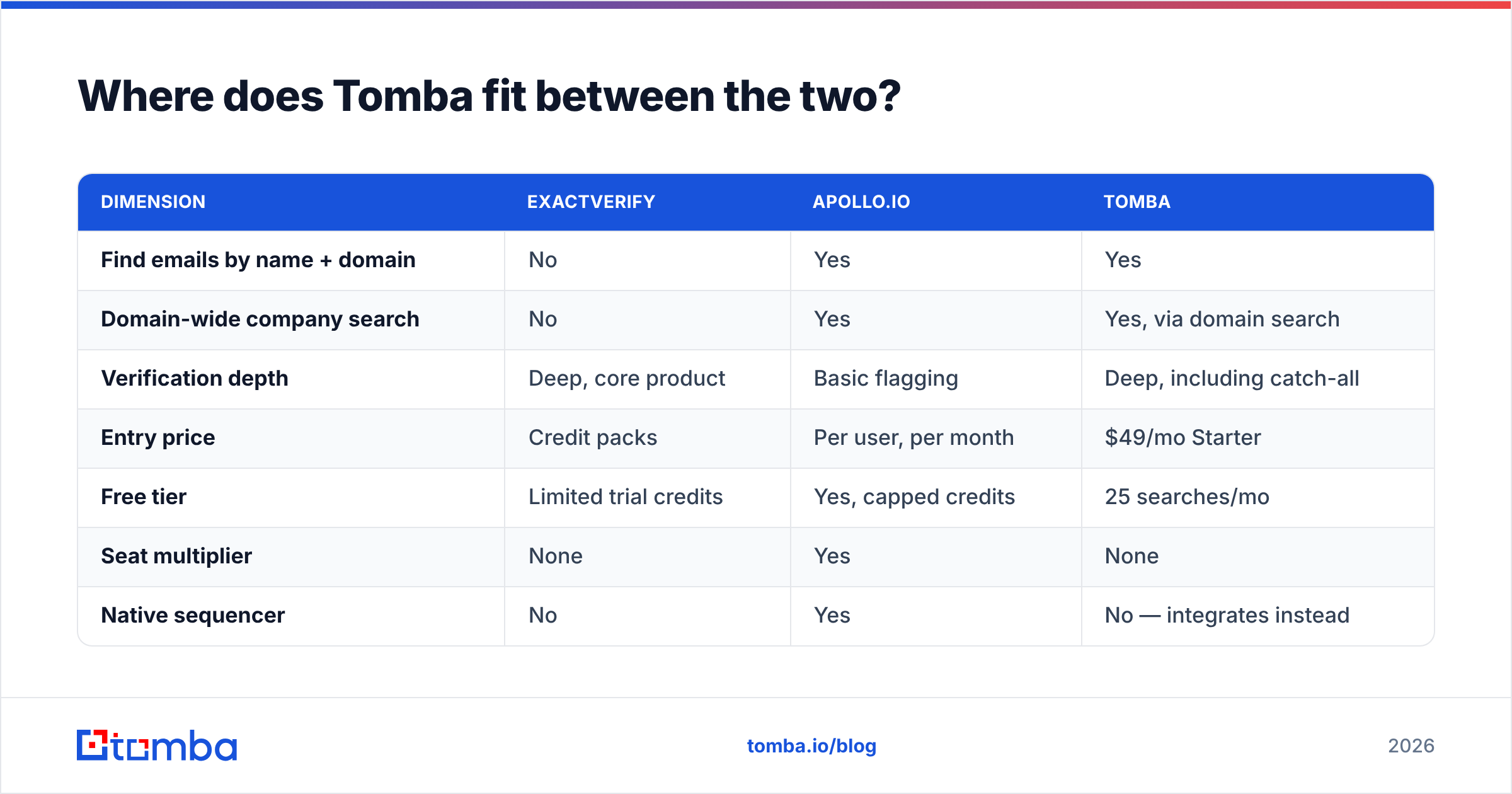
Tomba occupies the gap the two-tool stack creates: finding and verifying in one place, priced per plan rather than per seat.
| Dimension | ExactVerify | Apollo.io | Tomba |
|---|---|---|---|
| Find emails by name + domain | No | Yes | Yes |
| Domain-wide company search | No | Yes | Yes, via domain search |
| Verification depth | Deep, core product | Basic flagging | Deep, including catch-all |
| Entry price | Credit packs | Per user, per month | $49/mo Starter |
| Free tier | Limited trial credits | Yes, capped credits | 25 searches/mo |
| Seat multiplier | None | Yes | None |
| Native sequencer | No | Yes | No — integrates instead |
| API-first workflow | Yes | Yes, tiered | Yes, Tomba API |
| Sheets / Excel / CRM add-ons | Limited | Yes | Yes |
The honest framing: Tomba is not trying to be Apollo. There is no dialer, no native sequencer, no intent-data layer. If you want one platform to run your entire outbound org, Apollo is the more complete purchase and you should pay for it with clear eyes.
But if your actual need is "give me correct, verified email addresses and get out of the way" — and your sending happens in Instantly, Smartlead, or your own SMTP — you are paying an enormous platform tax for a data function. That is where a focused finder plus verifier wins on cost per usable contact, which is the only metric that matters.


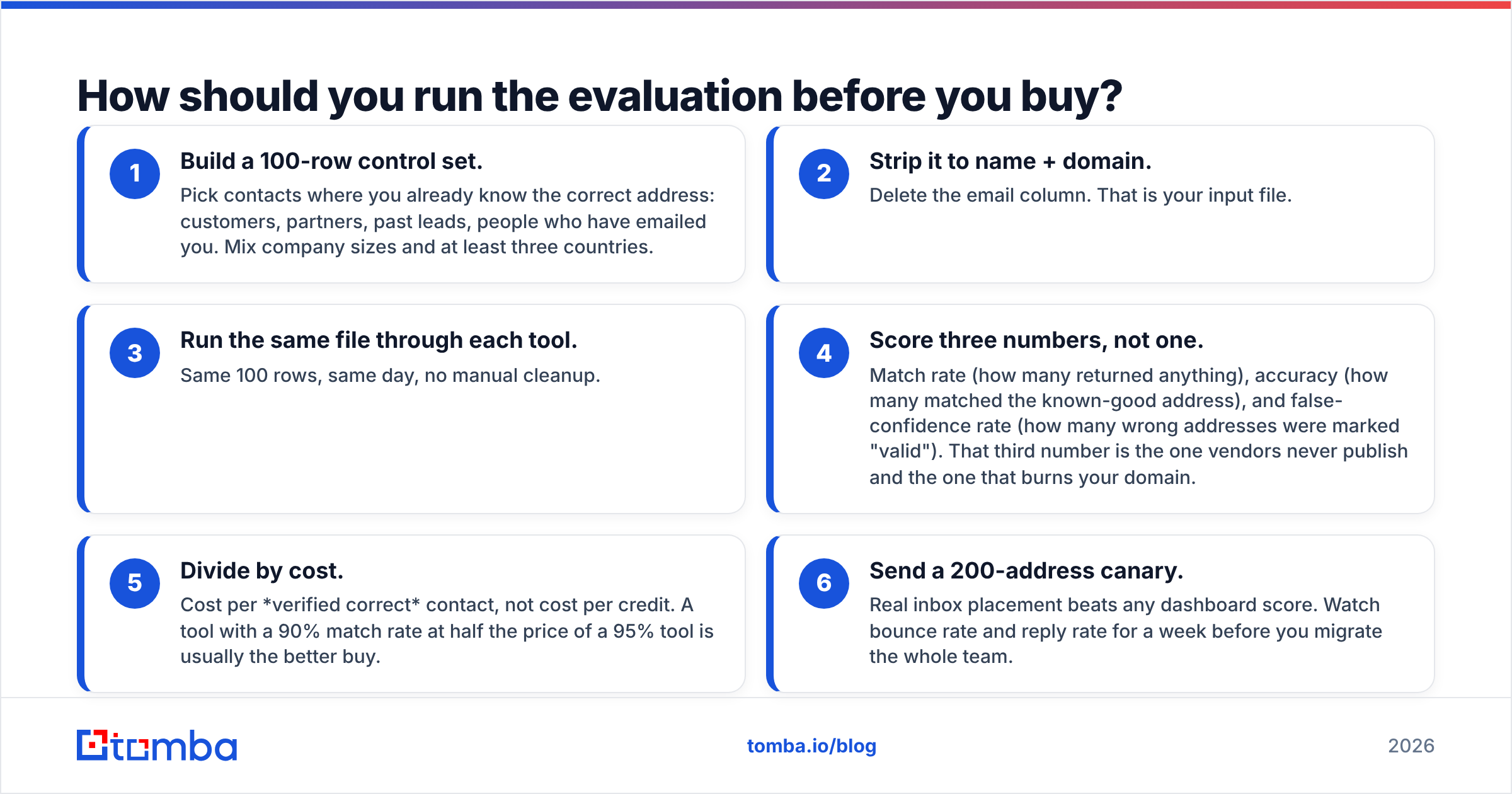
How should you run the evaluation before you buy?#
Do not trust anyone's published accuracy claim, including ours. Run this test — it takes an afternoon.
- Build a 100-row control set. Pick contacts where you already know the correct address: customers, partners, past leads, people who have emailed you. Mix company sizes and at least three countries.
- Strip it to name + domain. Delete the email column. That is your input file.
- Run the same file through each tool. Same 100 rows, same day, no manual cleanup.
- Score three numbers, not one. Match rate (how many returned anything), accuracy (how many matched the known-good address), and false-confidence rate (how many wrong addresses were marked "valid"). That third number is the one vendors never publish and the one that burns your domain.
- Divide by cost. Cost per verified correct contact, not cost per credit. A tool with a 90% match rate at half the price of a 95% tool is usually the better buy.
- Send a 200-address canary. Real inbox placement beats any dashboard score. Watch bounce rate and reply rate for a week before you migrate the whole team.
Most teams discover the gap between tools is smaller on accuracy than on price and workflow friction. That is the actual decision axis.
What is the verdict for 2026?#
Conclusion first: they are complements, not rivals — and if you are choosing only one, choose based on which half of the problem you actually have.
- No list, big team, want everything in one login → Apollo.io, and budget for the seat math.
- Have a list, bouncing badly, ops-led → ExactVerify or an equivalent dedicated verifier.
- Need correct addresses at volume, already have a sending tool, hate seat pricing → a combined finder and verifier.
The worst outcome is buying a full platform to use 20% of it, then still bolting on a verifier because the platform's data was not clean enough to send to. That happens constantly, and it is the single largest source of waste in a mid-market outbound budget.
If your bottleneck is finding verified addresses rather than running the whole sales motion, start with the Tomba Email Finder. The free tier gives you 25 searches a month to run the control-set test above, Starter is $49/mo with finding and verification bundled, and there is no per-seat multiplier waiting for you at renewal. Run your 100-row benchmark against whatever you use today, compare cost per verified correct contact, and let the numbers pick the winner.
Related guides#
Ready to find emails that actually work?
Join 150,000+ professionals who stopped guessing and started sending. Free credits on signup — no credit card required.
Get the Tomba newsletter
Practical outbound tactics and product updates — once every two weeks.
About the author