ExactVerify vs FindThatLead: Which Email Tool Wins in 2026?
ExactVerify verifies lists. FindThatLead builds them. We compare accuracy, pricing, credit models, and API depth to show which one actually belongs in your 2026 outbound stack.
ExactVerify vs FindThatLead is a popular search. It is also the wrong fight. One tool cleans lists. The other one builds them.
TL;DR
- The exactverify vs findthatlead matchup is not a real rivalry. ExactVerify is a bulk email verification engine. FindThatLead is a prospecting and outreach suite. Most teams need one of each.
- FindThatLead wins on lead discovery. It does domain search, LinkedIn extraction, local business scraping, and cold email sending.
- ExactVerify wins on cleaning lists you already own. It costs less per check, handles catch-all, and sells credits that do not expire each month.
- Neither tool covers the whole loop. If you want find, verify, and enrich behind one API and one credit pool, a single platform like Tomba is usually cheaper.
- Budget check: FindThatLead's mid tier plus an ExactVerify credit pack runs about $60–$100 a month. Tomba's Growth plan is $99 a month and covers both jobs.
ExactVerify vs FindThatLead: what does each tool do?#
Short version: they solve opposite halves of one problem.
ExactVerify is an email verification service. You upload a list as CSV, or push it through the API. It returns a status per address. That status is valid, invalid, catch-all, role-based, disposable, or unknown. It does not find emails. It only tells you which addresses will bounce. You buy credit packs instead of seats. That model suits agencies with bursty volume.
FindThatLead (findthatlead.com) is a Spanish prospecting suite. It launched in 2015. Domain search is the core: give it a company domain, get employee emails. It also runs lead search by role and location. You get a LinkedIn extractor, a Chrome extension, and a cold email sender with sequences. It checks emails too. That check is lighter than a dedicated verifier.
So the honest framing of exactverify vs findthatlead is not "which tool is better." Ask a sharper question. Which half of your pipeline is broken right now?
- Your bounce rate crossed 4% and Google started throttling you. That is a verification problem. Look at ExactVerify.
- Your sending is clean, but you only find 200 prospects a month. That is a sourcing problem. Look at FindThatLead.
- Both are true. That is the normal case. Read the cost section before you buy two subscriptions.
How do ExactVerify vs FindThatLead compare head to head?#
Here is the practical breakdown. Prices reflect public plans in early 2026. Both vendors change tiers often. Treat these as ballpark numbers, not contract terms.
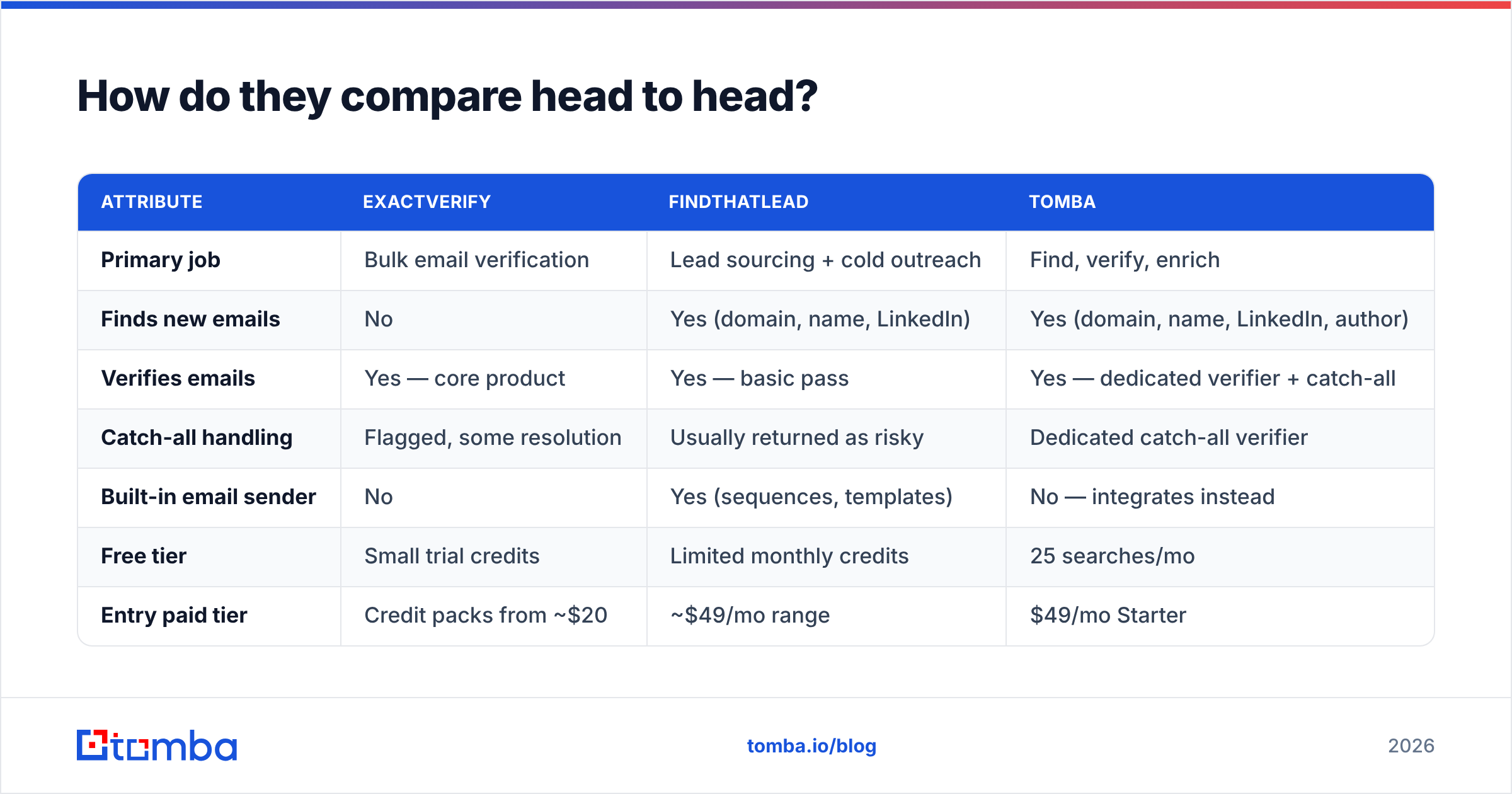
| Attribute | ExactVerify | FindThatLead | Tomba |
|---|---|---|---|
| Primary job | Bulk email verification | Lead sourcing + cold outreach | Find, verify, enrich |
| Finds new emails | No | Yes (domain, name, LinkedIn) | Yes (domain, name, LinkedIn, author) |
| Verifies emails | Yes — core product | Yes — basic pass | Yes — dedicated verifier + catch-all |
| Catch-all handling | Flagged, some resolution | Usually returned as risky | Dedicated catch-all verifier |
| Built-in email sender | No | Yes (sequences, templates) | No — integrates instead |
| Free tier | Small trial credits | Limited monthly credits | 25 searches/mo |
| Entry paid tier | Credit packs from ~$20 | ~$49/mo range | $49/mo Starter |
| Mid tier | Volume packs | ~$99/mo range | $99/mo Growth |
| Credit expiry | Packs typically don't expire monthly | Monthly reset | Monthly reset on plans |
| API | Verification endpoints | Search + verify endpoints | Full REST API, CLI, MCP server |
| Spreadsheet add-ons | CSV upload | CSV + Chrome extension | Sheets, Excel, Airtable, Chrome |
| Best for | Agencies cleaning bought lists | Solo founders + small SDR teams | Teams wanting one vendor for both |
The row that decides most purchases is credit expiry. ExactVerify's pack model is better when volume is spiky. You buy 100k checks in January. You burn them over six months. Nothing evaporates. Subscription tools reset every 30 days, and leftover credits are gone. If you verify 40k addresses once a quarter, packs win on arithmetic alone.
The next row that decides purchases is the built-in sender. FindThatLead bundles outreach into the same seat. That is real convenience for a one-person GTM motion. It is also the piece you outgrow first. Soon you need inbox rotation, warmup pools, and real deliverability data. Then you move sending to a dedicated platform. The bundled sender becomes dead weight you still pay for.
Which one has better data accuracy?#
Each tool needs a different test, so measure them apart.
For ExactVerify, accuracy means one thing. Does a "valid" verdict really deliver? Run a holdout test. Take 1,000 addresses with known delivery history. Some landed. Some hard-bounced. Strip the outcome, run them through the verifier, then score its verdicts against reality. Four numbers matter.
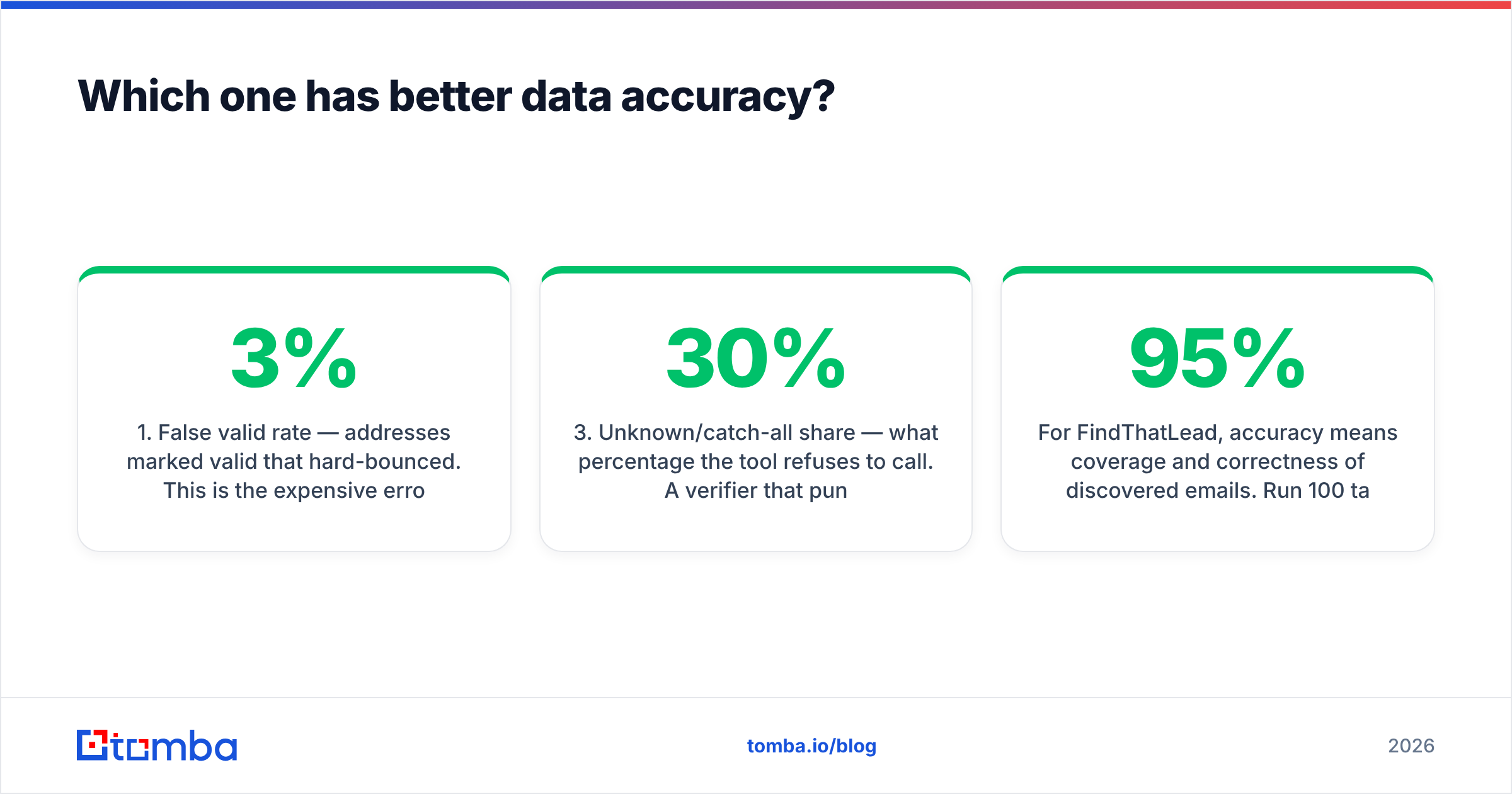
- False valid rate — addresses marked valid that hard-bounced. This is the expensive error. Anything above 3% will hurt your sender reputation at volume.
- False invalid rate — good addresses marked invalid. You lose revenue in silence. Nobody notices, because you never emailed them.
- Unknown or catch-all share — the share the tool refuses to call. A verifier that punts on 30% of a B2B list is not doing much. Catch-all domains are very common in large companies.
- Throughput — how long 50k rows really take. Some engines throttle hard on big jobs.

For FindThatLead, accuracy means coverage. Run 100 target companies you know well through domain search. Then score the output. How many contacts came back? How many were the right person? How many were role addresses like info@ or sales@? How many stayed valid after a real verification pass?
Prospecting tools like to quote "95% accuracy." They quietly drop everything they could not find. Coverage and accuracy trade against each other. The honest metric is verified-valid contacts per 100 target accounts. A lone percentage tells you nothing.

Both tools share one weakness, and so does every vendor here. European and APAC coverage is thinner than US coverage. Say your ICP is DACH mid-market or Japanese enterprise. Then test with your own account list before you sign an annual plan. Published accuracy numbers lean heavily on US tech companies, where the data is densest.
What does the total cost actually look like?#
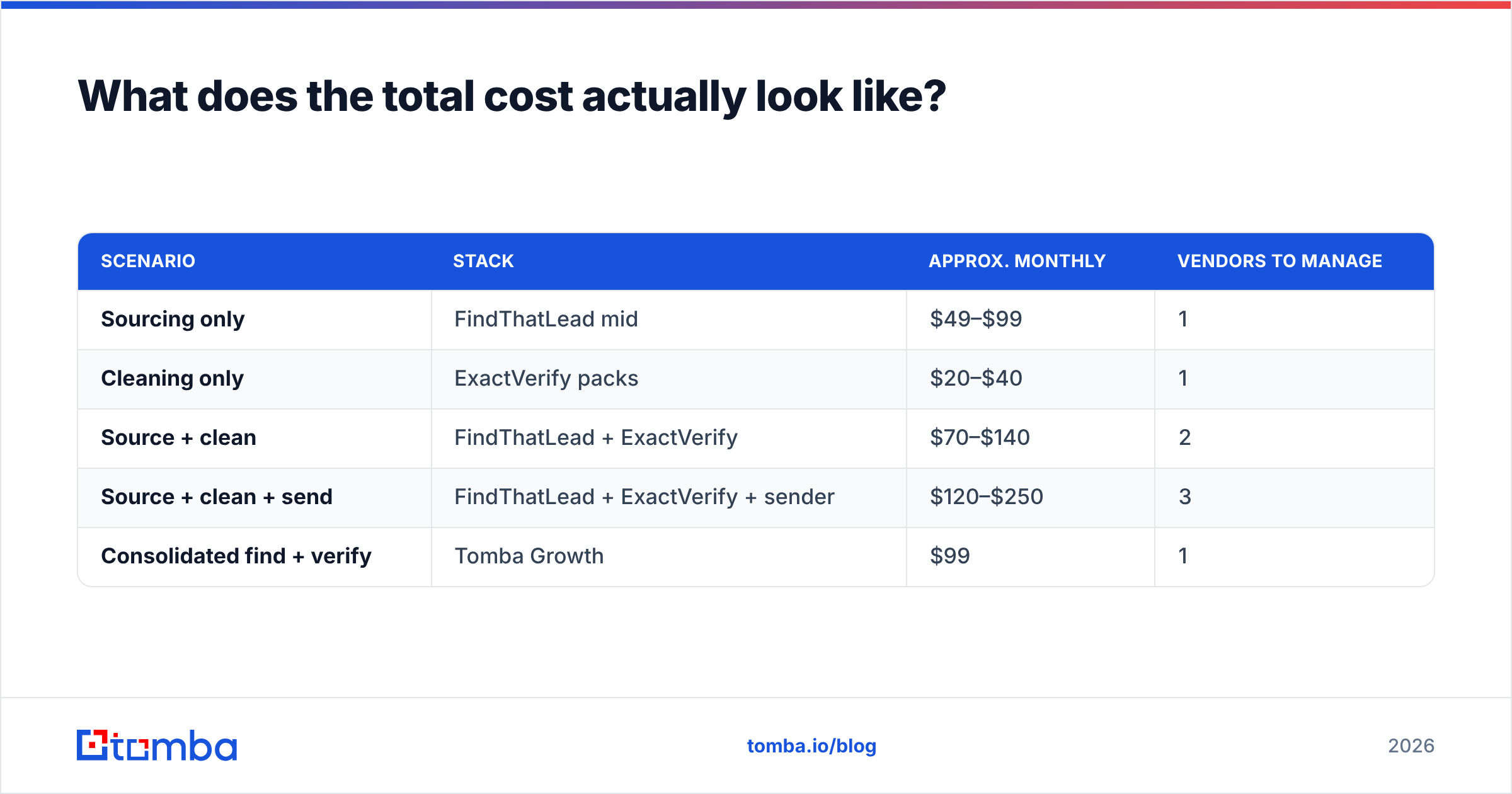
This is where the two-tool approach falls apart. The exactverify vs findthatlead bill adds up faster than it looks.
Say you run a three-person outbound team. You work 1,500 new prospects a month. Sourcing them through FindThatLead's mid tier costs roughly $49–$99 a month. Then the built-in check hands back a pile of catch-all results you do not trust.
So you push 40–50% of the list to ExactVerify. Call that another $20–$40 a month in packs. Add a sending tool once you outgrow the bundled one. Now you pay $120–$200 a month across three vendors. You also juggle three dashboards, three credit ledgers, and two API keys in your CRM sync.
| Scenario | Stack | Approx. monthly | Vendors to manage |
|---|---|---|---|
| Sourcing only | FindThatLead mid | $49–$99 | 1 |
| Cleaning only | ExactVerify packs | $20–$40 | 1 |
| Source + clean | FindThatLead + ExactVerify | $70–$140 | 2 |
| Source + clean + send | FindThatLead + ExactVerify + sender | $120–$250 | 3 |
| Consolidated find + verify | Tomba Growth | $99 | 1 |
For comparison, Tomba pricing starts free at 25 searches a month. Starter is $49, Growth is $99, and Pro is $249. Enterprise is custom. The email finder, email verifier, domain search, and catch-all verifier all draw from one credit pool. You never forecast two budgets that drift apart.
One honest counterpoint. Maybe you verify in rare, huge bursts, like a 200k-row cleanup twice a year. Then a pack-based verifier such as ExactVerify beats any subscription. Do not consolidate for its own sake. Consolidation pays when usage is steady and monthly.
What are the alternatives worth testing?#
The category is crowded. Several tools overlap with the exactverify vs findthatlead pair.
Start with the sourcing side:
- Hunter — the best-known domain search tool. Strong free tier, verification included, and clear API docs. Credits cost more at volume than either tool here.
- BookYourData — good when you would rather buy a ready-made, pre-verified list. Strong filters by firmographics and geography. It is a purchase model, not a search model. That suits teams who know their ICP and want volume today.
- Apollo — sourcing, sequences, and a huge contact database in FindThatLead's lane. It is heavier and pricier. Data quality swings sharply by segment. The Apollo alternative page covers where it wins.
Then look at the cleaning side:
- ZeroBounce and NeverBounce — dedicated verifiers in ExactVerify's lane. Both add mature deliverability tooling, such as blacklist monitoring and inbox placement. Compare them on the same holdout test. The ZeroBounce alternative page covers the credit-model differences.
- Tomba — find, verify, enrich, and resolve catch-all under one API. Best fit if you build the pipeline in code rather than clicking through a dashboard.
Check review volume before you commit. G2 and Capterra both carry enough reviews here to spot patterns. Support speed and billing complaints separate these vendors more than accuracy claims do.
How should you run the evaluation?#
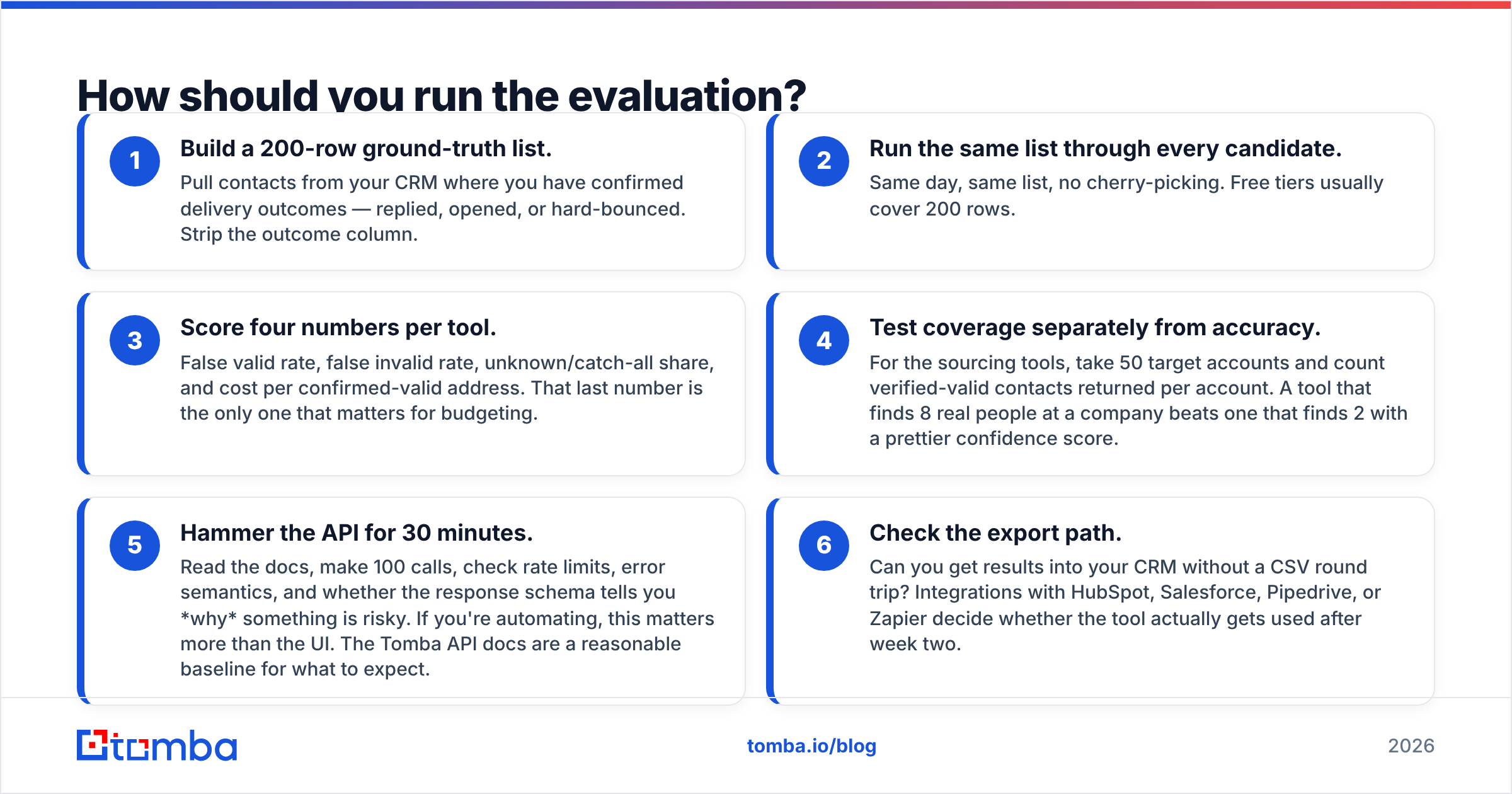
Do not settle exactverify vs findthatlead from a blog post. Run a bake-off. It takes one afternoon.
First, test the verifiers:
- Build a 200-row ground-truth list. Pull contacts from your CRM with known outcomes: replied, opened, or hard-bounced. Strip the outcome column.
- Run the same list through every candidate. Same day, same list, no cherry-picking. Free tiers usually cover 200 rows.
- Score four numbers per tool. False valid rate, false invalid rate, unknown share, and cost per confirmed-valid address. That last number drives your budget.
Then test sourcing and plumbing:
- Check coverage on its own. Take 50 target accounts. Count verified-valid contacts per account. A tool that finds 8 real people beats one that finds 2 with a prettier confidence score.
- Hammer the API for 30 minutes. Read the docs. Make 100 calls. Check rate limits and error semantics. See whether the response tells you why an address is risky. The Tomba API docs are a fair baseline.
- Check the export path. Can results reach your CRM without a CSV round trip? Integrations with HubSpot, Salesforce, Pipedrive, or Zapier decide whether anyone still uses the tool in week two.
One warning about step 2. Never test verifiers with fake or disposable addresses. Every tool catches those. The interesting failures look real: a live company, a mailbox switched off three months ago. That group wrecks email deliverability. It also separates good verifiers from average ones.
ExactVerify vs FindThatLead: which should you pick?#
Straight answers by situation:
- You bought or inherited a large list and need it clean. Pick ExactVerify. Pack pricing, no monthly waste, built for the job.
- You are a solo founder who needs leads and emails tomorrow. Pick FindThatLead. The bundled sender saves you a second tool while volume is low. The Chrome extension makes ad-hoc prospecting fast.
- You run a small SDR team with steady monthly volume. Consolidate. Paying two vendors to swap CSVs costs more in coordination than in dollars.
- You are building automated pipeline infrastructure. Pick on API quality alone. Clean errors, real rate-limit headers, and honest confidence scores save more hours than any price gap.
- Your ICP sits outside North America. Test all three with your own account list first. Published numbers will not predict your results.
Avoid one mistake. Do not assume a prospecting tool's bundled verification is enough. It usually is not, especially on catch-all domains. You find out when your bounce rate is already visible to Google and Microsoft. Verify separately, or use a platform where verification is a first-class product.
If one credit pool sounds better than two, start with the Tomba Email Finder. Find emails by domain, name, or company. Verify them in the same workflow. Push results into your CRM through the API or a spreadsheet add-on. The free tier gives you 25 searches a month. That is enough to run the ground-truth test above against whatever you use now. Do the test with your own data before you renew anything.
Related guides#
Ready to find emails that actually work?
Join 150,000+ professionals who stopped guessing and started sending. Free credits on signup — no credit card required.
Get the Tomba newsletter
Practical outbound tactics and product updates — once every two weeks.
About the author