Examples of B2B Marketing That Actually Generated Pipeline in 2026
Nine real examples of B2B marketing — from ABM plays to community-led growth — broken down by cost, cycle length, and the pipeline they actually produce.
TL;DR
- The best examples of B2B marketing are not campaigns — they are repeatable systems: ABM, product-led content, community, and outbound built on verified contact data.
- Content and SEO have the lowest cost per lead over 12 months but the longest ramp (6–12 months before meaningful pipeline).
- ABM produces the highest deal sizes and the worst efficiency if your target account list is built on stale data.
- Webinars and podcasts are the most underrated mid-funnel plays in 2026 because they generate first-party intent signals you can act on within 48 hours.
- Every play below fails the same way: bad contact data. Fix the data layer before you scale spend.
What Counts as a B2B Marketing Example Worth Copying?#
Most "examples of B2B marketing" lists are screenshots of pretty landing pages. That is useless. A B2B marketing example is only worth copying if you can see three things: what it cost, how long it took to produce revenue, and what infrastructure it required.
B2B buying is not B2C buying with bigger numbers. A typical mid-market software purchase involves 6 to 10 stakeholders, takes 3 to 9 months, and dies more often from internal inertia than from competitive loss. Gartner's research on buying groups has been consistent on this for years — the buying committee is the unit of purchase, not the individual.
So the examples below are organized by what they actually do to a buying committee: create awareness across it, create consensus inside it, or create urgency at the end of it.
The Six Structural Differences That Change Everything#
- Multiple decision-makers — your message has to survive being forwarded to a CFO who never saw your ad.
- Long cycles — attribution windows of 30 days are lying to you; use 90–180 days.
- Small addressable markets — you might have 4,000 real accounts, not 4 million users. Precision beats volume.
- High deal values — a $60K ACV justifies a $3,000 cost per opportunity, which changes every channel math.
- Rational-but-political buying — the champion needs a business case and internal cover.
- Data dependency — you cannot reach a named account without a verified email or phone number for the right person.
That last point is where most programs quietly break. You can build a flawless ABM strategy and still miss 40% of your target list because your contact records are three job changes old.
Which Examples of B2B Marketing Produce the Most Pipeline?#
Here is the honest comparison. These numbers reflect typical mid-market B2B SaaS ranges ($15K–$80K ACV), not enterprise outliers.
| Play | Typical cost/month | Time to first pipeline | Cost per opportunity | Best for |
|---|---|---|---|---|
| SEO + content engine | $6,000–$15,000 | 6–12 months | $400–$900 | Broad category demand |
| Account-based marketing | $10,000–$40,000 | 2–4 months | $1,500–$4,000 | Named enterprise accounts |
| Cold email outbound | $2,000–$8,000 | 3–6 weeks | $600–$1,800 | Fast market validation |
| Webinars / virtual events | $3,000–$9,000 | 4–8 weeks | $500–$1,200 | Mid-funnel consensus |
| Community-led growth | $4,000–$12,000 | 9–18 months | $200–$600 | Category creation |
| Paid search (bottom-funnel) | $8,000–$50,000 | 1–2 weeks | $1,200–$5,000 | Capturing existing intent |
| Customer advocacy / referrals | $1,000–$4,000 | 3–6 months | $150–$400 | High-NPS products |
| Partner / co-marketing | $2,000–$6,000 | 2–5 months | $300–$1,100 | Ecosystem plays |
| LinkedIn thought leadership | $3,000–$10,000 | 3–9 months | $700–$2,000 | Founder-led sales |
The pattern: the cheapest cost per opportunity comes from plays that take the longest to build (community, advocacy, SEO). The fastest plays (paid search, ABM) cost the most per opportunity. Any team claiming both speed and efficiency is either lying or has an unfair distribution advantage.
What Does a Real Account-Based Marketing Example Look Like?#
ABM is the most-cited and least-executed example of B2B marketing. The version that works looks like this:
The setup. A workflow automation company identified 280 target accounts in logistics with 200–2,000 employees. Not 5,000 accounts. 280.
The data layer. For each account they mapped 5 roles: VP Operations, Director of IT, CFO, an ops manager, and a systems admin. That is 1,400 contacts. They used domain search to pull the email pattern and existing contacts per company, then ran everything through an email verifier before touching a sequence. Bounce rate landed under 2%.
The orchestration. Each account received a coordinated sequence over 8 weeks: LinkedIn ads to all 5 roles, a personalized landing page referencing their logistics stack, direct mail to the VP, and a 4-touch email sequence to the ops manager and IT director.
The result. 61 accounts engaged (21.8%), 24 meetings, 9 opportunities, 3 closed deals averaging $74K. Program cost was roughly $118,000 over the quarter. Payback landed at month 7.
The part nobody publishes. They ran the same program the previous year against a 1,900-account list using scraped data and generated 2 opportunities. Same team, same creative, same budget. The variable was list quality and contact accuracy.
If you are considering ABM, the sequencing matters: build the account list, then verify contacts, then build creative. Not the other way around.
How Does Content and SEO Work as a B2B Marketing Example?#
The strongest content examples in B2B share one trait: they answer a question the buyer is already typing, at the moment they have budget.
Bottom-funnel comparison content. Pages like "X vs Y" and "alternatives to Z" convert at 4–8x the rate of top-funnel blog posts. They attract someone mid-evaluation. A single well-executed alternatives page can carry more pipeline than 40 thought-leadership posts.
Programmatic templates. Companies like Zapier built enormous organic footprints from a repeatable page structure multiplied across thousands of entities (integrations, job titles, cities, use cases). It works when the underlying data is real and each page has genuine utility.
Free tools as content. A calculator, checker, or generator earns links and captures intent simultaneously. Tomba's own free email checker and subject line generator work this way — utility first, capture second.
The distribution mistake. Most teams spend 90% of effort on production and 10% on distribution. Flip it. A post that took 12 hours to write deserves 12 hours of syndication, sales enablement, newsletter placement, and LinkedIn repurposing.
Content ROI compounds, which is why it looks like a failure at month 4 and a miracle at month 14. If your CFO cannot tolerate a 9-month lag, do not start here — start with outbound or paid capture and layer content underneath.
Is Cold Email Still a Viable B2B Marketing Example in 2026?#
Yes, but the tolerance for sloppiness is gone. Google and Microsoft's bulk sender requirements have made list hygiene a technical prerequisite, not a best practice.
What separates working cold email programs from banned domains:
- Verified lists only. A 3% bounce rate is the threshold where inbox providers start throttling. Verified sending lists keep you at 0.5–1.5%. Run every list through verification before send — no exceptions, no "it's a small batch."
- Authentication in place. SPF, DKIM, and DMARC configured correctly. Check yours with an SPF checker before you scale volume.
- Volume discipline. 30–50 emails per mailbox per day, spread across multiple sending domains, with warmup running continuously.
- Relevance over personalization tokens. "I saw you're hiring 3 SDRs" beats "Hi {{FirstName}}, I loved your post" every time. The first proves research; the second proves a merge field.
A working example. A cybersecurity vendor targeting CISOs at 500–5,000 employee companies built a 2,100-contact list, verified it down to 1,840 deliverable addresses, and ran a 5-touch sequence built around a single specific insight (a compliance deadline affecting their vertical). Reply rate: 8.4%. Meetings booked: 47 over six weeks. Cost: under $5,000 including tooling.
The unglamorous truth is that the list was the campaign. The copy was above average. The data was excellent.
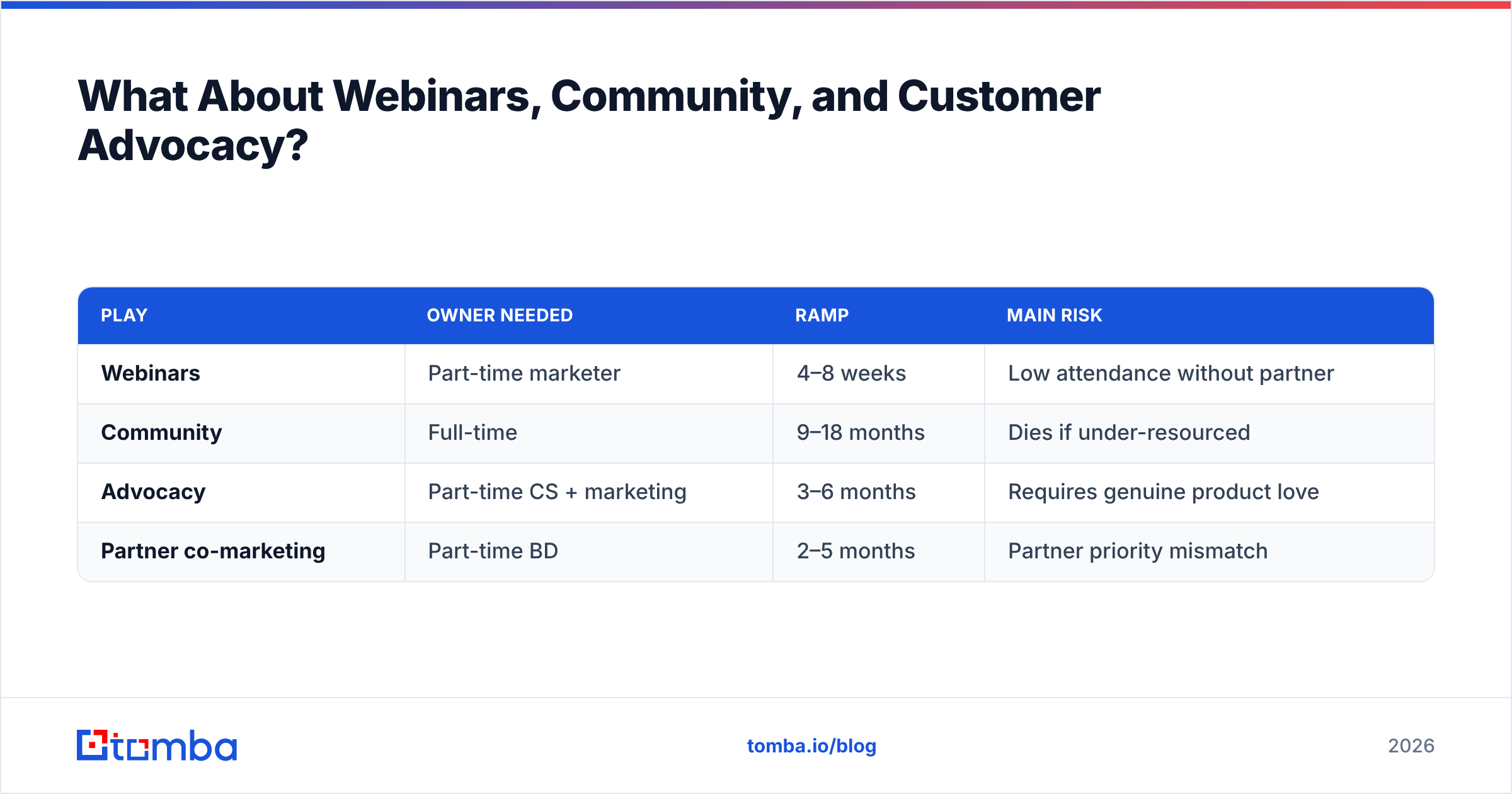
What About Webinars, Community, and Customer Advocacy?#
These three are the most underused examples of B2B marketing relative to their return.
Webinars as consensus machines. The value is not the lead list — it is that a webinar gets 3 people from the same account in the same room. That is buying-committee alignment you cannot buy any other way. Partner webinars with a complementary vendor cut your acquisition cost roughly in half because both audiences show up.
Community-led growth. Slack groups, private forums, and curated newsletters compound slowly and then dominate. HubSpot's inbound community and Pavilion's paid GTM community are the canonical examples. The catch: you need 12–18 months and a full-time owner. Half-committed communities die visibly, which is worse than never starting.
Customer advocacy. The cheapest pipeline in B2B. A structured referral motion — asking every customer above a certain health score, with a defined incentive and a written ask template — routinely produces leads at 20–30% of the cost of paid channels. Most companies never formalize it because it does not feel like marketing.
| Play | Owner needed | Ramp | Main risk |
|---|---|---|---|
| Webinars | Part-time marketer | 4–8 weeks | Low attendance without partner |
| Community | Full-time | 9–18 months | Dies if under-resourced |
| Advocacy | Part-time CS + marketing | 3–6 months | Requires genuine product love |
| Partner co-marketing | Part-time BD | 2–5 months | Partner priority mismatch |
How Do You Choose Which B2B Marketing Example to Run First?#
Pick based on three constraints: your runway, your ACV, and your data readiness.
If your runway is under 6 months: outbound and bottom-funnel paid search. They are expensive per opportunity but they produce pipeline inside a quarter. Build the list, verify it, sequence it.
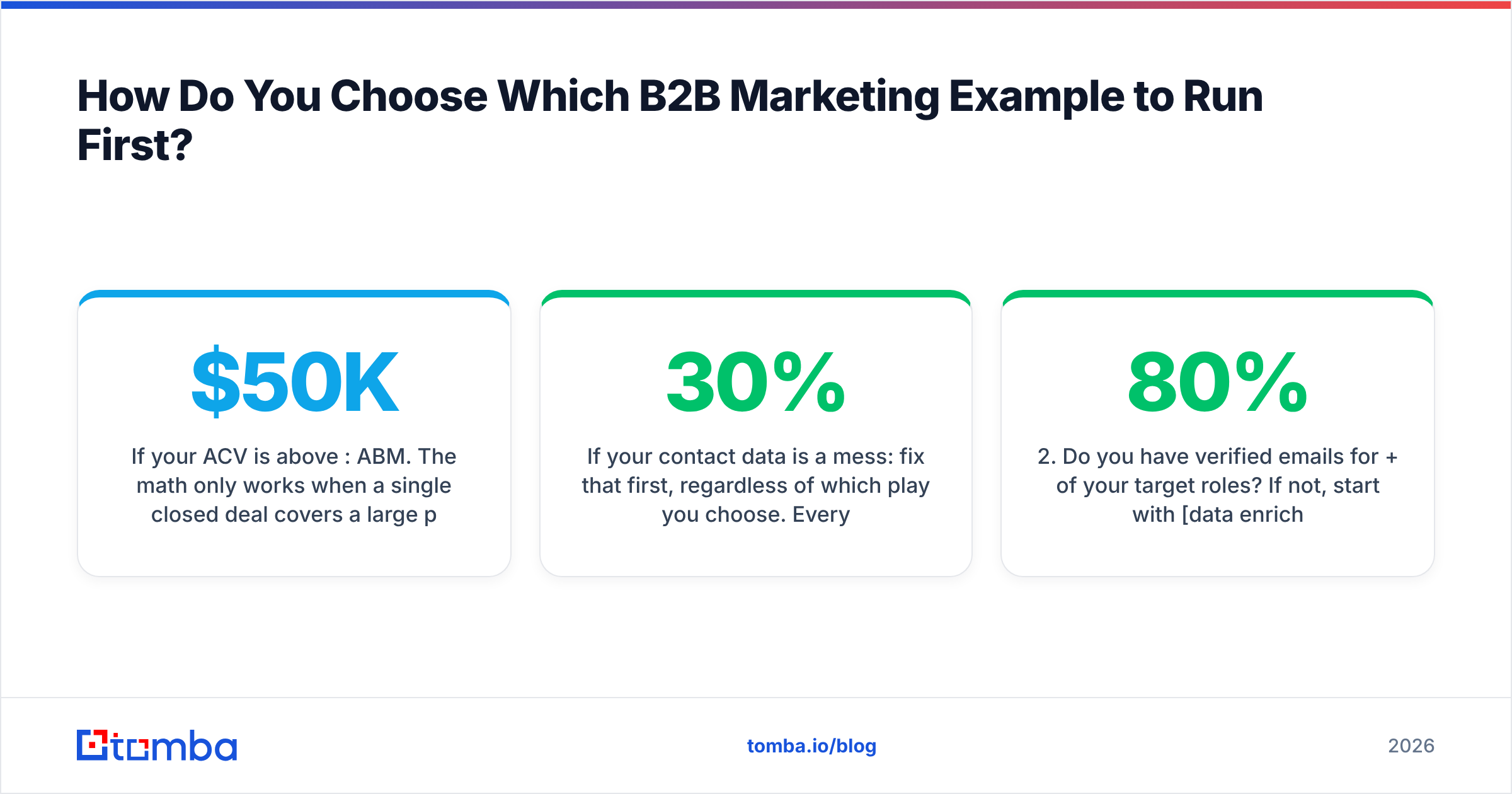
If your ACV is above $50K: ABM. The math only works when a single closed deal covers a large program cost. Below $25K ACV, ABM economics rarely clear.
If you have 12+ months and patient leadership: content, community, and product-led motions. These have the best long-run unit economics and the worst short-run optics.
If your contact data is a mess: fix that first, regardless of which play you choose. Every channel above degrades proportionally to data decay. B2B contact data decays at roughly 25–30% annually because people change jobs; a list you built 18 months ago is meaningfully wrong today.
A practical readiness check before you commit budget:
- Can you name your top 200 target accounts? If not, you are not ready for ABM.
- Do you have verified emails for 80%+ of your target roles? If not, start with data enrichment and verification.
- Is your sending domain authenticated and warmed? If not, outbound will burn your domain.
- Do you have a CRM that tracks account-level engagement? If not, you cannot measure ABM at all.
- Can you tolerate a 9-month payback? If not, skip content-first strategies.
Vendor comparison sites like G2 and Capterra are useful for benchmarking what tooling your competitors run, and HubSpot's research library is a reasonable free source for channel benchmarks — treat vendor-published stats with appropriate skepticism, since they measure the channel they sell.
What Do All These Examples Have in Common?#
Three things, and none of them are creative.
One: a defined account universe. Every working example above started with a list of specific companies, not a persona description. "VP of Ops at mid-market logistics companies" is a targeting fantasy. A spreadsheet of 280 named companies with 5 verified contacts each is a campaign.
Two: contact-level accuracy. Your beautiful ABM creative reaches nobody if the email bounces. Your cold sequence torches your domain if 6% of addresses are dead. Your enrichment-driven personalization embarrasses you if the job title is two roles stale.
Three: a measurement window that matches the sales cycle. If your average cycle is 120 days and you kill channels at 30 days, you will systematically defund everything that works and over-fund everything that generates cheap, unqualified leads. Match the window to the cycle.
Everything else — the creative, the copy, the channel mix — is a variable you tune after those three are locked.
Where Should You Start This Quarter?#
Start with the data layer, then run one fast play and one slow play in parallel.
The fast play gives you pipeline this quarter and keeps leadership funded. The slow play (content, community, advocacy) is what makes next year cheaper. Running only fast plays means you rent your pipeline forever at rising prices. Running only slow plays means you may not survive to see them work.
Before you launch either, build the contact foundation. Tomba's Email Finder lets you go from a target account list to verified, role-specific contacts — search by domain to map an entire company's email pattern, pull the decision-makers you actually need, and verify deliverability before a single send. The free tier gives you 25 searches a month to test your list quality; paid plans start at $49/mo, with Growth at $99/mo for teams running real outbound volume. Full Tomba pricing is public, and the Tomba API handles enrichment inside your existing CRM workflow.
Whichever example of B2B marketing you copy, copy the data discipline first. The rest is execution.
Related guides#
Ready to find emails that actually work?
Join 150,000+ professionals who stopped guessing and started sending. Free credits on signup — no credit card required.
Get the Tomba newsletter
Practical outbound tactics and product updates — once every two weeks.
About the author