Examples of Inbound and Outbound Marketing That Work in 2026
Real examples of inbound and outbound marketing side by side — with cost per lead, time to first pipeline, and the exact plays that still convert in 2026.
Below are 14 examples of inbound and outbound marketing you can run this quarter. Each one lists the mechanic, the rough cost, and how fast it pays back. No debate about which side is morally superior — just the plays.
TL;DR
- Inbound earns attention (SEO, content, free tools, community); outbound buys or takes it (cold email, cold calls, ads, direct mail, events). Both are demand capture or demand creation depending on execution, not on the channel label.
- Inbound compounds but is slow: most B2B blog programs need 6–12 months before they produce reliable pipeline. Outbound produces meetings in week two but stops the day you stop.
- The 14 examples of inbound and outbound marketing below are concrete plays with real mechanics — not "write great content."
- The cheapest hybrid in 2026: publish a free tool or benchmark study (inbound), then run outbound to the exact people who should care about it.
- Outbound quality now lives or dies on data. Bad emails burn your domain before your copy ever gets read.
Examples of Inbound and Outbound Marketing: What Is the Actual Difference?#
Inbound marketing pulls buyers toward you. Someone has a problem, searches for it, finds your article or free tool, and raises their hand. You never picked them — they picked you.
Outbound marketing pushes your message toward a buyer who did not ask for it. You built the list, you chose the account, you sent the email or made the call.
Think of it like a restaurant. Inbound is the smell of bread drifting onto the street plus a good sign and a Google Maps listing — people walk in on their own. Outbound is standing outside handing menus to people who match your ideal customer profile. Neither one is classier. One scales with time, the other scales with headcount and data quality.
The practical difference that matters to a revenue team:
- Who initiates. Inbound = buyer initiates. Outbound = you initiate.
- Timing control. Outbound lets you decide this quarter which 500 accounts hear from you. Inbound gives you whoever shows up.
- Cost curve. Inbound has high upfront cost and near-zero marginal cost. Outbound has low upfront cost and linear marginal cost.
- Attribution. Inbound is messy to attribute (dark social, brand search). Outbound is clean — you know exactly who you touched.
- Failure mode. Inbound fails silently (nobody reads it). Outbound fails loudly (spam complaints, blocked domains, angry replies).
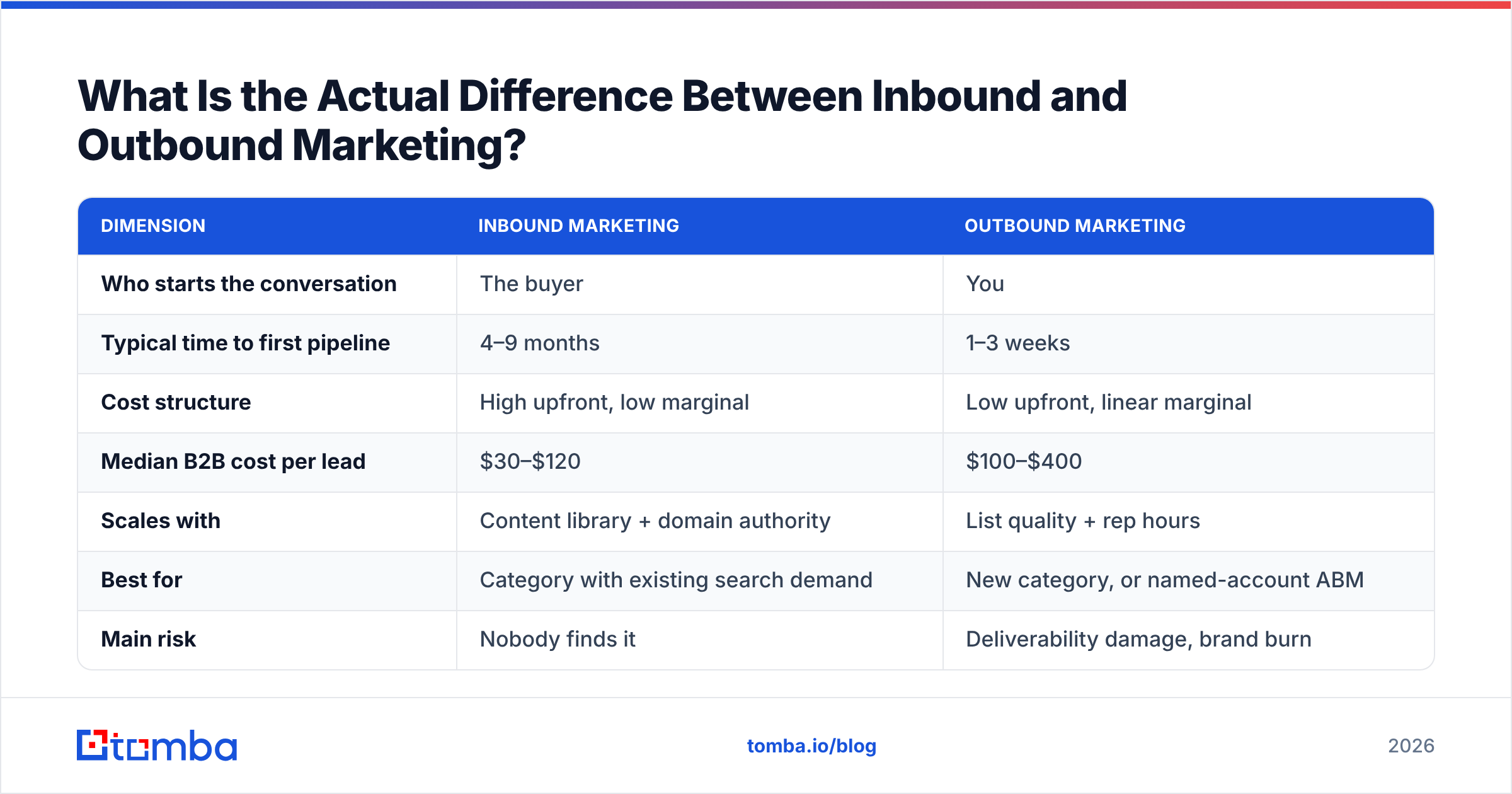
| Dimension | Inbound marketing | Outbound marketing |
|---|---|---|
| Who starts the conversation | The buyer | You |
| Typical time to first pipeline | 4–9 months | 1–3 weeks |
| Cost structure | High upfront, low marginal | Low upfront, linear marginal |
| Median B2B cost per lead | $30–$120 | $100–$400 |
| Scales with | Content library + domain authority | List quality + rep hours |
| Best for | Category with existing search demand | New category, or named-account ABM |
| Main risk | Nobody finds it | Deliverability damage, brand burn |
| Stops working when | You stop publishing (slowly, over ~12 months) | You stop sending (immediately) |
What Are Real Examples of Inbound Marketing?#
These are plays you can copy this quarter, not abstractions.
1. Bottom-of-funnel comparison pages. A "X vs Y" or "best X alternatives" page targeting people already shopping. These convert at 3–8x the rate of top-of-funnel blog posts because the buyer has intent. Every serious SaaS company runs them. Check any G2 category page and you will find the same vendors bidding for those phrases organically.
2. Free tools as lead magnets. HubSpot built a company partly on free tools (Website Grader, Email Signature Generator). The mechanic: give a genuinely useful single-purpose utility away, capture the email at the result step. A free email checker or subject line generator costs one engineering sprint and earns links forever.
3. Original benchmark data. Survey 400 customers, publish the numbers, and every writer in your space cites you. This is the best link-building play in B2B. Journalists need statistics, and there are never enough.
4. Programmatic SEO pages. One template, thousands of pages, each targeting a long-tail query — "email format for {company}", "average salary for {role} in {city}". Works when your database is the content. Dies when the pages are thin.
5. Customer-facing documentation. Underrated. Public docs and API references rank for problem-shaped queries ("how to verify an email via API") and pull in exactly the technical buyer you want.
6. Community and newsletter. A 15,000-subscriber niche newsletter is a distribution asset you own, unlike a search ranking you rent from Google.
7. YouTube walkthroughs and teardowns. Video is where inbound has the least competition in B2B. A 9-minute screen recording of you solving a real workflow outranks 2,000 words of theory for a specific slice of buyers.
Screenshot placeholder: Google Search Console performance graph showing a 9-month impressions ramp for a comparison-page cluster.
What Are Real Examples of Outbound Marketing?#
8. Trigger-based cold email. Not "spray 10,000 contacts." The play: monitor a signal (new funding round, new VP of Sales hired, job posting mentioning a competing tool), then email the 12 people that signal makes relevant within 72 hours. Reply rates on trigger sequences routinely run 3–5x flat-list sends.
9. Cold calling with a research layer. Still works in 2026, but only with a pre-call reason. Reps who open with a specific, verifiable observation about the account book meetings; reps reading a script do not.
10. LinkedIn outbound. Connection request, no pitch, then a relevant comment on their post, then a message. Slower per contact than email but with a much higher ceiling on response quality. Pair it with a LinkedIn finder so you can move the conversation to email once they engage.
11. Paid retargeting and cold paid social. Yes, ads are outbound. You are interrupting. Cold LinkedIn ads to a matched account list is outbound with a media budget instead of a rep's calendar.
12. Direct mail to named accounts. Expensive per touch ($40–$150), absurdly effective on a 50-account enterprise list. A physical object on a VP's desk still beats email #7.
13. Conference and event outbound. Get the attendee list, enrich it, book meetings before the show. The booth is not the play; the pre-show sequence is.
14. Partner and channel outbound. Ask a complementary vendor to intro you to 20 of their accounts. It reads as a warm intro to the buyer, but you initiated it — which makes it outbound in every way that matters.
Which Is Better: Inbound or Outbound Marketing?#
Neither. The honest answer depends on three variables.
Does search demand already exist for your category? If people type your problem into Google, inbound is available to you and it will be cheaper long-term. If you invented the category, nobody is searching, and outbound is your only way to create awareness.
How named is your total addressable market? If your TAM is 800 accounts, SEO is nearly pointless — you will not rank for enough queries to reach them, and you already know their names. Go outbound. If your TAM is 400,000 SMBs, inbound wins on unit economics.
What is your time horizon? Board meeting in 90 days? Outbound. Building a durable moat over three years? Inbound.
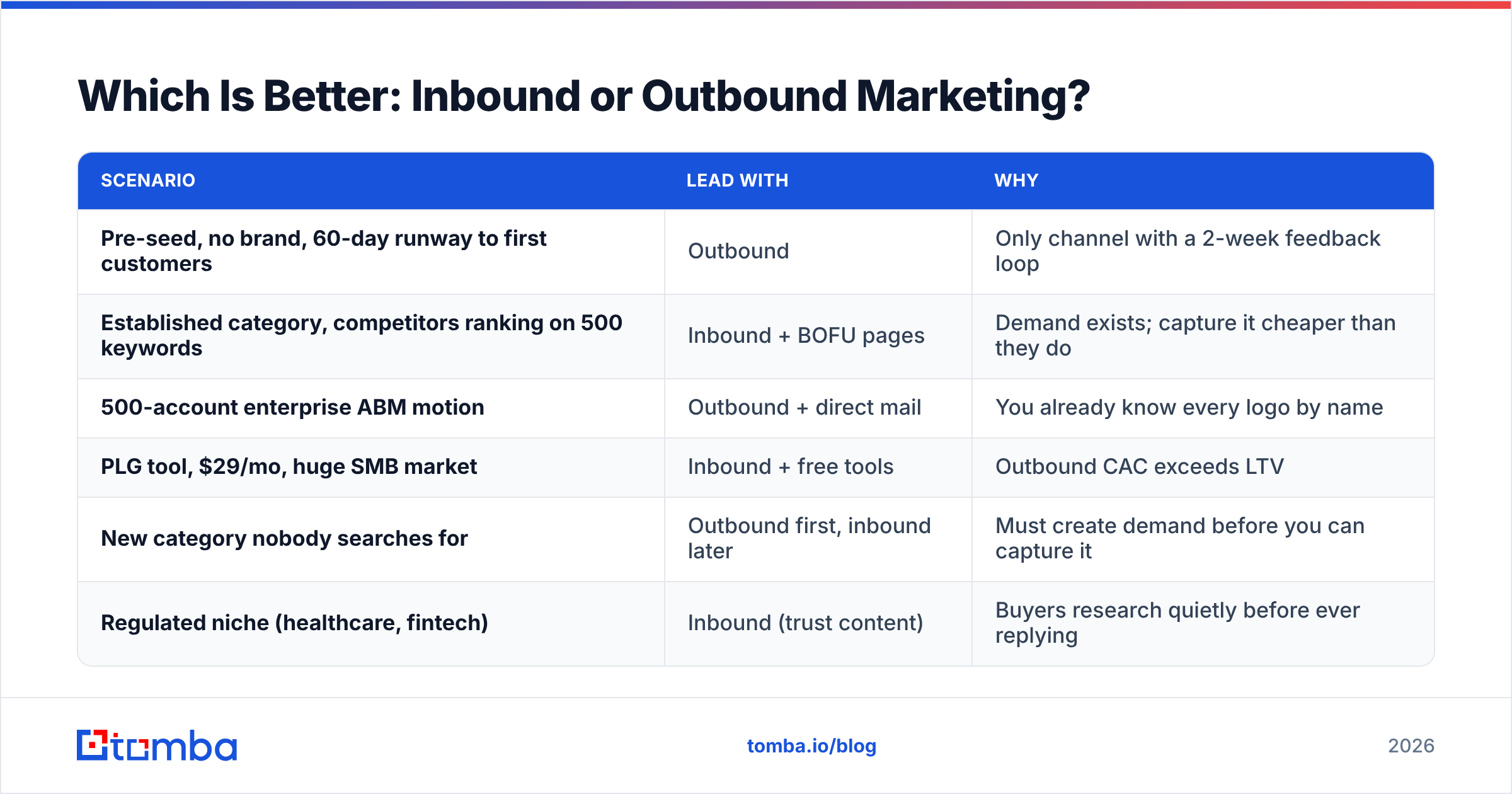
| Scenario | Lead with | Why |
|---|---|---|
| Pre-seed, no brand, 60-day runway to first customers | Outbound | Only channel with a 2-week feedback loop |
| Established category, competitors ranking on 500 keywords | Inbound + BOFU pages | Demand exists; capture it cheaper than they do |
| 500-account enterprise ABM motion | Outbound + direct mail | You already know every logo by name |
| PLG tool, $29/mo, huge SMB market | Inbound + free tools | Outbound CAC exceeds LTV |
| New category nobody searches for | Outbound first, inbound later | Must create demand before you can capture it |
| Regulated niche (healthcare, fintech) | Inbound (trust content) | Buyers research quietly before ever replying |
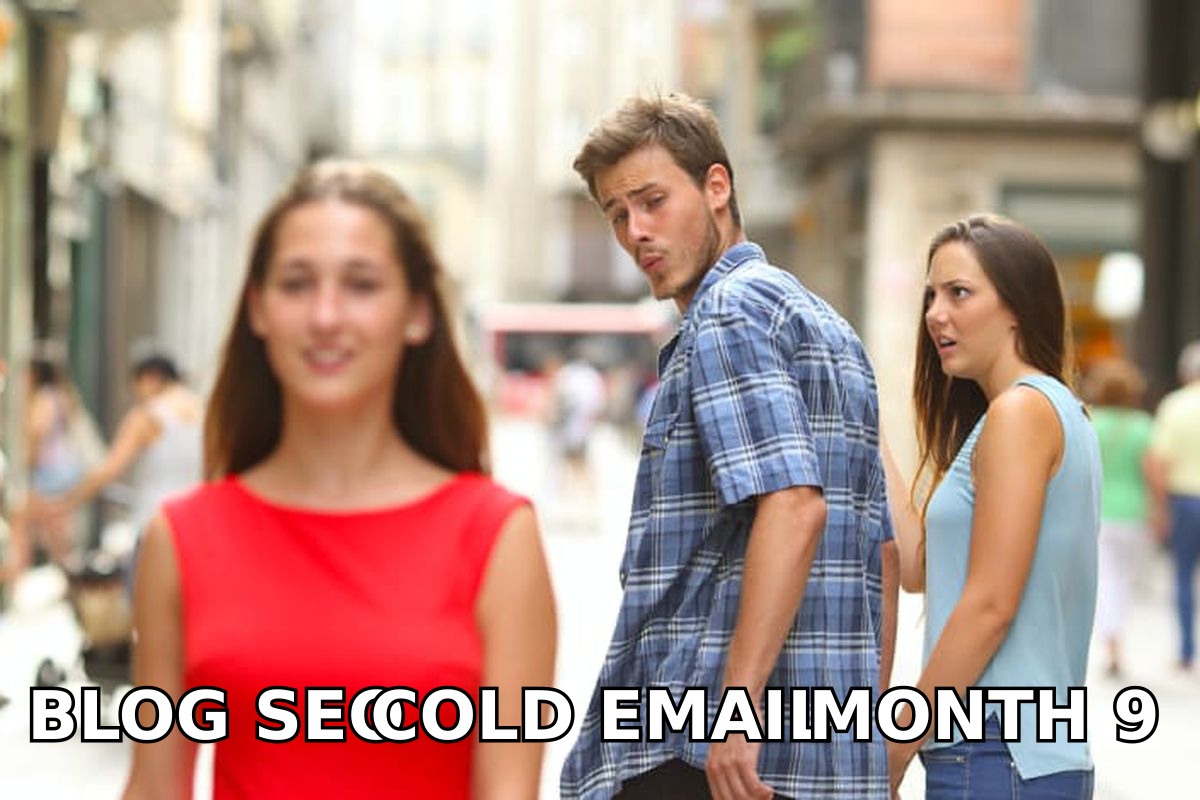
Most teams that claim inbound "doesn't work" published 20 top-of-funnel posts and quit at month five. Most teams that claim outbound "is dead" bought a bad list and torched their sending domain. Both are execution failures wearing a strategy costume.
How Do Inbound and Outbound Work Together?#
The best 2026 programs stopped treating these as separate departments. Three patterns:
Content-fed outbound. You publish the benchmark study (inbound). Then you outbound the study — not your product — to the 600 people whose job title makes them care. The email has a reason to exist, and the asset does the selling. Reply rates on "we published data about your exact problem" sequences beat feature pitches consistently.
Outbound-informed content. Your SDRs hear the same eight objections every week. Those objections are your content calendar. If 40 prospects asked "how do you handle catch-all domains," that is a post, and it will rank, because everyone else is asking it too.
Visitor-reveal loops. Someone reads your comparison page but never fills the form — which is 97% of your traffic. Website visitor reveal turns anonymous inbound traffic into named accounts you can then outbound. This is the single clearest bridge between the two motions, and it is where most of the incremental pipeline is hiding.
Retargeting the readers. Inbound content gets someone in your pixel; outbound ads bring them back. Cheap, boring, works.
Why Does Outbound Fail Without Clean Data?#
Because the failure is invisible until it is catastrophic.
Here is the mechanic. Every email you send to a dead address is a bounce. Go over roughly 2–3% bounces and mailbox providers start to throttle you. Go over 5% and Google and Microsoft route your mail to spam — including mail to the prospects whose addresses were fine. Your sender reputation is one shared score across everything you send, so a single bad list poisons the good ones. Google's own bulk sender guidelines spell out the thresholds.
The order of operations that actually protects you:
- Find the address with a real source, not a guessed pattern. Pattern-guessing tools output
first.last@company.comand hope. Use a proper email finder that returns a confidence score and sources. - Verify before sending. SMTP-level email verification removes the dead ones. Do this even on data you just bought — resold databases decay at roughly 22–30% per year as people change jobs.
- Handle catch-alls separately. Catch-all domains accept everything, so standard verification returns "unknown." A dedicated catch-all verifier reduces that gray zone instead of forcing you to guess.
- Warm the domain before volume. Use a warmup calculator to set a realistic ramp instead of sending 500 on day one from a fresh domain.
- Re-verify quarterly. Lists rot. A list you verified in January is meaningfully worse in July.
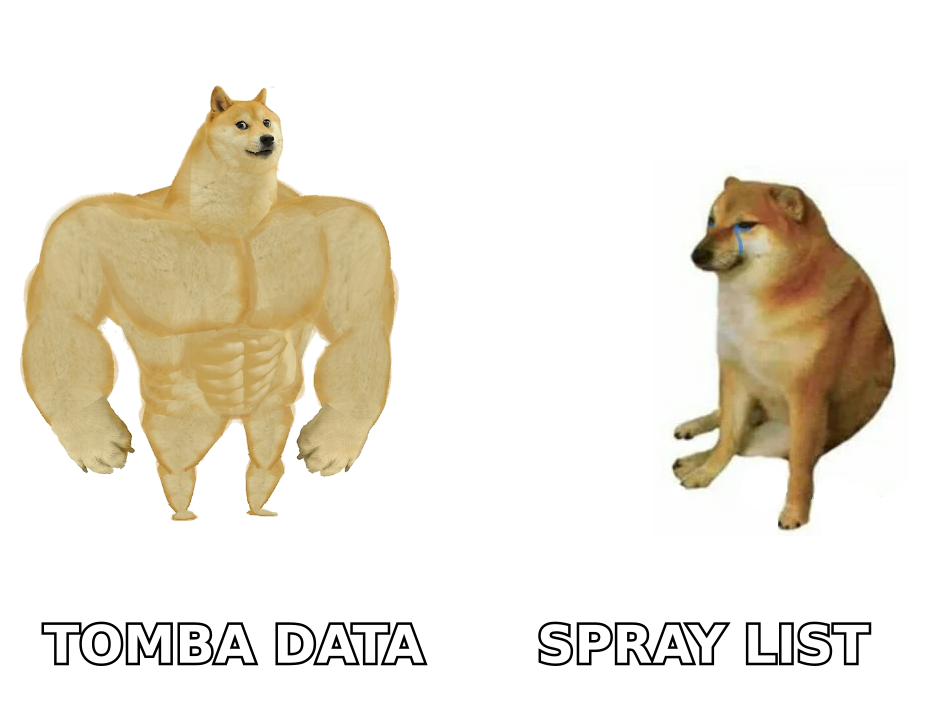
Teams comparing data vendors weigh three things: coverage, verification depth, and price. Providers like BookYourData lead with pre-verified purchased lists and pay-as-you-go pricing, which suits one-off campaigns. Tools like Tomba lean toward search-and-verify workflows, where you find contacts at accounts you already chose. That fits account-driven outbound better than volume-driven outbound. Both approaches are legitimate. The mistake is buying volume you never verified and calling it a strategy.
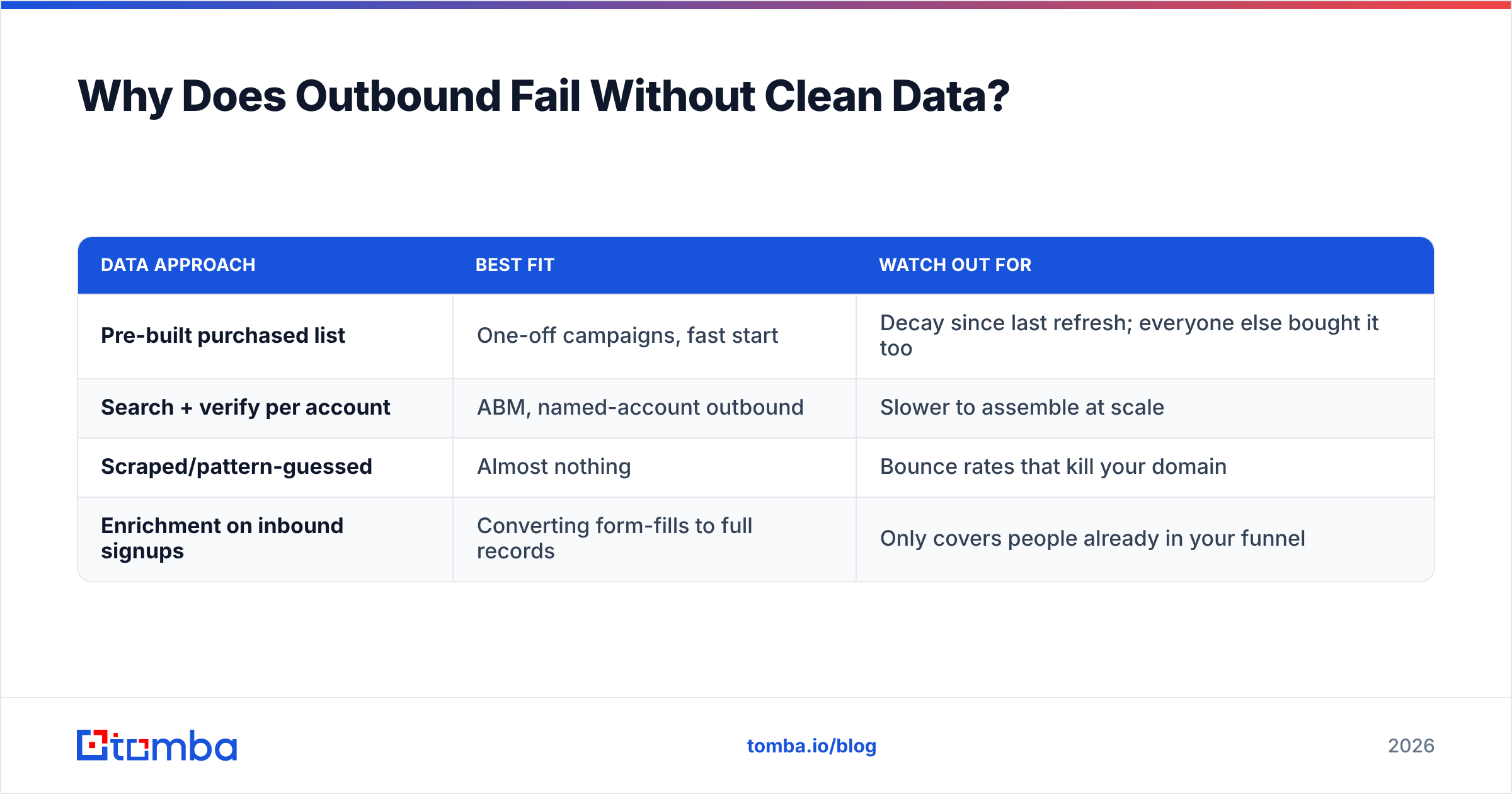
| Data approach | Best fit | Watch out for |
|---|---|---|
| Pre-built purchased list | One-off campaigns, fast start | Decay since last refresh; everyone else bought it too |
| Search + verify per account | ABM, named-account outbound | Slower to assemble at scale |
| Scraped/pattern-guessed | Almost nothing | Bounce rates that kill your domain |
| Enrichment on inbound signups | Converting form-fills to full records | Only covers people already in your funnel |
What Metrics Should You Track for Each?#
Do not use the same dashboard for both. Inbound and outbound fail in different places, so they need different early warning signals.
Inbound metrics that matter: organic impressions by intent tier (BOFU vs TOFU separately — a blended number hides everything), keyword position for your money terms, assisted conversions, email list growth rate, and time-to-first-ranking for new pages. Vanity trap: total pageviews.
Outbound metrics that matter: bounce rate (before anything else), reply rate segmented by list source, positive reply rate, meetings booked per 100 verified contacts, and domain health. Vanity trap: emails sent.
Shared metrics: cost per qualified opportunity, pipeline created, and win rate by source. This is where the argument actually gets settled — inbound leads typically show higher win rates but lower volume; outbound shows the inverse. Run both numbers before you defund either channel.
One caution on benchmarks: published averages for reply rates and cost per lead vary wildly by industry and deal size. Gartner's B2B buying research is a better guide to why buyers behave the way they do than any single conversion benchmark. Measure your own baseline for one quarter, then optimize against that.
What Should You Do First?#
If you have neither motion running, start here:
- Week 1–2: Define 200 named target accounts. Build the list, verify it, send a trigger-based sequence. You will learn more about your positioning from 40 replies than from four months of content strategy meetings.
- Week 3–6: Take the three objections you heard most and write three BOFU pages answering them. These are your first inbound assets and they target buyers already shopping.
- Week 7–12: Ship one free tool. It earns links, it earns emails, and it never asks for a salary.
- Ongoing: Feed outbound with inbound assets, feed inbound with outbound objections. Re-verify your contact data every quarter.
Work through the examples of inbound and outbound marketing above in that order and both motions are live inside a quarter. The teams that win are not the ones that picked the right side of this debate. They are the ones whose outbound has something worth reading and whose inbound has someone worth following up with.
Start with the data layer. Every outbound example above collapses if the addresses are wrong, and every inbound-to-outbound bridge depends on knowing who is actually behind the traffic. Tomba Email Finder returns verified professional emails with confidence scores and sources, so your sequences reach real inboxes instead of your bounce log. The free tier covers 25 searches a month, Starter runs $49/mo, and Growth is $99/mo — see full Tomba pricing to match a plan to your list size, or wire it straight into your stack with the Tomba API.
Related guides#
Ready to find emails that actually work?
Join 150,000+ professionals who stopped guessing and started sending. Free credits on signup — no credit card required.
Get the Tomba newsletter
Practical outbound tactics and product updates — once every two weeks.
About the author