Exellius Reviews 2026: Is This Lead Gen Agency Worth It?
An independent look at Exellius reviews in 2026: what the company actually sells, why public feedback is thin, how retainer pricing compares to running outbound in-house, and when a data tool beats an agency.
TL;DR
- Exellius sells done-for-you B2B lead generation — list building, outbound email, and appointment setting — not a self-serve software seat. That single fact explains most of what you'll read in Exellius reviews.
- Public review volume is thin. There is no large G2 or Capterra corpus to average, so treat any "4.9 stars" claim you see on an agency's own site as marketing, not evidence.
- Agency retainers in this category typically run four figures a month with a 3–6 month minimum. A DIY stack — data tool plus a sending platform — usually lands under $300/mo.
- The honest verdict: Exellius makes sense if you have no SDR, no data budget owner, and need meetings booked in 60 days. It's the wrong buy if you already have someone who can run sequences.
- Before signing anything, run the 30-day pilot checklist at the end of this post. It surfaces lead-quality problems while you can still walk away.
What is Exellius, and what does it actually sell?#
Exellius operates in the done-for-you B2B lead generation category: an agency that builds target lists, writes and sends outbound campaigns, handles replies, and drops qualified meetings onto your calendar. That's a different product from an email finder or a sales engagement platform, even though the marketing pages of all three use similar language ("pipeline", "qualified leads", "verified contacts").
The distinction matters because it changes what a review can even tell you. Software reviews are comparable — everyone gets the same UI, the same API, the same rate limits. Agency reviews are not. Two clients of the same agency can get wildly different outcomes based on which strategist they were assigned, how good their offer was, and whether their ICP was 500 accounts or 50,000.
So when you search "Exellius reviews," you're really asking three separate questions:
- Is the company legitimate? — Does it deliver work and respond to clients?
- Is the data any good? — Are the contacts real, current, and correctly targeted?
- Is it worth the price for my motion? — Which is entirely dependent on your team, not theirs.
Question 3 is the one that actually decides your ROI, and it's the one no third-party review can answer for you.
Why are Exellius reviews so hard to find?#
Because the category doesn't generate reviews the way SaaS does. A software buyer signs up self-serve, gets nagged by an in-app prompt, and leaves a G2 rating in 90 seconds. An agency client signs an MSA, works with a named account manager, and — if things go badly — usually just churns quietly rather than posting publicly, because the relationship was personal.
Practical implications when you're researching:
- Check the review site directly, not screenshots. Visit G2 and Capterra and search the exact company name. If the profile has fewer than 10 reviews, you have anecdotes, not data.
- Weight recency over volume. A 2023 review of a lead-gen agency describes a pre-Google/Yahoo-bulk-sender-rules world. Deliverability rules changed hard in 2024, and any agency's results changed with them.
- Read the one-star reviews first. In this category, the complaints cluster — and the cluster tells you the operating model's weak point.
- Verify the claims on the vendor's own site. Start at the official homepage (exellius.com) and note which numbers are sourced versus asserted.
- Ask for two references in your exact industry. Not "similar" — exact. Outbound results in dev tools do not transfer to outbound results in medical devices.
How does an Exellius retainer compare to running outbound in-house?#
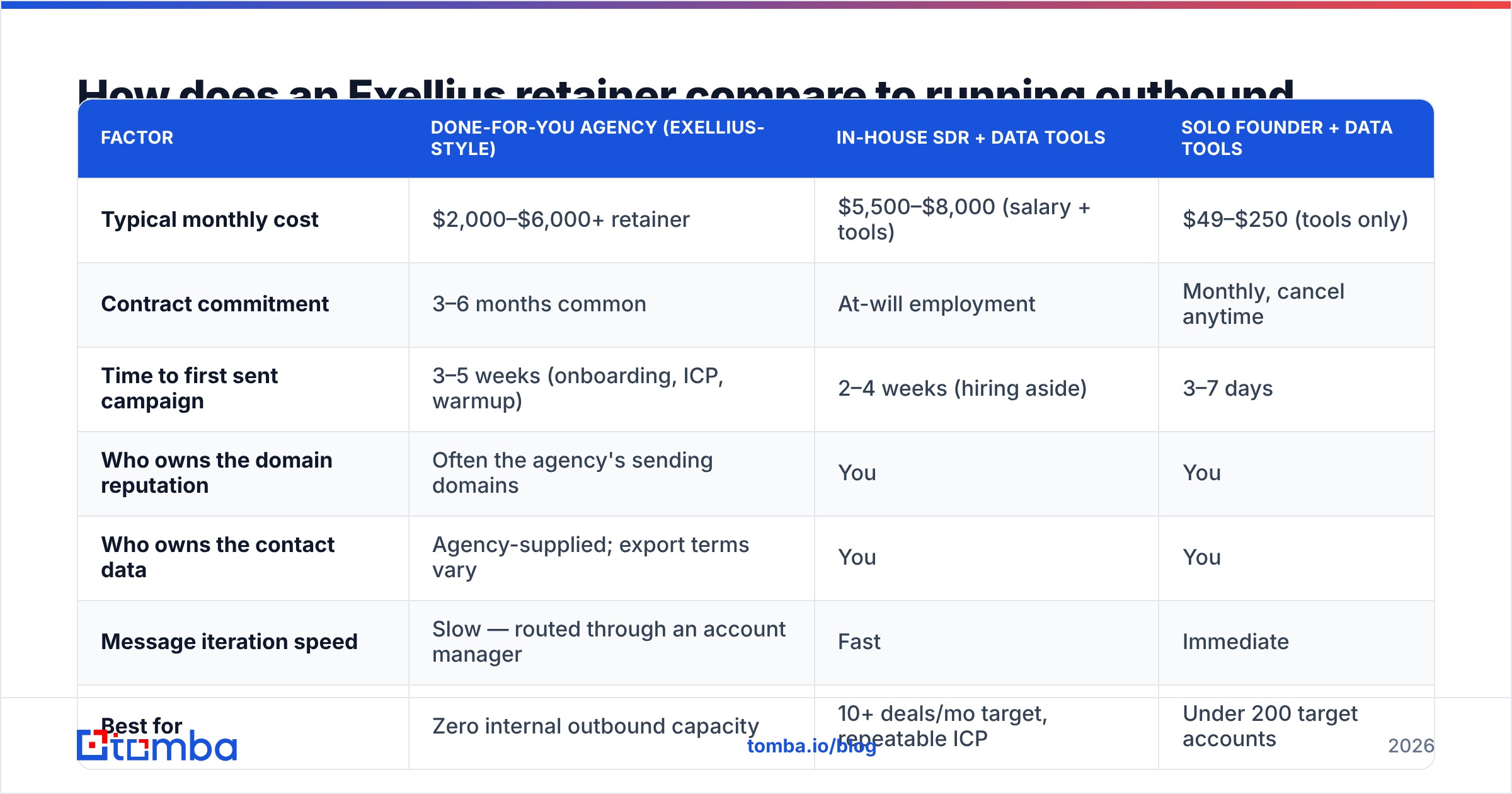
This is the comparison that actually moves the decision. Below is a like-for-like look at three ways to get the same job done. Agency figures reflect typical published ranges for done-for-you B2B lead gen providers — Exellius, like most in the category, quotes custom rather than listing prices, so confirm your own number before budgeting.
| Factor | Done-for-you agency (Exellius-style) | In-house SDR + data tools | Solo founder + data tools |
|---|---|---|---|
| Typical monthly cost | $2,000–$6,000+ retainer | $5,500–$8,000 (salary + tools) | $49–$250 (tools only) |
| Contract commitment | 3–6 months common | At-will employment | Monthly, cancel anytime |
| Time to first sent campaign | 3–5 weeks (onboarding, ICP, warmup) | 2–4 weeks (hiring aside) | 3–7 days |
| Who owns the domain reputation | Often the agency's sending domains | You | You |
| Who owns the contact data | Agency-supplied; export terms vary | You | You |
| Message iteration speed | Slow — routed through an account manager | Fast | Immediate |
| Best for | Zero internal outbound capacity | 10+ deals/mo target, repeatable ICP | Under 200 target accounts |
| Biggest risk | Lead quality drift after month 2 | Ramp time and turnover | Your own time |
The row people underestimate is who owns the domain reputation. If an agency sends from its own infrastructure, your campaign performance is pooled with other clients' behavior, and you don't take the sender reputation with you when you leave. If it sends from your domains, ask exactly how warmup is handled and check your own SPF record before the first send.
The row people overestimate is cost per meeting. Agencies quote it confidently; it is almost always calculated on the best cohort. Ask for the median across all clients in the last two quarters, and ask what counts as a "meeting" — a booked calendar slot and a held, qualified call are very different numbers.
What do buyers actually complain about in lead gen agency reviews?#
Across the category — not Exellius specifically — negative reviews of done-for-you providers cluster into five patterns. Use these as your due-diligence questions:
- Lead quality drifts after the first month. Month one is hand-curated by a senior strategist. Month three is often pulled from a broad database filter. Fix: contract a fixed bounce-rate ceiling (under 3%) and a defined ICP filter set in writing.
- "Qualified" is defined loosely. If the SLA counts a positive reply as a lead, you'll get curiosity replies, not buying intent. Fix: define qualification as budget-holder + stated pain + booked call held.
- Volume substitutes for targeting. Sending 20,000 emails to a loose filter produces meetings and a wrecked domain. Fix: cap monthly volume and require verification logs.
- Data isn't portable. Some contracts keep the contact list on the agency's side. Fix: get an export clause in the MSA — CSV of every contact touched, monthly.
- You can't test the copy yourself. Iteration goes through a queue. Fix: negotiate direct access to the sequence builder or a 48-hour turnaround SLA on copy changes.
Every one of these is contract-fixable before you sign and nearly impossible to fix afterward. That's the single most useful thing to take from reading agency reviews of any kind.
Is Exellius worth it for your team?#
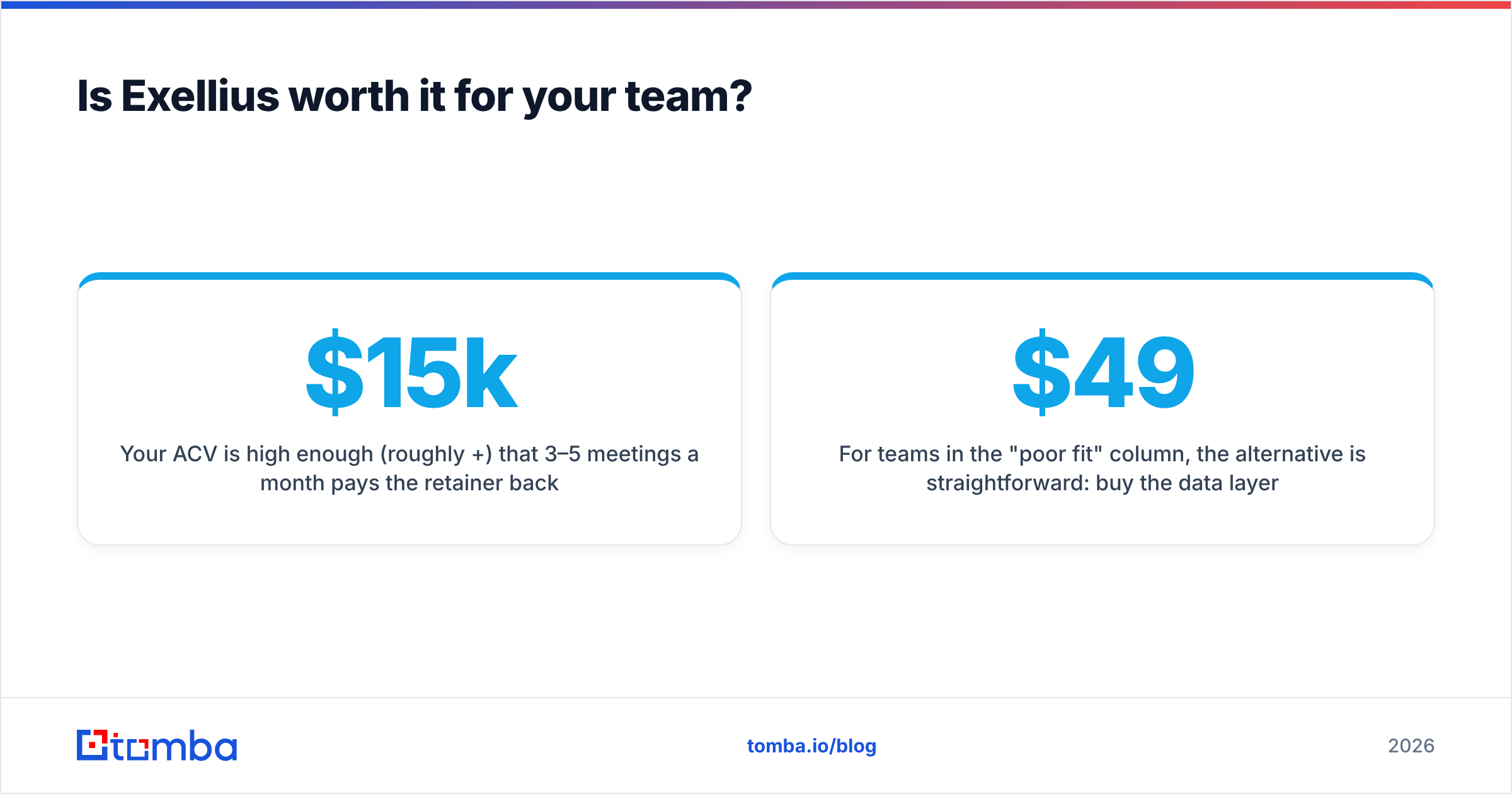
Conclusion first: it's worth it when your bottleneck is people, not data. It's not worth it when your bottleneck is data, because you can solve that for two orders of magnitude less money.
Good fit if:
- You have no SDR and no plan to hire one this quarter.
- Your ACV is high enough (roughly $15k+) that 3–5 meetings a month pays the retainer back.
- Your ICP is well defined and stable — you can name the titles, the company sizes, and the trigger events without hedging.
- Someone on your side can take a discovery call within 24 hours of it being booked. Agencies book meetings; they don't close them.
Poor fit if:
- You're still testing which ICP works. Agencies are execution engines, not discovery engines — paying a retainer to run experiments is the most expensive way to learn.
- Your total addressable market is under a few hundred accounts. At that size, one person doing manual research beats any automated volume play.
- You need to own the data asset. If your long-term plan is a proprietary contact database, don't rent someone else's.
- Your sales cycle depends on deep personalization. Templated agency sequences underperform badly in those markets.
For teams in the "poor fit" column, the alternative is straightforward: buy the data layer and run the sending yourself. A domain search to map contacts at target accounts, an email verifier pass before every send, and any of the common sending platforms is a complete stack. Tomba's tiers run Free (25 searches/mo), Starter $49/mo, Growth $99/mo, and Pro $249/mo — see full Tomba pricing for credit allocations. That's the entire data cost of what an agency bills as one line item.

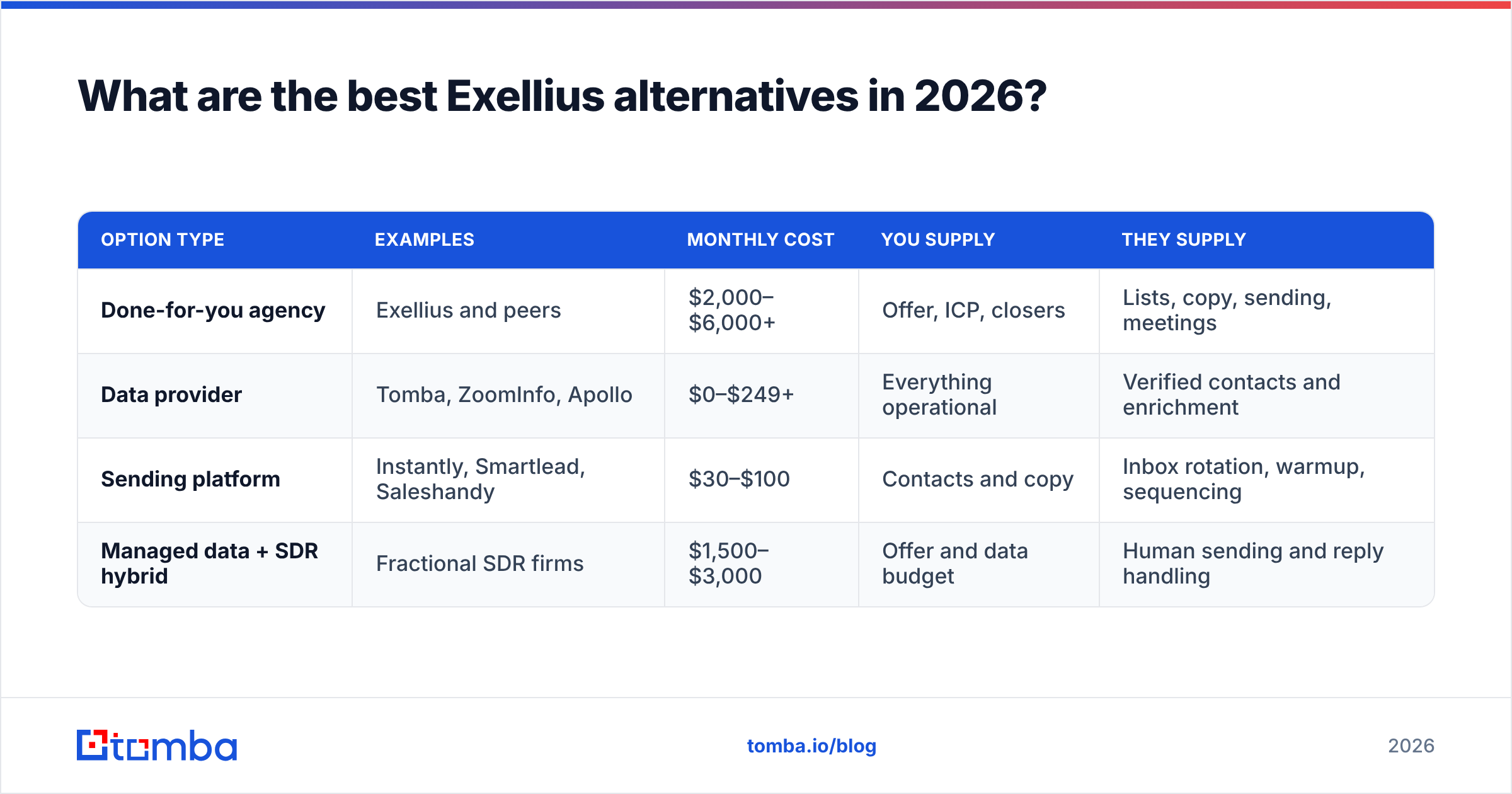
What are the best Exellius alternatives in 2026?#
Alternatives split into three groups, and mixing them up is the most common buying mistake.
| Option type | Examples | Monthly cost | You supply | They supply |
|---|---|---|---|---|
| Done-for-you agency | Exellius and peers | $2,000–$6,000+ | Offer, ICP, closers | Lists, copy, sending, meetings |
| Data provider | Tomba, ZoomInfo, Apollo | $0–$249+ | Everything operational | Verified contacts and enrichment |
| Sending platform | Instantly, Smartlead, Saleshandy | $30–$100 | Contacts and copy | Inbox rotation, warmup, sequencing |
| Managed data + SDR hybrid | Fractional SDR firms | $1,500–$3,000 | Offer and data budget | Human sending and reply handling |
A useful rule: pick the cheapest layer that solves your actual bottleneck. If your problem is "I don't have valid email addresses for my 2,000 target accounts," you have a data problem — a $49/mo tool solves it this afternoon. If your problem is "nobody here will make the calls," that's a people problem, and no tool fixes it.
If you're specifically evaluating vendor-versus-vendor at the data layer, our Apollo alternative breakdown covers the accuracy and pricing tradeoffs in more detail than a general review can.
How do you run a 30-day pilot that proves it?#
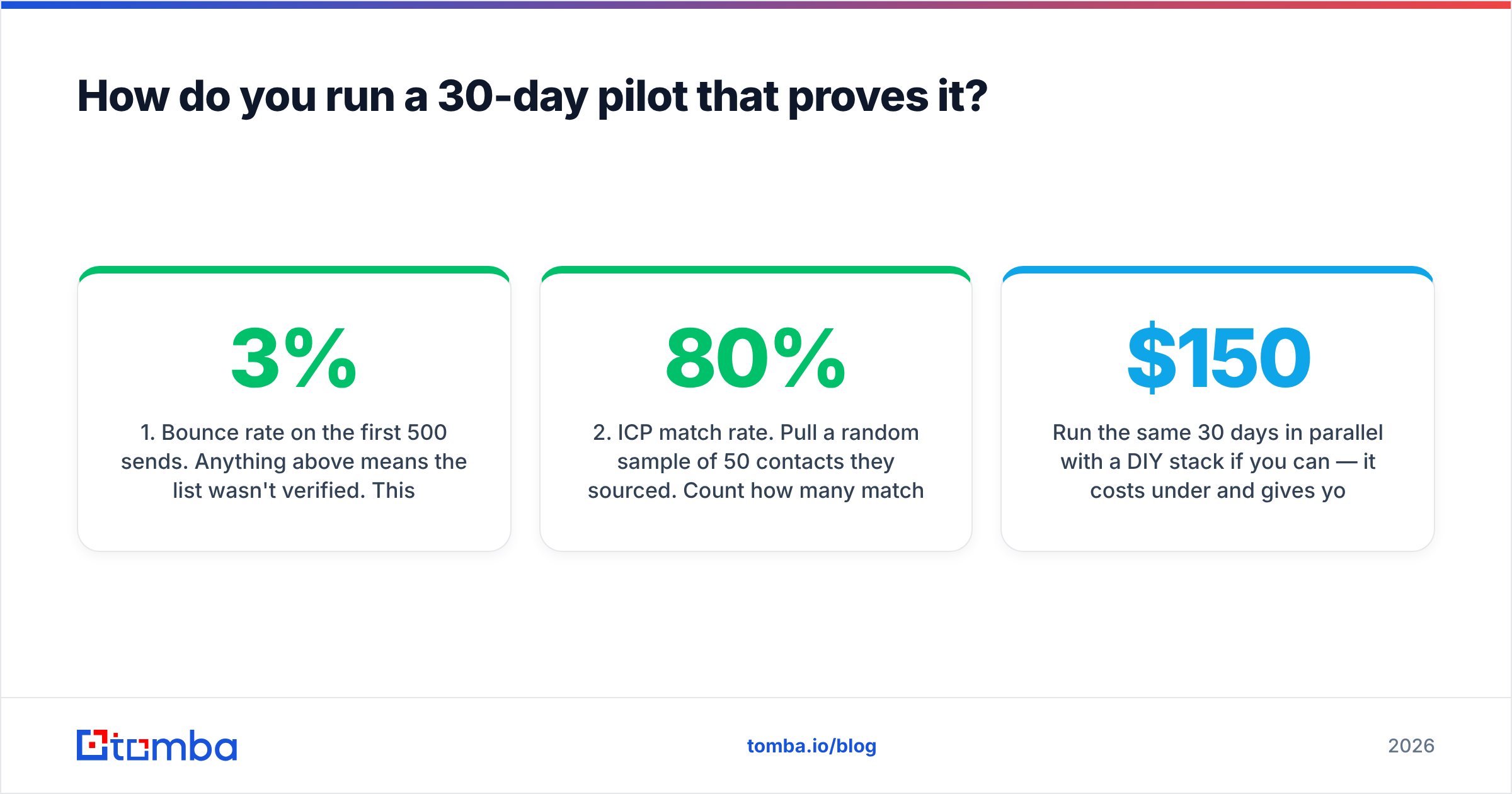
Never buy a six-month retainer on a demo. Structure a paid pilot instead, and measure these five things:
- Bounce rate on the first 500 sends. Anything above 3% means the list wasn't verified. This is measurable within week one and is the fastest disqualifier there is.
- ICP match rate. Pull a random sample of 50 contacts they sourced. Count how many match your written ICP exactly. Below 80% means you're paying for filler.
- Reply-to-meeting conversion. Positive replies are cheap; held calls are the metric. Track both and watch the gap.
- Time-to-iteration. Request a copy change on day 10 and time the turnaround. This one number predicts the next five months of the relationship.
- Data portability. Ask for a CSV export in week three. If it's slow or conditional, you now know what leaving looks like.
Run the same 30 days in parallel with a DIY stack if you can — it costs under $150 and gives you a genuine control group. Most teams are surprised by how close the results are, which is precisely the information the agency's sales process is designed to keep you from having. For a broader view of how vendors source and refresh contact records, Gartner publishes ongoing coverage of the B2B data market that's worth a read before any six-figure annual commitment.
Frequently asked questions about Exellius reviews#
Is Exellius a scam? Nothing in the public record suggests that. The category's real risk isn't fraud — it's paying retainer prices for outcomes you could produce cheaper, or signing a contract without an SLA on lead quality.
How much does Exellius cost? Pricing is quote-based, like most done-for-you providers. Budget in the low-to-mid four figures monthly and ask for the minimum term in writing during the first call.
Can I get a refund if leads are bad? Only if the contract defines "bad" numerically. Push for a bounce-rate ceiling and a monthly qualified-meeting floor with a make-good clause.
Should I use an agency and a data tool together? Often yes. Keeping your own verified database in parallel means you own the asset even if you change providers, and it gives you a benchmark to check their list quality against.
The verdict#
Exellius reviews, like reviews of every done-for-you lead gen provider, tell you more about the buyer than the vendor. The teams that report good outcomes had a defined ICP, a high ACV, and closers ready to take calls. The teams that report bad outcomes were trying to buy their way past a positioning problem.
If your gap is genuinely operational — no headcount, no time, and a proven offer — an agency retainer is a reasonable trade. If your gap is data, skip the retainer entirely. Start with the Tomba Email Finder on the free tier, verify everything before it hits an inbox, and spend the $4,000 you didn't burn on retainers testing offers instead. You'll own the contact data, the domain reputation, and the learnings — and those are the three things you can't get back after a contract ends.
Related guides#
Ready to find emails that actually work?
Join 150,000+ professionals who stopped guessing and started sending. Free credits on signup — no credit card required.
Get the Tomba newsletter
Practical outbound tactics and product updates — once every two weeks.
About the author