Exellius vs Apollo.io (2026): Which B2B Data Source Wins?
One sells you a managed, human-checked contact list. The other sells you a self-serve database with sequencing bolted on. Here is how Exellius and Apollo.io actually compare on accuracy, cost per usable contact, and workflow fit.
TL;DR
- Exellius is a managed, service-led B2B data provider: you brief an ICP, a team builds and checks the list, you get a delivered file. Pricing is quote-based, not published.
- Apollo.io is a self-serve sales platform: a very large contact database plus sequencing, dialer, and CRM sync, sold per seat with credit limits.
- They are not really competitors on features — they compete for the same line item in your budget. The real question is whether you want labor or software.
- Both share one weakness: neither replaces a verification step you control. Bounce rates above 3% will hurt sender reputation regardless of who sourced the record.
- If you mostly need accurate email addresses on demand and not a full sequencer, a focused finder plus verifier stack is usually the cheapest path to the same outcome.
What is Exellius and who is it actually for?#
Exellius sits in the managed B2B data category. Instead of handing you a search UI and a credit counter, the model is service-first: you describe the ideal customer profile — industry, headcount, geography, job titles, tech stack, sometimes intent signals — and a team assembles a custom contact list against that brief, usually with a human review pass before delivery.
That matters more than it sounds. Database vendors sell you access to what they already have. Managed providers sell you the work of finding what they do not already have. If your ICP is "VP of Facilities at multi-site healthcare operators in the Nordics with 200-800 beds," a generic database will return either noise or nothing. A research team will return 340 rows, and 300 of them will be right.
The trade-offs are the ones you would expect from any service business:
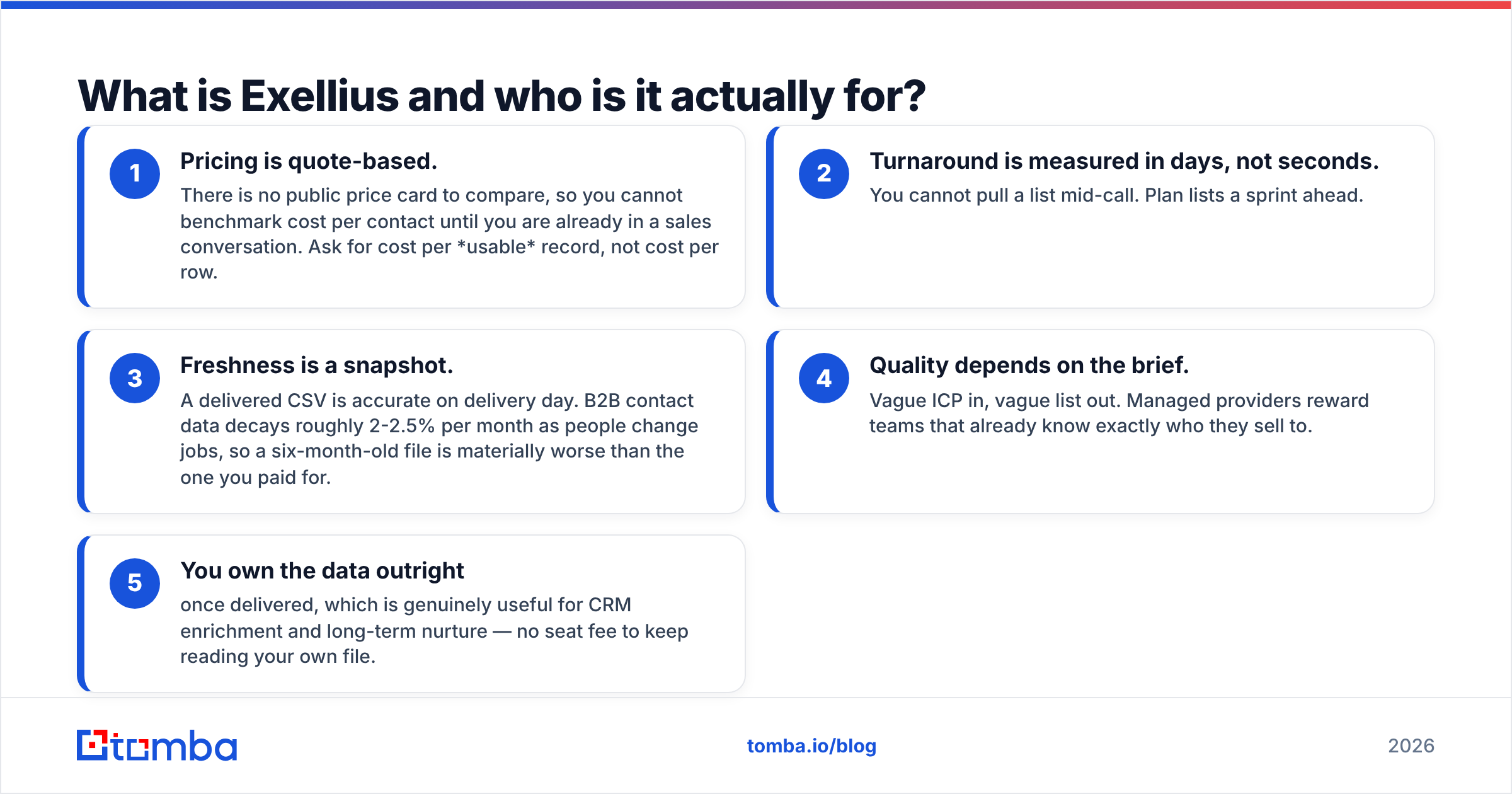
- Pricing is quote-based. There is no public price card to compare, so you cannot benchmark cost per contact until you are already in a sales conversation. Ask for cost per usable record, not cost per row.
- Turnaround is measured in days, not seconds. You cannot pull a list mid-call. Plan lists a sprint ahead.
- Freshness is a snapshot. A delivered CSV is accurate on delivery day. B2B contact data decays roughly 2-2.5% per month as people change jobs, so a six-month-old file is materially worse than the one you paid for.
- Quality depends on the brief. Vague ICP in, vague list out. Managed providers reward teams that already know exactly who they sell to.
- You own the data outright once delivered, which is genuinely useful for CRM enrichment and long-term nurture — no seat fee to keep reading your own file.
Before signing anything, confirm sourcing and compliance posture in writing, especially for EU contacts under GDPR. "Publicly available" is a description, not a legal basis.

What is Apollo.io and where does it actually fit?#
Apollo.io is the opposite bet: everything self-serve, everything in one tab. It combines a contact and company database (marketed in the 200M+ contact range) with a prospecting UI, email sequencing, a dialer, LinkedIn extension, basic enrichment, and CRM sync to HubSpot and Salesforce.
The appeal for a small outbound team is obvious. One login, one bill, and an SDR can go from filter to first touch inside an afternoon. That consolidation is why Apollo shows up so heavily in the sales intelligence listings on G2 — it is the default "we need to start outbound next week" purchase.
The friction shows up later, at scale:
- Credit math. Seats are priced per user per month, but exports, mobile numbers, and enrichment all draw from credit pools with their own caps. Teams routinely discover the real cost is the seat price times users plus a credit top-up.
- Data quality is uneven by segment. US mid-market tech is strong. SMB, non-English markets, blue-collar industries, and senior titles at private companies get thin fast. Contributory data models are only as good as who contributes.
- Everyone has the same list. If your competitors also run Apollo with the same filters, your prospects are receiving four near-identical emails in the same week. The database is not a moat.
- Catch-all domains. Apollo will happily export addresses at catch-all domains that its own status flags cannot resolve. Send into those blind and your bounce rate is a coin flip.
Check the current numbers on Apollo's own pricing page before budgeting; tiers and credit allowances have changed more than once, and per-seat annual pricing differs from monthly.
Exellius vs Apollo.io: how do they compare head to head?#
Here is the practical comparison, with the caveat that Exellius pricing is negotiated and Apollo's published tiers move.
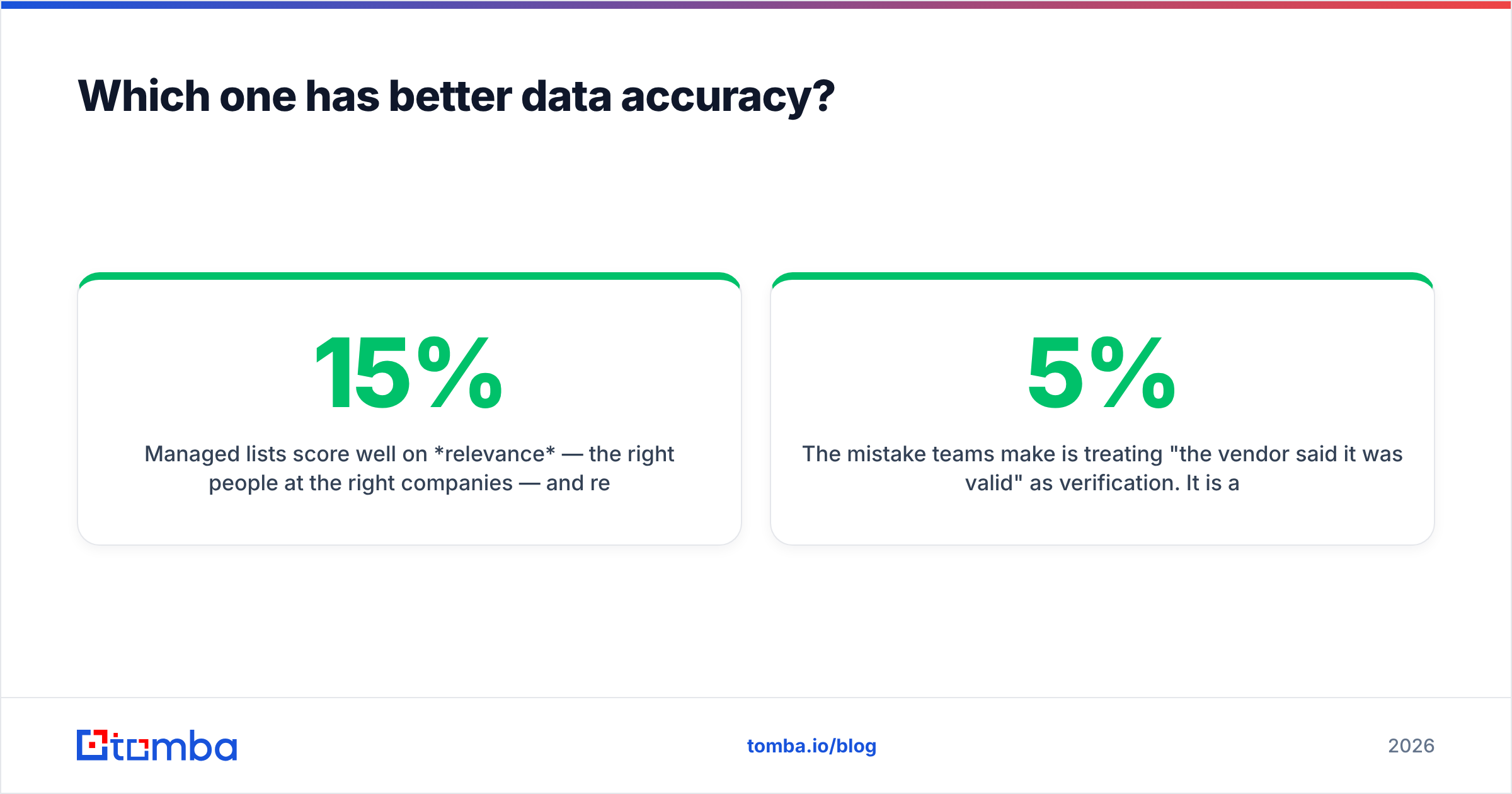
| Dimension | Exellius | Apollo.io | Tomba |
|---|---|---|---|
| Model | Managed / done-for-you list building | Self-serve platform + database | Self-serve finder, verifier, and API |
| Pricing | Custom quote, per project or retainer | Free tier; paid seats roughly $49-$149/user/mo depending on tier and billing term | Free 25 searches/mo; Starter $49/mo; Growth $99/mo; Pro $249/mo |
| Time to first list | Days (brief → research → QA → delivery) | Minutes | Seconds per lookup; minutes for a bulk file |
| Niche / hard-to-find ICPs | Strongest — humans research to spec | Weak outside well-covered segments | Pattern + source based; strong on company domains |
| Sequencing / dialer | Not the product | Included | Not included — pairs with your sender of choice |
| Verification depth | Vendor-side QA before delivery | Basic status flags, catch-alls often unresolved | Dedicated email verifier plus catch-all handling |
| API access | Varies by contract | Available on higher tiers | Full email finder API, CLI, and MCP on all paid plans |
| Data freshness | Snapshot at delivery | Continuous but variable by record | Live lookup at query time |
| Best for | Defined niche campaigns, ABM target lists | Small teams wanting one tool for everything | Teams that need accurate addresses on demand |
The pattern is clear once you lay it out. Exellius wins on precision for hard segments. Apollo wins on speed and breadth for common segments. Neither is optimized for the workflow most teams actually run in 2026, which is: I already know the company and the person, I just need a deliverable address, right now, inside a script.

Which one has better data accuracy?#
Accuracy is the only metric that survives contact with an inbox, and it has to be measured the same way for both vendors or the comparison is theater.
Use one test: take 200 records, run them through an independent verifier you control, then send a real campaign and record the hard-bounce rate. Not the vendor's claimed accuracy. Not the "valid" flag in their UI. Your bounce log.
What you will typically see:
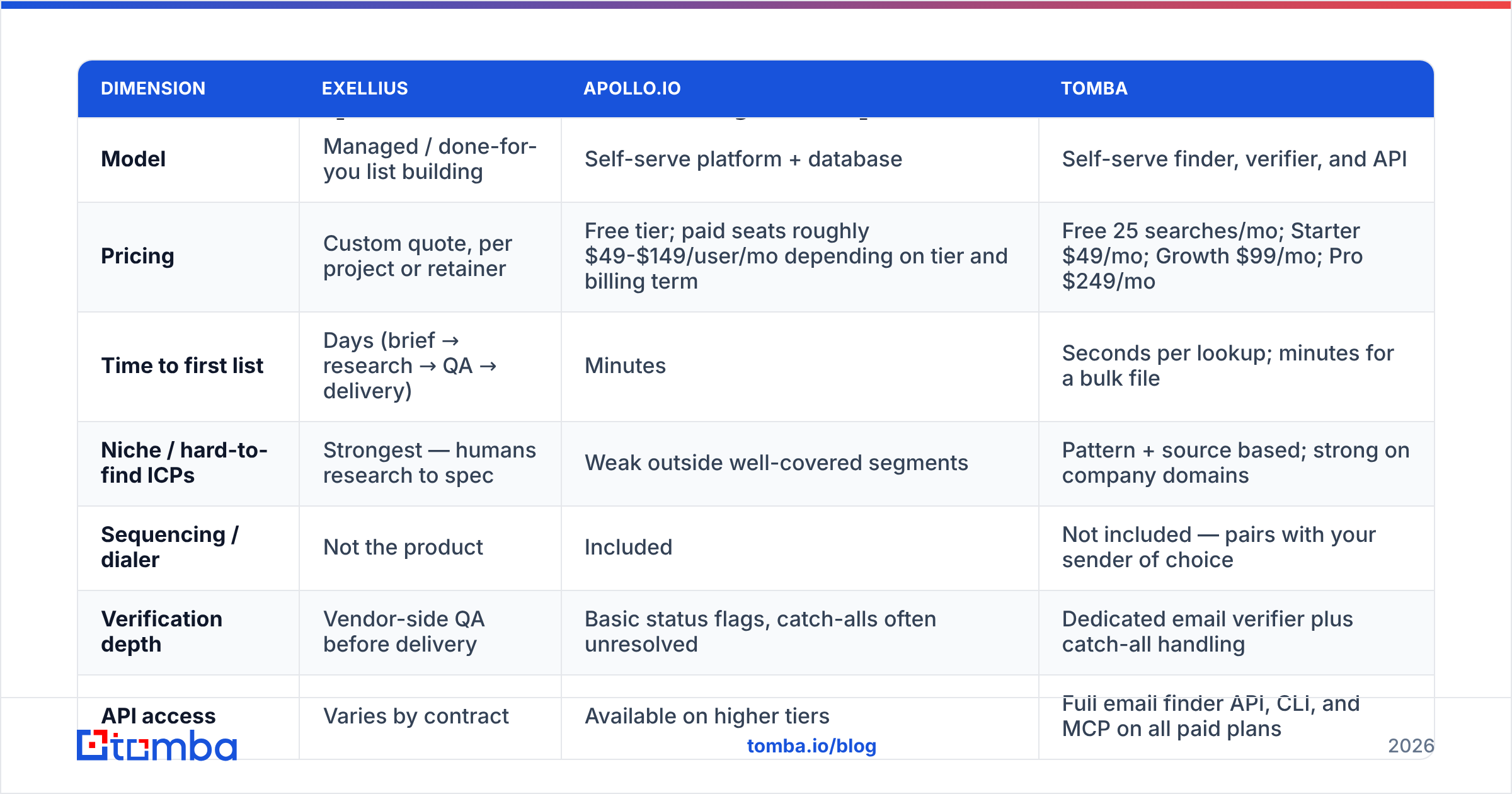
- Managed lists score well on relevance — the right people at the right companies — and reasonably on deliverability, because a human eyeballed the file. Their weakness is age. A list built in March and sent in September carries roughly 12-15% job-change drift.
- Large self-serve databases score well on coverage and poorly on edge cases. Common patterns at big companies resolve cleanly. Catch-all domains, recently acquired companies, and non-US formats are where the bounces hide.
- Independently verified addresses score best on deliverability specifically, because verification is the whole job rather than a feature bundled into something else.
The mistake teams make is treating "the vendor said it was valid" as verification. It is a claim. Re-verify anything older than 30 days before a send, and re-verify everything before a high-volume campaign — a 5% bounce rate does not just lose 5% of your list, it degrades sender reputation for the other 95%.

What does each one really cost per usable contact?#
Sticker price is the wrong unit. The honest unit is cost per contact that is (a) in your ICP, (b) reachable, and (c) not already in your CRM.
Work it like this:
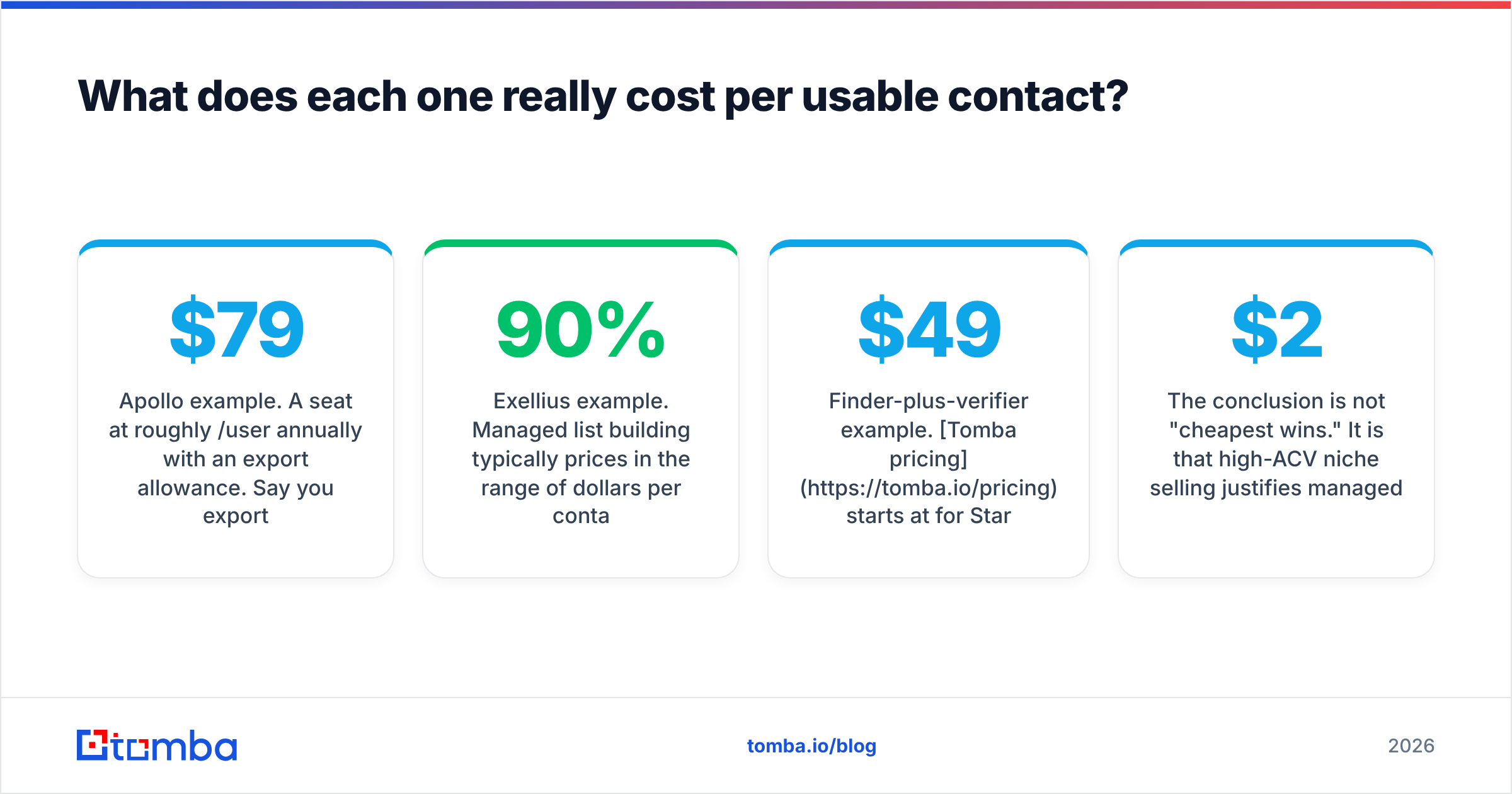
- Apollo example. A seat at roughly $79/user/mo annually with an export allowance. Say you export 1,000 contacts in a month. Sticker cost is about $0.08 per contact. Now apply reality: strip 20% out-of-ICP rows, 10% duplicates against your CRM, and an 8% bounce rate. You are left with ~660 usable contacts, so the true cost is closer to $0.12 — before you buy extra credits for mobile numbers.
- Exellius example. Managed list building typically prices in the range of dollars per contact rather than cents, but the ICP-fit rate is far higher because a human built to spec. If 90% of a 500-row delivered list is usable, a $1,000 project is $2.22 per usable contact — expensive per row, potentially cheap per meeting if the segment is high-ACV.
- Finder-plus-verifier example. Tomba pricing starts at $49/mo for Starter and $99/mo for Growth, with a free tier at 25 searches. Because you look up specific people you have already qualified, ICP fit is near 100% by construction — the waste is in unfound records, not wrong ones.
The conclusion is not "cheapest wins." It is that high-ACV niche selling justifies managed research, and high-volume repeatable selling justifies self-serve tooling. Paying $2 per contact to blast a generic offer is a bad trade. Paying $0.08 per contact for a segment where only 30% is relevant is also a bad trade.
When should you skip both and just use a finder?#
Skip both when your bottleneck is not discovery but contactability.
That is more common than vendors like to admit. If you are running:
- Inbound follow-up — someone filled a form or hit your site, you know the company, you need the right person's address
- Account-based outbound — you have a hand-picked target account list from research, not from a filter
- Content or partner outreach — you have a URL and an author byline, not a job title filter
- CRM hygiene — you have 8,000 stale rows that need refreshed, deliverable addresses
…then you do not need a 200M-row database or a research retainer. You need a lookup that resolves a name and a domain into a verified address, and an API that runs it in bulk without a human in the loop.
That workflow looks like: domain search to map who works where, email finder to resolve the specific person, verifier to confirm deliverability, then push into your sequencer of choice. It composes with Apollo rather than replacing it — plenty of teams keep Apollo for sequencing and swap the data layer underneath because the bounce rate was unacceptable. If that is your situation, the Apollo alternative breakdown covers the migration path in more detail.
Which should you choose in 2026?#
Short version:
Choose Exellius if your ICP is genuinely hard to filter for, your deal sizes are large enough that 300 correct contacts beat 30,000 approximate ones, and you have the lead time to brief a project a few weeks before you need to send. Get cost per usable contact, sourcing methodology, and a refresh policy in the contract.
Choose Apollo.io if you are a small team standing up outbound now, your targets sit in well-covered segments (US, tech, mid-market), and the value of having database plus sequencer plus dialer in one bill outweighs data-quality variance. Budget for credit overages, and verify before you send.
Choose a dedicated finder and verifier if you already know who you want to reach and the missing piece is a reliable, scriptable way to get their address. That is the narrowest of the three jobs and the one where specialization pays off most directly.
The honest framing is that these are three different purchases wearing similar labels. Managed research buys you precision. A platform buys you convenience. A finder buys you accuracy per lookup. Most teams that get outbound working end up buying two of the three, not one.
Ready to fix the data layer without replacing your whole stack? Start with the Tomba Email Finder — 25 free searches a month, no card, and every result comes back with a verification status so you know what is safe to send before you send it. Run 50 of your existing Apollo exports or a sample of your last delivered list through it, compare the bounce rates, and let the numbers pick your vendor for you.
Related guides#
Ready to find emails that actually work?
Join 150,000+ professionals who stopped guessing and started sending. Free credits on signup — no credit card required.
Get the Tomba newsletter
Practical outbound tactics and product updates — once every two weeks.
About the author