Exellius vs Kipplo (2026): Which B2B Data Tool Wins?
Exellius and Kipplo both promise verified B2B contact data at a lower price than the incumbents. Here is how they actually compare on coverage, accuracy, credits, and export limits — and when a more established finder is the safer buy.
Exellius vs Kipplo comes down to one question: which tool returns more verified emails for your ICP at the same spend? Neither vendor has enough public evidence to answer that for you. A 200-contact control list does, and it takes an afternoon.
TL;DR
- Exellius and Kipplo sit in the same bucket: newer, lower-priced B2B contact-data tools pitched at teams that find Apollo or ZoomInfo too expensive or too bloated.
- Both are thin on public evidence. Neither has the review volume on G2 or Capterra to back a headline accuracy claim.
- The choice rarely comes down to features. It comes down to three things: verified-hit rate on your ICP, credit rollover, and whether the API is usable in production.
- Run the same 200-contact test list through both. More
valid(notaccept-all) addresses at the same spend wins. That is the only benchmark that matters. - Need a finder you can ship into production today? A known tool with a documented API and a real free tier is the safer buy.
What are Exellius and Kipplo?#
Both are B2B contact-data platforms. They do the same job as Hunter, Apollo, Findymail, and Tomba: find a work email from a name and a domain. Both price under the enterprise tier.
The category works roughly the same way everywhere. You give the tool a person and a company, or just a domain. It infers the likely email pattern from its index of known addresses. Then it validates that candidate against the receiving mail server before handing it back. The differences between vendors sit in two places: how big and how fresh the underlying index is, and how honest the confidence score is.
That second one is where cheap tools quietly fail. Say a finder hands back a guessed address with an 85% "confidence" badge and no SMTP check. That is not data. That is an email permutator with a subscription attached. You find out four weeks later when your bounce rate crosses 5% and your domain reputation tanks.
Be honest about the evidence gap here. Neither Exellius nor Kipplo has deep third-party reviews, a published method, or a public API doc trail. So an outside analyst cannot check their claims. That isn't automatically disqualifying — every tool starts somewhere. But it does shift the burden of proof onto your own test, not their marketing page.
Exellius vs Kipplo: how do they compare head-to-head?#
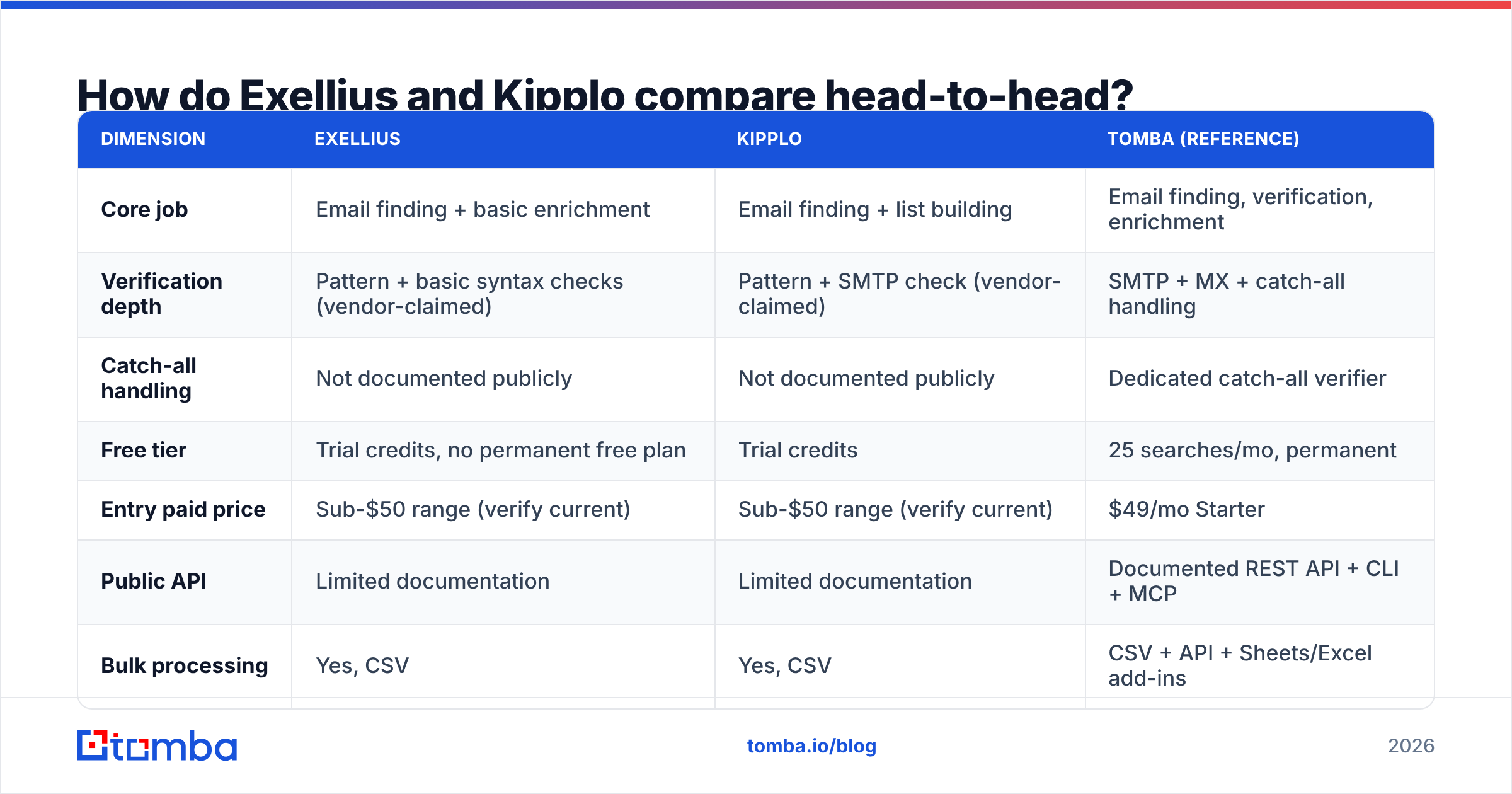
Here is the comparison frame that actually predicts outcomes. Treat vendor-published numbers as claims to test, not facts, and check current figures on each vendor's own site before you buy.
| Dimension | Exellius | Kipplo | Tomba (reference) |
|---|---|---|---|
| Core job | Email finding + basic enrichment | Email finding + list building | Email finding, verification, enrichment |
| Verification depth | Pattern + basic syntax checks (vendor-claimed) | Pattern + SMTP check (vendor-claimed) | SMTP + MX + catch-all handling |
| Catch-all handling | Not documented publicly | Not documented publicly | Dedicated catch-all verifier |
| Free tier | Trial credits, no permanent free plan | Trial credits | 25 searches/mo, permanent |
| Entry paid price | Sub-$50 range (verify current) | Sub-$50 range (verify current) | $49/mo Starter |
| Public API | Limited documentation | Limited documentation | Documented REST API + CLI + MCP |
| Bulk processing | Yes, CSV | Yes, CSV | CSV + API + Sheets/Excel add-ins |
| Credit rollover | Not documented | Not documented | Plan-dependent |
| Third-party review volume | Very low | Very low | Established on G2/Capterra |
The pattern in that table is the real finding. Half the rows read "not documented publicly." A vendor that hides its catch-all rules or its credit rules is rarely hiding good news. Those are the details a confident vendor puts on the pricing page.
Which one has better data accuracy?#
Nobody can answer that for you from the outside — and any article that claims a precise percentage for two low-visibility tools is inventing it. What you can do is measure it in an afternoon.

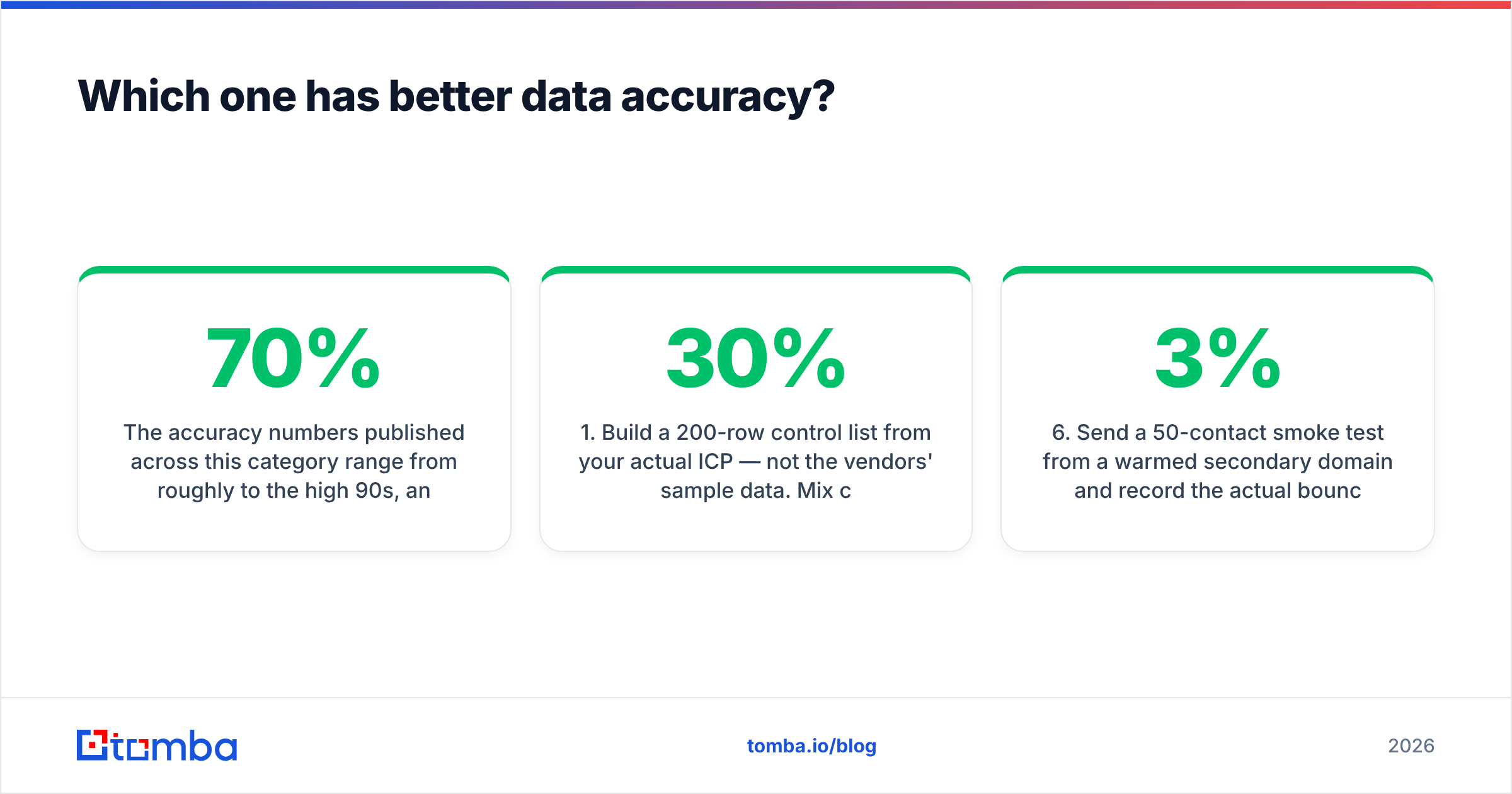
The accuracy numbers published across this category range from roughly 70% to the high 90s, and they're not measured the same way. Some vendors count "we returned something" as a hit. Others count only addresses that survive an SMTP handshake. A tool reporting 95% on the first definition can easily be worse in practice than a tool reporting 82% on the second.
Run this test instead:
- Build a 200-row control list from your actual ICP — not the vendors' sample data. Mix company sizes, include at least 30% non-US domains, and include a few companies you know use Google Workspace and a few on Microsoft 365.
- Run the identical list through both tools on the same day. Same inputs, same order, no manual cleanup between runs.
- Separate the response classes. Count
valid,accept-all/catch-all,unknown, andnot foundseparately. Merging catch-all into "found" is how vendors inflate hit rate — a catch-all domain accepts everything, so acceptance proves nothing.
Then grade the results without taking either vendor's word for them:
- Re-verify the winners with a neutral third tool. Push both output sets through an independent email verifier so neither vendor is grading its own homework.
- Compute cost per verified contact, not cost per credit. Divide monthly price by the count of confirmed-valid addresses. This is the only number your CFO cares about.
- Send a 50-contact smoke test from a warmed secondary domain and record the actual bounce rate. Anything above 3% means the data failed regardless of what the dashboard said.
Steps 3 and 4 are where cheap tools separate. Bounce rate is a deliverability input, not a data-quality footnote. Google and Yahoo's bulk-sender rules set a low bar for complaints and bounces. One bad list can cost you a month of sender reputation recovery.
Wait — that's the point of the test. Guessed addresses feel free until they aren't.
What do Exellius and Kipplo actually cost?#
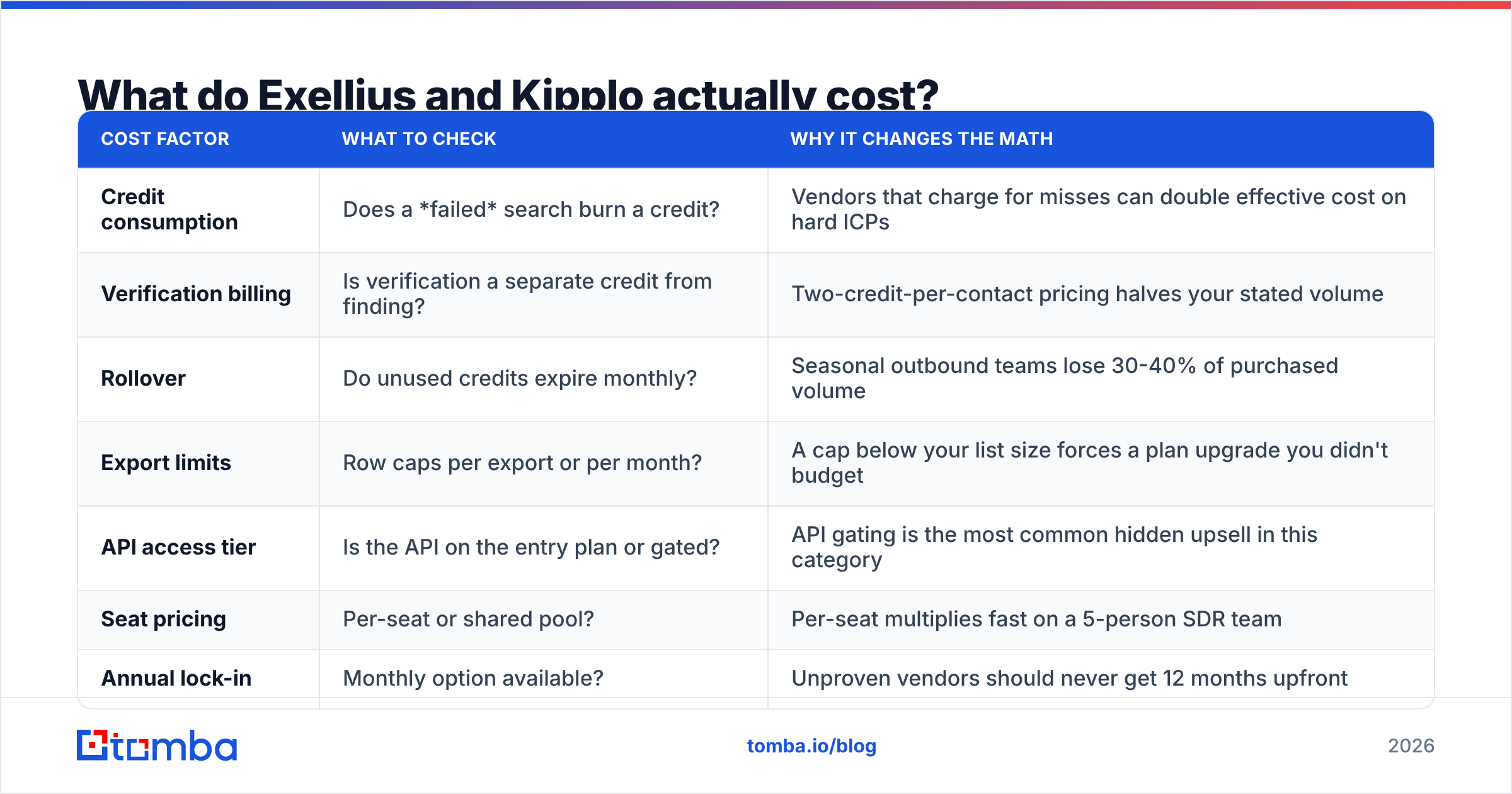
Price Exellius vs Kipplo on cost per verified contact, not on sticker price. Two tools at $39 and $49 can differ 3x in real cost once you account for how credits are consumed and what a "credit" buys.
| Cost factor | What to check | Why it changes the math |
|---|---|---|
| Credit consumption | Does a failed search burn a credit? | Vendors that charge for misses can double effective cost on hard ICPs |
| Verification billing | Is verification a separate credit from finding? | Two-credit-per-contact pricing halves your stated volume |
| Rollover | Do unused credits expire monthly? | Seasonal outbound teams lose 30-40% of purchased volume |
| Export limits | Row caps per export or per month? | A cap below your list size forces a plan upgrade you didn't budget |
| API access tier | Is the API on the entry plan or gated? | API gating is the most common hidden upsell in this category |
| Seat pricing | Per-seat or shared pool? | Per-seat multiplies fast on a 5-person SDR team |
| Annual lock-in | Monthly option available? | Unproven vendors should never get 12 months upfront |
Use a published price as your yardstick. Tomba pricing runs a free tier at 25 searches/month, Starter at $49/mo, Growth at $99/mo, Pro at $249/mo, and custom Enterprise. When Exellius or Kipplo quotes you a number, turn it into cost per verified contact. Then compare that, not the headline price.
One rule either way: do not sign a year with a vendor you cannot verify. Monthly costs a little more. It also lets you walk away when the test month says no.
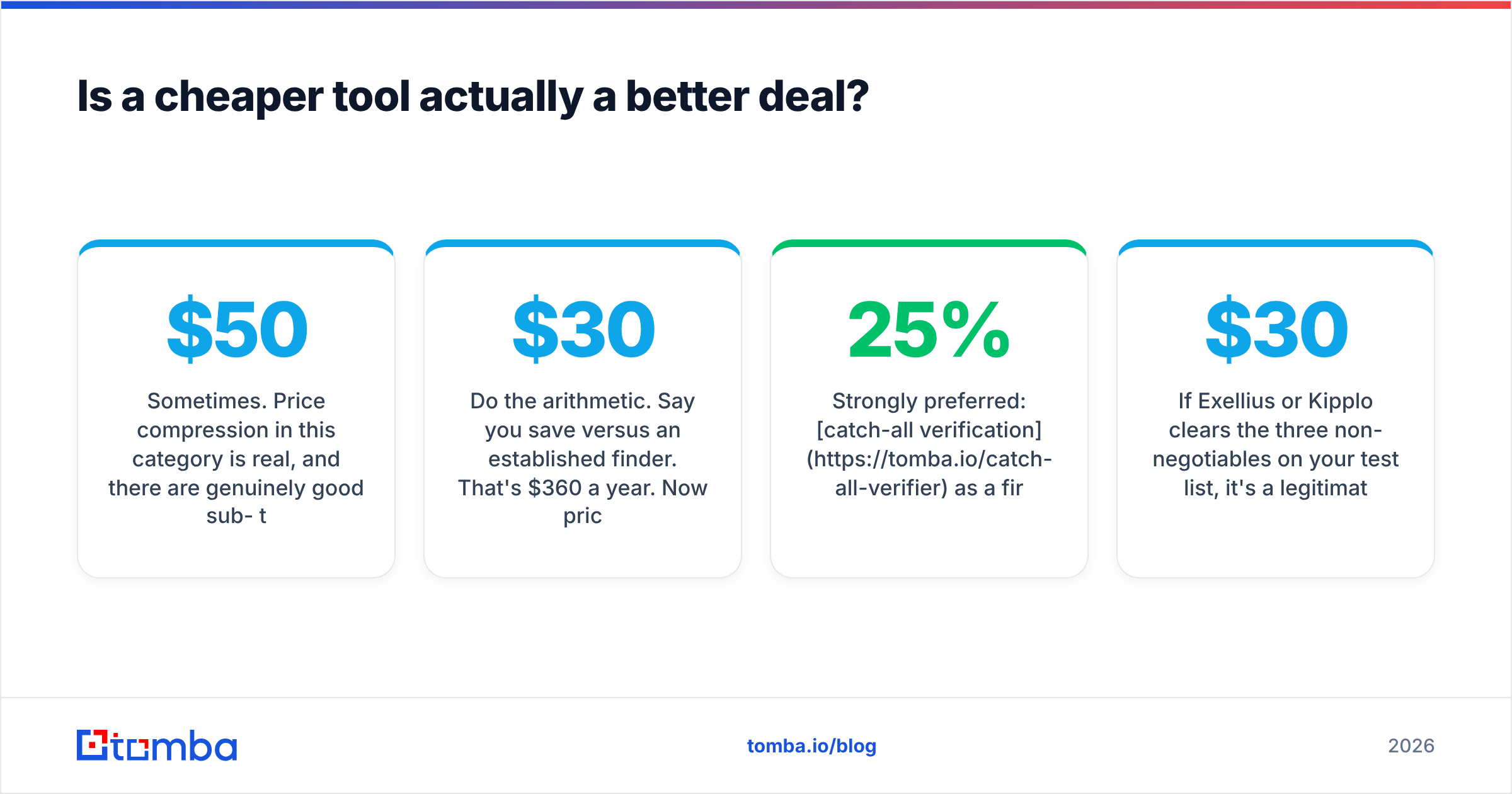
Is a cheaper tool actually a better deal?#
Sometimes. Prices really are falling here, and some sub-$50 tools are good. The trap is the math: the savings are small and the downside is not.
Do the arithmetic. Say you save $30/month versus an established finder. That's $360 a year. Now price the alternative outcome: a list with a 12% bounce rate on a domain you've spent six months warming. You lose inbox placement. Your live sequences decay. Then you spend four to eight weeks rebuilding reputation, while outbound pipeline drops to near zero. For most teams running 2,000+ sends a month, that costs more than the annual subscription difference in the first week.
That's why the buying criteria for a budget tool should be stricter than for an expensive one, not looser:
- Non-negotiable: separate
validvscatch-allstatus in the response. If everything comes back "found," the tool is hiding uncertainty from you. - Non-negotiable: monthly billing available.
- Non-negotiable: a real free or trial tier you can test on your own ICP before paying.
- Strongly preferred: documented API with rate limits published, so you can wire it into your workflow later without a migration.
- Strongly preferred: catch-all verification as a first-class feature. Catch-all domains are 15-25% of most B2B lists and the biggest source of hidden bounces.
- Nice to have: native Sheets, Excel, or CRM integrations so the data lands where your team already works.
If Exellius or Kipplo clears the three non-negotiables on your test list, it's a legitimate buy. If either fails one, the $30/month saving is not compensation for the risk.

What are the alternatives to Exellius and Kipplo?#
Say your test month is a wash, which happens a lot with small vendors. These are the known options worth a shortlist, each for one reason:
- Tomba — strongest fit when you want finding, verification, catch-all handling, and enrichment from one vendor with a documented API. The permanent free tier makes head-to-head testing free.
- Hunter — the category's most recognized brand; broad domain coverage, simple credit model, weaker on enrichment depth.
- BookYourData — a solid choice when you'd rather buy a pre-built, filtered list than run searches one at a time. Pay-as-you-go pricing suits teams with lumpy, campaign-driven demand rather than steady daily prospecting.
- Apollo — makes sense only if you want the database, sequencer, and dialer bundled. If you already run a separate sending tool, you're paying twice; see the Apollo alternative breakdown for the unbundled comparison.
- Findymail — narrower scope, good reputation for accuracy on hard-to-find contacts, less useful as a general-purpose platform.
For most teams the real choice is not "Exellius or Kipplo." It is one of these two versus a known finder with public docs and a free tier you can test first. Where the data comes from matters as much as the price. Vendors that publish their data sources give you something the quiet ones do not.
Which should you choose?#
The Exellius vs Kipplo call comes down to what your control list returns. Here is how to read it.
Choose Exellius if your test list comes back with a clearly higher verified-hit rate. Budget tools are often strong in one region or industry and thin everywhere else. If that pocket is your ICP, the price is real value.
Choose Kipplo if it wins the same test and you want its list-building workflow more than raw API access. Teams that build lists by hand in a UI care about different things than teams that hit an endpoint 10,000 times a night.
Choose neither if both return under 60% verified on your control list. Same if either one merges catch-all into "found," or if monthly billing is off the table. Those are not preferences. They are problems you pay for later in deliverability.
And whatever you pick, keep verification independent from finding. Even a good finder should have its output re-checked before a campaign. The index that was accurate in January is 20-30% stale by December, because people change jobs and B2B data decays every day. That's not a knock on any specific vendor; it's the physics of the category.
FAQ#
Are Exellius and Kipplo the same kind of tool? Broadly yes. Both sell B2B email finding and contact data below the enterprise price point. They differ in index coverage and workflow, not in category.
How many contacts should I test before buying? 200 is the practical minimum for a signal you can trust. Below 100, random variance in your sample swamps the difference between tools.
Does a higher price mean better data? No. It correlates with breadth of coverage and support quality, not necessarily with accuracy on your specific ICP. That's why the control-list test beats reading pricing pages.
Can I use two finders at once? Yes, and large teams often do. Waterfall enrichment runs a contact through finder A, then sends the misses to finder B. It raises coverage and cost at once. Only worth it above roughly 5,000 contacts a month.
Ready to benchmark against a known quantity? Run your control list through the Tomba Email Finder next to whichever tool you are testing. The free tier covers 25 searches a month, no card required. Compare verified-hit rates on your own ICP before anyone gets your credit card. Whatever you pick, pick it with your data, not a vendor landing page. For a wider read on how the industry benchmarks contact data, HubSpot's sales research is a fair neutral start.
Related guides#
Ready to find emails that actually work?
Join 150,000+ professionals who stopped guessing and started sending. Free credits on signup — no credit card required.
Get the Tomba newsletter
Practical outbound tactics and product updates — once every two weeks.
About the author