Exellius vs Revli (2026): Which B2B Lead Data Tool Wins?
Exellius sells done-for-you B2B lists and data services. Revli sells self-serve lead lookup. They compete for the same budget but solve different problems — here's how to pick, and when neither is the right answer.
Exellius vs Revli is really a choice between two ways of buying data. Exellius builds lists for you. Revli lets you search and export them yourself. This guide compares both on data, price, and fit — and gives you a test to pick one.
TL;DR
- Exellius is a data services vendor. You brief them on your target market. They build the list and hand it over.
- Revli is self-serve. You log in, look up contacts or companies, export, and go. Less friction, lower ceiling.
- The real question is not "which tool is better." It is build vs. buy. A bought list decays. A lookup layer you control does not.
- Neither vendor posts deep, stable pricing in public. A real budget comparison needs a sales call. Plan for that.
- Do you just need repeatable email discovery and checks, wired into your stack? Then an API-first email finder usually wins on cost per usable contact. Tomba starts free at 25 searches, then $49/mo.
Exellius vs Revli: what are they, actually?#
Start here. Review sites drop both into the same "lead generation software" bucket. They are not the same shape.
Exellius sells B2B data and demand generation as a service. The model is managed. You describe your ideal customer: industry, headcount, tech stack, region, seniority. The vendor sends back a targeted contact list. Research, list cleanup, or outreach help often ride along. It is closer to a data broker with a service layer than to software you run yourself.
Revli goes the other way. It is a self-serve lookup and list-building tool. Search a company, pull contacts, get emails, then export a CSV or push it to your outreach tool. The pitch is speed and independence. No scoping call. No minimum order. No three-day wait.
That gap shapes everything else: price, data freshness, how you handle bounces, and how much you can automate.
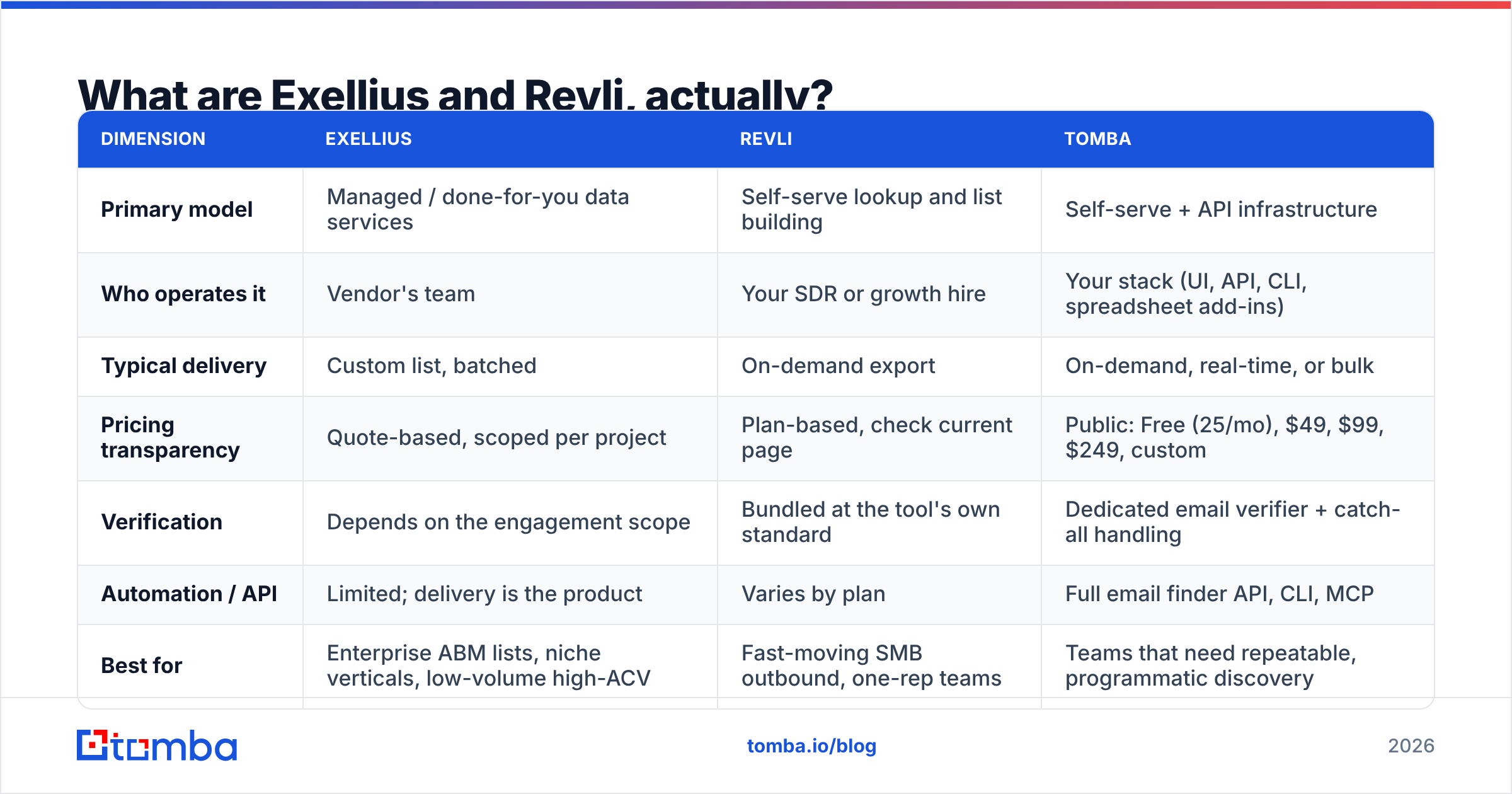
| Dimension | Exellius | Revli | Tomba |
|---|---|---|---|
| Primary model | Managed / done-for-you data services | Self-serve lookup and list building | Self-serve + API infrastructure |
| Who operates it | Vendor's team | Your SDR or growth hire | Your stack (UI, API, CLI, spreadsheet add-ins) |
| Typical delivery | Custom list, batched | On-demand export | On-demand, real-time, or bulk |
| Pricing transparency | Quote-based, scoped per project | Plan-based, check current page | Public: Free (25/mo), $49, $99, $249, custom |
| Verification | Depends on the engagement scope | Bundled at the tool's own standard | Dedicated email verifier + catch-all handling |
| Automation / API | Limited; delivery is the product | Varies by plan | Full email finder API, CLI, MCP |
| Best for | Enterprise ABM lists, niche verticals, low-volume high-ACV | Fast-moving SMB outbound, one-rep teams | Teams that need repeatable, programmatic discovery |
How do their data sourcing models differ?#
This is where most buyers get burned. So ask precise questions.
A managed vendor like Exellius builds a list from licensed databases, public web sources, and manual research. The upside is human judgment. Say you sell compliance software to credit unions with 50–200 staff in three US states. A researcher can filter that way. A generic search box cannot.
The downside: the list is a snapshot. It is accurate the day it ships. Then it starts to decay. B2B contact data churns at roughly 25–30% a year. In tech it runs higher, and higher still in a layoff cycle. Six months on, a real slice of that list points at people who left.
A self-serve tool like Revli queries a live index at the moment you search. The record you pull today shows what the index knew today. Freshness is better. But the quality work shifts to you. No researcher checks that the "VP Marketing" you found owns the budget you care about.
There is a third model, and most mature outbound teams end up there: pattern plus verification. You skip the list. You resolve emails on demand from a name and a domain. Then you verify each one before it enters a sequence. Tomba's domain search works this way. Give it a company domain, get the email pattern and known contacts, then run each address through verification. It is not glamorous. But cost per deliverable contact is usually the lowest of the three, because you never pay for records you will not mail.

Which one is cheaper — and is that the right question?#
Neither vendor prices like a commodity SaaS product. So a straight side-by-side number would mislead you.
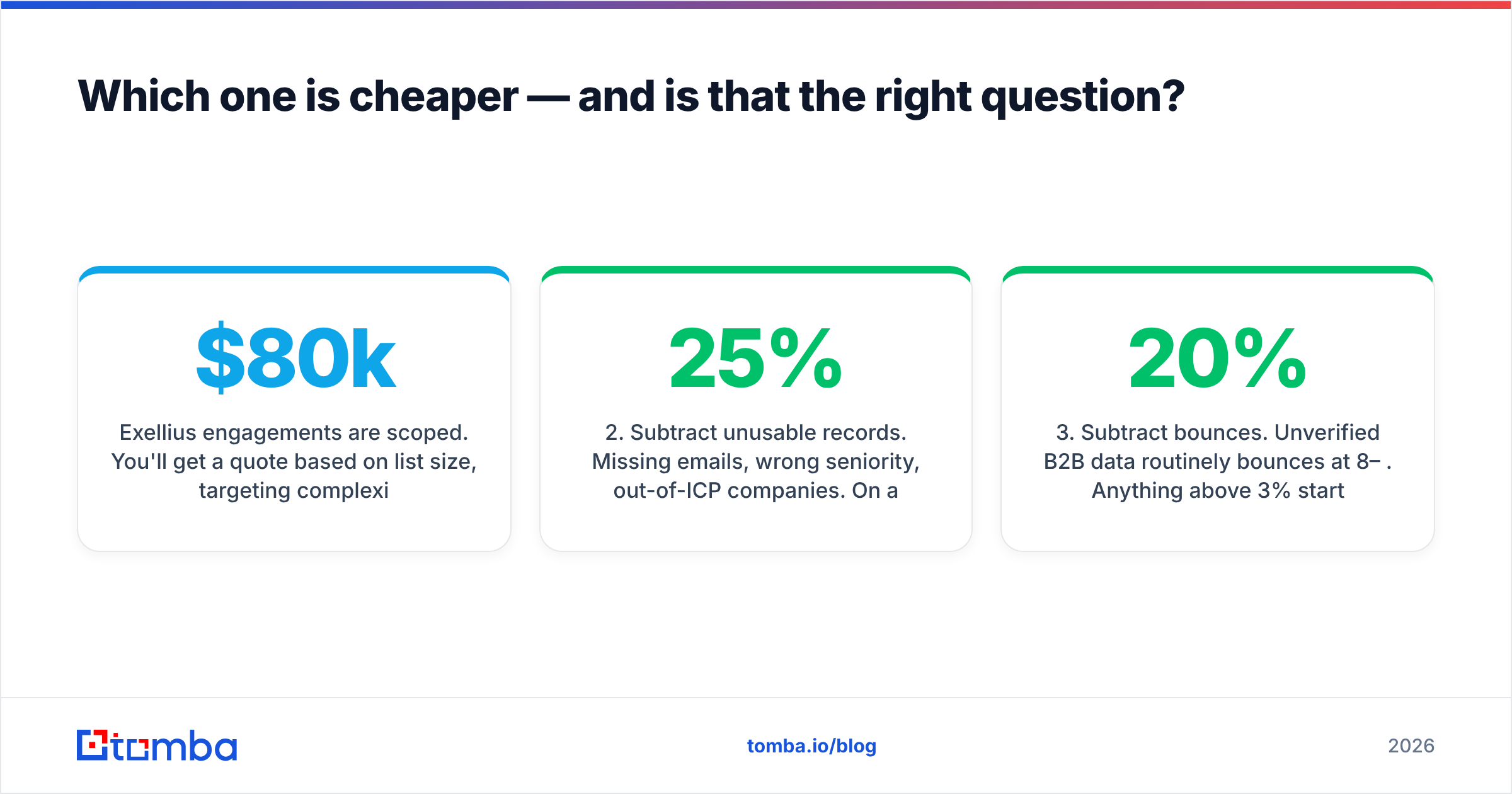
Exellius deals are scoped. You get a quote based on list size, targeting difficulty, and any services attached. At high deal value that can be great. If one closed deal is worth $80k, a $4,000 list that books two meetings pays for itself. At low deal value it is poor. The cost is fixed and paid up front, whatever the outcome.
Revli prices more like normal SaaS: a monthly fee tied to credits or lookups. Check the current pricing page before you budget. Vendors in this category revise tiers often, and any number quoted in a blog post ages badly.
The metric that matters is cost per contact that gets your email and does not bounce. Run it like this:
- Start with list price. Total spend divided by records delivered. This is the number vendors quote.
- Subtract unusable records. Missing emails, wrong seniority, out-of-market companies. On a bought list, 15–25% attrition here is normal.
- Subtract bounces. Unverified B2B data bounces at 8–20%. Above 3%, you start to hurt your sender reputation.
- Subtract catch-all guesswork. Catch-all domains accept every address, so "valid" tells you nothing. A catch-all verifier is the only way to settle these without gambling.
- Divide again. Now you have the real number. It is usually 1.5× to 3× the quoted price.
- Add the reputation cost. A domain burned by a bad list takes weeks of warmup to recover. That is real money, even if it never shows up as a line item.
Do this math on any quote from either vendor before you sign. It often shows that the cheaper list costs more.
Is Exellius better than Revli for enterprise outbound?#
For true enterprise ABM, the managed model has a real edge. Picture a named list of 200 logos where every contact matters. Human research handles what algorithms fumble: org charts, subsidiaries, and whether the "Director of Operations" at a 40-person company is the buyer. Exellius-style work is built for that.
For high volume, the math flips. At 3,000 contacts a month across a broad market, custom research is too slow and too costly. You do not need it either. You need coverage, freshness, and checks that run without a human. That is Revli's turf, and it is where API-first tools compete hardest.
A useful rule of thumb:
- Under 200 contacts a month, deals above $25k → managed services earn their premium.
- 200–2,000 contacts a month → self-serve lookup, with a hard verification gate.
- Above 2,000 contacts a month → API plus bulk email finder, automated end to end. Manual work becomes the bottleneck.
- Target market still unclear → do not buy a list at all. You will pay to reach the wrong people. Use a free tier and iterate.
What about data accuracy and verification?#
Ask both vendors the same three questions. Compare the answers, not the marketing:
"What bounce rate do you guarantee, and what happens if you miss it?" A confident data vendor commits to a number, usually 95–98% deliverability, and credits you for overage. A vague answer like "we verify everything" means no commitment.
"How do you handle catch-all domains?" This question separates real verification from checkbox verification. About one in five B2B domains is catch-all. A vendor that marks every catch-all address as "valid" is inflating its accuracy numbers. The honest answer is a separate confidence tier, not a green checkmark.
"How old is the average record?" For managed lists, ask when the source was last refreshed. That is a different date from when the file was assembled.
Outside signal helps too. G2's lead intelligence category carries unfiltered reviews. Ignore the star rating. Look at where the complaints cluster: data quality, billing, or support. Each of those three problems needs a different fix.

Whatever you buy, verify it again on arrival. Data checked by the seller is not the same as data checked against your sending setup at the moment you send. A fresh pass through an independent email verification step takes fifteen minutes. It routinely saves a domain.
How do the two compare on integrations and automation?#
Managed services and automation pull against each other. When the deliverable is a file, the integration story ends at "import the CSV." Some vendors will push to your CRM. But you are still on a batch cadence: you request, they deliver, you import.
Self-serve tools do better here, though depth varies a lot by plan. Look for four things:
- Native CRM sync, not just export. One-way CSV export means someone maintains a spreadsheet forever.
- API access on a plan you would actually buy. Many vendors lock the API behind an enterprise tier, which makes it theoretical.
- Rate limits you can live with. An API capped at 60 requests a minute will not enrich a 50,000-row database this quarter.
- A browser extension for the manual half of prospecting, when a rep is already on a company page.
Tomba's approach here is boring in a good way. The same data is reachable through a Chrome extension, Google Sheets, a REST API, a CLI, and an MCP server. So the rep doing manual research and the pipeline running 10,000 lookups overnight hit one source of truth. That consistency matters more than any single integration.

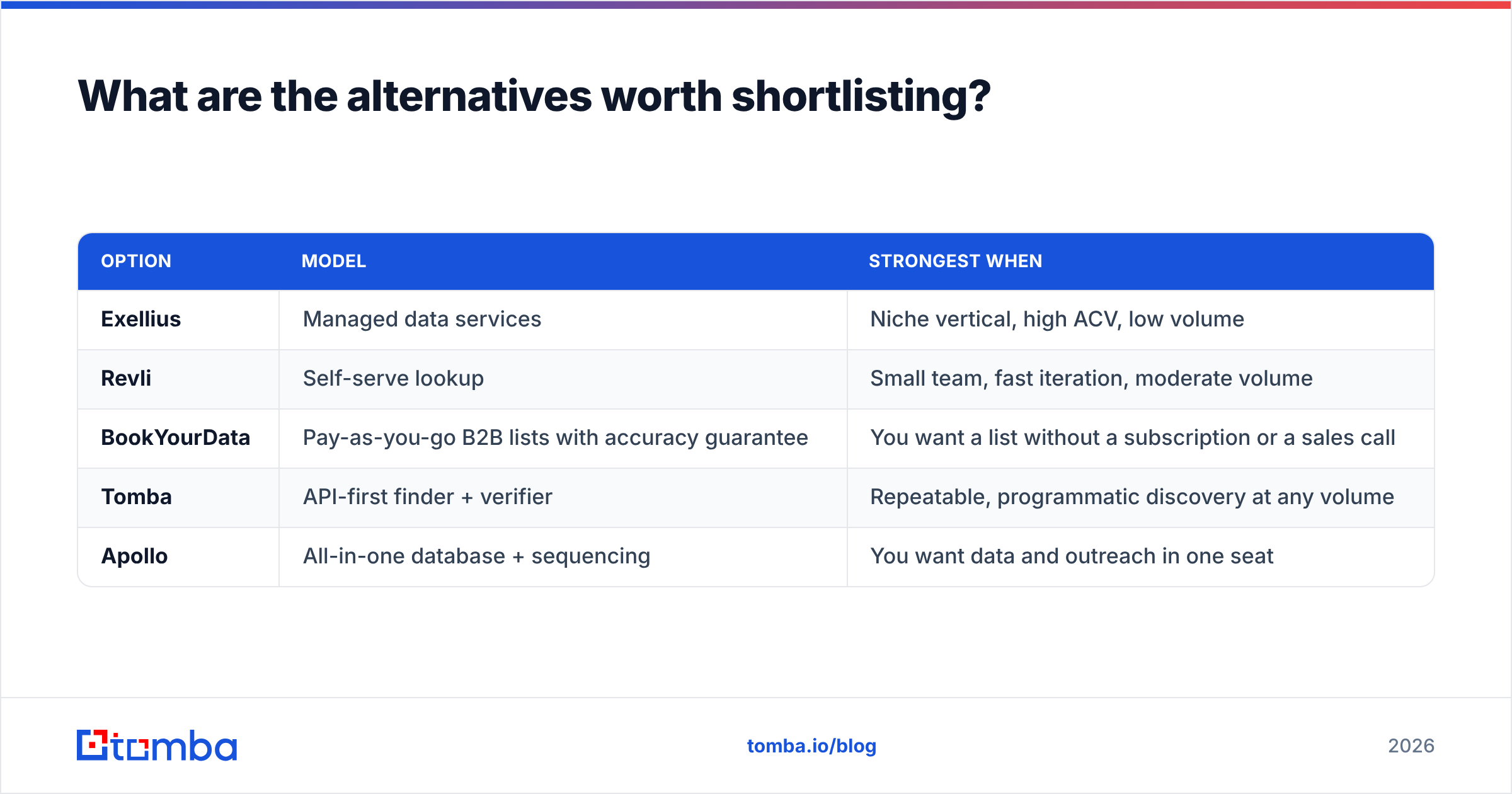
What are the alternatives worth shortlisting?#
Do not run a two-horse race. The category is crowded, and a nearby option often fits better than either finalist:
| Option | Model | Strongest when |
|---|---|---|
| Exellius | Managed data services | Niche vertical, high ACV, low volume |
| Revli | Self-serve lookup | Small team, fast iteration, moderate volume |
| BookYourData | Pay-as-you-go B2B lists with accuracy guarantee | You want a list without a subscription or a sales call |
| Tomba | API-first finder + verifier | Repeatable, programmatic discovery at any volume |
| Apollo | All-in-one database + sequencing | You want data and outreach in one seat |
BookYourData is worth a look for one reason. Its pay-per-list model dodges both failure modes in this comparison: no annual commitment, no scoping call. If your buying friction is "I do not want to talk to sales, and I do not want a subscription," that is a clean fit.
Apollo is the consolidated option, and the tradeoff is well documented: bundled convenience versus best-in-class parts. Teams that outgrow the bundle usually split it. The Apollo alternative breakdown covers where that seam tears.
For a broader way to judge any of these, HubSpot's sales blog has solid material on prospecting economics that is not tied to one vendor's pitch.
How should you actually run the evaluation?#
Four weeks, structured. No vendor demos until week three:
Week 1 — Define the test set. Pick 100 real target accounts from your own market. Do not clean the sample. Include the messy ones: subsidiaries, rebrands, sub-200-employee companies, non-US domains. This is your benchmark, and it is the only fair one, because it is yours.
Week 2 — Run every candidate against it. Use free tiers and trials where you can, and a small paid test where you cannot. Measure three things: coverage (what share of your 100 returned an email), accuracy (what share survived independent verification), and effort (minutes of human time per 100 records).
Week 3 — Send. Take the output from your top two candidates. Send a real 200-contact sequence from a warmed domain and record the actual bounce rate. This is the only number that is not a vendor claim. Anything above 3% should disqualify the source.
Week 4 — Price the winner honestly. Take your real cost per usable contact from weeks 2 and 3. Multiply it by your monthly volume. Compare that against each quote. Now you negotiate with data instead of vibes.
Most teams that run this process find the same thing. The gap between vendors on coverage is smaller than the marketing suggests. The gap on verification quality is much larger. A coverage gap of 5–10 points is common and survivable. A verification gap shows up in your bounce rate, and then in your sender reputation.
Exellius vs Revli: the verdict#
Choose Exellius if you run low-volume, high-value ABM into a niche where human research beats database filters, and you can treat data as a services budget rather than a tool.
Choose Revli if you are a small team that needs contacts today, values self-serve speed over bespoke targeting, and can absorb the quality control in-house.
Choose neither if what you really need is a dependable, programmatic layer that finds and verifies emails on demand. That is an infrastructure problem, and both of these solve a different one.
That third case is the most common one we see. If it is yours, start with the Tomba Email Finder. The free tier gives you 25 searches a month. That is enough to run the 100-account benchmark above before you spend anything. Paid plans start at $49/mo for Starter, $99/mo for Growth, and $249/mo for Pro. API access, verification, and catch-all handling come with every tier, not just an enterprise call. Full Tomba pricing is public, so you can budget before you talk to anyone.
Run the benchmark. Let your own 100 accounts pick the winner.
Related guides#
Ready to find emails that actually work?
Join 150,000+ professionals who stopped guessing and started sending. Free credits on signup — no credit card required.
Get the Tomba newsletter
Practical outbound tactics and product updates — once every two weeks.
About the author