Exellius vs VCBacked: Which B2B Data Source Wins in 2026?
Exellius sells custom-built, human-checked contact lists. VCBacked sells funding-triggered data on venture-backed companies. They solve different problems — and only one of them fits how your team actually prospects.
Exellius vs VCBacked is a fair fight only if you know what you need. One sells hand-built lists. The other sells funding signals. Pick the wrong one and you pay for data your reps never use.
TL;DR
- Exellius is a managed B2B data service. You brief a team, they build a custom contact list, and they hand it back. Best when your ICP is odd, niche, or hard to filter out of a standard database.
- VCBacked is a signal-first database of venture-funded companies. Best when "just raised a round" is the trigger that makes your offer relevant.
- Neither is a self-serve email finder. Both hand you data on their schedule, not yours. Neither replaces a verification layer before you send.
- Cost models differ more than feature sets. Exellius quotes per project. VCBacked sells access. Compare cost per usable contact, not sticker price.
- Most teams under 20 reps pair a lightweight email finder with one of these. Few pick one tool and stop there.
What are Exellius and VCBacked, exactly?#
They get compared because both sell B2B contact data. That's where the similarity ends.
Exellius works like an outsourced research desk. You describe the account profile — "Series B fintechs in DACH with an in-house compliance team, VP-level and above" — and a human team builds the list, checks it, and sends a file. You get a spreadsheet or a CRM import, not a search box. The value is specificity. Filters you cannot pick from a dropdown get written into a brief instead.
VCBacked sits at the other end. It is a database built around one signal: venture funding. Round size, stage, investor, announcement date, and the operators inside those companies. The value is timing. You reach a company in the 90-day window after a raise, when budget exists and buying committees are still forming.
The difference matters because it decides what breaks. Managed lists break on freshness. A list built in March is a March list, and B2B contact data decays 22% to 30% a year as people change jobs. Signal databases break on coverage. If your buyer works at a bootstrapped 40-person agency, funding data will never find them.

Exellius vs VCBacked: how do they compare head to head?#
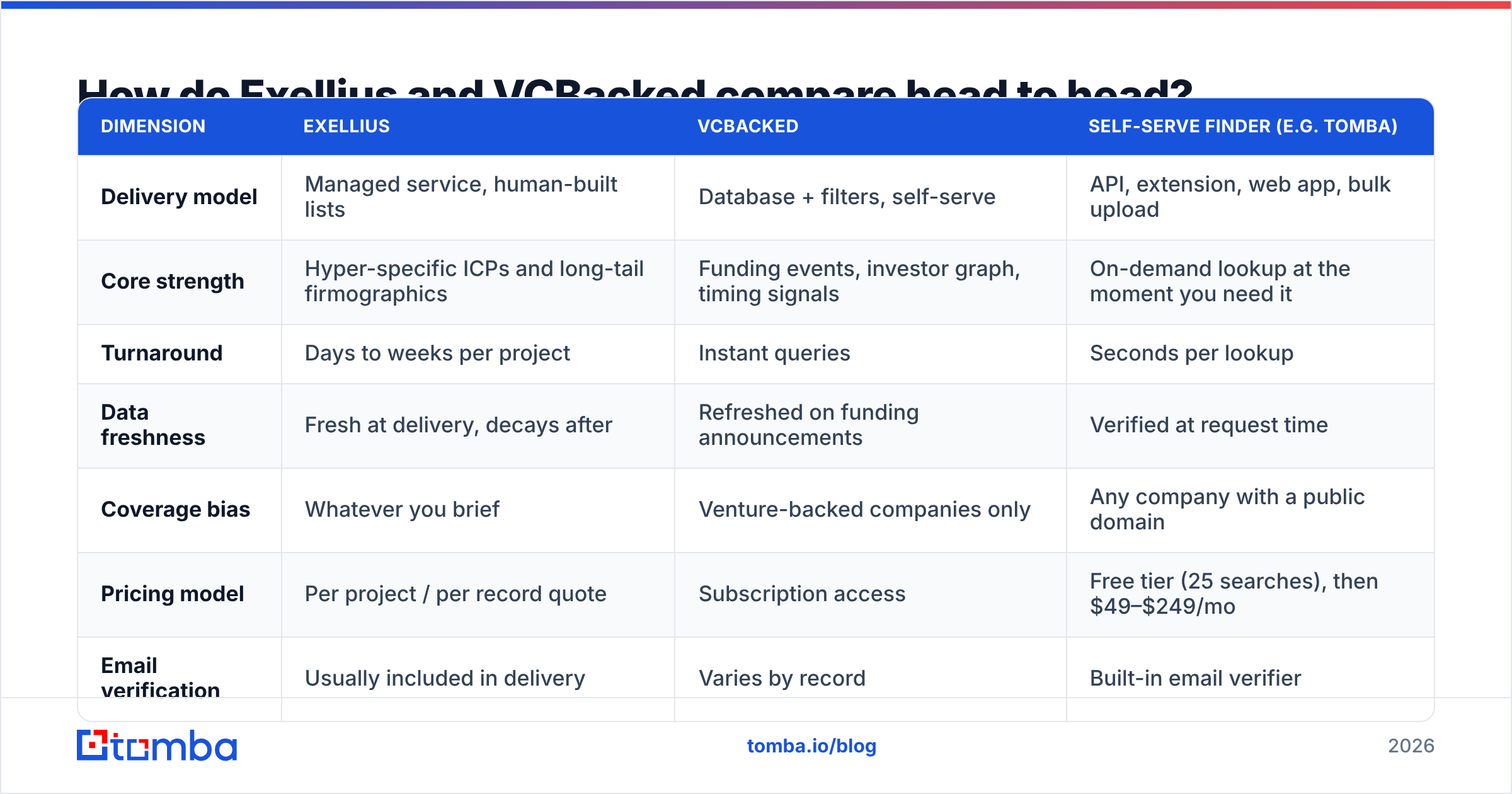
Here is the practical breakdown. Pricing for both is quote-driven and shifts with seat count and volume. Treat the cost row as a shape, not a quote.
| Dimension | Exellius | VCBacked | Self-serve finder (e.g. Tomba) |
|---|---|---|---|
| Delivery model | Managed service, human-built lists | Database + filters, self-serve | API, extension, web app, bulk upload |
| Core strength | Hyper-specific ICPs and long-tail firmographics | Funding events, investor graph, timing signals | On-demand lookup at the moment you need it |
| Turnaround | Days to weeks per project | Instant queries | Seconds per lookup |
| Data freshness | Fresh at delivery, decays after | Refreshed on funding announcements | Verified at request time |
| Coverage bias | Whatever you brief | Venture-backed companies only | Any company with a public domain |
| Pricing model | Per project / per record quote | Subscription access | Free tier (25 searches), then $49–$249/mo |
| Email verification | Usually included in delivery | Varies by record | Built-in email verifier |
| API access | Limited or custom | Depends on plan | Full email finder API |
| Best for | Enterprise ABM, niche verticals | Startup-selling GTM teams | Any team enriching continuously |
Read that table twice and the real split shows up: Exellius optimizes for precision, VCBacked optimizes for timing, and a finder optimizes for latency. Those are three different bottlenecks. The one you have decides your answer.
What does Exellius do best?#
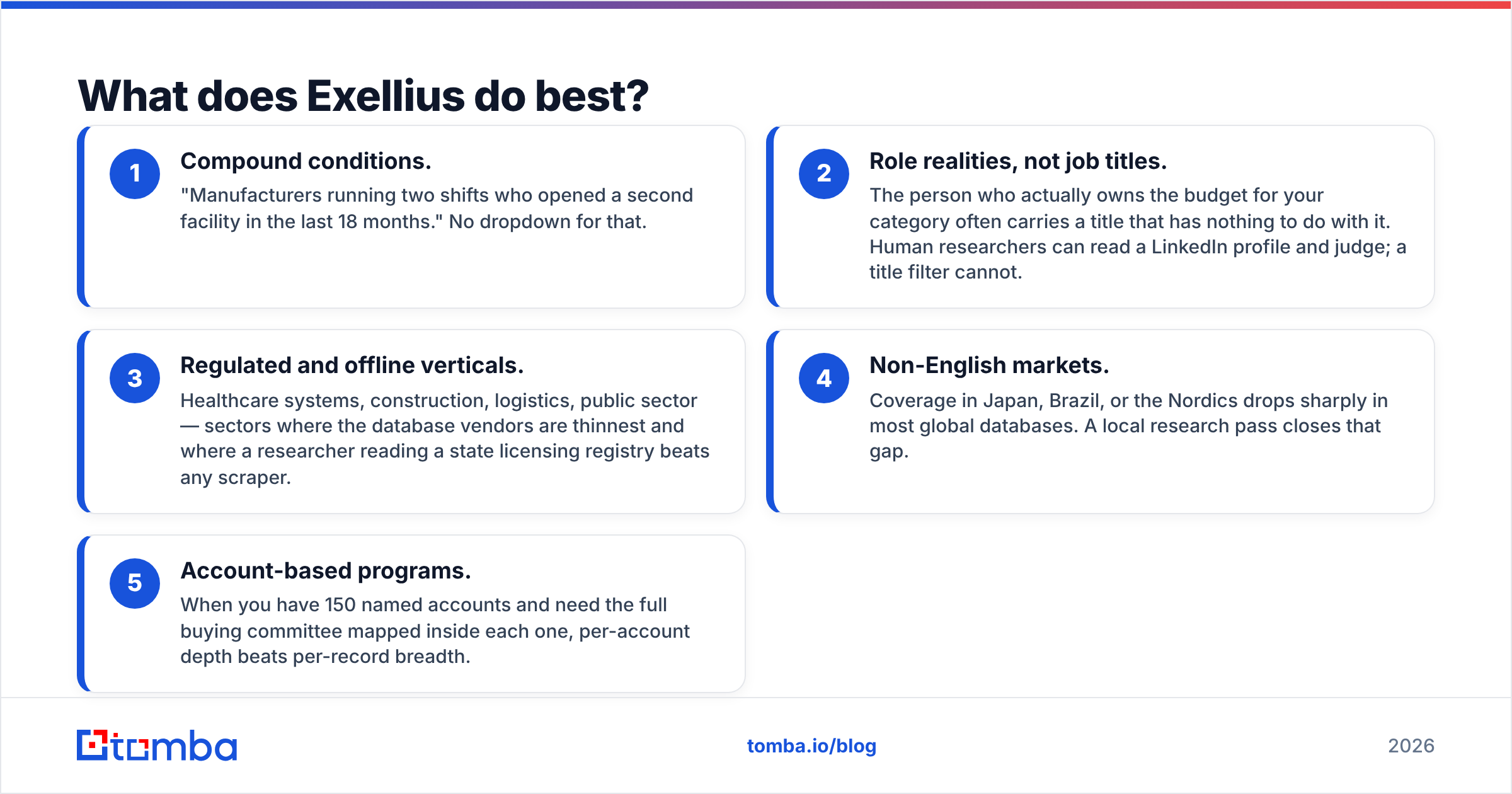
Managed list building earns its keep when your filter set does not exist as a filter.
Standard databases index the obvious: industry, headcount, revenue band, installed technology, job title. That covers maybe 70% of B2B ICPs. The other 30% look like this:
- Compound conditions. "Manufacturers running two shifts who opened a second facility in the last 18 months." There is no dropdown for that.
- Role realities, not job titles. The person who owns your budget often carries a title that says nothing about your category. A researcher can read a LinkedIn profile and judge. A title filter cannot.
- Regulated and offline verticals. Healthcare systems, construction, logistics, public sector. Database vendors are thinnest here, and a researcher reading a state licensing registry beats any scraper.
Two more cases push teams toward managed research:
- Non-English markets. Coverage in Japan, Brazil, or the Nordics drops sharply in most global databases. A local research pass closes that gap.
- Account-based programs. You have 150 named accounts and need the full buying committee inside each one. Per-account depth beats per-record breadth.
The tradeoff is honest and unavoidable. You are buying a snapshot. Every managed list starts aging the day it lands. If your sales cycle is long and the list sits in a sequence for four months, expect bounce creep by month three. That is why you re-verify before each send instead of trusting the delivery date.
The second tradeoff is throughput. A research team can build you 2,000 excellent contacts. It cannot build 2,000 excellent contacts every week without a very different invoice.
What does VCBacked do best?#
Funding is the cleanest buying signal in B2B. Building a data product around it is a solid idea.
A company that just closed a round has three useful properties. It has budget that did not exist last quarter. It has a mandate to spend that budget fast. And it has a hiring plan that creates new roles, which creates new tool decisions. If you sell recruiting software, security tooling, dev infrastructure, or finance ops, that window is your best window. The mechanics of venture capital all but guarantee it: money raised is money that must be spent on a clock.
VCBacked-style data gives you the trigger plus the context around it. Which fund led, what stage, how much, and which operators sit inside. That context turns a generic cold email into a specific one. "Congrats on the round" is noise. "Series A led by an investor whose portfolio all standardizes on X, and you're hiring three SREs" is a reason to reply.
The limits are structural:
- The universe is small. Venture-backed companies are a rounding error inside the total B2B market. If your ICP includes established mid-market firms, you're fishing in the wrong pond.
- Signal decay is brutal. A funding trigger is worth a lot in week two and very little in month six. Everyone else bought the same signal from the same feeds.
- Competition is maximal. The moment a round is announced, that company's inbox floods. Your edge has to come from message quality, not from data access.
- Contact-level depth varies. Company-level funding data is easy. Reaching the right VP of Engineering with a deliverable address is a separate problem, usually solved with a domain search on top.
How accurate is the data in practice?#
Ask both vendors for the same thing: a sample, run against your own verification, on your own ICP.
Vendor-published accuracy numbers are marketing artifacts. They are measured on their sample, with their definition of "valid," at their chosen moment. The number you care about is deliverable-rate-on-your-slice. That is the share of records that survive verification for the exact industry, seniority, and geography you sell into. It swings by 30 points or more across slices of the same database.
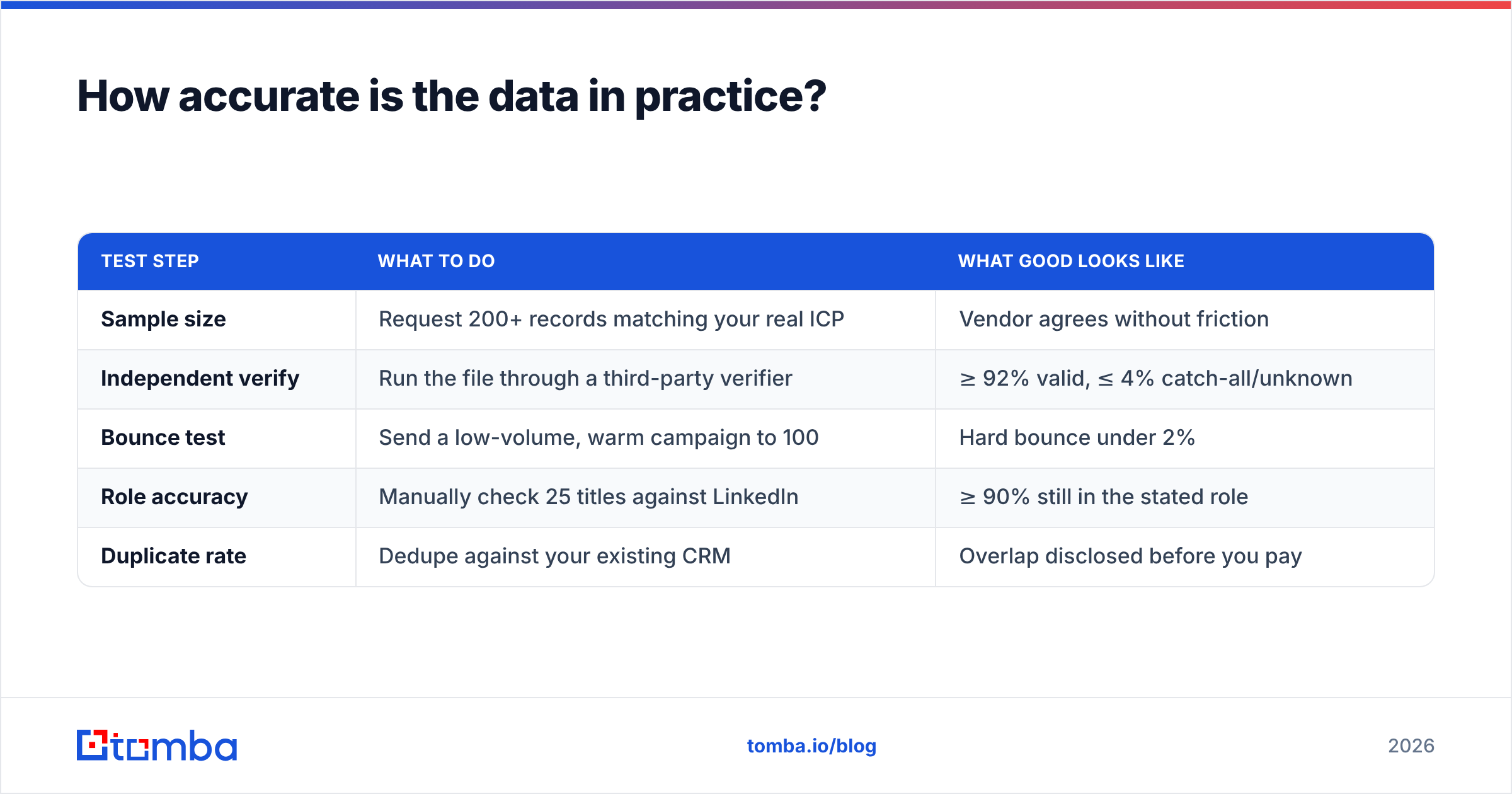
A defensible test costs you one afternoon:
| Test step | What to do | What good looks like |
|---|---|---|
| Sample size | Request 200+ records matching your real ICP | Vendor agrees without friction |
| Independent verify | Run the file through a third-party verifier | ≥ 92% valid, ≤ 4% catch-all/unknown |
| Bounce test | Send a low-volume, warm campaign to 100 | Hard bounce under 2% |
| Role accuracy | Manually check 25 titles against LinkedIn | ≥ 90% still in the stated role |
| Duplicate rate | Dedupe against your existing CRM | Overlap disclosed before you pay |
That last row catches the most expensive failure mode. Plenty of teams pay for 5,000 "new" contacts and find that 1,400 were already in the CRM. Run a remove duplicates pass before you sign off on any delivery.
Check one more thing, whichever vendor you choose: catch-all domains. Many enterprise domains accept every address at the SMTP layer. A naive verifier marks them "valid," and your bounce rate says otherwise a week later. A dedicated catch-all verifier resolves most of them properly instead of shrugging.

What do they actually cost?#
Both are quote-based, so headline comparison is useless. Convert everything to cost per contact that gets a reply.
Rough shape of the math:
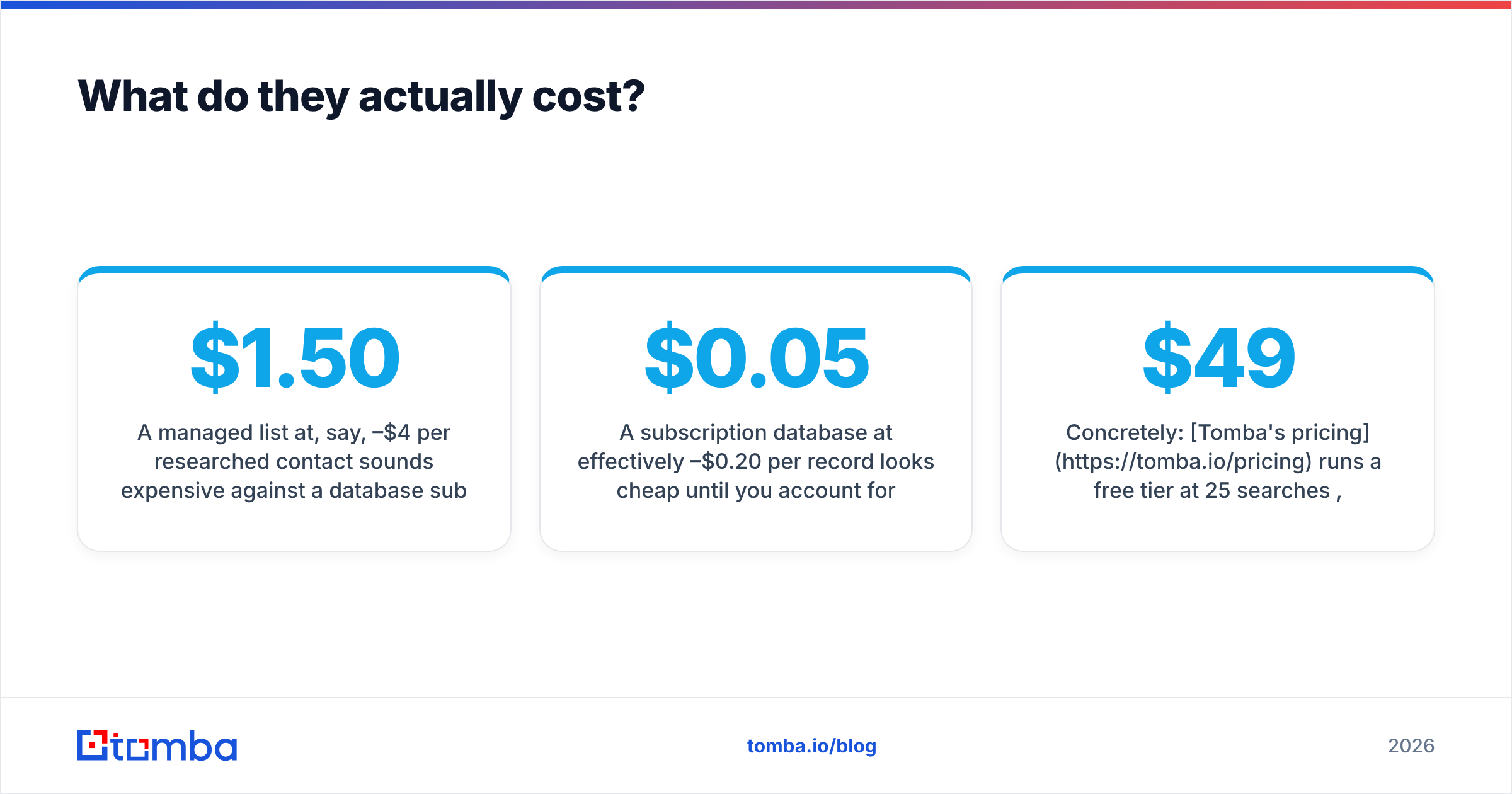
- A managed list at $1.50–$4 per researched contact sounds costly next to a database subscription. But if 95% are deliverable and 90% match your ICP, your effective cost per qualified contact stays flat.
- A subscription database at $0.05–$0.20 per record looks cheap. Then you count the records you export, verify, and throw away. A 60% usable rate quadruples your true unit cost.
- A self-serve finder charges per successful lookup. That ties cost to value. You pay for hits, not for the right to search.
Concretely: Tomba's pricing runs a free tier at 25 searches/month, Starter at $49/mo, Growth at $99/mo, Pro at $249/mo, and custom enterprise deals above that. That is not the same product as a managed research engagement. It is the layer you run underneath one, or instead of one when your ICP is filterable.
The finance question is not "which is cheaper." It is "which line item survives a bad quarter." Project research spend is easy to cut and hard to restart. Subscription access is sticky, but it bills whether or not you prospect. A metered finder scales down with your activity, which is usually the healthiest shape for a young outbound motion.
Which one fits your GTM motion?#
Match the tool to the bottleneck, not to the feature list.
- You sell to startups and timing is everything. VCBacked. The funding signal is the whole product, and no generic database surfaces it as cleanly. Pair it with contact-level enrichment, because company data alone doesn't fill a sequence.
- Your ICP cannot be expressed in filters. Exellius. Pay humans to do human work. Budget for a re-verification pass at 60 and 120 days.
- You run continuous, high-volume outbound across a broad market. Neither, primarily. You need per-lookup economics and an API. Batch deliveries create a stop-start rhythm that kills sequence cadence.
The smaller and earlier your team, the more the answer shifts:
- You're doing named-account ABM under 300 accounts. Exellius for the committee mapping, then a finder for the contacts that turn over mid-campaign.
- You're a two-person team testing three ICPs at once. Start self-serve. Managed research locks you into an ICP hypothesis before you've validated it, and that is the most expensive kind of wrong.
- You already have accounts, you're missing contacts. Skip both and run data enrichment against the company list you own.
Worth reading alongside this: the G2 category pages for lead intelligence, where reviews break out by company size. A vendor that rates 4.6 with enterprise buyers can rate 3.9 with SMBs, and the gap is usually about onboarding and minimums. HubSpot's ongoing sales research is a fair sanity check on reply-rate benchmarks before you blame the data for a bad campaign.
Is there a third option worth considering?#
Yes, and most teams land there eventually. Keep a lightweight finder as the always-on layer. Buy managed or signal data only for specific campaigns.
The reason is operational. Managed lists and signal databases both produce events: a delivery, an export. Your pipeline needs a service. Something that answers "what is this person's email" at 2pm on a Tuesday, while a rep stares at a LinkedIn profile. Those are different jobs. Forcing an event-shaped tool to do a service-shaped job is where CSV sprawl comes from.
A finder layer handles the boring 80%. It verifies a pattern, fills a missing address on an inbound form, enriches a CRM record on create, or pulls the full contact set for a domain you just found. Then, when you need the 20% that requires research or timing signals, you buy it on purpose, for a defined campaign, with a defined budget.
In practice that looks like a Chrome extension for reps working in-browser, an API call from your CRM on record creation, a bulk email finder job for lists you exported elsewhere, and a verification pass before every send.
Which should you pick in 2026?#
The Exellius vs VCBacked call comes down to your bottleneck, not your budget.
Pick VCBacked if funding is your trigger. Nothing else replaces it. The ROI math is simple when your product is something a freshly funded company buys in its first 90 days.
Pick Exellius if your ICP defeats filters. Human research is better at judgment calls, non-English markets, and offline industries. Just budget for decay and re-verify on a schedule.
Pick neither as your only data source. Both are campaign inputs. Neither is infrastructure. A team that runs one managed list per quarter and nothing else has a process that stalls between deliveries.
Then run the sample test in this post before you sign anything. Two hundred records, your ICP, your verifier. It settles arguments that vendor decks cannot.
Start with the layer you'll use every single day. The Tomba Email Finder gives you on-demand professional email lookup by name, domain, or company. Verification is built in, and the free tier covers 25 searches a month, so you can benchmark it against any sample file a vendor sends you. Run the same 200 contacts through both, compare deliverable rates, and let the numbers decide which tool deserves your budget in 2026.
Related guides#
Ready to find emails that actually work?
Join 150,000+ professionals who stopped guessing and started sending. Free credits on signup — no credit card required.
Get the Tomba newsletter
Practical outbound tactics and product updates — once every two weeks.
About the author