9 Best Extruct AI Alternatives in 2026 (Tested & Compared)
Extruct AI turns research prompts into company lists, but credit burn, thin contact data, and export limits push teams to look elsewhere. Here are nine alternatives compared on coverage, pricing, and workflow fit.
TL;DR
- Extruct AI is an AI research agent for building and enriching company lists — it is strong at account discovery and weak at contact data. Most teams that leave do so because they still need emails and phones after the research runs.
- The right replacement depends on which half of the job you care about: account research (Clay, Ocean.io, Explorium, Exa Websets), firmographic reference data (Crunchbase, BookYourData), or contact discovery and verification (Tomba, Apollo).
- Credit-based pricing is the single biggest complaint across this category. A prompt that reruns on 500 companies can silently consume a month of budget.
- If your bottleneck is "I have the company list, I need reachable people," a dedicated email finder at $49/mo does more for pipeline than another research agent.
- Realistic 2026 stack: one AI research layer for account scoring, one contact layer for emails and phones, one verification pass before send.
What is Extruct AI, and who actually needs it?#
Extruct AI is an AI agent for company research. You describe the kind of company you want — "Series A fintechs in the EU using Stripe Connect, 20-100 employees" — and it builds a table of matching companies, then fills custom columns by researching each one on the open web. Instead of filtering a static database, you write research instructions and the agent goes and reads.
That model genuinely helps in three situations:
- Your ICP is not a filter. If "companies hiring their first RevOps person" or "brands that just switched e-commerce platforms" defines your market, no static database has that field.
- You need qualitative columns. Things like "does their pricing page show a free trial?" or "who is their named competitor?" only exist in prose on a website.
- You are doing market mapping, not outbound. Building a landscape of 300 vendors for a board deck is exactly this tool's shape.
Where it stops helping is the moment you need to email someone. Research agents return company records. Sales teams need people records — name, title, verified email, direct dial — and that is a different data problem with different infrastructure behind it.

Why do teams look for Extruct AI alternatives?#
Four recurring reasons show up in G2 reviews and in practice across this whole category of AI-native research tools:
- Credit math is unpredictable. Every enriched cell is a research call. Ten custom columns across 1,000 companies is 10,000 operations, and reruns cost again. Teams budget for a list and get billed for a research project.
- Contact data is thin or absent. You end up exporting to a second tool to find emails anyway, which means two subscriptions and a join key problem.
- Latency on large lists. Agentic enrichment is slow by design — it reads pages. A 5,000-row list is not an interactive experience.
- Verification is not the same as research. An agent can find a string that looks like an email. It cannot tell you the mailbox accepts mail without an SMTP-level check, and sending to unverified addresses is how sender reputation gets destroyed.
None of that makes the category bad. It makes it one layer of a stack, not the stack.
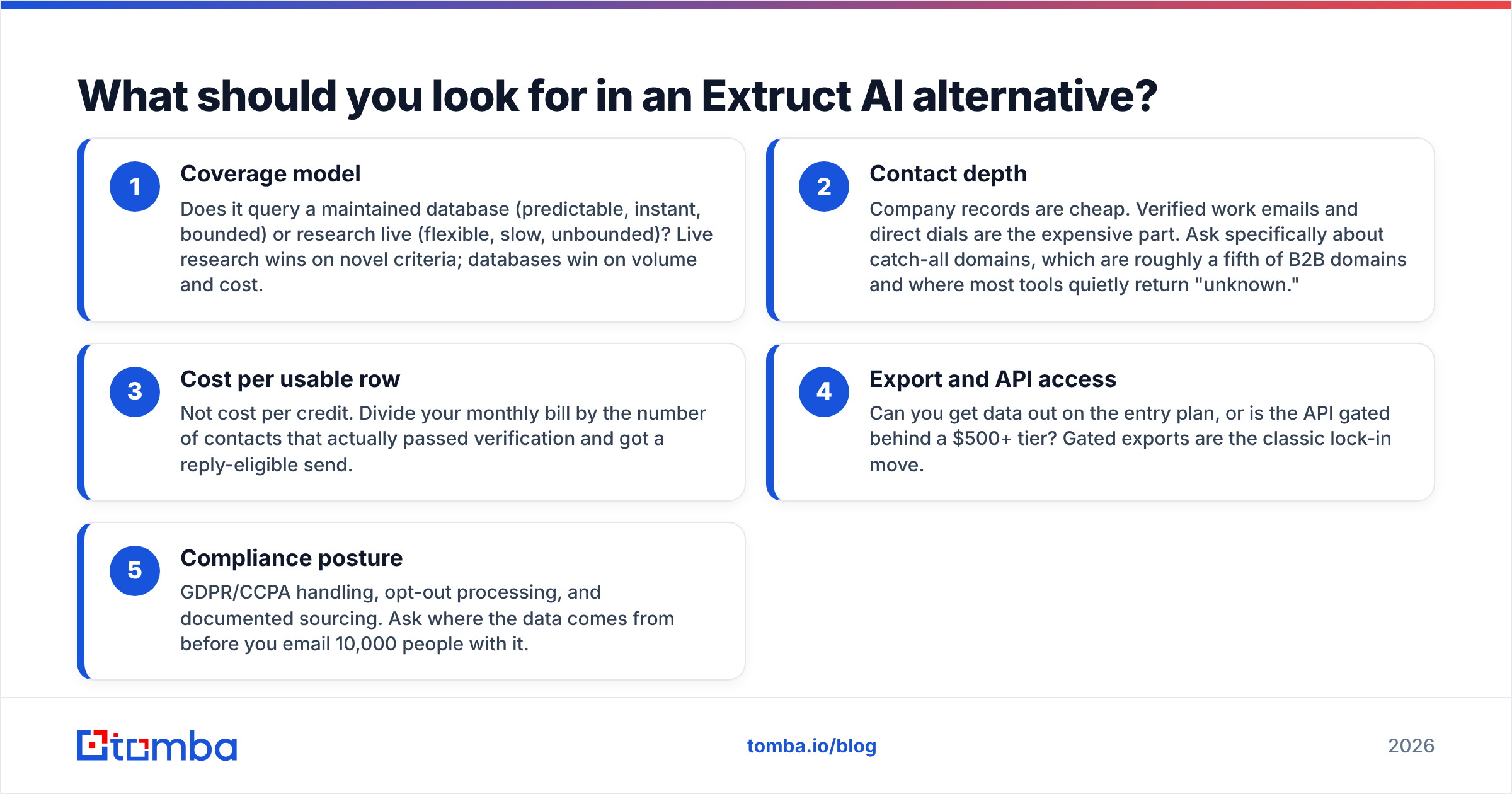
What should you look for in an Extruct AI alternative?#
Score every option on these five dimensions before you look at price:
- Coverage model — Does it query a maintained database (predictable, instant, bounded) or research live (flexible, slow, unbounded)? Live research wins on novel criteria; databases win on volume and cost.
- Contact depth — Company records are cheap. Verified work emails and direct dials are the expensive part. Ask specifically about catch-all domains, which are roughly a fifth of B2B domains and where most tools quietly return "unknown."
- Cost per usable row — Not cost per credit. Divide your monthly bill by the number of contacts that actually passed verification and got a reply-eligible send.
- Export and API access — Can you get data out on the entry plan, or is the API gated behind a $500+ tier? Gated exports are the classic lock-in move.
- Compliance posture — GDPR/CCPA handling, opt-out processing, and documented sourcing. Ask where the data comes from before you email 10,000 people with it.
Which Extruct AI alternatives are worth testing in 2026?#
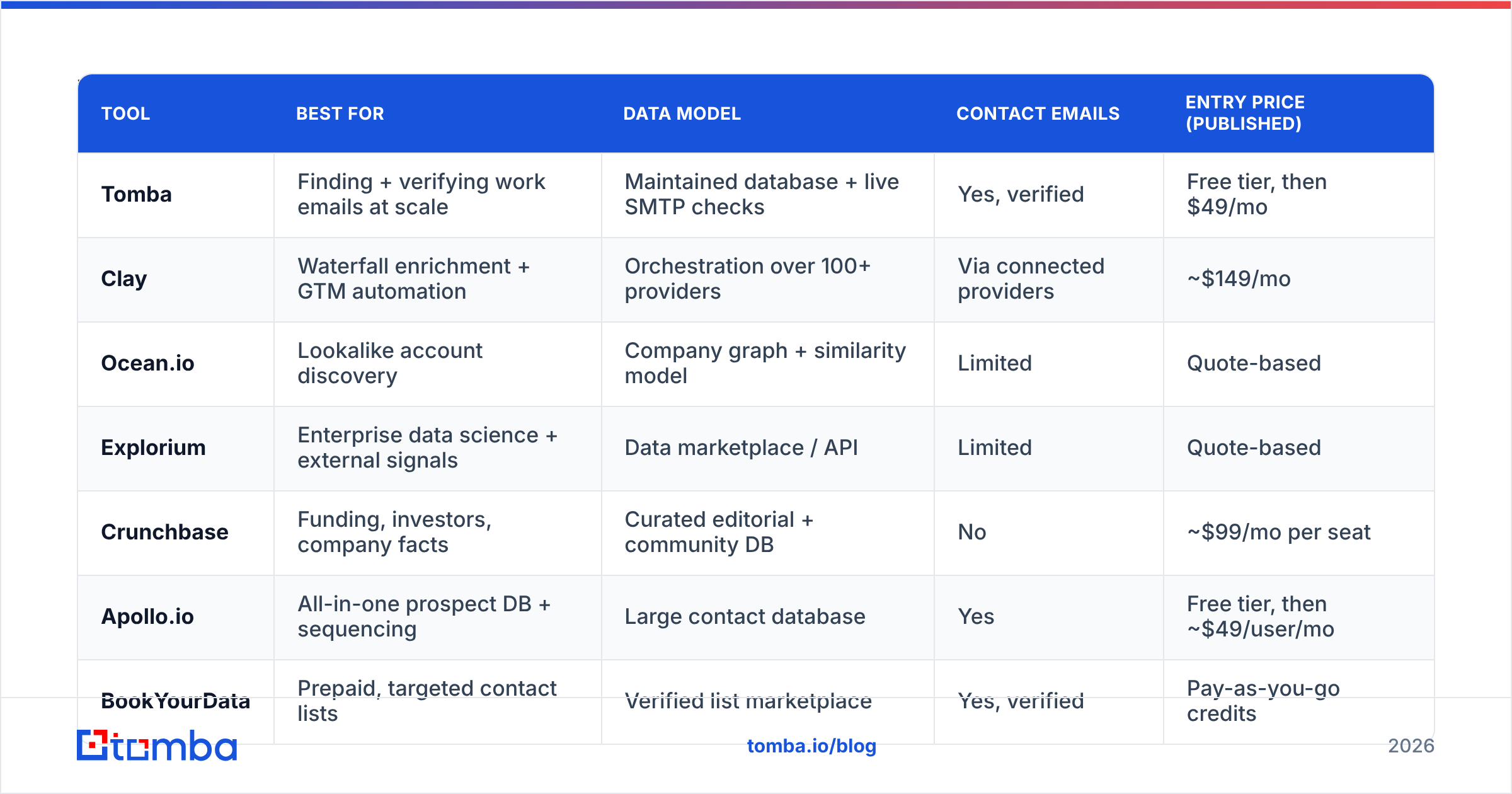
| Tool | Best for | Data model | Contact emails | Entry price (published) |
|---|---|---|---|---|
| Tomba | Finding + verifying work emails at scale | Maintained database + live SMTP checks | Yes, verified | Free tier, then $49/mo |
| Clay | Waterfall enrichment + GTM automation | Orchestration over 100+ providers | Via connected providers | ~$149/mo |
| Ocean.io | Lookalike account discovery | Company graph + similarity model | Limited | Quote-based |
| Explorium | Enterprise data science + external signals | Data marketplace / API | Limited | Quote-based |
| Crunchbase | Funding, investors, company facts | Curated editorial + community DB | No | ~$99/mo per seat |
| Apollo.io | All-in-one prospect DB + sequencing | Large contact database | Yes | Free tier, then ~$49/user/mo |
| BookYourData | Prepaid, targeted contact lists | Verified list marketplace | Yes, verified | Pay-as-you-go credits |
| Exa Websets | Semantic web search for company sets | Neural web index | No | Usage-based |
| HubSpot Breeze Intelligence | Enriching records already in your CRM | CRM-native enrichment credits | Partial | Credit packs on top of Hub |
Pricing was checked at publication and changes often — confirm on each vendor's own page before you commit.
Clay#
The closest philosophical match. Clay is an orchestration layer: you build a table, then chain providers in a waterfall so if provider A misses, B tries, then C. It also runs AI research columns like Extruct does. It is the most powerful option here and the one with the steepest learning curve — most teams need a Clay specialist or an agency to get value out of it. See Clay's own pricing for current tiers; credits move fast once waterfalls are live.
Choose it if: you have an ops person who will own it. Skip it if: you need results this week.
Tomba#
Tomba solves the half Extruct leaves open. Give it a company domain and it returns the people, the email pattern, and a confidence-scored, SMTP-verified address for each. The domain search endpoint takes the exact output of any account-research tool — a list of domains — and turns it into a contact list, which makes it a natural second layer rather than a competitor.
Pricing is flat and readable: free tier at 25 searches/mo, Starter $49/mo, Growth $99/mo, Pro $249/mo, Enterprise custom. The Tomba API is available from the entry paid plan, not gated behind enterprise, so you can script the handoff from research agent to contact layer on day one.
Choose it if: your list of target companies is already solid. Skip it if: you have not defined an ICP yet — no email finder fixes that.
Ocean.io#
Feed it 20 of your best customers and it returns companies that look like them, using website content and firmographic signals rather than SIC codes. Good at the "expand the list" problem, less good at "tell me 14 specific things about each one." Pricing is quote-based, which usually means annual commitment.
Explorium#

Aimed at data and RevOps teams that want external signals piped into a warehouse or model, not a UI to click around in. If your enrichment ends in Snowflake rather than a CSV, this is the serious option. Enterprise pricing and enterprise sales cycle.
Crunchbase#
Not an AI agent — a curated database with the best funding, investor, and acquisition data in the category. For "who raised a Series B in the last 90 days," Crunchbase beats any research agent on both accuracy and speed, because the data is maintained rather than inferred.
Apollo.io#
The all-in-one incumbent: contact database, filters, sequencing, and a Chrome extension in one subscription. Breadth is the selling point and also the tradeoff — accuracy on smaller and non-US companies is inconsistent, and export limits on lower tiers surprise people. If you want a deeper breakdown of where it fits, our Apollo alternative page covers it.
BookYourData#
A different, honest model: prepaid, targeted contact lists with verification applied before delivery and no subscription attached. If you need 3,000 verified contacts in a defined segment for one campaign and do not want another monthly seat, buying the list outright is often the cleaner answer. Credits do not expire, which makes it a good fit for teams with lumpy, campaign-driven demand rather than continuous volume.
Exa Websets#
Semantic search over a neural web index. Ask for "companies whose docs mention SOC 2 and Postgres" and it returns matching sites. It is the most raw and the most flexible — closer to infrastructure than product. Developers love it; non-technical AEs will not use it.
HubSpot Breeze Intelligence#
If most of your accounts already live in HubSpot, enriching in place beats exporting to a research tool and re-importing. Coverage is narrower than a dedicated provider, but the zero-integration-work factor is real.

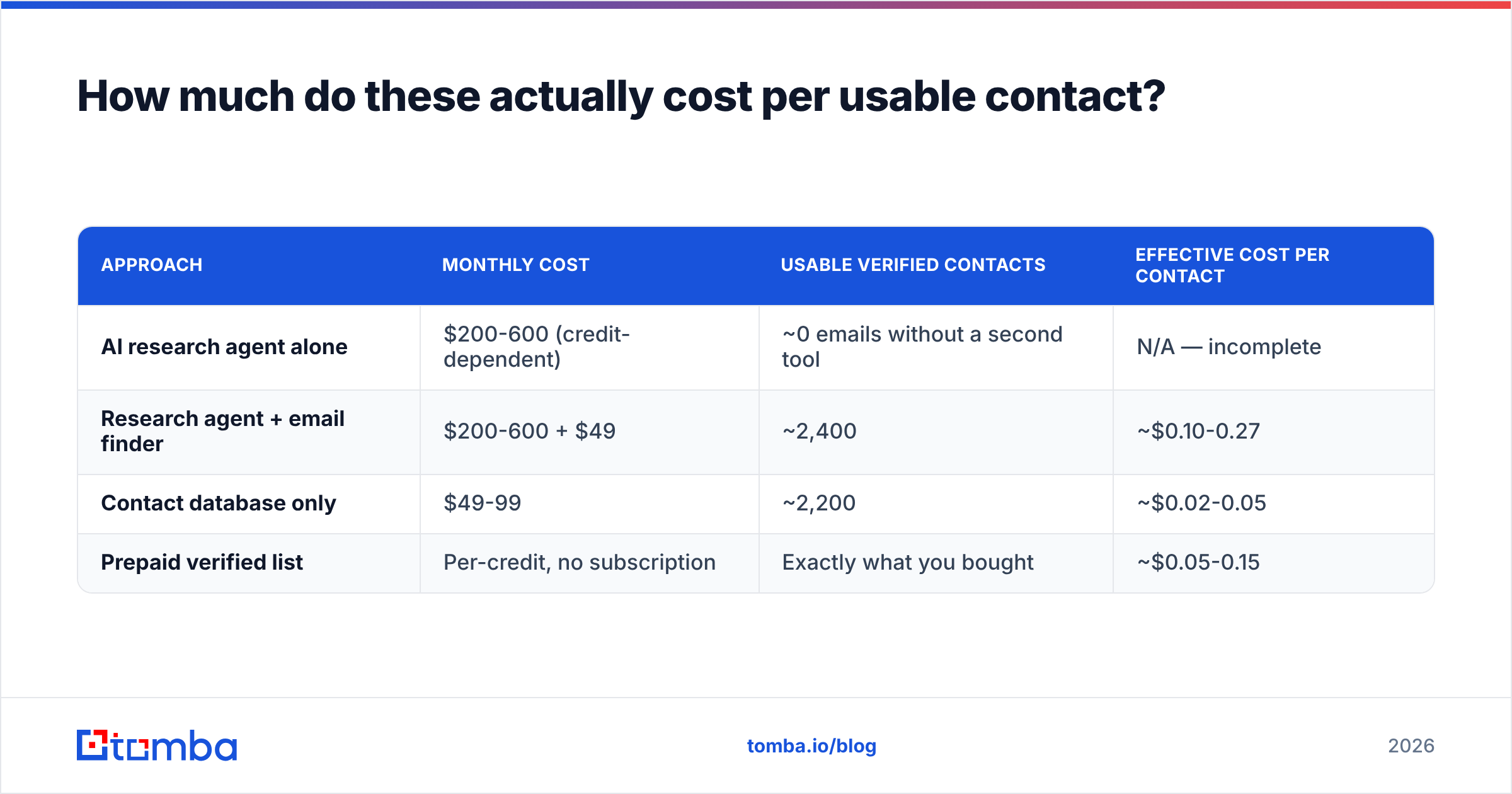
How much do these actually cost per usable contact?#
The sticker price is the wrong number. Here is the metric that matters, using a common scenario: 1,000 target companies, 3 contacts each, run monthly.
| Approach | Monthly cost | Usable verified contacts | Effective cost per contact |
|---|---|---|---|
| AI research agent alone | $200-600 (credit-dependent) | ~0 emails without a second tool | N/A — incomplete |
| Research agent + email finder | $200-600 + $49 | ~2,400 | ~$0.10-0.27 |
| Contact database only | $49-99 | ~2,200 | ~$0.02-0.05 |
| Prepaid verified list | Per-credit, no subscription | Exactly what you bought | ~$0.05-0.15 |
The pattern is consistent: the research layer is a targeting expense and the contact layer is a volume expense. Teams that overspend usually bought two targeting tools and no volume tool, or paid research-agent prices to do work a $49 plan does deterministically. Compare the current Tomba pricing tiers against your credit burn — the arithmetic usually decides the question faster than a feature matrix.
Is an AI research agent still worth keeping in 2026?#
Yes, for one job: qualifying accounts on criteria that do not exist as database fields. Keep it, but cap it. A practical setup that survives contact with a real quarter:
- Layer 1 — Discovery. Ocean.io, Exa, or Crunchbase to produce a domain list. Cheap, fast, broad.
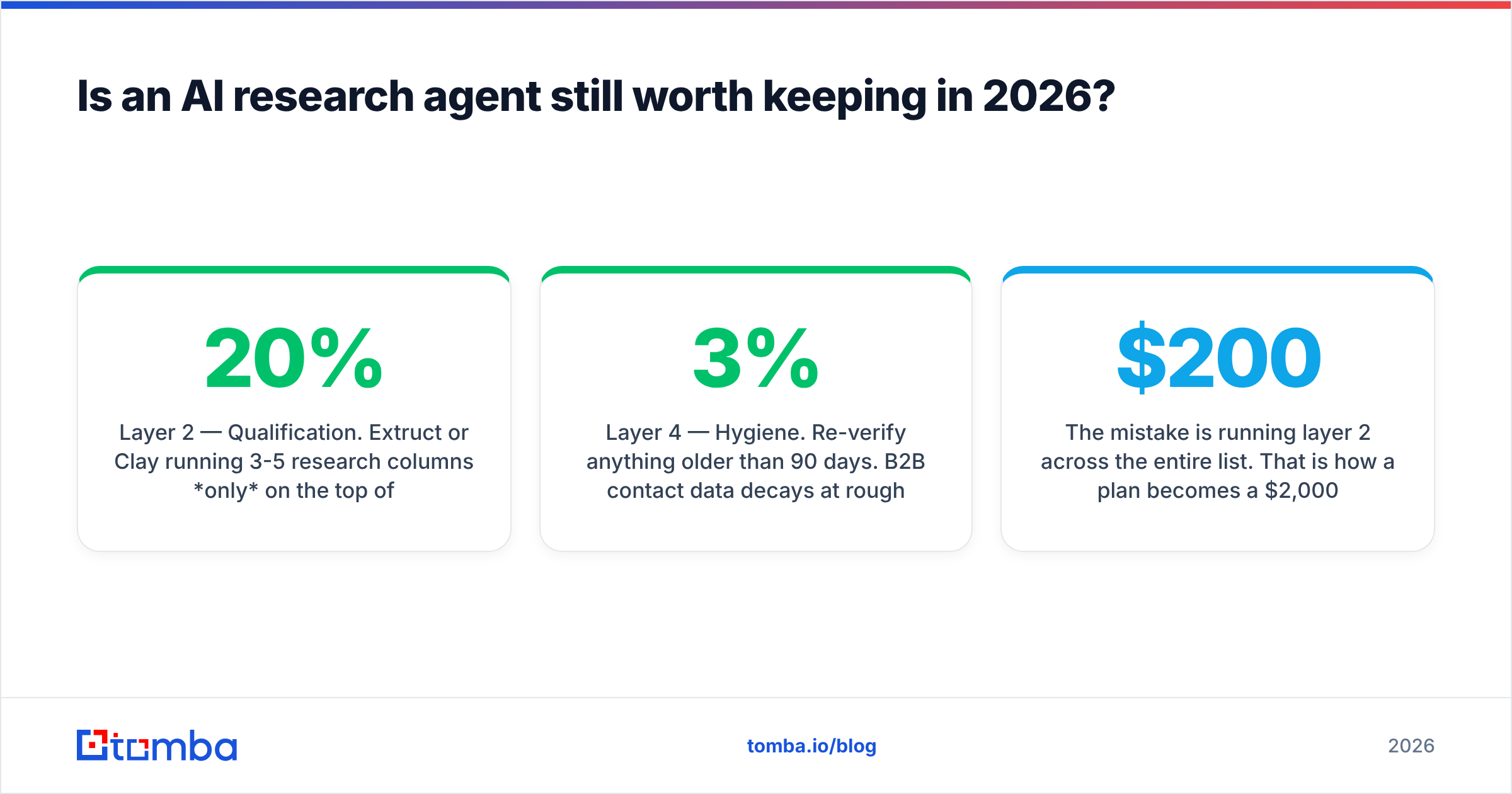
- Layer 2 — Qualification. Extruct or Clay running 3-5 research columns only on the top 20% of that list. Research is expensive; spend it on the accounts you would actually work.
- Layer 3 — Contact. Tomba's email finder over the qualified domains, with the email verifier as a mandatory gate before anything enters a sequence.
- Layer 4 — Hygiene. Re-verify anything older than 90 days. B2B contact data decays at roughly 2-3% per month through job changes alone.
The mistake is running layer 2 across the entire list. That is how a $200 plan becomes a $2,000 invoice.
How do you switch without losing your existing lists?#
Export before you cancel — this is the step people skip. Pull every table to CSV while your account is live, including the AI-generated columns, because those do not exist anywhere else once the subscription lapses.
Then dedupe on domain, not company name ("Acme Inc." and "Acme, Inc." are two rows and one company). Run the surviving domains through a contact layer, verify, and only then load into your CRM. Keep the original research columns as custom fields so you do not pay to regenerate the same qualitative data next quarter.
Run the new tool in parallel for two weeks on the same 100 accounts before you cut over. Compare match rate and bounce rate on identical inputs — vendor-published accuracy numbers are marketing, and your ICP is the only benchmark that matters.
Which Extruct AI alternative should you pick?#
- You need qualitative research at scale and have an ops owner → Clay.
- You need more companies like your best customers → Ocean.io.
- You need funding and investor facts → Crunchbase.
- You need signals in a warehouse → Explorium.
- You need one subscription that does everything adequately → Apollo.
- You need a defined list once, with no subscription → BookYourData.
- You need verified emails for companies you already identified → Tomba.
That last case is the most common one, and it is the cheapest to fix. If your research agent is already producing good target accounts and the gap is reachable people, start with the Tomba Email Finder — free tier for 25 searches to test match rate on your own domains, $49/mo when it works, and an API you can wire directly to whatever research layer you keep. Verify before you send, and let the expensive research tool do only the work no database can.
Related guides#
Ready to find emails that actually work?
Join 150,000+ professionals who stopped guessing and started sending. Free credits on signup — no credit card required.
Get the Tomba newsletter
Practical outbound tactics and product updates — once every two weeks.
About the author