Extruct AI vs Apollo.io: Which GTM Data Tool Wins in 2026?
One builds AI-researched company lists from scratch. The other ships a 200M+ contact database with a sequencer bolted on. Here is where each actually earns its money — and where both leave you cleaning up data.
Extruct AI vs Apollo.io is a fight between two different jobs. One picks the right companies. The other finds the people to email inside them. Buy the wrong one and you pay to solve a problem you don't have.
TL;DR
- Extruct AI is a company research engine, not a contact database. AI agents read the web and build your list with custom columns. Strong at "which accounts?", weak at "who do I email?"
- Apollo.io makes the opposite trade. A huge contact database, plus sequencing, dialing, and CRM sync. Broad reach, but you can only filter the way Apollo filters.
- They are not really rivals. Extruct sits upstream of Apollo. Many 2026 stacks run a research agent first, then a contact layer.
- Both share one weak spot: email accuracy. Apollo's data goes stale on SMB and non-US domains. Extruct owns no contact data at all. Verify before you send.
- Pick by your bottleneck. Can't define good accounts? Extruct. Can't reach them? Apollo, or a cheaper finder and verifier.
What is Extruct AI?#
Extruct AI is an AI company-research platform. You don't query a fixed database with fixed filters. You describe your ideal customer instead. Say, "Series A-to-C fintechs in the EU that mention SOC 2 and are hiring compliance staff." Research agents then read the open web and build a spreadsheet.
The output looks like a table. Each row is a company. Each column is a question you wrote in plain English. "Do they sell to enterprise?" "What CRM do they use?" "Did they raise money in the last 12 months?" The agent fills each cell with a value and a source link.
That's the real product. Not the list — the custom columns. A normal B2B database only knows what someone mapped in advance: headcount, industry code, tech tags, revenue band. An agent can answer questions nobody mapped, because a model reads the page and decides.
Flexibility costs speed and money. Reading 500 websites with an LLM is slower and pricier than a SQL filter over a static table. It is research, and research is priced like research.
What is Apollo.io?#
Apollo.io is an all-in-one sales intelligence and outreach platform. It bundles:
- A contact and company database (Apollo markets it in the 200M+ contacts / 60M+ companies range)
- Search filters — title, seniority, headcount, tech stack, intent signals, funding
- A Chrome extension for LinkedIn prospecting
- Email sequencing, a dialer, meeting scheduling
- CRM sync with Salesforce and HubSpot
- Basic enrichment and data hygiene jobs
Apollo's pitch is consolidation. One seat replaces a data vendor, a sequencer, and a dialer. For a five-person SDR team that is a real win. It also explains why Apollo ranks near the top of most G2 sales intelligence grids.
The catch: you inherit Apollo's view of the world. If your criterion is not a filter in the UI, you cannot build the list. And like every large crowd-sourced database, Apollo is strongest on US tech firms with 50+ staff. It is weakest everywhere else.

Extruct AI vs Apollo.io: how do they differ?#
Here is the honest side-by-side. Treat pricing as directional. Both vendors change plans, and per-seat models are hard to compare with credits.
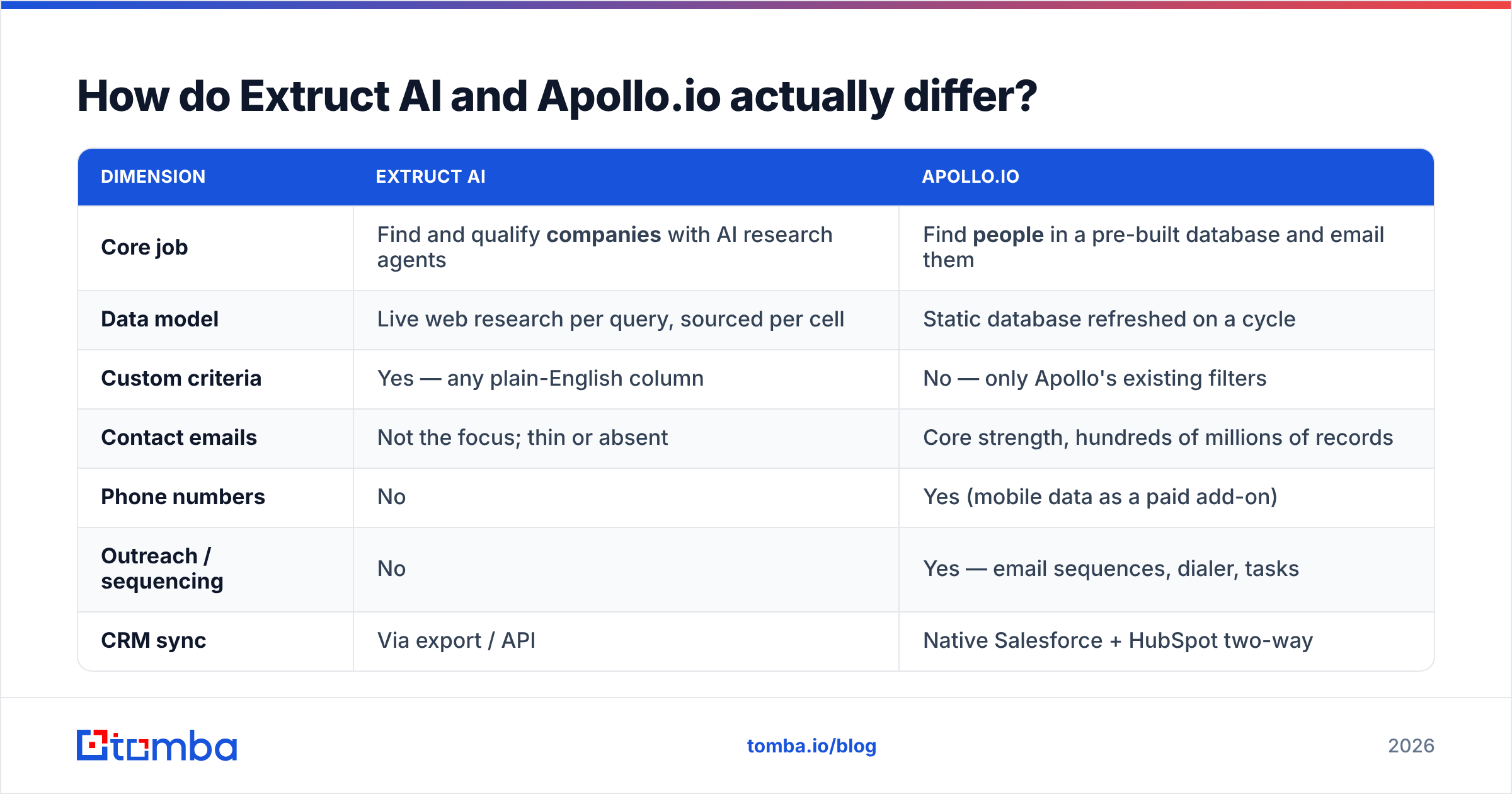
| Dimension | Extruct AI | Apollo.io |
|---|---|---|
| Core job | Find and qualify companies with AI research agents | Find people in a pre-built database and email them |
| Data model | Live web research per query, sourced per cell | Static database refreshed on a cycle |
| Custom criteria | Yes — any plain-English column | No — only Apollo's existing filters |
| Contact emails | Not the focus; thin or absent | Core strength, hundreds of millions of records |
| Phone numbers | No | Yes (mobile data as a paid add-on) |
| Outreach / sequencing | No | Yes — email sequences, dialer, tasks |
| CRM sync | Via export / API | Native Salesforce + HubSpot two-way |
| Speed per 1,000 rows | Minutes to hours (agents read pages) | Seconds (query returns instantly) |
| Pricing model | Credit / usage-based, quote-driven | Per seat, per month — free tier plus paid tiers |
| Typical entry cost | Trial credits, then paid workspace plans | Free plan; paid tiers commonly ~$49–$119/user/mo annually |
| Best for | ICP definition, account research, market mapping | Volume outbound, SDR teams, one-tool stacks |
| Weakest at | Contact-level coverage, outreach execution | Non-obvious qualification, non-US/SMB email accuracy |
Check both pricing pages before you budget. Apollo has repriced tiers more than once. Extruct quotes by workspace instead of a simple per-seat number.
Which tool builds a better target account list?#
Extruct, and it is not close — if your ICP depends on something no database stores.
Think about how each one fails. Say you want "manufacturers that recently opened a second facility." In Apollo you approximate it: SIC code, headcount growth, maybe a location count. You get 4,000 rows. Maybe 400 are right. Your SDRs burn a week finding that out. In Extruct you write the criterion as a column. The agent reads press releases and site footers. You get 320 rows, each with a source link.
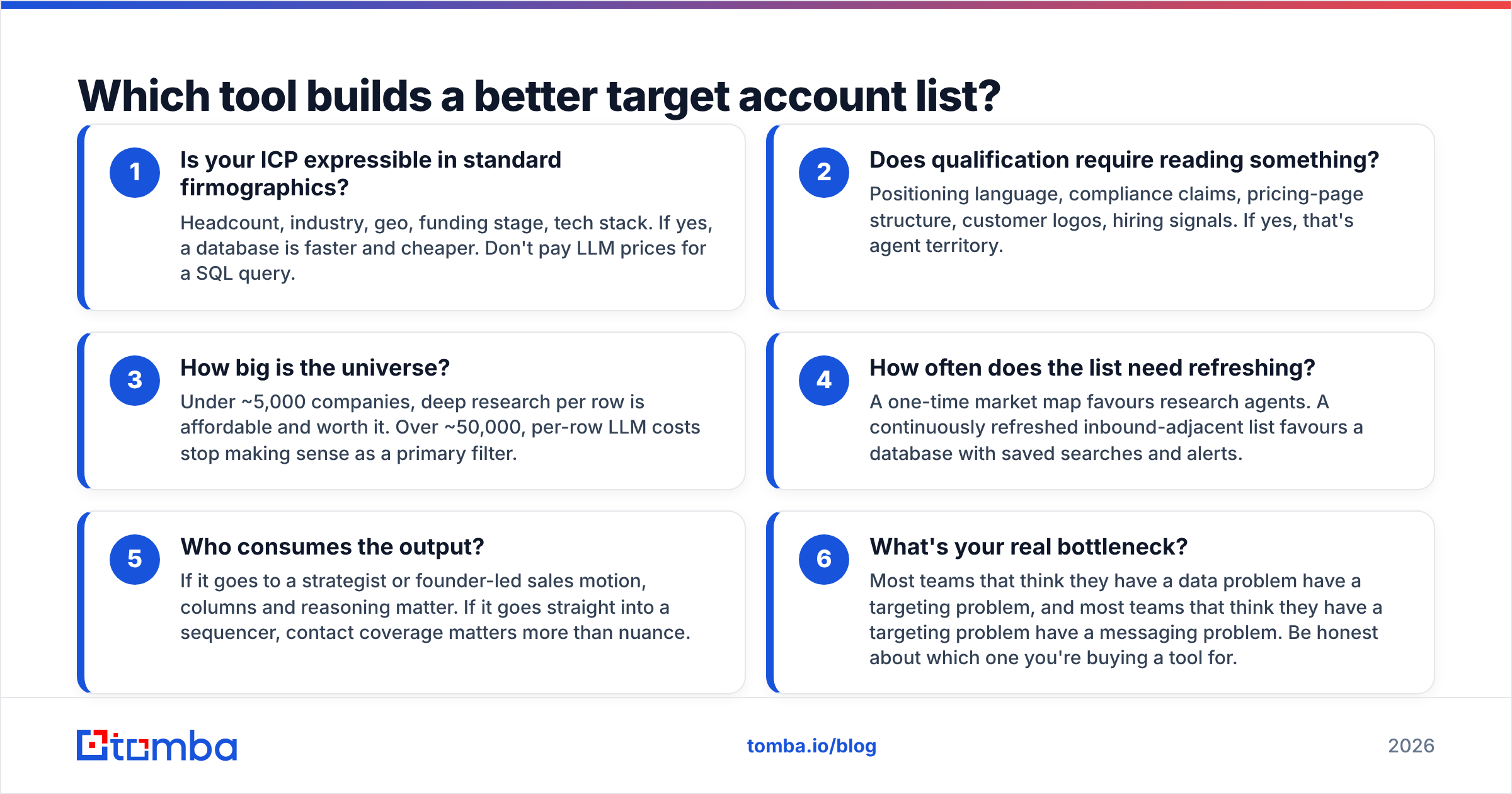
Here is how to tell which side of the line you are on:
- Is your ICP standard firmographics? Headcount, industry, geo, funding stage, tech stack. If yes, a database is faster and cheaper.
- Does qualifying require reading? Positioning, compliance claims, pricing pages, customer logos, job posts. If yes, that is agent work.
- How big is the universe? Under 5,000 companies, deep research per row pays off. Over 50,000, it does not.
- How often must the list refresh? A one-time market map favours agents. A living list favours saved searches and alerts.
- Who reads the output? Founders and strategists want columns and reasons. A sequencer just wants contacts.
- What is the real bottleneck? Many data problems are targeting problems. Many targeting problems are messaging problems.
Which one gives you contacts you can actually email?#
Apollo, by default — with a big asterisk.
Apollo's database is genuinely broad. Sell to VPs of Engineering at US SaaS firms with 200–2,000 staff and coverage feels close to complete. Most emails land. That is the segment the database grew up around, and where most of its reviews come from.
Move away from that centre and the numbers drop fast. European SMBs, agencies, manufacturers, healthcare practices, anyone under 50 staff. Add any contact who changed jobs in the last eight months. Crowd-sourced records decay there. They don't vanish when they go stale. They just turn into bounces.
Extruct does not fix this, because it never set out to. Company research gives you the account, and often the right person by name and title. Turning "Head of RevOps, Maria Kaufmann, Acme GmbH" into a working inbox is a different problem. It needs pattern detection on the domain, SMTP checks, and catch-all handling.
That is where a dedicated tool fits. A domain search pass returns the email patterns a company actually uses. An independent email verifier pass tells you which addresses accept mail — before you burn domain reputation finding out.

Extruct AI vs Apollo.io: what does each cost in 2026?#
The two models differ enough that "which is cheaper" depends on your team shape.
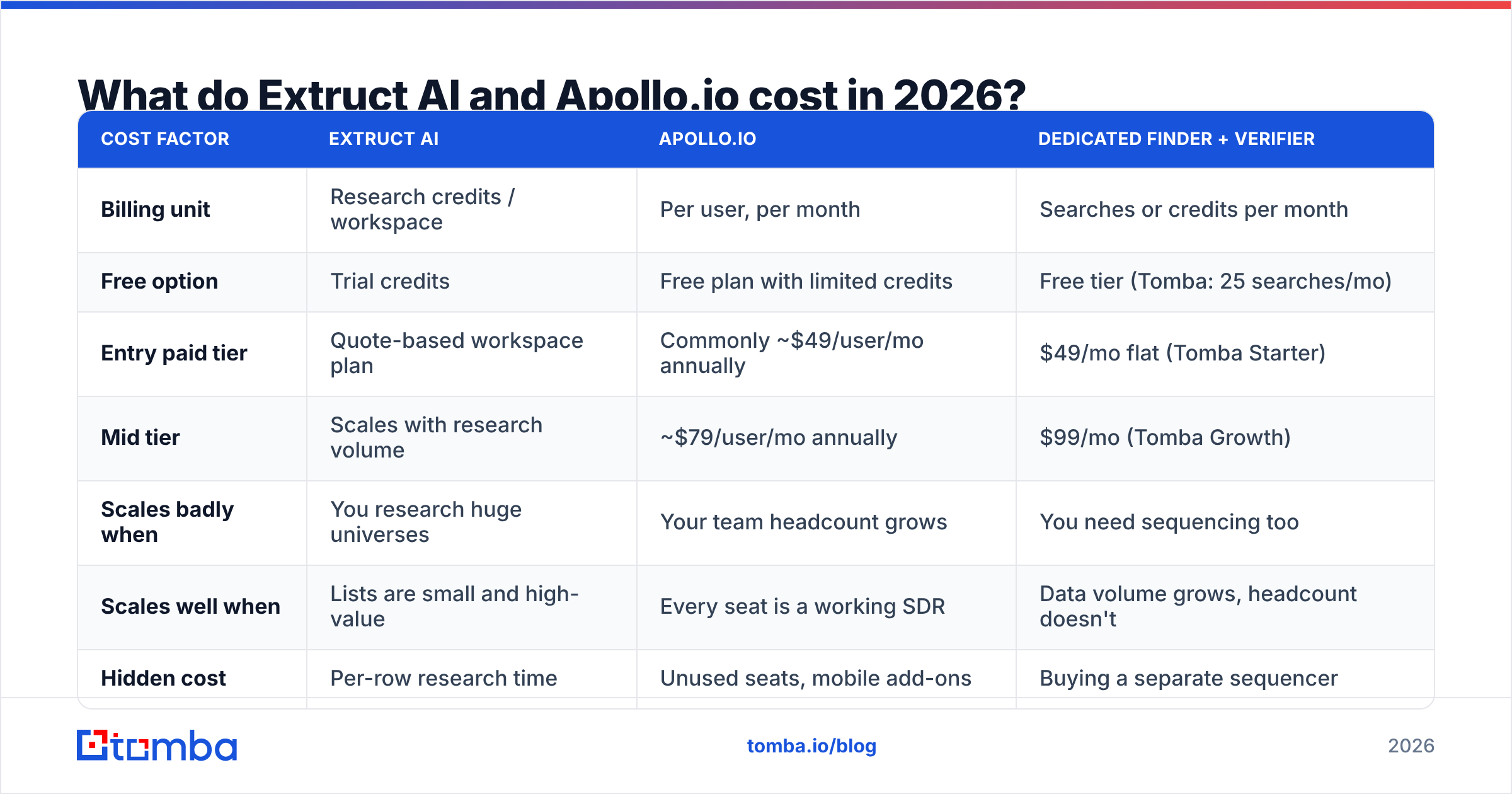
| Cost factor | Extruct AI | Apollo.io | Dedicated finder + verifier |
|---|---|---|---|
| Billing unit | Research credits / workspace | Per user, per month | Searches or credits per month |
| Free option | Trial credits | Free plan with limited credits | Free tier (Tomba: 25 searches/mo) |
| Entry paid tier | Quote-based workspace plan | Commonly ~$49/user/mo annually | $49/mo flat (Tomba Starter) |
| Mid tier | Scales with research volume | ~$79/user/mo annually | $99/mo (Tomba Growth) |
| Scales badly when | You research huge universes | Your team headcount grows | You need sequencing too |
| Scales well when | Lists are small and high-value | Every seat is a working SDR | Data volume grows, headcount doesn't |
| Hidden cost | Per-row research time | Unused seats, mobile add-ons | Buying a separate sequencer |
Three practical notes on budgeting:
Apollo's per-seat model punishes light users. Marketers, founders, and ops people still cost a full seat. Say four people prospect daily and six need data monthly. You overpay by roughly 60%.
Extruct's usage model punishes exploration. Every row costs research. So iterating on your ICP — run it, dislike it, rewrite it, run again — costs money each cycle. Budget for three passes before your first usable list.
Credit-based tools scale with volume, not headcount. That is why teams split the stack: a research layer, a data and verification layer priced by volume, and a cheap sequencer. Tomba's pricing sits in that middle layer. Free at 25 searches/mo, Starter at $49/mo, Growth at $99/mo, Pro at $249/mo. No per-seat tax on the analyst who logs in twice a week.
Can you use Extruct AI and Apollo.io together?#
Yes. For teams over about 10 people, this is the pattern that works.
A realistic 2026 pipeline runs in four stages.
Stage 1 — Define. Extruct turns your ICP guess into 300–2,000 companies with qualification columns attached. You now know why each account made the list. That matters more than most people admit. It is the raw material for your first line.
Stage 2 — Populate. Find the right people at each account. Apollo covers its core segment well. Outside it, an email finder with domain-level pattern detection often recovers contacts a static database missed. An API call slots this into the pipeline with no UI at all.
Stage 3 — Verify. Never skip this, whatever the source. Run the merged list through verification. Drop hard bounces. Route catch-all domains to a small separate sequence instead of treating them as valid. Google and Microsoft both tightened bulk-sender rules in the last two years. A spike in invalid recipients is one of the fastest ways to wreck your sender reputation.
Stage 4 — Send. Apollo's sequencer, Instantly, Smartlead, whatever you already pay for. The tool matters far less than steps 1 to 3.
Teams get burned when they treat one vendor as all four stages. Apollo's enrichment cannot rescue bad targeting. Extruct's research columns are worthless if 30% of your emails bounce.
Where does each tool genuinely fall short?#
Extruct AI's limits:
- No contact database, so you still need a data layer downstream
- No outreach, so it feeds your stack rather than being it
- Research takes time, so it is wrong for live lookups on a call
- LLM-written cells need spot checks; a source link is not proof
- Cost grows with the size of the universe you search
Apollo.io's limits:
- Contact accuracy drops outside US mid-market tech
- Filters cannot express odd qualification logic
- Per-seat pricing hurts when users are occasional
- Bundled sequencing is fine, not great; heavy senders move on
- Credit caps on low tiers bite sooner than the marketing suggests
If Apollo's data quality is your complaint, compare dedicated options before you renew. We keep a breakdown of Apollo alternatives sorted by what you want to replace: data, sequencing, or both. Replacing the whole platform is rarely needed.
Which should you choose?#
Choose Extruct AI if your ICP needs judgment, your deals justify per-account research, your list runs to hundreds rather than tens of thousands, and you already have a way to get contacts and send mail.
Choose Apollo.io if you run volume outbound, your ICP fits standard filters, you want data and sequencing on one bill, and your market sits inside Apollo's sweet spot.
Choose neither as your data layer if you mainly need accurate addresses at a predictable price. That is a narrower problem, and narrower tools solve it better and cheaper. A finder with real domain-pattern logic plus SMTP verification beats a bundled enrichment feature on accuracy and on cost per usable contact.
Here is the strategic read on Extruct AI vs Apollo.io. Extruct answers "who should we sell to." Apollo answers "how do we reach them at scale." A verification layer answers "will this email arrive." Three different questions. Buying one tool and expecting all three answers is how teams end up with a 40% bounce rate and a blocked domain.
Ready to fix the part both tools leave broken?#
Whichever platform builds your account list, the addresses still have to be real. Tomba's Email Finder detects the pattern each domain uses. It returns a confidence score with sources, and pairs with SMTP verification, so you know what is deliverable before you send. Start free with 25 searches a month. Or run your Extruct or Apollo export through bulk find and verify at $49/mo on Starter. No per-seat tax, and no credits expiring on the analyst who only logs in on Tuesdays.
Related guides#
Ready to find emails that actually work?
Join 150,000+ professionals who stopped guessing and started sending. Free credits on signup — no credit card required.
Get the Tomba newsletter
Practical outbound tactics and product updates — once every two weeks.
About the author