FAB Framework in Sales: Turn Features Into Real Benefits
The FAB framework converts product specs into reasons a buyer actually cares. Here's the formula, the failure modes, side-by-side comparisons with AIDA and SPIN, and copy-paste examples for cold email and discovery calls.
TL;DR
- The FAB framework is a three-part messaging structure: Feature (what it is) → Advantage (what it does) → Benefit (why the buyer cares). Only the last part sells.
- Most reps stop at Advantage. That gap is why "AI-powered, real-time, enterprise-grade" pitches get ignored.
- FAB is a translation tool, not a full sales methodology. Pair it with SPIN or MEDDIC for discovery, and use FAB when it's time to speak.
- The benefit half only works if it's specific to a segment. "Save time" is not a benefit; "cut list-building from 6 hours to 40 minutes per week" is.
- FAB works best in cold email, one-pagers, demo narration, and objection handling — and worst in long enterprise deals where you haven't diagnosed the problem yet.
What is the FAB framework?#
The FAB framework is a sales and copywriting structure that forces you to connect a product detail to a customer outcome in a single breath. FAB stands for Features, Advantages, Benefits.
Think of it like a restaurant menu. "Dry-aged 45 days" is a feature. "More concentrated flavor and a tender texture" is the advantage. "You get a steakhouse dinner at home without booking a table" is the benefit — the only part that makes someone order. Technically, FAB is a mapping exercise: you take an attribute of your product, derive its functional consequence, then tie that consequence to a goal or pain the buyer already has.
Here's the anatomy:
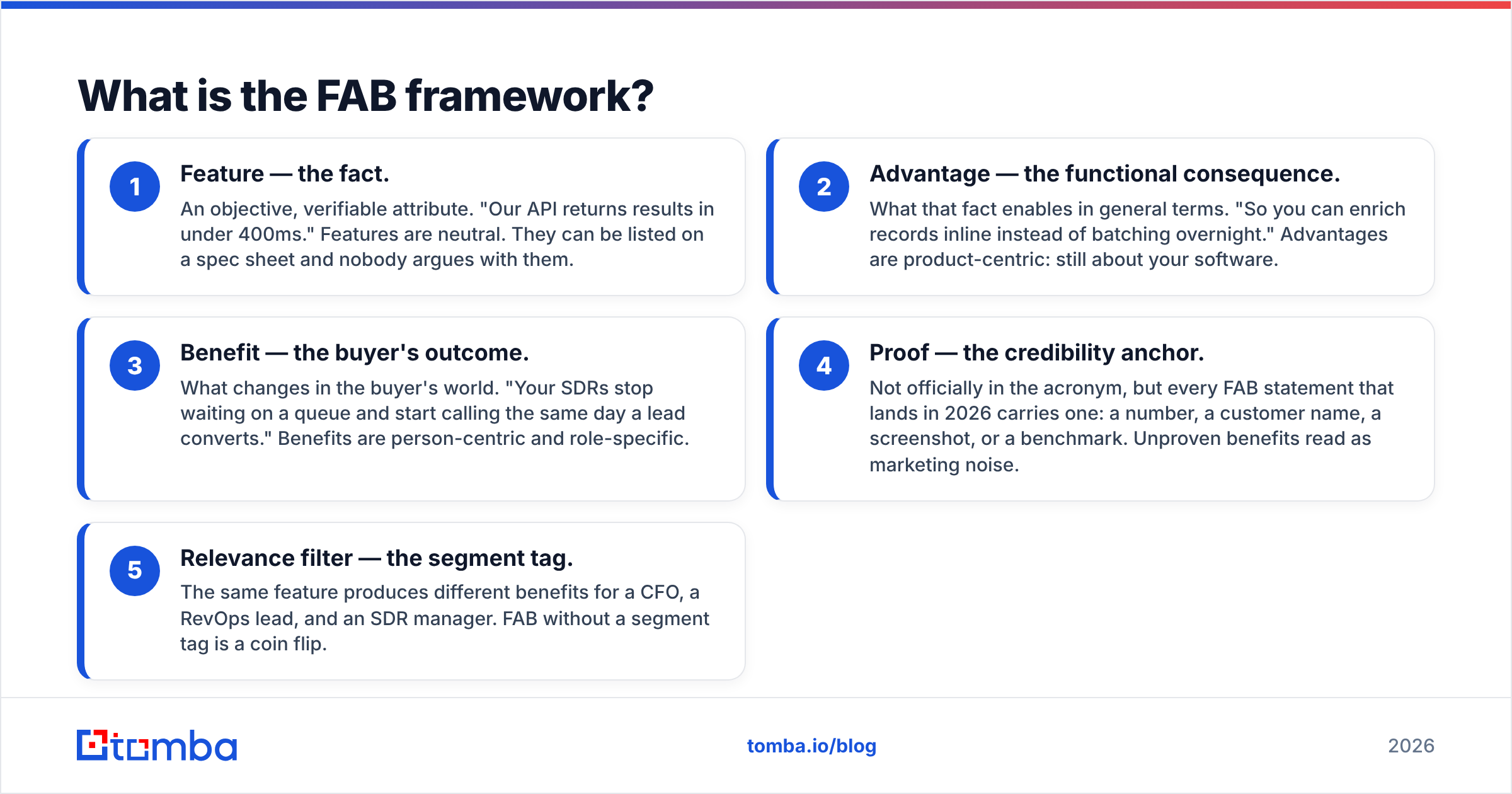
- Feature — the fact. An objective, verifiable attribute. "Our API returns results in under 400ms." Features are neutral. They can be listed on a spec sheet and nobody argues with them.
- Advantage — the functional consequence. What that fact enables in general terms. "So you can enrich records inline instead of batching overnight." Advantages are product-centric: still about your software.
- Benefit — the buyer's outcome. What changes in the buyer's world. "Your SDRs stop waiting on a queue and start calling the same day a lead converts." Benefits are person-centric and role-specific.
- Proof — the credibility anchor. Not officially in the acronym, but every FAB statement that lands in 2026 carries one: a number, a customer name, a screenshot, or a benchmark. Unproven benefits read as marketing noise.
- Relevance filter — the segment tag. The same feature produces different benefits for a CFO, a RevOps lead, and an SDR manager. FAB without a segment tag is a coin flip.
The reason FAB survives decade after decade is simple: buyers do not buy features, and they do not have the patience to translate specs into consequences on your behalf. Gartner's B2B buying research has documented for years that buying groups spend the majority of their time not talking to vendors — which means whatever they read from you has to be self-explanatory. FAB is the cheapest way to make it self-explanatory.
Why do most FAB statements fail?#
Because reps write two-thirds of the sentence and stop.
Look at the pattern in almost any cold email you've received this quarter: "We use AI to enrich contact data at 98% accuracy so you can build lists faster." That's Feature + Advantage. It ends where the buyer's interest begins. Faster than what? Faster for whom? What does the person reading it get to stop doing?
The four failure modes I see most often when auditing outbound copy:
- Advantage cosplay. "Saves time," "increases efficiency," "streamlines workflows." These sound like benefits but describe no measurable change. If it could apply to a project management tool, a CRM, and an office chair, it's not a benefit.
- Wrong-persona benefit. Pitching cost-per-record savings to an SDR who doesn't own the budget, or pitching daily UX improvements to a VP who never logs in.
- Unearned specificity. Inventing "3x more meetings" without a case study behind it. One skeptical prospect asking "based on what?" collapses the entire message.
- Feature dumping in disguise. Listing six FAB statements in one email. Three benefits compete; one benefit converts.
Actually, let me correct that markdown — the image goes here:

The fix is mechanical. Write the feature, then ask "so what?" three times. The first answer is usually the advantage. The second is a generic benefit. The third is the one worth sending.
How do you write a FAB statement step by step?#
Use a four-column worksheet. Fill it in for your five most-mentioned features and you'll have a messaging library your whole team can pull from.
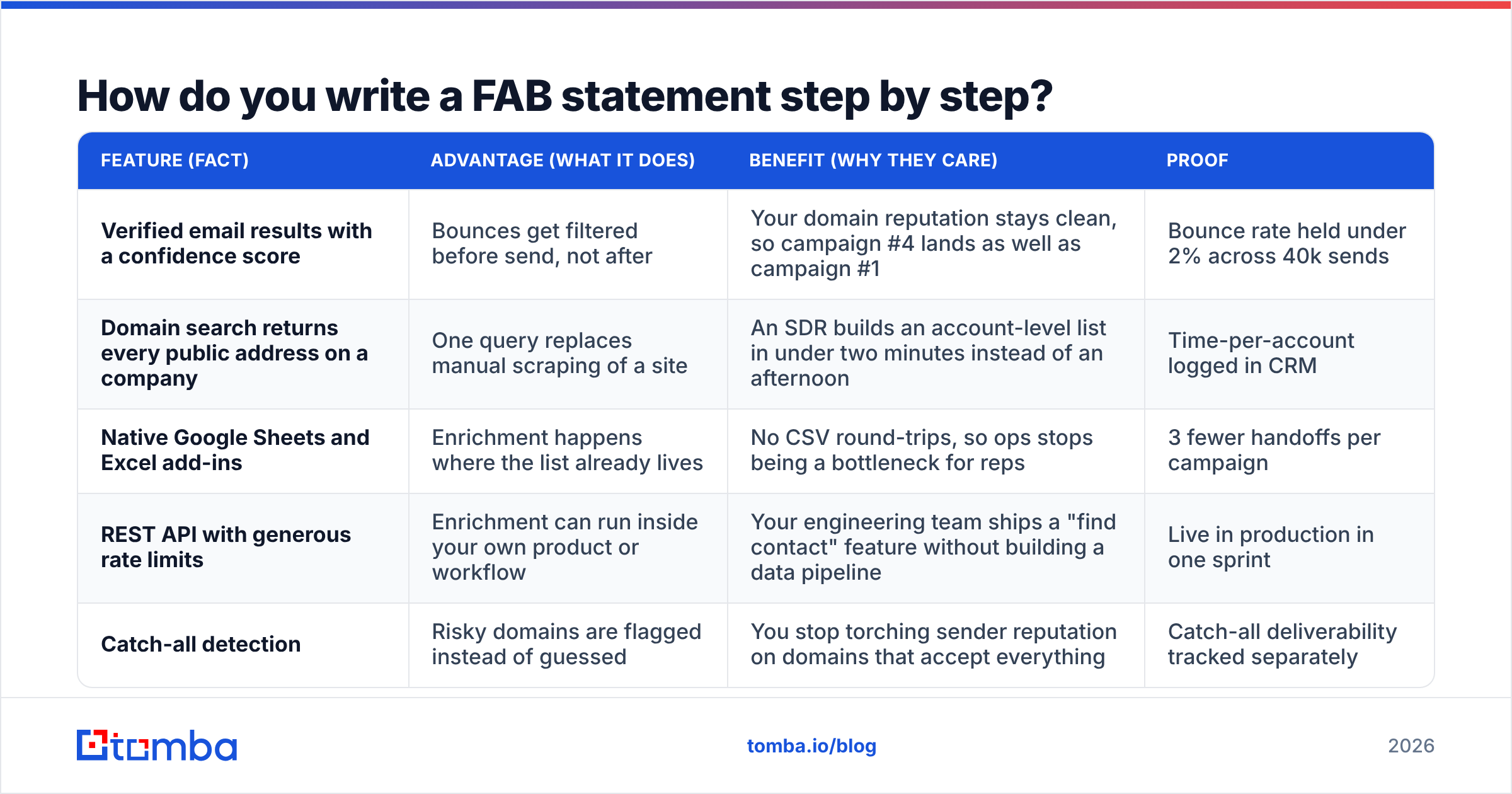
| Feature (fact) | Advantage (what it does) | Benefit (why they care) | Proof |
|---|---|---|---|
| Verified email results with a confidence score | Bounces get filtered before send, not after | Your domain reputation stays clean, so campaign #4 lands as well as campaign #1 | Bounce rate held under 2% across 40k sends |
| Domain search returns every public address on a company | One query replaces manual scraping of a site | An SDR builds an account-level list in under two minutes instead of an afternoon | Time-per-account logged in CRM |
| Native Google Sheets and Excel add-ins | Enrichment happens where the list already lives | No CSV round-trips, so ops stops being a bottleneck for reps | 3 fewer handoffs per campaign |
| REST API with generous rate limits | Enrichment can run inside your own product or workflow | Your engineering team ships a "find contact" feature without building a data pipeline | Live in production in one sprint |
| Catch-all detection | Risky domains are flagged instead of guessed | You stop torching sender reputation on domains that accept everything | Catch-all deliverability tracked separately |
Two notes on using this table in practice. First, benefits should be written in second person — "you," "your team" — because that's how buyers read. Second, the proof column is non-negotiable; if you can't fill it, the row is a hypothesis and should be tested before it enters a sequence.
If you want a working example of the sequencing, email templates that convert almost always front-load one benefit and demote every feature to a single supporting clause.
Is the FAB framework better than AIDA, SPIN, or PAS?#
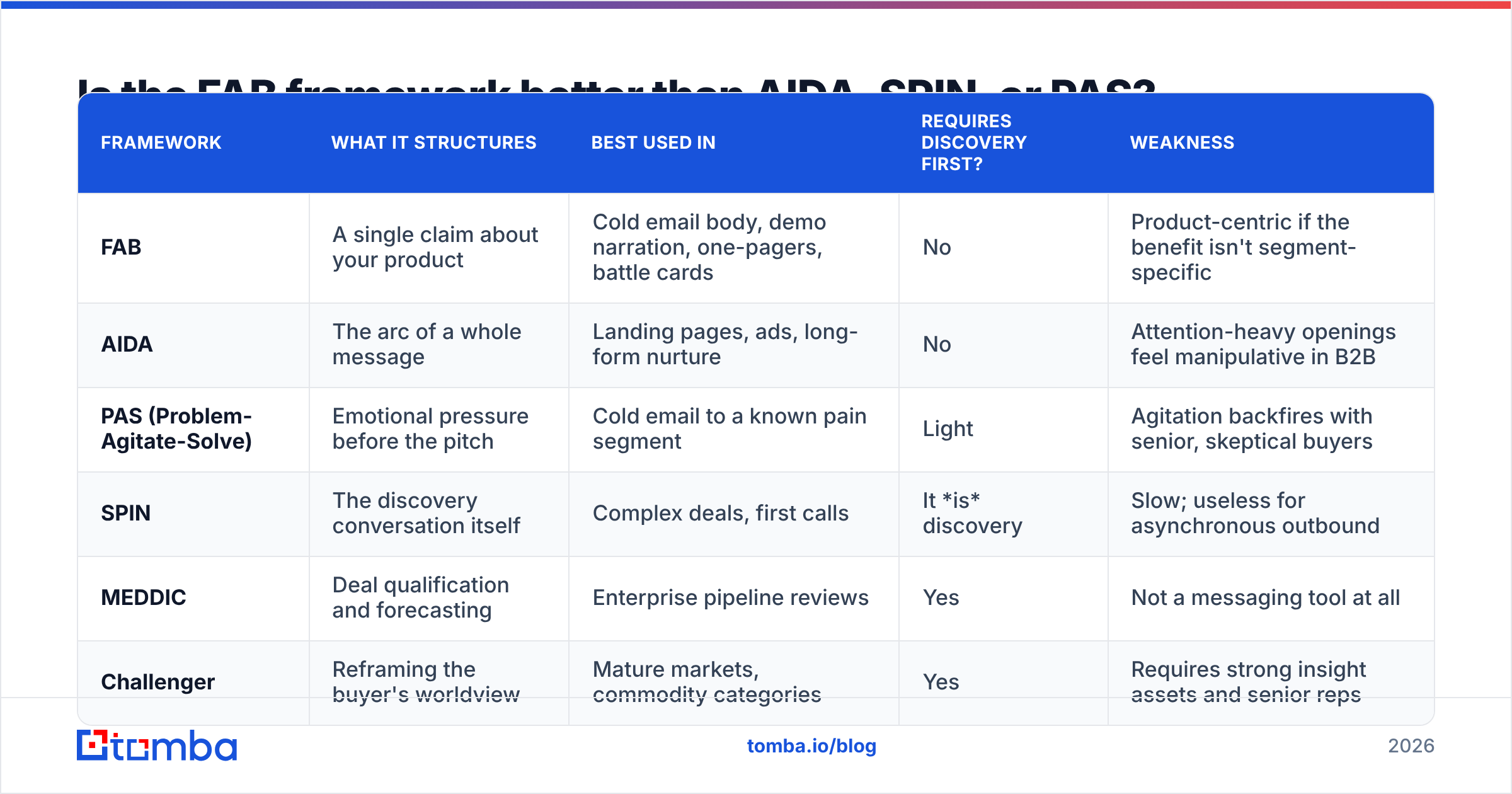
They solve different problems, and the most common mistake is treating them as competitors. FAB is a sentence-level framework. AIDA and PAS are message-level. SPIN and MEDDIC are conversation-level.
| Framework | What it structures | Best used in | Requires discovery first? | Weakness |
|---|---|---|---|---|
| FAB | A single claim about your product | Cold email body, demo narration, one-pagers, battle cards | No | Product-centric if the benefit isn't segment-specific |
| AIDA | The arc of a whole message | Landing pages, ads, long-form nurture | No | Attention-heavy openings feel manipulative in B2B |
| PAS (Problem-Agitate-Solve) | Emotional pressure before the pitch | Cold email to a known pain segment | Light | Agitation backfires with senior, skeptical buyers |
| SPIN | The discovery conversation itself | Complex deals, first calls | It is discovery | Slow; useless for asynchronous outbound |
| MEDDIC | Deal qualification and forecasting | Enterprise pipeline reviews | Yes | Not a messaging tool at all |
| Challenger | Reframing the buyer's worldview | Mature markets, commodity categories | Yes | Requires strong insight assets and senior reps |
The practical stack most teams land on: SPIN or Challenger to run the conversation, MEDDIC to qualify the deal, and FAB to write every sentence that goes into email, decks, and follow-ups. FAB is the layer that produces words. HubSpot's sales resources and Salesforce's sales guides both teach roughly this split, though they use different labels.
What does FAB look like in a cold email?#
Here's a 68-word cold email built on one FAB statement, one proof point, and one ask.
Subject: 6 hours of list building per week
Hi Dana — your team posted three SDR roles this month, which usually means list building is eating ramp time.
Most teams we work with were spending ~6 hours a week pulling contacts by hand. Running domain-level lookups against their target accounts cut that to about 40 minutes, because the verification happens before export instead of after the bounces come back.
Worth a 12-minute look at your account list?
Break it down:
- Feature: domain-level lookup with verification before export.
- Advantage: verification happens pre-send, not post-bounce.
- Benefit: six hours a week back, and new reps ramp on calls instead of spreadsheets.
- Proof: the before/after time figure, framed as observed rather than promised.
Notice what's missing: no adjective stack, no "AI-powered," no feature list. One claim, one number, one question.
The same structure works on calls. When a prospect asks "what does it actually do?", the untrained answer is a feature list. The FAB answer is: "It finds and verifies work emails for a company in one query — which means your reps aren't guessing formats — so the list you hand them on Monday still works on Thursday." Feature, advantage, benefit, in twenty seconds.
When should you not use the FAB framework?#
Three situations where FAB actively hurts you.
1. Before you know the buyer's problem. FAB assumes you already know which outcome matters. If you're on a first call with an unfamiliar segment, leading with benefits is guessing out loud. Run discovery, then FAB.
2. In a category where everyone claims the same benefit. If nine competitors all say "more meetings booked," your benefit statement is wallpaper. In commoditized categories, the differentiator moves back to how — the mechanism — which means a sharper feature statement plus proof outperforms a generic benefit.
3. With technical evaluators. Engineers, security reviewers, and data teams often want the feature straight, with specs. Benefit-wrapping a rate limit annoys them. Give them documentation like the Tomba API reference and let the buying champion handle the benefit translation internally.
There's also a data problem hiding under all of this. A perfect FAB statement sent to a stale, unverified list still produces nothing. Messaging quality and list quality multiply — they don't add. Before you spend a week rewriting sequences, run your list through an email verifier and check what percentage is even deliverable. Teams frequently discover their "messaging problem" was a 30% bounce rate.
How do you audit your existing messaging with FAB?#
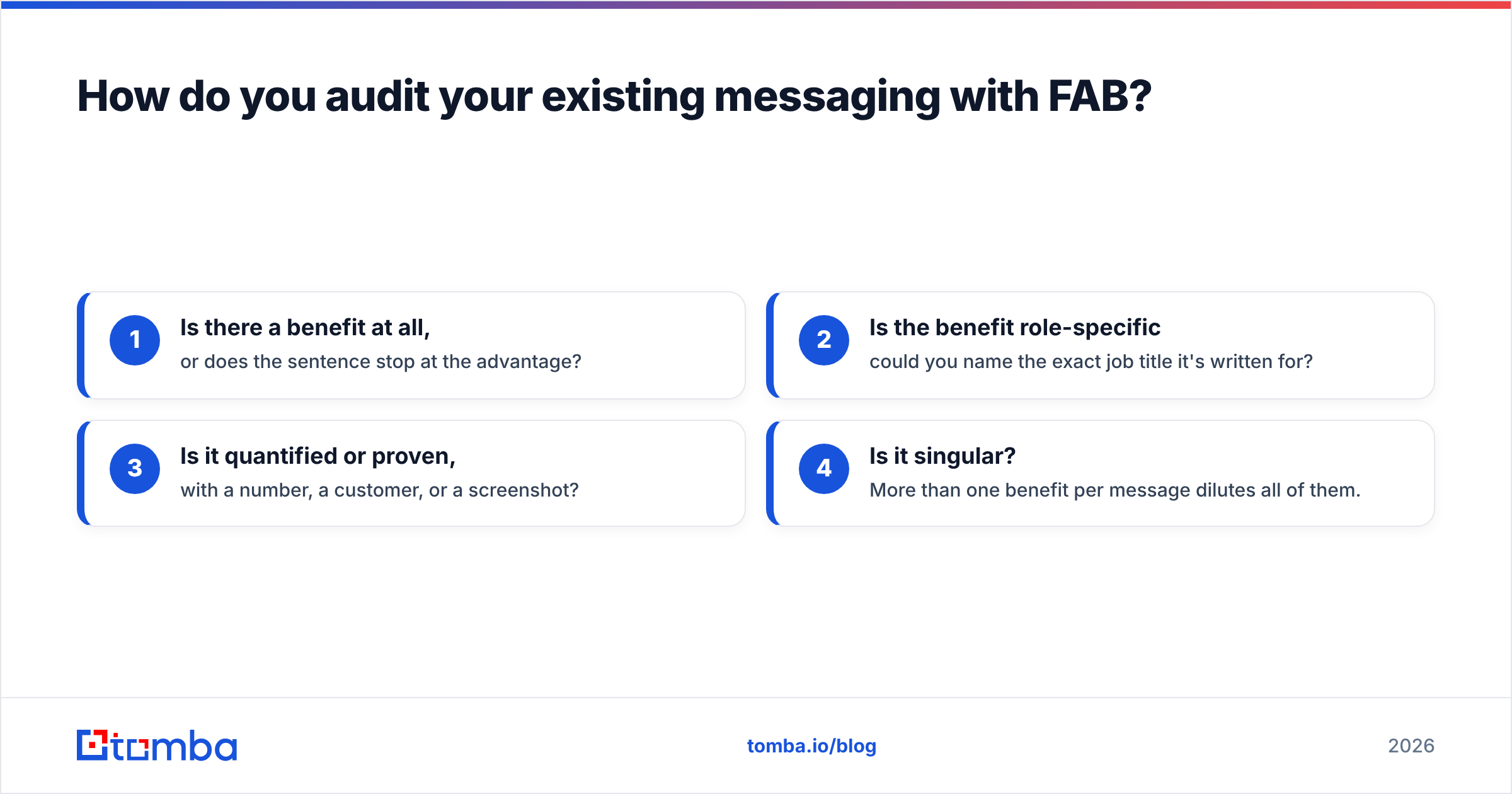
Pull your last 10 outbound emails and your current pitch deck, then score each claim against four questions:
- Is there a benefit at all, or does the sentence stop at the advantage?
- Is the benefit role-specific — could you name the exact job title it's written for?
- Is it quantified or proven, with a number, a customer, or a screenshot?
- Is it singular? More than one benefit per message dilutes all of them.
Anything scoring under 3/4 goes back for a rewrite. In practice, most teams find that 60-70% of their claims are advantages wearing a benefit costume, and that fixing the top five recurring claims lifts reply rates more than any subject-line experiment.
Then close the loop on data. Track reply rate by claim, not just by sequence. If "cut list building to 40 minutes" outperforms "increase pipeline coverage" by 2x with the same audience, you've learned something durable about which outcome your buyers actually rank first — and that insight transfers to your website, your ads, and your demo script.
Ready to put a FAB statement in front of the right person?#
A benefit-first message only pays off when it reaches a real, reachable human. That's the part most teams under-invest in. Tomba Email Finder finds and verifies professional email addresses by name, domain, or company, so the sequence you just rewrote lands in inboxes instead of bouncing off catch-alls and dead aliases. Start on the free tier with 25 searches a month, or check Tomba pricing — Starter is $49/mo, Growth $99/mo — and see what your reply rate looks like when the list is as sharp as the copy.
Related guides#
Ready to find emails that actually work?
Join 150,000+ professionals who stopped guessing and started sending. Free credits on signup — no credit card required.
Get the Tomba newsletter
Practical outbound tactics and product updates — once every two weeks.
About the author