FAC Intelligence Pricing, Reviews, Pros and Cons (2026)
FAC Intelligence publishes no pricing page and has no G2 or Capterra reviews. Here is what the reported tiers actually cost per credit, where the tool fits, and when a cheaper email finder wins.
TL;DR
- FAC Intelligence is an AI prospecting and B2B contact-data tool from Final Approach Consulting that crawls the live web (plus SEC filings) rather than serving a static purchased database.
- There is no public pricing page on fac-intelligence.com. Third-party comparison sites report four tiers — roughly $83, $830, $1,250 and $2,080 per month — but those numbers are unverified. Treat the tool as trial-then-contact-sales.
- FAC Intelligence has no listings on G2, Capterra or TrustRadius, so there are effectively zero independent user reviews. Most "pros" circulating online trace back to the vendor's own blog.
- The strongest honest case for it: real-time enrichment on obscure or newly-formed companies where static databases go stale. The weakest: you're buying blind on price, support SLA, and refund terms.
- If your actual job is "find and verify work emails at scale," a transparent-priced email finder like Tomba pricing at $49/mo starter is the lower-risk starting point.
What is FAC Intelligence?#
FAC Intelligence is a sales-intelligence and prospecting platform operated by Final Approach Consulting. Its pitch is that it answers "why this prospect matters," not just "who they are."
The everyday analogy: most B2B databases are like a phone book printed last year — comprehensive on the day it shipped, quietly rotting ever since. FAC Intelligence positions itself more like a research assistant who goes and looks things up when you ask, pulling from live web pages and public filings at query time.
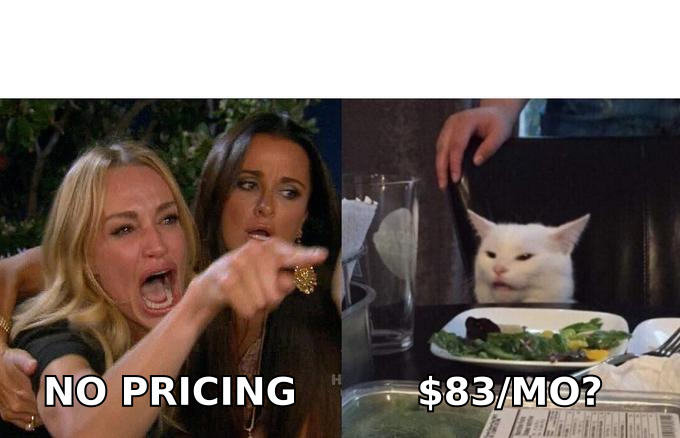
Technically, that means the platform advertises real-time crawling plus SEC-filing ingestion to assemble company and contact records, which you then filter by geography, business type, and other firmographic criteria. Advertised capability set:
- Real-time record building — records assembled at search time rather than pulled from a pre-scraped snapshot.
- Bulk search and export — run lists in batches and push results out to CSV or a CRM.
- Built-in email sending — outreach lives inside the tool instead of requiring a separate sequencer.
- AI message drafting — generated first-touch copy based on the enrichment context.
- Team sharing and seats — shared lists and multi-seat access on higher tiers.
- API access — programmatic pulls for teams that want enrichment in their own stack.
That is the feature list as marketed. Nothing here is exotic; the differentiator claimed is freshness, not breadth.
What does FAC Intelligence pricing actually cost?#
Short answer: nobody outside the company can tell you with confidence, and that is the single most important fact in this review.
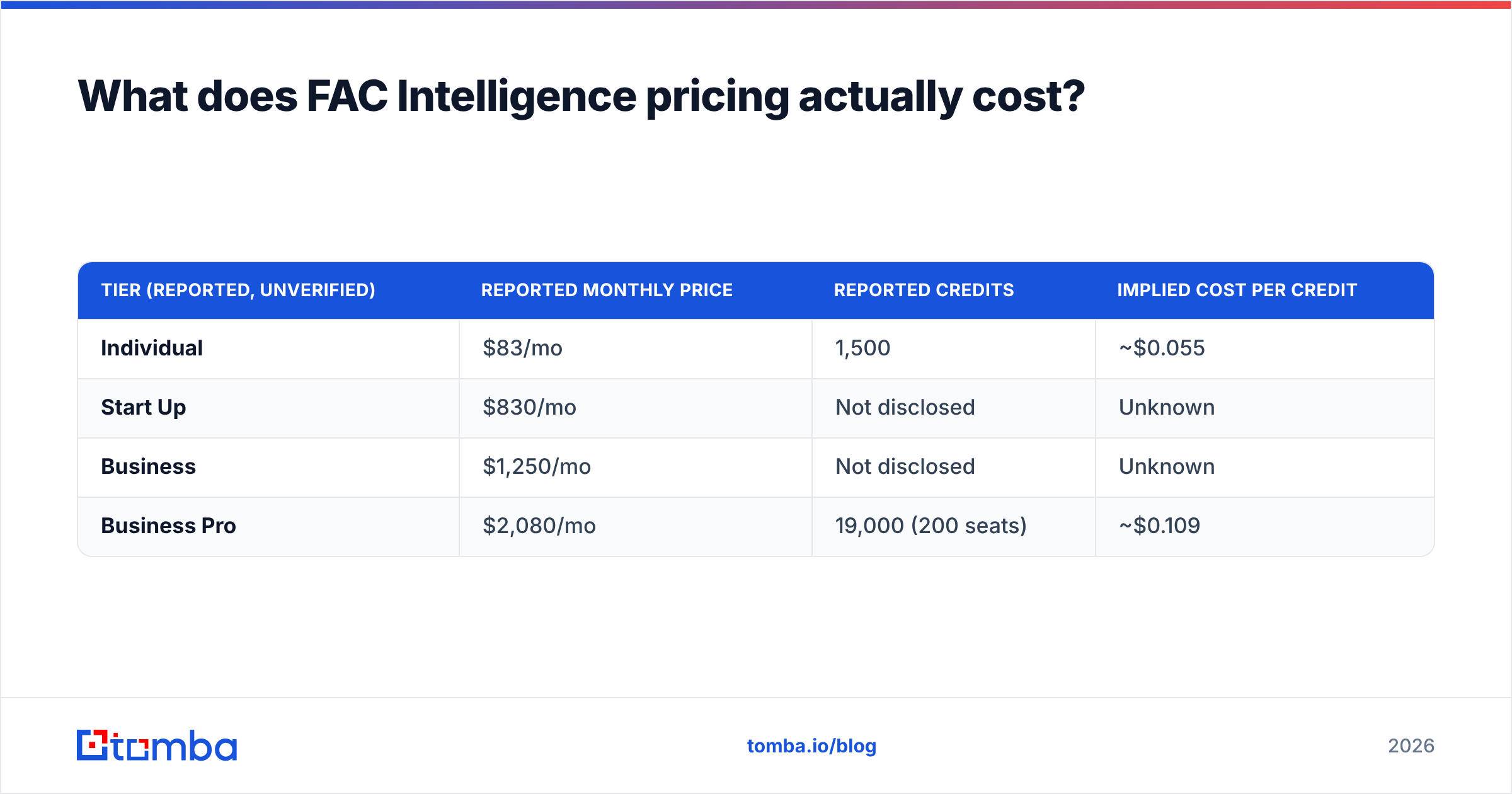
There is no indexed pricing page on fac-intelligence.com. The signup flow offers a stated one-week free trial and then routes you into the product. Third-party comparison pages report a four-tier structure, but we could not confirm any of these figures on the vendor's own site, so they should be treated as secondhand and possibly stale.
| Tier (reported, unverified) | Reported monthly price | Reported credits | Implied cost per credit |
|---|---|---|---|
| Individual | $83/mo | 1,500 | ~$0.055 |
| Start Up | $830/mo | Not disclosed | Unknown |
| Business | $1,250/mo | Not disclosed | Unknown |
| Business Pro | $2,080/mo | 19,000 (200 seats) | ~$0.109 |
Two things jump out of that table.
First, the per-credit math moves in the wrong direction. On most usage-priced data tools, volume buys you a lower unit cost. Here the reported top tier works out to roughly double the entry tier's cost per credit — you're paying for seats and team features, not for cheaper data. If you are a five-person team that just needs more lookups, that structure penalises you.
Second, the two middle tiers publish no credit allowance at all. You cannot compute value on Start Up or Business without a sales conversation. That's a deliberate design: opacity in the middle of a pricing ladder is how vendors preserve room to negotiate — and how buyers end up overpaying relative to peers on the same plan.
What the missing pricing page actually costs you#
Undisclosed pricing is not automatically a red flag; plenty of enterprise data vendors quote by seat and volume. Gartner's research on software buying behaviour consistently shows B2B buyers spend the majority of the cycle in independent research before contacting a vendor. A tool with no pricing page and no review-site presence removes both of those research paths at once.
Practically, here's what you cannot verify before you commit:
- Overage rates. What happens on credit 1,501? Hard stop or metered billing?
- Credit consumption rules. Does a failed lookup burn a credit? Do verifications cost the same as finds?
- Annual commitment discounts and whether monthly billing is even available.
- Refund and cancellation terms if data quality doesn't hold up on your ICP.
Ask all four in writing during the trial. If a vendor won't put credit-burn rules in an email, that answer is itself the answer.
What do FAC Intelligence reviews say?#
They don't — because there aren't any. As of early 2026, FAC Intelligence has no product listing or user reviews on G2, Capterra, or TrustRadius.
This matters more than it might seem. Review platforms are imperfect — they skew toward vendors who run review campaigns — but they're the only place where a buyer sees an unfiltered complaint about billing surprises, support response times, or data accuracy on a specific vertical. With zero listings, the entire public "pros and cons" record for FAC Intelligence consists of:
- The vendor's own blog — including "FAC Intelligence vs ZoomInfo," "vs Apollo," and "vs Clay" posts published on the Final Approach Consulting site. Predictably favourable.
- Competitor comparison pages — third-party tools that publish "FAC Intelligence vs [us]" pages. Predictably unfavourable.
Neither source is neutral. Anyone presenting a confident pros-and-cons list for this tool is repackaging one of those two, and you should discount accordingly.
What are the real pros and cons?#
Here's an honest split, with each claim labelled by how well it's supported.
Pros (vendor-claimed, plausible, unverified by users)
- Freshness over snapshot. Real-time crawling genuinely does solve the stale-record problem that plagues static databases, especially for companies founded in the last 12–18 months.
- SEC filings as a source. Useful and specific — this is a real signal layer, not marketing fluff, if your ICP skews toward US public companies or their subsidiaries.
- Sending built in. Fewer tools in the stack for a small team that doesn't already own a sequencer.
- API access advertised on paid tiers. Table stakes, but present.
Cons (structural, verifiable right now)
- No published pricing. You cannot budget, compare, or get finance approval from public information.
- Zero third-party reviews. No independent signal on support, uptime, billing disputes, or accuracy.
- Unclear coverage outside the US. Real-time crawling plus SEC filings implies a US-centric bias; nothing published establishes EU, APAC, or LATAM coverage depth.
- Per-credit cost rises with tier. Based on the reported figures, scaling up costs more per lookup, not less.
- Small-vendor concentration risk. A single-product company with no review footprint is a longer bet on continuity than an established platform.
How does FAC Intelligence compare to alternatives?#
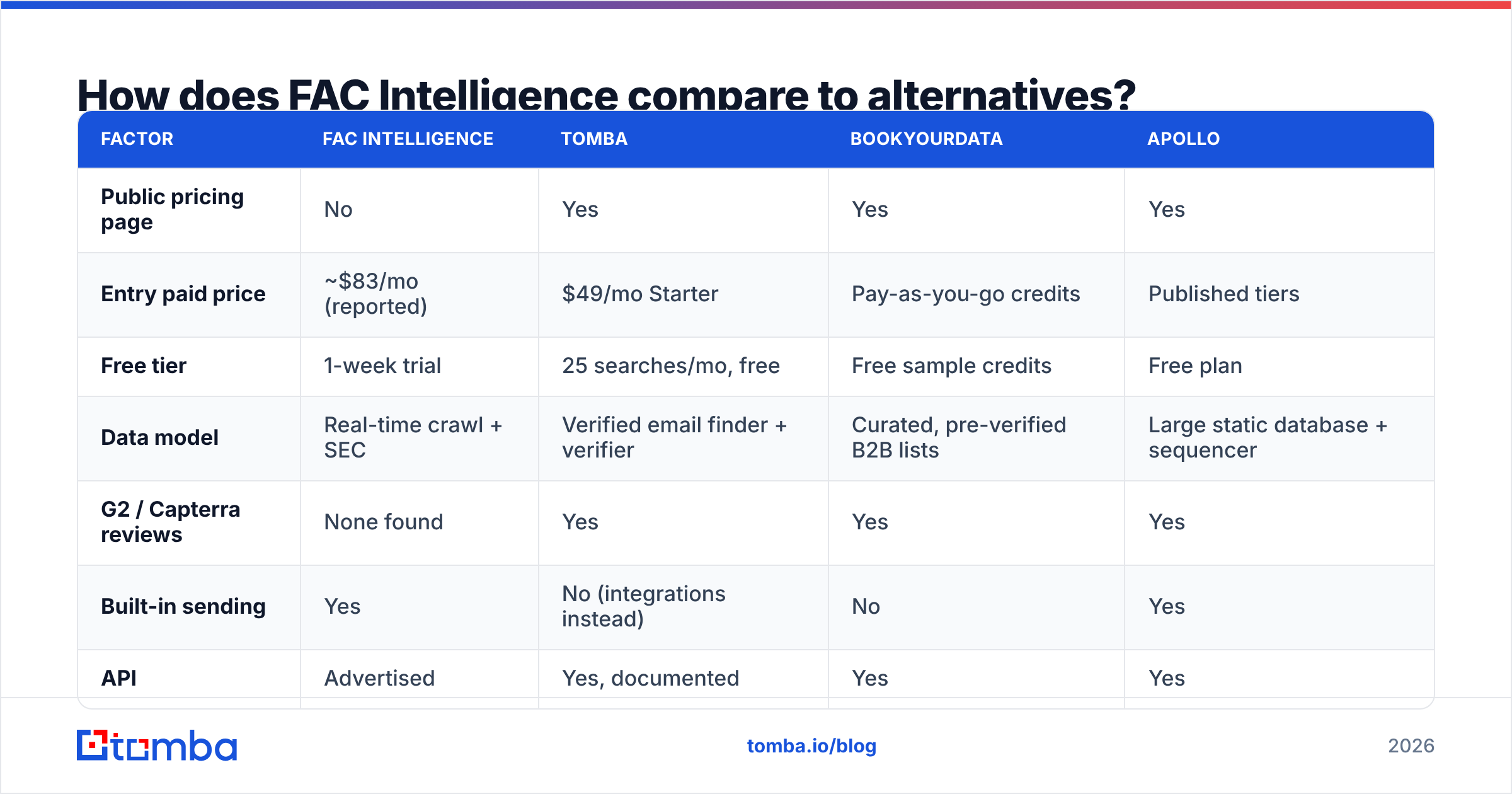
The honest framing: FAC Intelligence competes in a crowded lane where several vendors publish everything it doesn't.
| Factor | FAC Intelligence | Tomba | BookYourData | Apollo |
|---|---|---|---|---|
| Public pricing page | No | Yes | Yes | Yes |
| Entry paid price | ~$83/mo (reported) | $49/mo Starter | Pay-as-you-go credits | Published tiers |
| Free tier | 1-week trial | 25 searches/mo, free | Free sample credits | Free plan |
| Data model | Real-time crawl + SEC | Verified email finder + verifier | Curated, pre-verified B2B lists | Large static database + sequencer |
| G2 / Capterra reviews | None found | Yes | Yes | Yes |
| Built-in sending | Yes | No (integrations instead) | No | Yes |
| API | Advertised | Yes, documented | Yes | Yes |
| Best for | Fresh intel on obscure/new companies | Accurate email finding + verification at a known price | Buying a clean, pre-built list outright | All-in-one prospect-and-send |
Where each one actually wins:
- FAC Intelligence wins when your targets are companies too new or too small to appear in established databases, and you have budget tolerance for an opaque quote.
- Tomba wins when the bottleneck is contact accuracy, not company discovery — you already know the accounts and need deliverable addresses, verified before they hit a sequencer.
- BookYourData is a solid pick when you'd rather buy a clean, pre-verified list outright than run lookups yourself. Its credit model and pay-as-you-go structure suit one-off campaigns well, and it's transparent about what you're getting.
- Apollo wins on breadth and native sequencing, at the cost of data that's broad rather than deep. If you're weighing it, an Apollo alternative comparison is worth reading before you commit annually.
Is FAC Intelligence worth it for your team?#
Run this decision in order.
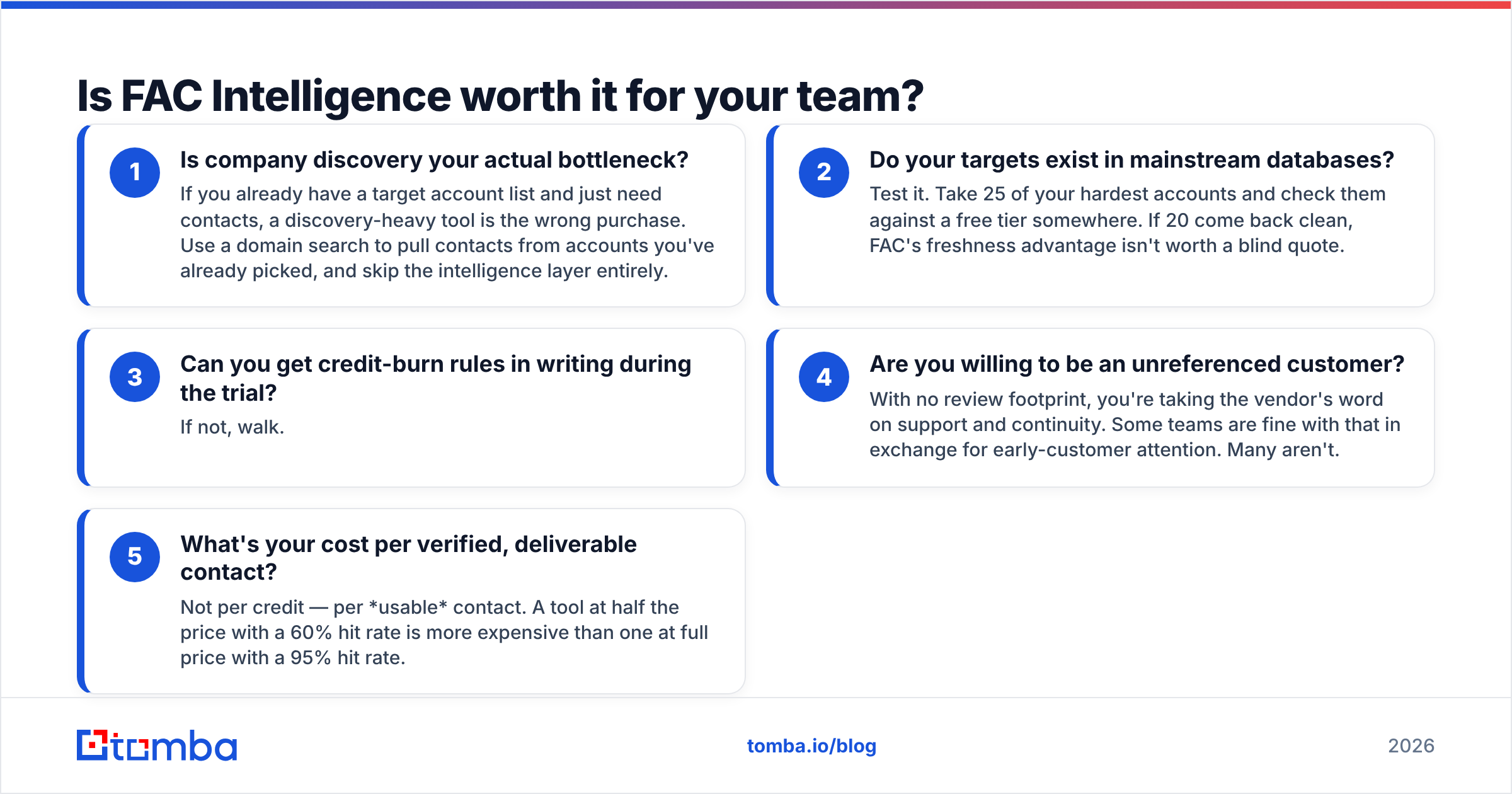
- Is company discovery your actual bottleneck? If you already have a target account list and just need contacts, a discovery-heavy tool is the wrong purchase. Use a domain search to pull contacts from accounts you've already picked, and skip the intelligence layer entirely.
- Do your targets exist in mainstream databases? Test it. Take 25 of your hardest accounts and check them against a free tier somewhere. If 20 come back clean, FAC's freshness advantage isn't worth a blind quote.
- Can you get credit-burn rules in writing during the trial? If not, walk.
- Are you willing to be an unreferenced customer? With no review footprint, you're taking the vendor's word on support and continuity. Some teams are fine with that in exchange for early-customer attention. Many aren't.
- What's your cost per verified, deliverable contact? Not per credit — per usable contact. A tool at half the price with a 60% hit rate is more expensive than one at full price with a 95% hit rate.
That last point is where most B2B data purchases go wrong. Credits are the unit vendors sell; deliverable contacts are the unit your pipeline actually consumes. Always convert before comparing. A bounced address doesn't just waste a credit — it damages your sender reputation, which costs you across every campaign that follows.
How should you validate any B2B data vendor before buying?#
A repeatable trial protocol, whichever tool you're evaluating:
- Build a 50-row golden set of contacts you can independently confirm — customers, partners, people you've already emailed successfully.
- Run the vendor against it blind. Measure exact-match rate, not "found something" rate.
- Verify every returned address through an independent email verifier before counting it as a hit. Vendors grade their own homework; you shouldn't let them.
- Test your worst segment, not your best. Everyone finds emails at Fortune 500 companies. The differentiator is 30-person firms in secondary markets.
- Time the support response. Send a real technical question on day two of the trial. How long it takes to get a substantive answer predicts the next twelve months better than any feature list.
Run that on FAC Intelligence, on its competitors, and on whatever you're using today. Five days of work saves a year of a bad contract.
The bottom line#
FAC Intelligence may well be a competent tool — the real-time crawling approach addresses a genuine weakness in snapshot databases, and SEC-filing ingestion is a legitimate signal source. But in 2026 you're being asked to buy it without a published price, without a single independent review, and without any way to compute cost per usable contact before you commit. That's a lot of unknowns for a line item.
If your core problem is finding and verifying professional email addresses at a price you can put in a budget spreadsheet today, start with the Tomba Email Finder. The free tier gives you 25 searches a month to test against your own golden set, Starter runs $49/mo, and every plan publishes exactly what you get. Verify your list, then spend the budget you saved on outreach instead of on a quote you couldn't compare.
Related guides#
Ready to find emails that actually work?
Join 150,000+ professionals who stopped guessing and started sending. Free credits on signup — no credit card required.
Get the Tomba newsletter
Practical outbound tactics and product updates — once every two weeks.
About the author